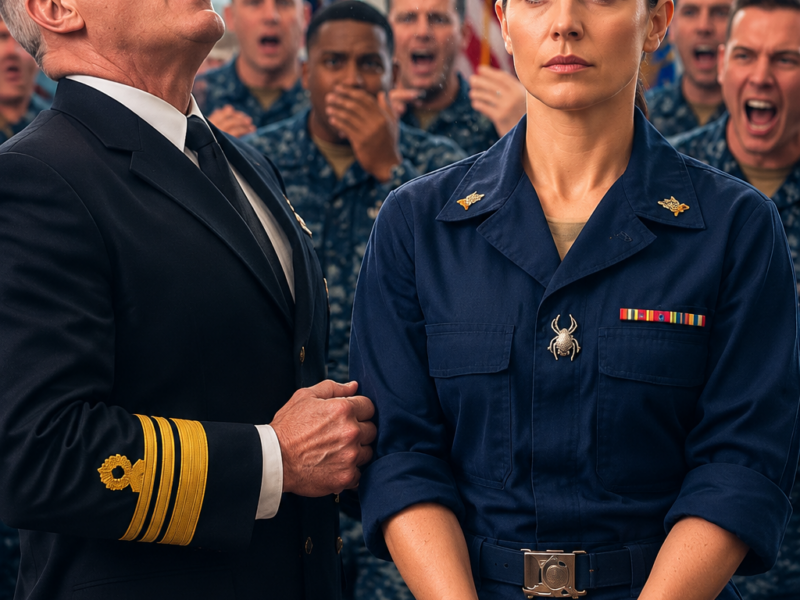
The SEAL Admiral Asked Her Call Sign as a Joke — Until ‘Iron Widow’ Made Him Collapse in Shock
The SEAL Admiral Asked Her Call Sign as a Joke — Until ‘Iron Widow’ Made Him Collapse in Shock
The morning sun rose over the Pacific Ocean, casting long golden shadows across the immaculate training grounds of the Naval Special Warfare Center in Coronado, California. The air carried the familiar scent of saltwater, polished equipment, and warm concrete. Along the main parade ground, twenty elite special warfare operators stood in perfect formation, their uniforms pressed, their boots aligned, and their expressions carefully controlled. Every one of them had endured years of demanding preparation, countless hours of physical conditioning, and training designed to separate those who merely wanted to become warriors from those who possessed the discipline to survive as one.
Yet among the twenty operators, one figure stood out.
Lieutenant Commander Arwin Blackwood was the only woman in the formation.
She stood at the far end of the line, her posture straight, her chin level, and her hands resting precisely at her sides. Her expression revealed absolutely nothing. She had learned long ago that the smallest reaction could become an invitation for someone else to test her limits. A raised eyebrow, a frustrated breath, or even a momentary hesitation could provide ammunition to people who had already decided she did not belong.
For the past fifteen days, she had endured more scrutiny than any other candidate in the advanced combat leadership program. Every movement had been questioned. Every decision had been examined. Every minor deviation from established procedure had become an opportunity for criticism.
And the man responsible for much of that hostility was now approaching.
Admiral Victor Hargrove moved slowly down the formation, inspecting each operator with the practiced attention of someone who had spent three decades in naval special warfare. At sixty-two, he remained physically imposing despite his relatively compact frame. His weathered face, steel-gray eyes, and rows of military decorations reflected a career filled with classified operations across multiple continents.
He was respected, feared, and accustomed to having the final word.
Three rows of ribbons covered his chest, each representing years of service and operations that most people would never be permitted to discuss. Among special warfare officers, his reputation was almost legendary.
But behind his distinguished appearance was a man who had never accepted the idea that women should serve in the most demanding special operations positions.
He considered the Pentagon’s integration initiative a political experiment, one that threatened traditions he believed should remain untouched. And in his eyes, Arwin Blackwood represented everything wrong with that experiment.
When Hargrove reached her position, he stopped.
His gaze traveled slowly from her boots to her uniform, searching for something that could justify the criticism he clearly intended to deliver.
“Lieutenant Commander Blackwood.”
“Yes, Admiral.”
“Your cover appears to be approximately one centimeter out of regulation alignment.”
Arwin knew it was perfectly positioned. She had checked it twice before leaving her quarters.
Nevertheless, she responded without hesitation.
“Understood, sir. I’ll correct it immediately.”
A faint smirk appeared on the face of Lieutenant Orion Thade, a square-jawed team leader standing several positions away. He exchanged a knowing glance with another operator.
Everyone understood what was happening.
Hargrove was not correcting her uniform. He was reminding the entire formation that he considered her an unwelcome guest.
Arwin adjusted her cover with a small movement and returned to attention.
The admiral continued down the line, apparently satisfied that he had made his point.
Standing nearby, Commander Zephr Coltrain observed the interaction without comment. At forty-two, Coltrain had seventeen years of experience in special operations. He had witnessed the changing culture of the military and understood that the future would not necessarily resemble the past. Although he maintained certain reservations about placing inexperienced candidates into particularly demanding combat positions, he believed that every qualified operator deserved an honest assessment.
Unfortunately, honest assessments were becoming increasingly difficult under Hargrove’s leadership.
After completing his inspection, Coltrain stepped forward.
“Today’s evolution will focus on extended maritime extraction under enemy observation,” he announced. “Full combat load. Fifteen-mile offshore approach. Structure infiltration and package retrieval.”
A subtle change passed through the formation.
This was an advanced exercise normally reserved for the final week of the thirty-day program. They were only halfway through the course.
Hargrove folded his hands behind his back.
“Command has accelerated the timeline,” he added. His eyes briefly settled on Arwin. “Some candidates may find the adjustment challenging.”
The implication was unmistakable.
The schedule had been changed specifically to test her before she could fully adapt to the program.
The formation was dismissed, and the operators moved toward the equipment facilities.
As Arwin walked past Thade, he deliberately brushed his shoulder against hers.
“Hope you’re a strong swimmer, Blackwood,” he muttered. “The extraction weights got mysteriously heavier overnight.”
She continued walking.
Inside the equipment room, Arwin began checking her gear. Every strap, buckle, seal, and attachment point was inspected with methodical precision. When she lifted her tactical vest, she immediately noticed something unusual.
The weight distribution was wrong.
Someone had added approximately two pounds to the left side.
It was a small modification, almost impossible to detect without experience. During an extended swim, however, the imbalance could create unnecessary strain, compromise efficiency, and potentially become dangerous.
Arwin examined the adjustment for several seconds.
Then, without saying a word, she redistributed the weights and restored the balance.
She did not report the tampering.
She did not ask who had done it.
She simply corrected the problem.
A moment later, Captain Vesper Reeve entered the equipment room. Her naval intelligence insignia stood out against her otherwise unremarkable uniform.
“Lieutenant Commander,” Reeve greeted her.
“Captain.”
Their exchange lasted barely two seconds, but there was something unusual in the way they looked at each other. It was the quiet recognition of people who shared information that could never be discussed openly.
Reeve’s presence at the training center was unusual. Naval intelligence generally maintained a considerable distance from ordinary special warfare training activities unless something important was taking place.
Several operators noticed her arrival and exchanged curious looks.
Before anyone could ask questions, a communications officer approached Arwin with a secure tablet.
“Priority message. Lieutenant Commander Blackwood, eyes only.”
She accepted the device, entered a complicated authentication sequence, and read the message.
It took only a few seconds.
Then she returned the tablet.
Her expression remained unchanged, although her shoulders squared slightly.
Whatever the message contained, it had confirmed something important.
Minutes later, the helicopters lifted from the training grounds, carrying the operators toward their offshore objective.
Arwin sat opposite Commander Coltrain. As the aircraft gained altitude, her eyes automatically followed its movement, assessing the wind direction, aircraft angle, and changing environmental conditions.
Coltrain noticed.
He had been reviewing her personnel file for several days. The document contained an unusual number of redacted sections, vague descriptions of specialized assignments, and references to operational experience that seemed disproportionate to her officially documented career.
He had initially assumed the missing information was simply related to naval intelligence.
Now he was beginning to wonder whether there was considerably more to her history.
Fifteen miles offshore, the Pacific Ocean was rolling beneath an overcast sky. Four-foot swells moved across the water, creating challenging but manageable conditions for experienced maritime operators.
The teams prepared to enter the water.
Hargrove’s voice came through their communications systems.
“Extraction packages are positioned at the northwest corner of the target structure. Teams will compete for retrieval. The first team to secure its package and return will receive priority selection for next month’s classified deployment.”
The announcement immediately changed the atmosphere.
What had been presented as a collaborative training exercise had become a competition.
Thade’s team entered the water first.
Thirty seconds later, Arwin’s four-person team followed.
Although she was not the designated team leader, she took the forward position without hesitation.
Her teammates included Lieutenant Estraas Kelwin, a relatively inexperienced operator who had graduated from basic underwater demolition and special warfare training only eight months earlier.
Kelwin was young, observant, and eager to prove himself. He had entered the program believing that confidence and physical ability were the defining qualities of a successful operator.
That belief was beginning to change.
Beneath the surface, Arwin communicated through a series of subtle hand signals. Her movements were economical, her direction changes deliberate, and her communication methods noticeably different from the standard procedures taught during ordinary training.
Kelwin noticed almost immediately.
He had heard rumors about specialized underwater communication techniques developed for covert maritime operations in denied territories. Most instructors dismissed those stories as exaggerations.
Yet the woman swimming ahead of him seemed to be using precisely those techniques.
When they reached the submerged entrance of the decommissioned oil platform, Arwin stopped.
Her teammates expected her to perform the usual reconnaissance procedure, establish positions, and coordinate a synchronized entry.
Instead, she made one unfamiliar hand gesture and disappeared through the entrance alone.
For several seconds, the others remained motionless.
Kelwin exchanged a confused glance with another teammate.
They had no idea what she intended.
Eventually, they followed.
Inside the flooded lower level, visibility dropped to less than five feet. The metal structure groaned under the changing pressure of the rising tide. Training sensors had been installed throughout the facility, programmed to detect conventional approach patterns and trigger simulated enemy responses.
Arwin moved through the darkness with extraordinary confidence.
Her route appeared random to anyone watching from behind, but it was actually a carefully calculated path that avoided every sensor activation point.
She seemed to know exactly where the detection systems were positioned.
When the teams reached the package area, Thade’s group had already arrived from the opposite direction.
Thade had one hand on the weighted case.
Even through his rebreather, Kelwin could recognize the unmistakable satisfaction in his body language.
He believed he had won.
Then Arwin moved.
What happened next would later become one of the most discussed moments of the entire exercise.
She manipulated the surrounding water movement, creating a temporary disturbance that disrupted visibility and altered the immediate tactical environment. At the same time, she directed her teammates through an alternative approach.
Thade’s team reacted to what appeared to be a secondary threat.
There was no actual enemy.
But the confusion created exactly the opportunity Arwin needed.
Without directly confronting the opposing operators, her team secured the package and began its extraction.
By the time Thade realized what had happened, Arwin and her teammates were already moving toward the exit.
Kelwin followed her through the dark water, struggling to understand what he had witnessed.
He had never seen anyone manipulate a training environment so effectively.
It did not resemble an improvised maneuver.
It looked like something developed through years of experience under genuine combat conditions.
Back aboard the command vessel, Hargrove received the results with obvious displeasure.
“Time differential was minimal,” he remarked, examining the performance report. “And these unconventional tactics suggest poor adherence to established protocols.”
Arwin stood at attention.
“The mission parameters prioritized successful extraction over methodology, Admiral.”
His eyes narrowed.
“Protocols exist for a reason, Lieutenant Commander. Creative interpretations may work in controlled training environments. Real combat requires disciplined execution.”
“Understood, sir.”
Across the deck, Captain Reeve watched the exchange.
When her eyes met Arwin’s, a brief understanding passed between them.
Neither woman needed to say anything.
The first part of the operation had gone exactly as expected.
That evening, the operators assembled in the advanced training center’s briefing room.
Commander Coltrain announced that the culmination ceremony would take place at the end of the program.
“Each operator who successfully completes the advanced combat leadership course will receive an official call sign. These names reflect the characteristics, accomplishments, and defining moments that distinguish each individual within special warfare.”
Thade leaned back in his chair.
“Some traditions are earned, not given,” he remarked loudly enough for Arwin to hear.
She ignored him.
Coltrain continued explaining that Admiral Hargrove would personally present the call signs in front of representatives from Naval Special Warfare Command, SOCOM, and several partner forces.
It would be an important professional milestone.
After the briefing, Captain Reeve intercepted Arwin in a secluded corridor.
“The admiral has made his position clear,” Reeve said quietly.
“Has he compromised the operation?”
“No. He’s behaving exactly as expected.”
“Then everything remains unchanged?”
“The final assessment still takes place at the ceremony.”
Arwin nodded.
“And the package?”
“Arriving tomorrow. Seven years to the day.”
For the first time that evening, something changed in Arwin’s expression.
It was not fear.
It was the appearance of a memory she had spent years keeping under control.
“Will you maintain your position?” Reeve asked.
“Until the mission is complete.”
Neither woman noticed Lieutenant Kelwin standing in the shadows farther down the corridor.
He had heard enough to understand that something significant was happening, but not enough to understand what it was.
The following days became increasingly difficult.
Arwin continued performing exceptionally well, but her teammates found themselves subjected to a series of exercises designed to isolate and disadvantage her.
During one tactical planning session, Thade deliberately excluded her from important strategy discussions. When the team presented its final plan, he criticized her for failing to contribute enough information.
Hargrove, observing the exercise, nodded approvingly.
“Operational planning requires comprehensive situational awareness,” the admiral remarked. “Something that appears to be lacking in certain participants.”
Commander Coltrain glanced at the assessment.
“All teams achieved their objectives within the established parameters,” he replied. “Lieutenant Commander Blackwood’s team actually recorded the lowest projected casualty rate.”
“Projected casualties are meaningless compared with actual field experience,” Hargrove dismissed. “Some types of experience cannot be simulated. They must be lived.”
His words hung in the room.
The message was clear.
No matter how well Arwin performed, he would continue questioning her qualifications.
Later that afternoon, Kelwin approached her while she was preparing for a nighttime infiltration exercise.
“Commander, may I ask you something?”
“Go ahead, Lieutenant.”
“That maneuver at the oil platform. I’ve never seen anything like it.”
Arwin continued inspecting her equipment.
“Improvisation is sometimes necessary.”
“With respect, ma’am, that wasn’t improvisation. It looked like a formal technique. I’ve searched the advanced tactics manuals, but I can’t find anything remotely similar.”
She paused.
“Not everything worth knowing appears in manuals, Lieutenant.”
Kelwin hesitated.
“Where did you serve before this assignment?”
“That information is classified beyond your current access.”
Her response was polite, but it ended the conversation.
Before Kelwin could ask another question, Thade arrived with several operators.
“Sharing secrets, Blackwood?”
“Discussing equipment configurations,” Arwin answered.
Thade examined her tactical vest.
“That’s not regulation configuration.”
“It’s within acceptable parameters for this evolution. Commander Coltrain approved the modifications.”
Thade shook his head.
“Just because they’ve lowered the standards to accommodate you doesn’t mean the rest of us have to pretend you belong here.”
Kelwin shifted uncomfortably.
Arwin continued preparing her equipment.
“We should focus on mission readiness. The evolution begins in thirty minutes.”
Thade stepped closer.
“You think surviving fifteen days in this program makes you a SEAL? You have no idea what real operators face. The decisions, the casualties, the responsibility when everything goes wrong and nobody is coming to help.”
For the first time, a dangerous expression briefly appeared in Arwin’s eyes.
“I understand more than you might think, Lieutenant.”
“Then prove it.”
Thade proposed a direct nighttime competition between their teams, with full tactical autonomy and no restrictions beyond essential safety requirements.
Commander Coltrain immediately objected.
“This program is not about personal rivalries.”
“Competitive pressure reveals actual capability, Commander,” Thade insisted.
Coltrain considered the suggestion before looking at Arwin.
“Lieutenant Commander, your opinion?”
“I have no objection.”
Her answer surprised him.
“Battlefield conditions rarely conform to training parameters. Adaptability under pressure is worth assessing.”
Coltrain finally agreed.
The exercise would proceed that night.
Under a moonless sky, both teams inserted by helicopter into densely forested terrain five miles from a simulated enemy communications center.
Thade’s team moved aggressively toward the objective.
Their approach was direct, efficient, and textbook.
Arwin’s team appeared to disappear.
For the first thirty minutes, their tracking beacons showed almost no movement.
Inside the command center, Hargrove studied the tactical display.
“Blackwood’s team appears stationary.”
“Perhaps they’re gathering intelligence,” Coltrain suggested.
“Or perhaps they’re stuck and too proud to request assistance.”
At the one-hour mark, Thade’s team had covered nearly seventy percent of the distance to the objective.
Hargrove smiled.
“They’ll reach the target at least thirty minutes before Blackwood’s team gets anywhere close. This should conclusively demonstrate the performance differential I’ve been documenting.”
He had barely finished speaking when the tactical display erupted with warning alerts.
The simulated enemy communications center had suddenly entered a heightened security state.
Thade’s team had been detected.
“What happened?” Hargrove demanded.
The technical officer examined the incoming information.
“The alert appears to have been triggered by a communications intercept, Admiral. Not physical detection.”
Thade’s team was forced into defensive positions.
Their element of surprise had disappeared.
Hargrove searched the display.
“Where is Blackwood’s team?”
Moments later, another series of alerts appeared.
The communications center’s security systems began failing in sequence.
One after another, the simulated defenses shut down.
Coltrain leaned forward.
“They’re already inside.”
“How?” Hargrove demanded.
“Their tracking beacons never showed an approach.”
Captain Reeve watched the screen without changing her expression.
“Perhaps Lieutenant Commander Blackwood found an alternative route.”
Within minutes, Arwin’s team had secured the objective and neutralized every simulated opposition unit without firing a single training round.
Thade’s team remained pinned down, unable to advance without suffering substantial simulated casualties.
The command center became silent.
Arwin had not simply won.
She had accomplished something that none of the senior officers could immediately explain.
Hargrove ordered an immediate debrief.
When Arwin entered the briefing room, she found the admiral seated at the center of the observation table, his fingers steepled beneath his chin.
She approached the tactical display and began explaining her team’s route.
“We utilized a non-standard insertion technique. By diverting through this drainage system, we avoided the primary sensor grid.”
Coltrain studied the map.
“That feature isn’t shown on standard topographical maps.”
“It’s a seasonal drainage route. It becomes visible only under certain environmental conditions.”
Thade leaned forward.
“Even accounting for that route, your team covered the distance in an impossible amount of time.”
“We modified our equipment configuration and redistributed the load. That improved movement efficiency by approximately twenty-two percent.”
Hargrove’s jaw tightened.
“These modifications aren’t part of standard SEAL doctrine.”
“No, sir. They were developed for specific operational requirements.”
“And the communications intercept? How did you compromise their systems without specialized equipment?”
Arwin paused briefly.
“We repurposed standard communications equipment using modified protocols.”
“Impossible,” Thade interrupted.
“Not with standard configurations,” she acknowledged. “But certain adjustments can expand the functionality considerably.”
Hargrove slammed his hand against the table.
“Enough evasions.”
The room fell silent.
“You employed classified techniques outside the scope of this program. Techniques for which you have no documented training or authorization.”
Arwin remained perfectly composed.
“With respect, Admiral, my full operational history contains classified sections that aren’t accessible at this briefing’s security level.”
“I have Alpha Nine clearance,” Hargrove snapped. “There is no Naval Special Warfare operation I cannot access.”
Something almost resembling a smile appeared on Arwin’s face.
“Yes, sir.”
The simplicity of her answer made the atmosphere even more uncomfortable.
If an admiral with the highest level of access could not examine her entire record, then her previous assignments existed beyond ordinary naval special warfare structures.
Captain Reeve stepped forward.
“Admiral, perhaps we should continue this discussion in a more appropriate setting. Lieutenant Commander Blackwood’s team achieved every mission objective.”
Hargrove looked between them.
“This isn’t over.”
He ordered a complete report by eight the following morning and left the room.
After the other operators departed, Kelwin remained behind.
“Commander, that drainage route doesn’t appear in historical satellite imagery either. I checked.”
Arwin regarded him carefully.
“You have good attention to detail.”
“My father served in special reconnaissance. He taught me that what isn’t said often matters more than what is.”
For a moment, she seemed to consider his words.
“Focus on the training, Lieutenant.”
Before he could respond, Reeve appeared.
She waited until they were alone before activating a small electronic device that established a localized counter-surveillance field.
“The admiral is accelerating his inquiries,” she informed Arwin. “He’s requested your complete service record from Naval Personnel Command.”
“They’ll provide the official version.”
“Yes, but he’s also contacting former teammates and previous commanding officers through unofficial channels.”
“That makes him predictable.”
“It also makes him dangerous.”
Arwin glanced toward the clock.
“The ceremony is in three days. He won’t remove me before then.”
“You’re certain?”
“His pride demands public vindication. He needs to prove that his opposition to female integration was justified. He’ll want the visiting dignitaries to witness what he believes will be my failure.”
Reeve nodded.
“The package arrived this morning. It’s secure in my quarters.”
“Any word on our ghost?”
“Still silent. But if our theory is correct, they’ll make contact during the ceremony.”
Arwin’s expression hardened.
“Seven years is a long time to wait for answers.”
“Some missions require patience.”
The following morning, the training center hosted another advanced exercise, this time involving close-quarters combat in a simulated urban environment.
Several visiting senior officers had arrived to observe the program.
Among them was Marine Corps General Hayes, an experienced officer who had followed the female integration initiative with considerable professional interest.
He stood beside Hargrove in the elevated control room.
“Lieutenant Commander Blackwood,” Hayes remarked, studying her file. “Impressive qualifications.”
“On paper, perhaps,” Hargrove replied. “Reality often proves less impressive than administrative documentation.”
“I understand she’s performed exceptionally well.”
“Temporary success in controlled environments doesn’t demonstrate sustained combat effectiveness.”
General Hayes turned toward him.
“The available data increasingly suggests that properly selected and trained female operators can provide valuable tactical advantages.”
Before Hargrove could respond, alarms suddenly sounded throughout the facility.
Warning indicators flashed across the control panels.
Smoke was appearing inside one section of the training structure.
A technician hurried toward the control station.
“Sir, we’ve got a malfunction. The fire suppression system has activated actual incendiary components instead of training markers.”
“Evacuate the structure immediately,” General Hayes ordered.
The technician shook his head.
“There’s a security lockdown. The standard access points are sealed until the system can be reset from the main control node inside the structure.”
The situation deteriorated rapidly.
Operators began moving toward emergency exits, but one team found itself trapped in a section where the smoke was thickest.
It was Thade’s team.
Four operators were separated from the nearest evacuation route by a security door that had automatically sealed during the malfunction.
Communications became intermittent.
“Get me a connection to that team,” Hargrove ordered.
“Last transmission indicated they were attempting to reach the eastern utility shaft.”
On another monitor, Arwin’s team appeared.
But instead of moving toward the exit, they were advancing deeper into the structure.
“What is Blackwood doing?” Hargrove demanded. “She should be evacuating.”
General Hayes watched the movement.
“She appears to be addressing the source of the problem rather than simply escaping it.”
Arwin’s team reached a collapsed section of the corridor.
The route to the control node was blocked.
Without hesitation, she redirected her teammates toward an alternative evacuation route.
Then she continued alone.
Hargrove frowned.
“That’s a direct violation of protocol. No operator proceeds without team support in hazardous conditions.”
Hayes said nothing.
His attention remained fixed on the screen.
Arwin moved through the smoke-filled corridors with extraordinary certainty. Her movements suggested that she possessed a complete mental understanding of the building’s architecture.
When she reached the security door separating Thade’s trapped team from the evacuation route, she examined its electronic access panel.
Then she performed a sequence of actions that caused the door to release.
The trapped operators emerged coughing and disoriented.
“How did she bypass that security system?” Hargrove asked.
Nobody in the control room had an answer.
Arwin continued toward the control node.
Inside the room, smoke was beginning to obscure the cameras. Yet she reached the main console and began entering a complicated sequence of commands.
The process took several minutes.
Then the fire suppression system finally activated correctly.
The emergency ventilation system began clearing the smoke, and the facility’s security lockdown was lifted.
Emergency medical teams entered to assess the personnel.
Remarkably, there were few serious injuries.
At the medical checkpoint, Thade sat receiving treatment for smoke inhalation when Arwin passed nearby.
“Commander,” he called.
She stopped.
“How did you know the bypass sequence for those doors?”
“Emergency override procedures.”
“That wasn’t an ordinary override. It’s proprietary technology. Even I don’t have access to that level of information.”
Arwin looked at him.
“Sometimes training includes elements that don’t appear in standard documentation.”
Thade stared at her.
“Nobody gets trained on those security systems except…”
He stopped speaking.
A new understanding had begun to form.
Before he could finish, Hargrove approached.
“Lieutenant Commander Blackwood. My office. Now.”
The admiral’s office was austere and meticulously organized. Naval special warfare memorabilia covered the walls, each item representing a different stage of his distinguished career.
Once the door closed, Hargrove turned toward her.
“Explain how you accessed those security protocols.”
“Standard emergency procedures, Admiral.”
“Don’t insult my intelligence. Those weren’t standard procedures.”
Arwin stood at attention.
“Perhaps my previous assignments included relevant training.”
“I’ve reviewed every accessible record of your service. Annapolis graduate. Three years in naval intelligence. Transfer to surface warfare. Selection for the female integration pilot program. Nowhere does it mention advanced security systems or specialized operational training.”
“Not all training appears in accessible records, sir.”
Hargrove stepped closer.
“I have the highest possible security clearance.”
“Yes, sir.”
The answer was calm, almost disarming.
The admiral studied her face.
“Who are you really working for? The CIA? DIA? Some shadow organization that nobody is supposed to know exists?”
“I’m a naval officer assigned to complete this training program, sir.”
“We both know that’s not true.”
He walked behind his desk.
“The culmination ceremony is in two days. Senior officials from several branches will be attending. I will not allow this training center to become a stage for someone else’s agenda.”
“No games are being played, Admiral. I’m completing the mission as assigned.”
Something about the word mission caused him to hesitate.
Then his expression hardened.
“You’re confined to quarters until further notice. I’m initiating a full security review.”
“That would violate direct orders from Naval Special Warfare Command regarding the integrity of this program.”
“I am Naval Special Warfare in this command.”
Before Arwin could respond, someone knocked sharply.
Captain Reeve entered without waiting.
“Admiral, General Hayes has requested Lieutenant Commander Blackwood’s immediate presence for an operational debrief.”
Hargrove’s jaw tightened.
“I’m currently conducting a security review.”
“Understood, sir. However, the general specifically requested her input regarding the security system override.”
The admiral stared at Reeve.
For several seconds, neither officer moved.
Finally, he stepped aside.
“Very well. But this conversation isn’t finished.”
“Of course not, sir.”
Reeve escorted Arwin from the office.
However, they did not proceed toward General Hayes.
Instead, they entered a restricted communications room.
Once the door closed, Reeve activated the security systems.
“We have a problem.”
Arwin turned toward her.
“The malfunction wasn’t accidental. Someone deliberately sabotaged the training systems.”
“Is Ghost making a move?”
“We don’t know. But the sabotage used access codes that should have been disabled after the Song Juan incident.”
Arwin’s expression changed almost imperceptibly.
“Whose codes?”
Reeve hesitated.
“Codes associated with Admiral Hargrove’s authentication profile.”
The room became very quiet.
Arwin considered the information.
“He’s forcing our hand, or someone is using his credentials.”
“Either possibility represents a major security breach.”
“Has his movement been monitored since the incident?”
“Continuously. He hasn’t made any unauthorized communications.”
“Then someone inside the facility may be assisting the breach.”
“That’s possible.”
Reeve looked at her colleague.
“We should accelerate the timetable.”
“No.”
“Arwin, the situation is becoming more dangerous.”
“Changing the plan now would alert whoever is responsible. The ceremony remains our best opportunity.”
“With multiple flag officers and foreign observers present?”
“Exactly. Nobody is likely to attempt something catastrophic under that level of security. This is about exposure and manipulation, not direct action.”
Reeve studied her face.
“Seven years is a long time to carry this mission.”
“Some debts can only be repaid in full.”
Before Reeve could respond, the secure communications terminal activated.
A message appeared on the screen.
WIDOW PROTOCOL INITIATED.
STAND BY FOR PACKAGE DELIVERY.
Both women recognized the significance immediately.
The endgame had begun.
Two days later, the ceremony hall was transformed into an impressive display of military tradition.
Naval Special Warfare Command had spared no expense. American flags flanked the stage, a ceremonial display featuring the SEAL trident occupied the center, and carefully directed lighting illuminated the polished floor.
Officers in dress uniforms filled the auditorium.
Foreign military attachés sat among representatives of several special operations commands. Their uniforms displayed decorations and insignia accumulated through decades of service.
The graduating operators occupied the front rows.
At the center of the stage stood Admiral Hargrove, wearing his full dress uniform.
Behind him were Commander Coltrain, Captain Reeve, and several other senior officers.
Hargrove looked completely at ease.
He believed the ceremony would be the final demonstration of his authority over the program.
He approached the podium.
“For more than sixty years, naval special warfare operators have represented the highest standards of American military capability,” he began. “Those who earn the right to serve in these units do so through extraordinary physical strength, tactical expertise, and unwavering character.”
He emphasized the word earn.
“Tonight, we continue a tradition that reflects the very essence of our community. Each operator will receive a call sign, a name that will accompany them throughout their special operations careers. These names are not selected casually. They represent defining moments, character, and proven ability under pressure.”
The ceremony proceeded.
One by one, operators were called forward.
Each received a ceremonial chalice containing saltwater, symbolizing the ocean that defined their profession.
Hargrove announced the assigned call sign and briefly explained its significance.
When Lieutenant Orion Thade approached, the admiral smiled.
“Your instructors and fellow operators recognize your leadership during the Omen training evolution, where your decisions under extreme conditions helped ensure your team’s survival. You will be known as Beacon.”
Thade accepted the chalice proudly.
He drank the saltwater and exchanged a salute with the admiral.
The ceremony continued until almost every operator had received a call sign.
Only Arwin remained seated.
The order had been deliberately arranged to leave her until the end.
It was another calculated attempt to isolate her in front of the assembled audience.
Hargrove returned to the podium.
“As many of you know, the integration of women into special operations represents a significant change to our historical composition. While the Navy follows lawful directives regarding this integration, it remains the responsibility of command to ensure that every operator meets the standards that have defined our forces for generations.”
His words were carefully chosen.
The message beneath them was unmistakable.
He intended to make Arwin’s final moment as uncomfortable as possible.
“Lieutenant Commander Arwin Blackwood.”
She stood.
Her movements were calm and controlled as she walked toward the stage.
The entire room watched.
Hargrove held the final ceremonial chalice.
“Lieutenant Commander, you have completed the required training period. Before I assign your call sign, perhaps you could share your most significant operational achievement to date.”
The request was completely outside the established ceremony protocol.
No other operator had been asked to justify their qualifications.
A murmur passed through the audience.
Arwin remained composed.
“With respect, Admiral, my operational history includes classified deployments that cannot be discussed in this setting.”
A thin smile appeared on Hargrove’s face.
“Of course. How convenient.”
He turned slightly toward the audience.
“Call signs represent achievement, character, and proven ability. They are earned through exceptional service.”
Then he faced her again.
“Nevertheless, tradition must be observed. Lieutenant Commander Blackwood, what call sign have you been assigned by your instructors and peers?”
It was a trap.
Because she had been systematically excluded from several team activities, she had not participated in the usual call sign deliberations.
By the normal procedure, she should have had no answer.
The audience waited.
Some operators looked uncomfortable. Others watched with curiosity.
Hargrove expected embarrassment.
He expected hesitation.
He expected the woman standing before him to finally realize that she had no place among them.
Arwin accepted the chalice.
Her eyes never left his.
Then she spoke.
“Iron Widow, sir.”
Two words.
Nothing more.
But they changed everything.
For a moment, Hargrove seemed unable to understand what he had heard.
His expression moved from satisfaction to confusion, then to something resembling genuine terror.
The ceremonial chalice slipped from his fingers.
It struck the polished stage and shattered.
Saltwater spread across the floor.
The entire auditorium fell silent.
Hargrove staggered backward, reaching for the podium.
“That’s not possible,” he whispered.
His voice was barely recognizable.
“Iron Widow is a classified designation. You can’t possibly…”
Arwin stood motionless.
“Seven years ago, six SEAL operators were captured during a compromised intelligence operation in North Korea.”
A number of senior officers immediately looked toward one another.
“Those operators were taken to a black-site facility designated Song Juan. Their presence in denied territory created an extraordinary political and military problem. Official rescue operations were considered too dangerous, and the six men were eventually classified as unrecoverable.”
Hargrove’s face lost its color.
Arwin continued.
“The operators included then-Captain Victor Hargrove.”
A visible shudder passed through the admiral.
“After conventional rescue operations were abandoned, a specialized asset operating under the designation Iron Widow entered the facility and extracted all six personnel.”
She paused.
“The extraction was conducted without the support of an officially acknowledged rescue force. The operator sustained serious injuries during the mission but successfully brought every prisoner out.”
From the audience, Thade suddenly stood.
His face had changed completely.
“You carried me three miles through the mountains with a broken femur,” he said.
His voice trembled.
“I never saw your face. You wore a tactical mask. They told us you were a local asset.”
Arwin looked at him.
For the first time since entering the room, a hint of emotion appeared in her expression.
“You’re welcome, Lieutenant.”
Thade stared at her.
For seven years, he had remembered the person who had carried him through the mountains. He remembered a voice telling him he would not die in that place.
He had never known the identity of the person who had made that promise.
Now he was standing in front of her.
Before anyone could speak, Captain Reeve stepped forward.
She removed the naval intelligence insignia from her uniform.
Beneath it were the stars of a rear admiral.
The revelation created another wave of shock throughout the hall.
“Lieutenant Commander Blackwood’s identity as Iron Widow has remained classified at the highest levels for operational security,” Reeve announced.
Her voice carried clearly across the auditorium.
“Her placement in this program was the final phase of a seven-year counterintelligence operation intended to identify the source of the original Song Juan mission compromise.”
Hargrove gripped the edge of the podium.
“This is irregular.”
“Indeed, Admiral.”
Reeve continued.
“However, what is irregular is the systematic targeting of an officer whose qualifications and operational record are protected by the highest levels of military authority.”
From the audience, Commander Ror stood.
Two other operators followed him.
All three had been among the six men captured in North Korea.
Together, they raised their hands in a formal salute toward Arwin.
It was not the routine salute of a military ceremony.
It was something deeper.
A recognition offered by men who knew exactly what she had risked to bring them home.
One by one, other special warfare operators rose.
Within moments, nearly the entire military audience was standing.
The woman who had been isolated and mocked for weeks was now receiving the respect of hundreds of people.
Hargrove slowly sank into the chair behind him.
His carefully planned public humiliation had become his own undoing.
Arwin looked toward Rear Admiral Reeve.
“Permission to address the assembly?”
Reeve nodded.
“Granted, Commander.”
Arwin turned toward the audience.
“Seven years ago, I made a promise to six men I extracted from that facility. I promised that I would find the person responsible for betraying them, regardless of how long it took or how high that person stood in the chain of command.”
She reached inside her uniform jacket and removed a small object.
It was a widow spider brooch.
Its dark metallic body carried a small red hourglass symbol.
She pinned it to her collar.
“That mission ends tonight.”
The auditorium remained silent.
“The original Song Juan operation was compromised through a security breach involving access credentials belonging to Admiral Victor Hargrove.”
The admiral immediately shook his head.
“That’s impossible.”
Arwin continued.
“Your authentication credentials were used to access classified information concerning the North Korean operation shortly before the extraction team entered the area.”
“I was in a classified briefing,” Hargrove protested.
Rear Admiral Reeve stepped forward.
“You were absent from that briefing for twenty-three minutes. Multiple witnesses and security records confirm the absence. During that period, your credentials were used to access restricted operational information.”
Hargrove looked around desperately.
“That doesn’t prove intent. My terminal could have been accessed without my knowledge. It could have been negligence.”
“Which is precisely why the investigation took seven years,” Reeve answered.
She gestured toward the large screen behind the stage.
A series of classified records appeared.
“Lieutenant Commander Blackwood was assigned to this program to observe your behavior when confronted with the operator responsible for saving your team. Her mission was to establish whether your original security breach resulted from negligence, deliberate cooperation, or an ongoing effort to conceal the truth.”
The screen displayed records of the admiral’s recent communications, access logs, and authorization activity.
“Your continued efforts to discredit and remove her from this program became part of the investigation. Your conduct revealed a pattern of behavior consistent with someone desperately attempting to protect his reputation.”
Hargrove shook his head.
“You cannot accuse me of treason based on a training exercise.”
“No one has announced a final criminal finding, Admiral,” Reeve replied. “But the evidence establishes serious security failures that require immediate investigation. The use of your authentication profile in the sabotage of this facility makes the situation even more serious.”
Arwin looked directly at him.
“Six men spent years believing that their government had abandoned them. They survived because someone decided their lives were worth more than the political consequences of rescuing them.”
Her voice remained calm.
“But the betrayal that placed them in that facility was never properly investigated. Instead, the people responsible for the security failure continued building their careers while the survivors carried the consequences.”
Hargrove opened his mouth.
Nothing came out.
For the first time in his career, he had no speech capable of restoring his authority.
Then Thade stepped forward.
He removed the trident pin he had received earlier that evening.
The small metal insignia represented years of training, sacrifice, and achievement.
He placed it on the stage in front of Arwin.
The gesture was extraordinary.
Other operators followed.
One by one, they removed their newly awarded trident pins and placed them beside his.
The growing collection represented something no official ceremony could manufacture.
Respect.
Not respect for her gender, her rank, or her classified designation.
Respect for what she had done when six men had needed someone to come for them.
Hargrove watched in disbelief.
“This is highly irregular,” he whispered.
Reeve looked toward the operators.
“On the contrary, Admiral. This is perhaps the most authentic expression of special warfare values I have witnessed in decades.”
She turned toward Arwin.
“Lieutenant Commander Arwin Blackwood. Call sign Iron Widow. You have completed the Advanced Combat Leadership Program with distinction. Your operational record, including seven classified extractions and the Song Juan recovery mission, places you among the most accomplished special operators in naval history.”
She opened a small presentation case.
Inside was a specially modified special warfare insignia carrying the red hourglass symbol.
“By authority of Naval Special Warfare Command, with the concurrence of the Joint Chiefs, you are hereby officially designated as the first female operator in the Naval Special Warfare Development Group, effective immediately.”
For one brief second, Arwin simply looked at the insignia.
Then she accepted it.
The auditorium erupted in applause.
This time, nobody was applauding because they were expected to.
They were applauding because they understood what they had witnessed.
A woman who had been treated as an outsider had demonstrated that courage, competence, and sacrifice could not be measured by appearance.
Meanwhile, security personnel quietly approached Admiral Hargrove.
He was informed that he would be escorted to Naval Intelligence headquarters for further questioning.
The official explanation would eventually describe his departure as a sudden retirement for health reasons, but everyone who had witnessed the ceremony understood that the truth was considerably more complicated.
As the auditorium gradually emptied, Thade approached Arwin.
He waited until her conversation with Reeve had concluded.
“Commander.”
She turned.
“I owe you an apology.”
Arwin studied him.
“Several, actually,” he added.
She remained silent.
“I was wrong about you. I judged you before I knew anything about your experience. I treated you like you had to prove something that the rest of us were never asked to prove.”
“You were operating under false assumptions, Lieutenant.”
“That’s not an excuse.”
“No,” she agreed. “It isn’t.”
Thade looked down at the floor.
“I remember that night in North Korea. I remember the mountains, the cold, and the pain in my leg. I remember thinking I wasn’t going to make it.”
His voice became quieter.
“Then I heard someone tell me I wasn’t going to die there.”
Arwin listened.
“I’ve carried that promise for seven years without knowing who made it.”
“The promise was what mattered,” she replied. “Not the identity of the person who gave it.”
“Maybe,” Thade said. “But knowing now changes things.”
He looked toward the other operators, who were gathered in small groups.
Their attitudes had changed completely.
The hostility that had defined the training program was gone, replaced by a mixture of respect, embarrassment, and admiration.
Kelwin approached next.
“Commander, if you don’t mind my asking something…”
“Go ahead.”
“How did you maintain your cover for so long? Especially with the way Admiral Hargrove treated you?”
A faint smile appeared on her face.
“Special warfare training teaches endurance under pressure, Lieutenant. I simply applied those lessons in a different context.”
“Will you remain with the program?”
Before Arwin could answer, Rear Admiral Reeve joined them.
“Lieutenant Commander Blackwood has a new assignment, effective immediately. Her experience will be invaluable in reshaping our special operations procedures for future integrated teams.”
Kelwin nodded.
He had entered the program believing that the most important qualities of an operator were physical strength, confidence, and aggression.
Now he understood that those qualities were only part of the equation.
The ability to remain composed while being underestimated, to recognize danger before anyone else noticed it, and to continue working toward a mission despite personal humiliation required an entirely different kind of strength.
Later that evening, Arwin returned to her quarters.
For the first time in seven years, she allowed herself to sit quietly without thinking about the next stage of an operation.
She removed the widow spider brooch from her collar and placed it on the desk.
Its small red hourglass symbol caught the light.
She studied it for a long time.
The object represented more than a call sign.
It represented the night she had entered a hostile facility in North Korea, the six men she had carried out, the injuries she had suffered, and the promise she had made to discover who had betrayed them.
It also represented seven years of silence.
A knock interrupted her thoughts.
Rear Admiral Reeve entered after receiving permission.
“The official debrief is scheduled for eight tomorrow morning,” she informed her. “Naval Intelligence will want a complete accounting of the investigation, including your conclusions regarding Hargrove’s involvement.”
Arwin nodded.
Reeve looked at the brooch.
“Was it worth it?”
The question was not about the paperwork or the ceremony.
It was about everything that had happened over seven years.
The hidden assignments. The false personnel records. The deliberate isolation. The years spent watching people who had once been her enemies continue their careers without knowing who had saved them.
Arwin looked down at the small symbol.
“You saved six lives that night in Song Juan,” Reeve continued. “And by completing this mission, you’ve likely prevented countless others from being compromised by the same security failures. So yes, Commander. It was worth it.”
Arwin nodded slowly.
“What happens next?”
“That’s largely up to you. Your cover identity is no longer necessary. Your actual service record will be restored to active status, and you’ll have every opportunity that comes with it.”
Reeve smiled slightly.
“The female integration program will continue with your input and expertise. You’ve demonstrated something that no policy directive could ever accomplish.”
“What is that?”
“That excellence cannot be judged by appearance or assumptions.”
Arwin looked toward the window.
Beyond it, the lights of the training center illuminated the quiet night.
For the first time in seven years, the mission was over.
One month later, the advanced combat leadership program welcomed a new group of candidates.
Twenty operators stood in formation.
This time, two women stood among them.
Their uniforms were identical to those of their male counterparts. Their boots were equally polished, their posture equally disciplined, and their expressions equally determined.
At the front of the formation stood Lieutenant Commander Arwin Blackwood.
Her uniform now carried the specialized insignia of her new position as a program instructor.
The widow spider pin remained attached to her collar.
But it was no longer hidden beneath her jacket.
It was worn openly as a symbol of an identity that no longer needed protection.
Commander Coltrain stood nearby, assisting with the opening briefing.
Thade, now serving as an assistant instructor, occupied a position along the side of the training room.
His attitude toward the program had changed completely.
Arwin looked across the assembled candidates.
“This program will test every aspect of your capabilities as special warfare operators,” she began.
Her voice was quiet, but every person in the room listened.
“You will be evaluated on your performance, your discipline, your ability to work as part of a team, and the decisions you make when circumstances become difficult.”
She paused.
“You will not be evaluated on where you came from or what you look like. You will be evaluated on what you contribute and how you perform when the mission demands everything you have.”
Her eyes briefly settled on the two female lieutenants.
They were watching her carefully.
One of them seemed almost unable to believe that the woman standing before them had once faced the same doubts and hostility they were likely to encounter.
Arwin understood that expression.
She had seen it in herself many years earlier.
“Some of you may have heard stories about recent changes in our command structure and training philosophy,” she continued. “Let me make something clear. The standards have not been lowered. They have not been weakened or altered to accommodate anyone.”
Her voice became slightly firmer.
“What has changed is our understanding that excellence comes in different forms. True operational capability is not limited by traditional expectations.”
She walked slowly along the formation.
“Over the next thirty days, you will be pushed beyond what you believe possible. You will make mistakes. You will experience setbacks. Some of you will question whether you belong here.”
She stopped.
“And when that happens, I expect you to remember something important. Your greatest limitation may not be your physical ability, your equipment, or your experience. Sometimes, it is the assumption you make about yourself or the person standing beside you.”
The operators remained silent.
“You will learn to trust your teammates. You will learn that leadership is not about being the loudest person in the room. And you will discover that strength is not simply the ability to endure pain or overcome an opponent.”
She looked across the entire group.
“Strength is the willingness to accept responsibility when others are depending on you. It is the ability to make difficult decisions without knowing whether they will be understood. And it is the determination to continue when everything tells you that the mission is impossible.”
The briefing concluded.
The candidates began preparing for their first evolution.
Kelwin, who had returned to assist with advanced maritime training, approached Arwin.
“Commander, I’ve been meaning to ask you something.”
“Go ahead, Lieutenant.”
“That night in North Korea, when you extracted Admiral Hargrove’s team against impossible odds, how did you know it could be done?”
Arwin considered the question.
For a moment, she remembered the dark facility, the frightened prisoners, the freezing mountain air, and the weight of an injured man across her shoulders.
She remembered the uncertainty.
She remembered the pain.
And she remembered the promise she had made.
“I didn’t know it could be done, Lieutenant.”
Kelwin waited.
“I simply knew it had to be done. And that was enough.”
The young officer nodded slowly.
There was no dramatic explanation after that.
No secret technique.
No complicated philosophy.
Only a simple truth.
Arwin had never entered that facility because she was certain she would succeed. She had entered because six men were waiting for someone to come, and she refused to accept that their lives had already been written off.
That same principle had guided her through the seven years that followed.
She had endured suspicion, isolation, and deliberate humiliation because the mission mattered more than her personal comfort.
Now, standing before a new generation of operators, she finally understood that the greatest achievement was not the recognition she had received during the ceremony.
It was what came afterward.
The two young women standing in the formation would not have to begin their careers believing that they were automatically outsiders. They would still have to meet every standard, endure every challenge, and prove their capabilities through performance.
But they would begin with an opportunity that had not existed in the same way before.
And that opportunity had been purchased through years of sacrifice.
Arwin watched as the candidates moved toward their equipment.
Thade approached the two female lieutenants and began explaining the first exercise. His manner was professional and respectful, without the dismissive attitude that had characterized his behavior only weeks earlier.
Kelwin moved toward the maritime training area.
Commander Coltrain checked the day’s schedule.
The training center was returning to its normal rhythm.
But something fundamental had changed.
The widow spider pin on Arwin’s collar caught the morning sunlight. Its red hourglass symbol was no longer a secret mark known only to a handful of intelligence officers.
It had become a reminder of a mission completed, six lives saved, and a promise kept.
Arwin looked toward the Pacific.
Seven years earlier, she had entered the darkness carrying the weight of six lives and the responsibility of a secret that could destroy careers and reputations.
Tonight, or rather this morning, that darkness was finally behind her.
She had not sought applause.
She had not demanded recognition.
She had never needed an admiral to tell her that she belonged.
But when the moment came, the people who understood the meaning of sacrifice had stood and recognized her.
And perhaps that was the most important lesson of all.
True warriors are not defined by the loudness of their voices, the number of decorations on their uniforms, or the authority of the people who command them.
They are defined by what they do when nobody is watching, by the promises they keep when the cost becomes unbearable, and by their willingness to step forward when everyone else has decided that nothing can be done.
For seven years, Arwin Blackwood had carried the name Iron Widow in silence.
Now, she wore it openly.
Not as a symbol of revenge.
Not as a declaration of superiority.
But as a reminder that courage does not always announce itself, that strength is often hidden behind a quiet expression, and that the person everyone underestimates may be the very person who will save them when everything falls apart.
The most formidable warrior in the room had never needed to prove herself through words.
She had already proved herself through actions.
And this time, nobody would forget her name.
THE END



