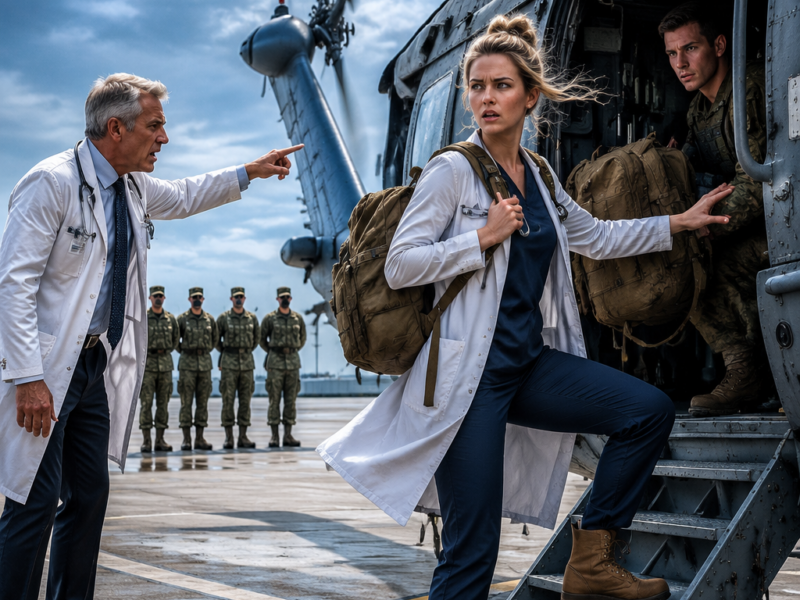
The Hospital Director Fired Her — Moments Later, a Navy Helicopter Landed on the Hospital Roof
The Hospital Director Fired Her — Moments Later, a Navy Helicopter Landed on the Hospital Roof
“Dr. Brooks, you’re fired.”
The words rang through the emergency department of Memorial Hospital, cutting through the usual noise of ringing monitors, hurried footsteps, and urgent voices. For a moment, the entire room seemed to fall silent. Nurses stopped what they were doing. Two residents exchanged uneasy glances. Even the patient lying on the operating table appeared to become part of the strange stillness that had settled over the room.
Dr. Talia Brooks stood beside the operating table, her surgical gloves stained with blood, her shoulders rising and falling as she tried to steady her breathing. Only moments earlier, she had been fighting to keep an elderly man’s heart beating. Now, the very people who had watched her save his life were looking at her as though she had committed an unforgivable crime.
She was only twenty-eight years old, barely five feet tall, and had spent the last four years working tirelessly to establish herself as a respected physician. She had endured exhausting shifts, endless examinations, humiliating criticism, and countless nights studying until sunrise. She had sacrificed almost everything to earn her place in the medical profession.
Yet none of that seemed to matter to Dr. Harrison Mitchell, Memorial Hospital’s powerful chief of surgery.
“You performed surgery without authorization,” Mitchell repeated, his voice cold and deliberate. “You bypassed established procedures, ignored the chain of command, and made a decision that could have exposed this hospital to enormous legal consequences.”
Talia looked down at the elderly man. His name was Gerald Patterson. Less than twenty minutes earlier, his heart had stopped following a catastrophic chest injury. The attending physicians had hesitated, arguing over the next course of action while his condition deteriorated. Talia had recognized that there was almost no time left. She had acted when everyone else was still discussing what they were permitted to do.
Now Gerald was alive.
His heartbeat had returned. His vital signs were stabilizing. The medical team had already begun preparing him for further treatment.
“He was dying,” Talia said quietly.
Mitchell’s expression did not change.
“That does not give you permission to disregard every rule in this institution.”
“I made the decision because waiting would have killed him.”
“You are a resident, Dr. Brooks. You are not authorized to make decisions of that magnitude without supervision.”
Talia looked at the other physicians, hoping someone would speak. She knew several of them had witnessed what happened. They had seen Gerald’s heart stop. They had watched her work desperately to save him. Surely someone would acknowledge that the situation had been extraordinary.
But nobody said anything.
A few nurses lowered their eyes. One young intern looked as though he wanted to protest but lacked the courage. Others simply pretended to be busy.
Mitchell stepped closer.
“Your employment at Memorial Hospital is terminated, effective immediately. I suggest you leave before I have security escort you out.”
For several seconds, Talia remained motionless. She wanted to defend herself. She wanted to remind him that the patient was alive because she had refused to stand by and watch him die.
Instead, she slowly removed her gloves.
“All right, Doctor.”
She placed them in the disposal container, washed her hands, and walked out of the emergency department without another word.
As she passed through the corridor, she could hear people whispering.
Some believed Mitchell had gone too far. Others thought Talia had finally received the punishment she deserved. A few simply shook their heads, unwilling to become involved in a conflict that could threaten their own careers.
Talia kept walking.
She had learned long ago that sometimes the only way to survive a difficult situation was to keep moving, even when everything inside you wanted to stop.
What none of her colleagues knew was that the calm, quiet resident they had just watched lose her job had once served in some of the most dangerous military operations in the world.
And what Dr. Mitchell certainly did not know was that his decision would soon attract the attention of an organization far more powerful than his hospital administration.
Outside, the afternoon sun illuminated the hospital parking lot. Talia walked toward her old Honda Civic, carrying a small bag containing her personal belongings. Her hands were trembling slightly, although she tried to hide it.
She had never imagined her career would end this way.
Four years of civilian medical training, countless examinations, and endless sacrifices had apparently been reduced to a single disciplinary decision.
She unlocked the car, sat behind the steering wheel, and stared through the windshield.
For a moment, she considered calling someone. Her family, perhaps. An old friend. Anyone who might understand what had happened.
But she couldn’t bring herself to do it.
She placed both hands on the steering wheel and straightened her back. It was an unconscious habit, one that had followed her from another life. Even after four years of trying to become an ordinary civilian doctor, her body still remembered the discipline of military service.
She closed her eyes.
A distant memory briefly surfaced: a medical tent under a dark Afghan sky, the smell of smoke, the sound of explosions, and a wounded soldier whose life depended on decisions made in seconds.
Talia opened her eyes and pushed the memory away.
That part of her life was over. At least, she had spent four years convincing herself that it was.
A few minutes later, the automatic hospital doors opened.
Dr. Harrison Mitchell emerged, accompanied by Patricia Williams, the hospital’s administrative director. Mitchell was a tall man with silver hair, an imposing figure whose reputation for enforcing hospital regulations was well known throughout San Diego’s medical community.
He stopped in front of the gathering staff members.
“I want everyone to understand what happened today,” he announced.
His voice carried easily across the parking lot.
“Dr. Brooks violated multiple medical protocols. She performed an unauthorized thoracotomy without proper supervision, without following established procedures, and without considering the legal responsibilities of this institution.”
Several people nodded.
Mitchell continued.
“I have warned her repeatedly about her aggressive approach to emergency medicine. She believes that being confident gives her the right to ignore established procedures. That attitude is dangerous.”
A young intern finally gathered enough courage to speak.
“But Dr. Mitchell, she saved Mr. Patterson’s life.”
Mitchell turned toward him.
“That is not the point.”
The intern fell silent.
“Medicine is not about playing hero,” Mitchell continued. “It is about following established standards. What happens if a physician makes an unauthorized decision and kills a patient? What happens if the procedure causes complications? Who takes responsibility? This hospital does.”
Patricia Williams shifted uncomfortably beside him.
Mitchell barely noticed.
He had spent twelve years building his authority as chief of surgery. Few people challenged his decisions, and those who did often discovered that questioning him could become a serious professional mistake.
To him, Talia Brooks was simply another difficult resident who had refused to understand her place in the hierarchy.
He had no idea how wrong he was.
Meanwhile, several miles offshore, an entirely different emergency was unfolding aboard the USS Abraham Lincoln.
Commander Jake Rodriguez stood inside the ship’s operations center, listening to an increasingly urgent radio transmission.
“Commander, we have a pilot down. Lieutenant David Harris went into the water following an engine failure during a training exercise. His F-18 experienced a catastrophic malfunction at approximately twelve hundred feet.”
Jake’s expression tightened.
“Did he eject?”
“Yes, sir. The ejection system functioned, but the impact was severe. He sustained significant chest trauma during the descent and water landing.”
“What is his condition?”
“Unconscious. Blood pressure dropping. Heart rate irregular. Our medical officer suspects internal bleeding and possible cardiac involvement.”
Jake remained silent for a moment.
He had spent enough years in military service to understand what those words meant. A young pilot could be perfectly healthy one moment and fighting for his life the next. In certain emergencies, the difference between survival and death was measured in minutes.
“Get him stabilized,” Jake ordered. “I want a full medical assessment immediately.”
“Our medical team is working on him, Commander, but we’re facing limitations. We suspect a serious injury around the heart. If that’s correct, we may not have the equipment or specialist experience required to treat him.”
Jake looked toward the officer standing beside him.
“Who do we have available?”
The officer began listing the possibilities.
The Navy’s leading trauma specialist was stationed on the East Coast. A highly experienced military surgeon was overseas. Another specialist was unavailable because of an ongoing operation.
Jake listened, increasingly frustrated.
Then he remembered a name.
It was a name he had encountered several months earlier while reviewing confidential medical personnel records. Someone had mentioned an unusually talented former combat medic who had left military service and disappeared into civilian medicine.
Her reputation had survived even after she left the battlefield.
Her name was Talia Brooks.
Jake reached for his secure tablet and searched through the limited information available to him.
There she was.
Dr. Talia Brooks, currently associated with Memorial Hospital in San Diego.
He immediately contacted the flight deck.
“Prepare an MH-60 Seahawk. We are going to Memorial Hospital.”
The communications officer looked confused.
“Sir, are we requesting a civilian medical consultation?”
“Something like that.”
“Do we have authorization to land on their rooftop?”
“We’ll obtain it. Prepare the aircraft.”
Jake turned back toward the radio.
“Tell the medical team we are bringing someone who may be able to save Lieutenant Harris. And tell them to keep him alive until we get there.”
Back at Memorial Hospital, Talia was still sitting inside her Honda Civic.
The adrenaline had finally begun to disappear, leaving behind exhaustion and disappointment. She had given everything to her work, and now she was wondering whether she had made a terrible mistake by choosing civilian medicine.
A gentle knock on the passenger-side window interrupted her thoughts.
She looked up.
Emily Chen, one of the trauma nurses, stood outside.
Talia lowered the window.
“Hey,” Emily said softly. “Are you okay?”
Talia managed a tired smile.
“I’ve had better afternoons.”
Emily glanced toward the hospital entrance before looking back at her.
“I wanted you to know that what you did in there was incredible.”
Talia looked away.
“It doesn’t seem like anyone else agrees.”
“I don’t care what Mitchell thinks. I was in that room. I watched you save that man’s life.”
Emily hesitated before asking the question that had been bothering her for months.
“Where did you learn to work like that?”
Talia turned toward her.
“What do you mean?”
“The way you handled the emergency. You knew exactly what needed to happen. You weren’t panicking. You didn’t waste time arguing. You just took control.”
“Experience,” Talia replied.
“From where?”
“Medical school. Emergency rotations. Lots of studying.”
Emily smiled faintly, although she clearly wasn’t convinced.
“Whatever it was, whoever taught you, they did a remarkable job.”
Talia nodded.
“Thank you, Emily. That means more than you know.”
Emily was about to say something else when a strange sound began growing louder overhead.
At first, neither woman paid much attention. Helicopters occasionally approached the hospital, usually carrying patients from accidents or remote locations.
But this sound was different.
It was heavier, more powerful, and accompanied by a deep mechanical vibration that seemed to shake the air.
Emily straightened.
“That’s not one of our regular medical helicopters.”
Both women looked toward the sky.
A gray military helicopter appeared above the hospital’s main building.
Its Navy markings were unmistakable.
It circled once before descending toward the rooftop helipad.
Within seconds, the entire hospital seemed to awaken.
Patients gathered near windows. Visitors pulled out their phones. Security personnel rushed toward the rooftop access points. Staff members began asking one another whether a military emergency had been declared.
Dr. Mitchell stormed through the main entrance.
“What is happening?” he demanded.
Nobody immediately answered.
The helicopter touched down.
Its side door opened, and Commander Jake Rodriguez stepped out. He wore a Navy uniform and moved with the unmistakable confidence of someone accustomed to making decisions under pressure.
A crew chief and a military medic followed him.
Jake immediately approached the nearest hospital employee.
“I’m Commander Rodriguez, United States Navy. I need to speak with Dr. Talia Brooks.”
The employee blinked.
“Dr. Brooks?”
“Yes. Where can I find her?”
Before anyone could answer, Mitchell stepped forward.
“Commander, I’m Dr. Harrison Mitchell, chief of surgery here. I’m afraid there has been a misunderstanding. Dr. Brooks is no longer employed by this institution.”
Jake frowned.
“What do you mean?”
“She was terminated less than an hour ago for serious violations of medical protocol.”
“Terminated?”
“Yes. She performed an unauthorized surgical procedure and endangered a patient’s safety.”
Jake studied Mitchell’s face.
“What kind of procedure?”
Mitchell explained the incident, emphasizing every alleged violation and describing Talia as an impulsive physician who had demonstrated a dangerous disregard for established medical standards.
Jake listened without interrupting.
When Mitchell finished, the commander asked a simple question.
“Is the patient alive?”
Mitchell hesitated.
“Yes.”
“Then I think we have a different understanding of what happened.”
The chief of surgery’s expression hardened.
“Commander, with all due respect, you don’t understand the responsibilities of running a civilian hospital.”
“And you don’t understand the emergency I’m dealing with.”
Jake stepped closer.
“We have a twenty-six-year-old Navy pilot aboard the Abraham Lincoln. He sustained severe chest trauma and is showing signs of possible cardiac tamponade. Our medical team believes he may have less than two hours to live without specialized intervention.”
Mitchell folded his arms.
“That is unfortunate, but I can recommend several qualified surgeons.”
“We need Dr. Brooks.”
“She’s been terminated.”
“I heard you the first time.”
Mitchell’s irritation became obvious.
“Commander, I cannot recommend someone who has just demonstrated such reckless behavior.”
Jake took a slow breath.
“Dr. Mitchell, I didn’t fly a Navy helicopter here because I wanted a recommendation. I came because someone with Dr. Brooks’s specific experience may be the only person capable of helping us.”
Across the parking lot, Emily had heard everything.
She turned toward Talia.
“They’re asking for you.”
Talia stared at her.
“What?”
“The Navy. They specifically requested you.”
Talia felt her heartbeat quicken.
For four years, she had worked to keep her military background hidden. She had avoided mentioning deployments, declined invitations to veterans’ events, and deliberately presented herself as an ordinary medical resident.
How could the Navy have found her?
Why would a commander fly a military helicopter to a civilian hospital just to speak with her?
“There must be some mistake,” she whispered.
But deep down, she knew there wasn’t.
Emily opened the passenger door.
“Come on. They’re waiting.”
Talia stepped out slowly.
By then, Jake was becoming increasingly impatient.
He looked at his watch, then toward the sky.
“Every minute matters,” he told Mitchell. “We have a pilot whose condition is deteriorating. If Dr. Brooks has the experience we need, I want to speak with her now.”
Mitchell shook his head.
“She is not authorized to practice medicine here.”
“She doesn’t need your authorization to consult with the Navy.”
Before Mitchell could respond, Emily approached.
“Commander, Dr. Brooks is here.”
Talia walked beside her.
Jake turned.
For a moment, he simply studied the woman standing before him.
She was small, dressed in wrinkled hospital scrubs, and carried a modest personal bag. Nothing about her appearance suggested that she had once worked in some of the world’s most demanding military medical environments.
Yet something about the way she moved caught his attention.
She was observant. Controlled. Alert to the people and activity around her.
“Dr. Brooks?”
“Yes, Commander.”
“I’m Jake Rodriguez. We have an emergency, and I need your help.”
Talia glanced at Mitchell.
“I understand, but I’m just a resident. I think there may be some confusion about my qualifications.”
Jake brought out his secure tablet.
“I was informed that you have experience treating severe combat-related chest trauma. Is that correct?”
The question struck her harder than she expected.
Combat-related chest trauma.
There were very few people who could have supplied that information.
She hesitated.
“I’m not sure what you’ve been told.”
Jake lowered his voice.
“I have a pilot whose life depends on getting the right medical care. I don’t have time to discuss your employment history. I need to know whether you can help us.”
Mitchell immediately stepped between them.
“Absolutely not. Dr. Brooks is no longer part of this hospital. I will not permit her to participate in any official medical operation under our institution’s name.”
Jake looked at him.
“She won’t be representing your institution.”
Then he turned back toward Talia.
“Dr. Brooks, will you come with us?”
Talia glanced at the helicopter.
She could feel the past closing in around her.
Before she could answer, Jake’s radio crackled.
“Commander Rodriguez, urgent update. Lieutenant Harris’s blood pressure is continuing to fall. Our medical officer suspects rapidly progressing cardiac tamponade. We estimate ninety minutes at most.”
Talia’s professional instincts immediately took over.
Cardiac tamponade meant that blood or fluid was accumulating around the heart, preventing it from filling and pumping effectively. Without timely treatment, the condition could become fatal.
She knew exactly how serious it was.
She also knew that the medical team aboard a carrier might not have the experience required to handle such a complicated emergency.
“How far away is the ship?” she asked.
“Approximately forty-five minutes by air,” Jake answered.
Talia calculated the available time.
They would have to reach the ship, assess the patient, stabilize him, and arrange further treatment. Every delay mattered.
Mitchell’s voice interrupted her thoughts.
“Dr. Brooks, you are not authorized to participate in any medical procedure. If you attempt to practice medicine without proper credentials, I will ensure that you face the appropriate legal consequences.”
Talia turned toward him.
For four years, she had listened to that man’s criticism. She had endured his condescending remarks, his constant suspicion, and his repeated attempts to undermine her confidence.
She had tried to become the kind of physician he wanted.
She had followed his instructions, studied his preferred protocols, and swallowed her frustration whenever he dismissed her judgment.
But not anymore.
“I resign my position, effective immediately,” she said.
Mitchell’s mouth fell open.
“You cannot simply resign in the middle of a disciplinary action!”
Talia ignored him.
She turned toward Jake.
“Commander, what do you need me to do?”
Jake’s expression changed immediately.
“Come with us. Our medical officer will brief you during the flight.”
“I need five minutes to collect my things.”
“Make it fast.”
Talia headed toward the hospital entrance.
Emily followed.
“Are you sure about this?” she asked.
Talia looked at her.
“No.”
Emily stopped.
Talia continued, her voice quieter now.
“But that pilot doesn’t have any other options.”
Inside the hospital, staff members watched as Talia returned to her locker. Some were surprised. Others seemed embarrassed by the way they had treated her earlier.
Mitchell intercepted her near the elevators.
“Brooks, I want to know what’s really happening. Why would the Navy request a resident? What aren’t you telling me?”
Talia placed a few belongings into her bag.
“I don’t know, Doctor. Perhaps they heard about my textbook knowledge.”
Mitchell studied her.
For the first time, he noticed something different about her. She wasn’t apologizing. She wasn’t trying to defend herself. She wasn’t even particularly interested in convincing him that he was wrong.
There was a quiet confidence in her expression that he had never seen before.
“This isn’t over,” he warned. “When you return, we’re going to discuss your background and qualifications.”
Talia closed her locker.
“I think you’re about to learn more about my background than you ever wanted to know.”
She walked away.
On the rooftop, Jake was waiting beside the helicopter.
Talia approached without hesitation. She knew where to stand, how to move around the aircraft, and how to enter safely despite the powerful rotor wash.
The crew chief offered a hand.
“Need some help, Doctor?”
“Thank you.”
She climbed aboard with an ease that Jake immediately noticed.
As the helicopter lifted away from Memorial Hospital, Jake opened his tablet and began explaining the situation.
“Lieutenant David Harris. Twenty-six years old. Experienced fighter pilot. He was conducting a training flight when his aircraft suffered engine failure. He ejected successfully, but the impact with the water appears to have caused serious blunt-force injuries.”
Talia listened carefully.
“Was he conscious after the ejection?”
“Initially, yes. He was rescued and transferred to the ship, but his condition deteriorated.”
“Any evidence of penetrating injuries?”
“None that we know of. The medical officer suspects internal bleeding and possible damage around the heart.”
“Imaging?”
“Limited. Basic X-ray equipment. Nothing sophisticated.”
Talia nodded.
She understood the limitations.
For a moment, she looked out the window.
Below them, San Diego stretched across the coastline. The city was peaceful, almost impossibly ordinary compared with the environments where she had once worked.
Jake studied her.
“Dr. Brooks, can I ask where you developed your trauma experience?”
“Emergency medicine. High-volume trauma cases.”
“That’s a broad answer.”
“It’s the answer I can give you right now.”
Jake recognized the boundary and decided not to push.
His priority was saving Lieutenant Harris.
The helicopter crossed the coastline and headed toward the enormous aircraft carrier waiting offshore.
As the ship came into view, Talia felt an uncomfortable mixture of familiarity and anxiety.
She had told herself she would never return to a military environment.
Yet here she was, flying toward a Navy carrier with a military commander beside her and a wounded pilot waiting for treatment.
The flight took approximately forty-two minutes.
When they landed, sailors immediately guided them toward the medical bay.
Talia kept her head slightly lowered as they crossed the flight deck.
Then she saw someone she recognized.
Chief Petty Officer Marcus Webb.
He stood near the entrance to the medical facilities, wearing his khaki uniform and speaking with another sailor.
Talia’s stomach tightened.
Webb had served alongside military medical personnel during overseas operations. If he recognized her, her carefully protected identity would disappear.
She pulled the borrowed Navy cap lower over her forehead and stayed close behind Jake.
But as they approached, Webb called out.
“Rodriguez! That your trauma specialist?”
Jake stopped.
“That’s right. Dr. Brooks.”
Webb looked toward Talia.
“Brooks? That name sounds familiar. Have we met before, Doctor?”
Talia maintained a neutral expression.
“I don’t think so, Chief. I’d remember.”
Webb studied her for another moment.
“Maybe I’m mistaken. Come on. Your patient’s waiting.”
They entered the medical bay.
The familiar smell of antiseptic immediately brought back memories Talia had spent years trying to bury. The organized equipment, the hurried voices, the monitors, the tension of a medical team working against time.
She felt as though she had stepped backward into another life.
Commander Dr. Sarah Martinez, the ship’s senior medical officer, approached them.
“Dr. Brooks, thank goodness you’re here.”
“Tell me what’s happening.”
Martinez led her toward the examination table.
Lieutenant David Harris lay unconscious beneath the bright medical lights. His face was pale, his breathing shallow, and his vital signs dangerously unstable.
Talia began assessing him.
She checked the available monitoring equipment, reviewed his injuries, and listened carefully as Martinez explained what the team had already attempted.
“How long has he been deteriorating?”
“About three hours since the accident. He was initially conscious, but his condition has steadily worsened.”
Talia studied the available findings.
Her expression became serious.
“He has blood accumulating around the heart. The pressure is preventing it from functioning properly.”
Martinez nodded.
“That’s our concern. We believe he’s developing cardiac tamponade.”
“We need to relieve the pressure.”
Martinez looked uncomfortable.
“Under normal circumstances, we’d have a fully equipped surgical team, advanced imaging, and a controlled environment. Here, we have limited resources. None of us has extensive experience performing this procedure under these conditions.”
Talia looked around the room.
“Then we work with what we have.”
Her voice had changed.
The hesitant resident who had stood in the hospital parking lot was gone. In her place stood someone who had spent years making difficult decisions under circumstances where hesitation could cost lives.
She began organizing the medical team.
“Dr. Martinez, I need you monitoring his condition continuously. Keep the necessary medications ready. Commander Rodriguez, I want you coordinating anything we need from the ship’s medical stores. Chief Webb, make sure additional blood products are available.”
Everyone moved immediately.
Jake watched her closely.
She wasn’t shouting. She wasn’t trying to impress anyone. She simply understood what needed to happen and communicated it with absolute clarity.
Martinez approached her.
“Dr. Brooks, this is an extremely risky intervention. If something goes wrong, we could lose him.”
Talia looked directly at her.
“If we do nothing, we lose him anyway.”
The room fell silent.
Talia returned her attention to Harris.
For a brief moment, she remembered another young soldier lying beneath a military medical tent in Afghanistan. He had been barely conscious, with a chest wound that had left him struggling to breathe.
She remembered the explosions outside.
She remembered the frightened expression of the young medic assisting her.
And she remembered telling him that fear could wait until the patient was safe.
She pushed the memory aside.
This was not the time to remember.
This was the time to work.
The procedure began.
Talia positioned herself beside the patient and proceeded with deliberate precision. Her movements were economical, confident, and practiced. Every decision was based on her assessment of the patient and the resources available.
Martinez watched carefully.
The technique was not unfamiliar, but the confidence with which Talia approached it was extraordinary.
Within moments, blood began to collect in the aspiration syringe.
“That’s it,” Talia said quietly.
The medical team watched the monitors.
Gradually, Harris’s breathing improved. His heart rate began to stabilize, and the color slowly returned to his face.
Martinez looked at the readings.
“His blood pressure is coming back.”
Talia continued monitoring him.
“Keep watching for any sign of deterioration. We aren’t finished yet.”
The immediate danger began to pass.
Jake released a breath he hadn’t realized he was holding.
Chief Webb looked at Talia with open admiration.
“That’s remarkable work, Doctor.”
Talia did not respond immediately.
She was still checking Harris’s condition.
“He needs definitive surgical treatment as soon as possible,” she explained. “What we’ve done has stabilized him, but the underlying injury still needs to be repaired. He should be transferred to a fully equipped facility.”
Martinez nodded.
“I’ll coordinate with Balboa Naval Hospital.”
For the first time since arriving, Talia allowed herself to relax slightly.
She had done what she came to do.
But the questions were only beginning.
Martinez turned toward her.
“Dr. Brooks, where exactly did you train? That wasn’t ordinary residency-level experience.”
Talia began organizing the equipment.
“Emergency medicine teaches you to adapt.”
Martinez smiled.
“That’s true, but what I just witnessed goes beyond adapting.”
Chief Webb approached from the other side of the room.
“Actually, Doctor, watching you work reminded me of someone I served with in Afghanistan.”
Talia’s hands paused briefly.
“Did it?”
“Absolutely. The way you move. The way you organize a team. The way you approach trauma without wasting a second. I’ve seen that kind of training before.”
Talia kept her expression neutral.
“Emergency medicine has similarities everywhere.”
“Maybe,” Webb replied. “But some of the terminology you used and the way you handled the situation were very familiar.”
Jake looked between them.
He had already suspected that Talia’s background was more complicated than she admitted.
Now he was certain.
“Dr. Brooks,” he said carefully. “Is there something about your professional history we should know?”
Talia looked toward him.
For four years, she had managed to keep her military identity separate from her civilian career. She had wanted to be evaluated as a doctor, not as a former soldier.
She had wanted to leave the battlefield behind.
But the people standing around her had just witnessed skills that could not be explained by a few emergency rotations.
Before she could answer, Lieutenant Harris began to stir.
His eyes opened slowly.
“What happened?” he whispered.
Martinez moved toward him.
“You were involved in an aircraft accident, Lieutenant. You’ve been unconscious for several hours, but you’re stable now.”
Harris tried to move, then winced.
“My chest…”
“Don’t try to sit up,” Martinez told him. “You’ve sustained serious injuries.”
He looked around the room.
“Did everyone make it back?”
Jake stepped forward.
“You were on a solo training flight. Everyone else is accounted for.”
Harris nodded weakly.
Then his attention shifted toward Talia.
“Who are you?”
“Dr. Talia Brooks. I helped treat you.”
He studied her face.
Something seemed to awaken in his memory.
“Brooks?”
“Yes.”
He swallowed.
“There was a medic in Afghanistan. Years ago. She saved my entire squadron after an IED attack. Her name was Brooks, too.”
Talia felt her heart tighten.
Harris continued.
“Operation Red Dawn. September 2019. Our convoy was hit outside Kandahar. We had three casualties, all with serious chest wounds. Our regular medical team thought they couldn’t do anything more.”
He paused, trying to remember.
“Then this woman arrived. She was with a special operations medical team. She treated all three of us.”
He looked directly at Talia.
“I remember her name because one of my friends kept repeating it during recovery. Brooks saved my life. Brooks saved my life.”
Nobody spoke.
Talia felt the walls of her carefully constructed civilian identity beginning to collapse.
“Lieutenant,” she said gently, “you’ve been through a serious injury. You should concentrate on recovering.”
But Harris shook his head.
“No. I remember her.”
He looked toward Jake.
“She was a female Delta Force medic. I’m sure of it.”
Jake slowly turned back to Talia.
“Dr. Brooks, is he right?”
Before she could respond, Chief Webb suddenly stepped closer.
“Wait a minute.”
He looked at her face more carefully.
Then his eyes widened.
“Good Lord. I know you.”
Talia closed her eyes briefly.
Webb’s voice carried genuine astonishment.
“Sergeant Brooks. You’re Sergeant Talia Brooks.”
The room went completely silent.
“You were attached to the 168th Medical Company during special operations. You were the medic who saved those Rangers at Fire Base Charlie. The one who kept working while the position was under fire.”
Jake looked at her with renewed understanding.
The pieces were finally coming together.
Her familiarity with military aircraft. Her ability to organize a medical team. Her extraordinary composure. Her experience with complicated trauma cases.
All of it suddenly made sense.
“Sergeant Brooks,” Jake said, using her former rank deliberately, “is Chief Webb correct?”
Talia looked around the room.
There was no point denying it anymore.
She reached up and removed the borrowed Navy cap.
Her hair fell naturally around her shoulders.
When she spoke, her voice was stronger than before.
“Yes. I’m former Delta Force combat medic Sergeant Talia Brooks.”
She paused.
“I served four deployments in Afghanistan between 2017 and 2021.”
For several seconds, nobody moved.
The quiet resident from Memorial Hospital had suddenly become someone entirely different in their eyes.
Not because she had changed, but because they finally understood who she had been all along.
Jake nodded respectfully.
“Sergeant, why didn’t you identify yourself when I first contacted you?”
Talia looked down at the medical equipment.
“Because I left that life behind, Commander. I wanted to be a civilian doctor. I wanted to work in a normal hospital, where I could help people without worrying about incoming fire, military operations, or whether the next patient would survive the night.”
Martinez looked at her with admiration.
“You never mentioned any of this.”
“I didn’t want it to define me.”
Chief Webb shook his head.
“Sergeant, your reputation in the special operations community is something else. There are people walking around today because of you.”
Talia looked uncomfortable.
“I was doing my job.”
“That’s what you always said,” Webb replied.
Harris, still lying on the table, managed a weak smile.
“My mother sent you a letter after Red Dawn. Through the Red Cross. She wanted to thank you for bringing me home.”
Talia’s expression softened.
“I received a lot of letters during those years.”
“Did you read them?”
“Every single one.”
Harris smiled.
“My mother will be happy to know that.”
For a moment, the room became quieter.
Then Jake’s radio interrupted them.
“Commander Rodriguez, this is the bridge. Balboa Naval Hospital has confirmed transfer arrangements. Please provide an update on Lieutenant Harris’s condition.”
Jake looked toward Talia.
She checked the monitors one final time.
“He’s stable enough for transport. The emergency intervention was successful, but he still requires surgical repair of the underlying cardiac injury.”
Jake transmitted the assessment.
As the medical team prepared Harris for evacuation, he pulled Talia aside.
“Sergeant, I have a question.”
“Go ahead.”
“What are your plans now?”
Talia frowned.
“I was planning to return to civilian medicine. Although, after today, I’m not entirely sure what that means.”
Jake nodded.
“I understand. But the Navy has been looking for someone with your qualifications.”
“What kind of position?”
“Someone who can help train the next generation of military medical personnel. Someone who understands combat trauma but also understands civilian medicine.”
Talia considered the suggestion.
“Commander, I appreciate the offer, but I left military service for a reason.”
“I know.”
“I wasn’t looking to return to that world.”
Jake looked toward the patient.
“Lieutenant Harris is alive because you were available when we needed you. How many other people might benefit from what you know?”
Talia did not answer.
She had spent four years trying to convince herself that leaving the military meant leaving behind the skills, experiences, and responsibilities that had shaped her.
But perhaps those things had never truly left her.
The helicopter carried Talia and Jake back toward San Diego.
As the coastline appeared beneath them, Jake explained that the Navy was considering a new position that would combine military experience with civilian medical training.
It would involve developing trauma programs, advising medical teams, consulting on difficult cases, and helping former military medical personnel transition into civilian healthcare careers.
“You wouldn’t have to return to combat operations,” Jake explained. “You’d be based at Balboa Naval Hospital, but you’d work with military and civilian medical institutions throughout Southern California.”
Talia looked out the window.
It was an interesting proposal.
For the first time, someone was suggesting that she did not have to choose between being a former combat medic and a civilian physician.
Perhaps both identities could exist together.
When the helicopter approached Memorial Hospital, Talia noticed something unusual.
News crews had gathered in the parking lot.
Several reporters stood near the entrance, their cameras pointed toward the rooftop.
The footage of the military helicopter arriving and requesting a recently fired resident had already begun circulating online.
People were asking questions.
Why had the Navy requested Talia Brooks?
Why had the hospital fired her?
What kind of experience did she possess that made a military commander fly directly to her workplace?
The story was spreading faster than anyone at Memorial Hospital could control.
The helicopter landed.
Talia stepped out, accompanied by Jake.
They descended toward the main hospital floors, where administrators were already waiting.
Dr. Mitchell stood near the elevators.
His expression was no longer arrogant.
He looked tired, anxious, and deeply uncomfortable.
“Dr. Brooks,” he began. “Commander Rodriguez has informed me about your background. I think we need to discuss what happened today.”
Talia regarded him calmly.
“I believe I resigned before leaving with the commander. I’m not sure what remains to be discussed.”
Mitchell cleared his throat.
“The hospital board has been in emergency session for the past hour. We’ve received inquiries from the Pentagon, the Navy Department, and several news organizations.”
Jake stepped forward.
“Any questions involving the military operation should be directed through the appropriate Navy channels.”
Mitchell nodded.
“Of course. But this situation involves more than the military. Dr. Brooks performed emergency surgery here this morning. She was terminated for doing so. Then she was requested by the Navy and subsequently saved the life of a military pilot.”
He looked toward Talia.
“The implications are significant.”
Before she could respond, Emily Chen approached.
“Dr. Brooks, there’s something you should know.”
“What is it?”
“The Patterson family has been waiting for you.”
Talia looked surprised.
“Gerald’s family?”
Emily nodded.
“His son and daughter-in-law. They heard about what happened and wanted to speak with you.”
She glanced toward the waiting area.
“They also heard about your military background.”
Talia felt uncomfortable.
She had never wanted public recognition. Her military service had involved enough attention, official reports, and painful memories. Civilian medicine had seemed like a chance to work quietly.
But today, that possibility had disappeared.
Before she could say anything, another man approached.
He wore a Navy dress uniform and carried himself with the authority of a senior officer.
“Commander Rodriguez.”
Jake immediately straightened.
“Captain Torres.”
Captain Michael Torres commanded Balboa Naval Hospital.
“I’ve just come from the medical facility,” Torres said. “Lieutenant Harris is in surgery. His condition is improving.”
Talia listened carefully.
“The surgical team has confirmed that the emergency intervention performed aboard the carrier saved his life. Without it, he would not have survived the journey to our hospital.”
Talia nodded.
“I’m glad he’s doing well, sir.”
Torres turned toward her.
“Dr. Brooks, I understand you’re responsible for that intervention.”
“I simply did what was necessary.”
“Commander Rodriguez has already given me his report. So has Dr. Martinez. They described your performance in considerable detail.”
He paused.
“I also understand that you served in Afghanistan.”
Talia nodded.
“Yes, sir.”
“Four deployments?”
“Yes.”
Torres looked toward Mitchell.
“Then perhaps we should discuss something important. Dr. Brooks appears to possess medical qualifications and professional experience that were not properly reflected in her civilian employment records.”
Mitchell looked uncomfortable.
“Captain, her military service was not included in her application.”
Talia spoke before the conversation could become an accusation.
“That was my decision, sir. I wanted to be evaluated based on my civilian training. I wanted to establish myself as a physician without relying on my previous military service.”
Torres considered her explanation.
“I understand the desire to start fresh. But your military experience is directly relevant to your medical capabilities.”
He continued.
“Combat medical personnel frequently develop skills under circumstances that most civilian physicians never encounter. That experience can be extremely valuable in emergency medicine, disaster response, and trauma care.”
Jake nodded.
“That’s exactly what I’ve been thinking.”
Torres turned toward him.
“Commander, I believe we have a larger opportunity here.”
He looked back at Talia.
“How many former military medical personnel do you think are currently working in civilian healthcare without their experience being properly recognized?”
Talia considered the question.
“I honestly don’t know, sir.”
“Why not?”
“Because I assumed my situation was unusual. Military medicine and civilian medicine are different environments. In combat, you work with limited resources, limited time, and situations where the normal rules cannot always be applied in the same way. Civilian hospitals have different responsibilities. I thought it would be better to learn those systems without constantly comparing them to what I had done overseas.”
Emily stepped forward.
“But your military experience made you a better physician, Dr. Brooks. Everyone who worked with you noticed your composure, your ability to assess emergencies, and your confidence under pressure.”
Talia looked at her.
Emily continued.
“People thought you were naturally talented. They didn’t understand how much experience was behind those skills.”
Mitchell lowered his eyes.
For the first time, he seemed to be genuinely considering how badly he had misunderstood her.
“That’s true,” he admitted. “Your evaluations consistently mentioned exceptional trauma management. We assumed it was the result of intensive study and natural ability.”
Talia looked directly at him.
“It wasn’t natural talent, Dr. Mitchell. It was four deployments worth of experience. It was years of treating wounded soldiers under conditions that most people cannot imagine.”
The room became quiet.
Then a middle-aged man approached, accompanied by a woman.
“Dr. Brooks?”
Talia turned.
“Yes?”
“My name is Robert Patterson. I’m Gerald Patterson’s son.”
The woman beside him smiled.
“I’m Susan, his daughter-in-law. I’m also a retired nurse.”
Robert’s eyes were filled with gratitude.
“I wanted to thank you for saving my father’s life.”
Talia smiled gently.
“I’m glad he’s doing well.”
Susan shook her head.
“You don’t understand. I was here this morning. I saw what happened. I watched the other doctors hesitate while your patient was deteriorating. I watched you take responsibility when nobody else wanted to.”
She glanced toward Mitchell.
“You saved his life.”
Robert nodded.
“My father is a Korean War veteran. When we heard that you had served in the military, we thought it was particularly meaningful that another veteran had saved him.”
Talia struggled to find the right words.
“Please tell your father I’m glad I could help.”
Robert shook her hand.
“He knows. And he wants to meet you as soon as he’s able.”
The simple expression of gratitude affected Talia more deeply than she expected.
For years, she had remembered the soldiers she could not save more vividly than those who survived.
She had never considered herself extraordinary.
She had simply tried to do everything possible for the people who depended on her.
Now, standing in a hospital corridor surrounded by people who understood what she had done, she felt something she had not experienced in a long time.
She felt that her work mattered.
Captain Torres waited until the Patterson family had moved away.
Then he presented an opportunity that would change the direction of her career.
“Dr. Brooks, the Navy is developing a new program called the Military Civilian Medical Bridge Initiative. We’re looking for experienced former military medical personnel to help connect military and civilian healthcare systems.”
Talia listened carefully.
“What would the position involve?”
“Several things. You would help train civilian medical personnel in advanced trauma preparedness. You would consult on emergency response procedures, advise on complex cases, and help former military medical professionals translate their experience into civilian healthcare careers.”
Jake added, “The position would be based at Balboa Naval Hospital, but you’d work with hospitals throughout Southern California.”
Talia looked between them.
For the first time, the idea did not feel like a return to her old life.
It felt like an opportunity to create something new.
But before she could respond, Mitchell cleared his throat.
“Dr. Brooks, there is something else I would like to discuss.”
Everyone turned toward him.
“Memorial Hospital would like to offer you a position.”
Talia raised an eyebrow.
“What kind of position?”
Mitchell took a breath.
“Director of Emergency Trauma Services.”
Emily’s eyes widened.
Mitchell continued.
“The hospital board has approved the creation of a new department. We believe your experience could help us improve emergency response procedures and strengthen our trauma services.”
He hesitated.
“The position would include authority to review existing protocols, develop new emergency procedures, and train our medical staff. It would also come with a substantial salary increase.”
Emily looked at Talia.
“This morning you were fired. Now you’re being offered a director position.”
Talia almost smiled.
The reversal was almost too absurd to believe.
But the situation was far from over.
Mitchell’s phone began ringing.
He answered, listened, and slowly lost color in his face.
“What do you mean?” he asked.
He listened again.
Then he lowered the phone.
“The hospital’s legal department has received a formal investigation notice from the state medical board.”
Nobody spoke.
Mitchell continued.
“They’re reviewing the circumstances surrounding Dr. Brooks’s termination.”
Captain Torres nodded.
“The Defense Health Agency will also be examining how military medical credentials are evaluated by civilian institutions. This case may become part of a larger review.”
Mitchell looked toward Talia.
For the first time, the powerful chief of surgery appeared genuinely frightened.
He had spent years making decisions that affected the careers of physicians, nurses, and residents. He had believed that his authority was unquestionable.
Now his own decisions were being examined.
And the people who once remained silent were beginning to speak.
Emily stepped forward.
“There’s something else, Dr. Mitchell.”
He looked at her.
“The nursing staff has submitted a formal complaint about Dr. Brooks’s termination. We’ve documented several incidents where hospital policies prevented timely patient care. We’re requesting a full review of emergency procedures.”
Mitchell’s expression tightened.
“How many nurses signed it?”
“Almost the entire trauma department.”
The statement landed heavily.
The people he had expected to remain obedient were no longer willing to protect his authority.
He looked toward Talia.
“Dr. Brooks, I owe you an apology.”
Talia remained silent.
“I made a serious error in judgment today. I allowed my commitment to procedure to override my understanding of the situation. I should have considered the patient’s condition and your experience before making that decision.”
It was a difficult admission for him.
But it was also necessary.
“I was wrong to dismiss your actions without properly examining the circumstances.”
Talia studied him.
“Dr. Mitchell, protocols exist to protect patients. I understand that. But they should never become more important than the lives they’re supposed to protect.”
Mitchell nodded slowly.
“I understand that now.”
She continued.
“I didn’t want to violate the hospital’s rules. I wanted to save a man who was dying. Those are not the same thing.”
Nobody interrupted.
Captain Torres watched the exchange with quiet interest.
He had seen many talented medical professionals throughout his career. Some were brilliant but arrogant. Others were technically gifted but struggled to lead.
Talia was different.
She understood that expertise carried responsibility.
And she understood that leadership was not about being the loudest person in a room.
It was about knowing when to act, when to listen, and when to accept responsibility for difficult decisions.
A few hours later, Jake received another update.
He checked his phone and smiled.
“Captain Torres, we have news.”
Torres turned.
“How is Harris?”
“The surgery was successful. The cardiac injury has been repaired. No major complications.”
A wave of relief passed through the group.
“What’s his prognosis?” Talia asked.
Torres checked the report.
“The surgical team expects a full recovery. If rehabilitation progresses as planned, he may return to flight status within six months.”
Talia closed her eyes briefly.
Another life saved.
Another family that would not have to receive the worst possible phone call.
For her, that was enough.
But the afternoon still had one more unexpected development.
Captain Torres stepped forward with a formal offer.
“Dr. Brooks, I’m authorized to offer you a direct commission as a Lieutenant Commander in the Navy Reserve, along with an appointment as director of the Military Civilian Medical Bridge Initiative.”
Talia looked surprised.
“A direct commission?”
“Yes. Your previous service and medical qualifications make you an exceptional candidate. You would be responsible for developing programs that could improve emergency trauma care across multiple institutions.”
He continued.
“Your work could also bring you into discussions with congressional committees regarding veteran healthcare policy. There are significant gaps between military medical training and civilian recognition of those qualifications. Your experience could help address them.”
Talia considered the offer.
It was far more than she had expected when she woke up that morning.
Only hours earlier, she had been sitting in her car, unemployed and wondering whether she would ever find another hospital willing to hire her.
Now she was being offered a leadership position by the Navy.
But she did not want to make an emotional decision.
“Captain, I appreciate the confidence you’re placing in me. But I need some time to consider everything. Today has been overwhelming.”
Torres smiled.
“Of course. You don’t need to answer immediately.”
As the afternoon moved toward evening, Mitchell was summoned to an emergency meeting of the hospital board.
He returned nearly an hour later.
His face was pale, and his usual commanding posture had disappeared.
The administrators gathered around him.
“The board has accepted my resignation,” he announced quietly. “Effective immediately.”
Nobody responded.
He looked toward Talia.
“Dr. Brooks, my decision to terminate you today was the worst professional decision of my career.”
He swallowed.
“You were exactly the kind of physician this hospital needed, and I failed to recognize it.”
Talia did not celebrate.
She did not feel the satisfaction she had once imagined she would experience if Mitchell ever admitted he was wrong.
Instead, she felt tired.
The day had reminded her that professional authority could be misplaced, that institutions could become more concerned with protecting themselves than protecting people, and that even talented individuals could be overlooked when others refused to look beyond appearances.
Mitchell continued.
“The hospital will review its emergency procedures. We will also introduce a new framework for evaluating the qualifications of former military medical personnel.”
Talia nodded.
“That would be a good place to start.”
The hospital board had already approved changes to its emergency response policies. The intention was to create a system in which urgent medical decisions could be evaluated according to the patient’s needs and the physician’s qualifications rather than administrative convenience alone.
The new framework would eventually become known informally as the Brooks Protocol.
It would not be a license to ignore medical standards.
Instead, it would emphasize the importance of rapid assessment, clear responsibility, experienced leadership, and patient-centered decisions during extraordinary emergencies.
For the hospital staff, the changes represented something larger than a new set of rules.
They represented a willingness to question a culture that had discouraged people from speaking up.
Emily approached Talia as the administrators began dispersing.
“Can I ask you something?”
“Of course.”
“Are you really considering the Navy position?”
Talia looked toward the windows.
The sun was setting over San Diego.
“Yes. I think I am.”
Emily smiled.
“Then what happens to civilian medicine?”
Talia considered the question.
“Perhaps I don’t have to choose between them.”
She looked back toward the hospital.
“For four years, I thought leaving the military meant leaving that part of myself behind. I thought I needed to become someone completely different.”
Emily nodded.
“But you never really did.”
“No,” Talia admitted. “I suppose I didn’t.”
A little later, Commander Rodriguez approached.
“Sergeant Brooks, have you made a decision?”
Talia smiled faintly.
“I think I have.”
Jake waited.
She looked toward Captain Torres.
“Captain, I’d like to accept the offer.”
Torres smiled.
“Are you certain?”
“Yes, sir.”
Talia took a breath.
“I spent four years trying to build walls between my military experience and my civilian medical career. I thought those two parts of my life couldn’t exist together. But today showed me something different.”
She glanced toward Emily and the other hospital employees.
“Some people need to understand that the skills developed in military medicine can save lives far beyond the battlefield. There are veterans who deserve recognition for their experience. There are civilian hospitals that could benefit from what they know. And there are patients who shouldn’t have to suffer because two different systems don’t know how to work together.”
Jake nodded.
“That’s exactly what we want to change.”
Talia extended her hand toward Captain Torres.
“Then let’s build something worthwhile.”
Torres shook it.
“Welcome aboard, Lieutenant Commander Brooks.”
For the first time in four years, Talia felt comfortable acknowledging every part of her identity.
She had been a combat medic.
She was a physician.
And now she had the opportunity to bring those two worlds together.
The following morning, she visited Balboa Naval Hospital to check on Lieutenant Harris.
He was awake, recovering from surgery, and already complaining about how long he would have to remain in bed.
When he saw Talia enter, his expression brightened.
“Sergeant Brooks!”
Talia smiled.
“Good morning, Lieutenant.”
“I can’t believe you’re here.”
“How are you feeling?”
“Like someone used my chest as a landing strip.”
She laughed softly.
“That’s one way to describe it.”
Harris looked at her for a moment.
“I wanted to thank you properly. The surgeons told me that if you hadn’t treated me aboard the carrier, I probably wouldn’t have survived long enough to reach this hospital.”
Talia pulled a chair closer.
“You’re welcome, Lieutenant. But you’re the one who has to do the hard work now. Recovery takes time.”
Harris nodded.
“There’s something else. My mother heard about what happened. She said she wants to send you another letter.”
Talia smiled.
“Tell her she doesn’t have to.”
“She insists.”
“Then I’ll look forward to reading it.”
Harris hesitated.
“Sergeant, do you ever think about what happened in Afghanistan?”
The question caught her off guard.
She looked toward the window.
“More often than I’d like.”
“Do you miss it?”
Talia considered her answer.
“I miss the people. I miss the sense that everyone around me understood exactly why we were there. I miss knowing that when someone needed help, nobody questioned whether saving them was worth the effort.”
She paused.
“But I don’t miss the things we had to go through to do it.”
Harris nodded.
“I understand.”
Before leaving, Talia checked his recovery plan with the medical team and reminded him to follow his rehabilitation instructions.
She was pleased with his progress.
As she stepped into the corridor, Jake was waiting.
“Good news?”
“Very good news.”
He smiled.
“Then I suppose we have work to do.”
Over the following weeks, Talia’s life changed dramatically.
The story of the fired resident who had been summoned by the Navy and saved a fighter pilot became national news.
Videos from the hospital parking lot circulated across social media. Reporters interviewed former military personnel, civilian physicians, nurses, and hospital administrators.
People wanted to know how someone with Talia’s experience could have spent four years working in a civilian hospital without anyone understanding the full extent of her qualifications.
Others questioned why Dr. Mitchell had been so quick to dismiss a physician who had successfully saved a patient’s life.
The state medical board began reviewing the circumstances surrounding her termination. The hospital launched an internal investigation into its emergency procedures, and the Defense Health Agency began examining broader questions about the recognition of military medical experience.
For Talia, the attention was uncomfortable.
She had never wanted to become a public figure.
She preferred working quietly, treating patients, and allowing the results to speak for themselves.
But she also understood that the attention could serve a purpose.
Her experience was not unique.
Across the country, former military medical personnel were transitioning into civilian healthcare careers. Many had spent years treating traumatic injuries, organizing emergency responses, and making critical decisions under pressure.
Yet their experience was not always properly understood by civilian institutions.
Some struggled to translate their military qualifications into civilian credentials. Others found themselves placed in positions that did not fully use their abilities.
Talia began working with Captain Torres and Commander Rodriguez to address those problems.
The Military Civilian Medical Bridge Initiative became her primary responsibility.
She helped develop training programs, participated in discussions with civilian hospital administrators, and advised medical institutions on emergency preparedness.
She also worked with former military medics who were trying to establish new careers.
During one meeting, a young former Army medic approached her after the presentation.
“Ma’am, can I ask you something?”
“Of course.”
“How do you explain your military experience to civilian doctors who don’t understand what you’ve done?”
Talia considered the question.
“Don’t start by explaining what you’ve survived. Start by explaining what you’ve learned.”
The young man looked confused.
She continued.
“Your experience matters, but you have to help people understand how it applies to the work they do. Show them your judgment, your skills, your ability to work under pressure, and your commitment to patient safety. Don’t assume they’ll understand everything immediately.”
He nodded.
“What if they don’t value it?”
Talia smiled slightly.
“Then find a way to demonstrate its value. But don’t allow someone else’s lack of understanding to convince you that your experience means nothing.”
The young man thanked her.
After he left, Talia found herself thinking about how different her own life might have been if someone had told her those words four years earlier.
She had spent so much time trying to hide her military identity that she had almost convinced herself it was something she should be ashamed of.
Now she understood that the problem had never been her experience.
The problem was that she had believed she needed to choose only one version of herself.
Months passed.
The new initiative began receiving attention from military and civilian healthcare organizations.
Hospitals expressed interest in its training programs. Former military medical personnel began contacting the team. Several institutions started reviewing their procedures for evaluating veteran qualifications.
At Memorial Hospital, the changes continued as well.
The board appointed new leadership and introduced the emergency response framework developed with input from Talia’s team.
The hospital also established a program to recruit and evaluate experienced military medical professionals.
Emily Chen became one of the leading nursing representatives on the emergency protocol review committee.
When Talia returned to Memorial Hospital for the official announcement of the Brooks Protocol, Emily greeted her with a huge smile.
“Look at you,” Emily said. “A few months ago, you were sitting in your car thinking your career was over.”
Talia laughed.
“And now I’m standing here discussing hospital policy.”
“Life has a strange sense of humor.”
They walked through the emergency department together.
Several of the nurses who had once watched Talia leave after her termination now approached her with genuine respect.
One of the young interns who had questioned Mitchell that afternoon was also there.
“Dr. Brooks,” he said, “I wanted to thank you.”
“For what?”
“For showing us that sometimes doing the right thing means having the courage to speak up.”
Talia smiled.
“You should remember something. Courage isn’t about believing you’re always right. It’s about being willing to take responsibility for your decisions and being brave enough to question them when necessary.”
The intern nodded.
“I’ll remember that.”
As the event continued, Robert Patterson approached with his father.
Gerald Patterson was recovering well.
He was walking slowly with assistance, but his face was bright with life.
When he saw Talia, he extended his hand.
“Doctor Brooks.”
Talia immediately approached him.
“Mr. Patterson. It’s wonderful to see you.”
He smiled.
“I’ve been waiting for this day.”
She shook his hand.
“How are you feeling?”
“Much better. My son tells me I owe you my life.”
Talia smiled.
“You’ve still got plenty of living to do.”
Gerald looked at her carefully.
“My father served in Korea,” he said. “I served in the military too, although my experience was nothing like yours. I know what it means to be away from home, and I know what it means to depend on someone when things go wrong.”
He paused.
“I want you to know that what you did mattered.”
Talia felt her eyes begin to sting.
“Thank you, sir.”
Gerald squeezed her hand.
“Don’t ever let anyone convince you that saving a life is the wrong thing to do.”
For a moment, Talia couldn’t speak.
She thought about the emergency department, the arguments, the accusations, and the helicopter that had arrived just when she believed everything was over.
She realized that the most important moment of that entire day had not been Mitchell’s resignation or the Navy’s offer.
It had been the simple fact that Gerald Patterson was standing in front of her, alive.
That was why she had become a physician.
That was why she had once become a combat medic.
And that was why she would continue.
Later that afternoon, Talia received a message from Commander Rodriguez.
Lieutenant Harris had completed another medical evaluation. His recovery was progressing better than expected, and his rehabilitation team believed he would eventually return to flying.
Talia read the message twice.
Then she smiled.
She had spent years remembering the people she could not save.
Perhaps it was time to remember the ones who survived.
That evening, she stood outside Balboa Naval Hospital, looking toward the ocean.
The sun was disappearing beyond the horizon, leaving a golden reflection across the water.
Jake approached and stood beside her.
“Thinking about the past?”
“A little.”
“Regretting your decision?”
Talia shook her head.
“No.”
She watched the waves for a moment.
“I think I finally understand something.”
“What is that?”
“For years, I thought leaving the battlefield meant leaving behind the person I had become. I thought I needed to forget everything in order to move forward.”
She paused.
“But you can’t erase experiences that have shaped you. You can only decide what to do with them.”
Jake nodded.
“That’s a good way to look at it.”
Talia turned toward him.
“I don’t want to spend the rest of my career proving that I’m better than the people who underestimated me. I want to make sure the next generation of medical professionals doesn’t have to fight the same battles.”
Jake smiled.
“Then I think we’ve found the right person for this initiative.”
Talia looked back toward the ocean.
Somewhere offshore, the USS Abraham Lincoln continued its operations. Somewhere inside Balboa Naval Hospital, Lieutenant Harris was beginning another stage of recovery. And somewhere in the country, another former military medic was trying to find a place in civilian medicine.
Talia knew there would be challenges ahead.
There would be disagreements, administrative obstacles, difficult cases, and people who would question decisions they did not understand.
But she no longer felt the need to hide.
She had learned that military medicine and civilian medicine were not opposing worlds. They were different environments connected by the same responsibility: protecting human life.
She had also learned that leadership was not measured by how strictly someone enforced their authority.
It was measured by how many lives their decisions helped protect.
The woman who had been fired for acting when a patient was dying had returned with a purpose greater than her previous job.
She was no longer simply trying to prove herself to a hospital.
She was helping build a bridge between two medical worlds, giving recognition to people whose experience had too often been overlooked, and creating opportunities for countless patients to receive better care.
And perhaps the greatest lesson of all was that the day she believed her career had ended had actually been the beginning of something far more important.
When Talia Brooks looked back on that afternoon, she would remember the words that had once sounded like a final judgment.
“Dr. Brooks, you’re fired.”
She would remember the blood on her gloves, the silent faces in the emergency department, the humiliation of walking through the hospital corridors with her belongings in a small bag.
But she would also remember the thunder of rotor blades approaching the rooftop.
She would remember Commander Rodriguez asking for her by name.
She would remember the young pilot who had opened his eyes and recognized the medic who had saved him years earlier in Afghanistan.
And she would remember the moment she finally stopped hiding.
Because some battles do not end when soldiers leave the battlefield.
They simply move to a different place.
Sometimes the greatest battles are fought against fear, misunderstanding, bureaucracy, and the belief that people should remain within the limits others have assigned to them.
Sometimes courage means standing in a medical tent while explosions shake the ground.
Sometimes it means entering a hospital room when everyone else is afraid to act.
And sometimes it means telling the world that the experience you spent years trying to forget is precisely what allows you to help others.
Talia Brooks had once believed she needed to choose between being Sergeant Brooks and Dr. Brooks.
Now she understood that she had never needed to choose.
They were both the same woman.
The same woman who had served four deployments in Afghanistan.
The same woman who had saved wounded soldiers under impossible conditions.
The same woman who had restarted an elderly man’s heart when others were still debating procedure.
And the same woman who had flown to a Navy aircraft carrier to save a young pilot who still had an entire life ahead of him.
She had not become someone new.
She had finally accepted who she had always been.
And as she began the next chapter of her career, she carried one simple belief with her: experience should never be dismissed simply because it comes from a different world, and no professional title should ever become more important than the human life depending on it.
For Talia Brooks, the mission had never truly ended.
It had only changed its battlefield.
THE END



