SEAL Admiral Asked Her Rank As A Joke — Until He Noticed Her Sniper Tattoo And Froze
SEAL Admiral Asked Her Rank As A Joke — Until He Noticed Her Sniper Tattoo And Froze
The desert sun hung mercilessly over Fort Davidson, turning the outdoor firing range into a shimmering sea of heat and dust. The afternoon air was thick with the smell of gun oil, dry earth, and spent ammunition. Fifteen military personnel were scattered across the range, completing their scheduled qualification drills, when Admiral Victor Kane arrived with six officers at his side. His polished boots crunched against the gravel as he walked along the firing line, his chest decorated with ribbons earned over decades of military service. At fifty-eight, Kane had developed the unmistakable presence of a man accustomed to having every room fall silent when he entered it. His voice carried authority, his expression rarely revealed uncertainty, and his patience for people he considered beneath his rank was notoriously limited.
That afternoon, however, his attention was drawn to someone who seemed completely uninterested in his arrival.
A young woman sat cross-legged in the narrow strip of shade beside the equipment shed. She appeared to be around twenty-nine, dressed in a standard military uniform that had clearly seen better days. Her sleeves were slightly faded, her boots dusty, and there were no visible rank insignia, unit patches, or name tape identifying her. In front of her lay a disassembled M110 sniper rifle. She was cleaning its components with extraordinary care, moving a cloth across the metal surfaces in small, deliberate circles.
There was something almost mechanical about her movements. Nothing was wasted. Every motion seemed to have been practiced thousands of times until it had become instinct rather than conscious effort.
She did not look up when the admiral approached.
Kane stopped a few feet away and examined her with an expression of mild amusement.
“So tell me, sweetheart, what’s your rank? Or are you just here to polish our rifles?”
The question hung in the air.
Six officers accompanying him exchanged glances before laughing. Lieutenant Brooks, his thirty-two-year-old second-in-command, stepped forward with his arms crossed. Brooks was lean, confident, and accustomed to being considered one of the most capable marksmen at the installation. His uniform was immaculate, his posture almost aggressively confident, and his smile carried the unmistakable arrogance of someone who had rarely been challenged.
“Maybe she doesn’t speak English, sir,” he said. “Probably facilities maintenance. You know how it is. They let anyone onto the range these days for cleanup duty.”
Another officer laughed.
A younger lieutenant nudged his companion and whispered that he would bet ten dollars the woman could not even load the rifle properly. His friend raised the stakes, claiming she had probably never fired anything larger than a nine-millimeter handgun.
The woman continued cleaning.
She did not argue, protest, or even acknowledge the insults.
Near the range control tower, however, Range Master Ellis was watching her with growing interest. At sixty-two, Ellis had spent fifteen years overseeing weapons qualification at Fort Davidson. He had trained thousands of shooters, watched elite marksmen demonstrate their abilities, and seen enough military professionals to recognize the difference between someone who understood a weapon and someone who had merely learned how to operate one.
Something about this woman bothered him.
It was not her appearance. It was her breathing.
Four counts in. Four counts held. Four counts out.
A controlled rhythm so natural that most people would never notice it.
Ellis recognized it immediately. He had encountered that particular breathing discipline in highly specialized training environments, places where people were taught to control not only their weapons but their reactions to fear, exhaustion, and extraordinary pressure.
He looked again at her hands.
The way she held the rifle components was unusual. Her fingers moved with an economy that suggested years of experience under conditions far more demanding than an ordinary qualification range.
Ellis straightened.
He had a feeling that the officers standing around the woman were making a serious mistake.
Kane, meanwhile, was becoming impatient.
“I asked you a question, miss. Look at me when I’m talking to you.”
For the first time, her hands stopped moving.
Only for a heartbeat.
She carefully placed the bolt carrier beside the cleaning cloth, wiped her fingers, and raised her head.
Her eyes were a striking gray-green, resembling storm clouds gathering over distant water. They were calm, almost unnervingly so. There was no anger in them, no embarrassment, and certainly no fear.
“No rank to report, sir,” she answered quietly. “Just here to shoot.”
Brooks snorted.
“Just here to shoot? You hear that, Admiral? She’s just here to shoot.”
He turned toward the other officers.
“Hope she’s got someone to hold her hand on the trigger. Recoil on those rifles can be rough if you don’t know what you’re doing.”
Someone suggested they should probably stand nearby to make sure she did not hurt herself.
The laughter continued.
Ellis shifted his weight, his hand moving unconsciously toward the radio clipped to his belt. He did not activate it, but his attention remained fixed on the woman.
Kane leaned slightly forward.
“You’re cleared to be on this range?”
“Yes, sir.”
“And you’re planning to shoot today?”
“Yes, sir.”
“At what distance?”
For the first time, something almost resembling a smile crossed her face.
“Eight hundred meters, sir.”
The laughter that followed was louder than before.
Brooks slapped his knee.
“Eight hundred? Seriously?”
He looked at Kane, barely concealing his excitement.
“Sir, with your permission, I’d love to see this. It might be educational for everyone.”
Kane’s expression remained composed, although amusement flickered in his eyes.
“By all means, Lieutenant. Let’s see what our mystery shooter can do.”
He gestured toward the firing line.
“Please show us your skills.”
The woman stood.
She did so without placing her hands on the ground, rising smoothly from her seated position. She collected the rifle, checked its condition, and walked toward lane seven.
Ellis was already moving in her direction.
He could not explain why, but every instinct told him that he needed to be closer.
The woman settled behind the rifle and made several small adjustments. Her posture was precise, her movements controlled. She checked the equipment without rushing and adjusted the position of the support bag by a fraction.
Around her, the officers continued making jokes.
“Somebody get her extra ammunition,” Brooks called out. “She’s going to need plenty of practice.”
Another officer suggested she might mistake the scope for a telescope.
The woman ignored them.
Her index finger remained outside the trigger guard. Her eyes moved briefly across the range, then returned to the rifle.
Ellis stopped approximately ten feet behind her.
He recognized the posture.
The position of her cheek against the stock, the angle of her shoulders, the subtle control of her breathing. He had seen something similar only twice during his entire career, both times in circumstances involving personnel whose identities were protected by classifications far beyond his clearance.
His heart began beating faster.
“Whenever you’re ready,” Kane called. “We haven’t got all day.”
The woman did not respond.
She breathed slowly.
One cycle.
Another.
Then another.
At the bottom of the next exhalation, she fired.
The rifle produced a sharp report that echoed across the desert. The recoil moved smoothly into her shoulder. She did not lift her head or disturb her position.
She worked the bolt.
The next round was chambered.
She settled again.
The second shot followed.
Then the third.
The fourth.
And finally the fifth.
From the first shot to the last, only eighteen seconds had passed.
The range fell strangely quiet.
Ellis raised the spotting scope and looked toward the eight-hundred-meter target.
He already suspected what he would see.
Still, when the image came into focus, his fingers tightened around the equipment.
Five holes.
All clustered around the exact center of the target.
Five perfect tens.
The automated scoring system displayed the results on the monitor above the control tower.
Five shots. Five tens. Perfect score.
Eight hundred meters.
Eighteen seconds.
Brooks stopped smiling.
The younger officers stared at the screen, seemingly unable to understand what they were seeing. Kane stepped closer, examining the results as if he expected the numbers to change.
“Check the equipment,” he ordered.
Ellis lowered the spotting scope.
“Sir, everything is calibrated. We follow the morning verification protocol.”
“Check it anyway.”
A junior officer hurried toward the target line with a handheld rangefinder. He took several readings before reporting back.
“Distance confirmed, Admiral. Eight hundred meters, plus or minus half a meter.”
Brooks cleared his throat.
“Well, she got lucky.”
He tried to laugh, but the sound came out awkwardly.
“Wind must have been favorable.”
The woman sat back from the rifle and rested her hands loosely in her lap.
Brooks approached.
“What kind of optics are you using?”
“Standard issue. Leupold.”
“No way.”
He looked at Kane.
“Sir, I’d like to inspect the weapon. Make sure there aren’t unauthorized modifications.”
Kane nodded.
Brooks picked up the rifle and examined it carefully. He checked the scope mounts, barrel, receiver, and trigger assembly. His expression became increasingly uncomfortable as he discovered that everything was exactly as the woman had claimed.
There were no hidden modifications.
No special stabilizers.
No unusual equipment.
Just a well-maintained standard-issue rifle.
Brooks placed it down with more force than necessary.
“Fine. So you can shoot. Doesn’t mean you’re a sniper. One good string doesn’t make you an expert. Could have been luck.”
Ellis stepped forward.
“Lieutenant, that wasn’t luck.”
Kane turned sharply.
“Range Master Ellis, stand down. Thank you for your input.”
Ellis closed his mouth, but his eyes remained on the woman.
For a brief moment, she looked directly at him.
There was something in that glance that he could not explain. It was not gratitude. It was not a request for help.
It was recognition.
And perhaps a warning.
Kane approached lane seven.
“Where did you train?”
“Various locations, sir.”
“That’s not an answer.”
“It’s the only answer I’m authorized to give, sir.”
Brooks shook his head.
“You’re not authorized to keep secrets. You don’t even have a rank displayed. You’re just somebody who got lucky with a rifle.”
He leaned closer.
“Probably practiced this exact setup until you memorized it. People do that all the time.”
The woman said nothing.
Instead, she began disassembling the rifle again.
Her fingers moved through the process without hesitation, each component placed neatly beside the next.
Kane watched her for several seconds before speaking.
“If you’re really as good as that one string suggests, you’ll have no problem demonstrating it under more rigorous conditions.”
She paused.
“What conditions, sir?”
“An official qualification test. Tomorrow morning. Eight hundred or perhaps a thousand meters. Different range, different environmental conditions, strict time limits. Three attempts. If you pass, you’ll receive certification. If you fail, you’re permanently removed from my range.”
He lowered his voice.
“And I’ll make sure everyone knows that yesterday’s performance was nothing more than a lucky accident.”
“Sir, with respect, I’m not trying to impress anyone.”
“Then proving yourself shouldn’t be a problem.”
Brooks smiled again.
“I’ll bring a camera. This deserves to be documented.”
The officers gradually walked away, laughing and discussing the following morning’s spectacle.
The woman carefully placed the rifle components into their foam-lined case and closed the lid.
As she passed Ellis, she slowed.
“Range Master.”
Only two words.
But the way she said them made him look at her.
Then she continued walking.
Ellis watched until she disappeared beyond the equipment buildings.
Finally, he reached for his radio and switched to an encrypted command channel.
“Control, this is Range Master Ellis. I need to flag something. Off the record.”
The response came after a brief pause.
“Go ahead.”
“There’s a shooter here. Female. Cleared eight hundred meters with five perfect tens in eighteen seconds. I believe we need to run her identity quietly.”
He hesitated.
“Because if she’s who I think she is, we may have a serious situation.”
The operator requested her lane number and the exact time of the incident.
Ellis provided the information and lowered the radio.
For fifteen years, he had worked at Fort Davidson. He had watched Olympic-level competitors, special operations veterans, and Marine Scout Snipers demonstrate their abilities.
He had never seen anyone perform quite like the woman who had just walked away from lane seven.
He picked up one of the spent cartridge cases and turned it over in his palm.
Ordinary brass.
Ordinary ammunition.
There was nothing remarkable about the casing itself.
What was remarkable was the person who had fired it.
And Ellis had a growing suspicion that Admiral Kane had just insulted someone who operated in a world the admiral barely understood.
Across the installation, Lieutenant Brooks was having difficulty accepting what he had witnessed.
At 5:15 that afternoon, he sat in a small administrative office with a laptop open in front of him. A cup of coffee had gone cold beside his elbow. On the screen, the range footage played repeatedly.
He watched the woman approach the firing line.
He watched her settle behind the rifle.
He watched the five shots.
Eighteen seconds.
Five perfect hits.
He rewound the footage and watched again.
Nobody performed like that without serious training. Brooks knew it because he had spent eight years developing his own shooting skills. He had qualified as an expert marksman three consecutive years and considered himself among the better shooters at Fort Davidson.
His personal record at eight hundred meters was thirty-two seconds for five shots.
He had been extremely proud of that achievement.
The woman had done it in eighteen seconds, with a tighter group.
A roommate entered the office and dropped a gear bag beside the door.
“You’re still watching that?”
Brooks did not answer immediately.
“She did it in eighteen seconds.”
“So?”
“Five shots. Eight hundred meters. All tens.”
The roommate shrugged.
“Then she’s a good shooter. What’s the problem?”
“That’s not just good.”
Brooks finally turned away from the screen.
“That’s better than anything I’ve ever seen.”
His roommate studied him for a moment.
“Maybe she’s better than you. It happens.”
Brooks frowned.
“That’s not what bothers me.”
But he could not explain what did bother him.
It was the woman’s composure. The complete absence of fear. The way she had accepted every insult without changing her expression.
He had seen soldiers become nervous under pressure. He had seen experienced officers lose their temper when publicly challenged.
This woman had done neither.
It was almost as if the entire confrontation had been irrelevant to her.
Brooks closed the laptop.
“I’m checking her equipment again tomorrow. And I’m going to find out who she is.”
“You don’t even know her name.”
“I have the footage, the time, and the access records. That’s enough.”
He left the office and headed toward the personnel administration section.
The building was nearly empty. Fluorescent lights hummed overhead as he swiped his identification card and entered the records room.
He logged into the system and searched the range access records from that afternoon.
Lane seven.
The relevant time window.
He found the entry.
But the name field was blank.
The only notation read: Walk-on access approved by Range Master Ellis.
Brooks frowned.
That was not normal procedure. Every person entering the range was required to present identification.
He opened the security footage covering the sign-in desk and located the woman.
She appeared on the recording shortly before 3:30 p.m. She handed something to the clerk, who examined it, typed into the computer, and waved her through.
The interaction lasted less than thirty seconds.
The camera could not capture the details of the identification card.
Brooks leaned back.
There was something unusual happening.
He returned to the footage of the firing line and noticed another detail.
Ellis.
The old range master had been watching the woman from the moment Kane approached her. After she completed her shots, he had looked almost frightened.
And then he had made an encrypted radio call.
Brooks was certain that Ellis knew something.
The question was what.
Meanwhile, Ellis sat alone in his office, staring at his telephone.
Twenty minutes earlier, he had received a call from Colonel Vance, an intelligence officer from the G2 section.
The conversation had lasted less than five minutes.
It had changed everything.
“Range Master Ellis, we’ve processed your inquiry regarding the individual you encountered today,” Vance had said.
“Is she legitimate?”
“She is cleared to be on your range.”
“Can I see her service record?”
“No.”
Ellis had swallowed.
“Sir, I think there’s more going on here.”
“There is nothing you need to investigate. Do not run her profile. Do not flag her access. Do not discuss this conversation outside secure channels.”
“Understood.”
“And Ellis?”
“Yes, sir.”
“If she shoots tomorrow, let her shoot. Do not interfere.”
The line had gone dead.
Now Ellis sat in silence, considering the implications.
G2 intelligence officers did not call range masters without a significant reason. They certainly did not issue direct instructions to avoid investigating an individual’s identity unless that identity was protected for reasons involving national security.
He opened his desk drawer and retrieved the cartridge case he had collected.
As he turned it between his fingers, he remembered the brief glimpse of a tattoo beneath the woman’s sleeve.
Dark geometric lines.
He had not seen enough to identify the design, but something about it had triggered a memory.
He reached for his telephone and scrolled through his contacts until he found a name he had not called in three years.
Master Sergeant Lynn.
Retired.
Twenty years of service in places that rarely appeared on maps and operations that never appeared in public reports.
If anyone could recognize the woman, it would be Lynn.
The call connected after two rings.
“Ellis. That’s a surprise.”
“Lynn, I need to ask you something. Off the record.”
A pause followed.
“Go ahead.”
“Imagine a female shooter in her late twenties. No visible rank or unit identification. Five perfect tens at eight hundred meters in under twenty seconds, standard equipment. What would that tell you?”
The silence on the other end lasted several seconds.
When Lynn finally spoke, his voice had become noticeably colder.
“I’d tell you to stop asking questions.”
Ellis closed his eyes.
“That’s what I thought.”
“Listen carefully. If you’ve got someone like that on your range, do your job and nothing else. Don’t dig. Don’t speculate. And don’t interfere.”
“Admiral Kane has scheduled a public qualification test for tomorrow. He intends to embarrass her.”
Lynn muttered a curse.
“Then Kane is an idiot.”
“How serious is this?”
“Serious enough that you should prepare for things to go sideways. If she’s who I think she is, you’re not dealing with some enlisted shooter trying to prove a point. You’re dealing with someone who has survived things most people couldn’t imagine.”
He paused.
“Make sure nobody gets in her way.”
The call ended.
Ellis remained seated for a long time.
Tomorrow morning, at eight hundred hours, the admiral intended to challenge a woman whose identity apparently required the intervention of military intelligence.
And Ellis had a feeling the qualification test would become the least important event of the day.
At 10:00 that night, in temporary quarters inside Building 12, the woman sat alone at a metal desk.
The room was small and almost completely empty. Beige walls, a single bed, a metal locker, and a chair bolted to the floor. There were no photographs, no decorations, and no personal belongings except for a duffel bag beside the bed.
Her laptop illuminated her face with a pale blue light.
But she was not looking at the screen.
She was examining her hands.
There were faint scars across her knuckles, calluses on her fingertips, and a narrow line on her left ring finger where shrapnel had once embedded itself deeply enough to require emergency treatment in the field.
She slowly rolled up her sleeve.
The tattoo began halfway down her forearm and extended toward her elbow.
It depicted a sniper’s reticle, accompanied by the number 847.
Beneath it were two words.
DEATH ANGEL.
And beneath those words were the dates 2018–2021.
This was not an ordinary tattoo.
It was a record of a life that had almost disappeared.
Each number represented a confirmed elimination during her years in specialized operations. Each mission had its own memories, its own consequences, and its own weight.
Not every person represented by those numbers had been evil. Some had been combatants in circumstances they had not chosen. Others had been dangerous individuals whose continued existence threatened countless innocent lives.
She had learned to separate emotion from the task.
That did not mean she had forgotten.
Her name was Captain Vera Cross.
And for years, the people who knew her best had called her Death Angel.
Her laptop chimed.
An encrypted message had arrived.
She entered the decryption key from memory and read the short instructions.
Situation developing as expected. Kane has accepted the challenge. Brooks is investigating. Ellis suspects the truth. Proceed to phase two. Reveal only when forced. Package delivery confirmed for 2330. Good luck, Captain.
Vera read the message twice before closing it.
Captain.
It had been three years since anyone had openly addressed her by that rank.
Three years since the explosion in Kabul had nearly killed her.
Three years since she had disappeared.
She remembered the day everything changed.
She remembered the mission, the sudden explosion, the confusion, and the darkness that followed. She remembered waking in a basement room with her hands restrained, surrounded by men who asked the same questions repeatedly.
For eight months, she endured captivity.
There were interrogations, threats, physical suffering, and long stretches of silence. Her captors believed they had broken her. They believed the woman who had once been known as Death Angel had become nothing more than a frightened prisoner.
They were wrong.
Vera survived by learning to conserve every ounce of strength, by refusing to give her captors the reactions they wanted, and by holding on to the smallest remaining part of herself.
Eventually, her captors made a mistake.
They left her alone.
For fifteen minutes, they believed she was too injured and exhausted to attempt an escape.
Fifteen minutes were enough.
She escaped using whatever she could find and fought her way out of the compound. She eventually emerged into the night, wounded, barefoot, and barely able to walk.
She traveled twelve miles through hostile territory before reaching a checkpoint manned by Pakistani border guards.
The guards nearly opened fire when they saw her approaching.
Then the extraction team arrived.
Navy SEALs lifted her aboard a helicopter, wrapped her in a thermal blanket, and flew her away.
They asked almost nothing during the extraction.
The questions came later.
Medical examinations.
Debriefings.
Security reviews.
Psychological evaluations.
Finally, a decision was made far above her level of authority.
Captain Vera Cross was considered too compromised to return to her previous assignment. Her identity was burned, her operational history sealed, and her presence became a security risk.
She was instructed to disappear.
And so she did.
For three years, she lived quietly under protected records. She worked ordinary jobs, avoided unnecessary attention, and tried to discover whether there was anything left of her identity beyond the missions she had completed.
But the past refused to remain buried.
Intelligence eventually revealed that the same network responsible for the attack on her father was still operating inside military infrastructure.
The network had evolved. Its members had gained influence, money, and access to information. They were manipulating procurement contracts, selling classified intelligence, and sabotaging operations for profit.
And now they had another target.
Admiral Victor Kane.
The admiral was scheduled to testify before a closed congressional hearing about procurement fraud and intelligence leaks. He possessed information capable of exposing powerful individuals.
His death would silence him.
And Vera knew that the people who wanted him dead were connected to the same organization that had destroyed her family.
Her father, Brigadier General David Cross, had been a respected military officer and an investigator into corruption within defense procurement.
Years earlier, he and Kane had worked together on an investigation that threatened to expose the network.
Then David Cross died in a car bombing.
The official report described the incident as mechanical failure.
Vera had never believed it.
She remembered the news footage, the burning wreckage, and the moment her mother collapsed when the family was told that David would never come home.
She remembered the funeral.
She remembered the unanswered questions.
And she remembered deciding that one day she would discover the truth.
At eighteen, she entered military service.
She worked her way through the ranks, demonstrated extraordinary discipline, and eventually attracted the attention of a highly specialized organization whose members operated under the most restrictive security classifications.
Her recruitment changed everything.
She became a sniper.
Then a specialist.
Then a name that appeared in classified operational reports.
Every confirmed target was checked against the list she had kept since childhood.
Twenty-three of the 847 individuals associated with her operational history were connected to her father’s murder.
She had spent years tracing the people responsible, eliminating threats where authorized, and gathering evidence that could expose the larger organization.
But the network was larger than she had imagined.
And now it was moving against Kane.
Vera rolled her sleeve down.
A knock sounded at the door.
Three knocks.
A pause.
Then two more.
She stood and approached the entrance.
A man in civilian clothes waited outside. He was in his thirties, expressionless, and carrying a small case.
He handed it to her without speaking.
Inside was an encrypted telephone and a photograph.
The photograph showed Admiral Kane leaving the base housing area two hours earlier.
In the background stood a dark sedan with tinted windows.
Vera stared at it.
She recognized the vehicle immediately.
The license plates were different, and the model was slightly newer, but its configuration was unmistakable.
It was the same type of vehicle she had seen outside her father’s house shortly before the bombing.
The network had a signature.
And it had just appeared again.
She placed the photograph on the desk and examined the encrypted telephone.
One contact was stored inside.
Tower 4.
She did not call.
Not yet.
First came the qualification test.
First came the reveal.
And then came the moment when Admiral Kane would understand that the woman he had mocked was not an ordinary visitor to his range.
She was the soldier who had saved his life five years earlier in Afghanistan.
She was the woman he believed had died three years ago.
And she was the only person who understood how close he was to becoming the network’s next victim.
Vera lay on the bed, staring at the ceiling.
She breathed in a slow, controlled rhythm.
Four counts in.
Four counts held.
Four counts out.
Tomorrow would be difficult.
Not because she doubted her abilities, but because she knew the moment she revealed herself, everything would change.
She closed her eyes.
For the first time that night, she allowed herself to remember her father as he had been before the bombing.
Not a name in an investigation file.
Not a photograph in a classified report.
Just David Cross, standing in the kitchen, preparing breakfast and smiling at his daughter.
She could almost hear his voice.
And somewhere between memory and sleep, she remembered something he had once told her.
The people who do the right thing are not always the people who receive recognition.
Sometimes they are simply the ones who refuse to walk away.
The following morning arrived with a cool desert breeze.
Fort Davidson’s formal qualification range was located on the far side of the installation, away from the regular training lanes. It had concrete firing positions, standardized target arrays, and camera systems covering every angle.
Admiral Kane arrived early.
Four officers accompanied him, including Brooks, who carried a clipboard containing qualification regulations, equipment specifications, and scoring requirements.
Brooks had spent most of the night preparing.
He intended to document every detail so that if the woman failed, nobody could question the result.
Ellis stood near the control booth.
He had barely slept.
The previous night’s telephone conversations continued running through his mind. Colonel Vance’s instructions were clear, but Ellis knew that the situation was becoming increasingly unpredictable.
By 7:58 a.m., a crowd had gathered.
Word had spread throughout the installation about the mystery shooter who had embarrassed the admiral.
Some personnel expected to see her fail.
Others simply wanted to witness the spectacle.
Brooks checked his watch.
“Two minutes.”
Kane said nothing.
He was watching the entrance.
There was something about the previous afternoon that continued bothering him. The woman’s composure had reminded him of people he had encountered during classified operations, people who never discussed their assignments and whose names were sometimes absent from official paperwork.
At precisely eight o’clock, she appeared.
Same uniform.
Same rifle case.
Same calm expression.
She walked through the gate without acknowledging the crowd.
Brooks stepped into her path.
“Before you shoot, I need to inspect your equipment.”
She stopped.
“Regulations require inspection for personal weapons. Open the case.”
Vera placed the case on the bench and opened it.
Brooks carefully examined every component. He checked the stock, receiver, barrel, scope mounts, and serial numbers. He inspected the trigger assembly and verified the weapon against the applicable equipment requirements.
Everything was compliant.
His frustration grew.
Finally, he closed the case.
“Fine. You’re cleared.”
He straightened and raised his voice so everyone could hear.
“Today you’re shooting at one thousand meters. Three attempts, five shots per attempt. Minimum score of forty-five out of fifty. Different wind conditions, different elevation, and full camera coverage.”
Vera simply collected her rifle.
“Understood, sir.”
She walked to lane three.
The crowd moved closer.
Someone joked that they would need binoculars to see her misses.
Another suggested that the first target would probably remain untouched.
The range safety officer announced the formal procedures.
Ten minutes to prepare.
Three attempts.
Five shots each.
A minimum qualifying score of forty-five.
The range was declared hot.
Vera settled into position.
Her movements were as calm as they had been the previous afternoon.
She examined the equipment, made the necessary adjustments, and allowed herself a moment of stillness.
Brooks leaned toward Kane.
“Watch the first shot. She’s going to miss. One thousand meters is a different challenge.”
The first shot broke.
The target camera displayed the result.
Ten points.
Brooks blinked.
“Wind assisted.”
The second shot followed.
Another ten.
The crowd grew quieter.
The third shot landed in the center ring.
Then the fourth.
Then the fifth.
When the automated system finished calculating the results, the display showed a perfect fifty out of fifty.
Five shots.
Five center hits.
Brooks stared at the monitor.
His face had lost its color.
“Check the rangefinder.”
Ellis activated the communication system.
“All range systems are verified. Distance confirmed at one thousand meters, within three-tenths of a meter. Calibration completed this morning.”
Kane stepped closer.
The five impacts formed a remarkably tight group.
He looked toward Vera.
She was already preparing for the next attempt.
Something changed in his expression.
He was no longer amused.
He was beginning to recognize that the woman standing before him possessed a level of skill that could not be explained by ordinary military training.
But Brooks was unwilling to accept defeat.
“Change conditions.”
Ellis looked up.
“Lieutenant?”
“Move her to lane five. Lane three has a wind shadow. Lane five is fully exposed.”
“That’s not standard procedure.”
“I’m exercising safety officer discretion.”
Kane considered the request before giving a small nod.
“Do it.”
Vera stood and carried her equipment to lane five.
She did not complain.
The new position was exposed to stronger gusts. Flags downrange snapped in the wind, indicating changing conditions.
Brooks crossed his arms.
This, he believed, would finally reveal the truth.
Vera settled again.
She made her preparations.
She breathed.
Then she fired.
The first shot struck the center.
The second followed.
Then the third, fourth, and fifth.
Another perfect fifty.
One hundred points out of one hundred.
Nobody laughed.
The crowd had become completely silent.
Several personnel had taken out their phones, recording the extraordinary performance. Even those who had arrived expecting a public failure were now watching with undisguised respect.
Brooks dropped his clipboard.
Kane stepped forward.
“That’s enough.”
He looked at the monitor.
“She’s qualified. More than qualified.”
He approached Vera.
“Who trained you?”
“Various instructors, sir.”
“That’s not an answer.”
“It’s the answer you’re cleared to receive, sir.”
Kane’s jaw tightened.
“I want your identification. Your complete service record. Right now.”
Vera looked directly at him.
“I don’t think you want that, sir. Not here. Not in front of everyone.”
Kane’s expression hardened.
“That wasn’t a request.”
Brooks stepped forward before the admiral could say anything else.
“Show us your ID. Show us your orders. You’re clearly hiding something, and I’m beginning to think this entire thing is some kind of fraud.”
Vera remained standing.
Brooks moved closer.
He reached for her left arm, intending to force her to turn toward him.
His fingers closed around her forearm.
When he pulled, her sleeve slid upward.
And the tattoo became visible.
The sniper reticle.
The number 847.
The words Death Angel.
The dates 2018–2021.
Beneath the design was the insignia associated with her specialized operations unit.
Brooks froze.
His hand remained on her arm, but his expression changed completely.
He stared at the tattoo as though he had just encountered something impossible.
The conversations around them stopped.
Someone in the crowd gasped.
Ellis gripped the control console.
He had suspected the truth, but seeing the insignia confirmed was something entirely different.
He immediately activated his radio.
“All personnel, stand down. I repeat, stand down.”
Brooks released her arm as if he had touched something burning.
Vera calmly pulled her sleeve back into place.
Kane had gone pale.
His eyes moved from the tattoo to her face.
The number.
The dates.
The name.
A memory began to emerge from somewhere deep in his mind.
He had seen that symbol before.
Not in an ordinary personnel record.
Not on a public military award.
He had seen it in a classified report from Afghanistan.
His lips moved.
“Eight hundred and forty-seven.”
Vera said nothing.
Kane took a small step backward.
Then he whispered a word that seemed to drain the remaining color from his face.
“Ghost.”
The entire range fell silent.
A moment later, an older man pushed through the crowd.
It was Master Sergeant Lynn.
He had driven from Mesa after receiving Ellis’s call the previous evening.
Lynn stopped several feet away and looked at Vera’s arm.
His expression changed from uncertainty to recognition, then to something resembling profound respect.
“Death Angel,” he said quietly.
Vera turned toward him.
Lynn continued.
“Operation Silent Dawn. Afghanistan. Twenty-twenty. You pulled Kane’s team out of that valley.”
He looked toward the admiral.
“Thirty hostile combatants neutralized in six minutes. Confirmed engagement at extraordinary distance. The reports said she died in Kabul.”
Kane stared at her.
He remembered the valley.
He remembered the operation.
He remembered the moment when his team had been surrounded and communications had become unreliable. He remembered hearing a calm female voice over the radio, giving instructions that seemed to come from nowhere.
He remembered the precision of the support that had allowed his men to survive.
And he remembered asking who was helping them.
The answer had been simple.
It doesn’t matter who I am, Admiral. Just stay alive.
Now that voice had a face.
Vera stepped forward.
“I’m Captain Vera Cross. Joint Special Operations, Sniper Division, 2018 through 2021. Eight hundred and forty-seven confirmed eliminations.”
She paused.
“Admiral Kane, you’re in immediate danger.”
Kane looked at her.
“What are you talking about?”
“The organization responsible for my father’s death is targeting you. They know you’re scheduled to testify before Congress next month. They know you possess evidence concerning procurement fraud and intelligence leaks. They intend to eliminate you before you can speak.”
Brooks looked between them.
“That’s insane.”
Vera turned toward him.
“Lieutenant Brooks, how long has your family been receiving threats?”
His expression changed.
“What?”
“When did the photographs start arriving? The ones showing your wife leaving work. The photographs of your children outside school.”
Brooks went completely still.
Vera continued.
“Sarah. Emma. Lucas.”
His face drained of color.
“How do you know those names?”
“Because the same organization that threatened your family sent me into captivity in Kabul. They’ve been using you for six weeks.”
Brooks shook his head.
“You don’t know what you’re talking about.”
“Your family is being held in a warehouse in the industrial district south of the base. Two guards outside. Three inside. They’re using your cooperation to prevent anyone from getting close to Kane.”
The clipboard slipped from Brooks’s fingers and struck the ground.
For several seconds, he could not speak.
Then his voice broke.
“They said they’d kill them.”
Vera did not interrupt.
“They showed me photographs. They knew where Sarah worked. They knew my children’s school. They sent messages telling me what would happen if I didn’t cooperate.”
He looked toward Kane.
“I didn’t have a choice, sir.”
Vera stepped closer.
“That’s why I’m here.”
Brooks began shaking.
He had spent six weeks living in fear. At first, the demands had seemed relatively minor. A report here. A schedule there. A delayed communication. Then the instructions had become more serious.
He had been told to interfere with anyone showing unusual interest in Kane.
When Vera appeared at the range, the network recognized the opportunity.
They instructed Brooks to discredit her publicly, make her fail, and ensure that nobody took her claims seriously.
He had obeyed because he believed his family would otherwise die.
Kane listened in disbelief.
The woman he had mocked the previous afternoon had just revealed that an organized conspiracy was operating inside his own installation.
And the lieutenant he had trusted was being manipulated by the same people.
“If this is true,” Kane said, “why didn’t you come directly to me?”
“Because I needed to know who was compromised. I needed the network to believe I was an ordinary, unidentified shooter. I needed them to become confident enough to expose their methods.”
She looked directly at him.
“And I needed you to see what I could do before I asked you to trust me.”
Kane lowered his eyes.
Vera continued.
“Five years ago, in that valley, you asked over the radio who I was. I told you it didn’t matter. You just needed to stay alive.”
Her voice remained steady.
“It’s the same situation now, Admiral. You need to stay alive long enough to testify. I’m here to make sure that happens.”
Lynn stepped forward.
“Captain Cross, what do you need?”
“First, Lieutenant Brooks’s family must be extracted. I have forty-three minutes before they’re moved to a secondary location. After that, we may lose them.”
She turned toward Brooks.
“I can bring them home, but I need you to tell me everything you know.”
Brooks wiped his face.
“The warehouse is in the industrial district south of the installation. I don’t know the exact address. They blindfolded me when they took me there.”
He paused.
“But I know the area. I’ve been watching their movements. I know some of their safe houses and personnel.”
Vera looked at Kane.
“I need authorization to conduct a hostage rescue. I also need Lieutenant Brooks with me.”
Kane did not hesitate.
“You have it.”
“And you remain here, surrounded by witnesses. The network won’t risk moving against you while this many people are watching.”
She turned toward Ellis.
“I also need security footage from the industrial district covering the past three months. Any vehicles entering the area between two and four in the morning.”
Ellis was already reaching for his radio.
“Understood.”
“The person coordinating this operation is not outside the installation. They’re here. Someone with authority, access, and the trust of the people around them.”
Kane looked at Vera.
For the first time, he truly studied her.
He saw the scars beneath her uniform, the quiet exhaustion in her eyes, and the composure of someone who had spent years carrying responsibilities that most people could not imagine.
“Why didn’t you tell me when you arrived?” he asked.
Vera answered without hesitation.
“Because yesterday, you saw a nobody. Today, you know I’m Ghost. The woman who saved your life. The woman you believed was dead.”
She paused.
“Now I’m asking you to trust me one more time.”
Then she told him about her father.
Brigadier General David Cross had been Kane’s partner in an investigation into corruption within military procurement and intelligence.
He had discovered evidence connecting powerful officers, contractors, and intelligence personnel to a network that profited from military operations.
The night before he intended to brief senior defense officials, someone planted a bomb beneath his vehicle.
The official investigation was closed as mechanical failure.
Kane’s face changed.
“David was my friend,” he said quietly.
Vera looked at him.
“He was my father.”
“I know.”
Kane struggled to continue.
“When he died, I knew something wasn’t right. But I didn’t have proof. I had a family. A wife and children. I was afraid of what would happen if I kept investigating.”
Vera’s expression softened slightly.
“I understand.”
She explained that she had spent years tracing the individuals connected to the bombing. Twenty-three of her 847 confirmed targets had been linked to her father’s murder.
“But this was never only about revenge,” she said. “The same organization is still killing people. They’re selling information, destroying operations, and using innocent families as leverage. They’re coming for you because you have evidence.”
She looked toward Brooks.
“And they’re using him because they know he loves his family.”
Brooks lowered his head.
Vera continued.
“I need forty-two minutes. I need to bring three innocent people home. Then we can begin dismantling the network.”
Kane nodded.
“Bring them home.”
He turned toward Brooks.
“Lieutenant, you’ve made mistakes. But you have a chance to make the right decision now. Take it.”
Brooks looked at Vera.
“Are you sure you can get them out?”
She picked up her rifle case.
“I’m sure we’re going to try.”
“Then I’m coming.”
The crowd parted as Vera, Brooks, Lynn, and three other veterans moved toward the parking area.
They formed a six-person team and loaded into two vehicles.
Vera drove the lead vehicle.
Brooks sat beside her, his hands trembling slightly.
As they left the installation, the desert sun rose over the eastern horizon.
Forty-one minutes remained.
The warehouse stood in an isolated industrial district surrounded by chain-link fencing and neglected buildings.
Two guards stood outside, smoking casually.
They were not expecting trouble.
For years, the network had operated without meaningful interference. Its members had become comfortable with their position, confident that nobody knew what was happening behind the warehouse doors.
Vera parked several blocks away.
She turned toward Brooks.
“You stay with the vehicles. Keep the engine running. When your family comes out, you drive.”
“I should go inside.”
“No.”
“But they’re my family.”
“Exactly. You’re emotionally involved. I need you focused on getting them home, not making decisions under pressure.”
Brooks looked away.
Vera turned toward Lynn and the others.
“Priority is the hostages. We want everyone to come out alive.”
Lynn nodded.
“Understood.”
Vera checked the time.
Thirty-eight minutes remained.
The team approached the warehouse from separate directions.
The guards outside did not notice them until the situation was already under control.
Within moments, both men were disarmed and restrained.
The team moved toward the entrance.
Vera approached the door and examined the lock.
She opened it carefully.
Inside, three men sat around a table playing cards.
In the corner, Sarah Brooks sat with her two children.
Their hands were bound.
Sarah looked exhausted, but the children were alive and appeared unharmed.
The men barely had time to react before the rescue team moved in.
Within seconds, all three were disarmed and restrained.
Lynn immediately approached the hostages.
“You’re safe. We’re here to take you home.”
Sarah began crying.
She pulled her children toward her, holding them so tightly that they could barely move.
But Vera was not finished.
Something about the warehouse felt wrong.
The operation had been too organized, and the guards had seemed far too relaxed for people responsible for holding a senior officer’s family.
She looked toward a closed office at the rear of the building.
Rifle in hand, she approached.
She opened the door.
Inside sat a woman in a military uniform.
She was approximately fifty-two years old, with gray hair pulled tightly behind her head. Her uniform carried the insignia of a full colonel.
Colonel Diane Frost.
Deputy Commander of Fort Davidson.
A respected officer.
A trusted administrator.
And, according to everything Vera had discovered, the person coordinating the network from inside the installation.
Frost looked up from her desk.
For a moment, neither woman spoke.
Then Frost smiled.
“Captain Cross. I wondered when you would figure it out.”
Vera kept her eyes on her.
“Stand up. Hands where I can see them.”
Frost rose slowly.
“You know this doesn’t end anything.”
“Perhaps not.”
“I’m only one part of the organization. The network is much bigger than you realize.”
“Maybe. But you’re the person who killed my father. You’re the person who sold me to the people who tortured me. And you’re the person whose operation ends today.”
Vera’s voice had become cold.
“You’re going to testify. Every name, every account, every piece of evidence. You’re going to tell investigators everything.”
Frost smiled faintly.
“You think I’m afraid of prison?”
“No.”
Vera stepped closer.
“I think you’re afraid of being irrelevant. Of watching your organization abandon you. Of spending the rest of your life in a cell while everyone you protected pretends they never knew you.”
For the first time, Frost’s expression changed.
Vera continued.
“Testify, and you might be remembered as the person who helped bring the entire network down. Refuse, and you’re just another corrupt officer who got caught.”
Frost stared at her.
“Your choice.”
A long silence followed.
Then Vera spoke again.
“On your knees. Hands behind your head.”
Frost hesitated.
Finally, she lowered herself to the floor.
Lynn entered the office and secured her.
Outside, Brooks saw his family emerging from the warehouse.
For a moment, he simply stared.
Then Sarah recognized him.
She ran toward the vehicle with the children clinging to her.
Brooks dropped to his knees.
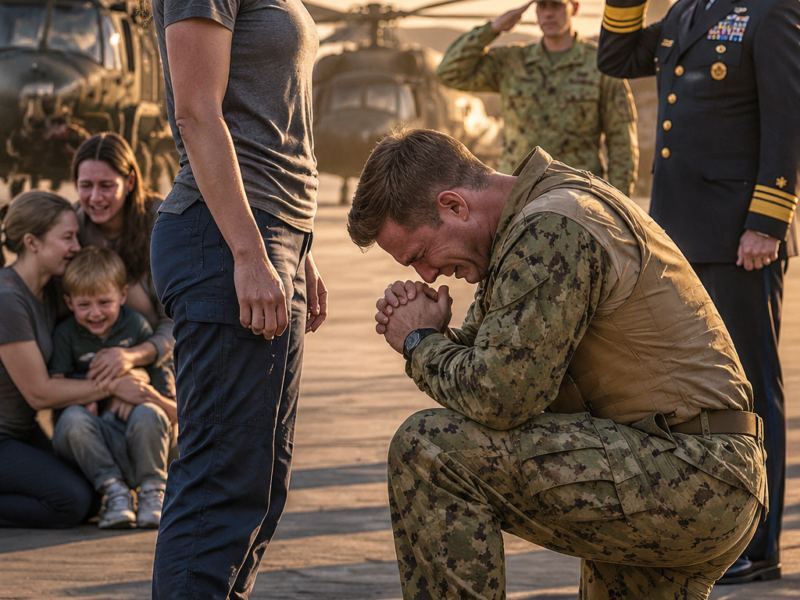
He wrapped his arms around them and began crying.
“I’m sorry,” he whispered. “I’m so sorry.”
Sarah held his face between her hands.
“You came back.”
“I should never have let this happen.”
“You came back,” she repeated.
And that was enough.
Vera emerged from the warehouse last, with Colonel Frost in custody.
By then, Admiral Kane had arrived with military police. A helicopter circled overhead, and the surrounding area had been secured.
Kane approached Frost.
“Why?”
She said nothing.
“Why kill David Cross? Why target me? Why betray everything you swore to protect?”
Frost looked toward him.
“Because the system is broken.”
Her voice was calm.
“People at the top become wealthy while the people at the bottom die. Someone has to profit from all this chaos. It might as well be us.”
Kane stared at her.
“Us? Who else?”
Frost smiled.
But she did not answer.
Vera stepped forward.
“She’ll talk.”
Frost looked at her.
“They always do when they realize their empire is collapsing.”
Military police transported Frost and the other captured suspects. Medical personnel examined Sarah and the children, confirming that although they were shaken, they had not suffered serious injuries.
Brooks approached Vera.
He looked at her for a long moment before lowering himself to his knees.
“Captain Cross, I humiliated you. I insulted you. I tried to sabotage you because I was afraid. And while I was doing that, you were protecting my family.”
His voice broke.
“You saved my wife. You saved my children. You gave me a chance to make things right when I didn’t deserve one.”
He lowered his head.
“I don’t expect you to forgive me. But I’m asking anyway.”
Vera looked down at him.
“Stand up, Lieutenant.”
He hesitated.
“Please.”
“Stand up.”
Her voice was firm, but not unkind.
“You were put in an impossible situation. You made mistakes. You allowed fear to make decisions for you. But when it mattered, you chose to help.”
She paused.
“Your family is safe. That’s what matters now. Go be with them.”
Brooks slowly stood.
“Thank you.”
Vera nodded.
Kane approached once Brooks had walked away.
For several seconds, the admiral simply looked at her.
Then he came to attention and raised his hand in a formal salute.
“Captain Cross. On behalf of the United States Navy, on behalf of every person you’ve protected, and on behalf of your father, thank you.”
Vera returned the salute.
“Just doing my job, sir.”
“No.”
Kane’s voice grew rough.
“You did far more than your job. You carried a burden no one should have been asked to carry. You hunted killers while being hunted yourself. You sacrificed your identity, your peace, and your chance at a normal life.”
He lowered his hand.
“And I’m sorry.”
Vera remained silent.
“I’m sorry I didn’t have the courage to continue investigating after David died. I’m sorry I stayed quiet while you fought alone. And I’m sorry it took you coming back from the dead to remind me what honor actually means.”
Vera looked at him.
“You’re testifying now, Admiral. That takes courage.”
“Only because you gave me the chance.”
He paused.
“You saved my life twice. Once in Afghanistan, and once here.”
The two stood quietly as the military police completed their work.
Finally, Kane asked, “What happens now?”
“The evidence goes to Congress. Frost’s network is exposed. Investigators will begin examining every officer connected to the operation. The procurement fraud, the intelligence leaks, the compromised security systems. Everything comes into the light.”
Vera looked toward the rising sun.
“My father’s death finally means something.”
“And what happens to you?”
“I testify. Then I disappear again.”
Kane frowned.
“You’ve earned recognition. A Medal of Honor. A promotion. Anything you want.”
“I don’t want recognition, sir.”
“What do you want?”
“I want my father’s killers in prison. I want the network broken. I want you alive long enough to tell Congress everything you know.”
She paused.
“Mission accomplished.”
She began turning away.
“Vera.”
She stopped.
Kane’s expression had changed.
“Your father told me something the night before he died.”
Her eyes returned to his.
“He said, ‘If anything happens to me, tell Vera she doesn’t have to be a soldier. Tell her she can just be my daughter. Tell her that’s enough.'”
For the first time that morning, Vera’s composure faltered.
Her eyes closed briefly.
When she opened them again, they were wet.
“Thank you for telling me, sir.”
Kane took a breath.
“Would you consider staying? The military needs people like you.”
Vera looked at him for a long moment.
“The military has people like me. It needs leaders willing to protect them.”
She offered a faint smile.
“Eight hundred and forty-seven confirmed kills. I think I’ve done my share. It’s time to let someone else carry the rifle.”
Kane nodded.
He extended his hand.
Vera shook it.
As the installation continued waking around them, she walked toward her vehicle.
Lynn approached.
“What’s next, Captain?”
Vera glanced at him.
“You tell me, Master Sergeant. You’ve been retired for three years. Do you miss it?”
Lynn laughed softly.
“Every single day.”
“Then maybe it’s time we found something new to do.”
“Something that doesn’t involve people shooting at us?”
“That would be ideal.”
“Sounds boring.”
“Sounds perfect.”
They stood together, watching the activity around the warehouse.
Two veterans.
Two people who had seen too much and given too much.
Two people who had spent years living with memories that could never be completely erased.
For the first time in a long while, both of them could imagine a future that did not involve another mission.
Three months later, the congressional investigation reached its conclusion.
Colonel Diane Frost was sentenced to thirty-five years in prison. Four other senior officers received sentences ranging from twenty to thirty years. Twelve additional officers faced court-martial proceedings, and several more individuals were investigated for their involvement in the corruption network.
The investigation revealed years of procurement fraud, classified intelligence sales, and deliberate interference with military operations.
The organization that had operated in the shadows for so long was finally beginning to collapse.
Lieutenant Brooks returned to active duty after investigators determined that his cooperation had been obtained under severe threats against his family. He was cleared of the most serious charges and began working with junior officers, helping them recognize ethical compromises before those compromises became irreversible.
His experience had changed him.
He no longer believed that confidence and authority were the same thing as leadership.
He understood how quickly fear could destroy a person’s judgment, and he never again laughed at someone simply because their rank or appearance did not meet his expectations.
Admiral Kane testified before Congress for six hours.
He presented evidence concerning the corruption network and described the circumstances surrounding David Cross’s investigation and death.
His testimony helped initiate reforms to procurement oversight across multiple branches of the military.
Six months later, he retired with full honors.
He also established a scholarship fund in the name of Brigadier General David Cross.
It was his way of ensuring that the man he had once called a friend would not disappear from history as another casualty buried beneath an incomplete investigation.
As for Vera Cross, she officially retired from military service.
She declined the Medal of Honor when it was offered.
“Give it to someone still fighting,” she said.
She did, however, accept a promotion to major in recognition of her years of service.
Then she left.
No elaborate ceremony.
No public speech.
No interviews.
No attempt to turn her story into a legend.
She purchased a small house in New Mexico, far from the noise of major military installations. The property was quiet, surrounded by open land and desert hills. It was the kind of place where neighbors valued privacy and rarely asked unnecessary questions.
For the first time in years, she could wake up without checking an operational schedule.
She could make coffee without listening for radio traffic.
She could sit outside and watch the sunrise without wondering whether the next telephone call would send her back into danger.
But peace did not arrive immediately.
Some mornings, she woke from dreams of the basement room.
Other nights, she remembered the people she had lost, the missions she had completed, and the moments when she had wondered whether she would ever see another ordinary day.
She had spent so many years preparing herself to survive that she had almost forgotten how to live.
Still, she tried.
She bought furniture.
She planted a few trees.
She learned the names of the people in the nearest town.
She began taking long walks in the early morning, when the desert air was cool and the world seemed to belong to nobody.
Her rifle case remained in the closet.
It was clean, carefully maintained, and untouched.
Not because she expected another operation.
But because some habits were difficult to abandon.
On her desk sat a photograph of her father.
David Cross was smiling, one arm resting around his daughter when she was much younger.
She kept it where she could see it every morning.
For a while, she believed the story was finally over.
Then, three days before an ordinary morning in New Mexico, an unmarked envelope appeared at her front door.
There was no return address.
No official seal.
No indication of who had delivered it.
Inside was a single photograph.
It showed a military installation she did not recognize.
A figure in the background had been circled.
Beneath the photograph was a handwritten note.
Tower 4 sends regards.
Vera studied the image for a long time.
She recognized the meaning immediately.
The network had been damaged, perhaps even shattered, but something had survived.
One name remained.
She placed the photograph inside the drawer of her desk.
Not because she was afraid.
Not because she had forgotten.
Because justice required patience, and she had learned long ago that rushing toward an uncertain target could destroy everything.
She closed the drawer.
Then she walked into the kitchen and made herself a cup of coffee.
Outside, the morning sun was beginning to rise over the New Mexico desert.
The world was quiet.
A light breeze moved across the dry grass, and somewhere in the distance, a bird called from the branches of a tree.
For a moment, Vera allowed herself to enjoy the ordinary sounds of an ordinary morning.
She was no longer Captain Cross operating under classified orders.
She was no longer Ghost.
She was no longer Death Angel.
She was simply Vera.
A daughter.
A veteran.
A survivor.
A woman who had spent much of her life believing that her only purpose was to finish a mission.
And perhaps, for the first time, she was beginning to understand that surviving the mission was not the same as living beyond it.
She thought about her father’s final message.
You don’t have to be a soldier. You can just be my daughter.
The words remained with her.
She had spent years trying to avenge him, years carrying his name through places where people disappeared without leaving records behind. She had believed that the only way to honor him was to finish what he had started.
But perhaps there was another way.
Perhaps honoring David Cross also meant allowing herself to have the life he had wanted for her.
She took another sip of coffee and looked toward the horizon.
The rifle case remained in the closet.
The photograph remained in the drawer.
And the final name remained unresolved.
She could ignore it for now.
She could choose peace for a little longer.
But if Tower 4 called again, if the remaining figure stepped into the light, or if another innocent family became a target, she knew she would not hesitate to answer.
Not because she wanted another fight.
Not because she missed the violence.
But because she understood what happened when good people looked away.
She had seen it in her father’s death.
She had seen it in Kane’s silence.
She had seen it in Brooks’s fear.
And she had seen it in the corruption that had spread through an organization supposedly built to protect others.
Her father had believed that the system could still be made to do the right thing.
For years, Vera had doubted him.
Now, after everything, she had seen that belief become reality.
The guilty had been exposed.
The hostages had returned home.
The admiral had testified.
And the truth about David Cross had finally emerged from the darkness.
It was not a perfect victory.
There were still unanswered questions, missing names, and people who had escaped accountability.
But it was a victory nonetheless.
And for someone who had spent years measuring success by the completion of a mission, that was enough to begin with.
Vera placed the coffee cup on the table and stepped onto the porch.
The desert stretched before her, endless and quiet.
She watched the sunlight slowly illuminate the hills.
Somewhere inside the house, her telephone remained silent.
For now, there were no orders.
No encrypted messages.
No range qualification tests.
No admiral demanding to know her rank.
There was only the morning, the open sky, and the possibility of a future she had once believed was beyond her reach.
She breathed slowly.
Four counts in.
Four counts held.
Four counts out.
The same rhythm that had carried her through firefights, interrogations, captivity, and years of hiding.
Only this time, she was not preparing to fire.
She was learning how to rest.
And perhaps that was the most difficult mission she had ever undertaken.
Because Death Angel might have retired, but the woman beneath the tattoo was still discovering who she could become.
Some promises never expire.
Some debts take years to settle.
And some people spend so long fighting for justice that they forget they deserve a little peace themselves.
Vera Cross had finally earned that chance.
For now, she was simply a woman watching the sunrise over the desert.
But somewhere beyond the quiet horizon, one unfinished story remained.
And if the day ever came when silence was no longer enough, if the final name finally appeared, if the truth demanded one last confrontation, Vera knew exactly what she would do.
She would stand up.
She would face it.
And she would finish what she had started.
Because the woman who had once been called Death Angel had never needed an audience, a uniform full of decorations, or an admiral’s approval to know who she was.
She had never needed the world to believe in her.
She had simply needed a reason to keep going.
And now, after sixteen years of carrying the weight of her father’s death, after 847 confirmed missions, after captivity, loss, betrayal, and the destruction of a powerful corruption network, she finally had something she had almost forgotten to want.
A future.
One that belonged to her.
The desert wind moved gently across the porch as Vera closed her eyes.
For the first time in years, she did not think about the next target.
She thought about breakfast.
About the small house.
About the trees she still needed to plant.
About the possibility of inviting Lynn over for coffee.
And about the promise her father had made her long before the world took him away.
She did not have to be a soldier forever.
She could simply be his daughter.
And for the first time, Vera Cross was beginning to believe that might be enough.
THE END



