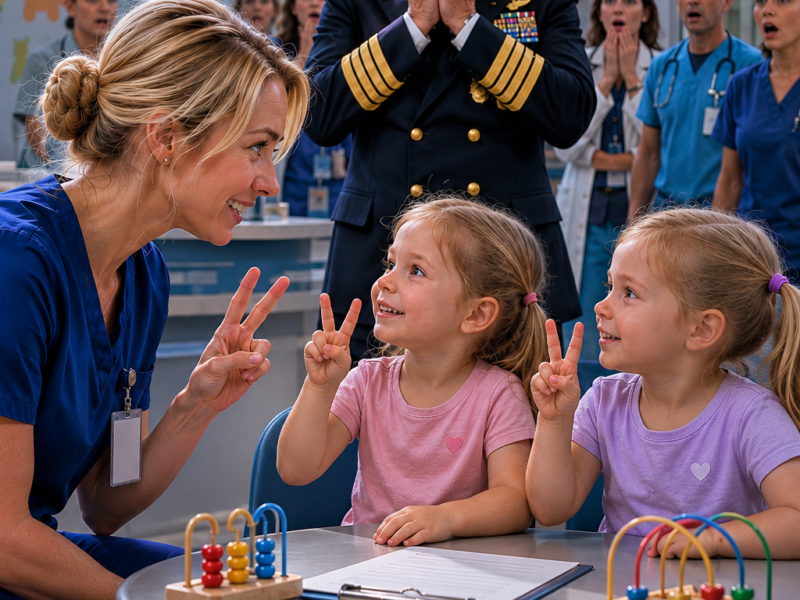
Nobody Would Speak to the Admiral’s Deaf Twins — a Nurse Did; It Changed Her Life Overnight
Nobody Would Speak to the Admiral’s Deaf Twins — a Nurse Did; It Changed Her Life Overnight
The morning of Admiral Thomas Callaghan’s retirement ceremony was supposed to be a celebration of thirty-four years of service, sacrifice, and honor. Hundreds of people had gathered on the military base to witness the final public appearance of a man who had spent most of his adult life serving his country. Senior officers stood proudly in their immaculate uniforms, families filled the rows of folding chairs, and photographers moved between the guests, searching for the perfect angles to capture what everyone expected would be a memorable occasion.
Yet, among all those people, two little girls sat almost completely alone.
They were eight-year-old twins, dressed in matching navy-blue dresses, their shoes polished, their hair neatly arranged, and their small hands resting quietly in their laps. They sat in the very first row, directly facing the reviewing stand where their father would soon deliver his final address as a three-star admiral. There were hundreds of people surrounding them, but nobody seemed particularly interested in speaking to them. The seats immediately to their left and right remained empty, even as the rows behind them filled with relatives, friends, and military families.
The girls were deaf.
And somehow, in a crowd filled with people who had dedicated their lives to service, discipline, and protecting others, almost nobody had thought to make them feel included.
An event photographer passed them twice without acknowledging their presence. A senior officer briefly leaned toward one of the girls, exaggeratedly moving his mouth as though speaking slowly would somehow solve the problem. When the child did not respond, he straightened, nodded to himself, and walked away, apparently satisfied that he had made an effort.
The girls returned to looking at their hands.
Their names were Lily and Mia Callaghan, and they had grown accustomed to being overlooked in rooms where everyone else seemed to know exactly where they belonged.
Their father, Admiral Thomas Callaghan, was preparing for the most important speech of his military career. He had spent weeks reviewing the ceremony schedule, meeting with senior officers, and attending farewell gatherings. He had also been struggling with something much more personal: the realization that the military, which had defined nearly every year of his adult life, was about to become part of his past.
His daughters were supposed to be enjoying the occasion. They were supposed to be surrounded by family members and friends, watching their father receive the recognition he deserved.
Instead, they were sitting alone, waiting for someone to notice them.
The person who finally did was a nurse named Claire Dunmore.
Claire had arrived at the parade ground nearly two hours before the ceremony was scheduled to begin. She had been assigned to medical duty, which meant setting up a small treatment station near the seating area, checking emergency supplies, and remaining available in case anyone experienced dizziness, dehydration, or an unexpected injury.
She was wearing bright cobalt-blue scrubs that were slightly too large around the shoulders. The fabric had been washed so many times that it had become soft and faded in places. Her short brown hair required little attention, and her medical bag rested beside a folding cot inside the small tent.
At first glance, Claire looked like an ordinary military nurse.
She was in her late thirties, quiet, professional, and careful about her responsibilities. She did not seem particularly interested in the ceremony or the attention surrounding the retiring admiral. She had simply come to do her job.
But there were things about Claire that an ordinary observer might have found unusual.
She always arrived early to crowded events. She preferred knowing where every exit was before the first guest arrived. She counted chairs, checked distances, noticed obstacles, and instinctively identified the safest paths through unfamiliar spaces.
Even when she was sitting still, her eyes moved.
A sudden noise sometimes made her shoulders tighten. A loud drumbeat could cause her fingers to freeze momentarily. When nothing urgent required her attention, her hands occasionally trembled.
It was not fear in the ordinary sense.
It was the lingering memory of a life she had spent years trying to leave behind.
That morning, however, Claire had no intention of thinking about the past. She was focused on arranging her medical supplies and making sure everything was ready.
Then she noticed the twins.
Something about their situation caught her attention immediately. It was not simply that they were deaf. It was the way they had been positioned in the crowd, the empty chairs surrounding them, and the fact that nobody seemed to have considered how they would participate in the ceremony.
Claire knew that particular expression on a child’s face.
It was the expression of someone who had learned not to expect too much from other people.
She had seen it many times before, especially when she was growing up with her younger brother, Danny.
Danny had lost his hearing when he was four years old. A severe fever had taken it from him during a terrible week that changed the entire family. Before that illness, Danny had been an ordinary little boy who loved asking questions, making noise, and following his older sister everywhere.
Afterward, the world became a much quieter place for him.
Their mother refused to let that silence become a barrier between her son and the rest of the family. One evening, she gathered everyone around the kitchen table, placed a laminated alphabet chart in front of them, and announced that they would all learn sign language.
She made it clear that nobody was exempt.
Claire learned to sign before she became comfortable writing in cursive. She learned how to communicate with her brother through expressions, gestures, and the subtle movements of his hands. She discovered that a conversation did not require a spoken voice to be meaningful.
By the time she reached adulthood, sign language had become as natural to her as breathing.
Danny was now thirty-one, married, and working as a middle-school science teacher. An interpreter helped him communicate in the classroom, but he never needed one when he spoke with Claire. Every Sunday evening, they connected through a video call, their hands moving across the screen while their voices remained unused out of habit.
Danny had also been the person who understood Claire best after she returned from her final military deployment.
When she came home, something about her had changed. She was quieter, more distant, and reluctant to discuss what she had experienced. Her family asked questions, but she rarely offered more than a few words.
Danny never pressured her.
One evening, he simply took both her hands and held them still for a moment, making the sign for wait.
He had understood that sometimes people needed time before they could explain what had happened to them.
Claire remembered that morning as she watched the twins.
She picked up her medical bag, crossed the grass, and approached them.
Rather than standing over them, she lowered herself onto one knee so that her eyes were level with theirs.
Then she smiled and signed slowly.
“Hello. My name is Claire.”
The reaction was immediate.
Lily sat upright so quickly that her chair scraped against the grass. Mia grabbed her sister’s arm, and both girls stared at Claire with expressions of astonishment.
Their hands began moving almost simultaneously.
“Are you talking to us?”
Claire smiled.
“Of course. Why wouldn’t I?”
Lily answered first.
“Nobody here talks with their hands.”
Mia quickly added that their father knew some sign language, but he was very busy that morning.
Claire nodded and asked who their father was.
Lily pointed toward the reviewing stand, where a tall man in immaculate white dress uniform was speaking with several officers.
The silver stars on his shoulders caught the morning sunlight.
“That’s Dad,” she signed.
Claire glanced at the program tucked into her scrub pocket.
Admiral Thomas Callaghan.
The retiring three-star admiral whose ceremony had brought hundreds of people to the base.
Claire looked back at the girls.
“Well, it looks like you’re stuck with me until everything begins. Is that okay?”
Mia’s hands moved quickly.
“Best okay all day.”
Claire laughed.
It was a small laugh, almost surprised, as though she had forgotten what it felt like to enjoy a conversation without thinking about what might happen next.
She went back to the medical tent, retrieved a folding chair, and placed it beside the twins. Instead of standing over them like an employee supervising children, she sat down as though she had come specifically to spend time with them.
For the next half hour, the three of them became a little island of conversation in the middle of the increasingly crowded parade ground.
Claire described the musicians warming up behind the reviewing stand. She commented on the officer whose hat seemed determined to slide sideways every time he turned his head. She even made a joke about the trumpet player who appeared to have a mustache large enough to deserve its own military decoration.
The twins laughed so hard that they had to cover their mouths.
At one point, Mia looked at Claire’s hands and asked whether they ever became tired from talking so much.
Claire considered the question.
“Never,” she signed. “Hands don’t get tired from being honest. They only get tired from lying. And I try not to do that with mine.”
Lily tilted her head.
“You’re different.”
Claire raised an eyebrow.
“Different how?”
“You talk differently with your hands than you do with your mouth.”
Claire smiled, though the observation touched something deeper than Lily could have understood.
“Everybody does.”
She did not explain further.
There were things she had not yet found the courage to discuss, even with herself.
A few minutes later, Mia pointed toward the thin white scar above Claire’s eyebrow. Then she noticed another pale mark running along the edge of Claire’s palm.
“Where did those come from?”
Claire glanced down at her hand.
“Old work.”
“What kind of work?”
“Before I became a nurse. I’ll tell you the boring version someday. I’ll leave out the scary parts.”
Lily immediately accepted the arrangement.
“Deal.”
Children sometimes understood boundaries better than adults. They knew that a person could have a story without being ready to tell it.
The ceremony preparations continued around them. The color guard practiced its positions, the musicians adjusted their instruments, and officers checked the arrangement of the flags.
Then a sudden crack of boots striking the ground made Claire’s body stiffen.
It lasted less than a second, but Mia noticed.
“You jumped,” she signed.
Claire looked at her.
“Old habit.”
“Are you scared?”
“Not anymore.”
For a brief moment, she almost believed the answer herself.
The peaceful conversation was interrupted when a man named Preston Vale approached them.
Vale was the event coordinator responsible for managing the ceremony’s schedule, seating arrangements, press access, and photography. He wore an expensive suit that looked completely out of place on the parade ground. A thick binder rested beneath one arm, and his phone seemed permanently attached to his other hand.
He walked toward Claire with the impatient confidence of someone accustomed to having people move whenever he asked.
“Excuse me, ma’am.”
He did not really look at her. His eyes were focused somewhere above her head.
“This seating area is reserved for immediate family within the primary camera frame. If you’re not credentialed staff, I’ll need you to relocate.”
Claire stood.
“I’m the nurse assigned to this event. These are the admiral’s daughters. I’m keeping them company until the ceremony begins.”
Vale looked down at the girls.
His expression changed almost imperceptibly.
“Right. Well, that’s actually something I was planning to discuss with the family liaison.”
He crouched slightly and turned toward the twins.
“Girls, we’re going to move you back to the family tent for the speech portion, okay?”
He spoke slowly and loudly, exaggerating every movement of his mouth.
Neither girl responded.
Vale looked annoyed.
“Just for the photography. It’ll be more comfortable back there.”
Claire watched the twins’ faces.
Lily had become completely still.
Mia’s fingers had stopped moving.
They understood perfectly well what was happening. They simply had no intention of answering a man who was speaking around them rather than communicating with them.
Claire stepped slightly closer.
“They understand you.”
Vale glanced at her.
“Excuse me?”
“They understand you perfectly. You don’t need to shout or exaggerate your mouth movements. You need to communicate with them.”
She pointed gently toward the ground in front of the chairs.
“They’re sitting here because they can feel the loudspeaker vibrations through the grass. That’s how they follow the ceremony. If you move them to the family tent, they’ll lose the only way they have to experience it.”
Vale’s jaw tightened.
“I don’t think you appreciate the optics concern.”
Claire said nothing.
“The network feed will capture the first three rows. We have donors, senior officials, and members of the press watching a retiring three-star admiral. Two children signing to each other in the middle of the frame could be distracting.”
For a moment, Claire thought she had misunderstood him.
But his expression made the meaning unmistakable.
“They’re not distracting,” she replied. “They’re his daughters.”
Vale straightened.
“This isn’t personal. It’s about maintaining the appropriate presentation.”
Claire held his gaze.
“That’s exactly the problem with what you just said.”
The two stood facing each other for several seconds.
Vale seemed to be deciding whether Claire was worth arguing with. Eventually, his phone vibrated, and he looked down at the screen.
He walked away, muttering something about camera angles and the family liaison.
Claire sat back down.
Mia immediately tugged at her sleeve.
“What did he say?”
Claire hesitated.
Then she signed, “He said you both look very nice today.”
Mia narrowed her eyes.
She knew that was not the entire truth.
Lily looked at Claire, understood that something unpleasant had happened, and decided not to press the matter.
Ten minutes later, Preston Vale returned.
This time, he had his phone raised.
He crouched in front of the girls and announced that he wanted a candid family photograph. Neither child responded immediately, partly because they were still watching their father speak with another officer.
Vale became impatient.
Without asking permission, he reached out and tilted Lily’s chin upward, turning her face toward the camera.
Claire moved instantly.
She stepped between the lens and the twins, crossing her arms.
“Ask first. Every time.”
Vale lowered his phone.
His expression hardened, but he said nothing.
He turned and walked away.
Claire watched him disappear into the crowd.
She did not know why, but something about the man unsettled her more than his arrogance alone.
Perhaps it was the way he regarded the girls as objects to be arranged rather than children to be respected.
Perhaps it was the complete absence of concern in his eyes.
Or perhaps Claire had simply become very good at recognizing people who thought their own convenience mattered more than everyone else’s safety.
The ceremony began shortly afterward.
An announcement crackled through the loudspeakers, and hundreds of guests rose to their feet.
Claire stood briefly, scanning the surrounding area before sitting again. Her eyes moved across the parade ground, automatically identifying the exits.
There were three practical routes out of the seating area: the wide central aisle, a gap near the flag detail, and a narrow passage running along the fence.
She noticed the ceremonial cannon crew positioned off to the left, preparing the saluting battery that would fire twenty-one rounds near the end of the program.
She also noticed that the nearest fire extinguisher was hanging from a post roughly forty feet away.
She did not consciously think about any of these details.
Her mind simply registered them.
Years of training had taught her to notice things before other people realized there was anything to notice.
She forced herself to relax and returned her attention to the twins.
They were busy inventing another joke about the musicians.
For the next twenty minutes, the ceremony proceeded exactly as planned.
Speeches were delivered. Military honors were presented. A retired chief spoke about the admiral’s long career, mentioning the ships he had commanded, the sailors he had led, and the difficult assignments that had shaped his reputation.
A young lieutenant read a formal citation describing an incident from decades earlier when Callaghan had helped rescue two wounded sailors under enemy fire.
The audience listened respectfully.
Claire watched the girls.
Lily leaned against her arm as applause rolled across the field. She could not hear the clapping, but she could feel the vibration traveling through the ground.
She looked toward her father and signed one word.
“Proud.”
Claire smiled.
“Me too.”
She meant it for the admiral, but she also meant it for the two girls beside her.
Then Admiral Callaghan approached the podium.
He looked older than he had in the photographs displayed throughout the ceremony. His white uniform was perfectly pressed, his posture remained straight, but his eyes carried the exhaustion of a man who had spent decades saying goodbye to people he would never see again.
He placed one hand on the podium.
For several seconds, he simply looked at the crowd.
Then he began speaking.
He talked about service, responsibility, and the privilege of commanding men and women who had trusted him with their lives. He remembered sailors who had died during his career. He thanked the officers who had served beside him and the families who had supported them.
He spoke about his wife, who had died six years earlier and would never see him retire.
His voice faltered once.
He paused, collected himself, and continued.
Claire noticed that he never mentioned his daughters.
Lily noticed it too.
Her shoulders dropped slightly, and she looked down at her hands.
It was a tiny movement, almost invisible among the hundreds of people listening to the speech.
But Claire saw it.
She understood the disappointment of waiting for someone to acknowledge you, especially someone whose approval meant more to you than anything else.
Then, just as the admiral appeared to be finishing, something unexpected happened.
He looked directly toward the first row.
He lowered his hands from the podium and began signing.
His movements were slow and somewhat awkward. He clearly had not mastered the language. Some of his gestures were imperfect, and he paused between words as though carefully recalling what he had practiced.
But the meaning was unmistakable.
“I love you both.”
He continued.
“Every single day.”
Then he signed something that made Lily and Mia immediately begin crying.
“I’m sorry I don’t say it enough with my hands instead of just my mouth.”
The girls were already moving before he finished.
They looked at their father, their hands shaking as they signed back.
Claire felt tears gather in her own eyes.
The admiral’s attempt was imperfect, but it was genuine.
For the first time that morning, the two little girls were not watching their father from a distance. They were participating in a conversation with him.
The crowd applauded.
It was the loudest applause of the ceremony.
And that was when everything went wrong.
The first sound was a flat, unnatural crack.
Claire’s body reacted before her mind could identify it.
A second crack followed almost immediately, accompanied by a sharp hiss.
Then an orange flash erupted near the ceremonial cannon crew.
For a fraction of a second, people stared in confusion.
A moment later, the decorative bunting hanging from the reviewing stand caught fire.
Flames raced along the fabric, climbing the scaffolding with alarming speed. Smoke began pouring across the parade ground.
Someone screamed.
Then another person screamed.
Within seconds, the carefully organized crowd became a mass of frightened people moving in every direction.
Chairs toppled. Children cried. Officers shouted commands that disappeared beneath the growing roar of panic.
The public address system emitted a piercing squeal and abruptly died.
The amplifier had apparently shorted out.
The only system designed to coordinate the crowd was now useless.
Claire did not have time to think.
She grabbed Lily and Mia by their hands, pulled them downward, and guided them beneath the line of folding chairs.
“Stay low.”
She signed with one hand while holding Mia’s wrist with the other.
“Eyes on me. Only me.”
The girls followed immediately.
Claire moved them toward the narrow passage between the seating area and the medical tent. It was a route she had noticed earlier, a stretch of open grass that remained clear even as people rushed toward the main exits.
She crouched, keeping the girls close.
Then she saw Master-at-Arms Reyes sprinting past the medical tent.
Reyes was a broad-shouldered petty officer who had exchanged only a few words with Claire earlier that morning.
He was shouting instructions, attempting to direct people toward the north gate.
But the crowd was too loud.
Most people could not hear him.
When he spotted Claire crouching with the twins, he raised his right arm and made a sharp signal.
His fist was closed, his thumb pointed toward the north exit.
It was an emergency crowd-marshal signal used in military evacuation drills.
Claire recognized it immediately.
Without hesitation, she raised her own arm and returned the exact acknowledgment.
Signal received. Moving now.
Reyes stopped for half a second.
His eyes widened.
He looked at Claire as though he had just seen something impossible.
A civilian nurse had recognized a tactical emergency signal and answered it correctly under active emergency conditions.
But there was no time for questions.
The crowd was still moving, and people were beginning to fall.
An elderly veteran had become trapped beneath an overturned wheelchair near the second row. His chair had tipped sideways, and people were streaming around him without slowing down.
Claire spotted two young sailors frozen near the aisle.
She raised her hand, pointed toward the veteran, and gave a sharp signal.
The sailors understood.
They rushed forward, helped lift the chair, and pulled the elderly man clear of the crowd.
Claire directed them toward the fence-line path.
The veteran caught her arm as they moved him.
“Thank you,” he managed to say.
She squeezed his shoulder.
Then she turned back toward the main field.
A dangerous bottleneck had formed near the collapsed scaffolding.
People were pushing into a narrow opening between two overturned rows of chairs, even though wider routes existed only a few feet away.
Claire moved toward the blockage.
She caught the eye of a senior chief in dress blues and gave him a flat-palm sweeping motion toward the left.
Open the lane.
The chief understood.
He began directing people away from the narrow passage, physically guiding them toward the wider route.
Two more sailors picked up the same signal.
Then another.
Within moments, the movement spread through the crowd.
A silent chain of instructions traveled from person to person, allowing people to move without relying on the failed loudspeakers.
The evacuation lane began to open.
It was a system Claire had used many times before.
She had once coordinated people and aircraft under conditions far more dangerous than this.
She knew that panic could turn a manageable emergency into a disaster. She knew that people needed clear directions, visible signals, and someone who could remain calm long enough for others to follow.
But the smoke was thickening.
It rolled low across the grass, dark and acrid, making it difficult to see more than a short distance ahead.
Claire scanned the field.
Then she noticed a man in a chief petty officer’s uniform kneeling near the edge of the smoke.
He was struggling to breathe.
One hand clawed at his collar. His face was turning red, then gray.
A woman beside him was shouting his name.
Claire looked back toward the medical tent.
Lily and Mia were standing against its canvas wall, exactly where she had instructed them to remain.
Both girls were frightened.
Lily’s hands trembled.
Mia had wrapped both arms around her sister.
Claire pointed toward them and signed carefully.
“Stay here. Backs against the tent. Do not move until I come back. I promise.”
Lily nodded.
Claire looked at them for one final second.
Then she ran toward the injured man.
His name, according to the identification tag on his uniform, was Chief Ambrose.
By the time Claire reached him, his breathing had deteriorated significantly.
She dropped beside him.
“Chief, can you hear me?”
He could barely respond.
His throat was swelling shut, and the sound escaping his airway was a thin, high whistle.
Claire immediately understood the danger.
She looked at the woman beside him.
“I need your belt or a strap. Right now. And everyone else needs to move back six feet.”
The woman hurried to help.
Claire opened her medical bag.
Inside were the supplies she had prepared for an ordinary ceremony. Gauze, dressings, basic airway equipment, and a limited selection of emergency instruments.
There was also an angiocath and a scalpel.
She had never expected to need them in the middle of a parade ground.
But there was no time to wait for a fully equipped trauma team.
Claire positioned Chief Ambrose carefully, identified the appropriate anatomical landmarks, and prepared to establish an emergency airway.
Her hands were steady.
The smoke made visibility difficult, and the noise around her was almost overwhelming, but her movements remained controlled.
She made the incision.
Then she inserted the airway device.
For one terrible second, nothing seemed to happen.
Then the sound changed.
The thin whistle became a wet, ragged movement of air.
Chief Ambrose’s chest rose.
He was breathing.
The woman beside him began sobbing.
“Oh my God. Oh my God. He’s breathing.”
Claire checked the airway and secured the device.
“Keep him still. Help is coming.”
She barely had time to look at the woman before her attention returned to the medical tent.
She needed to get back to the twins.
She had promised them.
And Claire Dunmore did not make promises she intended to break.
She turned and began moving through the smoke.
That was when she saw Preston Vale.
The event coordinator was running toward the parking lot.
His expensive suit was covered in dust and soot. His event binder was nowhere to be seen.
He was moving away from the emergency crews, away from the people who needed help, and away from the officers attempting to organize the evacuation.
He was thinking about himself.
As he approached the narrow passage beside the medical tent, he came directly toward Lily and Mia.
The girls were still standing where Claire had left them.
Lily saw him first.
She instinctively moved closer to her sister.
Vale did not stop.
He did not ask whether they were all right.
He did not attempt to help them reach safety.
Instead, he placed one hand on Lily’s shoulder and shoved her sideways so he could squeeze through the narrow gap.
Lily fell hard onto one knee.
Mia reached for her sister, but Vale’s movement knocked her off balance too.
Their hands separated.
For a moment, the girls were alone in the smoke.
Then Claire appeared.
She crossed the distance in four strides.
Her hand struck Vale’s chest, stopping him immediately.
“Not through them.”
Her voice was low and controlled.
It was not the voice of a frightened nurse.
It was the voice of someone who had once given orders in places where hesitation could cost lives.
“You go around. Everyone goes around the children. That is not negotiable today, and it is not negotiable any day.”
Vale opened his mouth.
Then he looked properly at Claire.
He saw the blood on her sleeve. He saw the soot across her face. He noticed that her breathing was controlled even though the entire field was collapsing into chaos around them.
And something in her expression made him stop.
He moved around the children.
Claire immediately dropped to her knees.
She checked Lily’s knee, finding a painful scrape but no obvious serious injury.
Then she looked at Mia.
Both girls were crying.
Claire raised her hands.
“You’re safe.”
She signed slowly, making sure they could follow every movement.
“I have you. Both of you. Always both of you.”
Lily reached for her.
Mia wrapped her arms around Claire’s shoulders.
For several seconds, Claire held them close.
The fire crews were finally gaining control of the flames. The decorative bunting had burned away, leaving blackened fabric and smoking metal supports.
Reyes and several other officers were directing the remaining crowd toward the north gate.
They were using the same hand signals Claire had recognized earlier.
A silent language was doing what hundreds of voices had failed to accomplish.
The evacuation continued for another twelve minutes.
Ambulances arrived.
Medical teams began treating injured guests.
Chief Ambrose was transported away with his airway secured, breathing steadily.
The elderly veteran was reunited with his family.
One by one, the people who had filled the parade ground were accounted for.
By the time the smoke began clearing, the field looked almost unrecognizable.
Rows of folding chairs lay scattered across the grass. The reviewing stand was partially damaged, and the ceremonial cannon crew’s position had become a blackened patch of earth.
Claire finally sat down.
Lily sat on her right.
Mia sat on her left.
All three were breathing hard.
Nobody spoke.
For the moment, there was nothing that urgently needed to be said.
Twenty minutes later, Admiral Callaghan found them.
His white uniform was streaked with soot. His face was tired, and his expression carried the unmistakable tension of a father who had spent the previous minutes searching for his children.
When he saw the twins, he moved toward them immediately.
He dropped onto the grass and pulled both girls into his arms.
Lily wrapped herself around his neck.
Mia buried her face against his chest.
He held them tightly, closing his eyes.
For several seconds, he did not seem capable of speaking.
Claire watched the reunion and began to stand.
She intended to return to the medical tent. There were still injured people who might need attention, and she had no desire to intrude on the family’s private moment.
But before she could move away, the admiral caught her wrist.
“Stay.”
His voice was quiet.
“Please.”
Claire stopped.
He looked at her properly.
Not simply as a nurse.
Not as someone who had been assigned to the event.
He was looking at her the way one professional recognizes another after witnessing something extraordinary.
Reyes approached a moment later.
He was still breathing heavily, and his uniform was dirty from moving through the crowd.
“Sir,” he said, looking toward the admiral. “There’s something I need to tell you.”
Callaghan nodded.
Reyes glanced at Claire.
“That signal I gave her near the tent. The north-gate emergency marshal signal. That’s not a hospital signal. It’s not something civilian medical staff are trained to recognize.”
He paused.
“She answered it perfectly. Not after thinking about it. Immediately. Under actual fire.”
The admiral turned toward Claire.
“Where did you serve?”
For a moment, Claire did not answer.
She looked down at Mia, who was still holding two of her fingers. Lily was watching her face.
The girls had trusted her from the moment she first approached them.
Now they were waiting to see whether she would tell the truth.
“Air Force,” Claire finally said.
The word felt strange.
It had been years since she had spoken about that part of her life.
“Combat control. Six years.”
Reyes looked at her with renewed interest.
Claire continued.
“I handled communications and aircraft marshaling on airstrips that officially didn’t exist. Some of the places I worked aren’t locations I can put on a résumé.”
The admiral studied her.
“Combat control?”
Claire nodded.
“Yes, sir.”
The people standing nearby had begun paying attention.
Some officers slowed their movements.
A few sailors turned toward the conversation.
The woman they had seen wearing ordinary blue scrubs was apparently someone with a military background none of them had suspected.
Callaghan lowered his voice.
“Why did you leave?”
Claire looked toward the girls.
It was a difficult question, not because she did not know the answer, but because she had spent years avoiding the words necessary to explain it.
“Because when I left, I didn’t know how to live with the silence.”
The admiral waited.
“My younger brother went deaf when he was four. I learned sign language before I learned cursive. I grew up believing I understood silence because I knew how to communicate without sound.”
She paused.
“Then I spent six years in the service, working in places where silence meant something completely different.”
Her eyes moved briefly toward the damaged reviewing stand.
“When I came home, I discovered that the silence I understood growing up and the silence that came home with me weren’t the same thing.”
She swallowed.
“I didn’t know what to do with that difference. So I became a nurse. I could help people. I could do something useful. And most people didn’t ask questions about what I had done before.”
Callaghan remained quiet.
He understood that some experiences could not be reduced to a simple explanation.
Mia tugged gently at Claire’s sleeve.
The little girl looked at her with a serious expression.
Then she signed something.
“You talk like us, and you talk like a soldier.”
Claire looked at her.
“Both hands. Same person.”
Claire smiled.
“Same person.”
She signed the words as she spoke them.
And for the first time in years, she felt that she was no longer dividing herself into separate versions of who she had been.
The admiral watched the exchange.
He looked at his daughters, then at Claire.
Something had become clear to him.
For years, he had believed that loving his daughters was enough. He had learned some signs, practiced a few conversations, and tried to make them feel included despite his demanding military schedule.
But he had not understood how much they needed him to meet them halfway.
The ceremony had exposed that failure in a way no private conversation ever could.
He finally spoke.
“There’s a program the Navy has been trying to develop for two years.”
Claire listened.
“Emergency communication training for family support units. Sign language, tactical signaling, and procedures for assisting deaf and hard-of-hearing dependents during evacuations and other emergencies.”
He glanced toward Reyes.
“We’ve had difficulty finding someone who understands both the medical and operational sides. Someone who knows how military emergencies work, but also understands the human side of communication.”
Then he looked directly at Claire.
“I think you could build it.”
Claire said nothing.
“You’d be stepping away from nursing,” the admiral continued. “I understand that’s not a small decision.”
Claire looked at her hands.
She thought about the years she had spent working in medical facilities, helping strangers recover from injuries and illnesses. She thought about the comfort of familiar routines and the safety of a job that rarely required her to explain her past.
Then she looked at Lily and Mia.
They were holding her fingers.
“I didn’t leave the service because I stopped being able to do the work,” she said quietly. “I left because I didn’t know what the work was for anymore once nobody around me spoke the same silent language I did.”
She looked at the admiral.
“I think I just found out.”
Reyes smiled.
“For what it’s worth, ma’am, most of us with twice your experience couldn’t have done what you did today.”
Claire looked at the girls.
Then she signed something and spoke the same words aloud.
“I think I might know someone.”
It was a small sentence, but everyone understood that she was no longer talking about the emergency.
She was talking about the future.
At the edge of the group, Preston Vale stood watching.
His suit was ruined, his hair disheveled, and his face streaked with soot. The binder he had carried so proudly that morning had disappeared somewhere in the chaos.
He looked at Claire.
The same woman he had attempted to remove from the camera frame was now surrounded by officers who listened to her with unmistakable respect.
He had spent the morning worrying about how the ceremony would appear.
She had spent it making sure people survived.
Admiral Callaghan noticed him.
He stood and walked over.
He did not shout.
He did not need to.
“You put your hand on my daughter to save yourself a few seconds.”
Vale looked down.
“Admiral, I was trying to get out of the—”
Callaghan raised one hand.
“I’ve commanded men in situations far worse than this one. I’ve seen people make difficult decisions when their lives were at risk. I’ve also seen people reveal exactly who they are when nobody is watching.”
He paused.
“Not one of the men I trusted with the lives of my sailors would have done what you did.”
Vale’s face lost what little color remained beneath the soot.
“You’re finished planning events on this base.”
There was no argument.
Within a week, Vale was formally removed from the military event planning roster.
Nobody made a dramatic public announcement. There was no elaborate investigation into his personality or a long series of speeches about his mistakes.
But the people who had witnessed him shove two frightened children aside understood why he was gone.
Several weeks later, he offered Lily and Mia an apology in a hallway.
He kept his eyes lowered.
The girls accepted it.
They were more gracious than he deserved.
But the apology did not erase what had happened.
And neither did it change the fact that, on the most important day of their father’s military career, two little girls had needed a stranger to make sure they were treated like they belonged.
The official retirement ceremony never resumed.
Nobody seemed particularly disappointed.
The fire had destroyed the carefully planned schedule, but it had also revealed something far more important than any speech or ceremonial presentation could have communicated.
That day, the admiral had learned something about his daughters.
Claire had rediscovered something about herself.
And hundreds of people had witnessed the difference between simply noticing someone and truly seeing them.
Three months later, Claire stood inside a converted classroom on the military base.
The cobalt-blue scrubs were gone.
She wore a simple uniform, neatly arranged, with no unnecessary decorations. A whiteboard stood behind her, and twenty people occupied the rows of chairs in front of it.
Some were young sailors.
Others were military spouses, family-support personnel, and officers who had volunteered for the new training program.
The room looked ordinary.
There were notebooks on the desks, a few cups of coffee, and a stack of printed materials beside the instructor’s table.
But for Claire, the classroom represented something she had not expected to find again.
A reason to bring every part of herself together.
Lily and Mia sat in the front row.
This time, the chairs beside them were not empty.
They were reserved for the girls because everyone in the base community understood that they belonged there.
Claire began the first lesson by writing the alphabet on the board.
A.
B.
C.
The same twenty-six letters her mother had once taught her at the kitchen table.
She turned toward the class.
“Before we begin, I want everyone to think about something.”
The room became quiet.
“Think about one person in your life you’ve never quite known how to reach.”
She waited.
“Maybe it’s a spouse who came home from deployment and stopped talking about what happened. Maybe it’s a grandparent whose hearing has gradually disappeared. Maybe it’s a child who becomes overwhelmed in crowded places and stops communicating altogether.”
She looked around the room.
“Maybe it’s someone who seems perfectly fine to everyone else, but you know there’s something they aren’t telling you.”
Slowly, hands began to rise.
A young sailor mentioned his grandfather.
A woman near the window talked about her teenage son, who had become withdrawn after a difficult year.
Another participant described a husband who rarely spoke about his deployment.
Claire listened.
She did not interrupt.
She did not tell anyone what they should feel.
She simply allowed them to speak.
Because she had learned that the first step in reaching another person was proving that you were willing to listen.
Admiral Callaghan was sitting in the back corner.
He had attended the first class as a student.
His uniform was still immaculate, but he no longer carried himself like a man who expected everyone to follow his instructions.
He had retired.
And now he was learning something that had nothing to do with rank.
Claire noticed him watching his daughters.
He was practicing the alphabet with his hands beneath the table.
His movements were slow.
Sometimes he confused one sign with another.
Sometimes Lily corrected him, and Mia laughed so hard that she nearly fell out of her chair.
But he kept trying.
By the fourth week, he could hold a slow conversation with his daughters over breakfast without requiring an interpreter.
He still made mistakes.
He still needed to stop and think about certain signs.
But the girls no longer had to wait for someone else to translate every thought they wanted to share with their father.
Lily eventually told Claire that something else had changed at home.
Her father had started leaving his phone in another room during dinner.
He wanted both hands free.
Claire smiled when she heard that.
It was a small detail.
Nobody would include it in a military report or list it among the program’s official achievements.
But it mattered more to her than almost anything else.
Two hands that had once been too busy commanding ships, attending meetings, and answering calls were now available to speak with two little girls who had waited years for that kind of attention.
Chief Ambrose also visited the classroom during its first week.
His voice was still rougher than before the accident. He had a visible scar around the area where the emergency airway had been established, and he moved a little more carefully than he once had.
He sat quietly in the back row for the entire session.
When Claire asked whether he wanted to introduce himself, he smiled.
“A person who owes his life to those hands ought to at least learn their language properly.”
The class laughed.
He stayed until the end.
He practiced the alphabet with the same determination he had once brought to military training.
Master-at-Arms Reyes enrolled in the second course that spring.
He told anyone who asked that he had grown tired of relying on borrowed hand signals from a nurse who apparently knew more about military communication than she had ever admitted.
But there was another reason.
He had seen what happened when ordinary communication systems failed.
He had watched people panic because they could not hear instructions.
And he had watched a single woman use her hands to restore order in a situation where hundreds of voices had become useless.
He never wanted to be unprepared for that again.
The program gradually expanded beyond the original base.
Other installations requested the curriculum.
Military family-support units began asking for instructors.
Some wanted basic sign-language training.
Others wanted more advanced emergency procedures, including how to communicate evacuation instructions to deaf and hard-of-hearing personnel and family members.
Claire helped develop the training materials.
She worked with medical teams, operational specialists, and accessibility coordinators. She made sure the lessons were practical rather than theoretical.
Participants learned how to gain someone’s attention respectfully, how to give clear visual instructions, and how to avoid assuming that a person who could not hear was incapable of understanding an emergency.
They practiced moving people through crowded areas without relying entirely on loudspeakers.
They learned how to identify safe assembly points, how to maintain communication during power failures, and how to coordinate with interpreters and family members.
Most importantly, they learned that accessibility could not be something considered after an emergency began.
It had to be part of the preparation.
Claire insisted on that point every time.
She did not want another pair of children sitting alone in a front row while hundreds of adults walked past them.
She did not want another family discovering, during a fire or an evacuation, that nobody had considered how to communicate with the people who needed help.
And she did not want anyone to believe that speaking louder was the same as communicating better.
Her teaching style was patient.
Sometimes she used humor.
Sometimes she asked difficult questions.
But every class began with the same lesson.
“People are almost never hard to reach,” she told them. “They are only waiting for someone willing to meet them exactly where they already are.”
She made the participants repeat it.
Not because she wanted them to memorize a slogan, but because she wanted them to understand the responsibility behind it.
Months passed.
The scorched patch of grass on the parade ground gradually disappeared beneath new growth.
The damaged reviewing stand was repaired.
The folding chairs were replaced.
The military base returned to its ordinary rhythm of inspections, briefings, training exercises, and family gatherings.
But some things had changed permanently.
When Lily and Mia attended events, people approached them directly.
They learned a few signs.
Some learned many more.
Officers who had once felt uncomfortable communicating with the girls began greeting them without hesitation. Families started bringing their children to the training sessions, and the twins occasionally helped Claire demonstrate basic conversations.
They were no longer the two children sitting alone in the front row.
They were part of the community.
One afternoon, Claire found Lily and Mia waiting outside the classroom.
They had finished school early and wanted to show her something.
Lily held up a small notebook.
Inside were several pages filled with drawings and handwritten words. Some were pictures of the parade ground, others showed their father practicing sign language, and one featured a woman in blue scrubs standing between two little girls.
At the bottom, Lily had written a sentence.
“You saw us.”
Claire stared at the words.
For a moment, she could not speak.
Mia stepped forward and signed something.
“Before you came, we thought nobody wanted to talk to us.”
Claire knelt so they could look directly at each other.
“I wanted to talk to you.”
“Why?”
The question was simple.
Claire thought about her brother Danny. She remembered their mother sitting at the kitchen table with the alphabet chart. She remembered the first time she understood that a conversation could happen without sound.
She remembered the military years, the smoke, the distant airstrips, the people she had lost, and the long silence that had followed her home.
Then she looked at the girls.
“Because you were there,” she signed. “And you deserved someone who would talk to you.”
Lily smiled.
Mia reached out and took her hand.
Claire felt something settle inside her.
Not everything from her past had healed.
Some memories still arrived without warning. Some sounds still made her body react before her mind could catch up. There were still nights when she woke remembering things she had spent years trying to forget.
But she no longer felt that the person she had been in the Air Force and the person she had become as a nurse were two separate lives.
They were both hers.
The same hands that had once directed aircraft through dangerous conditions could now teach a room full of military families how to communicate.
The same instincts that had helped her save lives during emergencies could help prevent people from being overlooked before those emergencies ever began.
And the same language she had learned as a little girl to communicate with her brother had become the foundation of something much larger.
One evening, several months after the ceremony, Claire drove home past the parade ground.
The sun was beginning to disappear behind the buildings.
The grass had grown back completely, covering the place where the flames had once consumed the bunting and scattered the crowd.
She slowed slightly.
For a moment, she remembered the fire.
She remembered the smoke, the overturned chairs, the cries of frightened people, and Chief Ambrose struggling to breathe.
But those were not the memories that stayed with her longest.
Instead, she remembered two little girls sitting in the front row.
She remembered the empty chairs beside them.
She remembered the way Lily had suddenly sat upright when Claire signed her name.
She remembered Mia laughing at the joke about the musician’s mustache.
And she remembered the moment both girls had reached for her hands after their father finally told them he loved them.
That was the moment everything had begun to change.
Not when the fire started.
Not when she recognized Reyes’s signal.
Not even when she saved Chief Ambrose’s life.
It had begun when she noticed two children whom everyone else had overlooked and decided that they deserved to be included.
She had approached them without knowing their father’s rank, without expecting recognition, and without imagining that the morning would change her own future.
She had simply seen two children who needed someone to speak their language.
And she had done it.
Sometimes, Claire thought, people spent their entire lives waiting for a dramatic moment to prove who they were.
They imagined courage as something loud, something visible, something that happened in front of an audience.
But courage could also look like a nurse kneeling in the grass.
It could look like a pair of hands moving gently in front of two frightened children.
It could look like staying beside someone when everyone else had decided that approaching them was too difficult.
And sometimes, the most important thing a person could do was not save a life, command a room, or perform an extraordinary act.
Sometimes, it was simply making another human being feel that they belonged.
Claire continued driving.
At home, she knew her phone would probably contain a message from Danny. It was Sunday, and their weekly video call was waiting.
She smiled as she imagined his face appearing on the screen.
She would tell him about the new class, about Reyes, and about how Admiral Callaghan had finally mastered a sign that had been giving him trouble for weeks.
She would tell him about Lily and Mia.
And perhaps, for the first time in a long while, she would tell him that she was beginning to feel at home inside her own life again.
The world had once tried to convince Claire Dunmore that she needed to leave part of herself behind in order to move forward.
But the little girls at the parade ground had shown her otherwise.
She did not have to choose between the soldier and the nurse.
She did not have to choose between the language of silence and the language of spoken words.
She did not have to erase the past to make room for the future.
She only needed to understand what all those experiences had been preparing her to do.
And somewhere, in a classroom filled with people learning to communicate in a different way, two little girls who had once been invisible were growing up knowing that their voices mattered, even when those voices came through their hands.
That was the real legacy of Admiral Callaghan’s retirement ceremony.
Not the speeches.
Not the decorations.
Not the medals or the photographs.
It was the knowledge that communication was not measured by how loudly someone could speak, but by how willing they were to reach another person.
And it was the reminder that a person could spend years being surrounded by hundreds of people and still feel completely alone, until one stranger decided to stop, kneel down, and say hello.
Sometimes, that was all it took to change a life.
Sometimes, it changed many lives at once.
THE END



