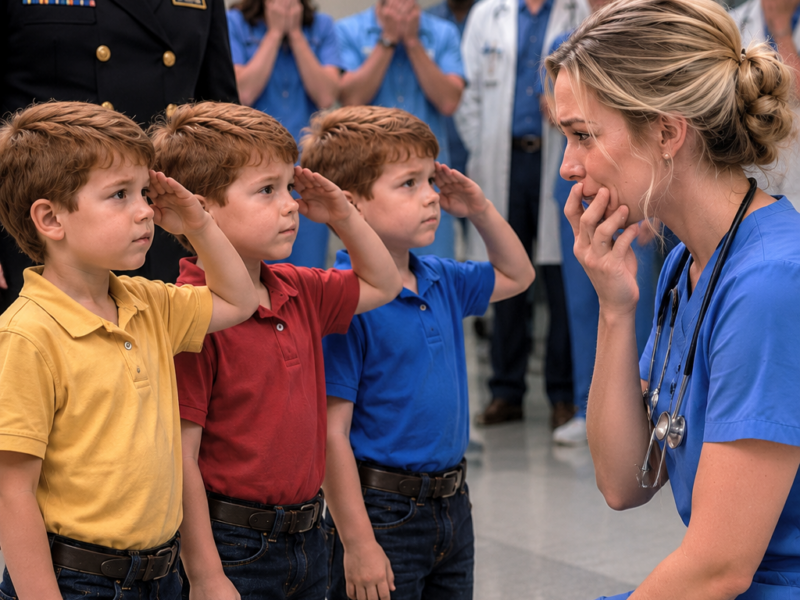
No One Knew Who the New Nurse Really Was — Until an Admiral’s Triplets Saluted Her
No One Knew Who the New Nurse Really Was — Until an Admiral’s Triplets Saluted Her
Nurse Emma Hartley had mastered the art of being invisible.
She arrived at Hospital Naval Central before most of the morning staff, completed her rounds without complaint, and usually remained long after her shift had officially ended. She rarely spoke unless someone asked her a question. She never volunteered stories about her past, never joined conversations about military service, and never seemed particularly interested when decorated officers walked through the hospital corridors.
Her colleagues had learned to describe her in a handful of words: quiet, polite, hardworking, and perhaps a little strange.
Some thought she was shy. Others assumed she was simply unfriendly. A few, including one particularly impatient physician, had decided she was an ordinary nurse who lacked the confidence to stand up for herself.
None of them knew that the woman walking silently through their hallways had once descended into violent ocean waters in the middle of a typhoon, rescued people from a sinking military helicopter, and carried the weight of a lost partner for three long years.
None of them knew that she had once been trusted with the lives of people who would never have survived without her.
And certainly none of them could have imagined what would happen on an ordinary Tuesday morning when a decorated admiral walked into the hospital with his three young sons.
Because the moment those boys saw Emma Hartley, something extraordinary happened.
All three stopped walking, straightened their backs, raised their right hands to their foreheads, and saluted her with the precision of soldiers who had practiced the gesture hundreds of times.
They weren’t saluting a doctor.
They weren’t saluting their father.
They were saluting the quiet nurse in the blue scrubs.
And the expression on her face suggested that she understood exactly why.
But before that moment could change everything, Emma had spent months trying to make sure nobody ever discovered who she really was.
That morning began much like every other morning at Hospital Naval Central.
The hospital stood only a couple of miles from the coastline, close enough that the salty ocean air sometimes found its way through the ventilation system. For most people, the smell was pleasant. It reminded them of summer mornings, fishing boats, and peaceful afternoons beside the water.
For Emma, it was different.
Sometimes the faint smell of salt made her chest tighten unexpectedly. Sometimes it brought back memories she had spent years trying to forget.
She had learned to ignore it.
She had learned to ignore almost everything.
At 7:15 that morning, she entered the staff room, placed her bag inside her locker, and changed into her cobalt-blue scrubs. Before closing the locker, she paused briefly to look at the small scar running near her collarbone.
It was pale now, almost invisible beneath ordinary lighting.
She touched it once, then pulled her collar into place.
Nobody had ever asked how she got it.
That suited her perfectly.
By the time she reached the nurses’ station, Dr. Puit was already reviewing the morning schedule on his tablet.
“You’re late again, Hartley.”
Emma stopped beside the medication cart.
“Good morning, Doctor.”
He didn’t return the greeting.
“Third time this month.”
“There was an accident on the bridge.”
“There’s always something with you, isn’t there?”
Emma lowered her eyes.
“It won’t happen again.”
Puit finally looked up. He was a competent physician when circumstances were calm, but he had little patience for people he considered inexperienced. He had never particularly liked Emma, partly because she rarely defended herself and partly because he interpreted her silence as a lack of confidence.
“Some of us have actual responsibilities around here,” he said. “We don’t have time to keep reminding people how to do their jobs.”
Emma nodded.
She could have told him that she had already reviewed the patients’ charts, checked the medication schedule, and identified two discrepancies before he had even arrived.
She could have explained that she had stayed late the previous evening to help stabilize an elderly sailor whose condition had deteriorated unexpectedly.
Instead, she simply picked up the chart.
“Understood.”
Puit returned to his tablet.
For a moment, Emma stood there, listening to the familiar sounds of the hospital waking up. Shoes moved across polished floors. Monitors beeped behind closed doors. Someone laughed near the elevators.
This was her world now.
No helicopters.
No rescue harnesses.
No radios crackling with desperate voices.
Just patients, medications, charts, and twelve-hour shifts.
It was supposed to be enough.
“Don’t let him get to you.”
The voice came from behind her.
Emma turned and found Nurse Rosa Ortiz holding two cups of coffee.
Ortiz had worked at the hospital for more than twenty years. She had the kind of experience that made her difficult to impress and almost impossible to intimidate. She remembered every patient’s name, knew which physicians needed reminders to eat lunch, and could recognize an approaching emergency from the expression on a nurse’s face.
She was also the only person on the unit who had bothered to remember how Emma took her coffee.
Black.
No sugar.
“Here,” Ortiz said, handing her the cup. “You look like you could use this.”
“Thank you, Rosa.”
“Don’t thank me. I made too much.”
Emma smiled faintly.
Ortiz leaned against the counter.
“Listen, Puit barks at everybody. Sometimes I think he wakes up in the morning already angry.”
“I know.”
“You’re good at your job, Emma. Don’t let anyone convince you otherwise.”
Emma looked down at the coffee.
“Some days I wonder.”
“Well, stop wondering.”
Ortiz gave her shoulder a gentle squeeze before heading toward the next patient room.
Emma watched her leave.
It was strange how a few ordinary words could sometimes affect her more deeply than people realized.
She had spent so long convincing herself that she deserved to remain unnoticed that genuine kindness occasionally caught her completely unprepared.
At 8:00, she began her rounds.
She checked a recovering sailor’s blood pressure, reviewed another patient’s medication schedule, and helped an elderly veteran adjust his pillows. She remembered that one patient disliked the television being too loud and that another preferred his breakfast before taking his morning medication.
These were small things.
But small things mattered.
That was something Emma had learned long before she became a nurse.
Sometimes saving someone wasn’t about pulling them from freezing water or carrying them away from a burning aircraft.
Sometimes it was simply noticing that they were frightened and refusing to let them face it alone.
At 9:40, the main entrance doors opened.
Emma was returning from the supply room when she heard several voices near the reception desk.
She glanced toward the lobby.
A man in immaculate Navy dress blues had entered the building. Gold insignia and ribbons decorated his uniform, and the stars on his shoulder identified him immediately as a rear admiral.
Rear Admiral Michael Callahan.
Emma recognized his rank before she recognized his face.
It was an old habit. Military insignia, uniform details, command markings—her eyes noticed them automatically, even after years away from active service.
Three little boys walked beside him.
They appeared to be around seven years old. Their matching haircuts and nearly identical faces made their relationship obvious. They were triplets, although their personalities seemed different even from a distance.
One wore a yellow polo shirt, another wore red, and the third wore blue.
The admiral rested a hand on the shoulder of the boy in blue while speaking quietly to the receptionist.
Emma immediately looked away.
Important visitors attracted attention. Important visitors also attracted conversations, questions, and people who wanted to know everything about them.
She wanted none of it.
She turned toward the supply closet and continued walking.
Then she heard the admiral speak.
“Look right there, boys.”
His voice was low, almost reverent.
Emma slowed.
Something about the tone made her turn around.
The three boys had stopped.
They were looking directly at her.
For one suspended moment, nobody moved.
Then, as though they had rehearsed the moment their entire lives, all three boys raised their right hands and saluted.
Their movements were perfectly synchronized.
Their elbows were positioned correctly. Their fingers were straight. Their expressions were serious.
It wasn’t a childish imitation of something they had seen in a movie.
It was a genuine military salute.
And it was directed entirely at Emma Hartley.
The lobby fell silent.
A physician stopped speaking in the middle of a sentence. The receptionist lowered the phone in her hand. Two nurses exchanged confused glances.
Even Dr. Puit, who had been standing near the nurses’ station, stopped moving.
Emma felt as though the floor had disappeared beneath her.
She knew that salute.
She knew the boys.
Or rather, she knew the man standing behind them.
Not from the hospital.
Not from any recent meeting.
From somewhere buried deep inside nine years of memories.
Her hands remained motionless at her sides.
She wanted to look away, but her body refused.
The admiral’s eyes met hers across the lobby.
For several seconds, he simply stared.
Then something changed in his expression. The uncertainty disappeared, replaced by recognition so complete that Emma felt her throat tighten.
“Boys,” he said gently.
The three hands dropped.
“At ease.”
The children lowered their arms but continued watching Emma.
Their expressions were strangely solemn, as though they were looking at someone they had heard about in stories for years.
Emma forced herself to breathe.
In for four counts.
Out for four counts.
She had used that technique in situations where panic could have killed her. It had worked underwater, inside aircraft, and during moments when the world seemed determined to collapse around her.
It worked now, too.
“Sorry,” she said, managing a small smile that didn’t reach her eyes. “I think you’ve mistaken me for someone else.”
The admiral studied her face.
He noticed the shape of her jaw, the familiar eyes, and the faint white scar near her collarbone.
Then he shook his head.
“No,” he replied quietly. “I don’t think I have.”
He didn’t mention her name.
He didn’t announce her former rank.
He simply gave her one small nod before turning toward the pediatric wing with his sons.
Emma remained standing in the lobby.
She could hear the sound of her own heartbeat.
Behind her, Dr. Puit finally found his voice.
“What was that?”
Emma picked up the supply clipboard.
“Nothing.”
“Nothing? Those children just saluted you.”
“They’re children. Perhaps they’re playing a game.”
Puit looked toward the corridor where the admiral had disappeared.
“Do you know Rear Admiral Callahan?”
“No.”
The answer came too quickly.
Puit studied her for another moment.
Emma turned away before he could ask anything else.
She had almost reached the supply closet when the emergency intercom crackled overhead.
“Trauma team to the ambulance bay. Incoming casualty. ETA two minutes. Blunt chest trauma. Patient unstable.”
Everything changed.
Emma’s expression became focused.
The old instinct returned before she could think about it.
She placed the clipboard down and headed toward the trauma bay.
Whatever had happened in the lobby would have to wait.
Someone needed help.
And that was the one thing she had never learned to ignore.
The ambulance doors opened less than two minutes later.
A young corpsman hurried beside the incoming gurney, one hand gripping the railing while the other held a medical bag.
“Petty Officer Dawson,” he reported breathlessly. “Twenty-two years old. Fell approximately fifteen feet during a storm-rigging exercise aboard the USS Holly. Struck the deck hard. Chest pain worsening. Blood pressure dropping during transport.”
Dawson looked terribly young.
His face had become pale, and his breathing was rapid and shallow. His eyes moved uncertainly around the room as if he were struggling to understand why everyone was suddenly shouting.
Dr. Puit stepped forward.
“Get him on the monitor. High-flow oxygen. Someone contact radiology. I want an immediate cardiac evaluation.”
The trauma team moved into position.
Emma approached the bed and began assessing the patient.
She checked his pulse, watched the monitor, and listened as the medical team reported their findings.
Something wasn’t right.
His heart rate was climbing, but his blood pressure continued falling. His neck veins appeared distended, and the sounds of his heartbeat were unusually faint.
Emma felt a cold sensation settle in her stomach.
She had seen those signs before.
Not in a hospital.
Not beneath fluorescent lights.
She had seen them in darkness, with freezing water rising around her knees and the sound of a damaged aircraft groaning somewhere above her.
Nine years earlier.
A different man.
A different emergency.
But the same terrifying pattern.
She forced herself back into the present.
“Doctor,” she said.
Puit was examining the chart.
“Yes?”
“His condition is concerning for cardiac tamponade.”
Puit glanced at her.
“Based on what?”
“His blood pressure is dropping, his neck veins are distended, and his heart sounds are muffled. We need an immediate bedside ultrasound.”
“We’ll wait for the imaging.”
“I don’t think we have time to wait.”
Puit’s expression hardened.
“Hartley, I’ve got this.”
Emma looked at Dawson.
The young sailor was becoming increasingly restless. His breathing was deteriorating, and the monitor continued showing signs of cardiovascular collapse.
She recognized the danger with an unpleasant certainty.
Cardiac tamponade.
Blood accumulating around the heart, compressing it until the heart could no longer fill properly.
She remembered the diagnosis from her military medical training. She remembered the exercises, the instructors, the simulations, and the moments when she had been forced to make decisions under impossible conditions.
More importantly, she remembered the night she had first encountered it outside a training environment.
A night that had changed the direction of her life.
“Doctor, this patient needs immediate intervention.”
Puit turned toward her.
“I said I’ve got this.”
His voice was louder now.
“You’re a nurse. Monitor the patient and let the physicians make the diagnosis.”
Emma didn’t argue.
She simply continued watching the monitor.
Then Dawson’s blood pressure dropped again.
A sharp alarm filled the room.
“Pressure is sixty systolic!” a resident shouted.
Another nurse looked toward Puit.
“He’s crashing.”
Puit reached for the ultrasound equipment, but for a brief moment, he seemed unable to decide what to do next.
Emma recognized that hesitation.
She had seen it in frightened young crew members during rescue operations. She had seen it in experienced professionals who suddenly realized that the situation in front of them was worse than anything they had imagined.
She had even experienced it herself once.
But she had learned that hesitation could become fatal when time was running out.
“Doctor,” she said again.
Her voice was different now.
Not louder.
Not emotional.
Just completely certain.
“We need emergency intervention now.”
Puit turned toward her.
“Hartley, stand down.”
Emma looked directly at him.
“He doesn’t have another two minutes.”
The room became strangely still.
A resident glanced between them.
Then another alarm sounded.
Dawson’s lips were turning blue.
The patient was losing the fight.
Emma moved toward the emergency equipment.
She had received advanced trauma training during her years as a Coast Guard aviation survival technician. Her background included emergency care in environments where evacuation was impossible and waiting for a physician was not always an option.
She knew the limitations of her current role.
She knew the hospital’s protocols.
And she knew that Dawson might not survive long enough for the operating room team to arrive.
The medical team rapidly reassessed the situation and prepared the necessary emergency equipment.
Puit hesitated.
Emma did not.
Under the direction of the emergency response team and with the patient’s condition deteriorating by the second, she drew upon the advanced emergency training she had carried with her long after leaving active service.
Within moments, the intervention had begun.
The room seemed to hold its breath.
Emma’s eyes remained fixed on the patient and the monitor.
She had learned a long time ago that panic wasted precious seconds.
The procedure was difficult. The consequences of a mistake could be devastating. But she remained composed, following the emergency team’s coordinated response as they worked to relieve the pressure surrounding Dawson’s heart.
Then the monitor changed.
The numbers began moving in the right direction.
“His pressure is coming back!”
The resident sounded almost disbelieving.
“Seventy-two systolic. His rhythm is improving.”
Dawson’s breathing became slightly more stable.
Emma kept her attention on him.
“Get cardiothoracic surgery down here immediately. He needs definitive treatment. Continue monitoring him closely and prepare for transfer.”
The room erupted into coordinated activity.
Someone contacted the surgical team. Another nurse established additional access. The resident continued reporting Dawson’s vital signs.
The young sailor was still in danger, but he was alive.
Emma stepped back only when the team had everything under control.
Her hands began shaking.
They always did afterward.
Never during the emergency.
Only when the danger had passed and her body finally understood what it had just experienced.
She turned toward the sink.
That was when she noticed someone standing in the doorway.
Rear Admiral Michael Callahan.
He was no longer looking at her face.
He was looking at her hands.
His expression was unreadable, but there was something unmistakable in his eyes.
Recognition.
He had seen enough.
“That wasn’t ordinary nursing work,” he said quietly.
Emma turned off the water.
“Sir?”
Callahan stepped farther into the room.
“I’ve seen that kind of emergency response before.”
She said nothing.
“Nine years ago,” he continued. “In the back of a military helicopter over open water.”
Emma felt her throat tighten.
The admiral studied her carefully.
“I remember the woman who did it.”
For a moment, she couldn’t find a response.
Then he spoke the words she had spent years trying not to hear.
“Petty Officer Hartley.”
Behind her, Dr. Puit inhaled sharply.
Emma closed her eyes for half a second.
There was no point pretending anymore.
The secret had found her.
And it had brought the past into the room with it.
The trauma bay began clearing as Dawson was transferred toward surgery. Cardiothoracic specialists surrounded the gurney, and the resident followed with the latest medical reports.
Emma remained at the sink, washing her hands even though they were already clean.
She needed something ordinary to do.
Something that didn’t require remembering.
“Hartley.”
Puit’s voice came from behind her.
“Come to my office. Now.”
Emma dried her hands.
She followed him through the corridor without saying anything.
His office was small, crowded with medical journals and folders. A half-empty coffee mug sat near his computer.
Puit closed the door.
“Do you understand what you just did?”
Emma looked at him.
“I understand that Dawson is alive.”
“That’s not what I’m talking about.”
He crossed his arms.
“You performed an invasive emergency procedure without the appropriate authorization. I could report this to the licensing board. I could have your employment terminated.”
Emma remained calm.
“Then I suppose you should report exactly what happened.”
“Don’t be sarcastic.”
“I’m not.”
Puit stared at her.
For three months, he had treated her as though she were an inexperienced employee who needed constant supervision. He had criticized her in front of colleagues, questioned her judgment, and dismissed her observations.
Now he was struggling to understand how the same woman had recognized a life-threatening condition before he had.
“You should have waited for the attending physician,” he said.
“There wasn’t time.”
“You don’t make that decision.”
Emma looked directly at him.
For the first time since joining the hospital, she did not lower her eyes.
“You froze, Doctor.”
Puit’s expression changed.
“I beg your pardon?”
“You froze. Dawson’s condition was deteriorating, and you were still discussing whether to wait for imaging. I recognized what was happening. The emergency team responded. And Dawson survived long enough to reach surgery.”
Puit opened his mouth, then closed it.
Emma continued.
“I don’t expect you to thank me. I don’t expect you to like me. But I won’t pretend that waiting would have been the safer choice.”
Before he could respond, someone knocked.
The door opened.
Rear Admiral Callahan entered, followed by Captain Reyes, the hospital’s chief of staff.
Callahan’s presence immediately changed the atmosphere.
“Dr. Puit,” he said politely. “I understand there’s a disagreement about the emergency response.”
Puit straightened.
“Admiral, with respect, this is a hospital personnel matter.”
“It became my concern when I watched a former Coast Guard rescue swimmer save one of our sailors.”
Puit glanced toward Emma.
Callahan continued.
“I’d like everyone in this room to understand exactly who was working in that trauma bay today.”
Emma felt her chest tighten.
She knew what was coming.
For nine years, she had built her life around avoiding this conversation.
She had wanted to become a nurse, not an inspirational story. She wanted people to know her as Emma Hartley, the woman who checked their medication and brought them blankets.
She didn’t want to be introduced through a history she could barely bear to remember.
“Sir,” she said quietly.
Callahan turned toward her.
“I’d rather explain it myself.”
The admiral considered her request, then nodded.
“Of course.”
Emma took a breath.
“My name is Emma Hartley. I served in the United States Coast Guard as an aviation survival technician and rescue swimmer.”
Captain Reyes listened carefully.
“I spent nine years on active duty. I left the service three years ago.”
Puit looked as though he had just discovered that someone had been speaking a foreign language in his presence.
Emma continued.
“Nine years ago, our unit received an emergency call during a typhoon. A Navy transport helicopter had gone down in open water off Guam. The weather was deteriorating rapidly, visibility was almost nonexistent, and the sea was extremely dangerous.”
She paused.
“There were five people aboard.”
Callahan lowered his eyes.
Emma looked at him briefly.
“Three of them were infants. They were the admiral’s sons.”
Nobody spoke.
“I recovered the three children first. Then I went back for Admiral Callahan. He was injured and trapped inside the aircraft. I managed to get him out, but his wife was still aboard.”
She paused again.
“By the time I returned for her, the helicopter was taking on water faster than anyone expected. The aircraft was unstable, and the conditions were getting worse. I went back in anyway.”
Callahan’s jaw tightened.
“I remember,” he said softly.
Emma nodded.
“I brought her out. All five people survived.”
Captain Reyes looked at her with a mixture of surprise and admiration.
“And the boys?”
Emma’s expression softened.
“They were very small. I remember their blankets more clearly than their faces.”
Callahan gave a faint smile.
“They were barely old enough to open their eyes.”
For a moment, something almost peaceful passed between them.
Then Emma’s expression changed.
“There was another mission three years ago. Different operation. Different crew.”
She swallowed.
“My partner was Danny Cho. He was one of the finest rescue swimmers I ever worked with.”
Her voice became quieter.
“We responded to another emergency in dangerous water. A rogue wave caught him before I could reach him. I tried to get to him, but the conditions were beyond what we could control.”
She stopped.
The words had become difficult.
“I lost him.”
The room remained silent.
“After that, I couldn’t go back into the water. I couldn’t trust myself to do the work anymore. I kept thinking about everything I could have done differently, even though the reports said there was nothing more I could have done.”
She looked down at her hands.
“So I left the service and became a nurse.”
Captain Reyes waited.
Emma finally raised her eyes.
“I wanted to help people without feeling like every life depended on whether I could jump into the ocean and bring them back.”
Callahan watched her with quiet understanding.
“Why didn’t you tell anyone?” Captain Reyes asked.
Emma gave a tired smile.
“Because the moment people discover what you used to be, they stop seeing what you are now.”
She looked toward the window.
“I wanted to be a good nurse. Just that. I didn’t want to be the woman from some rescue operation that everyone talked about in the break room.”
Callahan nodded slowly.
“And yet today, you saved another sailor.”
Emma said nothing.
Puit shifted uncomfortably.
“She performed an invasive procedure outside her authorized scope,” he said. “That still needs to be addressed.”
Callahan turned toward him.
“Of course hospital procedures matter, Doctor. So does accountability. But I would think carefully before making this conversation entirely about her actions and ignoring the fact that the physician responsible for the patient hesitated when seconds mattered.”
Puit’s face reddened.
Captain Reyes closed the folder she had been holding.
“Let’s review the emergency response properly,” she said. “There will be a formal assessment of what happened, including the decisions made by everyone involved.”
Emma nodded.
She understood that there were rules, responsibilities, and consequences.
She wasn’t asking to be treated differently.
She simply wanted the truth recorded accurately.
But before the conversation could continue, the hospital intercom crackled.
“Code blue. ICU bed twelve. Code blue. ICU bed twelve.”
Emma’s head turned immediately.
Bed twelve.
Dawson.
She was already moving before anyone else had fully processed the announcement.
The corridor blurred around her as she hurried toward the intensive care unit.
When she entered the room, the atmosphere was chaotic.
A resident was performing chest compressions. Another nurse was preparing emergency medication. The monitor was producing a continuous alarm.
Dawson had suffered cardiac arrest.
“What happened?” Emma asked, pulling on gloves.
“He was stable after surgery,” the ICU nurse replied. “Then his pressure dropped suddenly. We lost his pulse.”
Emma moved beside the bed.
Her mind began evaluating the possibilities.
The original condition had been relieved, but the underlying injury remained serious. There could be renewed bleeding, recurrent fluid accumulation, or another complication related to the trauma.
“Continue resuscitation,” she instructed.
She wasn’t trying to take command of the entire room. She was doing what she had always done when an emergency became complicated: observing, identifying the immediate problem, and making sure the right people had the information they needed.
“Get an ultrasound. We need to know what’s happening around his heart.”
The equipment arrived.
A resident positioned the probe while another physician reviewed the images.
Then the answer became clear.
“There’s fluid again.”
Emma looked at the screen.
The problem had returned.
“Recurrent tamponade,” the resident said.
The room seemed to tighten around those words.
The surgical team was contacted immediately, and the emergency response continued.
Emma looked at Dawson’s face.
He was twenty-two years old.
Only hours earlier, he had been worried about a training exercise. He probably had a family waiting for him somewhere, people who expected him to come home after another ordinary day in the Navy.
Now his heart had stopped.
For a moment, Emma felt the old fear rise.
She remembered Danny.
She remembered the radio transmission that had changed from calm conversation to urgent calls for assistance.
She remembered the waves.
The black water.
The terrible realization that there were moments when even the best training could not guarantee that someone would come back.
Her breathing became shallow.
For three years, she had carried that memory like a stone inside her chest.
But then she looked at Dawson again.
Not Danny.
Dawson.
A different man.
A different moment.
She couldn’t change what had happened three years ago.
But she could still help the person lying in front of her.
“Stay with us,” she whispered.
The medical team continued the emergency intervention, preparing the necessary treatment while the surgeons responded.
Emma remained at the bedside, coordinating with the team and watching every change in Dawson’s condition.
The room was loud, but her mind was strangely clear.
“Continue compressions.”
“Check the rhythm.”
“Keep the surgical team updated.”
The ultrasound findings confirmed the need for immediate intervention. The team acted without delay.
Emma’s experience helped them recognize the urgency and coordinate their response.
Then, once again, the monitor changed.
A rhythm appeared.
Someone looked at the screen.
“Wait.”
Another second passed.
“We have a pulse!”
The room seemed to release a breath it had been holding for far too long.
Dawson’s heartbeat had returned.
His condition remained critical, but he was alive.
Emma stepped away from the bed.
Her hands were shaking again.
This time, she didn’t try to hide it.
She removed her gloves and stood near the doorway, breathing slowly while the medical team continued caring for Dawson.
Through the glass, she noticed Rear Admiral Callahan.
He had been watching from the hallway.
His hands were pressed against the window frame, and his expression reflected the same fear that had appeared on Emma’s face moments earlier.
When she finally stepped outside, he was waiting.
“You did it twice in one day,” he said.
Emma looked exhausted.
“I didn’t have much of a choice.”
“Most of the rescue swimmers I served alongside never had to face that kind of situation even once.”
She shook her head.
“Dawson needed help.”
Callahan watched her carefully.
“Do you know what I remember about that night nine years ago?”
Emma didn’t answer.
“I remember the storm. I remember the aircraft going down. I remember hearing the crew say that the situation was getting worse.”
His voice softened.
“But I remember you most clearly.”
He looked at her.
“You went into that water four times.”
Emma lowered her eyes.
“Three of those times, I carried my sons. The fourth time, you came back for my wife.”
Callahan swallowed.
“I remember watching you disappear beneath the waves and wondering whether I would ever see you again. And every time you surfaced, you had someone with you.”
Emma felt her eyes sting.
“I was doing my job, sir.”
“I know. That’s why I’ve never forgotten you.”
He paused.
“My boys have asked about you every year.”
Emma looked up.
“Every year?”
“Every year on the anniversary of the rescue. They were too young to remember what happened, but my wife and I have told them the story many times.”
He gave a small smile.
“We told them about the woman who entered the ocean when everyone else was afraid of what it might take from her.”
Emma looked toward the pediatric wing.
“That’s why they saluted?”
Callahan nodded.
“I taught them. Every year, I explained that if we ever found you, they should thank you properly. I wanted them to understand that their lives were protected by someone who didn’t know them, owed them nothing, and still chose to go back into dangerous water.”
His eyes became bright.
“I never thought we’d actually find you in a hospital corridor.”
Emma let out a quiet breath.
“I never thought anyone would.”
Callahan looked at her for a long moment.
“Why have you been hiding?”
She considered giving him the usual answer.
Work.
Privacy.
A desire for a normal life.
But she was tired of pretending.
“Because I couldn’t keep being that person.”
Callahan didn’t interrupt.
“I saved four people on that first mission. I brought them all home. But three years ago, I lost Danny Cho. He was my partner. He trusted me, and I trusted him. When that wave took him, I kept thinking that I should have been faster.”
She shook her head.
“I know what the investigation said. I know what the report concluded. I know that the conditions were impossible.”
Her voice cracked.
“But knowing something and believing it aren’t always the same.”
Callahan nodded.
“No. They aren’t.”
“I spent three years thinking that if I stopped being a rescue swimmer, I wouldn’t have to feel responsible for anyone drowning again.”
She looked through the glass toward Dawson’s bed.
“Today reminded me that changing uniforms doesn’t change who you are.”
Callahan followed her gaze.
“Maybe that’s something you should stop fighting.”
For a long moment, neither spoke.
Behind the glass, Dawson’s heartbeat continued tracing a steady line across the monitor.
And for Emma, that sound meant something.
It was proof that this time, someone had come back.
Two days later, Dawson woke up.
He was confused, exhausted, and understandably unhappy about the pain in his chest.
When Emma entered his room, he was staring at the ceiling.
“Where am I?”
“Hospital Naval Central,” she answered.
He turned his head.
“How long have I been here?”
“Long enough to give everyone a very difficult couple of days.”
He attempted a smile, then immediately regretted it.
“What happened?”
Emma pulled a chair beside the bed.
“You suffered a serious chest injury during the training exercise. It affected your heart, and your condition became critical. The medical team worked to stabilize you.”
Dawson listened carefully.
“Did I almost die?”
Emma considered the question.
“Yes.”
He stared at her.
“How many times?”
She gave a faint smile.
“More than either of us would have preferred.”
He looked at her scrubs.
“You’re the nurse from the trauma room, aren’t you?”
“That’s me.”
“I remember someone talking. I don’t remember much else.”
“That’s probably for the best.”
Dawson hesitated.
“They told me you helped save my life.”
Emma looked down at his chart.
“The team did.”
“But they said you recognized what was wrong before anyone else.”
She adjusted the blanket.
“I’ve had a lot of experience with emergencies.”
He studied her hands.
There were old scars across both palms, small marks left by years of rope burns and demanding rescue work.
“Did you really do that twice?”
Emma glanced at him.
“Unfortunately.”
He laughed weakly.
“Thank you.”
The words were simple.
But something about hearing them from a young man who had almost died made Emma feel strangely emotional.
“You’re welcome, Dawson.”
She stood.
“And when you’re discharged, I expect you to be considerably more careful during your next training exercise.”
“Yes, ma’am.”
She smiled.
For the first time in a long while, the smile came easily.
By then, the story had spread throughout the hospital.
People talked in the staff lounge. Nurses exchanged details in the hallways. Physicians who had barely noticed Emma before suddenly seemed eager to know where she had trained.
Some looked at her with admiration.
Others were simply curious.
Emma found the attention uncomfortable.
She hadn’t wanted to become famous inside her own workplace.
She had only wanted to do her job.
One afternoon, she entered the staff lounge and noticed that several conversations stopped.
She poured herself a cup of coffee.
Then she heard someone approach.
“Emma.”
She turned.
Dr. Puit stood near the doorway.
He looked uncomfortable.
“I owe you an apology.”
Emma placed the coffee pot back on the counter.
“I’m listening.”
Puit took a breath.
“I’ve spent the last three months treating you as though you were inexperienced. I questioned your judgment, dismissed your concerns, and assumed that your quietness meant you didn’t know what you were doing.”
He looked down.
“That was unfair.”
Emma waited.
“I also need to acknowledge what happened with Dawson. I should have taken your concerns seriously. I hesitated when I should have acted more decisively.”
His expression tightened.
“I’ve been trying to convince myself that the problem was what you did, rather than what I failed to do.”
Emma looked at him.
“You froze.”
He nodded.
“Yes.”
“It happens.”
Puit seemed surprised by the simplicity of her response.
Emma continued.
“It happened to me once, too. A long time ago. And I lost someone.”
He remained silent.
“The difference is what you do afterward.”
Puit looked at her.
“I’ve been accepted into an additional trauma-response certification program. Captain Reyes recommended it.”
“Good.”
“I want to become better.”
Emma nodded.
“Then do it.”
He looked as though he wanted to say something else.
“I don’t expect you to forgive me immediately.”
“I don’t need you to apologize every day, Doctor.”
She picked up her coffee.
“I need you to become someone the next young sailor can trust when he’s lying on that bed.”
Puit nodded slowly.
“I understand.”
For the first time, Emma saw something in his expression that hadn’t been there before.
Humility.
He left the room quietly.
Emma took a sip of coffee.
It was still hot.
And for once, she didn’t feel the need to disappear before anyone else entered.
That evening, Captain Reyes called her into her office.
The atmosphere was considerably warmer than it had been during their earlier conversation.
Reyes gestured toward a chair.
“Please sit down, Miss Hartley.”
Emma sat.
The captain opened a folder.
“The Navy would like to formally recognize your actions during the emergency involving Petty Officer Dawson.”
Emma looked at the document.
“Admiral Callahan has already submitted a commendation request. I’ve added my own account of the response, including what I witnessed in the intensive care unit.”
Emma turned the page.
For years, her military service had existed in a place she rarely visited. There were official records, training documents, mission reports, and photographs stored in boxes she had never opened.
Now, for the first time, that history was being acknowledged without forcing her to return to the life she had left behind.
“Thank you,” she said.
Reyes nodded.
“There’s something else.”
She removed a small piece of paper from the folder.
“Admiral Callahan asked me to give you this.”
Emma accepted it.
There was a name and a telephone number written on it.
Danny Cho’s mother.
Emma’s fingers became completely still.
“How did he find her?”
“He began making inquiries after recognizing you. He located her in San Diego.”
Emma stared at the paper.
“She’s been asking about you,” Reyes continued gently. “Apparently, every year since Danny died, she’s asked whether anyone could tell her more about the swimmer who tried to reach her son.”
Emma couldn’t speak.
For nine years, she had carried Danny’s name in silence.
She had remembered his voice, his laugh, his terrible jokes, and the way he always checked his equipment twice before a mission.
She had also remembered the final moments.
But somewhere, hundreds of miles away, another person had been carrying that same loss.
A mother.
A woman who had spent years wondering what had happened to her son and whether anyone had been beside him when he disappeared.
“You don’t have to call her,” Reyes said. “The admiral simply thought you deserved the opportunity.”
Emma folded the paper carefully.
“Thank you.”
After leaving the office, she placed it in her pocket.
She didn’t call that evening.
She didn’t call the next morning either.
For two days, the number remained there, folded against the fabric of her scrubs.
Sometimes she took it out during breaks and stared at it.
Sometimes she put it away without dialing.
She was afraid of what the conversation might bring.
What if Danny’s mother hated her?
What if she asked questions Emma couldn’t answer?
What if talking about him brought back everything she had spent three years trying to bury?
But there was another possibility.
Perhaps the conversation would give both of them something they had been missing.
Three days after the emergency, Admiral Callahan returned to the hospital.
This time, he wasn’t wearing his dress uniform.
He arrived in civilian clothes, accompanied by his three sons, who were dressed in matching gray jackets.
He found Emma outside the pediatric wing.
She had just finished helping a frightened little girl prepare for a routine examination.
When she noticed him, she smiled.
“Good afternoon, Admiral.”
“Good afternoon, Emma.”
The boys stepped forward.
They were less formal than during their first visit, but all three seemed pleased to see her.
“Hello,” the boy in yellow said.
“Hello,” Emma replied.
Callahan waited until the boys had moved slightly ahead.
“I have an offer to make.”
Emma raised an eyebrow.
“An offer?”
“The Coast Guard would be willing to consider bringing you back into service.”
She became still.
“Full reinstatement. Your former rank could be restored, subject to the appropriate process. There would be opportunities in training and operational instruction.”
He paused.
“You wouldn’t necessarily have to return to rescue operations. You could teach the next generation everything you’ve learned.”
Emma listened carefully.
“A training command,” he continued. “Somewhere you could help prepare young rescue swimmers and aviation survival technicians without putting yourself back into the water.”
For a moment, Emma imagined it.
A classroom.
A training facility.
Young men and women learning how to make decisions when the world around them became dangerous.
She could teach them about preparation, teamwork, communication, and the responsibility that came with carrying someone else’s life in their hands.
She could help prevent some of the mistakes that had haunted her.
It was an appealing possibility.
But then she looked down the corridor.
A nurse was helping an elderly patient into a wheelchair. A young doctor was speaking with a worried family. Somewhere behind the pediatric doors, a child was crying.
This was where she had chosen to be.
And perhaps there was a reason.
“Thank you, sir,” she said. “I appreciate the offer.”
Callahan nodded.
“But I think I’m supposed to stay here.”
He studied her.
“Are you sure?”
Emma smiled faintly.
“For three years, I thought the only way to stop being haunted by the water was to stay as far away from anything that reminded me of it.”
She glanced at the boys.
“But Dawson didn’t need a rescue swimmer. He needed someone who could recognize what was happening and help him survive.”
She looked back at Callahan.
“I’ve spent too long treating my old life as something I had to hide from my new one. Maybe I don’t have to choose between them.”
The admiral nodded slowly.
“Then perhaps I have another offer.”
Emma waited.
“Not a permanent position. Just an invitation.”
He explained that he wanted her to teach an occasional emergency-response session for Coast Guard corpsmen and rescue swimmers.
One afternoon every three months.
She could share her experience, discuss difficult scenarios, and help young personnel understand what it meant to remain calm when circumstances became overwhelming.
“No uniform required,” he added.
Emma considered the suggestion.
She thought about the young corpsman who had accompanied Dawson into the trauma bay. She remembered his frightened expression and the way his hands had trembled when the situation became critical.
She thought about Puit.
About the importance of training.
And about how much difference one experienced person could make when someone else was struggling to find their footing.
“I can do one afternoon a quarter.”
Callahan smiled.
“Good.”
He extended his hand.
Emma shook it.
For a moment, they were no longer an admiral and a hospital nurse.
They were two people who had once trusted each other with something more important than either of their careers.
Then the three boys approached.
Without being prompted, they stood in front of Emma.
The boy in yellow glanced at his brothers.
Then all three raised their right hands and saluted.
The same sharp, synchronized gesture from the lobby.
But this time, Emma didn’t freeze.
She straightened her back.
Her shoulders settled into the familiar posture she had once carried naturally. Her right hand rose to her forehead.
And she returned the salute.
Properly.
Cleanly.
For the first time in nine years.
“At ease,” she said softly.
The boys lowered their hands.
The youngest smiled.
“Our dad told us you were very brave.”
Emma looked at Callahan.
He gave a small shrug.
“I told them the truth.”
She crouched slightly so she could look the boys in the eyes.
“You know something?” she said. “Your father is the brave one. He raised three very good young men.”
The boys smiled.
“And your mother?” Emma added. “I hope she’s doing well.”
“She’s at home,” the boy in red replied. “She says we should always say thank you to people who help us.”
Emma felt something warm settle in her chest.
“Your mother is right.”
Callahan watched the exchange quietly.
When they finally left, Emma stood in the corridor for several minutes.
She looked down at her hands.
The same hands that had once held rescue lines in freezing water.
The same hands that had carried three tiny children away from a sinking helicopter.
The same hands that had tried to reach Danny Cho.
And now, the same hands that brought comfort to frightened patients in a hospital.
Perhaps they had never been different hands at all.
That night, Emma returned to her apartment later than usual.
The building was quiet. The lights from the neighboring windows reflected against the kitchen glass.
She placed her bag on the floor, removed her shoes, and sat at the small kitchen table.
Then she reached into her pocket.
The folded paper was still there.
Danny Cho’s mother’s name.
Her telephone number.
Emma stared at it for a long time.
She remembered Danny laughing during training because she had complained about the taste of the coffee. She remembered him teasing her whenever she checked the equipment for the third time.
She remembered his voice on the radio.
And she remembered the silence afterward.
Her fingers trembled as she picked up her phone.
For a moment, she almost put it down.
Then she dialed.
The phone rang once.
Twice.
Three times.
A woman answered.
“Hello?”
Emma opened her mouth, but no words came.
“Hello?”
She took a breath.
“Mrs. Cho?”
“Yes?”
“My name is Emma Hartley.”
There was a pause.
“I served with your son, Danny. I was his rescue partner.”
The silence on the other end seemed endless.
Then the woman spoke.
“Emma?”
Her voice was suddenly fragile.
“Yes, ma’am.”
“I’ve been trying to find you.”
Emma closed her eyes.
“I’m sorry it took so long.”
“No, sweetheart. No. You don’t have to apologize.”
The woman’s breathing became uneven.
“Can you tell me about him?”
Emma looked toward the dark kitchen window.
For three years, she had avoided telling anyone about Danny because she believed remembering him meant returning to the worst moment of her life.
But as she began speaking, she realized that she didn’t have to start with the storm.
She could start with the person.
She told Mrs. Cho about Danny’s sense of humor. About the way he always brought extra food because he knew someone would forget lunch. About how he could make even the most exhausting training day feel manageable.
She told her about the way he encouraged younger crew members.
She told her that he had been a good partner.
A very good man.
And when she finally reached the day of the accident, she spoke honestly.
She explained the conditions, the sudden wave, and the desperate attempt to reach him.
She told Mrs. Cho that Danny had never been alone in the hearts of the people who served with him.
At some point, the woman began crying.
Emma began crying too.
For the first time in nine years, she allowed herself to share the grief with someone who understood why his name mattered so much.
The conversation lasted nearly an hour.
When they finally said goodbye, Emma remained seated at the table.
The apartment was still quiet.
The pain hadn’t disappeared.
Danny was still gone.
But something had changed.
His memory no longer felt like a secret she had to guard alone.
A month later, a small bronze plaque was installed in the courtyard garden at Hospital Naval Central.
The Callahan family had quietly funded it.
There was no press conference. No large ceremony. No television cameras.
Emma had asked for something simple, and Callahan had respected her wishes.
The plaque read:
In memory of Danny Cho, United States Coast Guard, who went into the water so others could come home.
Mrs. Cho traveled from San Diego for the unveiling.
When Emma saw her standing near the garden entrance, she walked toward her slowly.
They embraced.
Neither woman said much.
They didn’t need to.
After the small ceremony, they sat together on a bench beneath a tree.
Mrs. Cho held a photograph of Danny in his uniform.
He was smiling.
It was the same smile Emma remembered.
“He looks happy,” Emma said.
“He was,” his mother replied. “He loved what he did.”
Emma nodded.
“He was good at it.”
Mrs. Cho looked at her.
“He talked about his partner sometimes. He said she was one of the strongest people he knew.”
Emma lowered her eyes.
“I don’t know if I was strong.”
Mrs. Cho reached over and held her hand.
“Maybe he knew something about you that you couldn’t see yourself.”
Emma felt tears gathering again.
She didn’t fight them.
For a long time, the two women sat quietly in the garden, remembering the same man from different parts of his life.
One remembered the boy who had grown up in San Diego.
The other remembered the partner who had stood beside her on dangerous missions.
Both had lost him.
And both had finally found someone with whom they could speak his name.
When Mrs. Cho eventually left, Emma remained on the bench.
She stared at the bronze plaque.
For the first time in years, she didn’t feel the need to run away from the memory.
A familiar voice interrupted her thoughts.
“You okay?”
Nurse Rosa Ortiz sat beside her.
She didn’t ask permission. She simply lowered herself onto the bench, the way old friends often did.
Emma smiled faintly.
“Getting there.”
Ortiz glanced at the plaque.
“Beautiful tribute.”
Emma nodded.
“She deserved to have something like this.”
They sat together for a while.
Then Ortiz looked at her.
“You know, I’ve always suspected there was more to you than the quiet act.”
Emma laughed softly.
“Is it that obvious?”
“Only to people who pay attention.”
Ortiz bumped her shoulder gently.
“The rest of us just thought you were shy.”
Emma laughed again.
This time, the sound came naturally.
It was the first real laugh she could remember having in a very long time.
Through the hospital’s glass doors, she could see Dawson being escorted toward a waiting car.
He had been discharged.
He looked healthier, stronger, and considerably happier than the young sailor who had arrived on a gurney weeks earlier.
He noticed Emma through the glass and raised one hand in a broad wave.
She waved back.
Then she looked at the plaque again.
Danny’s name.
Dawson’s recovery.
The three Callahan boys.
The quiet kindness of Rosa Ortiz.
Even Dr. Puit, who had begun taking his additional trauma training seriously.
All of these things had become connected in ways she never could have predicted.
Perhaps life didn’t always give people the opportunity to repair everything they had lost.
Sometimes it simply gave them another chance to do something meaningful with what remained.
The following spring, the Callahan boys celebrated their eighth birthday.
Their father brought them back to Hospital Naval Central, but this time they weren’t there for a medical appointment.
They had asked to visit Emma.
Callahan found her on the pediatric floor, sitting beside a frightened seven-year-old girl who was waiting for test results.
The little girl had been unusually quiet all morning.
Emma had noticed that she kept looking toward the door whenever footsteps passed.
So she had found a picture book and begun reading it to her.
She didn’t rush.
She changed her voice for the characters, paused to let the girl ask questions, and encouraged her to turn the pages.
By the time she reached the final page, the little girl’s shoulders had relaxed.
“Do you think the puppy gets home?” the child asked.
“I think he does,” Emma replied.
“Really?”
“Absolutely. But I think he needs a little help along the way.”
The girl smiled.
Emma closed the book.
“See? Sometimes being brave doesn’t mean you’re not frightened. Sometimes it just means you keep going even when you are.”
The girl nodded.
“Like the puppy?”
“Exactly like the puppy.”
Emma stood and noticed three familiar faces waiting at the doorway.
The Callahan boys.
They had grown slightly taller, but their expressions were almost exactly the same as she remembered.
Behind them stood their father.
“Good afternoon,” Callahan said.
Emma smiled.
“Good afternoon, sir.”
The boys stepped forward.
They looked at one another.
Then, without a word, all three raised their hands and saluted.
Emma felt a smile spread across her face.
This time, she didn’t hesitate for even a second.
She straightened her cobalt-blue scrubs, stood tall, and returned their salute.
It was a small gesture.
But to Emma, it meant more than she could explain.
For nine years, she had refused to acknowledge the part of herself that had once worn a different uniform.
She had believed that returning a salute meant accepting a past she couldn’t bear to revisit.
She had thought that becoming a nurse required her to leave the rescue swimmer behind.
Now she understood that she had been wrong.
The woman in blue scrubs and the rescue swimmer had never been two different people.
They had always been Emma Hartley.
The same person who had once entered a storm to rescue three children.
The same person who had struggled to accept that she couldn’t save everyone.
The same person who had stood beside a young sailor when his heart was failing.
The same person who had finally found the courage to call a grieving mother.
The same person who continued showing up every morning, ready to help whoever needed her.
“At ease,” she said.
The boys lowered their hands.
The little girl sitting on the bed watched them with wide eyes.
“Why did they do that?” she whispered.
Emma glanced at the three boys.
“Because they know someone who helped their family a long time ago.”
“Are you a soldier?”
Emma smiled.
“Not exactly.”
“Then what are you?”
Emma looked down at her blue scrubs.
“I’m a nurse.”
The little girl considered that answer.
Then she smiled.
“I think nurses are heroes.”
Emma felt her throat tighten.
“Some of them are.”
She returned the picture book to the bedside table.
Outside the hospital, the afternoon sunlight reflected off the windows. Somewhere beyond the buildings, the ocean moved quietly against the shore.
For a moment, Emma could almost imagine the sound of waves.
Once, that sound had filled her with fear.
It had reminded her of the night she lost Danny, the mission that ended her career, and the years she spent believing she had somehow failed the people who trusted her.
But now, standing in a pediatric room with three smiling boys and a little girl who no longer seemed frightened, the ocean sounded different.
It was still powerful.
It was still unpredictable.
And it still carried memories she would never forget.
But it no longer had the power to decide who she was.
She had learned that courage wasn’t something a person either possessed or lost.
It wasn’t a uniform.
It wasn’t a rank.
It wasn’t a medal, a title, or a story told by someone else.
Sometimes courage was simply the willingness to keep showing up after life had given you every reason to stop.
Sometimes it meant admitting that you were hurting.
Sometimes it meant accepting an apology.
Sometimes it meant picking up a telephone and speaking to someone whose grief had become tangled with your own.
And sometimes it meant standing in a hospital hallway, wearing ordinary blue scrubs, and allowing three little boys to remind you that the good things you had done were not erased by the things you couldn’t change.
Emma had once believed that silence would protect her.
For three years, she had made herself smaller, quieter, and less noticeable because she thought disappearing was the only way to survive her memories.
But silence had never truly healed her.
It had only given her somewhere to hide.
The salute in the lobby had opened a door she thought was permanently closed.
Dawson’s emergency had reminded her that her experience still mattered.
Callahan’s gratitude had shown her that the people she saved had never forgotten her.
And Danny’s mother had helped her understand that remembering someone didn’t mean carrying the loss alone forever.
Emma would never forget the ocean.
She would never forget Danny.
She would never forget the five people aboard that helicopter off Guam or the terrible storm that had nearly taken them.
But she no longer needed to spend every day running away from those memories.
She could honor them by living.
By continuing to care for people.
By teaching others what she had learned.
By remaining present when someone needed help.
And by understanding that being ordinary was not the same as being insignificant.
The hospital continued moving around her.
A monitor beeped somewhere down the corridor.
A nurse called for assistance.
A physician hurried past with a chart in his hand.
Another patient needed reassurance.
Emma turned toward the hallway.
“Coming,” she answered.
And she walked forward.
Not as a former rescue swimmer trying to forget who she had been.
Not as a decorated hero hiding behind an ordinary job.
But as Emma Hartley, a nurse who had survived loss, rediscovered her purpose, and finally understood that the strongest parts of her past were still allowed to belong in her future.
Somewhere behind her, the three Callahan boys were laughing with their father.
One of them glanced back and raised his hand in a small wave.
Emma smiled and waved back.
She no longer needed to look down when people noticed her.
She no longer needed to pretend she was someone else.
And she no longer believed that being remembered was something to fear.
Because the people who truly understood her story had never admired her simply because she had once worn a uniform.
They remembered her because she had gone back when others needed her.
Because she had kept her hands steady when the world was falling apart.
Because she had cared enough to try, even when the outcome was uncertain.
And because, despite everything she had lost, she had chosen to keep helping.
That was the real meaning of her story.
Not the medals she might have received.
Not the rank she had once held.
Not even the three synchronized salutes that had brought her past rushing into the present.
It was the quiet decision she made every morning when she put on her cobalt-blue scrubs, walked through the hospital doors, and prepared to stand beside someone facing the worst day of their life.
She didn’t need an audience.
She didn’t need applause.
She didn’t need anyone to call her extraordinary.
She simply needed to know that when someone reached for help, she would still be there.
And sometimes, that was more than enough.
Because the greatest heroes are not always the people standing beneath bright lights, wearing decorated uniforms, or receiving recognition in front of a crowd.
Sometimes they are the quiet people nobody notices.
The nurse who remembers a patient’s name.
The stranger who enters dangerous water.
The partner who refuses to abandon someone.
The person who keeps showing up even after losing someone they loved.
Their histories may remain hidden for years.
Their sacrifices may go unrecognized.
Their courage may never become a headline.
But the people whose lives they touch remember.
A father remembers the woman who brought his children home.
Three boys remember the person who gave them a future before they were old enough to understand what they had almost lost.
A young sailor remembers the nurse who helped bring his heartbeat back.
And a grieving mother remembers the woman who finally called to tell her that her son had been loved, respected, and remembered.
Emma Hartley had spent years believing that her greatest failure defined her.
Now she understood that one terrible loss could never erase a lifetime of courage, compassion, and service.
She could not bring Danny Cho back.
But she could remember him.
She could honor him.
And she could continue doing the work that had always mattered to both of them.
As she disappeared around the corner toward her next patient, the faint smell of salt drifted through the hospital ventilation system.
Emma noticed it.
She paused for just a moment.
Then she took a slow breath and continued walking.
For the first time in many years, the ocean no longer felt like something she had to escape.
It was simply part of the world again.
And Emma Hartley was finally ready to live in it.
THE END



