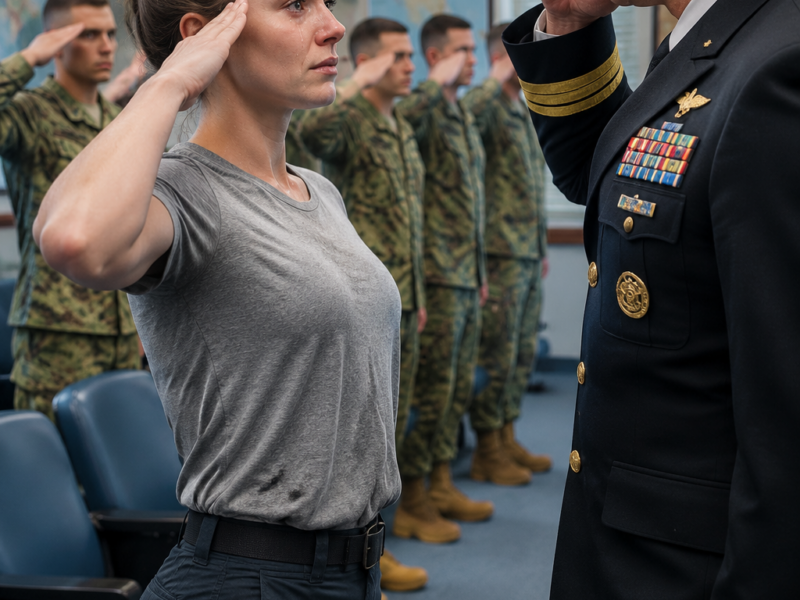
Navy SEAL Asked Her Rank As A Joke —Then The Entire Base Saluted Her Name
Navy SEAL Asked Her Rank As A Joke —Then The Entire Base Saluted Her Name
The sound of the Navy’s horn echoed across San Diego Bay at exactly two o’clock in the afternoon, its deep, resonant blast blending with the thunderous roar of two F/A-18 Super Hornets climbing into the brilliant California sky from North Island. A cool breeze swept in from the Pacific, carrying the unmistakable scent of saltwater, jet fuel, and sun-warmed concrete. Across Naval Base Coronado, the rhythmic pounding of combat boots echoed along the parade ground as more than two hundred Navy SEALs gathered for an important commendation ceremony. Families had traveled from different parts of the country to witness their loved ones receive recognition for their service, and senior officers were making their final preparations for the afternoon’s proceedings.
Everything appeared perfectly organized. The ceremonial platform had been inspected, the seating arrangements were complete, and the security teams were checking identification badges at the entrance.
At a small registration desk near the main gate, a woman named Selene Parker was carefully reviewing the guest list.
She wore a simple civilian uniform consisting of a neatly pressed navy-blue shirt and dark trousers. Her brown hair was tied back in a practical ponytail, and a small identification badge hung from her collar. Nothing about her appearance suggested that she was particularly important. To most people passing through the entrance, she was simply another administrative employee responsible for checking names, issuing visitor passes, and making sure everyone entered the correct section of the ceremony.
She had been working at the base for eight months, and during that time she had become known for her quiet efficiency. She rarely spoke unless necessary, never involved herself in conversations that did not concern her responsibilities, and always completed her assignments with remarkable precision.
Her movements were economical, her paperwork immaculate, and her attention to detail almost mechanical.
At 2:03 p.m., a group of six newly graduated Navy SEALs approached her registration desk.
They were young, confident, and visibly proud of the tridents attached to their uniforms. For them, graduating from the demanding SEAL training pipeline represented the beginning of a new chapter. They had endured months of physical exhaustion, psychological pressure, and relentless evaluations to earn the right to wear those symbols.
Leading the group was twenty-four-year-old Petty Officer Jake Morrison.
Morrison had a strong build, a confident smile, and the unmistakable attitude of someone who believed he had already proven himself to the world. His teammates frequently followed his lead, and he had developed a habit of turning ordinary conversations into opportunities to demonstrate his superiority.
He stopped directly in front of Selene’s desk, glanced at her identification badge, and smiled mischievously.
“Hey there, receptionist lady. What’s your rank?”
His voice was loud enough for all six teammates to hear.
Selene did not immediately look up. She continued checking the names on her clipboard, moving a silver Parker Jotter pen across the page.
“Petty Officer Morrison, your guest list has been confirmed. Please direct your family members to the designated seating area.”
Her response was polite and completely professional.
That, however, was not what Morrison wanted.
He leaned against the counter and exchanged an amused glance with his friends.
“Seriously, though. What’s your rank? Do you even understand military operations, or are you just here to check IDs?”
A few of the young SEALs laughed.
Selene finally raised her eyes.
“I understand enough to perform my responsibilities effectively, Petty Officer. Is there something specific you need assistance with?”
Her tone remained calm.
Morrison interpreted that calmness as disrespect.
“What I need is for civilian staff to recognize that they’re working among America’s elite warriors. Some of us actually earned our place here through blood, sweat, and sacrifice.”
He gestured toward the trident on his uniform.
“You know what this represents?”
“I do, Petty Officer.”
“Do you?”
Morrison leaned closer.
“Because sometimes people working around military personnel start thinking they’re part of the same world. They’re not.”
One of his teammates, Petty Officer Second Class Danny Torres, joined the conversation.
“Come on, Morrison’s just asking a simple question. You work on a SEAL base. You should at least understand basic military structure.”
Selene looked at Torres for a moment before returning her attention to the paperwork.
“I believe we’re finished with your registration. Your badges are ready.”
The exchange attracted attention from nearby families. A woman holding her young son’s hand looked uncomfortable, while an elderly gentleman standing behind them frowned at the young SEALs.
But nobody intervened.
Morrison seemed pleased with the attention.
“Some people just don’t understand what it means to serve.”
He delivered the remark with a smile before turning toward his teammates.
What Morrison did not realize was that a man standing several feet away had been observing the entire exchange.
Master Chief Rodriguez had spent twenty-five years in the Navy, much of that time serving alongside special operations personnel. At fifty-two, he possessed the kind of experience that allowed him to recognize the difference between youthful confidence and genuine professional competence.
He had seen hundreds of newly graduated SEALs arrive at the base with freshly earned tridents and enormous ambitions.
He had also seen how easily confidence could become arrogance.
Approaching the desk, Rodriguez looked at Morrison.
“Is there a problem here, Petty Officer?”
Morrison immediately straightened.
“No problem, Master Chief. Just having a conversation about military culture.”
Rodriguez glanced toward Selene.
She had already returned to her paperwork.
“Perhaps you and your team should concentrate on preparing for the ceremony. Admiral Thompson will be arriving shortly.”
“Yes, Master Chief.”
Morrison acknowledged the instruction, then turned away.
But before leaving, he made one final comment.
“Some people simply don’t understand what it means to be part of something bigger than themselves.”
Rodriguez watched the group walk toward the parade ground.
Then he turned back to Selene.
“Everything all right, Ms. Parker?”
“Everything’s fine, Master Chief. Just another day at the office.”
She smiled faintly.
Rodriguez nodded, but something about her behavior had caught his attention.
It wasn’t simply the way she handled the confrontation. Most civilian employees would have shown at least some irritation after being publicly insulted. Selene had displayed neither anger nor embarrassment.
She had remained completely composed.
More importantly, Rodriguez remembered what had happened when his radio had reported suspicious activity at gate three.
The instant the transmission came through, Selene had stood up.
Not casually.
Not with the uncertain movement of someone responding to an unexpected announcement.
She had risen with a posture so precise that Rodriguez immediately recognized it as the product of extensive military training.
Her shoulders had squared, her weight had settled evenly, and her eyes had instinctively moved toward the security perimeter.
It was a reaction that could not easily be learned from working behind a registration desk.
Rodriguez was still thinking about it when a small metallic sound interrupted his thoughts.
A challenge coin had slipped from Selene’s clipboard and struck the concrete floor.
She immediately bent down to retrieve it.
Rodriguez caught a glimpse of its surface.
The coin was worn, scratched, and darkened around its edges. It did not resemble the decorative souvenirs frequently sold at military gift shops.
It looked like something that had traveled through years of use.
Something carried by someone who had earned it.
Before he could examine it more closely, Selene placed it back beneath her clipboard.
“Excuse me, Master Chief. I need to finish organizing the remaining guest passes.”
“Of course.”
Rodriguez stepped aside, but his curiosity had grown considerably.
Over the following thirty minutes, he observed Selene more carefully.
She directed families toward their assigned sections, separated civilian visitors from active-duty personnel, and ensured that emergency exits remained unobstructed.
At first glance, it was ordinary crowd management.
But Rodriguez noticed details that most people overlooked.
Selene positioned families with young children near the closest exits. She kept open sightlines around the main platform and avoided allowing large groups to gather near restricted access points. Every time someone approached the perimeter, her eyes briefly tracked their movement before returning to her responsibilities.
She seemed to maintain awareness of the entire area without appearing distracted.
It was the kind of situational awareness that took years to develop.
Meanwhile, Morrison and his teammates had settled into the front row.
Their conversation continued.
“Typical civilian,” said Rick Chavez, Morrison’s closest friend in the group. “They think working on a military base makes them part of the community.”
Seaman Jake Wilson, the youngest member of the group, looked uncomfortable.
“Maybe we should just focus on the ceremony.”
“Relax,” Morrison replied. “I’m just saying that respect matters. We earned our place here. The least people can do is recognize the difference.”
Torres remained quiet.
He had noticed something unusual about Selene’s behavior and was beginning to wonder why Master Chief Rodriguez seemed so interested in her.
A few minutes later, Rodriguez received another radio transmission.
“Security to Master Chief Rodriguez. Communication test begins in five minutes. All posts need to respond to radio checks.”
Rodriguez acknowledged the message.
Then he looked toward Selene.
“Ms. Parker, we’ll need someone to coordinate civilian communications during the test. Can you handle that?”
“Roger that, Master Chief. I’ll establish communications with posts Alpha through Delta and maintain overwatch on civilian frequencies during the exercise.”
Rodriguez paused.
It was a perfectly ordinary response in the world of special operations.
But it was not an ordinary response from someone who supposedly had no formal military experience.
She had not said, “I’ll contact the security posts.”
She had said, “I’ll establish communications.”
She had not said, “I’ll monitor the radio.”
She had used the term “overwatch.”
Rodriguez had heard those words thousands of times during his career.
He recognized the difference between someone repeating terminology they had heard and someone speaking from experience.
The communication exercise began at 2:15 p.m.
Selene picked up the radio, adjusted the frequency, and began coordinating with the security posts.
“Post Alpha, this is Base Com. Radio check, over.”
“Base Com, Post Alpha. Five by five, over.”
“Post Alpha, good copy. Stand by for exercise traffic.”
Her voice was clear, controlled, and confident.
She continued through the assigned posts, maintaining communication with multiple channels while coordinating civilian movements around the ceremony area.
When one post reported a delay, she adjusted the sequence without interrupting the remaining communications.
When another reported interference, she immediately redirected the relevant traffic.
There was no hesitation.
No fumbling with the equipment.
No uncertainty about procedure.
She was not following a script. She was managing the exercise.
From the front row, Wilson leaned toward Morrison.
“Did you hear that?”
“What?”
“She sounds like she’s done this before.”
Morrison shrugged.
“Civilians can learn radio procedures. It’s not that complicated.”
But Torres was no longer laughing.
He had handled communications during several training exercises and knew that operating multiple channels simultaneously required more than memorizing a few phrases.
Selene was demonstrating something much more sophisticated.
The exercise ended fifteen minutes later.
She returned the radio to its designated position and resumed checking visitor credentials as though nothing unusual had happened.
At 2:30 p.m., Admiral Thompson arrived.
The commanding officer stepped out of his staff vehicle, and the atmosphere immediately became more formal.
SEALs stood at attention. Officers straightened their uniforms, and families rose from their seats.
Selene also changed her posture.
It happened almost unconsciously.
Her shoulders straightened, her chin lifted, and her feet settled into a perfectly balanced position.
Rodriguez watched her closely.
There was no hesitation in the movement.
It was instinct.
A deeply ingrained response developed through years of military discipline.
He approached her again.
“Ms. Parker, may I ask you something?”
“Of course, Master Chief.”
“Have you ever received military training?”
For a moment, her expression became slightly more guarded.
“I’ve had some experience with military procedures.”
“Some experience?”
“Nothing particularly formal.”
Rodriguez studied her face.
“Ms. Parker, I’ve spent twenty-five years in special operations. What I’m seeing isn’t something people develop from administrative experience.”
Before she could respond, Senior Chief Tom Hawkins approached.
Hawkins had spent twelve years as a BUD/S instructor and had trained generations of SEAL candidates. His ability to recognize military bearing was legendary among the personnel who worked with him.
He nodded toward Rodriguez before addressing Selene.
“Ma’am, I’ve been observing your work today. Your crowd-control methods are exceptional. Where did you learn tactical space management?”
Selene offered a small smile.
“I’ve always been interested in organization and logistics, Senior Chief. It’s common sense to maintain clear sightlines and safe movement around large groups.”
Hawkins exchanged a glance with Rodriguez.
Common sense did not explain the precision of her arrangements.
But neither man pressed further.
The ceremony began at three o’clock.
Admiral Thompson stepped onto the platform and welcomed the assembled families and military personnel.
He spoke about sacrifice, commitment, and the extraordinary responsibilities carried by members of the Navy’s special operations community.
Three SEALs would receive commendations for distinguished service.
The first recipient was Petty Officer First Class Maria Santos, recognized for coordinating a medical evacuation under fire during a deployment in East Africa.
The second was Chief Petty Officer James Wright, whose leadership during a hostage rescue operation in Southeast Asia had saved numerous lives.
The third was Master Chief Sarah Coleman, a twenty-year veteran receiving the Silver Star for exceptional service during a series of classified operations.
As Coleman stepped forward, the crowd rose in respectful recognition.
Selene stood at attention.
For the first time that afternoon, Rodriguez noticed genuine emotion in her expression.
Her eyes followed Coleman as the medal was presented.
The corners of Selene’s eyes became slightly wet, but she quickly composed herself.
When the Navy Hymn began playing, she remained perfectly still.
Rodriguez understood that the ceremony meant something deeply personal to her.
It was not simply a formal gathering.
It represented a world she knew intimately.
A world she had apparently left behind.
After the ceremony ended, the crowd gradually dispersed.
Morrison and his teammates approached the platform, discussing the awards and the achievements of the recipients.
But Rodriguez remained focused on Selene.
He approached her as she began securing the registration equipment.
“Ms. Parker, I’d like to continue our conversation. Do you have a few minutes?”
“Certainly, Master Chief.”
They walked toward a quieter section of the parade ground.
Rodriguez spoke carefully.
“Your radio procedures are flawless. Your crowd management demonstrates tactical awareness. Your military bearing is automatic. These aren’t skills someone develops working at a registration desk.”
Selene stopped walking.
For several seconds, she said nothing.
Then she looked directly at him.
“Master Chief, some questions are better left unasked. Some answers are better left unspoken.”
Rodriguez recognized the pain behind her words.
He had heard similar responses from people who had experienced things they were not ready to discuss.
“I understand,” he said gently. “But if you ever need someone who understands this community, I’m available.”
“Thank you. I appreciate that more than you know.”
They had barely returned to the main area when Senior Chief Hawkins hurried toward them.
“Master Chief, we’ve got a situation developing.”
Rodriguez immediately turned.
“What’s the assessment?”
“Security has identified suspicious vehicles near gates two and four. There are also personnel moving near the northern fence line. We don’t know what they’re doing yet, but the activity is concerning.”
Rodriguez’s expression hardened.
“Have the posts confirmed their observations?”
“Not all of them. We’re trying to establish a complete picture.”
The atmosphere changed almost instantly.
The remaining families were still gathering their belongings, and several officers were preparing to leave.
Then the radio crackled.
“All security personnel, confirmed hostile activity at gate three. Multiple subjects with suspicious packages. This is not a drill. Repeat, this is not a drill.”
A moment later, distant gunshots echoed across the installation.
The sound was unmistakable.
Families began turning toward the gates.
Some looked confused. Others started moving instinctively toward the nearest buildings.
Morrison and his teammates immediately became alert.
Their training took over, but the situation was developing faster than they expected.
Rodriguez was attempting to coordinate the security response when Selene stepped forward.
Something about her changed.
The quiet administrative employee who had spent the afternoon checking identification badges seemed to disappear.
Her shoulders squared.
Her eyes became intensely focused.
Her voice, when she spoke, carried an authority that silenced everyone around her.
“All civilian personnel, move to building twelve using the designated evacuation routes. Keep families together. Do not approach the perimeter.”
She turned toward the SEALs.
“Security personnel, establish the defensive perimeter. Coordinate with the gate teams and maintain communication discipline.”
Hawkins stared at her.
Then Selene continued.
“Senior Chief Hawkins, I recommend establishing observation positions on buildings eight and fifteen. Their elevated locations provide the necessary sightlines to monitor the secondary approaches.”
Hawkins instinctively responded.
“Roger that, Chief.”
He stopped.
The word had escaped his mouth before his mind fully processed what had happened.
Chief.
He looked at Rodriguez.
Rodriguez was staring at Selene with an expression that combined astonishment and recognition.
Before anyone could ask another question, Admiral Thompson’s voice came through the radio.
“This is Admiral Thompson. Chief Parker, you have tactical command. All personnel are to follow Chief Parker’s directives immediately.”
Silence spread across the remaining ceremony area.
Morrison stared at the woman standing in front of them.
Chief Parker?
The receptionist?
The woman he had mocked less than two hours earlier?
He turned toward Torres.
“Did the Admiral just call her Chief?”
Torres did not answer.
He was watching Selene coordinate the response.
And for the first time, he understood that the woman they had dismissed as an inexperienced civilian possessed a level of professional competence that they had barely begun to comprehend.
Selene raised her radio.
“Building eight team, report status.”
“Building eight secure. Observation position established.”
“Building fifteen team, report status.”
“Building fifteen secure. East and south approaches under observation.”
“Good copy. Maintain communication and report any unusual movement immediately.”
Her voice remained steady.
She was coordinating multiple teams, maintaining contact with base security, and ensuring that civilian personnel were moved away from danger.
There was no unnecessary shouting.
No dramatic gestures.
Every instruction was concise and deliberate.
Morrison and his teammates followed the orders they received.
The initial confusion gradually gave way to coordinated activity.
Security personnel established observation positions, gate teams reinforced access controls, and civilian visitors were moved to protected areas.
The hostile activity continued for several minutes.
Reports arrived from multiple perimeter locations, suggesting that the incident was more sophisticated than an ordinary security breach.
But Selene had anticipated the possibility of secondary approaches before the full situation became clear.
Her defensive coordination prevented the intruders from obtaining the access or observation opportunities they appeared to be seeking.
Approximately fifteen minutes after the initial alert, the radio delivered an important update.
“Gate three reports suspicious subjects withdrawing. No successful penetration of the installation.”
Selene acknowledged the transmission.
“Copy. Maintain elevated alert status. Continue observation until further instructions.”
Only after the immediate danger had passed did the people around her begin to understand what they had witnessed.
Admiral Thompson approached.
“Chief Parker.”
Selene turned.
“Sir.”
“That was an exceptional response.”
“Thank you, Admiral.”
Rodriguez joined them.
“Chief, your assessment was precise. Your coordination prevented this situation from becoming considerably worse.”
Selene looked toward the buildings where the security teams remained positioned.
“Everyone performed their responsibilities. The response was a team effort.”
Hawkins nodded.
“With respect, Chief, your leadership made the difference.”
For several seconds, Selene remained silent.
Then she spoke quietly.
“Some experiences change you permanently. Some doors, once opened, are difficult to close again.”
Rodriguez understood that the incident had exposed something she had spent months trying to keep hidden.
And he suspected that the truth was much larger than any of them imagined.
That evening, as the base returned to normal operations, Selene completed the required incident paperwork.
Rodriguez noticed the challenge coin beneath her clipboard.
“Ms. Parker, would you mind if I asked about that coin?”
Her fingers immediately moved toward it.
“It’s just a challenge coin, Master Chief.”
“Doesn’t look like an ordinary one.”
She hesitated.
“Perhaps someday.”
Rodriguez nodded.
He would wait.
But the questions surrounding Selene Parker were already spreading throughout the installation.
The next morning, she arrived at the main gate at 7:30.
She expected another ordinary day.
Instead, she noticed that several personnel looked toward her as she walked through the entrance.
Word had traveled quickly.
By the time she reached the registration desk, nearly everyone in the security department knew that the quiet civilian employee had taken command during an active threat and received direct authorization from the admiral.
Some stories were exaggerated.
Others contained details that were not entirely accurate.
But one fact remained consistent.
Selene Parker was not who people had assumed she was.
Morrison had barely slept.
He spent much of the previous night replaying his behavior, remembering the sarcastic remarks he had made and the way his teammates had laughed along.
The most uncomfortable part was not that Selene had turned out to be more experienced than him.
It was realizing that he had treated someone disrespectfully simply because he believed her job title placed her beneath him.
At eight o’clock, he gathered his teammates.
“We need to apologize.”
Torres nodded.
“Agreed.”
Wilson looked down at his boots.
“I still can’t believe we treated her that way.”
Chavez folded his arms.
“We didn’t know who she was.”
Morrison shook his head.
“That’s not an excuse. We shouldn’t have needed to know her background before treating her with respect.”
The four men walked toward the registration area.
Selene was reviewing the morning visitor schedule when they approached.
Morrison stopped in front of her desk.
“Ms. Parker, could we speak with you for a moment?”
She looked up.
“Certainly, Petty Officer.”
He took a breath.
“I wanted to apologize for yesterday. What I said was inappropriate. The way we treated you was disrespectful, and you didn’t deserve any of it.”
Torres stepped forward.
“We had no idea about your background, but that’s not an excuse. You were doing your job, and we made it unnecessarily difficult.”
Wilson nodded.
“What you did during the security incident was incredible. We were still trying to understand what was happening while you were already coordinating the response.”
Selene studied their expressions.
She could see that the apology was sincere.
“Thank you, gentlemen. I appreciate that.”
Morrison looked relieved but still uncomfortable.
“Ma’am, if it’s appropriate, we’d actually like to learn from you. Whatever your background is, you clearly have experience that could help us become better operators.”
Selene smiled faintly.
“Perhaps we can arrange some informal discussions about leadership, situational awareness, and decision-making under pressure.”
Their expressions brightened.
“We’d appreciate that,” Torres replied.
The conversation ended on a much better note than the previous afternoon.
But while the young SEALs returned to their training schedule, a separate investigation was beginning in the administrative offices.
Captain Sandra Williams, the officer responsible for civilian personnel records, had started reviewing Selene’s employment file.
The basic information appeared straightforward.
Selene Parker, thirty-two years old, employed eight months earlier as administrative support staff.
Previous employment included several civilian administrative positions.
Her references were legitimate, but strangely vague.
Williams had handled hundreds of personnel files during her career, and she recognized that something about this one was unusual.
The employment records appeared carefully constructed to confirm the basic facts without revealing much about the actual responsibilities involved.
She began making calls.
The first reference confirmed Selene’s employment.
The second did the same.
The third refused to provide additional information.
Williams eventually contacted a specialist at Naval Special Warfare Command who handled sensitive personnel transitions.
“I need a discreet inquiry concerning a civilian employee named Selene Parker,” Williams explained.
The response was immediate.
“Send me the information, Sandra. But if she has intelligence community connections, there may be reasons why her employment history is limited.”
“She demonstrated advanced tactical competence during a base security incident yesterday. Admiral Thompson gave her command authority.”
There was a pause.
“That changes things. I’ll look into it, but keep the matter restricted.”
Williams sent the necessary information through secure channels.
At approximately 10:30, she received a call.
The voice on the other end belonged to a representative familiar with sensitive personnel matters.
“I can’t provide the details over the phone, but I strongly recommend treating this as a classified matter. Someone will come to brief you in person.”
Williams felt her pulse quicken.
“What exactly are we dealing with?”
“Someone whose background extends well beyond ordinary military service.”
The conversation ended.
Meanwhile, Master Chief Rodriguez was conducting his own inquiries through contacts in the special operations community.
He had spent enough years in the Navy to know that some information could only be obtained through trusted professional relationships.
His inquiries were deliberately discreet.
He did not want to expose Selene unnecessarily.
He simply wanted to understand why someone with such extraordinary abilities had chosen to work at a registration desk.
At noon, Selene took her lunch break near the waterfront.
It was her favorite place on the installation.
A wooden bench overlooked San Diego Bay, where naval vessels moved steadily across the water. The view provided a sense of distance from the constant activity of the base.
She unpacked a simple lunch and watched the sunlight shimmer across the surface.
For eight months, this quiet routine had been her refuge.
She had come to Coronado because she wanted anonymity.
She wanted a job that required no operational planning, no difficult decisions, and no responsibility for the lives of other people.
She wanted to wake up in the morning without immediately thinking about missions, threats, or the people she had lost.
Most importantly, she wanted to remember what it felt like to be an ordinary person.
But yesterday had changed something.
Her instincts had taken over before she could stop them.
And now everyone was asking questions.
She was still thinking about it when someone approached the bench.
“Ms. Parker, may I join you?”
She turned.
Admiral Thompson stood beside her.
“Of course, Admiral.”
He gestured for her to remain seated and took the place beside her.
For a while, neither spoke.
They watched a naval vessel move slowly through the bay.
Finally, Thompson broke the silence.
“Yesterday was quite an interesting afternoon.”
“Yes, sir.”
“I gave you tactical authority during an active security situation. You performed flawlessly.”
Selene looked toward the water.
“I simply did what needed to be done.”
“That’s precisely what concerns me, Ms. Parker. You made complex decisions under pressure without hesitation. I’ve served in the Navy for thirty years. I’ve worked with some of the finest operators this country has produced. I recognize exceptional competence when I see it.”
She remained quiet.
Thompson continued.
“I also recognize when someone is working far below their actual capabilities.”
Selene slowly turned toward him.
“Admiral, some transitions are more complicated than others.”
“I imagine they are.”
He studied her for a moment.
“I want you to understand something. Whatever your background includes, you have my support. If you choose to remain in your current position, I will respect that. If you decide you are ready for something more challenging, I’ll support that too.”
His words were different from the questions she had been hearing.
He was not demanding an explanation.
He was offering her a choice.
“Thank you, Admiral. That means more than you know.”
Thompson stood.
“Heroes come in many forms, Ms. Parker. Some wear medals and ribbons. Others quietly perform jobs that rarely attract attention. Both kinds of service matter.”
After he left, Selene remained on the bench for several minutes.
For the first time, she wondered whether she might be ready to stop hiding.
At one o’clock, NCIS Agent Rebecca Collins arrived at Captain Williams’s office.
The briefing was conducted behind closed doors.
Collins carried official credentials and spoke with the measured precision of someone accustomed to handling sensitive information.
“Captain Williams, the information I’m about to share is classified. It must remain restricted to personnel with an operational need to know.”
Williams nodded.
“Understood.”
Collins opened a secure folder.
“Selene Parker is not her original identity. It was established following the conclusion of highly classified service involving multiple intelligence agencies.”
Williams leaned forward.
“Are you saying she was an intelligence operative?”
“I’m saying her service record includes activities that cannot be discussed outside authorized channels. Her operational background is extensive, and the tactical competence she demonstrated yesterday is consistent with elite special operations training.”
Collins continued.
“She chose civilian employment after completing her service because she required an extended period of recovery. Her decision to work in an administrative position was personal and therapeutic, not an attempt to deceive the installation.”
Williams looked stunned.
“What does this mean for her employment?”
“It means you should recognize that she has capabilities far beyond her current job description. But more importantly, you should respect the reasons she chose that position.”
Collins closed the folder.
“Her well-being should be a priority.”
The briefing provided no operational details, but it explained enough to change Williams’s understanding completely.
Selene was not an ordinary civilian employee with an unusual talent for military procedures.
She was someone whose past service had been significant enough to require extraordinary protection and discretion.
Later that afternoon, Rodriguez received a return call from one of his contacts.
“Rodriguez, the person you’re asking about has a Naval Special Warfare Development Group background.”
Rodriguez sat back.
DEVGRU.
He understood immediately.
The Naval Special Warfare Development Group was among the most elite special operations organizations in the American military, responsible for highly sensitive missions requiring extraordinary levels of training and operational experience.
“What’s her current status?” he asked.
“Medically retired following injuries sustained during her final deployment. Multiple deployments, classified missions, distinguished service. She was specifically trained in crisis management and tactical coordination.”
Rodriguez closed his eyes briefly.
Everything suddenly made sense.
The radio procedures.
The spatial awareness.
The calm response to danger.
The instinctive posture.
The challenge coin.
He had not been imagining anything.
Selene Parker had once belonged to a world most people on the installation could barely understand.
And she had chosen to leave it.
At four o’clock, Morrison approached her again.
“Ms. Parker, could I speak with you privately?”
“Of course, Petty Officer.”
He struggled to find the right words.
“I’ve been thinking about yesterday. About what I said to you. And about how quickly my assumptions changed once I saw what you were capable of.”
Selene waited patiently.
“I keep wondering how many other people I’ve misjudged simply because I didn’t take the time to understand them.”
It was an unexpectedly mature observation.
“Military service teaches us many lessons, Petty Officer Morrison. One of the most important is recognizing our own limitations.”
He nodded.
“Can I ask why you’re working here?”
Selene looked toward the registration desk.
“Sometimes the most difficult challenge isn’t taking on more responsibility. Sometimes it’s learning how to find peace with yourself after experiencing things that change who you are.”
Morrison considered her words.
“Are you saying this job helps you heal?”
“I’m saying that service takes many forms. Sometimes the courage to step back is just as important as the courage to step forward.”
Morrison nodded slowly.
“I understand.”
He paused.
“Well, I don’t know if I completely understand, but I respect it.”
That evening, Rodriguez invited Selene to his office.
She arrived at six o’clock.
“Thank you for coming,” he said.
“Of course, Master Chief.”
He gestured toward a chair.
“Selene, I hope you don’t mind me using your first name.”
She nodded.
Rodriguez took a breath.
“I’ve learned some things about your background today. I know about DEVGRU. I know about your medical retirement.”
For the first time since meeting him, Selene’s composure visibly softened.
“Master Chief…”
“I understand why you chose this position now.”
She looked down at her hands.
“That part of my life is over. I came here because I needed something simple. Something that didn’t require me to make decisions about life and death. I wanted to work, go home, and have a little peace.”
Rodriguez nodded.
“I understand completely.”
He leaned forward.
“But I want you to consider something. You don’t have to return to operational life. Nobody is asking you to deploy again. Nobody is asking you to carry responsibilities you aren’t ready for.”
Selene looked at him.
“What are you suggesting?”
“A middle ground. Training. Mentoring. Tactical consultation. Helping younger personnel develop the skills you spent years learning.”
He paused.
“You have knowledge that could save lives. You don’t have to bury it simply because your operational career has ended.”
Selene looked toward the window.
For months, she had believed that her only options were to return to the life that had nearly destroyed her or remain hidden forever.
Rodriguez was suggesting something different.
A way to contribute without sacrificing her recovery.
“Let me think about it,” she said.
“Take all the time you need.”
The following morning brought another unexpected development.
Admiral Thompson received a briefing from NCIS indicating that the previous day’s incident had been more serious than initially believed.
The suspicious activity had been part of a coordinated reconnaissance operation conducted by a sophisticated hostile intelligence organization.
The group had been testing the installation’s response capabilities, observing security procedures, and attempting to identify vulnerabilities around the perimeter.
The incident had not been random.
It had been deliberate.
And Selene’s rapid assessment had disrupted their objectives.
During the morning briefing, Thompson listened carefully.
“You’re telling me that Chief Parker’s intervention prevented them from obtaining the information they wanted?”
“Yes, sir,” Captain Stevens replied. “Her positioning decisions and communication coordination prevented the team from completing its reconnaissance.”
“Then I want a formal debrief.”
The meeting took place at two o’clock in a secure conference room.
Agent Collins, Captain Stevens, Admiral Thompson, and Selene were present.
For the first time, Selene discussed her tactical decisions openly.
She explained how she had recognized the pattern of activity around multiple perimeter points, why she had identified buildings eight and fifteen as valuable observation locations, and how the communication structure had helped coordinate the response.
Her explanations were detailed and precise.
When Collins asked how she had reached her assessment so quickly, Selene answered without hesitation.
“The activity suggested an attempt to map our defensive response. By establishing observation positions and coordinating communication immediately, we denied them the time and visibility necessary to complete their assessment.”
Thompson studied her.
“This level of analysis suggests advanced training in facility security and counterintelligence.”
Selene met his eyes.
“Yes, sir. It does.”
There was no deflection this time.
No attempt to minimize her abilities.
She had finally acknowledged what everyone in the room already understood.
Collins looked toward the admiral.
“Given the current threat assessment, NCIS recommends that Chief Parker be offered a formal position within base security operations.”
Thompson turned toward Selene.
“Would you be interested in a role that makes better use of your qualifications?”
For eight months, she had avoided precisely this question.
But something had changed.
She no longer felt that accepting a meaningful responsibility necessarily meant returning to the past.
“Admiral, I’d be honored to contribute to base security in whatever capacity you consider appropriate.”
Thompson smiled.
“Excellent. Captain Stevens will work with you to develop a position that utilizes your experience without requiring you to return to operational deployment.”
For the first time in a long while, Selene felt genuinely excited about the future.
Her operational career was over.
But her ability to serve had not disappeared.
Over the following weeks, her transition progressed smoothly.
She began conducting security assessments, reviewing emergency procedures, and developing training programs for junior personnel.
Her first formal training session included twelve young SEALs.
Morrison and his teammates were among them.
They entered the classroom expecting a lecture about military procedures.
Instead, Selene began with a question.
“What is leadership?”
Several hands went up.
One student suggested that leadership meant taking responsibility.
Another said it meant making difficult decisions.
Morrison offered an answer about discipline and setting an example.
Selene listened to each response before turning toward the whiteboard.
“Leadership is not simply about rank or authority. It is about making decisions under pressure that protect your people and accomplish your mission.”
She displayed a diagram of the base perimeter.
“Last month, this installation experienced a hostile intelligence probe. Your assignment is to analyze the situation and develop your own response plan. Then we’ll compare your solutions with what actually happened.”
For the next two hours, she guided the students through the scenario.
She challenged their assumptions, questioned their reasoning, and encouraged them to consider consequences they had initially overlooked.
When one student proposed an aggressive response without considering civilian safety, she asked him to reconsider.
When another focused entirely on defending the main gate, she asked what might happen if the threat was designed to draw attention away from another location.
She did not humiliate anyone for making mistakes.
Instead, she treated every mistake as an opportunity to improve judgment.
After the session, Morrison approached her.
“Chief Parker, thank you. What you’re teaching us isn’t something we can get from reading a manual.”
Selene smiled.
“Petty Officer Morrison, you’ve shown considerable improvement already. Keep developing your judgment, and you’ll become the kind of SEAL your teammates can trust.”
He nodded.
Then he asked a question that had been on his mind.
“Do you ever miss it?”
Selene looked through the classroom window toward the Pacific.
“The operational life?”
“Yes, Chief.”
She thought about it for a moment.
“I miss the brotherhood. I miss the sense of purpose that comes from knowing your work matters. I miss the people who stood beside me.”
She paused.
“But I don’t miss the weight of making decisions that determine who comes home and who doesn’t.”
Morrison remained silent.
“What I’ve found here is a different kind of purpose. Teaching you and the others means that everything I experienced can still have value beyond the missions I completed.”
She turned toward him.
“Perhaps I can help the next generation become better prepared than I was.”
Morrison nodded.
“That’s a pretty amazing legacy, Chief.”
“We’ll see, Petty Officer. We’ll see.”
Three months later, Naval Base Coronado held another ceremony on the same parade ground where Selene’s hidden capabilities had first become impossible to ignore.
This time, she stood in the front row wearing her formal uniform.
Her service record had been officially reviewed through the appropriate channels, and her title was recognized as Chief Petty Officer Selene Parker.
Admiral Thompson stepped to the podium.
“Today, we recognize individuals whose service exemplifies the Navy’s core values of honor, courage, and commitment.”
After several routine commendations, he paused.
“Chief Petty Officer Selene Parker.”
The crowd became quiet.
“Chief Parker served with distinction in multiple classified operations over eight years of active service. Following her medical retirement, she chose to continue contributing to the Navy community in a civilian capacity.”
He continued.
“During a recent security incident, Chief Parker demonstrated exceptional tactical leadership, protecting this installation and preventing a hostile intelligence organization from achieving its objectives.”
Selene stood perfectly still.
“But perhaps more importantly, Chief Parker has chosen to share her knowledge and experience with the next generation of naval personnel.”
Thompson stepped forward holding a certificate and a specially minted challenge coin.
“On behalf of Naval Base Coronado and the United States Navy, thank you for your continued service.”
The assembled personnel erupted in applause.
Morrison, Torres, Wilson, and Chavez were among the first to stand.
Their applause was not simply an expression of respect for her past achievements.
It was gratitude for everything she had taught them.
Selene accepted the recognition with a composed expression, although those who knew her could see the emotion in her eyes.
After the ceremony, Rodriguez approached.
“Chief Parker, how does it feel to be recognized for who you really are?”
She looked around the parade ground.
The same place where she had once stood behind a registration desk, trying to disappear into the background.
The same place where a young SEAL had asked her rank as a joke.
Now the entire installation was applauding her.
“Master Chief, it feels like coming home.”
Rodriguez smiled.
“That’s about the best outcome anyone could ask for.”
But Selene’s journey did not end with the ceremony.
In fact, it was only beginning.
Her training programs gradually expanded.
She developed advanced courses covering tactical thinking, crisis leadership, situational awareness, and communication under pressure.
Senior Chief Hawkins helped coordinate practical exercises, while Dr. Sarah Martinez, the base medical officer, began studying the effects of Selene’s methods on stress management and decision-making.
The results were encouraging.
Personnel who completed her courses demonstrated better communication during high-pressure exercises, improved control of their stress responses, and greater confidence when faced with unexpected situations.
Dr. Martinez presented the findings during a meeting with base leadership.
“Chief Parker’s training is doing more than teaching procedures,” she explained. “We’re seeing measurable improvements in how personnel respond to stressful scenarios. Their communication becomes more effective, their decision-making becomes more consistent, and they recover more quickly after demanding exercises.”
Morrison studied the data displayed on the screen.
“Are you saying the training is actually changing how we react physically to stress?”
“That’s exactly what I’m saying,” Martinez replied. “Effective crisis training teaches people what to do, but it also helps them remain capable of doing it when pressure becomes overwhelming.”
Selene nodded.
“During operational service, I learned that knowing the correct procedure is only half the challenge. The other half is maintaining enough control to execute it when everything around you becomes unpredictable.”
Rodriguez looked toward the group.
“That’s why this training matters. Chief Parker isn’t simply teaching tactics. She’s helping develop the judgment and emotional discipline that make those tactics useful.”
The program soon attracted attention beyond Coronado.
Naval Special Warfare Command requested a formal presentation about her methods and results.
Other facilities wanted copies of her curriculum.
Senior instructors began traveling to observe her training sessions.
What had started as an informal attempt to help a handful of young SEALs was becoming a broader educational initiative.
Morrison’s own transformation was particularly noticeable.
The young man who had once mocked Selene for being a civilian had become one of her most enthusiastic students.
He listened carefully, asked thoughtful questions, and began applying the principles she taught to his own leadership responsibilities.
One afternoon, after a particularly demanding practical exercise, he approached her.
“Chief, I wanted to thank you again.”
“For what, Petty Officer?”
“For not judging us based on how we treated you.”
Selene looked at him.
“You made a mistake. What matters is what you chose to do afterward.”
Morrison nodded.
“I keep thinking about the first day we met. I was so focused on your job title that I completely ignored the way you were doing your work.”
“That’s a valuable lesson.”
“During an operation, that kind of mistake could be dangerous. If we assume someone isn’t capable because they don’t look important, we might miss something that matters.”
Selene smiled.
“Exactly. Never evaluate a situation based only on what you can see immediately. The most important information is often hidden beneath the surface.”
Morrison considered her words.
“That’s probably one of the most important things you’ve taught us.”
Over time, he became an informal assistant instructor in several of her advanced courses.
His teammates also changed.
Torres became particularly interested in communications coordination, while Wilson developed a stronger understanding of situational awareness and emergency planning. Chavez, who had initially been the most vocal critic of civilian employees, became one of the strongest advocates for treating every member of the installation with professional courtesy.
Their transformation was visible not only in the classroom but in their everyday behavior.
They began listening more carefully.
They asked questions before making assumptions.
And they learned that professional respect was not something reserved exclusively for people wearing certain uniforms.
One evening, several months after the original incident, Selene was preparing to leave the base when she heard Morrison and his teammates discussing their latest training exercise.
They were standing near the equipment storage area.
“The communication exercise made a lot more sense today,” Torres said. “When Chief Parker explained how individual decisions affect the whole team, I thought it was mostly theoretical. But after running the scenario, I understood what she meant.”
Wilson nodded.
“What impressed me was how she connected individual competence with team effectiveness. You can have six highly capable people, but if they don’t communicate properly, the entire operation suffers.”
Chavez added, “I think the most important lesson was decision-making under stress. She doesn’t just tell us what to do. She teaches us how to think when things stop going according to plan.”
Morrison smiled.
“You know what’s interesting? She never makes anyone feel stupid for asking a question. Even when she knows the answer is obvious to her, she takes the time to explain it.”
Selene stood a short distance away, listening.
She felt something warm settle in her chest.
These young men were no longer simply learning tactical procedures.
They were becoming more thoughtful professionals.
They were beginning to understand that leadership involved responsibility, humility, and the ability to recognize the value of others.
Morrison eventually noticed her.
“Chief Parker!”
She turned.
He approached with a respectful smile.
“Thank you for everything you’ve taught us.”
Selene smiled back.
“Petty Officer Morrison, you and your teammates have taught me something, too.”
He looked surprised.
“Us?”
“Yes. You’ve reminded me that experience has value when it’s shared. And that one of the best ways to honor the past is to invest in the future.”
Morrison nodded thoughtfully.
He had come to understand that her decision to work at the registration desk had not been a sign of weakness.
It had been a decision made by someone who had already given years of her life to a demanding profession and needed time to recover.
And he had learned that real strength did not always announce itself.
Sometimes it remained quiet.
Sometimes it worked behind a desk.
Sometimes it helped people find their seats at a ceremony.
And sometimes, when circumstances demanded it, it stepped forward and protected everyone in the room.
As the months passed, Selene’s reputation spread throughout the Naval Special Warfare community.
Commanders requested her curriculum.
Military educators sought her advice.
Defense publications began discussing her approach to integrating tactical thinking, psychological resilience, and ethical leadership.
Her practical training exercises became increasingly sophisticated.
Students were required to coordinate teams, manage limited resources, communicate during unexpected developments, and make decisions while dealing with incomplete information.
The goal was not to produce people who simply followed instructions.
It was to develop individuals capable of thinking clearly when instructions were no longer sufficient.
Admiral Thompson frequently highlighted her contributions in his reports to Naval Special Warfare Command.
Base security assessments showed improvements in defensive coordination.
Training evaluations demonstrated stronger performance among personnel who completed her courses.
And feedback from deployed units indicated that graduates were applying the lessons effectively in demanding operational environments.
But the recognition that mattered most to Selene came from the people who had attended her classes.
Letters began arriving from former students.
Some described how a communication principle had helped their teams coordinate during a difficult assignment.
Others wrote about learning to recognize stress before it affected their judgment.
One letter came from a young SEAL whose family had sent a photograph alongside a short message.
He thanked her for teaching him to remain calm, listen carefully, and think about the safety of the people around him.
His family wanted her to know that they were grateful for the work she was doing to prepare their loved ones.
Selene kept the letter.
She placed it in a drawer beside the challenge coin Admiral Thompson had presented to her.
Her apartment near the base had also changed.
The simple living space that had once served as a refuge now contained bookshelves filled with military history, leadership theory, and educational psychology.
Her desk was covered with course materials and training schedules.
A computer allowed her to communicate with former students and collaborate with instructors at other installations.
The work was demanding, but it was a different kind of demanding.
It did not require her to return to the operational environment that had left her injured and exhausted.
Instead, it allowed her to use her experience in a way that was sustainable.
On quiet Sunday mornings, she often walked along the beach near the base.
She would watch the waves move toward the shore while aircraft from nearby facilities conducted their training flights.
The sounds reminded her of the life she had once lived.
But they no longer produced the same complicated feelings.
She still missed the people she had served alongside.
She still carried memories that would never completely disappear.
And there were moments when the past returned unexpectedly, reminding her that healing was not a straight line.
But she had learned that moving forward did not require forgetting everything that came before.
It required discovering a way to live with those experiences without allowing them to define every part of her future.
One afternoon, Captain Williams approached her after a training coordination meeting.
“Chief Parker, Naval Special Warfare Command is considering expanding your program into a regional training initiative.”
Selene looked up from her notes.
“A regional program?”
“Yes. They want personnel from multiple installations to attend advanced courses here. There may also be opportunities to train instructors who can eventually deliver the curriculum at their own facilities.”
Selene considered the possibility.
It was larger than anything she had imagined when she first accepted the administrative position.
“What would the timeline look like?”
“Initial planning begins next month. If everything goes smoothly, the first regional program could begin next year.”
Selene smiled.
“Then we’d better make sure the curriculum is ready.”
Williams laughed.
“That’s exactly the response I expected.”
The announcement excited Morrison when he heard about it.
“Chief, that means people from other bases will be coming here to learn from you?”
“Apparently.”
“That’s incredible.”
“It’s also a considerable responsibility.”
He nodded.
“You’re going to make us work harder, aren’t you?”
Selene smiled.
“Absolutely.”
He laughed.
But before leaving, Morrison became serious.
“Chief, I’ve been thinking about something. When I first met you, I thought respect was something people earned by displaying their rank and proving how tough they were.”
Selene listened.
“I understand now that respect should be there before you know anything about someone. Their rank, their experience, their background. None of that should determine whether you treat them like a human being.”
Selene nodded approvingly.
“That’s a good lesson, Petty Officer.”
“I wish I’d learned it earlier.”
“Most important lessons arrive after we’ve made mistakes. The important thing is not to repeat them.”
Morrison smiled.
“I won’t.”
As he walked away, Selene watched him join his teammates.
They were laughing about something, but their behavior had changed.
They were more disciplined, more thoughtful, and considerably more aware of the responsibilities that came with their profession.
She realized that the most meaningful result of her new position was not the recognition from senior leadership or the growing popularity of her training methods.
It was watching people develop.
She had spent years operating in environments where success was measured by completing missions, protecting personnel, and preventing threats from becoming tragedies.
Now she was helping prepare people before they ever encountered those situations.
The objective had not changed.
Only the method had.
One evening, as the sun began disappearing behind the Pacific horizon, Selene walked across the parade ground.
The familiar sounds of the base surrounded her.
Vehicles moved between buildings. Personnel secured equipment after training. Radios crackled with routine communications, and the steady rhythm of military life continued around her.
She stopped near the registration desk.
The same desk where Morrison had once stood and asked her rank as a joke.
The same place where she had spent eight months trying to become invisible.
She remembered the metallic sound of the challenge coin striking the concrete.
She remembered Rodriguez watching her.
She remembered the sudden gunfire and the moment the Admiral called her name.
And she remembered the feeling of standing in front of hundreds of people who had suddenly realized that the quiet woman they had overlooked was someone with a lifetime of experience behind her.
But the most important memory was not the moment they discovered who she was.
It was what happened afterward.
The apology.
The conversations.
The opportunity to teach.
The slow rebuilding of trust.
The realization that her past did not have to remain a source of pain.
She could transform it into something useful.
Rodriguez approached from the direction of the security building.
“Still enjoying the evening, Chief?”
Selene turned.
“Just thinking, Master Chief.”
“About what?”
She looked toward the parade ground.
“About how differently things turned out from what I expected.”
Rodriguez smiled.
“Most worthwhile journeys do.”
She nodded.
“I came here because I wanted to disappear.”
“And now?”
“Now I think I’ve finally found a way to be useful without losing myself.”
Rodriguez looked at her with genuine respect.
“That’s a pretty good place to be.”
They stood together for a moment, watching the evening activity.
Then Selene’s radio crackled.
“Chief Parker, training coordination requests your presence in classroom three. The advanced group is ready.”
She picked up the radio.
“Copy. I’ll be there shortly.”
Rodriguez smiled.
“Back to work?”
“Looks like it.”
As she walked toward the training facilities, her steps were confident and familiar.
She was no longer the woman trying to hide behind a clipboard.
She was no longer trying to convince herself that her previous life had no place in her future.
She was Chief Petty Officer Selene Parker.
A veteran of classified operations.
A survivor of a demanding career.
A mentor to young warriors.
And someone who had discovered that the end of one mission did not mean the end of her ability to serve.
Months later, when the regional training initiative finally began accepting its first students, Morrison was selected to assist with practical instruction.
He stood in front of a group of junior personnel and introduced the program.
“Before we begin, I want everyone to understand something. The person who developed this course has more operational experience than most people in this room can imagine. But the most important thing she teaches isn’t a collection of tactical procedures.”
He looked toward the classroom entrance.
“She teaches us how to think. How to recognize our limitations. How to communicate under pressure. And how to understand that leadership is about protecting the people who depend on us.”
Selene entered the room.
The students immediately stood.
She acknowledged them with a small nod.
“At ease, everyone.”
She placed her materials on the desk and looked around the classroom.
“Good morning. Today we’re going to discuss a subject that is more important than equipment, more important than individual strength, and more important than any title you might carry.”
She paused.
“Judgment.”
The room became quiet.
“Because when circumstances become difficult, your equipment may fail. Your plans may change. Your communication systems may become unreliable. But the quality of your judgment will determine what happens next.”
She turned toward the whiteboard and began writing.
“Never assume that the person standing beside you has nothing to contribute simply because you don’t understand their background. Never confuse a quiet person with an inexperienced person. And never believe that rank alone makes someone a good leader.”
Morrison listened from the back of the room.
He remembered the afternoon when he had asked her what rank she held.
He remembered the laughter of his teammates.
And he remembered the shock of hearing Admiral Thompson call her Chief Parker during the security emergency.
That single afternoon had changed his understanding of military service.
But it had also changed his understanding of people.
After the lesson began, Selene moved through the classroom, asking questions and encouraging the students to challenge their own assumptions.
She did not demand admiration.
She did not tell stories to impress them.
She simply taught.
And that was what made her different.
Her authority did not come from the number of medals she had earned or the classified missions she had completed.
It came from the knowledge that she understood the consequences of every decision she taught them to make.
When the session ended, the students gathered their notebooks and began leaving.
Morrison remained behind.
“Chief Parker?”
She turned.
“Yes, Petty Officer?”
“I wanted to tell you something.”
“Go ahead.”
“When I first met you, I thought your job made you less important than the rest of us. I was so focused on what I could see that I completely missed what was right in front of me.”
Selene listened quietly.
“I think about that a lot now. Especially when I’m working with new personnel. I try to remember that I don’t know everything about the person standing in front of me.”
She smiled.
“Then you’ve learned something worth carrying for the rest of your career.”
Morrison nodded.
“Thank you, Chief.”
He turned toward the door, then stopped.
“One more thing. I hope you know that everyone here respects you. Not just because of your background, but because of what you’ve done with it.”
Selene looked around the classroom.
The empty chairs.
The whiteboard.
The training materials.
The next generation of personnel who would soon return to their units carrying lessons that might one day protect their lives and the lives of their teammates.
“Thank you, Petty Officer Morrison. That means a great deal.”
After he left, Selene remained in the classroom for a few moments.
Outside, the Pacific Ocean stretched toward the horizon.
Aircraft moved through the sky, and the distant sounds of military training carried across the installation.
She thought about the years she had spent in operational service, the people she had lost, and the difficult decisions that had brought her to this point.
Those memories would always be part of her.
But they no longer represented the entire story.
She had once believed that medical retirement meant losing the identity that had defined her life.
Now she understood that an identity was not simply a uniform, a position, or a set of responsibilities.
It was the values that remained when everything else changed.
Courage.
Commitment.
Loyalty.
The determination to protect others.
Those qualities had never left her.
They had simply found a different way to express themselves.
As the evening light spread across the base, Selene collected her materials and walked toward the exit.
She passed the registration desk one final time.
A young civilian employee was checking visitor badges, helping families find their seats, and answering questions from people unfamiliar with the installation.
Selene paused.
“Everything going all right?”
The employee looked up.
“Yes, Chief. Just finishing the guest list for tomorrow’s event.”
Selene nodded.
“Good work. Let me know if you need anything.”
The employee smiled.
“Thank you, Chief.”
Selene continued walking.
She did not need anyone to know what she had accomplished during her operational career.
She did not need to display her medals or explain the significance of her challenge coin.
And she certainly did not need to prove her worth to someone who judged people by their job titles.
She had already discovered something more important.
Real leadership was not about making people look small so that you could appear important.
It was about helping others become stronger.
Real service was not limited to the people wearing uniforms.
And real warriors were not defined solely by the missions they completed, but by the people they protected, the lessons they passed on, and the difference they continued to make long after their operational careers had ended.
Jake Morrison had once asked a receptionist what her rank was, believing the question would expose how little she understood about military life.
Instead, he discovered that the woman behind the desk had already spent years living a life he was only beginning to understand.
The entire base had witnessed the revelation.
But the greatest transformation had not been the moment hundreds of people recognized her identity.
It had been the months that followed, when a wounded veteran rediscovered her purpose, when an arrogant young SEAL learned humility, and when an entire community discovered that some of its most valuable people were not always the ones standing at the front of the formation.
Chief Petty Officer Selene Parker had found her way home.
Not to the past, with all its achievements and painful memories, but to a future where her experience could become someone else’s protection, her knowledge could become another person’s confidence, and her difficult journey could help prepare others for challenges they had not yet faced.
The scars remained.
Some were visible.
Others would always remain hidden.
But they were no longer simply reminders of what she had lost.
They were evidence of what she had survived and what she could now give to others.
As she walked across the parade ground, the setting sun reflected off the windows of the buildings around her.
Behind her, young SEALs continued their training.
Ahead of her, new students would arrive, new courses would be developed, and new challenges would emerge.
Her mission had changed, but its purpose remained.
She was no longer preparing to enter the darkness herself.
She was teaching others how to face it and return home.
And perhaps that was the greatest achievement of all.
Because rank could be printed on a uniform.
Experience could be recorded in a file.
Medals could be displayed in a case.
But genuine leadership was something much harder to measure.
It lived in the decisions people made when nobody was watching, in the respect they showed to those who could offer them nothing in return, and in the courage to keep helping others even after life had given them every reason to step away.
Selene Parker had once chosen anonymity because she needed to heal.
She had eventually found something she never expected to discover: a community that valued her not simply for what she had been, but for what she was still capable of becoming.
And as the evening sounds of Naval Base Coronado faded into the distance, one lesson remained clear to everyone who had witnessed her journey.
Never mistake a quiet presence for a lack of strength.
Never confuse a job title with a person’s true capabilities.
And never assume that the person standing behind the desk has not already faced challenges you could barely imagine.
Because sometimes, the most extraordinary people are the ones who have the least desire to announce themselves.
And sometimes, the person you underestimate today may be the very person who saves you tomorrow.
THE END



