Navy SEAL Asked Her Call Sign at a Bar — “Viper One” Made Him Drop His Drink and Freeze
Navy SEAL Asked Her Call Sign at a Bar — “Viper One” Made Him Drop His Drink and Freeze
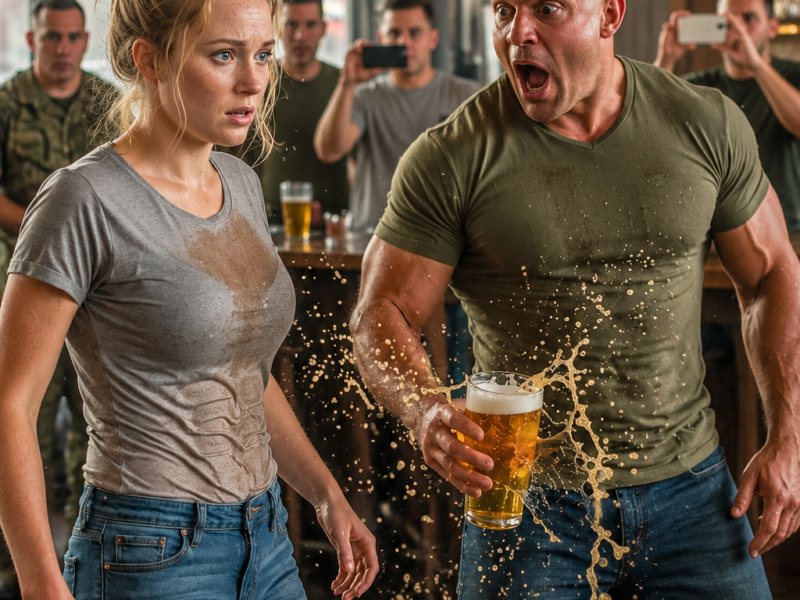
The sound of beer hitting denim echoed through the Anchor Point Bar, followed by a burst of laughter that seemed to shake the walls. Conversations stopped. Pool cues froze in midair. Even the bartender, who had spent years watching military personnel celebrate victories, drown their frustrations, and occasionally settle disagreements with their fists, looked up from the glass he was polishing.
“Oh, my bad, sweetheart.”
The man responsible for the mess wore a smug grin. His name was Rodriguez, an active-duty Navy SEAL whose enormous frame, shaved head, and heavily tattooed arms made him look more like a professional fighter than a military officer. He stood beside a woman sitting alone at the bar, holding an almost-empty beer bottle in one hand. Golden liquid ran down the front of her faded denim jacket, soaking through the gray T-shirt underneath.
The woman didn’t immediately respond.
Instead, she slowly placed her phone on the polished wooden counter and looked down at the spreading stain. Her name was Jessica Walker. She was thirty-five years old, with light brown hair twisted into a messy bun, a few loose curls framing her face, and green eyes that seemed unusually calm for someone who had just been deliberately humiliated. Small freckles dotted her fair cheeks and the bridge of her nose.
She looked like an ordinary woman who had finished a long day at work and stopped for a quiet drink before going home.
In fact, she had just completed a twelve-hour shift in the emergency department at Coronado Medical Center. Her feet hurt, her shoulders ached, and she had barely eaten anything since breakfast. The last thing she wanted was trouble.
Unfortunately, trouble had found her.
“This isn’t a place for tourists, baby,” Rodriguez continued, leaning closer. Whiskey fumes accompanied his words. “Anchor Point is for real warriors. You should probably head home.”
Four members of his SEAL team erupted into laughter. One slapped the table while another raised his glass in celebration of his friend’s performance.
Around them, more than fifty patrons watched. Most were active-duty military personnel, veterans, contractors, and people who had spent enough time around the armed forces to recognize the familiar atmosphere of a military bar. Several reached for their phones, anticipating an entertaining confrontation.
Jessica simply pulled a handful of napkins from the dispenser.
She began blotting the beer from her shirt with slow, careful movements.
There was something almost clinical about the way she worked. She didn’t rub the fabric aggressively or make any unnecessary movements. She pressed the napkins against the wet area, absorbed the liquid, and replaced them when they became saturated.
Rodriguez interpreted her silence as fear.
“Hey, I’m talking to you.”
His expression hardened.
Before Jessica could answer, his enormous hand closed around her wrist.
It was a small action, almost casual in appearance, but it changed everything.
For a fraction of a second, Jessica looked down at his fingers. Then her eyes moved to the faint circular scar on her wrist, an old mark that looked like a healed bullet wound.
Something passed across her face.
It wasn’t anger.
It was recognition.
The next movement happened so quickly that almost nobody understood what they were seeing.
Jessica shifted her weight, rose from the stool, and rotated her arm. Rodriguez’s grip became the very thing that worked against him. His balance disappeared, his shoulder turned beyond its comfortable range, and suddenly his massive body was pressed against the wooden bar.
His arm was twisted behind his back.
His face was inches from the counter.
The entire sequence lasted barely two seconds.
Silence descended over the establishment.
Rodriguez struggled, but every attempt to move only tightened the restraint. Jessica maintained control without appearing to exert much effort. She had positioned herself at an angle that neutralized his size advantage, and her body weight was distributed with such precision that his strength became almost irrelevant.
Then a voice came from a corner booth.
“Let him go.”
Master Chief Fletcher had been sitting alone, nursing his third whiskey. He was a broad-shouldered man in his late fifties, with weathered features and the unmistakable posture of someone who had spent most of his adult life in military service.
Twenty-five years in special operations had taught him to recognize certain things.
He had noticed the way Jessica moved. He had seen the transition from sitting to standing, the placement of her feet, and the precise angle of the restraint.
Those weren’t movements learned from a weekend self-defense course.
They were the product of thousands of repetitions under conditions where a single mistake could mean death.
Jessica released Rodriguez immediately.
She returned to her stool, picked up her phone, and placed it beside her glass.
Rodriguez stumbled backward, rubbing his wrist. His face had turned red, partly from embarrassment and partly from anger.
“Lucky shot,” he muttered.
But the uncertainty in his eyes betrayed him.
In years of military training, advanced operator courses, and operational deployments, he had never been neutralized so cleanly by someone half his size.
“A water, please,” Jessica said.
The bartender, Jake, nodded.
He had once served as an Army Ranger and had worked at Anchor Point for three years. His arms were covered in military tattoos, and his face carried the quiet confidence of someone who had seen more than enough violence to know that the loudest person in a room was rarely the most dangerous.
He placed a glass of ice water in front of Jessica.
“Anything else?”
“No, thank you.”
Jake studied her for a moment.
She had already returned to her original posture, but something about her behavior bothered him in a way he couldn’t explain. Her eyes moved occasionally across the room, registering the exits, the people standing near the entrance, and the changing positions of the men surrounding her.
She wasn’t looking around nervously.
She was assessing the environment.
It was a habit Jake recognized from his military years.
“Military Krav Maga,” someone muttered from the corner.
The speaker was Thompson, a veteran in his fifties wearing a faded Army jacket. His beard was gray, and alcohol had softened his movements, but his eyes remained unusually sharp.
“Not the gym version,” he added. “Real military training.”
A heavyset man near the dartboard laughed.
His name was Dimitri, a private military contractor who weighed nearly 250 pounds and looked as though he had been built from concrete. Years working in conflict zones had given him an enormous amount of confidence in his physical abilities.
“Lucky grab,” Dimitri said with a thick Slavic accent. “Little nurse probably watched some videos online.”
The word nurse traveled through the crowd.
Someone recognized Jessica from Coronado Medical Center. Another patron remembered seeing her in scrubs during an emergency visit a few months earlier.
The story immediately changed.
Apparently, an ordinary emergency room nurse had somehow managed to embarrass a Navy SEAL.
The crowd relaxed, and several people began smiling again.
A few expected Rodriguez to challenge her once more. Others thought the incident was over.
Jessica wanted it to be over.
She had no interest in proving anything.
Then the entrance opened, and Elena Rodriguez hurried inside.
Elena was a nurse at Coronado Medical Center. She had worked alongside Jessica for nearly two years and knew her better than most people in the hospital.
She had seen Jessica handle gunshot victims, highway accidents, cardiac arrests, and mass-casualty emergencies with extraordinary composure.
Her eyes immediately found Jessica.
“Jess?”
Jessica looked up and gave a barely noticeable shake of her head.
Elena understood.
She sat near the bar, close enough to intervene if necessary but far enough not to make the situation worse.
Rodriguez, meanwhile, was struggling to recover his pride.
“You got lucky,” he announced.
Jessica took a sip of water.
“Maybe.”
“How about we settle this properly? Arm wrestling. Right here.”
His teammates cheered.
An arm-wrestling match was familiar territory. Rodriguez had never lost to anyone in his team. His arms were enormous, his forearms thick with muscle, and his confidence had returned now that he could choose a contest that favored his physical strength.
Jessica shook her head.
“No, thank you.”
“Scared?” Captain Hayes asked.
Hayes was the only female Navy officer in Rodriguez’s group. Her blonde hair was pulled into a regulation bun, and her uniform-like posture suggested someone accustomed to having people follow her instructions.
“Beating someone through a surprise attack is one thing,” she continued. “Facing them in a fair contest is something else.”
Jessica placed her glass down.
She turned toward Hayes.
“Tell me something. Third phase of BUD/S training, week five. What’s the standard procedure for underwater knot tying when your dive partner experiences shallow-water blackout?”
Hayes blinked.
The question was so specific that it seemed to interrupt the rhythm of the entire room.
“How would you know about that?”
“Because the procedure they’re teaching is wrong.”
Jessica spoke calmly.
“The recovery position being recommended can increase the risk of secondary drowning if the casualty isn’t managed correctly. Anyone who has actually dealt with combat diving emergencies should know that.”
Hayes’s expression changed.
She had expected an insult, perhaps another sarcastic response.
Instead, she had received a technical question that touched on specialized training most civilians would never encounter.
Jake stopped polishing his glasses.
“Interesting,” he said.
He looked beneath the counter and retrieved a Glock 19 used for demonstrations during concealed-carry classes. The weapon was unloaded, and he made sure everyone understood that before placing it on the bar.
“You talk like someone who knows weapons. Let’s see something.”
Jessica glanced at it.
“How fast can you field-strip one of these?”
“Depends on the condition and the tools.”
“Without tools?”
“Twenty-three seconds, approximately.”
Jake raised an eyebrow.
“The record here is thirty-two seconds. Set by a former SEAL Team Six operator.”
He slid the unloaded pistol toward her.
“Show me.”
Jessica looked at the weapon for a moment.
Then she picked it up with her left hand.
Her right hand continued holding the glass of water.
What happened next would eventually become the most discussed part of the entire evening.
There was no dramatic display. No exaggerated movement. No attempt to impress the audience.
Jessica simply performed the task.
Her hands moved with the quiet efficiency of someone who had repeated the same action so many times that conscious thought was no longer necessary.
The components came apart in a controlled sequence and were placed neatly on the counter.
Jake checked his stopwatch.
“Fifteen point four seconds.”
He stared at the display.
Then he looked at Jessica.
“That’s not possible.”
Jessica returned the components to him.
“Apparently it is.”
Nobody laughed.
Rodriguez stood silently, his earlier confidence slowly disappearing.
Thompson leaned forward, studying Jessica with an expression that had become almost unsettling.
“You smell like death,” he said.
Jessica looked at him.
“Excuse me?”
“Not hospital death. Something else. The kind that follows people out of places where the Geneva Convention is treated like a suggestion.”
For the first time, Jessica’s expression became slightly colder.
“That’s enough.”
But Dimitri had already stood up.
His enormous frame cast a shadow over the woman sitting at the bar.
“Smart-mouth nurse needs lesson in respect,” he said. “In my country, we have ways of dealing with women who forget their place.”
Marcus, the bouncer, moved away from the entrance.
At six-foot-four and built like a former Marine, he was more than capable of handling most confrontations. His hand moved toward the baseball bat kept behind the door.
Elena half rose from her chair.
Fletcher lifted one hand.
“Wait.”
Something in the Master Chief’s expression told Marcus that the situation was no longer an ordinary bar disturbance.
Dimitri reached for Jessica’s shoulder.
He intended to turn her around and force her to face him.
But Jessica didn’t resist the initial movement.
She moved with it.
Her body rotated slightly, her weight shifted, and Dimitri’s own momentum carried him beyond his balance. A sudden movement brought him down against the floor, where he landed gasping, struggling to draw a full breath.
Jessica hadn’t even left her stool.
Her water glass remained in her hand.
She looked down at him.
“Are you finished?”
Dimitri couldn’t immediately answer.
The room was completely silent.
This time, nobody mistook what had happened for luck.
The door opened.
A tall man in his early sixties entered with two officers accompanying him.
Colonel David Brooks.
His reputation preceded him. He had commanded elite military units, participated in operations that were rarely discussed outside secure rooms, and spent decades dealing with people whose names would never appear in newspapers.
His eyes moved across the room.
He noticed Dimitri on the floor.
He noticed Rodriguez’s reddened wrist.
Then he noticed Jessica.
His expression changed.
“Who taught you that?”
Jessica slowly turned toward him.
For the first time that evening, the exhaustion on her face became more visible.
“Excuse me?”
“That takedown. That’s not standard close-quarters combat training. Not even the version taught to most special operations personnel.”
Jessica didn’t answer.
Brooks took another step forward.
“Where did you learn it?”
Before she could respond, Fletcher stood up from his booth.
He had already been making a phone call. His face was pale, and his voice had become unusually quiet.
Rodriguez noticed the sudden attention and interpreted it as an opportunity.
He and his teammates moved closer, forming a loose semicircle around Jessica.
“Everyone who’s served has a call sign,” he announced.
His confidence had returned, although it was now mixed with something resembling desperation.
“If you’re really some kind of operator, then tell us yours.”
Jessica looked at him.
“I don’t have one.”
“Bullshit,” Hayes replied.
“Everyone in special operations has a call sign. It’s part of the culture. You’re either lying or pretending to be someone you’re not.”
Jessica lowered her eyes toward the water glass.
Outside, a black SUV entered the parking lot.
Its headlights swept across the tinted windows before the vehicle stopped abruptly near the entrance.
Inside the bar, Rodriguez stepped closer.
“Last chance. Tell us your call sign, or we’ll assume you’re another wannabe trying to steal the reputation of people who actually served.”
Jessica said nothing.
Five trained operators now stood around a woman who had come into the establishment hoping for a quiet drink.
She could have left the stool at any moment.
She could have moved through the nearest gap before any of them understood what was happening.
But she didn’t.
She was tired.
And more than anything, she wanted to keep the past buried.
Fletcher ended his phone call.
“Stand down, Lieutenant.”
Rodriguez turned.
“Master Chief, this woman just—”
“I said stand down.”
The command carried an authority that made several people straighten instinctively.
Fletcher had retired years earlier, but the reputation he had earned in the teams had never disappeared.
Rodriguez hesitated.
“She needs to answer the question.”
“She doesn’t owe you anything.”
“Then what’s her call sign?”
Fletcher looked directly at him.
For a moment, he seemed to struggle with whether he should answer.
Before he could speak, the front door opened with enough force to make everyone turn.
Admiral Morrison entered.
He wore civilian clothes, jeans and a dark polo shirt, but nothing about his appearance diminished the authority he carried. He was a senior commander within Naval Special Warfare, a man whose decisions could redirect entire military organizations.
His breathing was slightly heavy, as though he had hurried from his vehicle.
He surveyed the room in seconds.
His eyes found Colonel Brooks.
Then Fletcher.
Then Jessica.
And when he recognized her face, something extraordinary happened.
The admiral stopped moving.
His expression changed from concern to disbelief.
Jessica looked back at him.
For the first time that evening, her carefully controlled composure began to crack.
Her shoulders tightened.
Her fingers trembled slightly.
Not because she was afraid.
Because she recognized the man who stood before her.
“Admiral,” Brooks began. “We have a situation.”
Morrison raised one hand.
The colonel stopped speaking.
Rodriguez, unaware of what was happening, took another step toward Jessica.
“Tell everyone your call sign,” he demanded. “Or admit you’re a fraud.”
Jessica slowly stood.
She was only five-foot-six, considerably shorter than the men surrounding her.
Yet something about her posture changed the atmosphere.
Her feet settled firmly beneath her. Her shoulders squared. Her chin lifted slightly.
The woman who had spent the last hour trying to disappear was suddenly impossible to ignore.
She looked directly at Rodriguez.
Then she spoke.
“Viper One.”
The words were quiet.
Almost gentle.
But their effect was immediate.
Rodriguez had been raising his beer bottle toward his lips.
His hand stopped halfway.
His fingers loosened.
The bottle slipped from his grip and crashed against the wooden floor.
Beer spread around his boots.
He didn’t notice.
His face had gone completely pale.
Fletcher took an involuntary step backward.
Hayes covered her mouth.
Jake dropped the glass he had been polishing.
Even Colonel Brooks seemed to lose his balance for a moment.
“No,” he whispered.
Thompson, who had been standing near the corner, slowly sank to his knees.
“Oh, my God.”
His eyes remained fixed on Jessica.
“The ghost sniper.”
He swallowed.
“You’re the ghost sniper.”
Dimitri, still sitting on the floor, looked up at her with an expression of disbelief.
Brooks shook his head.
“That’s impossible. You died at Blackwater. The entire unit was listed as killed in action. I personally reviewed the after-action report.”
Admiral Morrison stepped forward.
Then, in front of more than fifty stunned witnesses, the senior officer did something nobody in the establishment would ever forget.
He dropped to one knee.
“Master Chief Viper,” he said, his voice thick with emotion. “I’m sorry. I’m so sorry I didn’t recognize you.”
Jessica closed her eyes briefly.
For ten years, she had tried to become someone else.
For ten years, she had lived without the name that had once defined her.
And now, in a crowded military bar, the past had found her again.
Rodriguez sank onto a nearby stool.
His mind struggled to connect the woman who had just been insulted by his team with the legendary operator whose name had appeared in classified briefings.
“Viper One?” he whispered.
Hayes finally found her voice.
“You’re the operator from Task Force Black?”
Jessica didn’t answer.
Fletcher did.
“October fifteenth, 2014. Operation Blackwater.”
The date seemed to change the air in the room.
Every veteran present knew that something terrible had happened during that operation.
Few knew the details.
Even fewer understood the scale of the disaster.
Morrison slowly stood and addressed the room.
“Master Chief Jessica Walker, call sign Viper One, served as a primary sniper and special operations specialist with Task Force Black. Her record remains among the most extraordinary in the history of American special operations.”
He paused.
“Until ten years ago, most of you wouldn’t even have been permitted to know her name.”
A voice from the crowd whispered the number.
“One hundred and twenty-seven confirmed kills.”
Jessica looked down.
She didn’t seem proud.
She looked tired.
Hayes stared at her.
“You were the only woman to complete that selection process?”
Jessica finally spoke.
“That’s what the records say.”
Fletcher nodded.
“And Blackwater was the reason everyone thought you were dead.”
Morrison took a slow breath.
“Six operators were inserted into eastern Afghanistan to evacuate seventy-three civilians from a compound threatened by advancing Taliban forces. The intelligence suggested limited resistance. We expected a difficult extraction, but nothing beyond the capabilities of the team.”
His jaw tightened.
“It was a trap.”
The bar had become so quiet that the sound of the ice melting in Jessica’s glass seemed unusually loud.
“Three hundred enemy fighters surrounded the compound before the team could complete the evacuation. Heavy weapons, prepared defensive positions, and no reliable route for reinforcement.”
He looked at Jessica.
“Five of the six operators were killed within the first fifteen minutes.”
Nobody moved.
“Viper One held that position for sixteen hours.”
Morrison’s voice cracked.
“Alone.”
He continued, explaining how Jessica had kept the enemy forces occupied while organizing the evacuation of the civilians. She had established defensive positions, protected the survivors, and repeatedly exposed herself to enemy fire to ensure that people who had never held a weapon in their lives could reach the extraction point.
She had watched her teammates die.
She had been wounded repeatedly.
And despite injuries that should have made survival impossible, she had continued fighting until the last civilian was safely evacuated.
“Seventy-three people,” Morrison said. “All of them made it out.”
Jessica lowered her eyes.
“Not all of them came out unharmed.”
“But they came out alive,” he replied.
A long silence followed.
Then Jessica spoke.
“There were two children in the last group.”
Her voice had changed.
It was no longer the voice of a military operator discussing a mission.
It was the voice of a woman remembering something she had never managed to forget.
“Rasheed was eight. His sister, Amira, was six. She had been shot in the leg, and Rasheed refused to leave her.”
Jessica looked toward the window.
“I carried them both across about two hundred meters of open ground. Everyone was shooting at us. Rasheed kept saying he would be brave. He kept telling me he would be brave like me.”
She paused.
“He was eight years old. He was trying to comfort me.”
Elena felt tears gathering in her eyes.
For two years, she had watched Jessica save people in the emergency department. She had seen her remain calm during impossible situations and work through exhaustion without complaining.
Now she understood something about that calmness.
Jessica hadn’t simply learned to function under pressure.
She had survived a place where nearly everything she loved had been taken from her.
Brooks approached carefully.
“The official report lists you as killed in action. How did you survive?”
Jessica took a breath.
“Sixty-seven injuries. Shrapnel, bullets, blast trauma. I died twice during evacuation.”
She touched the faint scar on her wrist.
“I spent eight months at Walter Reed under an assumed identity. When I finally recovered enough to leave, my team was gone. The operation had been classified beyond ordinary records. My identity had effectively disappeared.”
She looked at Morrison.
“Master Chief Jessica Walker died in that valley. I decided to let her stay dead.”
“And became a nurse,” Elena whispered.
Jessica nodded.
“I wanted to save lives without having to think about taking them.”
She looked around the bar.
“Every gunshot wound that comes through the emergency department reminds me of someone. Every frightened child, every mother waiting outside a trauma room, every person who thinks their life is over because something terrible happened in one terrible moment.”
Her voice softened.
“I know what it feels like to lose everything. If I can help someone avoid that, even once, then maybe the things I couldn’t change back then can mean something now.”
Nobody had an answer.
Then Jessica’s phone rang.
She looked at the screen.
Her expression changed immediately.
She answered on the second ring.
“Blackjack.”
The voice on the other end was indistinct, but Jessica’s face gradually lost color.
“When?”
She listened.
“How many?”
Another pause.
“Understood. Send the intelligence package.”
She ended the call.
Morrison stepped closer.
“Langley?”
Jessica nodded.
“What happened?”
She remained silent for several seconds.
Then she said a name.
“Rasheed.”
The name seemed to bring the entire room back to Blackwater.
Jessica explained that the boy she had carried through the valley ten years earlier was now eighteen. He had grown up, reunited with his sister, and eventually established a school for girls in Kabul.
The school had become a symbol of resistance against the Taliban’s efforts to deny education to women.
Rasheed had helped recruit teachers, organize lessons, and create opportunities for children who otherwise might never have learned to read.
His sister, Amira, had become one of the school’s most committed organizers.
Three days earlier, Taliban fighters had captured him.
“They want to use him as leverage,” Jessica said. “He’s become a symbol. The boy who survived Blackwater and grew up to build a school where they wanted ignorance.”
She swallowed.
“They intend to execute him publicly in seventy-two hours.”
Elena covered her mouth.
“What about his sister?”
“She’s missing.”
Morrison understood immediately.
“They have her too.”
Jessica nodded.
The admiral looked at her for a long moment.
“Are they asking for you?”
“They’ve been sending messages. They know about Blackwater. They want the ghost to come back.”
Brooks looked toward Morrison.
“This is an intelligence operation now.”
“No,” Jessica interrupted. “It’s a rescue.”
Rodriguez finally spoke.
“You can’t go.”
Everyone turned toward him.
He looked uncomfortable, but his words were sincere.
“You’re a civilian now. You’re a nurse. Whatever happened ten years ago, you’re not required to walk back into that world.”
Jessica studied him.
“You think I chose emergency medicine by accident?”
He said nothing.
“Every patient I treat is a reminder of why I made that choice. I didn’t become a nurse because I forgot how to fight. I became a nurse because I wanted to spend the rest of my life doing something different.”
She looked at her hands.
“But Rasheed is alive because I made him a promise.”
“What promise?” Elena asked softly.
Jessica looked up.
“That I’d watch over him. That he would have a chance to grow up. That one day he could live without being afraid.”
She turned toward the window.
“I can’t let that promise become another casualty report.”
Thompson slowly nodded.
“They never really leave us,” he said.
His words carried the weight of years spent trying to forget things that could never be forgotten.
Hayes wiped her eyes.
“What do you need?”
Jessica looked around the room.
Only an hour earlier, these people had been laughing at her, questioning her identity, and trying to force her into a contest of strength.
Now they were looking at her differently.
Not with curiosity.
With respect.
“I need to make a few calls,” she said. “Then I need to disappear for a while.”
Morrison nodded.
“Whatever you need. Officially, Viper One remains deceased. Nothing about tonight changes that.”
“Good,” Jessica replied. “She needs to stay dead on paper.”
Fletcher reached into his pocket.
He withdrew a worn challenge coin and placed it on the bar.
The metal was old, its edges softened by years of handling.
“Task Force Black,” he said.
Jessica stared at it.
“My brother served there. Sergeant First Class Mickey Fletcher. You knew him as Rodeo.”
For a moment, she couldn’t speak.
Then she picked up the coin.
Her thumb moved slowly over the familiar markings.
“Rodeo,” she whispered.
“He talked about you all the time,” Fletcher continued. “He said his little brother was going to become the best Master Chief in the Navy.”
Jessica’s eyes filled.
“He was a good man.”
“He was.”
Fletcher looked down.
“I’ve spent ten years wondering whether anyone remembered what happened to those men.”
Jessica closed her fingers around the coin.
“I remember every one of them.”
The words were simple.
But Fletcher understood what they meant.
Outside, more vehicles were arriving.
Black SUVs and unmarked sedans were filling the parking lot. Calls were being made, permissions quietly discussed, and old contacts were being awakened.
Rodriguez approached Jessica.
For the first time that evening, there was no arrogance in his expression.
“I’m sorry.”
She looked at him.
“For the beer. For grabbing you. For the way I spoke to you. For everything.”
Jessica studied him.
“You weren’t supposed to know who I was.”
“I should have known better than to treat someone like that.”
She considered his words.
“Your record is impressive, Rodriguez. Three Bronze Stars, two Purple Hearts, successful deployments in Iraq and Syria. You’re a good operator.”
He lowered his eyes.
“But being good at the job isn’t the same as understanding what the job costs. Tonight you learned something. What you do with that lesson is up to you.”
Rodriguez nodded.
“Understood.”
Jessica moved toward the entrance.
Hayes called after her.
“You can’t do this alone.”
Jessica paused.
“I’ve been alone for ten years.”
“But you don’t have to be anymore,” Morrison replied.
She turned.
The admiral looked around the room.
“This time, you have people willing to stand beside you.”
Jessica didn’t immediately respond.
Then she nodded once.
She walked out into the night.
For several seconds, the Anchor Point remained completely still.
Then the room came alive.
Tables were pushed together. Laptops appeared. Phones displayed satellite images and encrypted messages. People who had been preparing for a bar fight were now discussing an operation that officially did not exist.
Morrison began making calls.
Brooks contacted senior officials.
Fletcher started reaching out to people he had not spoken to in years.
Rodriguez and Hayes began organizing volunteers.
Dimitri, still nursing his bruised ribs, quietly offered access to contacts in the private security community.
Nobody wanted recognition.
Nobody wanted medals.
They wanted Rasheed and his sister brought home.
Outside, Jessica sat inside her ten-year-old Honda Civic.
The engine was running, but the transmission remained in park.
She gripped the steering wheel.
For the first time since entering the bar, she allowed herself to cry.
Only thirty seconds.
Then she wiped her face, opened the encrypted message from Langley, and studied the intelligence package.
Satellite images showed a compound in eastern Afghanistan.
The surrounding terrain looked painfully familiar.
She recognized the mountains, the dry riverbeds, and the harsh landscape that had haunted her dreams for a decade.
Photographs of Rasheed appeared on the screen.
He was no longer the frightened eight-year-old boy she remembered.
He was a young man with kind eyes and a determined expression.
Beside him stood Amira.
Her face was older, but Jessica recognized the same stubborn courage.
The intelligence report included estimated enemy strength, the location of the compound, and a probable execution date.
The situation was difficult.
A single operator, no matter how experienced, could not safely extract fourteen hostages from a heavily defended location.
Jessica knew that.
She also knew what happened when a team entered a mission without adequate preparation.
Blackwater had taught her that lesson at a terrible price.
Her phone rang again.
Fletcher.
“You’ve got twelve operators ready,” he said without wasting time.
Jessica closed her eyes.
“Master Chief, I haven’t even agreed to anything.”
“Twelve volunteers. All with serious operational experience. Transportation is being arranged. Equipment is being sourced. Morrison is handling the political side, and Brooks is dealing with the Pentagon.”
“Tell them to stand down.”
“No.”
“Fletcher.”
“Respectfully, Master Chief, no.”
She was silent.
“Ten years ago, you saved seventy-three people when everyone thought it was impossible. One of those children is now asking for help. We’re not going to sit in a bar and pretend we didn’t hear him calling.”
Jessica looked into the rearview mirror.
Through the glass, she could see operators leaving Anchor Point.
Rodriguez was speaking on his phone.
Hayes was carrying a laptop.
Others were loading equipment into vehicles.
They were the same people who had laughed at her earlier.
Now they were willing to risk their careers, their reputations, and possibly their lives.
“Why?” she asked.
Fletcher’s answer came immediately.
“Because Rasheed was eight years old and tried to be brave for you. Now it’s our turn to be brave for him.”
Jessica looked down at the challenge coin.
Something inside her shifted.
For ten years, she had carried the burden of survival as though it were a punishment.
She had believed that surviving when her teammates died meant she owed the world an impossible debt.
Now, for the first time, she understood that perhaps she didn’t have to carry everything alone.
“All right,” she said.
Fletcher waited.
“But if we do this, we do it properly. No cowboys. No glory seekers. No unnecessary risks. We get Rasheed, Amira, and the teachers out. Everyone comes home.”
“Roger that, Viper One.”
Jessica put the car into gear.
“Everyone comes home.”
Three days later, an unmarked cargo aircraft touched down at a remote airfield under cover of darkness.
Officially, the flight did not exist.
Its records showed an ordinary supply movement that had never taken place, carrying equipment that had never been delivered for a mission that would never be acknowledged.
Jessica stepped down the aircraft ramp.
The smell of aviation fuel mixed with desert dust.
For a moment, she stood completely still.
Ten years disappeared.
She could almost hear the distant sound of helicopters from Blackwater. She could almost feel the weight of the old equipment on her shoulders and the familiar tension of preparing for an operation.
She was no longer wearing hospital scrubs.
She wore unmarked tactical clothing, with no name tape or insignia.
There was nothing on her uniform that could identify her.
“Viper One. Welcome back.”
Fletcher emerged from the shadows beside a line of vehicles.
He was dressed in similar equipment.
Behind him stood eleven more operators.
Rodriguez.
Hayes.
And nine volunteers who had answered the call.
Jessica looked at them.
Rodriguez stood differently now. His earlier arrogance had disappeared. His expression was focused, his equipment carefully checked, and his attention entirely on the mission.
“Sitrep,” Jessica said.
Fletcher unfolded a tablet.
“Rasheed and the others are being held in a compound approximately twenty kilometers northeast of our position. Same general region as Blackwater, different valley.”
He displayed the satellite imagery.
“The enemy has established observation positions around the perimeter. They’re expecting an assault.”
“Specifically,” Hayes added, “they’re expecting you.”
Jessica studied the photographs.
The Taliban had been broadcasting messages for three days, promising that the ghost of Blackwater would witness another family die.
They wanted her to return.
They wanted revenge.
They believed that the same woman who had once survived their forces would walk into another impossible situation and lose everything again.
“They have more than Rasheed,” Rodriguez said.
Jessica looked at him.
“Fourteen hostages total. Amira is there, along with twelve female teachers from the school. They’ve been sentenced to death for educating girls.”
The information settled heavily over the group.
Fourteen lives.
Fourteen people whose only crime was believing that girls deserved the opportunity to learn.
Jessica looked at the satellite image again.
The compound was heavily fortified, with thick outer walls and limited access points. The surrounding terrain favored its defenders.
A conventional approach would place the hostages at immediate risk.
“They want the ghost of Blackwater,” Jessica said quietly.
Fletcher nodded.
“Looks that way.”
Jessica studied the image for several more seconds.
Then, unexpectedly, she smiled.
“Then let’s give them exactly what they’re expecting.”
The next two days were spent preparing.
Every member of the team understood that this operation would demand discipline and absolute trust.
There would be no room for personal pride.
Rodriguez listened carefully as Jessica reviewed the plan.
Hayes checked the available intelligence and coordinated the rescue priorities.
Fletcher handled communication and ensured that every team member understood the broader objective.
They discussed contingencies, evacuation arrangements, and what would happen if the situation changed unexpectedly.
Jessica insisted on one thing above everything else.
The hostages came first.
Not the destruction of the compound.
Not revenge.
Not a demonstration of military superiority.
Fourteen people had to leave alive.
As dawn approached on the morning of the operation, the Hindu Kush mountains began to glow with pale gold light.
A lone figure appeared in the valley.
Jessica.
She walked slowly toward the compound with her hands visible and no obvious weapons.
From a distance, she looked vulnerable.
The Taliban fighters spotted her almost immediately.
Excited voices crackled over their radios.
The ghost of Blackwater had returned.
Their commanders rushed to the defensive positions.
Weapons were raised.
More fighters appeared along the walls.
In concealed positions throughout the surrounding terrain, Jessica’s team watched.
Rodriguez lay behind a rocky outcrop.
Hayes monitored the changing situation.
Fletcher coordinated the team.
Everyone understood that Jessica’s presence was the center of the operation.
She had to convince the enemy that she had come alone.
And she had to remain calm while walking directly toward people who had spent ten years dreaming about killing her.
At the compound entrance, a man stepped forward.
He was in his fifties, with scars across his face and hatred in his eyes.
“You are Viper,” he said in accented English.
Jessica stopped.
“I’m here for Rasheed.”
The commander laughed.
“You remember him?”
“I remember carrying him out of a valley when he was eight years old.”
“He grew into a foolish man.”
“He grew into someone who believes children deserve an education.”
The commander’s expression hardened.
“He has corrupted our people.”
“He taught girls to read.”
“He challenged our authority.”
“He gave them hope.”
The man raised his weapon slightly.
“You come here alone and demand that we surrender fourteen prisoners?”
Jessica looked directly into his eyes.
“You want me. Let them go.”
The commander smiled.
“You think you have leverage?”
He gestured toward the compound.
More fighters appeared along the walls.
“You will watch them die. The boy will die first. Then his sister. Then the teachers. And finally, you.”
Jessica remained still.
“Seventeen seconds,” she said.
The commander frowned.
“What?”
“That’s how long you have before you understand what you’ve done.”
He raised his weapon.
Jessica began counting.
“Sixteen.”
The commander’s expression changed.
“Fifteen.”
Somewhere in the valley, Rodriguez adjusted his position.
“Fourteen.”
Fletcher’s voice came through the communication system.
“All teams, hold.”
Jessica continued.
“Ten.”
The commander shouted an order.
“Nine.”
The enemy fighters tightened their grips.
“Eight.”
The morning air seemed to become unnaturally still.
“Seven.”
Rodriguez waited.
“Six.”
Jessica’s eyes remained fixed on the commander.
“Five.”
Fletcher gave the final confirmation.
“Stand by.”
“Four.”
The commander’s finger moved toward the trigger.
“Three.”
Jessica shifted her weight.
“Two.”
The commander raised his weapon toward her head.
“One.”
The valley erupted.
The operation began in a sudden burst of coordinated movement.
The commander’s attention was interrupted, and the defenders found themselves confronted by an attack they had not anticipated.
Jessica moved immediately.
She crossed the remaining distance to the entrance, using the confusion to get inside.
Behind her, the team advanced according to the plan.
The Taliban’s carefully prepared defensive positions began to collapse.
For the first time that morning, the defenders understood that the woman they had invited into their trap had brought an entire team with her.
Inside the compound, alarms sounded.
Fighters ran toward the main courtyard.
Jessica moved through the confusion, guided by the intelligence she had studied for two days.
Her objective was the holding area.
She reached the basement entrance and found a locked door.
Beyond it, she heard voices.
“Rasheed!”
There was a moment of silence.
Then a familiar voice answered.
“Who’s there?”
Jessica opened the door.
Fourteen people were gathered in the dim room.
Some were sitting against the walls. Others were standing, supporting those who could no longer remain upright.
Rasheed was among them.
He was taller now, his face thinner, and his expression carried the exhaustion of someone who had endured several days of fear.
Beside him stood Amira.
Her leg showed an old scar from the injury she had suffered ten years earlier.
When Rasheed saw Jessica, he stopped breathing for a moment.
“Viper?”
His voice broke.
“They told us you were dead.”
Jessica looked at him.
“They told me a lot of things, too.”
She approached him.
“I promised I’d watch over you.”
Rasheed’s eyes filled with tears.
“You came back.”
“I did.”
She turned toward the other prisoners.
“Can everyone move?”
A woman nodded.
Another began crying.
Jessica helped them prepare to leave.
There was no time for a long reunion.
The rescue had to continue.
Rasheed remained beside her as the group moved toward the extraction point.
Outside, the team maintained control of the situation and ensured that the hostages could move safely.
Rodriguez and Hayes joined the evacuation group.
Fletcher coordinated the withdrawal.
Jessica counted the civilians repeatedly.
She checked faces.
She checked names.
She checked that nobody had been left behind.
For ten years, she had remembered the faces of the seventy-three people from Blackwater.
She remembered the children.
The injured.
The elderly.
The people who had looked at her with terrified eyes and trusted her to get them home.
She had failed to save her team.
But she had saved them.
This time, she would not allow the ending to be different.
Eventually, the group reached the designated extraction area.
Two helicopters waited on a plateau, their rotors already turning.
The teachers climbed aboard.
Rasheed helped Amira into the aircraft.
Jessica performed one final head count.
Thirteen.
Fourteen.
Everyone accounted for.
She exhaled slowly.
For the first time in ten years, she allowed herself to believe that perhaps the past did not always have to repeat itself.
Then she noticed movement.
A young fighter emerged from behind a damaged structure.
He couldn’t have been older than sixteen.
Blood covered one side of his face, and his hands trembled around an old rifle.
The weapon was pointed toward Jessica and the helicopter.
The team immediately reacted.
Weapons shifted toward the teenager.
Jessica could have ended the threat.
Every instinct developed through years of military training told her that the situation demanded an immediate response.
But she looked into the boy’s eyes.
She saw something familiar.
Fear.
Not hatred.
Not confidence.
Not even the conviction of someone who truly understood the war he was fighting.
Just fear.
She remembered Rasheed at eight years old.
She remembered how he had clung to her during the Blackwater evacuation, trying to be brave while bullets struck the ground around them.
She remembered how small his hands had felt when she carried him.
Jessica slowly lowered her weapon.
“Don’t,” Rodriguez said quietly.
She raised one hand.
The team held its position.
Then Jessica spoke to the boy in Pashto.
“Go home to your mother.”
The teenager stared at her.
His finger trembled against the trigger.
Jessica continued.
“You’re still young. This war has taken enough children. You don’t have to die here.”
The boy’s eyes moved between her and the soldiers surrounding him.
For several long seconds, nobody moved.
Then his rifle lowered.
His hands relaxed.
He stepped backward.
Jessica didn’t follow him.
She simply watched as he turned and disappeared into the morning shadows.
“Mount up!” Fletcher called.
Jessica climbed aboard.
Rodriguez reached out and pulled her inside.
The helicopter lifted away from the plateau.
Below them, the compound gradually disappeared into the distance.
Jessica sat beside Rasheed.
For several minutes, neither spoke.
Then the young man reached for her hand.
His grip was firm, but there was something familiar about it.
Ten years earlier, she had carried him through a battlefield.
Now he was sitting beside her, alive, offering comfort to the woman who had saved him.
Amira looked across the cabin.
“The boy with the rifle,” she said quietly. “Why didn’t you shoot him?”
Jessica stared out at the mountains.
She thought about her teammates.
About Blackwater.
About the people she had killed and the people she had failed to save.
Then she answered.
“Because I’ve killed enough.”
She paused.
“Every enemy fighter was once someone’s child. Sometimes people are pushed into terrible things before they even understand what they’re doing.”
She looked toward Amira.
“Choosing not to kill when you have the ability to do so can be harder than pulling the trigger. But sometimes it’s the only choice that gives someone a chance to become something different.”
Amira nodded slowly.
Rasheed squeezed Jessica’s hand.
The helicopters eventually reached a forward operating base where the entire mission would officially remain undocumented.
The rescued teachers received medical attention.
Rasheed and Amira were reunited with representatives who could help them relocate to a safer environment.
The fourteen civilians would eventually receive new identities and assistance rebuilding their lives somewhere the Taliban could no longer reach them.
The operators gathered for a final briefing.
No medals were discussed.
No official photographs were taken.
There would be no public ceremony.
But the atmosphere was different from the one at Blackwater.
Fourteen people had survived.
Every member of the rescue team had returned.
No American casualties.
For Jessica, that last fact meant more than any military decoration ever could.
Rasheed approached her before the group separated.
He stood directly in front of her, looking into her eyes.
“You gave me life twice,” he said. “How do I repay you?”
Jessica smiled faintly.
“You already have.”
He shook his head.
“I don’t understand.”
“Every girl who learned to read in your school. Every student who discovered that she could have a future. Every teacher who refused to give up. That’s how you repay me.”
She placed a hand on his shoulder.
“Keep teaching, Rasheed. Keep building schools. Keep giving people opportunities. That’s how we really win this war.”
Rasheed lowered his head.
Then he embraced her.
Jessica held him for a moment longer than she intended.
When they separated, Amira stepped forward and hugged her too.
For the first time in a decade, Jessica felt that something lost at Blackwater had finally been returned to her.
Not her teammates.
Not the life she had lived before the operation.
Those things could never come back.
But the promise she had made to two frightened children had been fulfilled.
Hayes approached next.
She looked uncomfortable, as though she wasn’t accustomed to expressing emotion openly.
“Thank you,” she said.
Jessica raised an eyebrow.
“For what?”
“For showing me what real strength looks like.”
Jessica smiled.
“Keep being a good officer.”
Hayes hugged her.
Rodriguez approached afterward.
He stood straight and rendered a formal salute.
There was no theatrical apology this time.
No attempt to impress anyone.
Just respect.
Jessica returned the salute.
Fletcher was the last to approach.
He handed her an envelope.
“What’s this?”
“Your discharge papers.”
Jessica looked at him.
He smiled.
“The real ones. There was a clerical issue with your status ten years ago. Your identity was never formally closed in the way everyone believed. The Navy has authorized the correction. You’re officially recorded as missing in action until the final administrative determination, and your retirement is being processed with full honors.”
Jessica opened the envelope.
Her name appeared on the first page.
MASTER CHIEF JESSICA WALKER.
She stared at the words.
For ten years, she had lived as though that name belonged to someone who no longer existed.
Now it was printed on an official document.
She felt something tighten in her chest.
“I don’t know what to say.”
“Say you’ll go back to the emergency department,” Fletcher replied.
She laughed softly.
“That’s the plan.”
“And say you’ll let us buy you a beer at Anchor Point when we get home.”
Jessica looked at him.
“Maybe.”
“That’s not an answer.”
“Fine. But I’m buying the first round.”
Fletcher smiled.
“Wouldn’t have it any other way.”
Six months later, Jessica stood in her apartment in San Diego, surrounded by cardboard boxes.
She was preparing to move.
Coronado Medical Center had offered her a promotion to head of trauma services. The position would involve developing new protocols for treating serious injuries and improving coordination between emergency medical teams and trauma specialists.
It meant more responsibility.
More visibility.
And an end to the anonymous existence she had carefully built.
She had accepted.
The past was no longer something she needed to hide from every person she met.
She had begun speaking with other veterans about trauma, loss, and the difficult transition from military service to civilian life.
Some days were still hard.
There were nights when she woke from dreams of Blackwater.
There were moments when the sound of helicopters made her hands tighten.
There were days when she looked at an injured child in the emergency department and remembered Rasheed.
But she was learning that healing did not mean forgetting.
It meant finding a way to live without allowing the past to control every moment of the future.
Her phone rang.
The number was international.
“Hello?”
A young female voice answered.
“Miss Viper?”
Jessica straightened.
“Who’s calling?”
“My name is Fazila. I was a student at Rasheed’s school.”
Jessica sat down.
“Hello, Fazila.”
The girl spoke carefully, her English heavily accented but understandable.
“I wanted to tell you something. I got accepted into medical school in London.”
Jessica smiled.
“That’s wonderful.”
“I received a full scholarship.”
“Fazila, that’s incredible.”
The young woman laughed nervously.
“Rasheed told us about you. He said you were the nurse who saved his life. He said you showed him that women could be warriors in different ways.”
Jessica looked toward the coffee table.
“He said that?”
“Yes. He told us you saved lives before, and then you came back and saved us again. I want to become a doctor. I want to help people too.”
Jessica felt her throat tighten.
“Then do it. Study hard. Work hard. And when you become a doctor, help someone who needs you.”
“I will.”
“Good luck, Fazila.”
“Thank you, Miss Viper.”
The call ended.
Jessica remained seated for several minutes.
Around her were boxes containing the pieces of a life she had spent years rebuilding.
On the coffee table lay three objects.
The challenge coin Fletcher had given her.
A photograph of her old Task Force Black team.
And a new photograph taken outside a rebuilt school.
Fourteen teachers and students stood together in front of the building.
Rasheed and Amira were in the center.
Everyone was smiling.
Jessica picked up the photograph.
For a long time, she had measured her life by the people she had lost.
Now she was beginning to measure it by the lives that continued because she had refused to give up.
Her phone buzzed.
A message from Rodriguez appeared.
Team dinner at Anchor Point tomorrow. 1900 hours. That’s an order, Master Chief.
Jessica laughed.
She typed back.
Copy that. But I’m buying the first round.
She placed the phone on the table.
Outside, the San Diego evening was settling into darkness.
The city lights spread across the horizon, and somewhere beyond the apartment windows, ordinary people were finishing their workdays, driving home, preparing dinner, and living lives that had nothing to do with military operations.
Jessica looked at her hospital identification badge.
Then she looked at the old photograph of Task Force Black.
For the first time, she no longer felt that she had to choose between those two versions of herself.
She could be the nurse who saved lives in a hospital.
She could remember the operator who had survived Blackwater.
She could honor the people she had lost without spending the rest of her life trying to become someone who no longer existed.
Her phone vibrated again.
This time, the message came from an unfamiliar number.
It contained no greeting.
No explanation.
Only a photograph of a document bearing the letterhead of an organization that officially did not exist.
Jessica recognized the name immediately.
Blackjack.
She opened the message.
Viper One, your unique experience may be required for a new humanitarian security assignment. Consulting basis only. Complete discretion. No formal deployment.
Below the message were several coordinates.
The location was not Afghanistan.
It was somewhere closer to home.
The accompanying intelligence summary suggested that a group of children had disappeared, and conventional authorities had been unable to establish their whereabouts.
Jessica read the document twice.
Then she placed her phone down.
She thought about Fazila, who was preparing to become a doctor.
She thought about Rasheed and Amira, who were rebuilding their school.
She thought about the sixteen-year-old fighter she had allowed to walk away.
And she thought about the people in the emergency department who would arrive tomorrow, frightened and injured, hoping that someone would be there to help them.
She understood something now that she hadn’t understood ten years earlier.
Being a warrior didn’t mean spending the rest of your life searching for another battlefield.
Sometimes it meant having the courage to walk away from violence.
Sometimes it meant choosing patience over anger.
Sometimes it meant standing between someone vulnerable and the people who wanted to hurt them.
And sometimes it meant knowing when your skills could make a difference, even when nobody would ever know what you had done.
Jessica picked up the phone again.
She studied the coordinates.
Then she looked through the window at the lights of San Diego.
Tomorrow morning, she would report to the emergency department.
She would put on her scrubs, check the patient list, and spend another day doing the work she had chosen.
But tonight, there was another possibility waiting.
She dialed the number from memory.
It rang once.
“Blackjack.”
Jessica looked down at the old challenge coin resting beside her phone.
“It’s Viper.”
A brief silence followed.
Then Blackjack spoke.
“I was wondering when you’d call.”
Jessica smiled faintly.
“I’m interested. But I have conditions.”
“I’m listening.”
“No unnecessary risks. No glory hunting. No treating people like expendable numbers. And if there are children involved, their safety comes first.”
“Understood.”
“And I still have a day job.”
Blackjack laughed quietly.
“I wouldn’t expect anything less.”
Jessica ended the call.
For a moment, she stood in the middle of her apartment, surrounded by the remains of a life she was still learning to understand.
She was no longer the frightened survivor who had left Walter Reed ten years earlier.
She was no longer simply the legendary sniper whose name appeared in classified military reports.
She was Jessica Walker.
A nurse.
A veteran.
A survivor.
A woman who had learned that the ability to take a life was not the greatest measure of strength.
The greatest measure was understanding when a life could still be saved.
She placed the phone beside her hospital badge and turned off the apartment lights.
On the kitchen counter, the challenge coin caught a small reflection from the streetlights outside.
Its worn surface carried the memory of people who had served, people who had sacrificed, and people who had never returned.
Jessica picked it up one final time.
“Still here,” she whispered.
Then she placed it beside the photograph of her old team.
The following morning, she would walk into the emergency department as she had done countless times before.
Patients would arrive.
Alarms would sound.
Families would wait anxiously outside treatment rooms.
And Jessica would do what she had always done.
She would show up.
She would remain calm.
She would fight for every life she could save.
Nobody in the hospital would need to know that the quiet woman treating their loved ones had once been called the ghost sniper.
Nobody needed to know that a decade earlier, she had held a compound against overwhelming odds to save seventy-three civilians.
Nobody needed to know that fourteen more people were alive because she had returned to the mountains and faced the past she had spent ten years trying to escape.
The people she saved didn’t need to know her call sign.
They only needed someone who refused to give up on them.
And perhaps that was the greatest transformation of all.
Viper One had once been known for her extraordinary ability to survive situations in which survival seemed impossible.
But the woman standing in the emergency department now understood that survival was only the beginning.
What mattered was what came afterward.
The lives rebuilt.
The children educated.
The promises kept.
The people who found the courage to choose a different future.
Somewhere in London, Fazila was preparing for her first semester of medical school.
Somewhere in Afghanistan, Rasheed and Amira were teaching another generation of girls to read.
Somewhere, the young fighter Jessica had spared might be remembering the strange American woman who had lowered her weapon and told him to go home to his mother.
And somewhere in San Diego, Rodriguez and Hayes were preparing for another dinner at Anchor Point, still remembering the night they had learned that the most dangerous person in the room was sometimes the one who had no desire to prove anything.
Jessica walked past the hospital windows as the morning sun rose over the city.
Her reflection appeared briefly in the glass.
For a moment, she saw all the versions of herself at once.
The young operator preparing for her first deployment.
The woman who had survived Blackwater.
The exhausted nurse who had entered a military bar hoping to drink water in peace.
And the woman who had finally learned that she could carry all those memories without allowing any single one of them to define her entire existence.
She adjusted her hospital badge and continued down the corridor.
There would always be battles somewhere.
Some would happen in distant mountains.
Others would happen in hospital rooms, classrooms, crowded streets, and quiet homes.
Some would be fought by soldiers.
Others would be fought by teachers, doctors, nurses, and ordinary people who refused to look away when someone needed help.
Jessica had spent years believing that her greatest achievement was surviving Blackwater.
Now she knew better.
Her greatest achievement was that, after everything she had experienced, she had still found a reason to care.
The ghost of Blackwater had returned, but she was no longer interested in becoming a legend.
She wanted to protect people who had no one else.
She wanted to help children grow up without learning the language of war.
She wanted to make sure that the next frightened eight-year-old would have the chance to become eighteen, twenty-five, or fifty without spending his life remembering the sound of bullets.
And if the world ever needed Viper One again, she would decide whether to answer that call on her own terms.
Because Viper One was never truly defined by the number of enemies she had defeated, the missions she had survived, or the classified achievements recorded in secret files.
She was defined by the seventy-three people she had refused to abandon.
By Rasheed and Amira, whose future she had protected twice.
By the fourteen lives that returned home because she had chosen to face her past.
And by every patient who would walk into her emergency department tomorrow, unaware that the woman waiting to help them had once been called the deadliest ghost in American special operations.
Viper One had been declared dead ten years earlier.
But perhaps that was never the most important part of her story.
The warrior had survived.
The nurse had returned.
And the woman who stood between them had finally discovered what she had been searching for all along.
A purpose.
A reason to keep going.
A chance to turn everything she had once learned about taking lives into something far more meaningful.
The ability to save them.
Because some ghosts exist to haunt the past.
Others return to protect the future.
And Jessica Walker had finally learned which kind of ghost she wanted to be.
Viper One was dead.
Long live Viper One.
THE END



