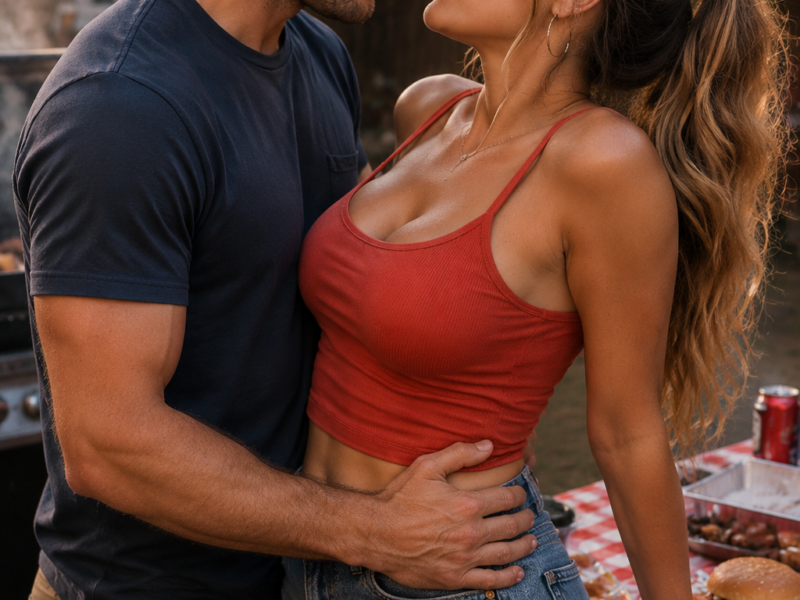
My Best Friend Bet I Couldn’t Get Her Tough Sister to Say Yes… Neither of Us Expected What Came Next
My Best Friend Bet I Couldn’t Get Her Tough Sister to Say Yes… Neither of Us Expected What Came Next
The first sign that my life was about to become considerably more complicated wasn’t when my best friend slapped a twenty-dollar bill onto the picnic table and announced that I couldn’t get his older sister to say yes to a date.
It was when his sister appeared behind me, picked up the money, folded it neatly in half, and slipped it into the front pocket of my shirt.
Then she leaned close enough for me to catch the faint scent of citrus on her skin and said, “If you’re going to gamble on my personal life, Owen, at least have the decency to make it interesting.”
I turned around.
Brooke Sullivan was standing there with one eyebrow raised, her dark hair pinned into a tight bun, and an expression that suggested she had already identified three structural weaknesses in the entire situation. At thirty-one, she was the kind of woman who could make a room full of grown men reconsider their decisions without raising her voice. She stood five feet seven in her work boots, carried herself with the confidence of someone who knew exactly what she was doing, and worked as a building inspector for the city.
I was Owen Mercer, twenty-nine years old, a custom furniture maker, and at that particular moment, I was holding a paper plate containing half an abandoned hamburger while desperately trying to remember how to breathe normally.
We were in Drew Sullivan’s backyard on a Saturday afternoon, celebrating his recent promotion at the fire department. Drew had been my best friend since our freshman year of college, which meant he knew nearly everything about me, including all the things I preferred to keep private.
Unfortunately, Drew considered that information a public resource.
His favorite subject for embarrassing me had always been his sister.
Not because I had ever admitted having feelings for Brooke. I hadn’t. Not directly. Not even after a few beers, when most people became considerably more honest than they intended to be.
Especially not after a few beers.
Brooke was Drew’s older sister, which automatically placed her in a category of things that were technically accessible but best left untouched. Like expensive museum artifacts, police evidence, and the electrical panel in an unfamiliar building.
She had been part of my life for almost seven years. I’d seen her at birthdays, family dinners, holiday gatherings, summer barbecues, and more than a few emergencies involving Drew’s questionable judgment.
She was usually the person everyone called when something needed fixing.
A broken porch railing? Brooke.
A leaking kitchen pipe? Brooke.
Drew making another terrible financial decision? Brooke, although she generally preferred to explain his mistakes while standing over him with her arms crossed.
She never seemed particularly interested in impressing anyone. She didn’t laugh at jokes simply because someone expected her to. She didn’t pretend a loud man was charming when he was actually being obnoxious. And she had a remarkable ability to make people understand that being confident and being competent were two entirely different things.
I had admired that about her for years.
The problem was that admiration had gradually become something else.
I had never done anything about it because there were too many reasons not to. She was Drew’s sister. She was older than me. She was intimidating in a way that made approaching her feel like submitting an application for a position I wasn’t qualified to hold.
And, if I was being completely honest, I was afraid of ruining the comfortable arrangement we already had.
My last serious relationship had ended badly. My former girlfriend had eventually left me for a man she described as more exciting. Apparently, excitement meant owning a motorcycle, making impulsive decisions, and forgetting birthdays.
After that experience, I had stopped trying to become someone I wasn’t.
I built furniture. I repaired old chairs. I paid my bills. I spent long hours in my workshop surrounded by wood shavings, tools, and unfinished projects.
I was dependable.
Predictable.
The human equivalent of a well-installed kitchen cabinet.
And I had convinced myself that was enough.
Brooke, however, had never made me feel boring.
She made me feel noticed.
That was considerably more dangerous.
Drew leaned back in his lawn chair, grinning as though he’d just discovered a new way to make my afternoon miserable.
“Come on, Brooke. Don’t act offended. You say no to everybody.”
Brooke looked at him.
“I say no to idiots.”
“Same thing in this town,” I muttered.
A few people laughed.
Brooke didn’t.
She was still watching me.
The twenty-dollar bill in my pocket suddenly felt as though someone had set it on fire.
I pulled it out and handed it back to Drew.
“No bet.”
He blinked.
“What?”
“No bet.”
“Why?”
I looked at Brooke, who was standing beside the picnic table with her arms crossed.
“Because your sister is standing right here.”
Drew groaned.
“Mercer, don’t get noble now. It was a joke.”
“Yeah, but it wasn’t a particularly funny one.”
The laughter around the table disappeared.
For a moment, I wondered whether I had just managed to ruin my best friend’s promotion party.
Then Brooke took the twenty-dollar bill from Drew’s hand, slapped it against his chest, and said, “He’s right. Your jokes are getting lazy.”
Drew stared at both of us.
“Traitors. Both of you.”
Brooke turned away, but not before I noticed the slightest movement at the corner of her mouth.
It wasn’t quite a smile.
It was more like a warning that one might eventually appear.
I tried returning to my hamburger, but my appetite had disappeared. I wandered toward the cooler, pretending I desperately needed another drink.
The backyard was full of familiar noise. Children were chasing each other near the fence. Drew’s coworkers were arguing about baseball. Someone’s aunt was questioning the origin of the potato salad as if she suspected a criminal conspiracy.
Then Brooke appeared beside me.
She reached into the cooler, retrieved a can of sparkling water, and brushed her shoulder against mine.
The contact lasted less than a second.
I noticed it anyway.
“You always get that serious at parties?” she asked.
I glanced at her.
“Only when I’m being used as a weapon in a sibling dispute.”
She cracked open her drink.
“Please. If you were a weapon, you’d be something handcrafted and unnecessarily expensive.”
“A walnut-handled butter knife?”
“Exactly.”
I laughed before I could stop myself.
Brooke took a sip of her sparkling water and glanced toward the patio, where Drew was loudly explaining something to one of his coworkers.
“He does that when he’s nervous,” she said.
“Insults people?”
“Performs. He got promoted, so now he has to prove he’s still the same idiot.”
“He is.”
“I know. That’s the problem. I love the idiot.”
There it was again.
That unexpected honesty hidden inside her sarcasm.
She could cut someone down with a single sentence and then say something so sincere that the entire atmosphere seemed to change.
I leaned against the cooler.
“For what it’s worth, I don’t think you say no to everybody.”
Her eyebrow lifted.
“No?”
“I think you wait until someone gives you a good reason to say yes.”
She studied me over the rim of her can.
“And what would you know about my reasons?”
I could have made a joke.
I almost did.
But Brooke had a way of making jokes feel like cowardice.
“Not much,” I admitted. “Just that people call you tough like it’s an insult. I’ve seen you check your mother’s porch railing before anyone else noticed it was loose. I’ve seen you leave family dinners early because a contractor called a single mother difficult for asking about mold. And I’ve seen Drew calm down when you walk into a room, even when he pretends you irritate him.”
Her expression changed.
It was subtle, but I noticed.
“You’re observant,” she said quietly.
“Occupational hazard. Furniture makers notice stress points.”
That finally earned me a genuine smile.
It was small and reluctant, but it was real.
And it did something to my chest that I wasn’t prepared to explain.
Then Drew shouted from across the yard.
“Hey, Owen! You ask her yet, or did your courage file for unemployment?”
Brooke closed her eyes.
I considered climbing into the cooler.
Instead, she stepped closer.
“Well?” she asked.
I looked at her.
“Were you going to ask me something?”
My mouth went dry.
“Brooke…”
“Careful, Mercer. This is where men either get honest or predictable.”
I took a breath.
“I was going to ask if you’d have dinner with me.”
Her expression remained steady.
“Why?”
“Not because of Drew. Not because of the bet. Because I’ve wanted to ask for a while and kept telling myself I had good reasons not to.”
She watched me for several seconds.
“And what were those reasons?”
“You’re Drew’s sister.”
“Accurate.”
“You intimidate most men.”
“I efficiently filter them.”
“And I didn’t want to become another guy wasting your time.”
Something moved behind her eyes.
For the first time that afternoon, she seemed almost uncertain.
“Dinner,” she said.
I nodded.
“Dinner with you,” she clarified.
“That’s generally how it works.”
“No audience. No Drew. No performance.”
“Definitely no Drew.”
She glanced toward her brother, who was pretending not to watch us from beside the grill and failing spectacularly.
Then she looked back at me.
“Yes.”
My heart did something deeply undignified.
“Yes?”
“Yes, Owen. Don’t make me repeat it.”
I smiled.
“Thursday?”
“Thursday.”
“Friday would be easier for me.”
“If I wait until Friday, I’ll overthink it and cancel.”
That was the first vulnerable thing I’d ever heard Brooke Sullivan admit.
It wasn’t dramatic. She didn’t lower her eyes or suddenly become someone else.
She simply acknowledged that she was nervous.
And somehow, that meant more to me than a hundred flirtatious compliments.
“I’ll pick you up at seven,” I said.
“Don’t bring flowers.”
“Noted.”
“And don’t take me somewhere with tiny food stacked vertically.”
“I was thinking burgers.”
She tilted her head.
“Risky choice after today’s burger.”
“I know a place where the buns don’t collapse under pressure.”
“Unlike some men.”
“Exactly.”
She laughed.
And for a few minutes, I forgot about the bet, the backyard, and the fact that I had just crossed a line I had spent nearly seven years carefully avoiding.
All I could think about was the fact that Brooke had said yes.
Then Drew’s mother, Linda, stepped out of the house holding Brooke’s phone.
“Brooke, honey. Your phone keeps ringing.”
The smile disappeared from Brooke’s face.
She took the phone and looked at the screen.
I was close enough to see the name.
Caleb.
She didn’t answer.
Instead, she turned the phone face down in her palm and stared at it as though the little rectangle had suddenly become something dangerous.
Then she looked at me.
“Owen, before you decide you still want to take me out, there’s something you should know.”
I waited.
She swallowed.
“My ex-fiancé is calling.”
The afternoon seemed to grow quieter.
“Caleb,” she added.
I nodded slowly.
“Do you want to step out front?”
She studied me for a moment, perhaps expecting me to retreat or suddenly remember an appointment elsewhere.
When I didn’t, she nodded.
We walked through the side gate, leaving the noise of the barbecue behind.
The front yard was shaded by two old maple trees. My truck was parked near the curb, and Brooke stopped beside it.
She looked down at her phone.
“Caleb was my fiancé.”
The word landed harder than I expected.
“How long ago?”
“Three years since I ended it. Two since he stopped trying to turn every conversation into a negotiation.”
“And now?”
“Now he calls every few months when he remembers I exist and wants something.”
I watched her thumb move along the edge of her phone case.
It was a small nervous habit.
I had never noticed it before.
“What does he want this time?”
She laughed without humor.
“Probably money or absolution. He was good at wanting both.”
I leaned against my truck, deliberately leaving space between us.
“You don’t owe me an explanation.”
“I know.”
“Then why are you giving me one?”
She lifted her eyes.
“Because I said yes. And I don’t do that unless I mean it.”
Something tightened in my chest.
I understood then that this wasn’t simply about a former boyfriend appearing at an inconvenient moment.
Brooke was giving me information she considered important. She was allowing me to see a part of her past she usually kept hidden.
I didn’t want to mishandle that.
“Then I’ll say this once,” I told her. “Caleb calling doesn’t change Thursday.”
Her eyes narrowed.
“You don’t know anything about him.”
“I know you didn’t answer.”
“That’s your standard?”
“No. My standard is that you looked me in the eye and said yes like it cost you something. I’m not giving that back because some guy’s name appeared on your phone.”
She stared at me.
Then she stepped closer and pressed one finger against my chest.
“You have a problem, Mercer.”
“Only one?”
“You make reasonable sound dangerous.”
“That’s the nicest thing anyone’s ever said to me.”
“It wasn’t a compliment.”
“I’ll take it anyway.”
Her mouth curved.
For a moment, the tension eased.
Then her phone buzzed again.
She looked down, her jaw tightening, and pressed the decline button.
A second later, she switched the phone off.
When she looked back at me, her expression was different.
“I was engaged to him for eight months,” she began. “He liked that I was strong until my strength became inconvenient. He liked my job until I refused to bend rules for his friends. He liked being with me until he realized I wasn’t going to admire every bad decision and call it ambition.”
I stayed quiet.
“He didn’t hit me,” she added quickly. “He didn’t cheat in some dramatic way, either. It was smaller. Meaner.”
Her voice became quieter.
“He made me feel like I was difficult to love because I didn’t make myself easy to handle.”
Anger rose in me.
I wanted to say something about Caleb, something sharp enough to make her feel better.
But Brooke wasn’t asking me to become angry on her behalf.
She was showing me a wound and waiting to see whether I would treat it carefully.
So I simply said, “He was wrong.”
She looked away.
“You don’t know that.”
“I do.”
“How?”
“Because Drew loves you. Your mother loves you. Every contractor in the city who isn’t cutting corners respects you, even when they complain about it.”
She gave me a doubtful look.
“And you?” she asked.
There it was.
The question I had avoided for years.
I could have made a joke.
Instead, I decided to tell her the truth.
“I’ve spent years looking forward to any room you walked into.”
Her expression softened.
“So if you’re difficult to love, Brooke, maybe some men have simply been showing up with the wrong tools.”
She stared at me.
Somewhere behind the house, Drew shouted at someone for overcooking a hot dog.
Brooke took another step closer.
“You talk like that on Thursday,” she whispered, “and I might not be responsible for my actions.”
My pulse quickened.
“What kind of actions?”
“Don’t get ambitious.”
“Too late.”
For one suspended moment, I thought she might kiss me.
Instead, she reached up and adjusted the collar of my shirt, where the twenty-dollar bill had crumpled it earlier.
Her fingers brushed my throat.
“Presentable,” she said.
“I wasn’t before?”
“You were earnest. Similar, but less dangerous to bystanders.”
I caught her hand gently.
I didn’t pull.
I simply held it, giving her room to decide whether she wanted to stay.
She did.
“Thursday,” I said.
“Thursday.”
Then she squeezed my hand.
“Seven. Wear that blue shirt you have.”
I blinked.
“You know my shirts?”
“I’m observant.”
“I thought that was my line.”
“You notice stress points. I notice shoulders.”
For several seconds, my brain stopped functioning.
Brooke smiled.
Then the front door opened, and Drew appeared on the porch.
“Everything okay?”
Brooke didn’t immediately let go of my hand.
“Fine,” she called. “I’m going on a date with Owen.”
Drew froze.
I had seen the man run into burning buildings.
Apparently, this was worse.
“With Owen?”
“No,” Brooke replied. “The other Owen I keep by the cooler.”
Drew pointed at me.
“If you hurt her, I’ll—”
“I’ll hurt him myself,” Brooke interrupted.
Drew slowly lowered his hand.
“Fair.”
I should have been uncomfortable.
Instead, I felt absurdly happy.
Brooke turned toward the backyard.
“Come on, Mercer. If we stay out here much longer, Drew will start planning our breakup speech.”
I opened the gate for her.
“Does this mean I passed the pre-date inspection?”
She paused beside me.
“For now. But I’ll need a more thorough evaluation Thursday.”
Then she walked back into the party, leaving me standing beside my truck with the ridiculous sensation that the safest thing in my life had just become the biggest risk I wanted to take.
By Thursday evening, I had changed shirts twice.
Not because I was particularly concerned about my appearance.
Because Brooke Sullivan had specifically requested the blue shirt.
Suddenly, every blue shirt I owned looked like evidence in a trial where I was accused of trying too hard.
At six fifty-five, I stood on her porch with no flowers, exactly as instructed.
Instead, I carried a small paper bag.
She opened the door before I could knock.
She was wearing dark jeans, ankle boots, and a green sweater that made her eyes look unfairly beautiful. Her dark hair fell around her shoulders in loose waves.
For a moment, I forgot the speech I had practiced on the drive over.
She glanced at the bag.
“If that’s flowers, I’m shutting the door.”
“It’s not flowers.”
“Chocolate?”
“No.”
“Then what?”
“A legal document releasing you from responsibility if this date goes badly.”
She stared at me.
“I should have thought of that.”
Then she took the bag.
Inside was a small wooden key tray made from walnut. It had a shallow groove along one side and her initials carved discreetly into the corner.
I’d made it the night before.
Apparently, I was the kind of man who handled romantic panic with sandpaper.
Brooke ran her thumb across the initials.
“You made this?”
“Yeah.”
“For my keys? Loose change? Tiny knives?”
“Whatever tough women keep near the door.”
She looked up.
“You made me an organizational object.”
“I panicked.”
Her mouth curved.
“It’s annoyingly thoughtful.”
“I can take it back.”
“Try.”
She stepped aside and allowed me inside.
Her house told me more about her than I expected.
There were work boots near the entrance, inspection reports stacked neatly on the kitchen table, a half-finished crossword puzzle beside a coffee mug, and a soft blue blanket folded over the couch.
Everything had a purpose, but the place didn’t feel cold.
It felt lived in.
It felt like a home belonging to someone who valued function but hadn’t entirely abandoned comfort.
Brooke placed the walnut tray beside the door and dropped her keys into it.
The little metallic sound was surprisingly satisfying.
“There,” she said. “You’ve entered the rotation.”
“Big night.”
“Don’t get smug. My mail basket has seniority.”
I smiled.
Dinner was at a burger restaurant near the river, exactly as promised.
We sat in a corner booth beneath warm lights. Brooke ordered a bacon cheeseburger with extra pickles, while I asked for mine without onions.
She gave me a look.
“What?”
“No onions?”
“I have a date with me.”
“Exactly.”
“You think I can be frightened off by onions?”
“I’m trying to be considerate.”
“You’re trying to appear kissable.”
I nearly dropped a french fry.
Brooke smiled into her water.
“You enjoy ambushes,” I said.
“I enjoy accuracy.”
“Fine. Yes, I was attempting to be kissable. And now I’m regretting admitting that.”
“Don’t.”
“Why?”
“It was cute.”
The word should not have had the power to affect me so much.
But coming from Brooke, it felt like being handed something valuable.
We talked about everything.
Her job, my workshop, Drew’s promotion, the city’s new courthouse, and the ongoing mystery of why restaurants insisted on putting too much lettuce in sandwiches.
She had precise opinions about nearly everything.
People who claimed to hate drama usually carried it in both hands.
The best french fries were stolen from someone else’s plate.
And anyone who said they were too busy to return a text was probably spending that time doing something considerably less important.
I found myself laughing more than I had in months.
Halfway through dinner, her phone lit up on the table.
Caleb.
Her smile thinned.
I saw the change in her shoulders, the tiny movement that suggested she was preparing for something unpleasant.
She turned the phone face down.
“Do you need to get that?” I asked.
“No.”
One word.
Solid as a closed door.
I didn’t ask anything else.
Instead, I slid the basket of fries between us.
“Emergency fry.”
Her gaze dropped to the basket.
Then she looked back at me.
“You think fried potatoes solve emotional discomfort?”
“No. But they can buy us time until one of us says something brave.”
She picked up a fry.
“And which one of us is that going to be?”
“I’m wearing the requested shirt. I’ve done my part.”
She laughed.
The tension slowly left her face.
After dinner, neither of us seemed particularly interested in leaving.
The restaurant gradually emptied. The server refilled our water glasses. Outside, the river caught the final light of sunset and broke it into golden fragments.
Brooke traced a circle around the edge of her glass.
“I almost canceled.”
“I know.”
Her eyes lifted.
“You do?”
“You told me you might.”
“I hate that I said that.”
“I liked it.”
“That I almost canceled?”
“That you trusted me enough to warn me.”
She leaned back.
“You make it hard to keep my guard up.”
“Is that bad?”
“It’s inconvenient.”
“I’ve been called worse.”
She shook her head.
“No, Owen. I mean it. I don’t know what to do with someone who doesn’t push.”
I felt something shift inside me.
“I can push,” I said.
Her eyebrow rose.
“If you want.”
I immediately realized how that sounded.
“Emotionally,” I added.
She burst out laughing.
I covered my face.
“Please forget I said that.”
“Absolutely not.”
Then her hand appeared on the table, palm up.
It wasn’t dramatic.
It wasn’t demanding.
It was simply there.
“This is me reaching,” she said quietly. “Don’t make it weird.”
I placed my hand in hers.
Her fingers closed around mine.
“I would never.”
“You already are.”
“Fair.”
Her thumb brushed over my knuckles.
For the first time that evening, I felt that she wasn’t hiding behind sarcasm or carefully constructed confidence.
She was simply Brooke.
A woman who had spent years learning how to protect herself and was now considering whether it might be safe to lower her defenses for someone.
I wanted to be worthy of that consideration.
Afterward, we walked along the river.
The air had cooled, and Brooke crossed her arms before pretending she wasn’t cold.
I removed my jacket and held it out.
She gave me a suspicious look.
“If this is a move, it’s an old one.”
“Classics endure for a reason.”
“I have body heat.”
“Congratulations.”
She rolled her eyes but accepted the jacket.
The sleeves swallowed her hands.
I thought it was adorable.
She noticed my expression.
“Don’t say anything.”
“I wasn’t.”
“You were thinking loudly.”
“I respect the jacket.”
“You better.”
We stopped near the railing, watching the water move beneath the streetlights.
Brooke stood close enough that her shoulder touched my arm.
This time, neither of us pretended it was accidental.
“I had fun,” she said.
“You sound surprised.”
“I am.”
“Ouch.”
“Not because of you.”
She looked down at the water.
“Because I forgot dates could feel like this.”
“Like what?”
She was quiet for a moment.
“Like I’m not being interviewed for a role I don’t even want.”
I turned toward her.
She turned too.
The space between us changed.
Not suddenly.
Not like lightning.
More like a door that had been slowly opening all evening finally reached the point where neither of us needed to hold it anymore.
I raised my hand carefully and brushed a loose strand of hair away from her cheek.
Her breathing changed.
“Still okay?” I asked.
Her eyes met mine.
“If you ask me that gently again, I’m going to kiss you just to shut you up.”
“I’m comfortable with that outcome.”
She stepped toward me.
Then she kissed me.
It wasn’t tentative, but it wasn’t careless either.
Her hand gripped the front of my blue shirt, and her lips were warm and certain against mine.
For one brief moment, I forgot my name.
Then I kissed her back.
My hands settled at her waist, careful at first, until she moved closer and made a small impatient sound.
That sound was probably going to live in my memory for the rest of my life.
When we finally separated, her forehead rested near my jaw.
“Thorough evaluation?” I whispered.
She laughed against my chest.
“You’re passing.”
I held her beside the river with my jacket around her shoulders and her fingers still curled into my shirt.
For the first time in years, I didn’t feel safe.
I felt chosen.
Then her phone buzzed inside my jacket pocket.
We both went still.
Brooke retrieved it and looked at the screen.
Caleb again.
Beneath the missed calls was a message.
I know you’re with him.
Her expression went blank.
I hated seeing that look return.
But before I could say anything, she switched off the phone and slipped it back into the pocket.
“No,” she said firmly. “He doesn’t get the last moment of this date.”
Then she rose onto her toes and kissed me again.
This time, the kiss was slower.
Softer.
A choice made twice.
When she pulled back, her eyes were steady.
“Take me home, Owen.”
“Of course.”
“And on the way, tell me something boring and real. I’ve had enough ghosts for one night.”
So I told her about a maple dining table I was building for a couple who couldn’t agree on chair height.
She listened, held my hand all the way to the truck, and occasionally asked questions about wood finishes.
I discovered that I could talk about furniture for an embarrassingly long time when Brooke was listening.
When we reached her house, I walked her to the door.
I didn’t kiss her goodnight.
Technically, she kissed me.
I was standing there with my hands in my pockets, fully prepared to say something mature like, “I had a wonderful evening,” when she looked at me for three seconds.
“You’re overthinking.”
“I’m respecting the moment.”
“You’re hovering like a nervous porch decoration.”
“Romantic?”
“Debatable.”
Then she caught the front of my shirt and pulled me down.
The second kiss was different from the first.
Less surprise.
More decision.
Her back touched the door, and her fingers slid toward the side of my neck.
I leaned closer.
When she finally pulled away, her mouth remained near mine.
“Saturday,” she whispered.
“What about it?”
“Second date. My house. I cook.”
“You cook?”
“Inspection is over.”
“That sounds like a threat.”
“It’s pasta.”
“I accept.”
Her expression softened.
“Good night, Owen.”
“Good night, Brooke.”
I had barely reached the sidewalk when she called after me.
“Mercer.”
I turned.
She stood in the doorway with my jacket still around her shoulders.
“Blue shirt was the right call.”
Then she closed the door.
I drove home feeling like a man who had just won the lottery and been instructed not to smile suspiciously.
By Saturday morning, Drew already knew.
He called at ten.
“You kissed my sister.”
I nearly cut my thumb with a chisel.
“Hello to you too.”
“Did you?”
“I’m not discussing that with you.”
“That means yes.”
“It means I value my life.”
“It means yes.”
I put down the chisel.
“Drew.”
He went quiet.
That was unusual enough to concern me.
“I’m not mad,” he finally said.
“Could have fooled me.”
“I’m… recalibrating.”
“Try not to hurt yourself.”
He sighed.
“She’s different with you.”
I looked around my workshop.
“How?”
“Less like she’s waiting for someone to prove her right.”
That landed harder than I expected.
I looked at the unfinished tables surrounding me, the carefully arranged tools, and the familiar smell of cedar.
Brooke wasn’t something I could build or repair.
She wasn’t a problem to solve.
She was a person I wanted to understand.
“I’m not playing around with her,” I said.
“I know.”
“Then what’s the problem?”
Drew exhaled.
“That’s what scares me.”
Before I could ask what he meant, he hung up.
I arrived at Brooke’s house at seven that evening.
The smell of garlic and basil reached me before she opened the door.
She was barefoot, wearing jeans and an old black T-shirt that read, “Permits are not optional.”
Her hair was clipped up badly, with several strands escaping around her face.
I stared.
She looked down.
“What?”
“That shirt is aggressive.”
“This is my casual personality.”
“I’m into it.”
Her eyes warmed.
“Careful, Mercer. Compliment the shirt too much and I’ll wear it to meet your mother.”
“My mother would respect the message.”
“Then she has taste.”
Dinner was pasta with spicy sausage, fresh bread, and a salad she apologized for because, in her words, leaves were not the point of a meal.
We ate at her kitchen table.
Our knees bumped once.
Then again.
Eventually, she hooked her foot around the leg of my chair and dragged me two inches closer.
“There,” she said. “More efficient.”
“Is this a seating-code requirement?”
“Personal preference.”
Those two words did more to me than they should have.
After dinner, I washed the dishes while Brooke dried them.
She argued that my method was inefficient.
I pointed out that I made furniture and therefore understood the importance of handling delicate objects.
She told me that plates were not delicate objects.
I told her that some plates had emotional needs.
She laughed.
Then, while we were standing side by side at the sink, I made a mistake.
I said, “My love language is handling splinters and wet plates.”
Brooke paused.
I realized what I had said.
“I didn’t mean—”
“I know.”
Her voice was quiet.
“But don’t take it back.”
So I didn’t.
We stood together, our reflections faint in the dark kitchen window.
Then Brooke leaned against the counter.
“Caleb came by my office yesterday.”
My stomach tightened.
She raised one hand.
“I’m fine. He didn’t threaten me.”
“What did he want?”
“To explain how much he’s changed. To tell me I overreacted. To convince me that seeing me with someone else made him realize what he lost.”
I dried my hands slowly.
“And what did you say?”
“I told him he lost access, not property.”
Pride hit me so hard it almost hurt.
“That’s a good line.”
“I practiced in the bathroom mirror.”
I smiled.
Then I stepped closer.
“Were you scared?”
Her jaw worked.
“Yes.”
She looked down.
“Not of him exactly. Of becoming the version of myself I was with him. The one who explained everything, defended every decision, and softened every boundary because I didn’t want him calling me cruel.”
I reached for her hand.
She gave it to me.
“I don’t want you to soften your boundaries for me,” I said. “I want to know where they are.”
Her eyes shone.
“That is a dangerously attractive sentence.”
“I’m full of them.”
“Don’t ruin it.”
She stepped into me and rested her forehead against my chest.
The gesture was so unguarded that I barely breathed.
I wrapped my arms around her.
Not because I thought she needed protecting.
Because I wanted to hold the woman who had chosen to trust me with something fragile.
She sighed.
“I like you,” she murmured.
My heart stopped behaving.
“I like you too.”
“No, I mean…”
She leaned back enough to look at me.
“I like you in a way that makes me want to make room. That’s new for me.”
There are moments when a man should say something perfect.
I kissed her instead.
She rose into it, her hands sliding around my waist.
The kiss began tenderly, then deepened as rain started tapping against the kitchen windows.
When we parted, she touched her thumb to my lower lip.
“You’re trouble.”
“I was considered very reliable until recently.”
“Not by me.”
I laughed.
She shook her head.
“I knew you were dangerous the minute you refused that bet.”
“That was my least seductive moment.”
“To you.”
Before I could answer, her phone rang from the table.
We both looked.
Drew.
Brooke answered on speaker.
“If you’re checking whether your friend is alive, he is.”
“I need you both to listen,” Drew said.
His voice was clipped.
“Caleb just showed up at the station asking about Owen.”
Brooke’s expression changed instantly.
I reached for her hand.
She gripped mine.
“What did he ask?” she said.
“He didn’t make a scene. He was fishing. Wanted to know where Owen works and where he lives. I told him to get lost.”
Brooke closed her eyes.
“Thanks.”
“I’ll handle it,” Drew said.
“I’ll handle it,” Brooke repeated.
She ended the call before her brother could argue.
Rain filled the silence.
Then Brooke stepped away from me.
I watched her shoulders straighten.
Her familiar armor seemed to lock into place piece by piece.
“I should have known,” she said.
“Brooke.”
“I should have known he’d eventually do something like this.”
“Come back here.”
She looked at me.
I held out my hand.
It wasn’t a command.
It was an invitation.
Her expression trembled slightly.
Then she crossed the kitchen and placed her hand in mine.
“I’m angry,” she whispered.
“I know.”
“I’m embarrassed.”
“You don’t have to be.”
“I hate that he touched this. Us.”
I cupped her face.
“Look at me.”
She did.
“He didn’t touch this. This is still ours.”
Her breath caught.
Then she kissed me fiercely, almost as though she needed to remind herself that she was still in control of her own choices.
I kissed her back.
When we separated, she rested her forehead against mine.
“Tomorrow,” she said, “I’m calling a lawyer.”
“Good.”
“Not because I’m helpless. Because I’m done letting him decide when I get peace.”
“I’ll drive you if you want.”
“I want.”
She swallowed.
“And afterward, I want lunch somewhere terrible with good fries.”
I smiled.
“That’s oddly specific.”
“I’m building a life, Mercer. Details matter.”
Outside, a car slowed in front of the house.
Headlights washed across the windows and lingered.
Brooke stiffened.
I felt it immediately.
Neither of us moved until the car continued down the street.
She exhaled.
“I hate this.”
“I know.”
“No. I hate that my first instinct is to make myself smaller so this doesn’t splash onto you.”
I reached for both her hands.
“Brooke, I’m serious.”
She looked at me.
“This is the part where I usually start calculating what I can handle alone,” she said. “And I don’t want to do that with you.”
There it was.
Not a grand declaration.
Not a dramatic promise.
Just Brooke Sullivan standing barefoot in her kitchen, admitting that she wanted someone beside her.
I kissed her knuckles.
“Then don’t.”
Her eyes became glossy.
“You make it sound simple.”
“No. I make cabinets. Those are simple. This is terrifying.”
She laughed through the emotion.
“Good. I’d hate to be terrified alone.”
The following morning, I drove her to the lawyer’s office.
Brooke wore her inspection boots and carried a folder containing screenshots, dates, and records of Caleb’s calls.
She looked determined.
She didn’t need me to speak for her.
She didn’t need me to save her.
She simply wanted me in the chair beside her.
That mattered more than I could explain.
The lawyer, a sharp woman named Priya Desai, listened carefully as Brooke described everything.
The calls.
The messages.
The visit to her office.
Caleb asking Drew about my workplace and home.
Priya didn’t dramatize anything, but she didn’t dismiss it either.
“We’ll send a formal no-contact letter today,” she explained. “If he violates it, document everything. Don’t engage. Don’t explain. Boundaries don’t require debate.”
Brooke glanced at me.
I mouthed, “Good line.”
She almost smiled.
Afterward, we went to the worst diner in the county.
The fries were greasy, the coffee tasted like it had been prepared during another decade, and the booths looked as though they had survived several generations of questionable decisions.
Brooke ordered two portions of fries.
“This place would fail three inspections,” she announced.
“Should we leave?”
“Absolutely not.”
She slid into the seat beside me rather than sitting across the table.
I looked at her.
“New seating code?”
“Personal preference.”
I put my arm along the back of the booth.
She leaned into me.
For a while, we ate fries and watched the rain beating against the window.
Then Brooke spoke.
“I’m not going to pretend I’m suddenly easy.”
“I didn’t order easy.”
She lifted her eyes.
“I like you exact,” I continued. “Difficult. Funny when you’re trying not to be. Brave when you’re scared. And annoyingly correct about onions.”
She stared at me.
“You’re admitting I was right?”
“Don’t make me regret vulnerability.”
She smiled.
Then she rested her head against my shoulder.
“I choose you too,” she whispered.
I looked down at her.
“Too?”
She glanced up.
As though she had heard the words I hadn’t quite managed to say.
“Yes, Owen. Too.”
That afternoon, I realized something important.
I didn’t want to be the man who made Brooke forget everything difficult that had happened before me.
I wanted to be the man who never made her feel she had to hide those experiences to deserve something good.
And I wanted her to know she could remain exactly who she was.
Three days later, Caleb appeared outside the city building.
He didn’t yell.
He didn’t threaten anyone.
He simply stood there as though his presence alone could pull Brooke back into the life she had left.
It didn’t.
She walked outside with two coworkers, looked him directly in the eye, and said, “You received the letter. Leave.”
When he tried to argue, she didn’t explain herself.
She went back inside and contacted the police.
The story could have become about Caleb at that moment.
But Brooke refused to hand him the plot.
By the following week, he had received an official warning.
By the end of the month, after another message he described as closure, Priya filed for a protective order.
Drew wanted to personally launch him into the sun.
Brooke told him there was a waiting list.
Through all of it, I stayed beside her.
But the most important moments weren’t the difficult ones.
They were the ordinary ones.
Tuesday tacos.
Sunday morning coffee.
Her laughing at me because I talked to stubborn table legs as though they were badly behaved pets.
Me discovering that Brooke sang terribly in the car, but only when she believed nobody was listening.
Our third date happened in my workshop.
She walked around inspecting the furniture with a seriousness that made me wonder whether she had brought an official clipboard.
She ran her fingertips along the smooth edges of a cherrywood dining table.
“This is beautiful,” she said.
“Careful. Compliments before dessert can look like bribery.”
She glanced over her shoulder.
“Who said anything about dessert?”
I put down the rag I was holding.
She crossed the workshop slowly, wearing an expression I had learned to recognize.
It meant I was in trouble.
When she reached me, she placed both hands against my chest.
“You know,” she said, “Drew still thinks this started because of his bet.”
“Drew thinks smoke detectors are optional if you wave a towel fast enough.”
“True.”
I brushed my thumb along her jaw.
“It started before the bet.”
Her eyes softened.
I considered making it sound casual.
I could have said something about the first time she complimented my work or the first time we’d shared a joke.
But Brooke had never given me less than the truth.
Even when it cost her.
So I gave her mine.
“The night your mother’s porch railing broke.”
She blinked.
“What?”
“You fixed it in the dark with a flashlight between your teeth. Then you yelled at Drew because he handed you the wrong screws.”
She laughed softly.
“I remember that.”
“I remember thinking that whoever got loved by you would never have to wonder whether you meant it.”
Her lips parted.
“Owen…”
“That was four years ago,” she whispered.
“I know.”
“You waited four years?”
“I’m patient.”
“You’re ridiculous.”
“Also true.”
She rose onto her toes and kissed me in the middle of my workshop.
Surrounded by sawdust, unfinished furniture, and everything I used to build things that lasted, I realized that I no longer felt like I was stepping over a line.
I felt like I was finally walking through a door.
The months that followed weren’t perfect.
Brooke still overthought things.
I still became quiet when I worried I had said too much.
Sometimes, Caleb’s name appeared in paperwork, a fading stain the legal system was slowly washing away.
But he was no longer between us.
And gradually, our lives began fitting together in ways neither of us had planned.
She started leaving things at my house.
At first, it was a toothbrush.
Then a sweater.
Then a pair of work boots she claimed were only there because she didn’t want to carry them back and forth.
Eventually, a drawer in my dresser became hers.
I started keeping coffee she liked in my kitchen.
She started buying the brand of sparkling water I preferred.
We developed routines.
I would call her on my way home from the workshop.
She would tell me about whatever contractor had tested her patience that day.
Sometimes we talked for an hour.
Sometimes we simply stayed on the phone while doing separate things.
Neither of us needed to fill every silence.
One Sunday morning, I found her standing in my kitchen wearing one of my shirts, her hair messy and her feet bare.
She was making coffee.
I leaned against the doorway.
“You’re getting comfortable.”
She glanced over her shoulder.
“You say that like it’s a problem.”
“It isn’t.”
“Good.”
She turned back to the coffee machine.
Then she added, “Your coffee is terrible.”
I looked offended.
“That’s a personal attack.”
“It’s an accurate observation.”
“You could make your own.”
“I could.”
“But?”
She smiled.
“But I like being here.”
That was Brooke.
She rarely announced her feelings with grand speeches.
She placed them into ordinary sentences and trusted me to understand their weight.
Six months after the barbecue, Drew hosted another backyard party.
The same picnic table stood beneath the old maple tree.
The same cooler sat near the patio.
The same grill was producing food that appeared to be cooked according to two entirely different temperature standards.
Brooke arrived with me.
Not behind me.
Not ahead of me.
With me.
Her keys now lived in the walnut tray by her front door.
My jacket had a permanent place on her coat rack.
Her shirts occupied a drawer in my bedroom, including the black one that warned people that permits were not optional.
We had built something.
Not something perfect.
Something real.
Drew saw us walking through the gate holding hands and immediately groaned.
“I created a monster.”
Brooke lifted an eyebrow.
“You created nothing. You lost twenty dollars and nearly ruined your own party.”
“I brought people together.”
“You objectified my dating life with money.”
“Romantically.”
I laughed.
Then I reached into my pocket and pulled out a folded twenty-dollar bill.
I placed it on the picnic table.
Drew stared at it.
“What’s that?”
“Your original bet.”
Brooke looked at me.
“He didn’t take the bet.”
“No,” I agreed. “But I figured we should settle accounts.”
Drew squinted.
“Meaning?”
I took Brooke’s hand.
Her expression changed immediately.
She noticed the slight trembling in my fingers.
I looked at Drew, then at Linda, who was standing near the patio, and finally at the woman beside me.
The woman who had terrified me before I understood that she could also become the safest place I had ever wanted to be.
“Meaning I didn’t get her to say yes,” I said.
Brooke’s eyes softened.
“I asked.”
I turned toward her.
“And she chose.”
The backyard grew quieter.
Even Drew seemed to understand that something important was happening.
I swallowed.
“And I’m going to keep asking.”
Brooke stared at me.
“Dinner. Sunday mornings. Terrible fries. Hard days. Easy days. Whatever comes next.”
I took a breath.
“So, Brooke Sullivan, will you keep choosing me?”
For several seconds, she said nothing.
She looked at the twenty-dollar bill.
Then at me.
“You’re asking me this at my brother’s barbecue?”
I suddenly regretted every decision I had made that afternoon.
“I thought it was appropriate.”
“Appropriate?”
“Possibly not.”
She laughed.
It was bright and tearful, and I loved the sound of it.
Then she took the twenty-dollar bill, folded it once, and slipped it into my shirt pocket.
Exactly as she had done six months earlier.
“Yes,” she said.
I let out a breath I hadn’t realized I was holding.
“Yes?”
“Yes, Owen. But if you ever gamble on my personal life again, I’m keeping the cash.”
I pulled her into my arms.
The backyard erupted.
Drew shouted something about betrayal.
Linda started crying.
Someone near the grill cheered so loudly that the neighbors probably wondered whether the fire department had been called.
And Brooke kissed me in the middle of that noisy backyard.
One hand gripping the front of my blue shirt.
The other holding on as though she had every intention of staying.
She always meant it.
Later that evening, after the food had been eaten and the guests had started leaving, Brooke and I sat together on the back steps.
Drew was inside arguing with someone about the proper way to clean a grill.
Linda was collecting empty plates.
The evening air was warm, and the backyard lights cast soft shadows across the grass.
Brooke leaned against my shoulder.
“Do you know what I remember most about that first afternoon?” she asked.
“The burger?”
She laughed.
“No.”
“The twenty dollars?”
“Not exactly.”
“Then I’m out of guesses.”
She turned her head toward me.
“When you handed the money back.”
I looked at her.
“That?”
“Yes. You could have played along. You could have made a joke. You could have used the bet as an excuse to approach me.”
“I suppose.”
“But you didn’t.”
I shrugged.
“I didn’t want you thinking your answer was something two men could negotiate over.”
She was quiet for a moment.
“Do you know how long it’s been since someone made me feel like my choices were actually mine?”
I didn’t answer immediately.
I took her hand and rubbed my thumb across her knuckles.
“I’m glad you know now.”
She rested her head against me.
“I do.”
For a while, we sat without speaking.
Then she looked up.
“You know, I used to think being strong meant never needing anyone.”
I turned toward her.
“And now?”
“Now I think it means being able to choose who gets to stand beside you.”
I smiled.
“That’s a pretty good definition.”
“I know.”
“Modest, too.”
“Don’t push it, Mercer.”
I laughed.
She kissed my cheek, then settled against my shoulder again.
Inside the house, Drew shouted that someone had stolen his favorite spatula.
Brooke closed her eyes.
“Your best friend is an idiot.”
“He is.”
“My brother is also an idiot.”
“Definitely.”
She smiled.
“But he’s my idiot.”
I looked down at her.
“Should I be concerned?”
“Only if he starts another bet.”
I laughed and pulled her closer.
The funny thing was that the twenty-dollar wager had never really been about whether I could convince Brooke to go on a date with me.
Drew thought it was.
He believed his sister was impossible to approach, that she was too stubborn to entertain the idea of dating someone from his circle, and that I was too cautious to do anything about the feelings I’d carried for years.
In a strange way, he had been right about all three things.
But he had misunderstood something important.
Brooke wasn’t waiting for a man who could persuade her.
She wasn’t looking for someone persistent enough to wear down her resistance.
She wanted someone who understood that her strength wasn’t an obstacle, her independence wasn’t an insult, and her boundaries weren’t challenges to overcome.
She wanted to be chosen without being controlled.
And I wanted to choose her without asking her to become someone else.
I had spent years building things.
Tables that could support the weight of generations.
Chairs designed to withstand daily use.
Cabinets made from carefully selected wood, assembled with patience and precision.
I knew how to identify weak joints and reinforce them. I knew how to sand rough edges until they became smooth. I knew that beautiful things required time, attention, and the willingness to start over when something wasn’t right.
But Brooke taught me something no workshop ever could.
People weren’t projects.
Love wasn’t construction.
And sometimes, the strongest thing two people could build was a place where neither of them had to pretend to be stronger than they felt.
I looked at her, sitting beside me with her head against my shoulder and her fingers intertwined with mine.
“Hey, Brooke?”
“Hmm?”
“Would you go to dinner with me next Thursday?”
She lifted her head.
“We’re already together.”
“I know.”
“And you’ve already taken me to dinner approximately seventeen times.”
“Sixteen.”
“You’re counting?”
“Occupational hazard.”
She laughed.
Then she leaned forward and kissed me.
“Yes, Owen.”
“Good.”
“But you’re paying.”
“Naturally.”
“And we’re getting fries.”
“Of course.”
“And I get to steal yours.”
“That’s how I know it’s a real relationship.”
She smiled.
I kissed her forehead.
And sitting there beneath the same maple trees where everything had started, I understood that I would probably spend the rest of my life asking her questions like that.
Would she have dinner with me?
Would she come to my workshop?
Would she take a weekend trip with me?
Would she let me make her coffee in the morning?
Would she keep choosing me when life became difficult, when the ordinary days outnumbered the exciting ones, when neither of us had anything particularly clever to say?
I didn’t need her to answer every question immediately.
I only wanted the chance to keep asking.
Because the best part of that entire story wasn’t that my best friend had bet twenty dollars I couldn’t get his tough sister to say yes.
It wasn’t even that she had eventually said yes.
It was that she had chosen to say it freely, without pressure, without a performance, and without anyone deciding what her answer should be.
And every day since, she had continued choosing.
So had I.
Sometimes love begins with a grand gesture.
Sometimes it begins with a chance meeting, an unexpected kiss, or a conversation that changes everything.
Ours began with a twenty-dollar bill, a backyard full of witnesses, and a woman who was never afraid to speak her mind.
I never won Drew’s bet.
I never even accepted it.
But somewhere between the first awkward invitation and the last kiss beneath those backyard lights, I realized I had gained something considerably more valuable than twenty dollars.
I had found the woman I wanted beside me for all the ordinary moments that make up a life.
And when Brooke Sullivan said yes, she wasn’t agreeing to be won.
She was choosing to begin something with me.
That made all the difference.
THE END



