I Woke Up in the Hospital… and My Ex’s Mom Was There With a Secret She Couldn’t Hide.
I Woke Up in the Hospital… and My Ex’s Mom Was There With a Secret She Couldn’t Hide.
The first thing I saw when I opened my eyes was not the ceiling.
It was Denise Whitaker.
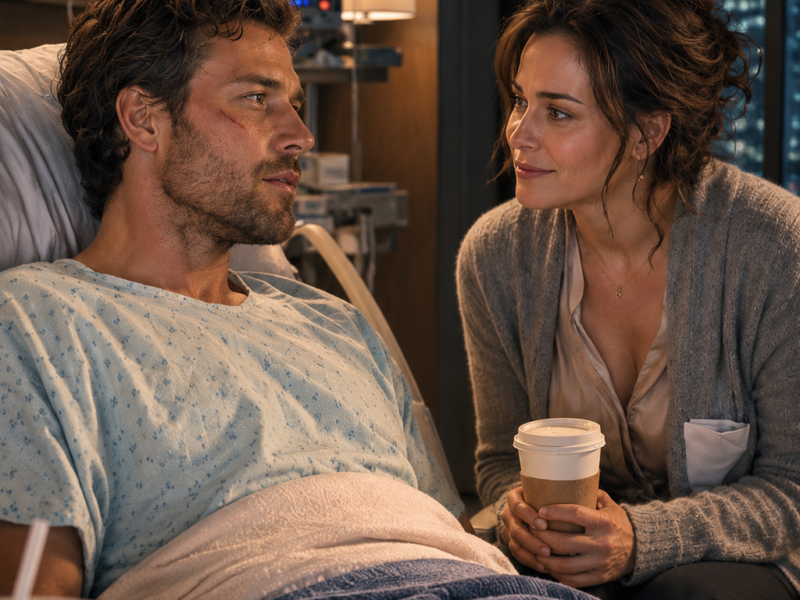
She was sitting beside my hospital bed, holding a paper cup of coffee with both hands as though it were the only thing keeping her upright. Her cardigan was buttoned incorrectly, her silver-blonde hair was coming loose from the clip at the back of her head, and her eyes were so swollen that I could tell she had been crying for hours.
When she noticed that I was awake, her entire face changed.
Relief came first. A sudden, unmistakable flash of it. But it lasted only a second before something heavier replaced it.
Guilt.
I had known Denise for nearly seven years, and I had never seen her look at anyone that way. She was the kind of woman who could organize an entire church fundraiser, manage a kitchen full of arguing relatives, and convince a stubborn contractor to redo his work without raising her voice. She had a talent for making chaos look manageable.
But sitting beside my hospital bed, she looked like a woman who had been carrying a secret for too long and was terrified of what would happen when she finally let it out.
“Graham,” she whispered.
I tried to answer, but my throat felt like somebody had dragged a handful of gravel across it. The only sound that came out was a dry rasp.
Denise immediately stood and reached for the little plastic cup on my bedside table.
“Easy. Just take a sip.”
I obeyed.
There was something particularly humiliating about being helped to drink water by the mother of the woman who had once caught me climbing out of her daughter’s bedroom window at two in the morning. Especially considering I was thirty-two years old, owned my own business, paid a mortgage, and had recently developed the kind of lower back pain that made me sound like an eighty-year-old man every time I stood up.
I was a cabinet maker. I built custom kitchen islands, dining tables, bookshelves, and the occasional ridiculously expensive bathroom vanity for people who used phrases like organic luxury and understated elegance.
My hands were usually covered in sawdust. My days were filled with measurements, invoices, and the smell of freshly cut walnut.
I was used to being in control of my surroundings.
But I couldn’t even lift my head without feeling like someone had driven a nail through my skull.
“What happened?” I managed to ask.
Denise looked down at the coffee in her hands.
“You were in an accident.”
I glanced around the room.
There were machines beside my bed, wires attached to my chest, a bandage wrapped around my left forearm, and a thick brace supporting my leg. My ribs hurt every time I breathed too deeply. My head felt heavy, and there was a strange emptiness in my memory where the previous several hours should have been.
“What kind of accident?”
“A car accident.”
“Where?”
“Mill Road. It was raining terribly.”
I closed my eyes, trying to find something familiar in the information.
Mill Road.
Rain.
My truck.
Nothing came back.
“How long have I been here?”
“Since last night.”
“Last night?”
She nodded.
I tried to turn my head toward the window. Gray clouds hung low over the city, and rainwater crawled down the glass in uneven streams.
“Did I hit something?”
“They think a deer ran into the road. You swerved, and your truck went off the shoulder.”
“They think?”
Denise hesitated.
“The police haven’t finished their report.”
That answer made something uncomfortable move through my stomach.
The police.
A report.
I had never been particularly interested in police reports before. I was the sort of person who preferred to avoid trouble, pay his bills, keep his business legal, and drive home before the weather became dangerous.
“What about my family?”
“Your parents are flying in from Phoenix. Your sister is driving from Dayton.”
I nodded slowly.
Then I looked at Denise again.
There was one question I couldn’t ignore.
“Why are you here?”
Her fingers tightened around the paper cup.
For several seconds, she said nothing.
That was the thing about Denise Whitaker. She had never been a convincing liar. Even when she tried to hide something, her face usually revealed the truth before her mouth had a chance to catch up.
“I was called,” she finally said.
“By who?”
Before she could answer, the door opened.
A young nurse walked in, carrying a tablet. His name tag read Marcus. He had kind eyes and the exhausted smile of someone who had already dealt with several difficult patients that morning.
“Good morning, Mr. Hale. Nice to see you awake.”
“Depends on what the alternative was.”
Marcus smiled.
“Your sense of humor seems to be working.”
“Unfortunately.”
He checked my monitor, asked me to confirm my name and date of birth, and then asked what year it was and where I was.
I answered correctly, although I briefly considered telling him I was in a luxury resort somewhere without fluorescent lighting.
He checked my pupils and asked about my pain.
“Everything hurts.”
“On a scale from one to ten?”
“Is twelve available?”
He laughed quietly and made a note.
After he left, Denise returned to her chair.
I watched her carefully.
“Where are my parents?”
“On the plane.”
“And my sister?”
“On her way.”
I waited.
Denise looked toward the door.
“Is Lila okay?”
The question escaped before I could stop it.
Her expression changed immediately.
And suddenly, I remembered.
Not everything. Just a small fragment.
My workshop.
The clock above the entrance.
An old Bruce Springsteen song playing from the radio.
A maple tabletop resting on the workbench.
And my phone lighting up with a familiar name.
Lila.
Lila Whitaker.
My ex-girlfriend.
The woman I had once believed I would spend the rest of my life with.
We had been separated for almost two years, but there were certain people a man never really learned how to stop missing.
Lila was one of them.
We hadn’t broken up because we stopped loving each other. That would have been easier to understand. We had broken up because she wanted a future, and I had become an expert at pretending I didn’t need one.
She had been offered a position coordinating a pediatric therapy program in another city. It was an opportunity she had worked toward for years, something that would allow her to help children who needed specialized treatment and support.
I told her she should take it.
She told me she didn’t need my permission.
She needed me to ask her to stay.
And I didn’t.
I convinced myself that I was being generous by refusing to hold her back. In reality, I was terrified that she would leave eventually anyway, and I wanted to make sure I didn’t have to watch her choose a life without me.
So I made the decision for both of us.
She packed her things.
I stood in the doorway.
And the woman I loved walked away believing I hadn’t loved her enough to fight.
For months afterward, I found excuses to drive past her old apartment. I kept her favorite coffee in my kitchen long after there was no reason to buy it. I sometimes opened our old message conversations just to read things she had sent me years earlier.
Eventually, I stopped doing those things.
Or at least I convinced myself I had.
Now, lying in a hospital bed, I remembered her name glowing on my phone.
“What happened to Lila?” I asked again.
Denise swallowed.
“She’s alive.”
The breath left my lungs.
“She was in the accident?”
Denise nodded.
“She’s here. In the hospital.”
“Is she hurt?”
“Nothing serious. A few cuts, a bruised wrist. She’s being checked over.”
I closed my eyes.
Relief washed through me so strongly that I almost forgot about the pain.
“Thank God.”
Denise reached for my hand, then stopped halfway.
That small movement hurt more than I expected.
For almost four years, she had treated me like a son. She had invited me to Sunday dinners, remembered my birthday, and made sure I received a Christmas stocking even when I wasn’t technically part of the family.
After Lila and I separated, I lost more than a girlfriend.
I lost a family.
I missed Denise’s kitchen, her terrible habit of putting too much cinnamon in everything, and the way she always sent leftovers home in containers she expected to get back.
I missed belonging somewhere.
Before I could ask another question, the door opened.
And there she was.
Lila stood in the doorway wearing a navy raincoat over her hospital clothes. Her dark blonde hair was twisted into a messy knot, and a white bandage wrapped around her wrist. There was a small cut near her temple.
She looked exhausted.
She also looked beautiful.
Not the polished kind of beautiful people put on for photographs. She looked like someone who had been through a frightening night, hadn’t slept, and was barely holding herself together.
Her eyes moved over my face, then my bandaged arm, the wires attached to my chest, and the brace on my leg.
For a moment, neither of us spoke.
Then she lifted a small paper bag.
“I brought you a muffin.”
I stared at her.
“That’s your opening line?”
“Well, now that you’re awake, I’m reconsidering.”
“What kind?”
“Bran.”
I grimaced.
“That’s cruel.”
“You’ve always needed more fiber.”
“After a car accident, you bring me bran?”
“Would you prefer flowers?”
“At this point, I’d prefer a will.”
She almost smiled.
Denise made a sound that was somewhere between laughter and crying.
Lila stepped closer to the bed.
“How are you feeling?”
“Like a truck lost an argument with my body.”
“Technically, your truck lost an argument with a tree.”
“That makes it worse.”
She glanced at my monitor.
“Your heart rate is high.”
“You’re standing in my room.”
“That isn’t a medical diagnosis.”
“It should be.”
Her expression softened.
For one brief second, I saw the woman I remembered. The woman who used to dance badly in my kitchen while making pancakes. The woman who could spend an entire evening watching baking competitions and somehow become emotionally invested in strangers she would never meet.
Then I noticed her wrist.
“What happened?”
“Airbag. A little glass. Nothing serious.”
I looked at her.
“You were with me?”
She didn’t answer immediately.
Denise stood up.
“I should get some coffee.”
“Mom,” Lila said.
There was something in her voice that made Denise stop.
I looked between them.
“What aren’t you telling me?”
Lila’s face went pale.
It wasn’t the expression of someone worried about my injuries.
It was the expression of someone terrified that I might remember something.
“Why were you in my truck?” I asked.
She lowered her eyes.
And Denise, who had apparently spent the entire morning trying to avoid this exact moment, finally whispered the truth.
“Because you were taking her to dinner, Graham.”
I frowned.
“What?”
“You asked my daughter to give you another chance.”
For several seconds, the room seemed to lose all its sound.
The machines continued beeping, but I could barely hear them.
I looked at Lila.
“Did I?”
Her eyes filled with tears.
“You don’t remember?”
“I remember your text.”
She shook her head.
“I sent that after you called me.”
My heartbeat climbed on the monitor.
“You called me?”
“For twenty-six minutes.”
I stared at her.
“That sounds like a long apology.”
“It was.”
“Was it any good?”
“Not at first.”
Despite everything, I smiled.
“That sounds about right.”
Her mouth trembled.
Denise wiped her eyes.
“I’m going to give you two some privacy.”
Lila glanced at her mother.
“Mom, you don’t have to.”
“Yes, I do.”
Before leaving, Denise turned toward me.
“For what it’s worth, Graham, you sounded different last night. You sounded like a man who had finally decided to stop being afraid.”
Then she closed the door behind her.
The room became quiet.
Lila lowered herself into the chair beside my bed.
Up close, I could see the shadows beneath her eyes and the little red marks around her wrist where the bandage had been secured.
I wanted to reach for her.
I also knew I had no right to assume she wanted me to.
“So,” I said carefully, “you said yes?”
She looked at me.
“Yes.”
“To dinner?”
“Yes.”
“With me?”
She raised an eyebrow.
“Unfortunately.”
I laughed, then immediately regretted it because my ribs protested.
“Don’t make me laugh. I’m injured.”
“You’ve always been dramatic.”
“Only when I have an audience.”
She looked down at her hands.
“You called me from your workshop.”
I waited.
“I almost didn’t answer.”
I couldn’t blame her.
For nearly two years, I had given her every reason to ignore my calls.
“What changed your mind?”
“You left a voicemail.”
“What did I say?”
She looked at me for a long moment.
“You said that if I didn’t want to talk, you’d understand. Then you said something I wasn’t expecting.”
“What?”
She swallowed.
“You said you were tired of making me do all the brave things alone.”
My throat tightened.
I didn’t remember saying it.
That bothered me more than I could explain.
I wanted to remember the conversation. I wanted to hear my own voice saying the things I had apparently been too afraid to say for years.
“What else?”
“You said you missed me.”
“That’s not exactly surprising.”
“Not in the way I expected.”
She smiled faintly.
“You said you missed my shampoo in your bathroom, my terrible parking, and the way I pretended not to watch baking competitions while somehow knowing everyone’s entire family history.”
I looked at her.
“That last part is exaggerated.”
“You cried when Paul under-proved his focaccia.”
“He mentioned his grandmother.”
“He mentioned her once.”
“She raised him.”
Lila laughed.
It was a small laugh, but it was real.
And hearing it again felt like finding something I had lost in a place I had stopped searching.
Then she grew serious.
“You asked me to have dinner with you. You said you weren’t asking me to forget what happened. You weren’t asking me to pretend everything was fine.”
I listened carefully.
“You said you wanted to start by getting to know me again.”
“And you agreed?”
“I said yes.”
I looked at her bandaged wrist.
“Where were we going?”
“Rosetti’s.”
I groaned.
She smiled.
“You hate that place.”
“They put microgreens on lasagna.”
“You said you were evolving.”
“I was clearly experiencing a medical emergency before the accident.”
“You also promised to wear the blue shirt I like.”
I looked down at my hospital gown.
“How did I do?”
“Bold choice. Very revealing.”
“Date two, I’ll wear pants.”
The words came out naturally.
Then we both went quiet.
Date two.
It sounded like a promise, and I wasn’t sure I deserved to make one.
Lila studied my face.
“You don’t even remember date one.”
“No,” I admitted. “But I remember wanting one.”
She looked away.
“That’s not the same thing, Graham.”
“I know.”
I slowly turned my palm upward on the blanket.
“I can’t ask you to trust me because I said a few things on the phone. But I can tell you that I meant them.”
She looked at my hand.
Then she placed her fingers in mine.
Her touch was gentle.
Familiar.
And painful in a way that had nothing to do with my injuries.
“I’m sorry,” I whispered.
Her eyes immediately filled.
“You don’t have to apologize because you’re lying in a hospital bed.”
“I’m not apologizing because of the accident.”
She waited.
“I’m sorry I let you leave thinking you were the only one who wanted us. I’m sorry I watched you make plans for your future and convinced myself that supporting you meant removing myself from the picture.”
I swallowed.
“I thought I was being noble.”
“You were being an idiot.”
“I know.”
“A very talented idiot.”
“I have range.”
She laughed through a tear.
I squeezed her hand.
“I was scared, Lila. You were moving forward, and I felt like I was standing still. You had opportunities and plans. I had a workshop and invoices. You were talking about the future, and I was trying to figure out how to survive the next month without admitting I was terrified of losing you.”
Her expression softened.
“I never needed you to have everything figured out.”
“I know that now.”
“No, Graham. I needed you to want to figure it out with me.”
I nodded.
She was right.
I had spent years confusing silence with strength. I thought being dependable meant never showing uncertainty. I thought love was something I could prove by working hard, fixing things, and making sure the bills were paid.
But Lila had never needed another person to fix her life.
She needed someone willing to share it.
“I should have asked you to stay,” I said.
“Yes.”
“I should have told you I wanted to come with you.”
“Yes.”
“I should have told you I loved you.”
Her fingers tightened around mine.
“Yes.”
I lifted her hand and pressed a gentle kiss against her knuckles.
“I’m trying to learn how to say those things before it’s too late.”
She looked at me for a long time.
Then she leaned forward until her forehead rested against mine.
“You scared me,” she whispered.
“I scared myself.”
“No. You scared me before the crash, too.”
I closed my eyes.
“Because of the phone call?”
“Because when you called, I believed you. And then I hated myself for believing you so quickly.”
I turned my face slightly toward her palm.
“Don’t hate yourself for knowing me.”
She began to cry.
I wanted to tell her everything would be fine. I wanted to promise that I would never hurt her again.
But promises were easy.
Keeping them was the difficult part.
So I simply held her hand.
After a while, she leaned back.
“I don’t know how to trust this yet.”
“You don’t have to.”
“Good.”
“But I am going to ask you to dinner again.”
She smiled.
“Rosetti’s?”
“Anywhere without medical lighting.”
“One dinner, Graham.”
“One chance?”
“One dinner. Don’t get greedy.”
I smiled.
“I’ve been in love with you for seven years. Greedy is already part of the package.”
Her expression changed.
“You never said that before.”
“I know.”
Before she could answer, the door opened.
Marcus stepped inside, followed by a woman in a dark coat. She had silver hair at her temples, a serious expression, and a badge clipped to her belt.
“Mr. Hale?” she asked.
“Yes?”
“I’m Detective Alvarez. I’m investigating your accident.”
Lila’s hand remained in mine.
The detective pulled a chair closer.
“I’m sorry to interrupt, but I need to ask you both a few questions.”
I glanced at Lila.
She gave my hand a small squeeze.
“Go ahead,” I said.
Detective Alvarez opened her notebook.
“Do either of you remember what happened immediately before the crash?”
Lila answered first.
“It was raining heavily. Graham was driving carefully.”
“How fast?”
“Not very fast. Maybe thirty or thirty-five.”
I nodded.
“I hate driving in the rain.”
“He also lectures strangers about tire tread in parking lots,” Lila added.
“People need to understand the importance of proper maintenance.”
Alvarez looked between us.
“All right. And what happened before you reached Mill Road?”
“We left his workshop,” Lila said. “We were going to dinner.”
“Rosetti’s,” I added.
Lila glanced at me.
“You’re remembering?”
“That much.”
The detective continued asking questions about the road, the weather, and the moments before impact.
Had I been drinking?
No.
Had I been using my phone?
No.
Had I been driving recklessly?
Absolutely not.
Then Lila explained that I had placed my phone inside the center console before leaving the workshop.
“He told me that if he ruined his second chance by texting while driving, I had permission to push him into traffic.”
Alvarez raised an eyebrow.
“Romantic.”
“It was very us,” Lila replied.
The detective made a note.
Then her pen stopped.
“There is something you should know. At this point, we have found no evidence that an animal was involved.”
I frowned.
“What do you mean?”
“No deer tracks. No hair, no impact evidence, and nothing at the scene that supports the initial explanation.”
The room seemed to grow colder.
“Then what happened?”
“We’re investigating another possibility. A witness reported seeing a dark SUV leaving the area at high speed shortly after the crash.”
Lila’s hand tightened around mine.
Alvarez noticed.
“Does that mean anything to either of you?”
Lila stared at the blanket.
“My ex-fiancé drives a black SUV.”
I turned toward her.
Her ex-fiancé?
I knew she had dated someone after our breakup. I had heard a few things through mutual friends, but I had never asked for details.
Still, hearing that word beside my hospital bed was unpleasant.
“What was his name?” Alvarez asked.
“Simon Voss.”
The detective wrote it down.
“Is he still in your life?”
“No. The engagement ended six months ago.”
“Was there any hostility?”
Lila gave a humorless laugh.
“Quite a lot.”
She explained that Simon had seemed perfect when she first met him. He had a successful career, a nice apartment, and an almost irritating ability to organize every detail of his life.
He knew exactly where he wanted to live, how many children he wanted, what kind of house he wanted, and even what color the kitchen countertops should be.
As a professional cabinet maker, I found the last detail particularly offensive.
“Did he ever threaten you?” Alvarez asked.
“Not directly.”
“Has he contacted you recently?”
“He kept calling after I ended things. He sent flowers to my workplace. He apologized, then blamed me, then apologized for blaming me.”
She looked down.
“I blocked his number last month.”
“Did he know you were with Mr. Hale last night?”
Lila didn’t answer.
I turned toward her.
“Lila?”
She looked miserable.
“He came to the clinic yesterday.”
“What?”
“He wanted to talk. I told him I wasn’t interested.”
“About what?”
“About us. About getting back together.”
I felt something tighten in my chest.
“And?”
She swallowed.
“He asked if there was someone else.”
I waited.
“I told him your name.”
For a moment, I didn’t know what to say.
She looked at me with tears in her eyes.
“I’m sorry.”
I shook my head.
“Come here.”
She hesitated.
Then she moved closer.
I reached for her hand.
“I’m not sorry he knows about me,” I said. “I’m sorry he frightened you. I’m sorry he made you feel responsible for his behavior. But I am not sorry you told him my name.”
She stared at me.
“You should be angry.”
“I am. Just not at you.”
Alvarez interrupted gently.
“I’ll need a formal statement from you, Ms. Whitaker. For now, please don’t respond to any messages or calls from Mr. Voss. If he contacts you, notify us immediately.”
Lila nodded.
The detective handed us her card and left.
For several minutes, neither of us spoke.
Then I looked at Lila.
“You were engaged?”
She winced.
“Almost.”
“That’s a very careful answer.”
“I gave the ring back after three weeks.”
“Why?”
She looked toward the window.
“He proposed in front of his entire family at a restaurant. There was applause. Someone brought out champagne. A violinist appeared from nowhere.”
I blinked.
“That sounds less like a proposal and more like a hostage situation involving Parmesan.”
She laughed unexpectedly.
Then her smile faded.
“I thought choosing someone stable would fix what broke when we ended.”
I stayed quiet.
“Simon had plans. He knew what he wanted. He had calendars, matching luggage, a retirement strategy, and a list of places he wanted to visit before he turned forty.”
“Sounds exhausting.”
“It was.”
She looked at me.
“He looked right on paper. But he never felt like home.”
The words settled between us.
I brushed my thumb over her fingers.
“And I did?”
Her eyes filled.
“You still do.”
There are moments when a man should say something intelligent.
That was one of them.
Unfortunately, my brain offered absolutely nothing.
I simply looked at her, then slowly tugged her closer.
She placed one hand beside my shoulder.
“Careful.”
“Historic levels of careful.”
“Your ribs.”
“I’m aware.”
“And your stitches.”
“I’m aware of those, too.”
She looked down at my mouth.
For a second, the entire world seemed to disappear.
Then she leaned forward and kissed me.
It was gentle, almost hesitant, because of my split lip and the bruises covering my body. But it was a kiss.
A real one.
The kind that carried seven years of memories, two years of regret, and the possibility of something neither of us had dared to imagine.
When she pulled back, her forehead rested against mine.
“That was reckless,” she whispered.
“That was the safest thing I’ve done in years.”
She smiled.
“You’re concussed.”
“I was in love before the head injury.”
Her fingers curled into the fabric of my hospital gown.
“Say it again.”
I looked directly into her eyes.
“I love you, Lila Whitaker. I loved you badly before. Quietly, cowardly, and without knowing how to show it. I’m trying not to do that anymore.”
She closed her eyes.
When she opened them, there were tears on her cheeks.
“I love you, too.”
I felt my entire chest tighten.
“But I’m still angry,” she continued. “And I don’t trust you completely. And I love you anyway.”
“I’ll take the package.”
“It comes with conditions.”
“I assumed there would be a spreadsheet.”
She ignored the joke.
“First, no disappearing when things become difficult.”
“Agreed.”
“Second, you’re going to therapy.”
I blinked.
“Couples therapy?”
“Eventually. Maybe individual therapy first. You have the emotional communication skills of a locked toolbox.”
“That’s offensive to toolboxes.”
“Third…”
Her voice became quieter.
“You don’t get to ask for another chance and then make me do all the brave things again.”
I covered her hand with mine.
“I won’t.”
For a while, we stayed like that.
Then her phone buzzed.
A blocked number appeared on the screen.
Lila’s expression changed immediately.
The color drained from her face.
She stared at the phone without touching it.
I wanted to reach over and throw it across the room. I wanted to find Simon Voss and make him understand what it meant to frighten someone I loved.
But anger wasn’t going to help her.
So I held out the detective’s card.
“Together,” I said.
She looked at me.
Then she picked up the phone and sent the missed call information to Alvarez.
A voicemail appeared.
She didn’t play it.
Instead, she locked the screen and put the phone down.
“I’m tired,” she whispered, “of men turning love into pressure.”
The words struck me harder than she probably intended.
I wasn’t Simon. I had never threatened her or followed her or tried to force her into anything.
But I had made her carry the emotional weight of our relationship for years.
“I did that, too,” I said.
She frowned.
“Not like Simon.”
“I know. But I made wanting me feel like work. I made you guess what I was thinking. I let you stand outside a locked door while I pretended I didn’t know you were there.”
She looked down.
“Sometimes loving you felt like standing outside a house with all the lights on, knowing you were inside but never knowing whether you wanted me to come in.”
I felt those words somewhere deep inside me.
“I don’t want you outside anymore.”
“You can’t say that because you nearly died.”
“I’m not saying it because I nearly died. I’m saying it because I nearly lived the rest of my life without telling you.”
She stared at me.
Then, slowly, she reached for my hand.
The phone buzzed again.
This time, it was a message from Detective Alvarez.
Lila read it aloud.
“We have received the voicemail. Do not respond. An officer will remain near your floor until we locate Mr. Voss.”
The news made my stomach tighten.
But I looked at Lila.
“Tell me something ordinary.”
She blinked.
“What?”
“Something that has nothing to do with Simon, the police, or the accident.”
She thought for a moment.
“Your sister is going to cry when she sees you.”
“Because she missed me?”
“Because she bet twenty dollars you would never get your head out of your own way.”
I laughed.
“That sounds like Tessa.”
“She asked about you every Christmas.”
My smile softened.
“I missed her.”
“I know.”
Lila looked toward the window.
“I missed your family, too.”
I remembered the crooked porch step at my house, the chipped blue mug beside the kitchen sink, and the ridiculous collection of old records that occupied more space than any reasonable person would allow.
“I missed your mother’s cooking.”
“She still makes too much food.”
“Some things shouldn’t change.”
Lila smiled.
Then I looked at her.
“You can come over sometime.”
Her eyes lifted.
“To your house?”
“Whenever you want.”
I didn’t rush to explain or convince her.
I simply let the invitation exist.
After a few seconds, she nodded.
“I’d like that.”
The door opened.
Denise returned carrying two coffees.
She stopped when she saw us sitting close together, our hands joined.
Her eyes filled immediately.
“Oh, thank God.”
“Mom,” Lila warned.
“I’m not saying anything.”
“You’re crying.”
“I’m allowed to cry.”
“You’re crying silently.”
“That is different.”
I smiled.
“Denise, if you’re taking orders, this hospital date could use dessert that isn’t made of tree bark.”
She glanced at the bran muffin.
“You brought him bran?”
“He deserved humility.”
Denise laughed.
Then she handed Lila a coffee and turned toward me.
“For what it’s worth, Graham, I knew something was different last night.”
I frowned.
“What do you mean?”
“When you called me before picking Lila up, you asked what kind of flowers she liked now.”
Lila turned toward me.
“You called my mother?”
Apparently, I had.
Denise nodded.
“You said you didn’t want to keep loving the memory of the girl you used to know. You wanted to learn the woman she had become.”
Lila went very still.
I looked at Denise.
“I said that?”
She smiled.
“Those were your exact words.”
Lila leaned down and kissed my forehead.
“That gets you a second date.”
I was about to respond when the hospital phone rang.
All three of us looked toward it.
The caller identification showed only the hospital’s front desk extension.
Denise put down her coffee.
“That’s strange.”
The phone rang again.
Before anyone could answer, Marcus appeared in the doorway.
“Everything okay in here?”
He looked at the phone.
“The front desk just called. A man asked for Mr. Hale’s room. He refused to give his name, but somehow this line started ringing.”
Lila went pale.
“Don’t answer it,” Denise said.
“I wasn’t planning on hosting a conference call,” I replied, although my voice had lost most of its humor.
Marcus stepped inside and unplugged the phone.
“I’ll notify security.”
The ringing stopped.
For a moment, nobody moved.
Then Lila looked at me.
“I don’t want him to steal another moment from us.”
I squeezed her hand.
“Then don’t let him.”
She took a shaky breath.
“I want the police to handle him. I don’t want to spend the rest of my life looking over my shoulder.”
“That’s what we’re going to do.”
She nodded.
A uniformed officer arrived ten minutes later.
Detective Alvarez followed shortly afterward.
They had located Simon Voss three blocks from the hospital, sitting inside his black SUV in a loading zone.
When officers approached, he claimed he had simply been waiting for someone.
But they found my hospital room number written on the back of a receipt in his center console.
He denied being anywhere near Mill Road.
Then investigators examined his vehicle more closely.
There was paint transfer on the front bumper.
The color matched the damaged section of my truck.
Alvarez explained that they were taking him in for further questioning while the investigation continued.
I expected to feel satisfaction.
I expected to feel anger.
Instead, I looked at Lila and saw her hands trembling.
She had spent months trying to get away from this man. She had returned his ring, blocked his number, and told him repeatedly that their relationship was over.
Yet somehow, he had managed to follow her into another frightening chapter of her life.
I hated him for that.
But I didn’t want him to become the center of our story.
When Alvarez left, Lila looked at me.
“I don’t want him to be the story of tonight.”
“He isn’t.”
“Promise?”
I lifted her hand and kissed her fingers.
“Tonight is the night you agreed to have dinner with me twice.”
She raised an eyebrow.
“Once in theory and once in a hospital.”
“Exactly.”
“You’re padding your numbers.”
“I’m a businessman.”
“You build tables.”
“And apparently relationships.”
She laughed.
And just like that, something inside the room became lighter.
My parents arrived close to midnight.
They had flown in from Arizona and looked terrified in the particular way parents do when they discover that their grown child is still capable of being hurt.
My mother cried the moment she saw me.
My father tried to make a joke about my hospital gown, then had to step into the hallway because his voice broke halfway through it.
Tessa arrived an hour later carrying a grocery bag full of snacks.
She took one look at Lila sitting beside my bed and burst into tears.
Then she pointed at me.
“You owe me twenty dollars.”
Lila laughed so hard she had to sit down.
I looked at my sister.
“What?”
“I bet you would eventually stop being an idiot.”
“That is an extremely broad category.”
“Apparently, I was right.”
Denise stood beside my mother, smiling through tears.
For the first time in almost two years, our families were in the same room again.
And even though I was bruised, exhausted, and attached to enough medical equipment to qualify as a small electrical installation, I felt something I hadn’t felt in a long time.
I felt at home.
I spent three days in the hospital.
Lila spent most of those days in the chair beside my bed.
She brought paperwork from the clinic, answered emails, stole my pudding, and occasionally fell asleep with her head tilted against the wall.
On the second morning, I woke to find her staring at me.
“What?” I asked.
“You snore when you’re medicated.”
“Clinical observation?”
“Romantic obsession.”
“That’s a dangerous combination.”
She rolled her eyes.
I smiled.
“Good morning, Whittaker.”
She blushed.
I discovered that calling her by her last name made her blush, so naturally, I did it whenever possible.
During those three days, we talked more honestly than we had in the final year of our relationship.
We discussed the breakup, the mistakes we had made, and the things we were both afraid to repeat.
She told me about her work.
Her pediatric therapy program had grown considerably since she moved. She was now supervising a small team and had recently started coordinating a new support initiative for families who couldn’t afford specialized services.
I listened.
Not because I was trying to impress her.
Because I wanted to know.
I wanted to know what made her happy now, what frustrated her, what she dreamed about, and what she had learned during the years we had spent apart.
She told me about a little boy at the clinic who had finally managed to communicate a full sentence after months of therapy.
She told me about a difficult parent meeting and a colleague who constantly forgot to replace the coffee in the break room.
She told me about the apartment she had rented and the plants she kept accidentally killing.
And I realized how much of her life I had missed.
I had spent two years imagining that I knew exactly who she was.
But the woman sitting beside my hospital bed wasn’t simply the girl I had loved at twenty-five.
She was older, more confident, more independent, and more certain about what she wanted.
She had built a life.
And if I wanted to be part of it, I would have to make room for the person she had become.
On the morning of my discharge, I expected her to drive me home, help me through the front door, and leave.
Instead, she walked into my living room and stopped.
The house looked exactly as it had when she last visited.
The crooked porch step.
The chipped blue mug.
The record collection against the wall.
The old photograph of us at a summer festival still sat inside a drawer, although I hadn’t looked at it in months.
Lila walked slowly through the living room.
“I missed this.”
I leaned against the kitchen counter, balancing on my crutches.
“You can come back whenever you want.”
She turned.
“I don’t want to rush.”
“Then we won’t.”
She studied me.
“I don’t want slow because I’m scared. I want slow because we’re doing it properly.”
I nodded.
“Then slow it is.”
She stepped closer and wrapped her arms around my waist.
I held her carefully, avoiding my bruised ribs.
That first hug in my house nearly undid me.
There were no monitors, no detectives, no strange hospital noises, and no blocked numbers lighting up a phone.
There was just the woman I loved standing in my kitchen.
“I love you,” she whispered.
I kissed the top of her head.
“I love you, too.”
“And I’m still mad.”
“I love you mad.”
“You’d better.”
“I do.”
She lifted her face, and I kissed her.
It was a simple kiss, but it felt different from the ones in the hospital.
There was no fear pressing against the walls.
There was only the beginning of something we both wanted to protect.
The months that followed were not a perfect romantic transformation.
Real life rarely works that way.
I had to attend physical therapy for my leg and ribs. I couldn’t return to the workshop immediately, and my business suffered a little while I recovered.
There were days when I became frustrated and withdrawn.
There were evenings when Lila looked at me and knew I was trying to hide something.
The old habits didn’t disappear simply because I had finally found the courage to say I loved her.
But this time, I tried something different.
When I was frightened, I told her.
When I felt overwhelmed, I said so.
When I needed time alone, I explained why instead of disappearing without a word.
Sometimes it was uncomfortable.
Sometimes I said things badly and had to try again.
But I kept trying.
We started individual therapy, followed by couples counseling when I was physically well enough to travel regularly.
Our therapist was a woman named Dr. Collins who had the unsettling ability to ask one question and make me reconsider every decision I had made since high school.
At our third session, she asked me why I had found it so difficult to tell Lila that I wanted her to stay.
I gave several answers.
I didn’t want to hold her back.
I didn’t want her to resent me.
I thought she deserved someone with more ambition.
Dr. Collins listened patiently.
Then she asked, “Did you ever consider that you were making her decision for her because you were afraid she might choose to leave?”
I sat there in silence.
Lila didn’t rescue me.
She simply waited.
And for once, I understood that the silence was mine to fill.
“Yes,” I finally admitted.
The word was small.
But it was honest.
Over time, I learned that love wasn’t about becoming a different man overnight.
It was about becoming a more honest version of the man I already was.
Lila learned things, too.
She learned that she didn’t have to turn every disappointment into a test I needed to pass.
She learned to tell me when something hurt rather than waiting for me to notice.
We both had to understand that the relationship we were rebuilding couldn’t simply be the old one with its mistakes covered up.
We needed something new.
And we needed to build it together.
Simon remained a part of the investigation for several months.
Detective Alvarez kept us updated.
The evidence from his vehicle, witness accounts, and the messages he had sent Lila helped investigators establish a stronger picture of what had happened.
The case eventually moved into the legal system, and protective orders were put in place.
Lila had to give a formal statement more than once.
There were difficult days when she felt exhausted by the process, and I learned to support her without trying to take control.
I went with her whenever she wanted company.
I stayed home whenever she wanted space.
I never contacted Simon.
I never tried to confront him.
I understood that protecting Lila didn’t mean becoming another man who made decisions about her life without asking.
It meant standing beside her while she made her own.
Slowly, the fear began to lose its power.
Six months after the accident, we finally made it to Rosetti’s.
I wore the blue shirt.
Lila wore a green dress that made me forget every apology I had practiced in the mirror.
When she stepped into the restaurant, I stood up.
She smiled.
“You’re staring.”
“I’m appreciating the view.”
“You’re supposed to say something romantic.”
“I had something prepared.”
“And?”
“I forgot it.”
She laughed and kissed my cheek.
We sat at the table near the window.
The waiter brought us menus, and I looked around the restaurant.
It was exactly as I remembered.
Warm lights, polished wooden tables, and an atmosphere that was just a little too proud of its expensive decorations.
Then the lasagna arrived.
I stared at the plate.
There were microgreens on top.
Lila looked delighted.
“Well?”
I picked up my fork.
“Growth is painful.”
She laughed.
I ate it without complaining.
Mostly.
Halfway through dinner, she reached across the table and took my hand.
“I’m proud of you.”
I smiled.
“For eating garnish?”
“For staying.”
The joke disappeared from my face.
She was right.
Staying had become the most important thing I had learned.
Not the dramatic kind of staying that happened in movies.
The ordinary kind.
Showing up for therapy on Tuesdays.
Calling when I said I would.
Asking how her day had gone and actually listening to the answer.
Driving to her apartment even when I was tired.
Making plans together instead of assuming she would somehow fit herself into my life.
And learning the woman she had become instead of trying to recover the girl I remembered.
That night, when I drove her home, she rested her hand on my arm.
“Thank you for dinner.”
“You’re welcome.”
“Even though you complained about the lasagna.”
“I was expressing a legitimate culinary concern.”
“You’re impossible.”
“Yet here you are.”
She smiled.
“Here I am.”
I kissed her goodnight outside her apartment.
Then I waited until she was safely inside before driving home.
It was a small thing.
But small things had started to mean more to me than grand declarations.
A year after the accident, I built a dining table from walnut.
It was a large table with a smooth surface and a narrow strip of maple running through the center.
The contrast was subtle.
You wouldn’t notice it immediately unless you looked closely.
But once you saw it, you couldn’t stop noticing how the two kinds of wood complemented each other.
Tessa came into the workshop while I was finishing the final coat.
She studied the table.
“Symbolic.”
“Expensive.”
She rolled her eyes.
Lila arrived a few minutes later.
She ran her fingers over the surface, following the pale line of maple through the darker walnut.
“It’s beautiful.”
“It’s ours,” I said.
She looked up.
I had asked her to move in with me three weeks earlier.
I hadn’t proposed.
We weren’t rushing toward marriage or trying to prove anything to anyone.
We had simply reached a point where sharing a home felt like the next natural step.
She had thought about it carefully.
Then she had said yes.
Now, standing in my workshop, she looked at the table again.
“I like the maple.”
“Why?”
“Because it’s different without trying to be separate.”
I smiled.
“That’s a very romantic way to describe a piece of furniture.”
“I’m dating a cabinet maker. I have to find romance where I can.”
I kissed her.
By then, Simon had become a closed chapter.
The legal proceedings had moved forward, and the protective orders gave Lila the distance she needed.
His name no longer changed the atmosphere of a room.
She no longer checked every unfamiliar number with fear.
She no longer looked over her shoulder when someone parked behind her car.
It took time, but she reclaimed the ordinary parts of her life.
And I reclaimed something, too.
I stopped treating love like a possession I could lose simply because I admitted how much it mattered.
That evening, we invited both families over for dinner.
Denise brought her famous apple pie.
My mother brought flowers.
Tessa brought a date nobody particularly liked, although he redeemed himself by carrying chairs into the dining room without being asked.
The new walnut table stood in the center of the room.
Everyone gathered around it.
Denise sat beside my mother, talking about a church fundraiser.
My father was explaining something about his golf game to a man who clearly had no interest in hearing about it.
Tessa was arguing with her date about whether pineapple belonged on pizza.
And Lila sat beside me, her knee touching mine beneath the table.
Halfway through dessert, she leaned toward me.
“You know something?”
“What?”
“This is a much better date than the hospital one.”
I looked around the room.
The candlelight.
The noise.
The laughter.
The people we loved.
Then I looked at the woman sitting beside me.
A year earlier, I had woken up in a hospital bed with no memory of how I had arrived there.
I had opened my eyes to find her mother sitting beside me, carrying a secret she was afraid to reveal.
I had thought the accident was the worst thing that could have happened.
I hadn’t known that the night before, I had finally said everything I had spent two years avoiding.
I hadn’t known that the woman I loved had agreed to give me another chance.
And I certainly hadn’t known that the road ahead would force us both to confront the difference between wanting someone and knowing how to love them.
I took Lila’s hand beneath the table.
“I don’t know,” I whispered. “The hospital date had a pretty good kiss.”
She smiled.
“That one was memorable.”
“You’re saying this one needs to compete?”
She leaned closer.
“This one can have a kiss, too.”
So I kissed her.
Right there, in front of everyone.
Denise immediately started crying.
My mother smiled.
Tessa raised her glass and announced that she was increasing her original bet.
Lila laughed against my mouth.
And for the first time in a very long time, I didn’t feel the need to look toward the future with fear.
I was happy with the moment I was in.
Later that night, after everyone had left, Lila and I sat at the dining table.
The dishes were stacked in the kitchen.
A few candles were still burning.
Rain tapped gently against the windows.
She rested her head on my shoulder.
“Do you ever think about that night?” she asked.
“Every now and then.”
“Do you remember anything else from before the accident?”
I considered the question.
“I remember the workshop. The maple table. The song on the radio. And I remember looking at my phone when your name appeared.”
She lifted her head.
“What did you feel?”
I smiled.
“Like a dog hearing a car in the driveway.”
She laughed softly.
“You always say that.”
“Because it’s true.”
She looked down at our joined hands.
“Do you wish you remembered the entire conversation?”
“Sometimes.”
“Why?”
“Because I wish I could hear myself saying those things. I wish I could remember being brave enough to ask you to dinner.”
She was quiet.
Then she reached across the table and touched the maple strip.
“Maybe you don’t need to remember every word.”
I looked at her.
“Why not?”
“Because you kept saying them afterward.”
I understood what she meant.
The call had been important.
The hospital had been important.
The accident had changed our lives in ways neither of us could have predicted.
But none of those moments would have mattered if I had returned to my old habits once the fear disappeared.
The real second chance hadn’t happened when I woke up.
It had happened every time I chose to be honest.
Every time I stayed.
Every time I listened instead of defending myself.
Every time I allowed Lila to be her own person rather than treating her future like a threat to mine.
I leaned forward and kissed her hand.
“I love you.”
She smiled.
“I know.”
“That’s a very confident answer.”
“You’ve had plenty of time to practice.”
“Seven years.”
“Seven years and a hospital stay.”
“Quite the romantic history.”
She laughed.
Then she stood, walked around the table, and sat beside me.
I wrapped my arms around her.
Outside, the rain continued falling.
For a moment, I thought about that first morning in the hospital.
The smell of antiseptic.
The sound of machines.
Denise’s trembling hands around a paper cup.
The terrible uncertainty of not knowing what had happened.
And the look on Lila’s face when she stepped through the doorway carrying a bran muffin.
I had woken up believing that I had lost control of my life.
But perhaps the most important thing I had lost wasn’t control.
It was the belief that I could keep everything I loved without ever risking an honest conversation.
I had spent years hiding behind work, convincing myself that being dependable was enough.
I had mistaken silence for maturity and distance for generosity.
And I had nearly lost the woman I loved because I was too afraid to ask her to share a future with me.
Now, sitting beside her at the table we had built together, I understood something I wished I had learned much earlier.
Love wasn’t simply about finding someone who made you feel at home.
It was about making sure that person never had to wonder whether they were welcome.
It was about opening the door.
It was about choosing them when things were difficult, when life became inconvenient, when fear made you want to retreat into yourself.
It was about showing up, even when you didn’t have all the answers.
Lila lifted her head from my shoulder.
“What are you thinking about?”
I smiled.
“How lucky I am.”
She rolled her eyes.
“That’s suspiciously romantic.”
“I’m trying something new.”
“Keep practicing.”
I kissed her forehead.
And she stayed there, wrapped in my arms, while the rain whispered against the windows.
I had once believed that waking up in a hospital meant surviving an accident.
But I knew better now.
Sometimes waking up meant realizing how much time you had wasted being afraid.
Sometimes it meant looking at the person you loved and finally understanding that a second chance wasn’t something you were entitled to.
It was something you had to earn.
And sometimes, if you were fortunate enough, the person you had hurt would still be willing to reach for your hand.
Not because they had forgotten what happened.
Not because everything was suddenly perfect.
But because they believed there might still be something worth building together.
I looked at Lila.
She smiled at me.
And I held her hand a little tighter.
For the first time in years, I wasn’t thinking about the things I had lost.
I was thinking about everything we still had the chance to create.
And that, I realized, was what waking up really felt like.
THE END



