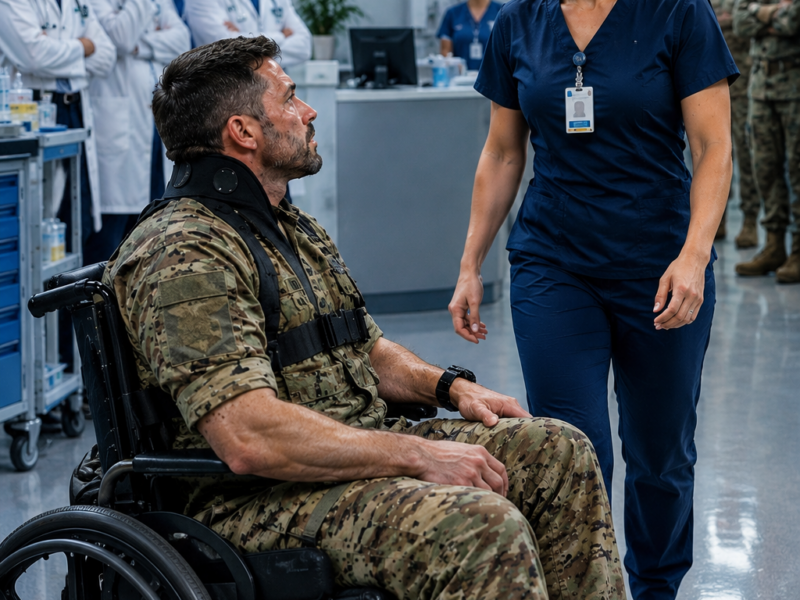
Doctors Refused to Treat the Paralyzed SEAL — Then He Called Her Codename, and They Regretted It
Doctors Refused to Treat the Paralyzed SEAL — Then He Called Her Codename, and They Regretted It
The laughter began before the wheelchair had even crossed the hospital’s double doors.
It was not particularly loud. There were no exaggerated jokes or bursts of amusement, nothing that would have attracted the attention of a visitor walking through the corridor. It was something much more disturbing: the quiet, effortless laughter of people who had already decided that someone else’s life was no longer worth their time.
Dr. Julian Thorne stood beside the nurses’ station at Marsh Harbor Naval Medical Center, his arms folded across his chest. His white coat was perfectly pressed, his expensive watch caught the fluorescent light, and his expression carried the familiar confidence of a man who had spent most of his career being the smartest person in every room he entered.
He watched two orderlies push a wheelchair toward him.
The man sitting in it was broad-shouldered, with a powerful upper body and close-cropped hair that had begun turning gray around the temples. His face was weathered, his jaw firmly set, and his pale eyes stared straight ahead. A green hospital blanket covered his motionless legs, its edges hanging unevenly over the footrests.
A plastic identification band circled his wrist.
Petty Officer First Class Raymond Doran.
Spinal cord injury, incomplete, T6 level.
Six months post-injury.
Transferred from Bethesda for continued care.
Thorne glanced at the chart, then at the man in the wheelchair.
“Another one from the spinal unit,” he remarked.
One of the younger residents standing beside him looked at the patient and nodded.
“Yes, doctor. Six months since the injury.”
“And still unable to walk?”
“Correct.”
Thorne released a short breath through his nose.
“Put him in room 411. Rehabilitation checks twice a day. Vitals once per shift unless something changes.”
He paused, looking again at the motionless legs beneath the blanket.
“Although I doubt anything is going to change.”
The younger resident laughed.
“Six months and he still can’t feel his own legs. What are we even rehabilitating at this point?”
“Job security, apparently,” Thorne replied.
The resident laughed harder.
The orderlies exchanged uncomfortable glances but said nothing. They had learned that challenging certain physicians was a good way to make their own working days considerably more difficult.
Ray Doran heard every word.
He did not turn his head. He did not argue. He did not even change his expression.
He had spent twenty years in the Navy learning how to control his reactions, and six months in a hospital learning that some battles were not worth fighting.
But somewhere beneath his calm exterior, the words settled like stones.
He had once been the man people called when a situation became impossible. He had crossed hostile territory, carried wounded teammates through gunfire, and spent nights in places where a single mistake could mean the difference between returning home and being remembered in a memorial service.
Now, apparently, he was an inconvenient patient occupying a bed that somebody else wanted.
At the far end of the corridor, a young nurse watched the entire exchange.
Her name was Elena Cross.
She was twenty-nine years old, barely five feet four inches tall, with dirty-blonde hair tied into a simple knot at the back of her head. Her gray-blue eyes were usually lowered, and her bright blue scrubs were slightly oversized around the shoulders.
She had been working at Marsh Harbor for eight months.
Most people barely remembered her.
She spoke softly, moved quietly, and never involved herself in conversations that did not concern patient care. Her colleagues considered her pleasant but unremarkable. Some thought she was shy. Others assumed she lacked confidence.
Nobody had ever questioned why a woman who seemed so uncomfortable attracting attention could remain so calm during situations that made everyone else nervous.
Nobody had noticed the thin white scar above her left eyebrow.
Nobody had wondered about the small marks scattered across the backs of her hands.
And nobody had questioned why she sometimes stood with her back against a wall rather than allowing anyone to approach her from behind.
Elena had spent eight months making herself invisible.
It was not an accident.
It was a decision.
She had learned that being underestimated could be a form of protection, especially when the people around you had no idea what you had once been capable of doing.
She placed the folded linens she was carrying on a nearby counter and walked toward the wheelchair.
“Good afternoon, Petty Officer Doran.”
Ray looked up.
For a brief moment, their eyes met.
Something passed through his expression. It was not recognition exactly, but something close enough to make Elena’s stomach tighten.
“You new here?” he asked.
“Eight months,” she replied.
“Still new.”
She smiled faintly and crouched to straighten the blanket covering his legs.
“I’m going to get you settled in your room. Is there anything you need?”
Ray looked toward the nurses’ station.
“Nothing anyone here is willing to give.”
There was no anger in his voice. That was what made the statement so difficult to hear.
It sounded like a fact he had accepted long ago.
Elena looked at him for a moment.
“I might be willing to give a little more than you think.”
Then she stood and began pushing his wheelchair toward room 411.
The room was small and painted in the familiar government shade of beige. A single window overlooked the hospital parking lot, with a narrow strip of marsh grass visible beyond the security fence.
Elena checked the bed, adjusted the pillows, and helped Ray transfer from the wheelchair.
She moved with an unusual level of precision.
Her hands found the correct positions without hesitation. She anticipated his shift in weight before he made it, adjusted her stance, and guided him onto the mattress with a smoothness that surprised him.
Ray noticed immediately.
He had spent years watching trained people move under pressure. He understood the difference between someone who had memorized a technique and someone whose body had learned it through repetition.
Elena’s movements belonged to the second category.
“You’ve done transfers before,” he remarked.
“It’s part of my job.”
“Not like that.”
She turned toward the bedside table.
“What do you mean?”
“I’ve had six months of nurses helping me transfer. Most of them struggle more than you do. You moved like you knew exactly what I was going to do before I did it.”
Elena checked his chart.
“Perhaps you’re easier to work with than you think.”
Ray watched her carefully.
“What’s your background?”
“Nursing.”
“That’s not what I asked.”
For the first time, her fingers stopped moving.
Only for a fraction of a second.
Then she placed the chart back into its holder.
“You should rest, Petty Officer Doran. I’ll check on you again before the end of my shift.”
She walked out before he could ask anything else.
Ray followed her with his eyes.
He had spent twenty years around military personnel, intelligence officers, combat medics, and special operations teams. He knew how people behaved when they were frightened, exhausted, confident, or pretending to be something they were not.
The young nurse had the movements of someone who had received training far beyond ordinary hospital procedures.
And there was something else.
She seemed to be deliberately hiding it.
Outside, Elena found Dr. Thorne waiting beside the nurses’ station.
“Cross.”
She stopped.
“The administration wants a case review on Doran by the end of the week. Regina Voss is pushing for a transfer to Cedar Grove Long-Term Care Facility.”
Elena looked at him.
“He’s only six months post-injury.”
“And?”
“Incomplete spinal cord injuries can continue improving well beyond six months. With the appropriate rehabilitation protocol, some patients regain function over a much longer period.”
Thorne looked at her as though a piece of hospital furniture had suddenly started offering medical opinions.
“That’s a very confident assessment for someone eight months into her first hospital position.”
“I read his file.”
“Reading a file and understanding a patient are two different things, Nurse Cross.”
He turned away.
“Get his vitals. That’s the extent of what we’re asking you to do.”
Elena remained still for a moment.
She wanted to tell him that he was the one who had failed to understand the patient.
She wanted to ask whether he had bothered to speak with Ray for more than thirty seconds.
But she swallowed the words.
She had not come to Marsh Harbor to fight people like Julian Thorne.
At least, that was what she had been telling herself.
At three o’clock, she returned to room 411.
Ray’s blood pressure was normal. His heart rate was steady. She checked his catheter, adjusted his pillow, and recorded the readings.
He watched her hands throughout the examination.
“You always this quiet?” he asked.
“Only when people ask too many questions.”
That earned a small smile from him.
For a few seconds, the room felt almost normal.
Then Elena left to continue her rounds.
At 5:15, she returned.
The moment she entered the room, something felt wrong.
She could not immediately explain it, but she recognized the change in the atmosphere before she had even reached the bed.
Ray’s face was flushed an alarming shade of red. Sweat covered his forehead, despite the cool temperature in the room. His hands were clenched tightly against the blanket, and his breathing had become shallow.
“Petty Officer Doran?”
He looked toward her.
“Something’s wrong.”
Elena crossed the room immediately.
“Tell me what you’re feeling.”
“My head.”
“Your head hurts?”
“Badly. Started all of a sudden. Feels like somebody’s squeezing it.”
She reached for the blood pressure cuff and wrapped it around his arm.
The machine hummed.
A moment later, the reading appeared.
204 over 118.
Elena felt a cold weight settle in her stomach.
She knew exactly what she was looking at.
Autonomic dysreflexia.
It was one of the most dangerous medical complications associated with spinal cord injuries above certain levels, particularly injuries around T6 and higher.
The condition could develop suddenly when an irritating stimulus below the injury triggered an uncontrolled nervous system response.
A full bladder, a blocked catheter, constipation, pressure injuries, or even tight clothing could become the trigger.
The body continued responding to the irritation, but the damaged spinal cord prevented the brain from properly regulating the reaction.
Blood vessels constricted.
Blood pressure rose rapidly.
The heart attempted to compensate.
And if the condition was not recognized and treated quickly, the consequences could include seizures, stroke, or death.
Many medical professionals knew the condition existed.
Far fewer recognized it immediately when it appeared.
Elena did.
“Ray, I need you to stay with me.”
She raised the head of the bed and checked his catheter tubing.
“Have you felt any pressure in your lower abdomen?”
He struggled to answer.
“Some. I don’t know. Why?”
“Has your bladder been emptying normally?”
“I thought so.”
She followed the catheter line with her fingers.
There.
A sharp fold in the tubing had developed behind his hip, probably during the earlier transfer.
The line had been obstructed long enough for pressure to build.
Elena corrected the kink and watched as urine began draining into the collection bag.
“That’s it,” she said quietly. “Stay upright. Keep breathing.”
Ray stared at her.
“How did you know?”
“Because I know what this is.”
Her voice had changed.
The softness disappeared.
The hesitant rhythm vanished.
What remained was clear, controlled authority.
“I need you to trust me for the next few minutes.”
She pressed the emergency call button and continued monitoring his blood pressure while the catheter drained.
The reading began to fall.
204\.
192\.
181\.
“Good. Keep breathing slowly.”
His expression remained strained, but the intense redness in his face began to ease.
A moment later, the rapid response team entered the room.
Dr. Alvarez, the attending physician leading the response, moved toward the bed.
“What happened?”
“Autonomic dysreflexia,” Elena answered immediately. “Likely caused by a blocked catheter. Peak pressure was 204 over 118. The obstruction has been corrected, and the head of the bed is elevated. Current pressure is 168 over 94 and trending downward.”
Alvarez looked at the monitor.
Then at Elena.
“How long ago did you recognize it?”
“Less than two minutes after entering the room.”
Alvarez examined Ray and instructed the team to continue monitoring him.
“Keep him under observation. We need to make sure the pressure continues to stabilize and check for any additional triggers.”
Elena nodded.
By the time Dr. Thorne arrived, the immediate emergency had already been brought under control.
He entered with his white coat moving behind him, his expression showing irritation at having been called away from whatever he had been doing.
Then he saw the patient.
And he saw Elena standing beside the bed, calmly giving the response team a detailed report.
“Autonomic dysreflexia,” she repeated when he approached.
Thorne glanced at the monitor.
“This is exactly the kind of unpredictable complication that supports moving him to a facility with more consistent monitoring capacity.”
Dr. Alvarez turned toward him.
“Actually, Doctor, this is exactly the kind of complication that demonstrates why patients with this injury level require attentive, informed care.”
Thorne frowned.
“I’ll be documenting the incident for Ms. Voss.”
“You should document that a nurse on your own floor recognized a potentially fatal emergency and intervened before it became a catastrophe,” Alvarez replied.
For a moment, nobody spoke.
Thorne tightened his jaw, scribbled something in the chart, and left.
Ray watched him disappear through the doorway.
Then he looked at Elena.
“That wasn’t textbook.”
She adjusted his IV line.
“Your pressure is coming down. You need to rest.”
“Textbook is knowing the symptoms from a lecture. What you did was field triage.”
She did not answer.
“I’ve seen corpsmen freeze in situations like that,” he continued. “You didn’t even hesitate.”
“I’m glad you’re stable.”
He studied her.
“What’s your name?”
She glanced at her badge.
“Elena Cross.”
“Not that.”
Her hand stopped.
Ray’s voice dropped.
“Bishop.”
She looked up.
“Excuse me?”
“That’s my call sign. Bishop. Some habits stay with you, even when the rest of your life changes.”
Elena felt something tighten inside her chest.
“I don’t know what that means.”
It was the first outright lie she had told since arriving at Marsh Harbor.
Ray noticed.
“I think you do.”
She finished checking the IV and stepped back.
“You should rest. I’ll come back in an hour.”
Then she left.
In the hallway, she leaned against the wall and closed her eyes.
Her hands began to tremble.
Not because she was afraid of the emergency.
She had handled emergencies far worse than that.
She was trembling because Ray Doran had recognized something she had spent eight months trying to bury.
And she had a terrible feeling that he was not going to forget it.
Twenty minutes later, Elena encountered Regina Voss near the elevator.
Voss was the hospital’s director of patient throughput and cost efficiency. She was tall, impeccably dressed, and carried a tablet everywhere she went.
Her job was to ensure that hospital resources were being used efficiently.
At least, that was how the administration described it.
Elena had always thought the title sounded like a polite way of deciding which patients were worth keeping.
“Nurse Cross.”
Elena stopped.
“I understand there was an incident in room 411.”
“An emergency, yes. The patient is stable.”
“Dr. Thorne tells me the situation demonstrates the unpredictability of his condition.”
“Autonomic dysreflexia is a recognized complication of his injury. It can be managed with appropriate monitoring and intervention.”
Voss looked down at her tablet.
“These complications are precisely why we consider transferring patients to long-term facilities. They have systems designed for ongoing management.”
“With respect, Petty Officer Doran needs specialized rehabilitation, not merely long-term maintenance.”
“He’s occupied that bed for six months.”
“He’s also showing signs of neurological improvement.”
Voss finally looked up.
“Minimal measurable improvement, according to Dr. Thorne.”
Elena took a breath.
“Have you reviewed the physical therapy notes?”
“That’s not your concern.”
“He has regained partial sensation in his left thigh. There have also been improvements in his trunk stability and transfer ability.”
Voss’s expression remained unchanged.
“Bed turnover matters, Nurse Cross. Other patients are waiting.”
Elena felt anger rise inside her.
“He gave his spine for this country.”
The words escaped before she could soften them.
Voss studied her.
“Sentiment does not run a hospital budget.”
Then she walked away.
Elena remained in the corridor, watching the woman disappear around the corner.
For eight months, she had kept her head down.
She had avoided arguments, avoided attention, and avoided becoming involved in anything that might expose her past.
But now a man who had already sacrificed so much was about to lose something else simply because the people responsible for his care had stopped believing he was worth the effort.
That evening, she returned to room 411.
Ray was sitting against his pillows, looking considerably better.
“They’re moving me,” he said before she could ask how he felt.
“I heard.”
“You fought it.”
“I did my job.”
Ray gave a tired smile.
“That’s not what fighting for somebody looks like.”
She checked his medication chart.
“Get some rest.”
“Nobody fights like that for a line item, Nurse Cross.”
She looked up.
Ray’s expression had become serious.
“You fought for me like you knew exactly what it felt like to be forgotten by the people who were supposed to remember you.”
For a moment, Elena could not find an answer.
She lowered her eyes.
“Get some sleep, Bishop.”
The name slipped out before she could stop it.
Ray noticed.
And he smiled.
The transfer order arrived four days later.
It was clipped to his medical chart, printed on official hospital letterhead and signed by Regina Voss.
Petty Officer First Class Raymond Doran was scheduled for transfer to Cedar Grove Long-Term Care Facility in eleven days, pending final review by Dr. Thorne.
The justification cited limited measurable neurological improvement and the need for more efficient allocation of acute-care resources.
Elena read the document twice.
Then she read it a third time.
Cedar Grove was not a specialized rehabilitation center.
She had researched the facility after hearing Ray mention it in passing. Its residents received considerably less intensive physical therapy than the patients at Marsh Harbor.
For someone with a spinal cord injury who was still demonstrating neurological recovery, the transfer could severely limit his opportunities.
It was the kind of decision that looked reasonable on a spreadsheet and devastating in real life.
Elena folded the memo and carried it into room 411.
Ray was attempting a wheelchair transfer into the shower chair when she entered. Sweat covered his forehead, and his arms shook slightly with the effort.
He looked at her face.
“They’re moving me.”
It was not a question.
“Eleven days.”
She handed him the document.
He read it silently.
His jaw tightened.
“I’ve improved,” he said eventually. “Three weeks ago, I started feeling something in my left thigh. The physical therapist documented it. I’ve improved my balance, too. I can transfer with less assistance than I could two months ago.”
“I know.”
“Then why are they saying there’s been minimal progress?”
“Because the reports Dr. Thorne is using don’t reflect everything documented by the rehabilitation team.”
Ray looked at her.
“Can you prove that?”
“Not yet.”
“What would it take?”
Elena pulled a chair closer to the bed.
“Every therapy record. Every session note. Every neurological assessment. I want to compare the original documentation with the summaries submitted by Dr. Thorne.”
“And if we find what you’re looking for?”
“Then we take it to the review board.”
Ray watched her for a long moment.
“You have that kind of influence?”
“I didn’t say that.”
“No. But I think you have something better.”
She frowned.
“What?”
“Experience.”
He leaned back against the pillows.
“I’ve spent twenty years learning to read people under pressure. I know when somebody is hiding something. I know when someone is pretending to be less capable than they really are.”
Elena said nothing.
“Every time this hospital pushes you, something underneath that nurse’s uniform pushes back. I’ve seen your hands. I’ve seen how you move. And I’ve seen how you look at a room before you enter it.”
“You’re overthinking things.”
“Maybe.”
He paused.
“But I know a trained operator when I see one.”
Elena looked toward the window.
Ray continued.
“I’m not asking you to tell me your story. I’m asking you to help me keep mine going.”
His voice was quiet now.
“I’ve spent six months trying to convince people that my life isn’t over. I don’t need someone to promise I’ll walk again. I just need the chance to find out what my body can still do.”
Elena looked at him.
Something inside her began to change.
She had spent years trying to convince herself that leaving her former life behind meant leaving behind the responsibility that came with it.
But the truth was becoming increasingly difficult to ignore.
She still knew how to recognize someone in danger.
She still knew how to protect people who could not protect themselves.
And she still knew how to fight when the situation demanded it.
“I’ll need your complete therapy records,” she said.
Ray straightened slightly.
“All of them?”
“Every session. Every assessment. Every measurable gain. I’ll also need Dr. Alvarez’s report from the emergency and an independent neurological evaluation.”
“And then?”
“Then we’ll make sure the board sees the entire picture.”
Ray studied her face.
“How much time do you need?”
“Until the hearing.”
“That’s seven days?”
“Seven days.”
He nodded once.
“Then you have my trust.”
Elena stood.
“Don’t make me regret it.”
For the first time, Ray laughed.
It was a small sound, but it was genuine.
And Elena realized she had not heard him laugh since the day he arrived.
She left the room and went directly to the medical records department.
Her lunch break disappeared.
So did the afternoon.
She began comparing therapy records with Dr. Thorne’s clinical summaries, and what she discovered made her increasingly angry.
There were three separate documented instances of neurological improvement that had never appeared in the summaries used to justify the transfer.
The first involved increased sensation in Ray’s left thigh.
The second documented improved trunk control during seated rehabilitation exercises.
The third recorded a measurable reduction in the assistance required for wheelchair transfers.
None of those developments had been included in the administrative assessment.
They were not minor details.
They were exactly the kind of information that could change a patient’s treatment plan.
Elena made copies of the relevant records through the proper medical channels and contacted Dr. Alvarez.
The physician reviewed the documents in the cafeteria later that afternoon.
Her expression changed with every page.
“These findings should have been included in the clinical summary.”
“Yes.”
“Why weren’t they?”
“That’s what I’m trying to establish.”
Alvarez closed the folder.
“This is more than a simple disagreement about treatment goals. If these findings were deliberately omitted, someone needs to investigate.”
“Can you provide a formal addendum to your emergency report?”
“Absolutely.”
“And an independent neurological consult?”
Alvarez nodded.
“I’ll request one today.”
She paused.
Then she looked at Elena more carefully.
“You’re not what this hospital thinks you are, are you?”
Elena held her gaze.
“I am exactly what this hospital needs right now.”
She picked up the folder and returned to the fourth floor.
But someone had been watching.
Dr. Thorne had noticed her visits to the records department. He had noticed her conversations with Alvarez and her growing involvement in Ray’s case.
That evening, he was waiting outside the staff lockers.
“You’ve been busy.”
Elena stopped.
“Good evening, Doctor.”
“Records room. Cafeteria. Dr. Alvarez’s office. You’ve made quite a few visits this week.”
“I’ve been doing my job.”
“Your job is patient care, Nurse Cross. Not building a political case to overturn an administrative decision.”
“Correcting inaccurate medical documentation is part of patient care.”
Thorne’s expression hardened.
“You’re eight months into a nursing career. You seem to have developed a very specific kind of confidence that nursing school doesn’t teach.”
Elena placed her belongings into her locker.
“Perhaps you should be more concerned about the information that wasn’t included in your reports.”
Thorne went quiet.
She looked at him.
For the first time, she did not lower her eyes.
“I find it curious that a doctor would rather defend a paperwork error than correct it.”
His jaw tightened.
“Careful.”
It was the same word Regina Voss had used.
Elena almost smiled.
“You’re not the first person to say that to me.”
“You are new here. There are proper channels for raising concerns, and there are ways to make yourself a problem this hospital doesn’t need.”
“I’m not trying to become a problem.”
She held his gaze.
“I’m trying to make sure a man who has already lost the use of his legs serving this country doesn’t also lose the only treatment that might help him recover because correcting a report would be inconvenient.”
For one brief moment, Thorne looked uncertain.
Then he straightened his coat and walked away.
Elena remained beside her locker.
She had done something she had promised herself she would never do again.
She had allowed someone to see the person beneath the disguise.
And she was beginning to understand that she might not be able to put that person away again.
Later that evening, she stopped by Walter Higgs’s room.
Walter was an elderly veteran recovering from a fall. He had a habit of telling the same fishing story every time Elena visited.
The story concerned a marlin that had supposedly escaped him off the coast of Tybee Island in 1983.
She had heard it twice that week.
She listened again.
But her mind was elsewhere.
After finishing her rounds, she walked toward room 411.
Ray was asleep.
His breathing was steady, and one hand rested loosely against the edge of his blanket.
Something small was visible beneath his palm.
A faded tan fabric patch.
Elena stopped.
She recognized the stitching immediately.
Black thread.
A single word.
ANGEL.
Her breath caught.
For several seconds, she could not move.
That name had once been hers.
Not Elena Cross.
Not the quiet nurse with oversized scrubs.
Angel.
The call sign had followed her through eleven years of joint special operations medical work. It had been stitched onto equipment, spoken over encrypted radios, and whispered by people who had depended on her when everything else had gone wrong.
She had not seen that patch in years.
And she had never expected to see it again.
She looked at Ray.
He was still asleep.
Carefully, she stepped closer.
The patch was worn around the edges, its fabric softened by years of handling. Someone had clearly carried it for a long time.
Elena backed away.
For the first time in eight months, she felt that her past was no longer safely behind her.
She left the room quietly.
That night, she barely slept.
At five in the morning, her alarm sounded.
She was already awake.
She showered, dressed, and arrived at Marsh Harbor an hour before her shift.
Ray was awake when she entered room 411.
The patch lay openly on his blanket.
He looked at her.
“You saw it.”
Elena closed the door.
“I saw it.”
Ray picked up the patch between his fingers.
“I’ve carried this for six years.”
She said nothing.
“Joint operation. Somewhere I can’t discuss in a hospital hallway. We had a small medical operator attached to our element for eleven days.”
His eyes remained fixed on hers.
“Small. Fast. Carried more equipment than anyone her size should have been able to manage. She barely spoke unless she needed to give an instruction.”
Elena felt her throat tighten.
“She pulled two of my men out of a position that should have killed all three of us.”
Ray turned the patch over.
“Her call sign was Angel.”
The room seemed to grow smaller.
“I never learned her real name. Never saw her again after that operation. Given the kind of work we were doing, I assumed she was dead.”
He looked up.
“Until I saw you.”
Elena stood beside the door.
“I don’t know what you’re talking about.”
Ray gave a faint, almost sad smile.
“Your hands were steady around that catheter line in exactly the same way hers were steady around a tourniquet. Your voice changed the moment you recognized the emergency. Then it softened again when the danger passed.”
He paused.
“I’ve replayed those eleven days more times than I’ll ever admit. I know what real competence looks like under pressure.”
Elena looked away.
“Bishop…”
“I’m not asking you to explain anything.”
He folded the patch carefully.
“I just need you to know that I remember.”
For several seconds, neither spoke.
Then Ray added something that changed the conversation entirely.
“In eleven days, this hospital is going to send me somewhere that might end my rehabilitation. I’d rather face that fight beside someone who understands what it means not to leave a teammate behind.”
Before Elena could answer, the door opened.
Dr. Thorne entered without knocking.
Regina Voss followed him.
Both carried the expressions of people who had already decided how the conversation would end.
“Nurse Cross,” Thorne said.
Elena turned.
“We need to discuss some irregularities in Petty Officer Doran’s chart.”
“Which irregularities?”
“Several physical therapy notes documenting neurological improvement were omitted from my clinical summaries.”
“I found them during a records review. I forwarded them to Dr. Alvarez.”
Thorne’s expression tightened.
“You do not have authority to initiate an independent consultation.”
“Dr. Alvarez has authority as the physician who responded to his medical emergency. She is exercising that authority.”
Voss stepped forward.
“This is becoming a concerning pattern, Nurse Cross. Going around the attending physician, collecting documents, involving other departments. I’m beginning to wonder whether you have a personal interest in this patient.”
“My professional judgment is that a patient with documented neurological improvement should not be transferred to a facility that cannot provide the rehabilitation necessary to continue that improvement.”
“That’s not what I asked.”
“My personal feelings are irrelevant.”
Thorne folded his arms.
“I reviewed your credentials this morning.”
Elena looked at him.
“Did you?”
“Your nursing license is legitimate. Eighteen months old. But your previous work history is unusually thin. There are unexplained gaps, and several records appear to be unavailable.”
He leaned closer.
“I find that professionally strange.”
Ray watched Elena carefully.
For the first time, he could see that she was genuinely uncomfortable.
Not because Thorne had discovered something embarrassing.
Because he was getting dangerously close to something she had spent years protecting.
“My file is exactly what it needs to be,” Elena replied.
Her voice was quiet, but it carried a weight that made the room go still.
“The review hearing is in seven days. It will examine Petty Officer Doran’s medical records, not my personal history. If either of you wants to change the subject because you don’t have an answer for the neurological improvements documented in that folder, I think that says everything the review board needs to know.”
Thorne opened his mouth.
Then closed it.
Voss gathered her tablet.
“We’ll speak again before the hearing.”
They left.
Ray watched the door close.
Then he released a low laugh.
“That wasn’t a nurse defending a patient file.”
Elena turned toward him.
“Don’t start.”
“That was an operator holding a line under direct fire.”
She shook her head.
“Please don’t call me that.”
“Then tell me what to call you.”
She looked at him for a long moment.
Finally, she answered.
“Elena.”
Ray nodded.
“All right, Elena.”
She moved toward the door.
“We’re going to win this hearing.”
Ray smiled.
“That’s what I wanted to hear.”
Neither of them noticed Dr. Thorne standing several feet down the corridor.
His phone was pressed against his ear.
He was already making inquiries about Elena’s background.
The results took two days to arrive.
And they were more troubling than he expected.
Her nursing license was legitimate. Her education was documented. Her employment at Marsh Harbor was properly authorized.
But almost everything before her transition into civilian nursing was sealed.
The records carried federal classification markings and restrictions that even experienced administrators could not easily access.
Thorne placed the folder on Regina Voss’s desk.
“Her background is not ordinary.”
Voss examined the documents.
“Meaning?”
“Meaning she has a history that somebody has gone to considerable trouble to conceal.”
“Can you access it?”
“No.”
“Then perhaps you should stop trying.”
Thorne frowned.
“If she had a previous relationship with Doran, that could constitute a conflict of interest.”
Voss closed the folder.
“Julian, if her records are federally sealed, I would be very careful about what you do next.”
He said nothing.
But his suspicions had already taken hold.
Meanwhile, something else was happening at Marsh Harbor.
Something far more dangerous.
At eleven o’clock the following morning, Elena was walking past the fourth-floor stairwell when she noticed a man wearing a maintenance uniform.
At first glance, nothing appeared unusual.
He carried a toolbox and wore an identification badge.
But Elena had spent years noticing the small things that other people overlooked.
The badge color was slightly wrong.
The photograph looked too polished.
The lanyard did not match the hospital’s standard issue.
And the man moved with a strange efficiency, as though he had memorized the building rather than worked there.
Elena continued walking.
She did not stare.
She did not change her pace.
But she watched him in the reflection of a glass panel.
He stopped outside the electrical room two doors away from room 411.
He checked a small device in his hand.
Then he glanced directly at Ray’s door.
Elena felt every instinct inside her body come alive.
The hospital corridor disappeared.
The familiar sounds of monitors and conversations became distant.
She was no longer thinking like a nurse.
She was assessing a potential threat.
She moved to the nurses’ station and quietly contacted the charge nurse.
A maintenance issue, she explained, required a temporary safety procedure on the fourth floor.
She instructed staff to move ambulatory patients away from the affected corridor without creating unnecessary alarm.
Then she went to room 411.
Ray looked up as she entered.
“What’s wrong?”
“Someone is here for you.”
His expression changed immediately.
“What?”
“An individual using questionable maintenance credentials. He checked a device outside your room.”
Ray’s hands tightened against the blanket.
“Who?”
“I don’t know yet.”
Elena closed the door and checked the room’s access.
“I need you to trust me completely for the next few minutes.”
She moved a heavy equipment cart toward the entrance, positioning it to slow anyone attempting to enter.
Ray watched her.
There was no hesitation in her movements.
No wasted motion.
No uncertainty.
“Someone knows I’m here,” he said.
“Apparently.”
“Why?”
“That’s what we’re going to find out.”
She contacted hospital security and provided a detailed description of the suspicious individual.
Then she moved toward the electrical room.
The man was kneeling beside an open control panel.
Elena immediately noticed that the panel was connected to the building’s fire suppression system.
The man was not repairing anything.
He was disabling it.
Her stomach tightened.
A fire on the fourth floor would create confusion, evacuate staff, and potentially leave certain rooms vulnerable.
It was not an ordinary security breach.
It was an operation.
She approached silently.
The man turned just as she reached him.
He moved quickly, his hand reaching toward the equipment beside him.
But Elena was faster.
She closed the distance, controlled his movement, and forced him away from the tools before he could reach them.
The struggle lasted only a few seconds.
When it ended, the man was on the floor, disarmed and unable to continue what he had been doing.
Elena secured the area and immediately called for security.
She then checked the electrical panel.
The sabotage had not yet been completed.
She restored the system as far as her training and the equipment allowed, then ensured the proper technical staff were summoned to verify it.
When security arrived, they found the suspicious man restrained beside the open panel.
The security supervisor stared at Elena.
“What happened?”
“He entered using falsified maintenance credentials. He was attempting to interfere with the fourth-floor fire suppression system and had been monitoring room 411.”
“How do you know he was monitoring that room?”
“I watched him.”
“You’re sure?”
“Yes.”
The supervisor looked at the man on the floor.
Then back at Elena.
“How did you manage to restrain him?”
She adjusted her sleeves.
“I’ve seen this kind of behavior before.”
She paused.
“I recommend you contact the Naval Criminal Investigative Service immediately.”
The supervisor raised his eyebrows.
“NCIS?”
“Yes. And I would recommend doing it before tomorrow’s hearing.”
She returned to room 411.
Ray was sitting upright, his expression tense.
He looked at her as she entered.
“Well?”
“He’s in custody. The fire suppression system is being inspected.”
Ray studied her face.
“You knew what he was doing.”
“I suspected it.”
“That wasn’t suspicion. You recognized the pattern.”
Elena sat in the chair beside his bed.
For the first time since meeting him, she looked exhausted.
“Someone wanted you silenced before the hearing.”
Ray’s expression changed.
“Why?”
“That’s what I need you to tell me.”
He looked toward the window.
For a long time, he said nothing.
Then his face grew pale.
“There is something.”
Elena leaned forward.
“About your last deployment?”
Ray nodded slowly.
“Something I never included in any official report.”
“Why not?”
“Because the men above me told me it never happened.”
He looked directly at her.
“And I think tomorrow we’re going to discover that this isn’t just about a hospital bed.”
The review hearing was scheduled for nine o’clock the following morning.
The conference room on the second floor had been arranged with a long table, several folders, and a row of chairs for hospital administrators.
Dr. Thorne and Regina Voss sat at one end.
Dr. Alvarez and an independent neurologist sat at the other.
Ray was wheeled into the room by Elena.
His back was straight, his expression composed.
He had spent twenty years learning how to face situations in which the odds were against him.
He was not about to let a hospital transfer hearing defeat him.
Elena positioned his wheelchair near the head of the table.
She stood beside him.
Officially, she was present as his nurse.
But everyone in the room understood that she had become much more than that.
Voss opened the hearing with a summary of hospital resources, bed occupancy, and rehabilitation costs.
She spoke about efficiency, availability, and the need to ensure that every patient received the appropriate level of care.
Thorne followed with his clinical assessment.
He described Ray’s injury as a serious spinal cord condition with limited prospects for meaningful improvement.
He emphasized the unpredictable nature of the patient’s complications.
Then Dr. Alvarez presented the emergency report.
She explained the autonomic dysreflexia episode, the rapid intervention, and the patient’s response to treatment.
The independent neurologist followed with a detailed review of the physical therapy records.
The three documented neurological improvements were presented one by one.
Ray’s increased sensation.
His improved trunk stability.
His reduced need for assistance during transfers.
The medical case for transferring him to a custodial facility was becoming increasingly difficult to defend.
Thorne shifted uncomfortably in his chair.
Voss looked down at her notes.
Then the conference room door opened.
A man in a formal military uniform entered.
Silver oak leaves marked his collar.
His expression was calm, but the authority he carried was immediately obvious.
He approached the table.
“Commander Reyes. Naval Criminal Investigative Service.”
He placed a folder in front of him.
“I apologize for interrupting. I’m here regarding last night’s security incident.”
The room became silent.
Reyes opened the folder.
“Our investigation has confirmed that the individual apprehended on the fourth floor was using falsified maintenance credentials. His identity is connected to a private contracting network currently under investigation for involvement in an illegal medical logistics operation.”
Ray’s fingers tightened around the arms of his wheelchair.
Reyes continued.
“Petty Officer Doran’s last deployment intersected with this operation. The connection was buried beneath a classification level that required additional authorization to access.”
Ray stared at the commander.
Elena felt a familiar tension settle in her chest.
There it was.
The truth Ray had been afraid to speak about.
“There is something else,” Reyes said.
He looked toward Elena.
“During our investigation, we also processed the identity of the nurse who apprehended the individual responsible for the sabotage.”
Thorne leaned forward.
“So there is a story here.”
Reyes glanced at him.
“There is.”
He turned back to Elena.
“Nurse Cross, I believe you know what I’m about to say.”
The room fell completely silent.
“Would you prefer to explain your background yourself, or would you like me to read it into the record?”
Elena looked at Ray.
His eyes were steady.
He did not look surprised.
He simply waited.
For eight months, she had hidden behind a name badge, oversized scrubs, and a quiet voice.
For eight months, she had allowed people to believe she was inexperienced, ordinary, and unimportant.
She had convinced herself that if she made herself small enough, the past would eventually stop looking for her.
But the past had never truly disappeared.
It had simply waited.
Elena stepped forward.
Her shoulders straightened.
Her chin lifted.
And for the first time since arriving at Marsh Harbor, she stood exactly as she had once stood before teams of trained personnel waiting for instructions.
“My name is Elena Cross,” she began.
Her voice was clear and steady.
“Before becoming a civilian nurse, I served eleven years in a joint special operations medical element.”
Nobody moved.
“My call sign was Angel.”
She paused.
“Six years ago, I participated in a rescue operation involving Petty Officer First Class Raymond Doran and members of his team. The operation lasted eleven days. During that mission, I helped extract two members of his unit from a compromised position.”
Ray’s eyes remained fixed on her.
“After my final deployment, I transitioned into civilian nursing through a protected program designed for personnel with sealed identities. My previous service records are classified. I did not disclose that history to Marsh Harbor because my authorization required confidentiality.”
She took a breath.
“And because I wanted eight months of my life where people saw a nurse and nothing else.”
Silence followed.
It lasted several seconds.
Regina Voss stared at her.
Dr. Thorne looked as though the floor had disappeared beneath his chair.
The independent neurologist glanced toward Ray, finally understanding why the patient had seemed so certain about the young nurse’s abilities.
Ray, however, showed no surprise.
Only recognition.
And something that looked remarkably like pride.
Elena turned toward Thorne.
“You never really looked at him.”
Her voice was no longer soft.
“You looked at his chart. You looked at his budget allocation. You looked at the number of days he had occupied a hospital bed.”
She paused.
“But you never looked at the man.”
Thorne swallowed.
“He had measurable neurological improvement. Your own department documented it. Those findings were excluded from the summaries used to justify his transfer.”
“I was following the available clinical assessments,” Thorne began.
“No.”
Elena’s answer was immediate.
“You were following the version of the record that was convenient.”
She turned slightly toward the review board.
“Petty Officer Doran gave his spine serving this country. He spent twenty years protecting people who would never know his name. He has spent six months fighting to regain control of his own body.”
Her eyes returned to Thorne.
“And instead of recognizing that he still has a chance to recover, you decided he was taking up too much space.”
Nobody spoke.
Commander Reyes closed his folder.
“Given the ongoing federal investigation and the medical evidence presented today, I recommend suspending the transfer decision indefinitely. I also recommend a complete review of the patient’s treatment history over the previous six months.”
The board members exchanged glances.
Then the vote began.
Within an hour, the transfer order was suspended.
Ray would remain at Marsh Harbor.
His rehabilitation would continue.
And the hospital administration would begin a formal review of the way his case had been managed.
Regina Voss did not argue.
For the first time, she appeared to understand the human consequences of the decisions she had been making.
Thorne left the room before the meeting had fully concluded.
His confidence had disappeared.
The records he had tried to use against Elena had revealed something he had never expected to find.
The nurse he had dismissed as inexperienced was the same woman who had once saved the lives of trained military operators in circumstances he could barely imagine.
But Elena did not feel victorious.
Not yet.
She was thinking about Ray.
She was thinking about the strange operation that had brought them together again.
And she was thinking about the years she had spent trying to forget who she was.
That evening, she found herself on the small balcony outside the fourth-floor lounge.
The marsh grass beyond the parking lot had turned golden in the fading sunlight.
The air was cool.
For the first time in weeks, nobody was asking her for anything.
A few minutes later, she heard the familiar sound of wheelchair wheels approaching.
Ray pulled up beside her.
“Quite a morning.”
Elena smiled faintly.
“You could say that.”
“Twenty years I’ve wondered what happened to the operator who saved my life.”
She looked toward him.
“I never imagined I’d find her pushing my wheelchair into a hospital hearing.”
Ray laughed.
Elena looked back at the marsh.
“I never imagined anyone would find me at all.”
He waited.
“I built eight months of quiet here,” she continued. “I thought if I stayed away from everything that reminded me of my previous life, I might finally be able to move on.”
“Did it work?”
She considered the question.
“For a while.”
Ray nodded.
“Maybe the problem wasn’t the quiet.”
She turned toward him.
“What do you mean?”
“Maybe you thought quiet meant hiding. Maybe it can mean something else.”
He looked out across the marsh.
“Resting. Living. Being allowed to exist without constantly preparing for the next emergency.”
Elena remained silent.
Then she slowly straightened her shoulders.
“I don’t think I was ever hiding weakness,” she said.
Ray looked at her.
“I think I was hiding command.”
He smiled.
“Then perhaps it’s time to stop hiding it.”
For several minutes, they sat together without speaking.
The sun disappeared behind the distant trees.
And for the first time in years, Elena felt no need to make herself smaller.
The following week, she requested a formal meeting with the hospital leadership.
She did not submit a resignation letter.
She did not ask for a transfer.
Instead, she arrived with a proposal.
She wanted Marsh Harbor to establish a dedicated trauma and rehabilitation review process for veteran patients.
No patient with a combat-related spinal injury would be transferred to long-term custodial care without a second independent clinical opinion.
Physical therapy documentation would have to be reviewed in full before any decision was made.
Staff would receive mandatory training on complications associated with spinal cord injuries, including autonomic dysreflexia.
The proposal also included a patient advocacy process that would allow veterans and their families to challenge decisions when they believed their treatment plans were being determined by financial considerations rather than medical evidence.
Some administrators questioned whether the changes were necessary.
Others worried about the cost.
But after the recent security incident, the federal investigation, and the revelations surrounding Ray’s case, the hospital leadership understood that ignoring the proposal would create problems far greater than implementing it.
The board approved the plan within a month.
And, to Elena’s considerable surprise, they appointed her as the first director of veteran patient advocacy.
She initially protested.
She had never wanted another title.
She had never wanted attention.
But Dr. Alvarez reminded her that leadership did not always mean standing in front of a room and giving orders.
Sometimes it meant ensuring that the people who needed help were no longer ignored.
Elena accepted.
Ray remained at Marsh Harbor.
His rehabilitation continued under a revised treatment plan, supported by the independent neurological team and a physical therapy staff that finally had the resources to give him the attention he needed.
Some days were difficult.
There were mornings when his legs felt completely unresponsive.
There were afternoons when exhaustion made even simple transfers seem impossible.
There were moments when he became angry at his body and frustrated with the slow pace of recovery.
But something had changed.
He was no longer treated as a patient whose future had already been decided.
People began speaking to him instead of speaking over him.
They asked about his goals.
They listened to his concerns.
And they recognized that progress was not always measured by whether someone could walk.
Sometimes progress was the return of a sensation.
Sometimes it was the ability to sit upright without assistance.
Sometimes it was the determination to try again after a difficult day.
Eight months after the hearing, the fourth-floor rehabilitation corridor was unusually crowded.
Several nurses had gathered near the nurses’ station.
A few physical therapists stood beside the wall, smiling.
Walter Higgs had somehow managed to position himself near the front, despite insisting that his legs were too tired to stand for long.
At the center of the corridor stood Ray Doran.
He was holding a cane.
His face was pale with concentration, and his breathing was uneven.
His legs trembled beneath him.
Elena stood a few feet away.
She did not rush toward him.
She did not tell him what to do.
She simply watched.
Ray looked down at his feet.
For six months, he had looked at those legs and wondered whether they would ever respond again.
Now, with a therapist close beside him, he shifted his weight.
One step.
It was small.
Almost painfully slow.
But it was a step.
He paused, breathing hard.
Then he moved his other foot.
Another step.
The corridor became completely silent.
Elena felt tears gathering in her eyes.
Ray took a third step.
Then a fourth.
He stopped, his hands tightening around the cane.
His therapist asked whether he wanted to continue.
Ray looked toward Elena.
She nodded.
He took another step.
Then another.
By the time he reached the middle of the corridor, the people watching had begun to clap.
Walter Higgs was the loudest.
“That’s it, son! Keep going!”
Ray laughed through the exhaustion.
He continued until he reached the far end of the hallway.
He had not walked quickly.
He had not walked easily.
But he had walked.
And eight months earlier, the same hospital had laughed when he arrived in a wheelchair.
Elena stood beside the wall, her arms folded loosely.
Ray turned toward her.
For a moment, neither spoke.
Then he lifted his cane slightly.
“Not bad for someone who wasn’t worth rehabilitating.”
Elena laughed.
“No. Not bad at all.”
The applause continued around them.
But the most important part of that moment was not the people watching.
It was the fact that Ray had been given the opportunity to try.
He had not been promised a miracle.
He had simply been given the care, time, and respect that should have been his from the beginning.
Elena remained at Marsh Harbor.
She did not return to her former operational life, and she did not abandon the quiet she had once worked so hard to find.
But the quiet meant something different now.
She no longer needed to disappear to feel safe.
She could walk through the hospital wearing her blue scrubs, greet patients, review medical records, and spend time listening to veterans who felt forgotten.
And when an emergency occurred, she could still stand tall.
She could still give an order.
She could still become Angel when the situation demanded it.
But she no longer believed that Angel and Elena had to be two different people.
They were both parts of the same woman.
One had spent eleven years saving lives in places where nobody could afford a mistake.
The other had discovered that saving lives did not always require a battlefield.
Sometimes it required recognizing a medical emergency before anyone else understood what was happening.
Sometimes it required challenging a decision made by people with more authority.
Sometimes it required looking at a man in a wheelchair and seeing a person whose future had not yet been written.
And sometimes, the most courageous thing a person could do was refuse to let someone else decide that another human being was no longer worth saving.
As for Ray, he never forgot the woman who had once pulled him out of a place where death seemed certain.
He kept the faded patch.
He kept the memory of those eleven days.
And now, whenever someone asked how he had managed to return to walking after so many people had given up on him, he told them about a young nurse with oversized scrubs, gray-blue eyes, and a quiet voice.
He told them how she had noticed what everyone else had missed.
How she had recognized a dangerous emergency while experienced doctors were still debating what to do.
How she had refused to accept a medical report that did not reflect reality.
And how, when someone tried to silence him before the hearing, she had stood between him and the danger without hesitation.
He never described her as a superhero.
He simply called her what she had always been.
A teammate.
And that was perhaps the greatest thing Elena Cross had learned at Marsh Harbor.
A person did not need a battlefield to demonstrate courage.
A person did not need a uniform to deserve respect.
And a person did not need to be able to stand on their own two legs to have a life worth fighting for.
Because the true measure of a person was never how much power they possessed, how impressive their credentials looked, or how many people recognized their name.
It was what they were willing to do when someone vulnerable stood in front of them and needed help.
Dr. Thorne had seen a wheelchair and assumed he was looking at a hopeless case.
Regina Voss had seen a hospital bed and calculated its financial value.
The younger resident had seen a man who could no longer walk and laughed.
But Elena had seen Ray Doran.
A man.
A veteran.
A teammate.
Someone whose story was not finished.
And perhaps that was why, when the doctors finally discovered who the quiet nurse really was, the revelation changed far more than a single patient’s medical future.
It changed the way an entire hospital understood the meaning of care.
Because sometimes the most dangerous mistake a medical professional can make is not failing to recognize a disease.
It is failing to recognize the person standing in front of them.
And sometimes, the person everyone overlooks is the very person who knows how to save a life.
The story of Elena Cross and Ray Doran also leaves an important reminder about a real medical condition known as autonomic dysreflexia.
People living with spinal cord injuries at or above certain levels can develop this dangerous condition when an irritating stimulus below the injury triggers an uncontrolled response in the nervous system.
A sudden, severe headache, excessive sweating, flushing, and a significant rise in blood pressure can be warning signs.
A blocked catheter or an overfilled bladder is a common trigger, although other sources of irritation can also cause an episode.
Recognizing the symptoms quickly and obtaining immediate medical assistance is essential. Appropriate emergency management includes positioning the person upright, loosening restrictive clothing or equipment, identifying and addressing the trigger when safe to do so, and monitoring blood pressure while following medical guidance.
For people living with spinal cord injuries, their families, and the professionals who care for them, understanding this condition can make an extraordinary difference.
Because the most important medical knowledge is not always the most complicated.
Sometimes it is simply knowing what to look for, taking a person’s symptoms seriously, and refusing to dismiss something that could save their life.
And sometimes, the person who makes that difference is the one everyone else has been overlooking.
THE END



