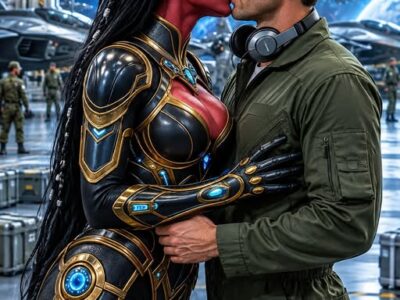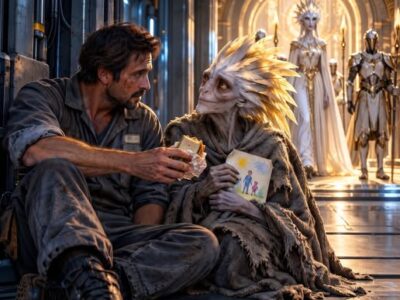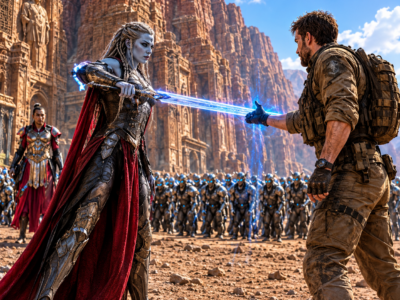
When the wounded alien woman collapsed outside my Colorado cabin, I carried her inside while the military hunters called her a monster and ordered me to surrender her, but years later she returned wearing a crown, touched my old scar, and whispered the words that revealed I had once saved the future ruler of her dying world.

The mountain wind howled against the wooden logs of my cabin, driving a wall of white across the Colorado wilderness.
I sat by the iron stove, nursing a cup of black coffee that had long gone cold.
A sudden, metallic thud shook the foundation of the house, followed by a low rumble that felt like thunder beneath the floorboards.
I grabbed my heavy coat and a flashlight, stepping out into the blinding storm.
Fifty yards into the pine line, a gouge of heat and torn earth smoked against the snow.
In the center of the wreckage lay a figure, barely visible through the thick haze.
I knelt beside her, my heart slamming against my ribs as the flashlight beam illuminated her face.
Her skin was a faint, luminous shade of pale blue, traced with thin silver markings that glowed weakly around her neck.
Dark crimson fluid soaked through her torn tunic, spilling onto the frozen snow.
She opened her eyes, her pupils large and dark as obsidian.
She reached up, her trembling fingers brushing my sleeve, and whispered a phrase that sounded like glass breaking on marble.
I didn’t need to understand her words to see the absolute terror in her gaze.
I knew if I left her out here, she would be dead before the hour was up.
I slid my arms beneath her shoulders and knees, lifting her off the freezing ground.
She was shockingly light, like porcelain filled with air.
As I carried her back toward the cabin lights, the distant chop of heavy helicopter blades echoed through the cloud cover.
I kicked the front door open and laid her gently on the long oak workbench in my living room.
My hands shook as I ripped open my heavy-duty medical kit, pulling out bandages and antiseptic.
The silver markings on her throat pulsed faintly every time her chest rose in a labored breath.
I cleaned the deep wound across her shoulder, wrapping it tightly while she gritted her teeth in silence.
Outside, the chop of the rotors grew louder, shaking the glass in the window frames.
Searchlights swept across the snow, casting long, frantic shadows through the cabin windows.
I pulled the heavy blackout curtains shut, holding my breath in the dim firelight.
For three days, the storm locked the mountain in ice, and I stayed by her side.
I fed her broth and water, watching the silver lines on her skin slowly brighten as her fever broke.
She rarely spoke, spending long hours staring out the high window toward the stars.
On the fourth morning, as the sun broke over the white peaks, she sat up and looked directly at me.
“You saved me,” she said, her voice clear and unnervingly soft, standard English dropping from her lips like she had studied it in her sleep.
I offered a tired smile, setting down a mug of hot tea.
“You’re welcome.”
She reached out, her fingers cool as river ice, and touched the back of my hand.
“I will remember.”
Before I could ask her who she was, the roar of engines exploded directly over the cabin roof.
Red laser lines pierced the frost on the glass, crisscrossing the living room walls.
The front door splintered open under a heavy boot, and four men in unmarked black tactical gear flooded the room.
Their assault rifles were locked directly onto my chest.
“Step away from the alien!” the lead operative barked, his voice distorted by a heavy respirator.
I stepped in front of the workbench, spreading my arms to block their line of fire.
“She’s unarmed and hurt,” I shouted over the wind rushing through the broken doorway. “Get out of my house!”
The leader didn’t lower his rifle an inch.
“You don’t understand what she is, civilian. Move or you die with her.”
I glanced back at her.
She was curled into a ball against the wall, her silver throat marks flashing wildly in panic.
Maybe I didn’t know what she was, but I knew what it looked like when something helpless was about to be slaughtered.
I lunged to my left, slamming my shoulder into the heavy iron stove pipe, dislodging it and filling the room with thick, gray smoke and flying embers.
In the chaos and coughing, I grabbed her wrist and pulled her into the dark hallway.
I kicked open the hidden trapdoor beneath my workshop floor, shoving her into the cramped, insulated root cellar.
“Stay quiet,” I whispered, pulling the rug back over the wood.
The soldiers tackled me seconds later, smashing my face against the floorboards.
A gun barrel pressed hard against the base of my skull.
“Where is she?” the commander growled, tearing through the cabin, kicking over furniture and pulling down shelves.
“She ran out the back,” I coughed, tasting blood from a split lip. “Into the trees.”
They held me in zip-ties on the freezing porch for three hours while dogs barked and search teams swept the ridge.
When the sun fully rose, the commander dragged me up by my collar.
“If we find out you helped her escape, we will come back for you,” he hissed.
They boarded their black unmarked choppers and lifted off into the pale morning sky.
When the sound of the blades finally faded, I dragged myself inside and cut the plastic ties with a kitchen knife.
I pulled open the root cellar hatch.
It was empty.
A single silver feather-shaped mark was etched into the wood where she had been sitting, alongside a deep scratch on my right hand from where the soldier’s boot had crushed me against the floor.
She was gone without a footprint in the fresh snow outside.
For seven long years, I lived alone on that ridge, convincing myself the whole thing was a hallucination brought on by cabin fever.
Until the sky opened up over Washington, D.C.
Every channel on the television turned to static before cutting to a live broadcast from the National Mall.
The afternoon light was swallowed whole by a ship the size of a city, floating noiselessly above the monuments.
Global news anchors were screaming, scrambling for words as a silver ramp lowered from the belly of the vessel.
I stood in my living room, clutching a cold cup of coffee, unable to blink.
A figure descended the ramp, flanked by armored guards wearing silver plate that shimmered like sunlight on water.
She wore a towering crown of woven light, a dark blue cloak trailing behind her on the tarmac.
She was taller now, her posture regal and terrifyingly powerful, but those silver throat markings were unmistakable.
“Queen Seraya, sovereign of the Lyrian Empire,” the reporter stammered, his voice shaking uncontrollably.
She walked toward the array of international news cameras, stopping just feet from the lenses.
Her dark eyes stared directly into the camera, looking past the reporters, past the millions of viewers worldwide.
Looking straight at me.
A tiny, subtle smile touched her lips before the broadcast cut to black.
Less than three hours later, the wind outside my mountain cabin shifted, carrying the sound of a heavy, silent engine.
A single black vehicle, sleek and windowless, sat idling in the knee-deep snow outside my front door.
The cabin door creaked open, and she stepped inside alone, letting the bitter wind blow the door shut behind her.
The crown was gone, but her blue skin and silver markings practically glowed against the dim light of my living room.
For a long minute, neither of us said a word.
She walked toward me, her footsteps completely silent on the rug.
She reached out and gently touched the faint scar on the back of my hand, left by the soldier’s boot seven years ago.
“You still have it,” she whispered.
My voice caught in my throat.
“You… you remember me?”
Tears gathered in the corners of her dark eyes, sparkling like liquid diamond.
“I remember everything.”
She pulled a small, silver object from beneath her cloak and held it out to me.
It was the plastic emergency tag from my old medical kit, worn smooth by years of handling.
“I carried this across three star systems,” she said softly.
I stared at the plastic tag in my hand, my mind spinning.
“Why did you come back here, Seraya?”
She stepped closer, the warmth radiating off her body filling the chilly room.
“Because you saved my life when I was weak and hunted,” she said, her voice dropping to a harsh tremble. “And because I was never supposed to be on Earth in the first place.”
I felt a cold knot form in my stomach.
“What does that mean?”
She turned toward the high window, looking out into the pitch-black mountain night.
“The mercenaries who hunted me through your woods seven years ago… they were not sent by your government.”
She paused, her throat marks pulsing a deep, warning red.
“And they were not hunting an alien soldier.”
I took a step back, my heart beating heavily against my ribs.
“Who were they hunting?”
She turned back to me, her expression pale with an ancient, unbearable grief.
“They were hunting a child.”
My breath hitched in my chest.
“A child?”
“My daughter,” Seraya said, her voice barely audible over the roaring wind outside. “The true heir to the Lyrian throne.”
She took my rough hand between her smooth palms.
“When my ship was shot down over these mountains, I wasn’t alone.”
“I didn’t see anyone else in that crash,” I stammered, my pulse racing.
“Because I hid her before your flashlight reached me,” she explained, her eyes searching mine.
“I placed her in an stasis pod and buried it beneath the frozen earth of this valley.”
She squeezed my hand tight enough to bruise.
“I left her here because I knew I was being hunted, and I knew Earth was primitive enough that my enemies would lose her trail.”
“You left a child in these woods for seven years?” I asked, horror creeping into my voice.
“She has been asleep, safe beneath the permafrost,” Seraya whispered. “Until now.”
A low, guttural vibration rattled the tea cups on my counter.
“The bloodlines have traced her,” Seraya said, turning toward the window. “They finally discovered where I hid her.”
Outside, the snow was no longer falling straight down.
It was swirling upward, pushed by massive anti-gravity thrusters hovering just above the tree line.
Three tall, spindly silhouettes stepped out of the whiteout, their armor jagged and black as coal.
They carried elongated pikes that crackled with blue plasma energy.
“The Shadow Guard,” Seraya spat, a cold, violent edge entering her regal voice.
She reached into her cloak and pulled out a slender silver hilt, which ignited into a blade of pure white light.
“They will tear this mountain apart to make sure my daughter never wakes up.”
“What do we do?” I grabbed my heavy hunting rifle from the wall mount, racking a shell into the chamber.
She looked at me, a mixture of awe and fear in her eyes.
“You are still fighting for me, human?”
“I didn’t let them take you seven years ago,” I said, setting my jaw. “I’m not starting now.”
The front wall of my cabin exploded inward in a shower of timber and ice.
A heavy black pike drove through the dust, striking the floor right where I had been standing a second before.
Seraya moved like a flash of blue lightning, her light-blade parrying the blow with a deafening screech of energy.
“Go to the cellar!” she roared over the storm. “Under the third support beam, there is a vault switch!”
I didn’t argue.
I dove through the shattered trapdoor into the dark root cellar, racking another round into my rifle.
Above me, the sounds of alien combat shook the foundation—metal clashing on metal, hot plasma scorching wooden beams.
I scrambled over the dirt floor to the third support beam, feeling around the cold stone base.
My fingers hit a smooth, metallic plate that hadn’t been there when I checked the cellar years ago.
I pressed down hard.
The dirt floor groaned, pulling apart to reveal a capsule of shimmering glass and gold.
Inside lay a tiny girl, her skin pale blue, her neck covered in soft, luminous silver marks.
She opened her eyes, staring up at me through the glass with the exact same obsidian pupils I had seen seven years ago in the snow.
Above us, the ceiling caved in as a black-armored guard crashed through the floorboards, raising his crackling pike to strike.
I raised my rifle, met his glowing visor, and pulled the trigger.