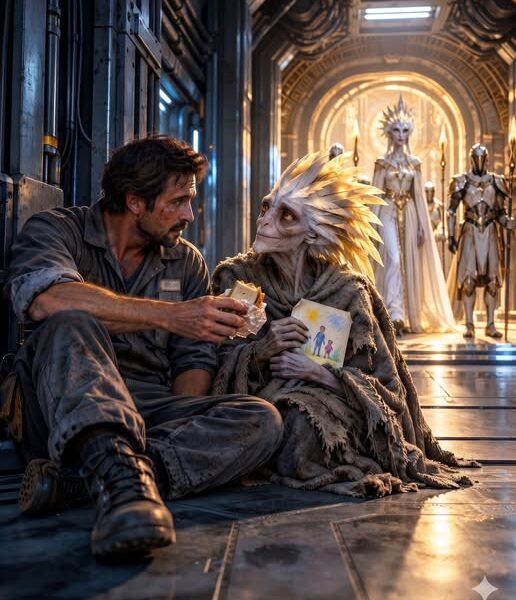
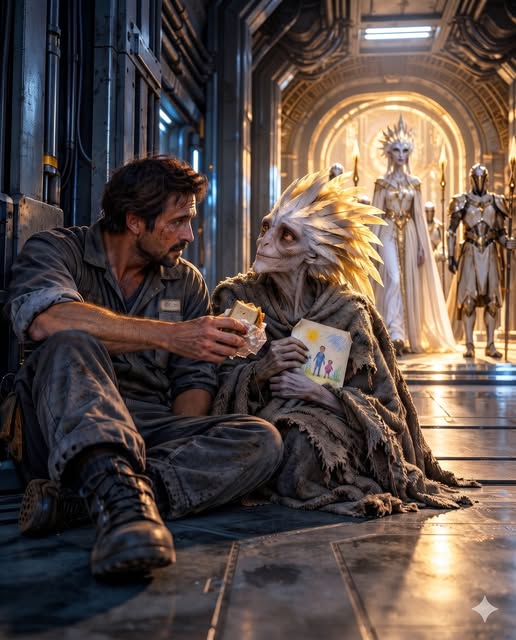
The old alien had gone four days without food. Hundreds of people had walked past him. Then a single father working as a janitor did something that would change the fate of an entire empire. He sat down on the cold metal floor, took half a sandwich from his lunch bag, and offered it to a stranger.
The following morning, Tomas stood outside the governor’s administrative office with a folder of evidence beneath his arm and a knot in his stomach.
He had barely slept.
All night, he’d imagined the same questions.
What if the governor refused to see him? What if Dren accused him of stealing station property? What if he lost his job?
And, worst of all, what if Hadril was already gone?
Lily stood beside him, holding the unfinished drawing she’d made the previous evening.
“Are you scared, Dad?”
Tomas looked down at her.
“A little.”
“Then why are we going?”
He smiled faintly.
“Because sometimes being scared means there’s something important we shouldn’t ignore.”
Before Lily could answer, the office doors slid open.
Dren emerged, flanked by two security officers.
His eyes immediately settled on Tomas.
“You again?”
“I need to speak with Governor Veyran.”
“The governor is busy.”
“Then I’ll wait.”
Dren laughed.
“You really don’t understand how this works, do you? You’re a maintenance worker. You clean floors. You don’t question administrative decisions.”
Tomas tightened his grip on the folder.
“I’m not questioning your authority. I’m asking where the missing food supplies went. I’m asking why medical shipments intended for lower-level workers never arrived. And I’m asking why people who complain suddenly lose their employment permits.”
Dren’s smile disappeared.
“You should be careful.”
“I’ve been careful for six years. It hasn’t helped anyone.”
One of the officers stepped forward.
But before he could speak, a voice came from inside the office.
“Let them in.”
Governor Veyran stood behind a wide transparent desk. He was a heavyset alien with dark green scales and four narrow eyes.
He looked irritated, as though the interruption had disturbed something far more important than a child’s welfare.
“What is this about?”
Tomas placed his folder on the desk.
“Workers’ ration shortages. Missing medical supplies. Unlawful deportations. I have statements from twelve employees, delivery records, and copies of the maintenance logs.”
Veyran barely glanced at them.
“These are administrative matters.”
“They’re people’s lives.”
“Your job is to maintain station infrastructure, not investigate imperial policy.”
Tomas felt Lily’s hand slip into his.
He looked at the governor.
“Then perhaps someone whose job it is should have done something.”
For a moment, the room became completely silent.
Dren moved toward Tomas.
“That’s enough.”
But Governor Veyran raised one hand.
“Leave the documents.”
Then he turned toward Tomas.
“And go back to work. If these allegations are false, you’ll face disciplinary action. If they’re true, someone will investigate.”
Tomas knew that was not a promise.
It was a dismissal disguised as an answer.
He collected Lily’s hand and walked toward the exit.
They had almost reached the door when every light in the administrative complex turned red.
A deep mechanical tone echoed through the station.
Then a voice filled the room.
“IMPERIAL PRIORITY ALERT. ALL STATION COMMAND PERSONNEL ARE TO REPORT TO THE CENTRAL ARRIVAL DECK.”
Governor Veyran went pale.
A holographic symbol appeared above the desk.
A golden crown surrounded by seven stars.
Dren took a step backward.
“No,” he whispered.
Veyran stared at the symbol.
“That’s the personal seal of the Imperial Throne.”
The voice continued.
“Her Imperial Majesty, Empress Saleith, has entered station jurisdiction. All civilian and military authorities are ordered to stand by.”
Lily looked up at her father.
“Dad, is that important?”
Tomas swallowed.
“I think so, sweetheart.”
He had no idea how important it was.
Twenty minutes earlier, aboard the imperial battleship Aurelian, Empress Saleith had been staring at a holographic identification screen.
The message was simple.
An unknown individual had attempted to register a citizen using an identity code that had been inactive for seventeen years.
The system had rejected the registration.
Then it had done something that had never happened before.
It had activated the imperial emergency protocol.
Saleith knew that code.
She had memorized it as a child.
It belonged to one person.
Her father.
“Show me the identification record,” she ordered.
Her chief intelligence officer, Commander Reth, hesitated.
“Your Majesty, the station has classified the individual as an unregistered vagrant. There appears to have been a dispute with local security.”
“Show me.”
The hologram expanded.
A photograph appeared.
An elderly alien with silver skin, a faded feathered crest, and tired golden eyes.
Saleith stopped breathing.
For seventeen years, she had believed her father was dead.
She had searched distant colonies, questioned former imperial officers, and sent reconnaissance teams into forgotten territories.
Nothing.
Then, suddenly, there he was.
Alive.
And apparently starving in a service corridor.
“Prepare my personal shuttle.”
“Your Majesty, we should dispatch a security delegation first. Kessan Spire is under investigation for possible—”
“My father is on that station.”
Her voice was quiet.
That made it more frightening.
“Prepare the shuttle.”
When Saleith arrived at Kessan Spire, the entire central deck had been cleared.
Imperial guards stood in perfect formation.
Station officials bowed as her shuttle doors opened.
Governor Veyran rushed forward, his four eyes blinking nervously.
“Your Majesty, what an extraordinary honor. We were not informed of your visit.”
Saleith walked past him.
“Where is he?”
Veyran hesitated.
“Who, Your Majesty?”
She turned.
“My father.”
The governor’s expression collapsed.
“I… believe there may have been a misunderstanding.”
“Where is he?”
Dren stepped forward, desperately attempting to recover his composure.
“Your Majesty, we recently detained an elderly alien matching that description. He was occupying an unauthorized sleeping area and receiving unauthorized assistance from a human employee.”
Saleith stared at him.
“You detained him?”
“He refused to identify himself.”
“He was weak, wasn’t he?”
Dren said nothing.
“Had he eaten?”
The supervisor looked toward the governor.
Saleith’s voice became colder.
“Answer me.”
“I… cannot confirm that, Your Majesty.”
She looked at the two officers standing behind him.
“Take me to him.”
Hadril was sitting in a temporary detention chamber beneath the station’s security complex.
His hands were folded in his lap.
The room was cold.
He had not eaten since the previous morning, when the guards had taken away the last container of stew Tomas had brought him.
He wasn’t angry.
He was disappointed.
For seventeen years, he had wondered whether his daughter had become the ruler he had hoped she would be.
Now he wondered whether the empire itself had become something neither of them would recognize.
The chamber door opened.
He looked up.
A woman stood in the doorway, dressed in white imperial armor.
Her silver hair fell over her shoulders, and a golden crown rested above her forehead.
For several seconds, neither spoke.
Then Hadril slowly stood.
“Saleith?”
The empress’s expression broke.
“Father.”
She crossed the room and fell into his arms.
Hadril held her as tightly as his exhausted body allowed.
She was crying.
An empress, commander of hundreds of worlds, ruler of countless civilizations, was crying like the little girl who used to hide beneath his desk during thunderstorms.
“I thought you were dead,” she whispered.
“I thought you were safer without me.”
“Why didn’t you come home?”
Hadril looked at the floor.
“Because I needed to know what kind of empire you were ruling.”
Saleith pulled away.
“And?”
He studied her face.
“I found a place where people starve while officials dine behind golden walls. I found workers afraid to visit doctors. I found children who have never seen the upper gardens because their parents cannot afford the elevator.”
His voice trembled.
“And I found a human being who gave away half his lunch to an old stranger.”
Saleith lowered her eyes.
“Who?”
“His name is Tomas Ray.”
For the first time since entering the chamber, the empress smiled.
“Then I would very much like to meet him.”
Tomas was halfway through repairing a broken ventilation unit when the imperial guards arrived.
He almost dropped his wrench.
“Are you Tomas Ray?” one asked.
“Yes.”
“Her Imperial Majesty requests your presence.”
Tomas stared at him.
“Have I done something wrong?”
The guard’s expression softened.
“No, sir. Quite the opposite.”
Lily immediately stepped forward.
“Can I come too?”
The guard looked at Tomas.
“If Her Majesty agrees.”
Tomas wiped his hands on his work trousers.
He had never imagined that the most important day of his life would begin with an invitation from the empress.
He had also never imagined that his daughter would insist on bringing a drawing to an imperial audience.
But Lily held it firmly against her chest.
When they entered the reception chamber, Hadril was standing beside the throne.
His crest had regained some of its golden color.
Lily gasped.
“Mr. Hadril!”
The old alien turned.
His eyes brightened.
“Little Lily.”
She ran toward him and hugged him around the waist.
“I thought we’d lost you!”
Hadril bent carefully and placed one hand on her head.
“I am sorry, little one.”
Tomas stood a few steps away, suddenly unsure what to do with his hands.
Then Hadril extended one toward him.
“Tomas Ray. The man who shared his lunch with a stranger.”
Tomas shook it.
“I didn’t know who you were.”
Hadril smiled.
“That is precisely why it mattered.”
The empress approached.
“Tomas, I understand that you helped my father when he had nothing.”
Tomas shook his head.
“Anyone should have done it.”
“But they didn’t.”
He glanced at Lily.
“She helped more than I did. Most of the food was her idea.”
Saleith looked at the little girl.
“What is that you’re holding?”
Lily unfolded her drawing.
It showed three figures sitting together around a small table.
The old alien, the human janitor, and a little girl.
Above them were the words:
“Nobody should eat alone.”
The empress studied it for a long time.
Then she looked at her father.
He nodded.
“Keep it, Saleith. It is more valuable than anything in this room.”
She accepted the drawing with both hands.
“I will.”
The investigation began that same afternoon.
Saleith ordered a complete audit of Kessan Spire’s administration.
Every ration shipment was traced.
Every medical delivery was checked.
Every employee complaint that had been ignored was reopened.
At first, Governor Veyran insisted that the shortages were caused by transportation delays.
Then investigators discovered that nearly forty percent of the food allocated to lower-level workers had been redirected to private distribution networks.
Medical supplies had been sold to wealthy private clinics.
Workers’ housing funds had been diverted into accounts controlled by senior administrators.
Dren had been collecting payments from contractors in exchange for falsifying maintenance reports.
The station’s security officers had been ordered to deport anyone who asked too many questions.
The evidence was overwhelming.
Veyran was removed from office.
Dren was arrested.
Several administrators were detained, and the investigation expanded to eleven other imperial stations.
But the most shocking discovery came three days later.
A sealed archive revealed that the corruption had not begun at Kessan Spire.
It had existed for nearly a decade.
And several high-ranking imperial ministers had known about it.
Some had even approved the policies that allowed it to continue.
Saleith stared at the files in disbelief.
Her father stood beside her.
“I thought the reports were exaggerated,” she whispered.
“I know.”
“I believed the people responsible were isolated.”
“Perhaps they were. But you allowed them to remain comfortable.”
She turned toward him.
“Are you saying this is my fault?”
Hadril considered his answer carefully.
“I am saying that a ruler cannot personally commit every injustice in an empire. But a ruler is responsible for building a system in which injustice can survive.”
Saleith looked down at the documents.
For the first time in many years, she felt the full weight of her crown.
She had spent her reign expanding trade routes, strengthening the military, and negotiating treaties.
She had measured success in ships, territories, and economic growth.
But she had forgotten something fundamental.
An empire was not the buildings at its center.
It was the lives of the people who lived at its edges.
“I need to change everything,” she said.
Hadril nodded.
“Then begin with the people who have been waiting.”
The changes at Kessan Spire happened faster than anyone expected.
Within a week, every worker received the full food allowance they were entitled to.
Emergency medical clinics opened on the lower levels.
Housing complaints were reviewed by an independent council.
Workers could report corruption without risking their employment permits.
Most importantly, the imperial government established a public system that allowed ordinary citizens to track essential supplies from departure to delivery.
No official could quietly redirect a shipment without leaving a record.
Saleith also ordered an investigation into every station in the empire.
But Tomas was not thinking about politics.
He was worried about his job.
The imperial guards had been appearing outside his apartment every morning, and Lily had started telling her classmates that her father was friends with the empress.
He wasn’t sure whether that was entirely accurate.
One evening, he found an official message waiting on his kitchen table.
It bore the imperial seal.
His stomach tightened.
He opened it.
The document announced that Tomas Ray had been offered a permanent position within the Imperial Civil Welfare Council.
The salary was more than ten times what he earned as a janitor.
The position included housing, medical benefits, and educational support for Lily.
Tomas read it twice.
Then a third time.
He put the document down.
Lily looked up from her homework.
“Does that mean we can buy a bigger apartment?”
“Maybe.”
“And you won’t have to work nights?”
“Maybe.”
“Then why do you look worried?”
Tomas rubbed his forehead.
“Because I don’t know anything about being a government official.”
Lily thought for a moment.
“Do you know how to help people?”
“Yes.”
“Then you already know the important part.”
Tomas laughed.
Sometimes, he thought, his daughter had a way of making complicated things embarrassingly simple.
Still, he wasn’t sure he should accept.
The next morning, he requested an audience with Hadril.
He found the old emperor sitting in a garden overlooking the station’s central observation windows.
The man was wearing a simple blue robe.
No crown.
No guards.
Just a small cup of tea and a stack of Lily’s drawings beside him.
“I heard you received an offer,” Hadril said.
“I did.”
“And you intend to refuse?”
Tomas sat beside him.
“I don’t want to become one of those people who starts with good intentions and ends up forgetting everyone below them.”
Hadril smiled.
“That is a reasonable fear.”
“How did you avoid it?”
The old emperor looked toward the distant stars.
“I didn’t always. That is the truth.”
Tomas turned toward him.
Hadril continued.
“When I was young, I believed a great ruler needed great victories. I built fleets, negotiated alliances, and expanded the empire. People praised me. I began to believe their praise.”
He paused.
“Then one day, during a famine on a distant moon, I received a report that thousands had died. I was told the situation was under control. I signed the document and moved on to the next meeting.”
His eyes lowered.
“Years later, I learned that the report had concealed the truth. I had not caused that famine, but my indifference had allowed it to continue.”
Tomas said nothing.
“Power does not always corrupt through greed,” Hadril continued. “Sometimes it corrupts through distance. You stop seeing people. They become numbers on a screen, problems in a report, expenses in a budget.”
He turned toward Tomas.
“You shared half a sandwich because you saw a hungry person. Never lose that ability.”
Tomas looked at the offer again.
“What if I make mistakes?”
“You will.”
“What if I fail?”
“Then listen to the people affected, admit your failure, and try again.”
The old alien placed a hand on his shoulder.
“The empire does not need another person who believes he is incapable of being wrong. It needs people who are willing to notice when they are.”
Tomas finally nodded.
“I’ll accept. But I want to keep visiting the lower levels. I don’t want to spend my days in an office.”
Hadril laughed.
“Then I suspect you will be more useful than most of the ministers.”
Three months later, Kessan Spire looked different.
Not in the way visitors would immediately notice.
The gardens were still beautiful.
The restaurants were still expensive.
The upper levels still shone beneath artificial sunlight.
But beneath the polished floors, something important had changed.
The maintenance workers now had proper protective equipment.
The food distribution center was open twenty-four hours a day.
The medical clinic had become one of the busiest facilities on the station, not because people were getting sicker, but because they were finally receiving treatment.
Tomas had begun working with the newly formed Civil Welfare Council.
He spent much of his time visiting neglected residential sectors, listening to complaints, and making sure that promises turned into actual improvements.
He wasn’t particularly good at giving speeches.
He didn’t enjoy wearing formal clothes.
And he still occasionally showed up to meetings with grease on his sleeves.
But people trusted him.
Not because he was powerful.
Because they knew he remembered what it felt like to have no power at all.
Lily had also become something of a local celebrity.
Her drawing, the one that had reached the empress, was now displayed in the entrance of the new community dining hall.
A small plaque beneath it read:
“Created by Lily Ray, age eight.
A reminder that dignity begins when we recognize one another.”
Every week, Lily visited the dining hall with her father.
She helped arrange tables, handed out fruit, and talked to children whose parents worked long shifts.
Sometimes, she brought extra drawings.
Sometimes, she simply sat with people who had nobody to talk to.
Hadril visited whenever his health allowed.
He had recovered remarkably well.
His silver skin had regained its shine, and the golden feathers along his crest had grown bright again.
But he still preferred simple meals and quiet conversations.
He never returned to his old palace.
When Saleith asked him why, he gave the same answer every time.
“I have spent enough of my life surrounded by people who bow. I would rather spend the rest surrounded by people who speak honestly.”
One afternoon, nearly a year after Tomas had first offered him the sandwich, Hadril requested a private meeting with Lily.
She found him in the observation garden, sitting beneath a tree imported from his home planet.
“Did you need something, Mr. Hadril?”
He smiled.
“I wanted to ask you a question.”
Lily sat beside him.
“Okay.”
“Do you remember the first drawing you gave me?”
She nodded.
“The one that said nobody should eat alone?”
“Yes.”
Hadril looked toward the stars.
“That drawing changed my life.”
Lily giggled.
“But it was just a picture.”
“Sometimes a small picture can remind someone of something enormous.”
He reached into his robe and produced a small object.
It was a silver pendant shaped like a circle surrounded by seven tiny stars.
Lily’s eyes widened.
“Is that a royal medal?”
“It is something older.”
He placed it in her palm.
“On my home world, this symbol represents the first responsibility of anyone who holds power. It means that the strength of a civilization should be measured by how it treats those who cannot repay its kindness.”
Lily examined it carefully.
“Why are you giving it to me?”
“Because you reminded an old emperor of something he had forgotten.”
She looked uncomfortable.
“But Dad was the one who gave you the sandwich.”
Hadril smiled.
“Your father gave me food. You gave me a reason to believe that kindness could survive even in a world that had forgotten it.”
He closed her fingers around the pendant.
“Keep it. Not because it makes you important, but because it reminds you that you never need to be important to make a difference.”
Lily hugged him.
“Thank you.”
Then she looked up.
“Can I ask you something?”
“Of course.”
“Are you happy now?”
Hadril considered the question.
He thought about the seventeen years he had spent wandering, the empire he had lost, the daughter he had nearly lost, and the countless people whose suffering he had once failed to see.
Then he looked through the garden window.
Tomas was standing near the entrance, talking to a group of workers.
Saleith was beside him, listening rather than speaking.
The old emperor smiled.
“Yes, little one. I believe I am.”
That evening, the imperial palace held a ceremony to mark the beginning of a new civic initiative.
Representatives from hundreds of worlds attended.
Military commanders stood beside scientists, merchants, farmers, and ordinary station workers.
At the center of the hall stood Saleith.
Beside her was Hadril.
And a little farther away stood Tomas and Lily.
The empress raised her hand.
The hall fell silent.
“For many years, our empire has celebrated its strength through the size of its fleets, the wealth of its cities, and the number of worlds beneath our banner,” she began.
“We have built magnificent structures and achieved extraordinary victories.”
She paused.
“But we have also allowed suffering to hide behind those achievements. We have mistaken order for justice, wealth for prosperity, and obedience for loyalty.”
Her eyes moved toward Tomas.
“An ordinary citizen recently reminded my family of a truth that should never have been forgotten.”
She turned toward the audience.
“When he saw an old stranger going hungry, he did not ask for his identity, his position, or his political importance. He simply shared what he had.”
Tomas lowered his head, embarrassed by the attention.
Saleith continued.
“That simple act exposed a failure in our civilization more clearly than a thousand official reports.”
She announced the creation of the Open Hands Initiative, a permanent imperial program focused on food security, accessible healthcare, worker protection, and independent oversight across all imperial territories.
But her final announcement surprised everyone.
“The initiative will be guided by a council that includes representatives chosen from the communities it serves. No longer will decisions about ordinary people be made exclusively by those who have never experienced their struggles.”
She looked toward Tomas.
“Mr. Ray has agreed to serve as one of its founding members.”
Applause filled the hall.
Tomas glanced at Lily.
She was smiling so widely that her cheeks had turned pink.
Then Saleith stepped aside.
Hadril approached the microphone.
His voice was old, but it carried across the enormous chamber.
“I once ruled this empire for nearly three centuries. I believed that power meant being able to command the stars.”
He looked around the hall.
“Then I spent four days hungry in a public corridor. Hundreds of people walked past me. Some were wealthy. Some were poor. Some were busy. Some simply did not care.”
His eyes settled on Tomas.
“Then one man gave me half a sandwich.”
The room became silent.
“He did not know my name. He did not know my history. He did not know that I had once commanded four hundred worlds.”
Hadril smiled.
“He saw a hungry old man. And he acted.”
He paused.
“I have received countless tributes in my lifetime. Gold, monuments, military honors, and titles that would fill an entire library. But I will remember that sandwich longer than any of them.”
His gaze moved toward Lily.
“And I will remember the little girl who wrote that nobody should eat alone.”
He slowly raised his hand.
“May this empire never again become so powerful that it forgets how to be kind.”
The hall erupted in applause.
But Tomas wasn’t thinking about the empress, the ministers, or the thousands of people watching.
He was thinking about a cold corridor, a tired old stranger, and a sandwich that had been wrapped in ordinary paper.
Something so small.
Something that had seemed almost meaningless.
Yet somehow, it had changed everything.
Years later, when Lily was old enough to understand the full story, she would often ask her father whether he regretted giving away half his lunch that morning.
Tomas always gave her the same answer.
“Not once.”
By then, the Open Hands Initiative had expanded across hundreds of worlds.
Millions of people had gained access to food, medical care, and protection they had once been denied.
The empire was far from perfect.
There were still dishonest officials, difficult decisions, and problems that could not be solved overnight.
But there were also people willing to speak up, systems designed to catch corruption, and leaders who had learned that listening was not a weakness.
Hadril eventually passed away peacefully, surrounded by his daughter, his friends, and the drawings Lily had made for him.
His final request was unusual.
He asked that no grand monument be built in his honor.
Instead, he wanted a public dining hall established on every imperial station, where anyone could receive a warm meal without being asked for their wealth, status, or identity.
At the entrance of the first hall, his favorite drawing was placed beneath a simple inscription:
“Nobody should eat alone.”
Lily grew older, but she never forgot the old alien who had once sat hungry on a cold metal floor.
She kept his silver pendant throughout her life.
And whenever someone asked her why she carried it, she told them the story of a sandwich.
Not a royal feast.
Not a military victory.
Not an ancient prophecy.
Just a sandwich made with cheese and tomato, prepared by a little girl for her father.
And given away by a man who had very little, but understood that someone else had even less.
Years later, when Lily became one of the youngest representatives on the Imperial Council, she used to repeat something her father had taught her:
“You don’t have to be powerful to help someone. But if you ever become powerful, you have even less of an excuse not to.”
That sentence eventually became part of the Open Hands Initiative’s founding principles.
And perhaps that was the greatest legacy of Hadril, Saleith, Tomas, and Lily.
An empire had once believed its greatness came from the number of worlds it controlled.
Now, it was slowly learning that greatness came from the lives it protected.
Because history often remembers emperors, generals, and the people who sit on thrones.
But sometimes, the future is changed by someone nobody notices.
A tired father.
A hungry stranger.
A little girl with a pencil.
And half a sandwich.
The greatest acts of kindness are rarely the ones that cost us everything. Sometimes, they are simply the ones we choose to give when we have very little.
And sometimes, that is enough to change an entire universe.