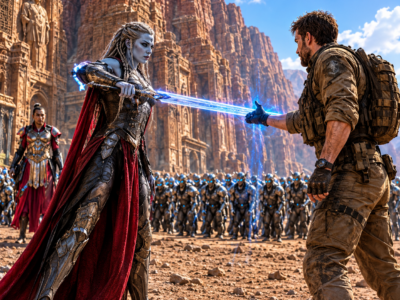
The entire ship had been warned to stay away from the silver-haired alien woman. Then a human mechanic sat beside her, offered her half his sandwich, and unknowingly changed both their lives.
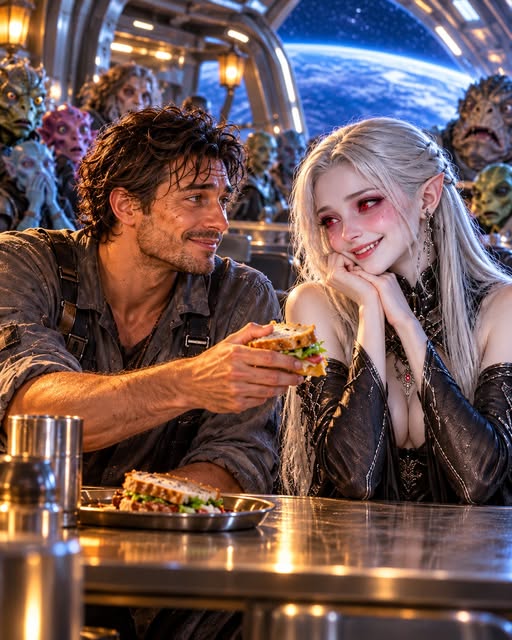
Whis looked at Saraphene’s pale face and realized something that made his stomach tighten.
She was dying.
The woman who had spent 206 years being feared, avoided, and treated like a walking disaster had just given away the one thing her species could never afford to lose.
Her own life.
“Hey,” Whis whispered. “Saraphene. Look at me.”
Her eyelids trembled.
“Don’t…” she managed.
“Don’t what?”
“Don’t waste… your strength.”
Whis almost laughed, although there was nothing funny about the situation.
“Lady, I’ve spent fourteen years fixing machines that were designed by people who apparently hated mechanics. You’re going to have to be more specific.”
He tried to move the wreckage pinning his legs, but pain shot through his body. His rescue suit was barely functioning. The temperature inside the compartment was dropping rapidly.
The five rescued engineers were already being carried toward the emergency exit by the security team. The coolant leak had been contained, but the compartment’s automatic doors had sealed after the pressure change.
They were trapped.
Whis reached for his emergency communicator.
“Control, this is Callaway. We need immediate medical assistance in compartment seven. One injured human, one Velari suffering severe energy depletion. I repeat, we need assistance now.”
Only static answered.
He tried again.
Nothing.
Saraphene’s fingers weakly closed around his wrist.
“Whis…”
“I’m here.”
“You must leave.”
“That’s a terrible suggestion.”
“You don’t understand. If I remain unconscious, my body will begin drawing energy from whatever is closest. I cannot control it.”
Whis looked at her hand.
He understood.
If he stayed beside her, she might accidentally drain him again. And if she did, there might not be enough left to save either of them.
He gently removed her hand from his wrist.
Then he did something she never expected.
He pulled off his damaged thermal undersuit, wrapped it around her shoulders, and activated the small emergency heating unit attached to his belt.
“Listen to me. You’re not dying in a freezer because you made the mistake of saving an idiot.”
“Human…”
“Whis. My name is Whis.”
For a moment, her eyes opened.
“Whis.”
“That’s better.”
He examined the collapsed catwalk. The metal beam trapping his legs was too heavy to lift manually. His cutting torch was out of fuel, and the compartment’s power system had failed.
But there was another possibility.
The emergency coolant pumps were connected to a manual pressure release system. If he could redirect the remaining pressure, he might be able to move the damaged catwalk enough to free himself.
There was just one problem.
The release lever was on the opposite side of the compartment.
He looked at Saraphene.
“Can you still sense the others?”
She barely nodded.
“Five… living signatures. Beyond the door.”
“Good. Then you can help me with something.”
Her expression changed.
“How?”
“Keep talking.”
She frowned.
“That is your plan?”
“Absolutely. Best plan I’ve got.”
He began describing his nephew’s latest dinosaur obsession. Apparently, the boy had recently decided that every dinosaur could be defeated by a sufficiently determined chicken.
Saraphene listened, confused by the absurdity of the story.
But she answered.
She asked questions.
She corrected his pronunciation of several Velari words.
And slowly, as her consciousness remained engaged, she managed to keep her natural energy field under control.
Whis dragged himself toward the manual release lever.
Every movement sent pain through his injured legs. Blood floated in tiny red droplets where the compartment’s artificial gravity had weakened.
He reached the lever.
It wouldn’t move.
“Of course,” he muttered. “Why would anything on this ship work properly?”
He wrapped both hands around it and pulled.
Nothing.
Then he noticed the pressure indicator.
The system wasn’t completely dead. The emergency pumps were still receiving power from the auxiliary reactor, but the control circuit had been damaged.
He removed the access panel and began connecting two wires manually.
A spark flashed.
The compartment shuddered.
The pressure valve opened.
Behind him, the catwalk shifted just enough for Whis to pull his legs free.
He collapsed onto the floor.
For several seconds, he couldn’t breathe.
Then he crawled toward Saraphene.
“See?” he whispered. “Told you I’d fix it.”
She looked at him through half-closed eyes.
“You are… an incredibly foolish creature.”
“Yeah. I’ve been told.”
The emergency door finally opened.
Medical personnel rushed inside.
They carried both of them to the infirmary.
Whis survived.
Saraphene survived.
But the doctors had troubling news.
The Returning had depleted nearly every reserve in Saraphene’s body. Her energy organs had entered a dormant state, and there was no guarantee they would recover.
Without sufficient nourishment, she might never regain her natural abilities.
Worse, the Returning had created an unusual biological connection between her and Whis.
The energy she had given him was no longer simply his own.
A small portion of her biological signature had become integrated into his cellular activity.
The ship’s physician, Doctor Elian Voss, spent three hours examining the results.
Finally, she removed her glasses.
“I have never seen anything like this.”
Whis was lying in a medical bed with both legs immobilized.
“Good news or bad news?”
“That depends on your definition.”
“That’s usually bad news.”
Doctor Voss turned toward Saraphene.
“Your body recognizes him as a compatible energy source. But his body also appears to recognize your energy signature. The exchange has become partially reciprocal.”
Saraphene stared at her.
“Impossible.”
“Apparently not.”
“Velari energy cannot permanently bond with another species.”
“Perhaps it cannot under ordinary circumstances.”
Whis raised one finger.
“Just checking. Does this mean I’m going to grow silver hair?”
Doctor Voss sighed.
“No.”
“Shame. I’ve always wanted to look mysterious.”
Saraphene laughed.
It was a weak laugh, but it was real.
And for the first time since boarding the Meridian Grace, she wasn’t afraid of what might happen when she did.
Over the next three days, something remarkable happened.
Whis recovered faster than expected.
His damaged tissues regenerated at an unusual rate, and his energy levels remained unusually stable.
Saraphene, however, barely improved.
She could sit up and speak, but her skin had lost its familiar silver glow. Her eyes, once bright as distant stars, looked almost colorless.
Whis noticed.
He also noticed something else.
She had stopped asking for company.
She spent most of her time staring through the infirmary window, watching the stars pass by.
On the fourth evening, he moved his wheelchair beside her bed.
“You know,” he said, “I’ve been thinking.”
“That sounds dangerous.”
“Very funny. You’re getting better.”
She didn’t smile.
“Whis, what I did was not a mistake.”
“I know.”
“I would do it again.”
“I know that too.”
“Then why do you look so troubled?”
He took a long breath.
“Because I don’t want you to think you have to die to prove that you’re worth saving.”
Saraphene turned toward him.
For a long moment, she said nothing.
Then she whispered, “My people have a saying. We are born to borrow the light of others. We are not supposed to keep it.”
“Sounds exhausting.”
“It is.”
“Then maybe it’s time your people learned something different.”
She looked at him.
“What?”
“That borrowing doesn’t mean stealing. And giving doesn’t mean disappearing.”
He reached for the small cup of water on her bedside table.
“Here. Drink.”
She accepted it.
Their fingers touched.
A faint silver glow appeared beneath her skin.
Both of them froze.
Doctor Voss, who had been examining a monitor nearby, rushed over.
“Do that again.”
Whis raised an eyebrow.
“Usually when someone says that, I expect a different kind of request.”
“Your hand. Put it against hers.”
He did.
The silver glow returned.
This time, it spread across Saraphene’s wrist and illuminated the delicate patterns beneath her skin.
Doctor Voss stared at the readings.
“Unbelievable.”
“What is it?” Saraphene asked.
“Your energy organs are responding. His body isn’t merely carrying your signature. It’s helping stabilize it.”
She adjusted the scanner.
“The connection created by the Returning is acting like a biological bridge. When you are close to him, your system can regulate itself without draining him.”
Saraphene looked at Whis.
“Does that mean…”
“It means,” Doctor Voss interrupted, “that your condition may be reversible.”
For the first time in eleven years, Saraphene allowed herself to hope.
But the discovery soon attracted attention beyond the medical department.
A message arrived from the Velari High Council.
They wanted Saraphene transferred to their research vessel immediately.
The message described her condition as a matter of extraordinary scientific importance.
It also included a formal request to detain Whis for examination.
Saraphene read the document twice.
Then she quietly handed it back to the doctor.
“They want to study him.”
Whis shrugged.
“Well, I’ve had worse performance reviews.”
“This is not funny.”
“No. It isn’t.”
He looked at the screen.
“Are they asking, or ordering?”
“Among my people, there is little difference.”
Whis leaned back.
“Then I guess they’ll have to learn the difference.”
Two days later, the Velari vessel arrived.
It was enormous, its silver hull reflecting the light of the nearby star. Six escort ships surrounded it.
A delegation boarded the Meridian Grace.
At their head stood Lord Vaelor, a tall Velari noble whose presence immediately changed the atmosphere of the corridor.
He wore ceremonial armor and carried the insignia of the High Council.
When he saw Saraphene, his expression hardened.
“You look terrible.”
Saraphene lowered her eyes.
“It is good to see you too, Lord Vaelor.”
He ignored Whis.
“Your condition has become a matter of great concern. The Council requires you to return.”
“I am recovering.”
“That is precisely why you must come with us.”
Vaelor finally looked at Whis.
“And this is the human responsible?”
Whis lifted a hand.
“Whis Callaway. Mechanic. Occasional sandwich enthusiast.”
Vaelor’s expression did not change.
“Remove him.”
Two security officers stepped forward.
Whis glanced at Saraphene.
She was already standing.
“No.”
The single word silenced the corridor.
Vaelor stared at her.
“Excuse me?”
“I said no.”
“You are a Velari citizen. Your obligations are to your people.”
“My obligations are to the truth.”
Her voice trembled, but she did not retreat.
“For eleven years, I lived alone because everyone believed I was dangerous. I accepted it. I believed it myself. Then I met someone who treated me like a person instead of a disease.”
Vaelor’s eyes narrowed.
“Sentimental nonsense.”
“Perhaps. But that human risked his life for strangers. He entered a freezing compartment to save five people who had never once spoken kindly to him. He gave me warmth when I had nothing left.”
She stepped closer.
“And now you want to take him because he might help us understand something about our own biology.”
Vaelor gestured to the officers.
“Enough.”
But before they could move, Whis spoke.
“Wait a second.”
Everyone turned.
He had been quiet for too long.
“Lord Whatever-Your-Name-Is, I think we’re missing the important part.”
Vaelor looked offended.
“Lord Vaelor.”
“Right. Here’s the thing. You keep saying you need Saraphene because she’s important to your people. But have you asked her what she needs?”
“She is a subject of the Council’s concern.”
“She’s a person.”
The corridor fell silent.
Whis continued.
“And if you think I’m going anywhere with someone who treats her like property, you’re going to have a very long afternoon.”
Vaelor’s face darkened.
“You are a primitive species with no understanding of Velari law.”
“Maybe. But I’ve got a pretty good understanding of basic manners.”
The security officers advanced.
Then the ship’s captain appeared.
Captain Rhea Solen had been watching the confrontation through the corridor cameras.
She carried a tablet displaying the ship’s medical records and incident reports.
“Lord Vaelor,” she said, “I believe you should review these before attempting to remove anyone.”
Vaelor frowned.
“What is this?”
“Evidence.”
The captain showed him the medical findings from the coolant accident.
It included the full energy transfer record.
Then she showed him the reports from the air-recycling incident, the testimonies of the rescued engineers, and the passenger statements documenting Saraphene’s treatment aboard the ship.
Finally, she displayed the results of a voluntary medical study Whis had agreed to undergo.
“Human and Velari biology can establish a reciprocal energy exchange under specific conditions,” she explained. “It may provide a way for Velari citizens to nourish themselves without unintentionally harming other species.”
Vaelor stared at the data.
For the first time, his confidence seemed uncertain.
“How many humans possess this compatibility?”
“We don’t know yet.”
“Then this discovery belongs to the Council.”
“No,” Captain Solen replied. “It belongs to the people who consent to participate.”
Whis smiled.
“See? That’s a much better sentence.”
Vaelor looked between them.
Then he turned to Saraphene.
“You understand what this means. Your people could finally live without fear of harming others.”
Saraphene nodded.
“I understand.”
“Then come with us.”
She glanced at Whis.
He didn’t tell her what to do.
He simply waited.
That mattered more than he could have imagined.
“I will return,” she said at last. “But not as a prisoner. Not as an experiment. I will return as a representative of my people, and I will decide what happens to my body.”
Vaelor hesitated.
The Council’s delegation had come expecting to collect a valuable scientific specimen.
Instead, they were leaving with a negotiation.
It was a small victory.
But it was the first one Saraphene had ever won.
Three weeks later, the Meridian Grace arrived at its destination.
Whis was finally able to walk without assistance, although he complained that the medical staff had ruined his favorite pair of work boots.
Saraphene’s strength had returned enough for her to travel.
The Velari Council had agreed to a temporary research partnership with several human medical institutions.
The arrangement was simple.
Any experiments required informed consent.
No individual could be detained for their biological characteristics.
And any discovery would be shared with the communities it affected.
It was not a perfect agreement.
But it was a beginning.
On the morning of departure, Whis found Saraphene standing near the observation deck.
Her silver hair floated gently in the artificial gravity.
She looked different now.
Not because her appearance had changed, but because she no longer seemed to be trying to make herself smaller.
“Leaving without saying goodbye?” he asked.
She turned.
“I was considering it.”
“Terrible habit.”
“I learned from a terrible human.”
He grinned.
They stood together, watching the stars.
After a while, Saraphene spoke.
“Whis, I have something to ask you.”
“Go ahead.”
“Would you consider traveling to Velari space?”
He looked at her.
“What’s there?”
“An entire civilization that needs to learn how to live differently.”
“Sounds like a lot of work.”
“It may be.”
“Do they have decent sandwiches?”
“I cannot promise that.”
“Then negotiations may be difficult.”
She laughed.
Then her expression became serious.
“I do not know what will happen between us. Our species are different. Our needs are different. There are things about my biology that even I do not understand.”
Whis nodded.
“That’s fine.”
“Fine?”
“We don’t have to figure out the next hundred years today.”
He looked at the stars again.
“We can start with tomorrow.”
For a moment, Saraphene simply watched him.
Then she reached for his hand.
Their fingers intertwined.
A soft silver light appeared beneath their skin.
Neither of them tried to explain it.
They didn’t need to.
Six months later, the first human-Velari cooperative medical center opened on the orbital station of Asterion.
Its purpose was not to turn humans into energy sources or Velari into research subjects.
It was to find safe, voluntary ways for different species to support one another.
The first patient was a young Velari girl named Nira.
She was only seventeen and had spent most of her life hiding from other species.
Her natural energy field had made ordinary friendships difficult. Her parents had kept her isolated, terrified that someone would accuse her of harming others.
When she entered the center, she refused to look at the human doctor waiting for her.
“Will it hurt?” she asked.
The doctor shook his head.
“Not if we do this properly. And you can stop whenever you want.”
Nira looked uncertain.
Then she noticed Whis standing near the doorway.
He was wearing a mechanic’s uniform, holding a toolbox in one hand and a paper bag in the other.
“Hey,” he said.
She recognized him from the stories circulating across the station.
The human who had sat beside a dangerous Velari woman.
The human who had survived the Returning.
The human who had challenged an entire delegation without raising his voice.
Whis held out the paper bag.
“Sandwich?”
Nira stared at it.
“What is it?”
“Something pretending to be chicken.”
She hesitated.
Then she smiled.
Across the room, Saraphene watched the exchange.
Her eyes shone.
She remembered the dining hall aboard the Meridian Grace.
The empty chairs.
The frightened faces.
The years of loneliness she had mistaken for an unavoidable part of being alive.
All of it had begun to change because one exhausted mechanic had refused to let fear choose where he sat.
Later that evening, she found Whis repairing a faulty ventilation unit outside the medical center.
“You know,” she said, “the Council has officially recognized you as an honorary friend of the Velari people.”
Whis looked up from his tools.
“Does that come with free food?”
“It comes with a ceremonial title.”
“Can I trade it for a sandwich?”
She shook her head, smiling.
“You are impossible.”
“That’s what keeps me employed.”
She sat beside him.
For a while, neither spoke.
Then she rested her head against his shoulder.
“Do you ever wonder what would have happened if you had chosen another table that day?”
Whis tightened a loose bolt.
“Probably would’ve eaten a worse sandwich.”
“Whis.”
He put the tool down.
“Yeah. Sometimes.”
“And?”
“And I think about how many people I almost didn’t meet because I was too tired, too busy, or too convinced that someone else’s problem wasn’t mine.”
Saraphene looked at him.
He continued.
“I didn’t know your story when I sat down. I didn’t know what you could do, or what people thought of you. I just saw someone sitting alone.”
He shrugged.
“Seems like a pretty small thing.”
“It wasn’t small to me.”
He took her hand.
“Then maybe that’s the point.”
Outside the station windows, thousands of stars glittered in the darkness.
Somewhere among them were worlds where people still feared what they did not understand.
There would be more misunderstandings, more prejudice, more moments when the easiest choice would be to look away.
Whis knew he couldn’t fix all of them.
Neither could Saraphene.
But they could keep choosing differently.
And sometimes, that was enough to begin changing the universe.
Years later, when the story of the Meridian Grace became part of Velari history, the Council commissioned a monument.
It stood in the central plaza of their capital city.
It did not depict a great warrior, a famous scientist, or a powerful ruler.
Instead, it showed two figures sitting at a small table.
One was a silver-haired Velari woman.
The other was a human mechanic holding half a sandwich.
At the base of the monument were engraved the words:
“Fear builds empty tables. Kindness gives us a reason to sit together.”
Children often gathered around it, asking their teachers why such a simple moment deserved to be remembered.
The teachers explained the science of the Returning, the discovery of reciprocal energy exchange, and the political changes that followed.
But Saraphene always preferred a different answer.
She would tell them that the most important part of the story had happened before anyone understood the science.
Before the Council arrived.
Before the medical discoveries.
Before the universe began paying attention.
It happened when a tired human looked at someone everyone else avoided and offered her half of his lunch.
Because kindness does not always begin with grand gestures.
Sometimes, it begins with an empty chair.
Sometimes, it begins with a question.
And sometimes, it begins when someone decides that another person’s loneliness matters more than the fear everyone else has taught them to feel.
Whis had never considered himself a hero.
He was still a mechanic.
He still complained about broken machinery.
He still told terrible jokes and made sandwiches that Saraphene insisted were barely edible.
But whenever someone asked him how he had changed an entire civilization, he always gave the same answer.
“I didn’t. I just sat down.”
And perhaps that was the greatest lesson the galaxy ever learned:
You do not need to understand someone completely before treating them with compassion.
You do not need to be powerful to challenge prejudice.
And you do not have to save the entire universe to make a meaningful difference.
Sometimes, all you need is the courage to sit beside someone who has been left alone.
THE END