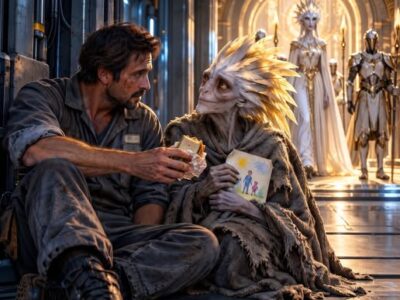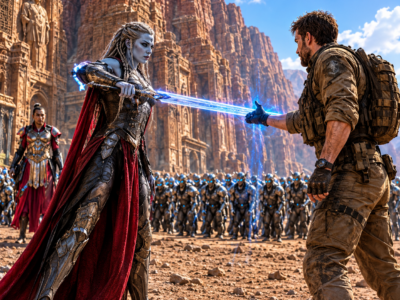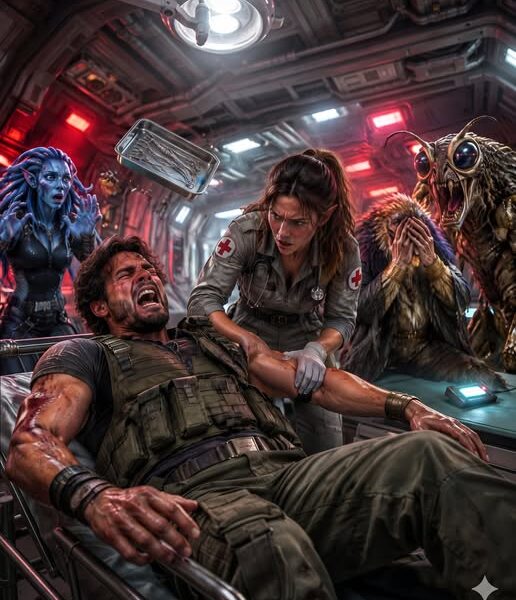
The alien doctor was already preparing to tell Danny Fletcher that he would never use his arm again. Then a human woman walked into the cargo bay, took one look at his shoulder, and said, “I’m going to fix it.”
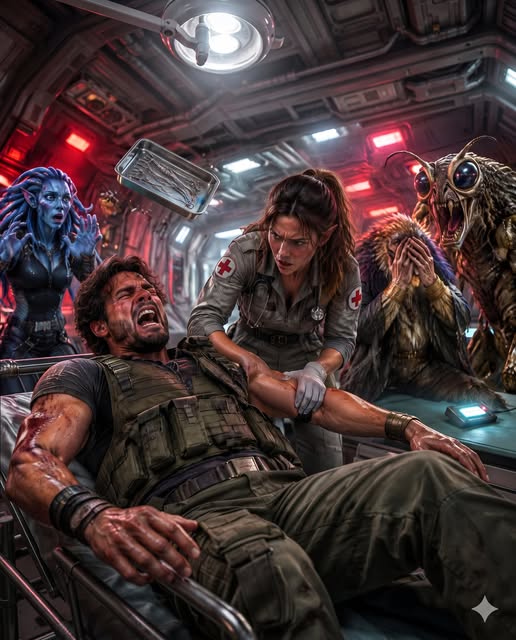
Three weeks after the accident in Reactor Tunnel Seven, Havern Station had begun to change.
At first, the changes were small. Jarry physicians started attending human medical demonstrations. Human engineers learned how to handle crystalline tissue without causing fractures. Even the station’s emergency response manuals were being rewritten.
But the biggest change was happening inside the medical department.
For the first time in Jarry history, young physicians were being taught that an injury did not automatically mean permanent loss.
Dr. Ilsane Torth was leading the program herself.
She had spent twenty-seven years studying Jarry medicine, and she had never questioned the principles she had been taught. Yet now, every day brought another discovery.
Humans had techniques for reducing dislocations, stabilizing fractures, controlling bleeding, and keeping damaged limbs functional while the body recovered.
Their bodies were far from indestructible.
In fact, human medical records revealed something that both fascinated and frightened her.
Humans suffered injuries constantly.
They broke bones, tore muscles, damaged organs, and sometimes lost limbs. Their bodies were not particularly elegant or resistant to trauma.
And yet, they had developed an extraordinary ability to keep going.
Ilsane found herself wondering whether this was the real secret of humanity.
Then, on the twenty-third day of the training program, everything changed again.
The station received an emergency transmission from a mining vessel called the Kestrel-9.
The ship had suffered a catastrophic pressure failure near the outer asteroid belt. Its engines were damaged, its navigation system was offline, and its crew had been exposed to a mixture of toxic coolant and decompression injuries.
Twenty-three survivors were requesting immediate medical assistance.
The nearest rescue vessel was nine hours away.
Havern Station was the only facility capable of reaching them in time.
The station commander, Rovan, summoned the medical team.
“How many survivors can we stabilize?” he asked.
Ilsane studied the transmission.
“Perhaps twelve. Our emergency facilities are not designed for this number of patients.”
“Then we use the auxiliary medical bay.”
“That facility has been inactive for eleven years.”
Rovan looked toward Laura Beckett, who was examining a diagnostic tablet.
“Can you make it work?”
Laura studied the damaged floor plans.
“Possibly. But we’ll need equipment, supplies, and a lot of help.”
Danny Fletcher, who had finally removed his shoulder sling, leaned against the doorway.
“How much help?”
Laura looked at him.
“Enough to make you regret asking.”
Danny grinned.
“Sounds like a normal Tuesday.”
Within twenty minutes, the entire station was moving.
Human technicians repaired oxygen regulators. Jarry engineers recalibrated medical scanners. Cargo workers transformed storage compartments into temporary treatment rooms.
Even Tessvive Maro, the young Jarry worker whose life Danny had saved, volunteered to help.
He was still recovering from his knee injury, but he insisted on carrying medical supplies.
Ilsane watched him carefully.
“You should be resting.”
Tessvive shook his head.
“I spent my whole life believing that surviving an accident meant waiting for someone else to save me. I would like to be useful now.”
Ilsane did not argue.
She simply handed him a supply container.
The rescue shuttle departed forty minutes later.
Laura, Ilsane, Danny, and four emergency technicians were aboard.
As the station disappeared behind them, Veil Corth watched from the observation deck.
He had already begun writing his next report.
But he suspected that this mission would give him something far more important than another collection of medical statistics.
He was about to witness humanity under pressure.
And he knew that was when humans were most difficult to understand.
The Kestrel-9 looked like a dead machine floating among the stars.
Its outer hull was torn open, exposing twisted metal and frozen insulation. One engine compartment was burning intermittently, and the ship’s emergency lights flashed through the damaged windows.
The rescue shuttle docked with the least damaged airlock.
Danny was the first through.
“Air pressure is holding,” he reported. “But not for long.”
Laura followed with the medical equipment.
Ilsane scanned the corridor.
“Twenty-three life signs. Some are extremely weak.”
They moved toward the crew quarters.
The first patient was an elderly human engineer with several broken ribs and a severe head injury. Laura immediately began assessing him.
The second was a Jarry navigator whose lower body had been crushed beneath a fallen console.
Ilsane knelt beside him.
“Do not move. Your crystalline structure is unstable.”
The navigator looked terrified.
“Am I going to lose my legs?”
Ilsane hesitated.
Three weeks earlier, she would have told him the truth as she understood it.
Now, she looked at Laura.
“We will do everything possible to preserve them.”
It was a small difference in wording.
But it mattered.
For the next forty minutes, the team worked without stopping.
Laura treated the human casualties. Ilsane stabilized the Jarry patients. Danny helped move equipment and clear debris, using his good shoulder whenever possible.
Then a sudden explosion rocked the vessel.
The corridor lights went out.
An alarm began screaming.
“Engine containment failure!” the shuttle pilot shouted over the communication channel. “You have four minutes before the damaged compartment loses structural integrity!”
Danny looked down the corridor.
There were still seven patients in the rear medical compartment.
“We’re not leaving them.”
Laura turned toward him.
“Danny, we don’t have time to carry everyone.”
“Then we don’t carry everyone.”
He pointed toward a maintenance trolley.
“We bring the trolley to them.”
Ilsane immediately understood.
The team divided into two groups. Laura and Danny would evacuate the patients while Ilsane prepared emergency stabilization equipment near the airlock.
They moved quickly.
The first three patients were loaded successfully.
The fourth was a young Jarry technician with a fractured pelvis.
Danny carefully transferred him onto the trolley.
Then the ship shuddered again.
A section of ceiling collapsed.
Laura was thrown against the wall.
Danny turned just in time to see a metal support strike her leg.
She fell with a cry.
“Laura!”
Danny rushed toward her.
The support had pinned her lower leg, and blood was spreading across the floor.
He tried lifting it, but the beam was too heavy.
The emergency countdown continued.
Three minutes.
Laura looked at him.
“Get the patients out.”
“Not happening.”
“Danny, listen to me!”
He ignored her and called for Ilsane.
The Jarry physician arrived moments later, examined the beam, and immediately understood the problem.
“If we lift it incorrectly, the support will shift. It could crush her leg.”
Danny looked at the ceiling.
“How long do we have?”
“Perhaps two minutes.”
Laura gritted her teeth.
“Ilsane, tell him to leave.”
Ilsane looked at Danny.
Then she looked at the injured human.
For the first time, she understood what she was witnessing.
Humans did not simply refuse to accept their own injuries.
They refused to abandon one another because of an injury.
She activated her communicator.
“Emergency team, I need two hydraulic supports and a stabilizing brace. Immediately.”
Danny positioned himself beside the beam.
Ilsane placed her hands against the support.
“On my signal. We lift only three centimeters.”
Danny nodded.
“One.”
The beam strained.
“Two.”
Metal screamed.
“Three!”
Danny pushed with everything he had.
The support rose just enough for Ilsane to slide the hydraulic brace underneath.
Laura pulled her leg free.
But the ship’s structure was already failing.
A violent explosion sent debris flying through the corridor.
The lights vanished.
For several seconds, nobody moved.
Then Danny’s voice emerged from the darkness.
“Everyone still alive?”
A weak laugh came from Laura.
“Unfortunately, yes.”
Danny exhaled.
“Good. I was getting worried.”
They escaped through the airlock with less than thirty seconds remaining.
The Kestrel-9 broke apart in a brilliant flash of light.
From inside the rescue shuttle, the crew watched the wreckage drift into the darkness.
Twenty-three lives had been saved.
But Laura’s leg was badly damaged.
And this time, there was no simple adjustment that could solve the problem.
Back aboard Havern Station, Laura was taken directly to the medical department.
Ilsane examined the scans in silence.
The fracture was complicated. Several small bones had shattered, and the surrounding tissue had suffered extensive damage.
Human medicine could repair much of it, but the recovery would be long.
Possibly six months.
Laura stared at the ceiling.
“Well, that’s inconvenient.”
Danny sat beside her.
“You almost died.”
“I noticed.”
“You could have lost your leg.”
“But I didn’t.”
Ilsane turned toward them.
“Your recovery will require surgery, followed by months of rehabilitation. There may be permanent limitations.”
Laura nodded.
“Then we’ll deal with them.”
Ilsane looked confused.
“You speak as though this is a minor inconvenience.”
Laura turned her head.
“No. It’s serious. I’m frightened, and I’m angry, and I would very much prefer to be walking tomorrow.”
She paused.
“But being frightened doesn’t mean I’ve run out of options.”
Ilsane said nothing.
Later that evening, after Laura had been moved into a recovery room, Ilsane returned with a proposal.
She wanted to study human rehabilitation methods more deeply. Not simply the emergency procedures, but the entire philosophy behind them.
She wanted to understand how humans could experience serious physical trauma and still rebuild their lives.
Laura smiled faintly.
“You’re asking about physical therapy?”
“Among other things.”
“Then you’re going to need a very patient teacher.”
Ilsane glanced at the medical scans.
“I believe I have found one.”
The next six weeks were difficult.
Laura underwent surgery and began rehabilitation. Her progress was slow, and there were days when the pain made her question whether she would ever return to normal.
Danny visited every day.
Sometimes he brought food.
Sometimes he brought terrible jokes.
Occasionally, he brought medical reports that Laura had absolutely no interest in reading.
But one afternoon, she found him sitting alone outside the rehabilitation room.
His expression was unusually serious.
“What’s wrong?” she asked.
Danny hesitated.
“Nothing.”
“Danny.”
He rubbed the back of his neck.
“I keep thinking about the accident.”
“Which one? We’ve had several.”
“The Kestrel.”
Laura studied him.
“What about it?”
“I should have seen that support coming down. If I’d moved faster, you wouldn’t have been hurt.”
Laura stared at him for several seconds.
Then she shook her head.
“You cannot take responsibility for every terrible thing that happens around you.”
“I was supposed to protect you.”
“I’m not a cargo crate, Danny.”
He looked down.
She continued.
“You helped save twenty-three people. You got injured, you made mistakes, and you kept going. That’s what happened.”
“But you—”
“I got hurt. That’s not a failure on your part.”
Danny remained silent.
Laura reached for his hand.
“You know what the difference is between courage and recklessness?”
He shook his head.
“Courage understands the danger and still chooses to do what’s necessary. Recklessness pretends the danger doesn’t exist.”
She squeezed his fingers.
“Don’t confuse the two.”
Danny nodded slowly.
For once, he had no joke to offer.
Meanwhile, Dr. Ilsane Torth was discovering that changing a medical system was far more difficult than changing a medical procedure.
Some senior Jarry physicians openly opposed her reforms.
They argued that human techniques were dangerous, unpredictable, and incompatible with crystalline physiology.
One physician, Dr. Vareth, challenged her during a council meeting.
“You are risking our medical traditions for the sake of an alien species whose bodies are fundamentally different from ours.”
Ilsane stood calmly.
“Our bodies are different. Our injuries are different. But our responsibility is the same.”
Vareth folded his arms.
“You are teaching young physicians to interfere with injuries that should be left to the regrowth chambers.”
“I am teaching them to recognize when intervention can prevent permanent damage.”
“And if they make a mistake?”
“Then we study the mistake and improve.”
Vareth gave a cold laugh.
“That is not how our profession works.”
Ilsane looked around the room.
“Perhaps that is precisely the problem.”
The council fell silent.
She activated a holographic display showing the medical outcomes from the Kestrel-9 rescue.
Twenty-three survivors.
Zero preventable deaths.
Fourteen patients had received emergency interventions using the new joint-stabilization and trauma-management techniques.
Every one of them had survived.
Some would require further treatment, but none had suffered the catastrophic damage the old protocols might have allowed.
Ilsane continued.
“For generations, we have measured the success of medicine by how well we preserve what remains. We have not asked whether we could preserve more.”
She paused.
“Humanity has taught us that survival is not the same as recovery. And recovery is not the same as returning to who we were before.”
One council member raised a hand.
“Then what is the purpose of this new program?”
Ilsane looked toward the medical bay, where young physicians were practicing alongside human instructors.
“To give our people more choices than they had yesterday.”
The proposal passed by a narrow margin.
It was not a complete victory.
But it was a beginning.
Three months after the Kestrel-9 rescue, Havern Station held its first joint Human-Jarry medical conference.
Delegates arrived from seven different systems.
Some came out of curiosity.
Others came because they had heard stories about the human who had repaired a dislocated shoulder in seconds, and the physician who had challenged centuries of medical tradition.
Veil Corth was assigned to present the final report.
He stood before the assembled delegates, his crystalline body reflecting the lights of the conference hall.
“I was originally sent here to study human physical resilience,” he began.
“I expected to find a species with unusual biological characteristics. Perhaps stronger bones, more efficient healing, or an exceptional resistance to trauma.”
He paused.
“I found none of those things.”
A few delegates shifted uncomfortably.
“Humans break bones. They bleed. They suffer injuries that would incapacitate them for months. Some never fully recover.”
He displayed images of Danny’s shoulder, Laura’s fractured leg, and the damaged medical records from the Kestrel-9.
“Yet humans possess something that cannot be measured by bone density or cellular regeneration.”
He looked toward the audience.
“They have developed a culture of recovery.”
The room became silent.
“They do not assume that the first answer is the final answer. They question established limits. They learn from failure. They build tools, share knowledge, and help one another stand again.”
Veil glanced toward Ilsane.
“Perhaps their greatest strength is not that they can survive extraordinary injuries. It is that they do not mistake an injury for the end of a life.”
The presentation ended.
For several moments, nobody spoke.
Then the room erupted in applause.
A year later, the changes had spread far beyond Havern Station.
The Jarry medical council established a new rehabilitation institute, combining human physical therapy with crystalline tissue regeneration.
Young physicians were trained in both disciplines.
Emergency crews adopted joint-stabilization procedures.
And, perhaps most importantly, Jarry medical schools began teaching students that preserving a patient’s future mattered just as much as treating the injury in front of them.
Tessvive Maro became one of the first Jarry trainees to graduate from the joint emergency-response program.
His knee had recovered completely.
He could run, climb, and work without pain.
During his graduation ceremony, he approached Danny.
“I still remember the day you saved me.”
Danny smiled.
“Hard to forget. You nearly got crushed by a shipping container.”
Tessvive lowered his head.
“I thought my life was over when I saw your shoulder.”
“Mine?”
“Yes. I thought I had destroyed the future of someone who had saved me.”
Danny laughed softly.
“Trust me. My shoulder has had worse days.”
Tessvive looked at him.
“You taught me something I will never forget.”
“What’s that?”
“That being injured does not make someone helpless. And being saved does not mean you must spend the rest of your life feeling indebted.”
Danny’s expression softened.
“That’s a pretty good lesson.”
Tessvive continued.
“I want to teach it to others.”
“Then you’re already doing better than most of us.”
They shook hands.
Across the hall, Laura watched them from her mobility support frame.
She had recovered enough to walk short distances without assistance, although her leg still required rehabilitation.
Danny approached her.
“Ready to go?”
She glanced toward the ceremony.
“Almost.”
He followed her gaze.
“Thinking about something?”
Laura nodded.
“Remember when Ilsane told us that humans were fragile?”
Danny smiled.
“She wasn’t entirely wrong.”
“No. She wasn’t.”
Laura looked around the hall.
At the physicians working together.
At the young trainees learning new techniques.
At the patients who had once been considered beyond recovery.
“Maybe that’s what everyone gets wrong,” she said.
Danny waited.
“Strength isn’t the absence of weakness. It’s knowing what to do when weakness appears.”
Danny considered that.
Then he offered his hand.
Laura took it.
Together, they walked toward the station’s observation deck.
Beyond the glass, thousands of stars stretched across the darkness.
That evening, Veil Corth sent one final message to the Jarry home council.
It was shorter than his previous reports.
He did not include statistics, medical comparisons, or anatomical observations.
Instead, he wrote about an incident that had occurred during the afternoon.
A young Jarry patient had suffered a serious injury during a training exercise. The damage was not life-threatening, but the patient was terrified.
He had asked the attending physician whether he would ever be able to walk again.
The physician had knelt beside him.
It was a young Jarry doctor trained in the new human-Jarry program.
She had examined the injury and replied:
“I cannot promise that everything will be exactly as it was before. But I can promise that we will not stop looking for ways to help you.”
Veil had recognized the words immediately.
They were not a medical guarantee.
They were something more important.
They were a promise that the patient would not face uncertainty alone.
He ended his report with a final observation:
“For centuries, we believed that the strongest species were those that could not be broken. Humanity has shown us another possibility. Perhaps true strength belongs to those who can be broken, acknowledge their pain, accept help, and still find a reason to rise.”
He transmitted the message.
Then he looked through the observation window.
Danny and Laura were standing together near the far end of the deck. Danny was telling a story, and Laura was laughing so hard that she had to lean against the railing.
They looked ordinary.
No heroic uniforms.
No medals.
No grand declarations.
Just two people who had been hurt, had helped others, and had continued living.
Veil finally understood why that mattered.
The humans had never claimed that they were invincible.
They had never promised that every injury could be healed or every loss reversed.
They simply refused to let pain become the only thing that defined them.
And perhaps that was the greatest lesson the galaxy could learn from them.
Because sooner or later, every civilization would face something it could not prevent.
A disaster.
A loss.
A wound that could never be completely repaired.
The question was never whether they would break.
The question was what they would choose to do afterward.
On Havern Station, the answer had become part of the medical oath shared by two very different species:
“We cannot promise that you will never fall. We can promise that you will never have to rise alone.”
And somewhere among the stars, a new generation of physicians began their work with those words.
Not because humans were unbreakable.
But because they had taught the galaxy that being broken was not the same as being defeated.