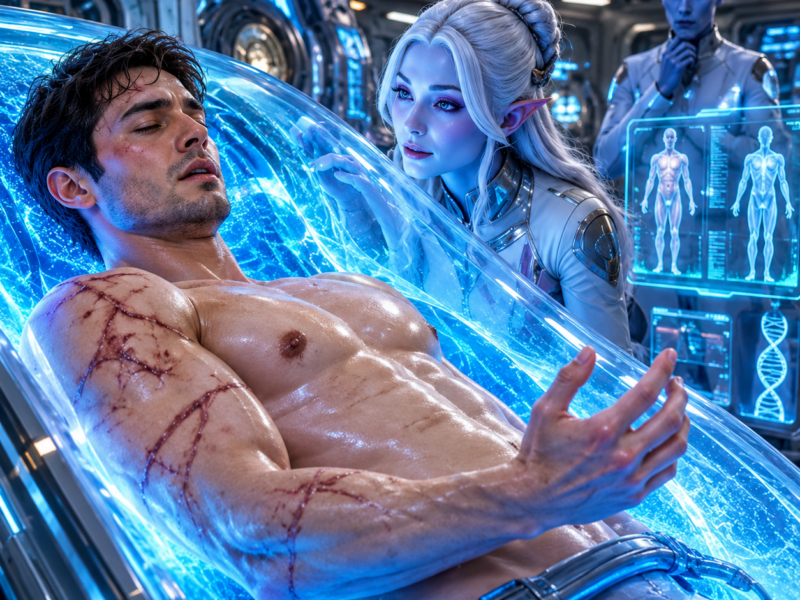
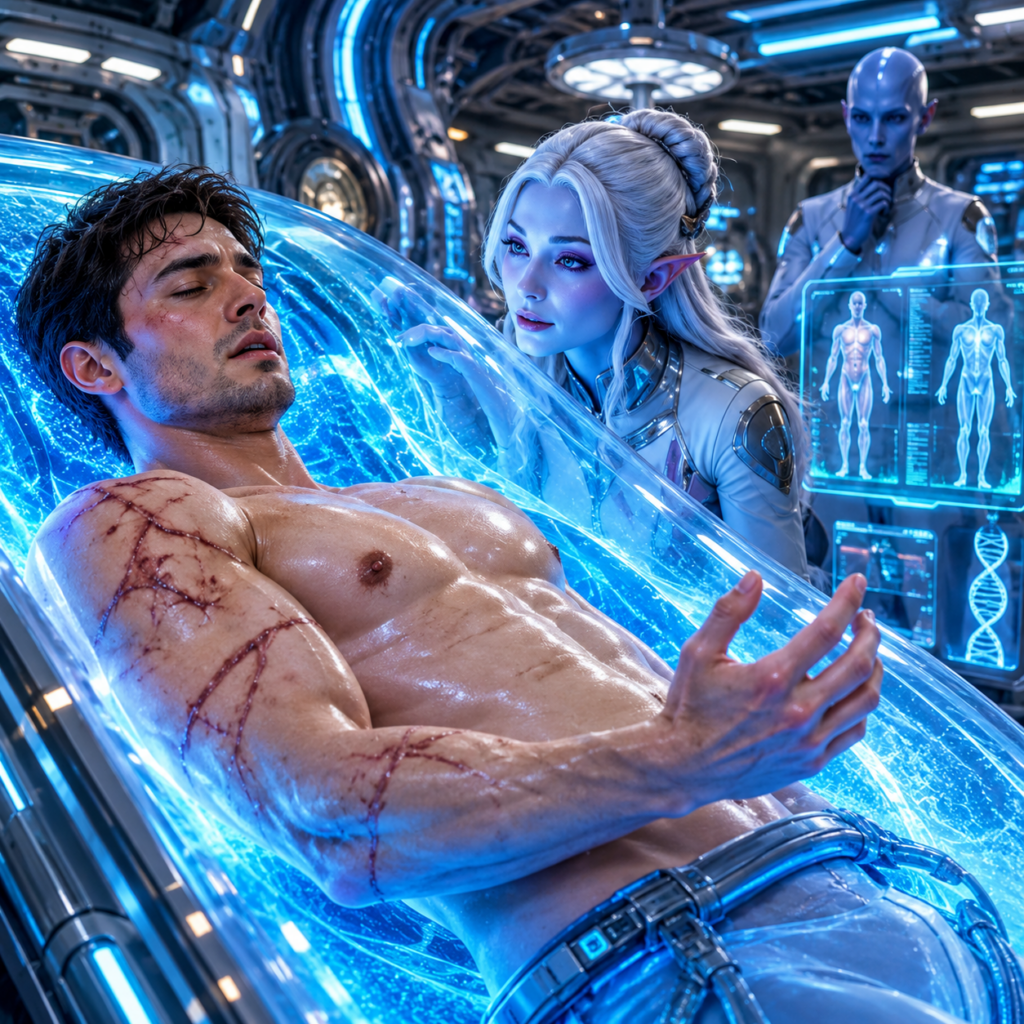
When the military doctors locked me inside an experimental regeneration chamber and laughed at my decades-old injuries, they expected another failed human experiment, but the machine suddenly began repairing wounds that had been buried in my body since the day I was born.
When the heavy steel doors of the underground Colorado laboratory sealed shut behind me, the air tasted like ozone and dried blood.
I stood there in my standard issue gray uniform, clutching my useless left arm against my chest like a broken wing.
Dr. Harrison didn’t even look up from his digital tablet when I approached the examination table.
“You’re late, Private,” he muttered, his voice sounding like dry leaves scraped across concrete.
“Traffic in the tunnels was slow,” I replied calmly, keeping my voice steady despite the familiar ache radiating through my ribs.
He finally raised his eyes, his gaze cold and clinical, stripping away whatever remained of my dignity with a single sweep.
“Sit in the pod,” he commanded, pointing a metal-tipped pen toward the towering cylinder at the far end of the room.
The regeneration chamber looked less like medical equipment and more like an iron maiden redesigned by NASA engineers.
Its transparent metal hull hummed with a low, rhythmic vibration that made my teeth ache.
“Will it hurt?” I asked, looking at the glowing blue liquid swirling behind the thick glass panels.
Dr. Harrison gave a dry, humorless laugh that echoed off the damp stone walls.
“Only for the first few seconds,” he said, turning back to his console without offering another word of reassurance.
I walked over to the pod, my left leg dragging slightly from an old training fracture that never healed right.
The metallic floor felt freezing beneath my bare feet as I stepped up and slipped inside the cramped vertical chamber.
“Remember,” Dr. Harrison called out over the intercom, his tone laced with bored detachment, “if you pass out, the machine handles the flush automatically.”
I didn’t answer.
I just closed my eyes and waited for the inevitable pain to begin.
The hiss of the pneumatic seal closing overhead sounded like a guillotine dropping into place.
Suddenly, a torrent of freezing blue liquid surged from the base of the chamber, swallowing my ankles, my waist, and finally my chest.
I gasped, swallowing a mouthful of the metallic fluid before my survival instincts kicked in and I clamped my mouth shut.
Through the glass, I watched Dr. Harrison tap a series of rapid commands into his master keyboard.
“Initiating standard regenerative protocol,” he mumbled into his headset mic.
At first, nothing happened at all.
Then a sharp, searing pain shot straight down my left arm, originating from the shoulder socket where the old shrapnel wound sat.
I screamed, but the sound was instantly swallowed by the heavy liquid surrounding my face.
My left arm began to violently spasm, the muscles twitching and knotting under my skin like trapped snakes.
Outside the glass, Dr. Harrison dropped his pen.
“Wait,” he whispered, leaning so close to the monitor his glasses fogged up.
“That’s impossible.”
The digital readouts were flashing a chaotic, blinding red across every screen in the subterranean laboratory.
My damaged bones were actively snapping back into alignment with audible, wet crunches.
Old fractures that had plagued me since childhood dissolved and rebuilt themselves into flawless calcium structures.
Torn nerves that had left my left hand numb for decades suddenly reconnected with a jolt of pure white electricity.
Even the mysterious jagged scar across my center chest began to fade, its purple tissue smoothing out into normal skin.
Dr. Harrison hammered his fists against the console glass, yelling at his assistant to record the data.
“Increase the coolant flow!” he shouted, panic bleeding into his previously monotone voice.
“Sir, the machine is bypassing our controls!” the assistant yelled back, frantically trying to pull plugs from the main wall array.
Inside the pod, my heartbeat accelerated to a frantic rhythm that felt like a trapped bird beating its wings against my ribs.
For the very first time in twenty-nine years, I could feel every single finger on my left hand.
I slowly opened my fist, watching my fingers curl and uncurl with absolute, fluid perfection.
Tears streamed down my face, mixing instantly with the strange blue fluid pressing against my cheeks.
I wasn’t broken anymore.
The warning klaxons began to wail, drowning out the steady hum of the laboratory’s ventilation system.
RED WARNING: FOREIGN BIOLOGICAL STRUCTURE DETECTED.
Dr. Harrison stumbled backward, nearly tripping over his rolling chair as he stared at the primary DNA sequencing monitor.
“What the hell is that?” he gasped, his fingers trembling as he pointed at the scrolling genetic helix.
The chamber ignored every manual override command the terrified technicians threw at it.
Instead, the machine increased its internal power output, vibrating so violently that the concrete floor beneath my feet began to dust away.
ORIGINAL ORGANISMAL BLUEPRINT RECOVERING.
The words flashed in bold, glowing amber letters across the main diagnostic screen.
Dr. Harrison grabbed his assistant by the shoulders.
“Cut the main breaker! Do it now!”
“I can’t! The system is drawing power directly from the subterranean geothermal grid!”
Through the thick glass, I watched the laboratory staff scramble like ants facing an oncoming storm.
Then, the ambient lighting inside the bunker flickered and died, replaced entirely by a blinding, pristine white glow emanating from the chamber itself.
A sound began to echo through the room, but it wasn’t coming from the machine’s speakers.
It was a voice.
Soft.
Melodic.
Deeply familiar, though I had never heard it before in my waking life.
“Welcome back,” the voice whispered, vibrating directly inside my skull.
Dr. Harrison froze dead in his tracks, his eyes wide with sheer terror.
“Who said that?” he demanded, spinning around to face the empty corners of the subterranean room.
The white light inside the pod intensified, washing away the shadows and flooding my mind with images that felt like stolen memories.
A burning room filled with smoke and ash.
A woman’s trembling hands wiping sweat from my forehead.
A massive, silver spacecraft tearing through an orange sky while alarms screamed in a language I somehow instinctively understood.
And a gentle voice whispering through the suffocating darkness of an escape pod.
“Sleep now, little one. They’ll find you if they know what you are.”
I began to sob, the grief hitting me with the force of a physical blow as all those hidden years came rushing back.
I pressed my palms against the transparent metal of the chamber, my mind racing through a gallery of impossible visions.
Starlit oceans of liquid nitrogen.
Towers of crystal that reached into the stratosphere of a world with twin suns.
Dr. Harrison stared at my medical history files, his hands shaking as he flipped through the physical backup pages.
“Your childhood injuries…” he muttered, his voice trailing off into stunned silence.
I looked at him through the glass, my breathing deep and completely effortless for the first time in my memory.
“What?” I whispered, though my voice couldn’t carry through the thick barrier.
He slowly turned the diagnostic monitor around so the screen faced the observation window.
My entire DNA profile was rewriting itself line by line, transforming into something entirely alien to human science.
The system had already identified over twelve thousand genetic structures that matched no known terrestrial organism.
Before Dr. Harrison could speak another word, the heavy security doors at the end of the long hallway blew inward with a deafening crash.
A squad of heavily armed military personnel rushed into the room, their assault rifles raised and locked.
Their commanding officer, a decorated veteran with graying temples, took one look at the glowing chamber and immediately lowered his weapon.
“Hold your fire!” he bellowed, raising a fist to halt the entire squad.
Dr. Harrison spun around, his face flushed with indignation and fear.
“Captain! Secure this area! This anomaly is destabilizing the entire facility!”
The commander ignored the doctor completely, walking slowly toward the glass pod with cautious, reverent steps.
“Nobody touches that machine,” the officer ordered, his eyes locked onto the glowing symbols appearing on the hull.
Dr. Harrison looked like he was about to lose his mind.
“Why? What the hell is happening here, Captain? Explain this right now!”
The commander swallowed hard, his throat working visibly as he stared at the bio-metric readouts.
“Because that regeneration technology wasn’t built by us, Doctor,” the officer said quietly.
“It was recovered from a spacecraft that crashed outside Earth eighty years ago during the Roswell incident.”
My breath hitched in my throat, the words hanging in the tense air of the subterranean laboratory like a physical weight.
The commander turned his gaze from the machine and looked directly into my eyes through the glass.
“The initial recovery reports stated that the civilian crew managed to eject an escape pod before the main hull disintegrated,” he continued steadily.
“They reported that they had lost one of their children during the descent.”
The main console beeped twice, a pleasant, melodic chime that contrasted sharply with the panic in the room.
The heavy hydraulic locks around the top of the cylinder disengaged with a loud hiss of escaping steam.
The front panel of the chamber swung outward, releasing a wave of cool, fresh air that smelled of rain and pine trees.
I stepped out onto the cold concrete floor, my legs strong, steady, and entirely free of pain.
For the first time in my life, standing upright didn’t feel like a daily battle against a broken frame.
As I took my first step forward, a faint, bioluminescent glow caught my eye on my left wrist.
I looked down and watched as a small, intricate symbol etched itself into my skin.
A silver circle surrounded by seven glowing points of light.
The hardened military commander immediately dropped to one knee, pressing his fist against his chest in a gesture of absolute respect.
Dr. Harrison stumbled backward, staring at the kneeling officer in utter disbelief.
“What… what does that symbol even mean?” the doctor stammered, pointing a shaking finger at my wrist.
The commander looked up at me, his eyes carrying a mixture of profound fear and deep-seated awe.
“It means we’ve just healed the last living heir of an interstellar civilization that disappeared from the galaxy ten thousand years ago,” he whispered.
Before I could even begin to process his words, the laboratory’s overhead speakers crackled back to life.
The same gentle, melodious voice echoed through the room once again, clear and impossibly close.
“Little one, if you can hear me, your mother is waiting for you.”
The primary computer terminal flashed violently, projecting a three-dimensional holographic map into the center of the room.
A set of deep-space coordinates hovered above the projection, pulsing with a bright blue light.
And right beneath the coordinates were three simple words that made my heart stop dead in my chest.
SHE NEVER DIED.
The holographic projection cast a brilliant sapphire glow across the stunned faces of the soldiers and scientists in the room.
I stared at the floating coordinates, my mind desperately trying to translate numbers that felt inherently familiar, like a language I had spoken in my sleep.
“Trace that signal!” Dr. Harrison suddenly shouted, breaking the heavy silence as he lunged back toward his ruined console.
“Don’t you dare,” the commander warned, leveling the barrel of his sidearm directly at the doctor’s chest without hesitation.
Dr. Harrison froze, his hands hovering inches above the keyboard.
“Captain, are you insane? That transmission could be a hostile broadcast! It could compromise national security!”
“Security?” the commander laughed bitterly, never taking his eyes off the doctor.
“Doctor, look at the kid. Look at his wrist. Humanity hasn’t owned this facility in twenty minutes.”
I ignored their argument, stepping closer to the hovering map of the stars.
As my bare hand passed through the blue light, the projection shifted instantly, zooming in past the orbit of Mars and out toward the distant edges of the Kuiper Belt.
A blinking beacon pulsed steadily near an uncharted cluster of space debris.
“That’s not an alien invasion broadcast,” I murmured, my own voice sounding deeper, richer, than it ever had before.
“That’s a homing beacon.”
The commander stood up slowly, stepping to my side and watching the stellar map rotate in the stale air of the bunker.
“Can you pilot whatever ship is out there?” he asked quietly, treating me less like an experiment and more like a superior officer.
“I don’t know,” I replied honestly, clenching and unclenching my fully healed left hand.
“But my body remembers things my mind forgot.”
Dr. Harrison slowly lowered his hands, watching us with a mixture of professional jealousy and raw terror.
“You’ll never make it past the atmospheric defense grid,” the doctor muttered.
“The military has automated anti-orbital batteries pointed straight up.”
The commander smirked, tapping the comms badge on his tactical vest.
“Major Vance, this is the subterranean lab. Stand down all surface defenses immediately. That’s a direct order.”
A crackling voice responded over the radio, filled with immediate confusion.
“Sir? Stand down the grid? Protocol dictates—”
“Protocol is dead, Major,” the commander interrupted sharply.
“Execute the order or face court-martial.”
The heavy iron blast doors at the far end of the underground laboratory began to grind open, revealing a long, dimly lit transit tunnel leading to the surface.
Cool mountain air rushed into the room, smelling of pine needles and wet earth.
I took a deep breath, feeling the oxygen fill my lungs with a clarity I had never experienced in my twenty-nine years of life.
“You can’t just leave,” Dr. Harrison protested, taking a desperate step forward before the commander’s steady gaze stopped him in his tracks.
“We have protocols for extraterrestrial contact. The Department of Defense will want—”
“The Department of Defense can write a strongly worded memo to the stars,” the commander said flatly.
He turned to me, offering a stiff, respectful nod.
“The motor pool elevator is at the end of the hall. It leads straight up to the private airstrip on the plateau.”
“Thank you, Captain,” I said, feeling a strange surge of confidence settle into my bones.
“Just remember one thing, son,” the commander added, his voice dropping to a low, serious rumble.
“If there’s something out there waiting for us… make sure you remind them we put up a good fight while you were gone.”
I gave him a faint smile and began walking toward the open transit tunnel.
My footsteps echoed off the concrete walls, firm, balanced, and completely free of the limp that had defined my entire existence.
Behind me, the laboratory faded into the shadows as I stepped into the elevator shaft that would carry me up into the night sky.
The metal cage began its slow, mechanical ascent, lifting me out of the underground prison and toward the freezing Colorado peaks.
Through the reinforced glass of the elevator car, I watched the stars begin to appear through the gaps in the mountain clouds.
One of them wasn’t twinkling.
It was moving.
Steady, bright, and growing larger with every passing second.
My left wrist began to warm up, the silver symbol glowing with a soft, pulsing rhythm that matched the beat of my heart.
The elevator came to a sudden, jarring halt, and the heavy security gates slid open with a sharp metallic clatter.
I stepped out onto the wide concrete plateau of the military airstrip, surrounded by towering pine trees and sweeping winds.
The night sky above was impossibly clear, a vast ocean of black velvet dotted with millions of burning diamonds.
Parked near the edge of the tarmac was a sleek, unmarked military transport jet, its turbine engines idling with a low, whistling whine.
A pair of armed guards stood near the boarding ramp, but as soon as they saw the glowing silver symbol on my wrist, they stepped aside without a word.
They knew the game had changed.
I walked up the aluminum ramp, the cold wind whipping my gray uniform jacket around my shoulders.
Inside the cargo bay, the interior had been stripped down to bare composite panels and wiring harnesses.
In the center of the cabin sat a sleek, obsidian terminal that wasn’t of human design.
As I approached it, the screen flickered to life on its own, displaying a continuous stream of rolling data written in the same glowing script as my wrist tattoo.
INCOMING SECURE FREQUENCY DETECTED.
I reached out with my left hand and pressed my palm flat against the smooth black glass of the console.
A sharp jolt of static electricity surged up my arm, but it didn’t hurt.
It felt like coming home after a very long winter.
“Authentication confirmed,” a synthetic voice echoed from the cabin speakers, smooth and impossibly clear.
“Welcome back, Commander. Jump drive is standing by for coordinate entry.”
I stared at the glowing cursor blinking on the screen, my reflection looking back at me from the dark glass.
I wasn’t a broken human experiment anymore.
I was the bridge between two worlds that had been separated by a lifetime of silence.
I typed the coordinates from the underground laboratory into the obsidian terminal, my fingers moving with a speed that felt entirely automatic.
The navigation system hummed in response, locking onto the distant signal lingering just beyond the edge of the solar system.
“Course locked,” the synthetic voice announced calmly.
“Atmospheric exit vector calculated. Initiating pre-launch sequence in ten seconds.”
I strapped myself into the pilot’s seat, pulling the heavy safety harness tight across my chest where the old scar used to be.
Outside the reinforced cockpit window, the automated anti-orbital batteries on the mountain ridges pivoted away, clearing the path to the stars.
Down below, somewhere in the dark heart of the Colorado bunker, I knew Dr. Harrison was staring at empty monitors and broken data streams.
Let him wonder.
Let the government try to classify a war they never even knew they were fighting.
“Five,” the automated voice counted down.
“Four.”
I closed my eyes and took one last deep breath of Earth’s crisp, pine-scented air.
“Three.”
I remembered the burning room, the trembling hands of a terrified woman, and the gentle whisper in the dark.
“Two.”
“She never died.”
“One.”
The twin turbine engines roared with a deafening blast of blue plasma, and the transport jet surged straight up into the waiting sky.
The G-force pressed me hard into the seat as the jet tore through the troposphere, leaving a trail of silent white fire in our wake.
The blue expanse of Earth’s atmosphere rapidly faded into the deep, absolute blackness of outer space.
Stars stopped twinkling and turned into sharp, unblinking points of brilliant colored light.
Right ahead of us, suspended silently in the shadow of a decaying communication satellite, hovered a massive silver vessel.
It was shaped like a crescent moon, its hull gleaming with ancient, unblemished metal that absorbed the starlight around it.
As our transport jet approached, the massive docking bay doors of the alien ship slid open like a sleeping eye waking up.
A warm, golden light spilled out from the interior, casting long, welcoming rays across our cockpit glass.
“Manual docking bypassed,” the ship’s computer announced softly.
“Tractor beam engaged. Relax, little one. You’re safe now.”
I cut the jet’s engines, letting the invisible current pull us gently into the vast, echoing belly of the mothership.
As the transport settled onto the deck with a soft, pneumatic thud, the outer airlock hissed open.
I unbuckled my harness, stood up, and walked down the ramp into the glowing golden haze.
Standing at the center of the vast metallic platform was a tall, slender woman with silver hair that caught the light like spun glass.
She turned slowly, her dark eyes wide with a mixture of disbelief, overwhelming relief, and tears she didn’t try to hide.
She didn’t say a single word.
She just opened her arms.
And as I ran toward her across the glowing deck, for the first time in twenty-nine years, I knew exactly who I was.