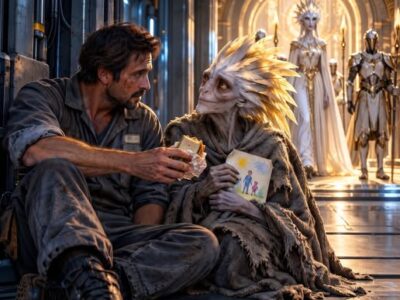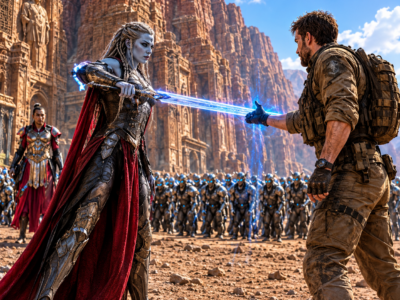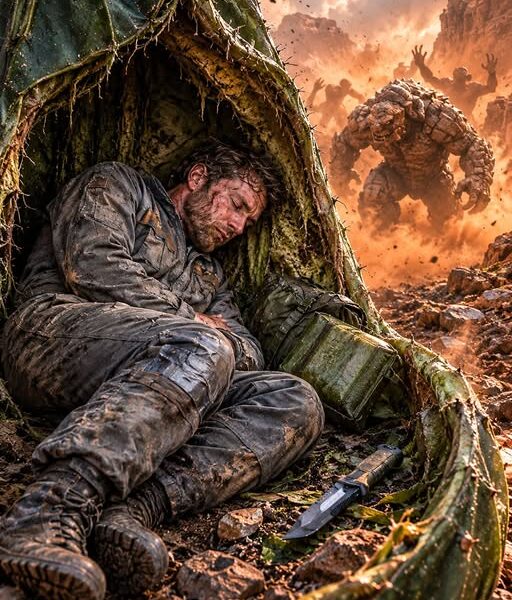
The other competitors brought million-credit shields and armor designed to withstand planetary disasters. Hayes brought a battered survival suit, a combat knife, and a plan nobody else thought was worth considering.
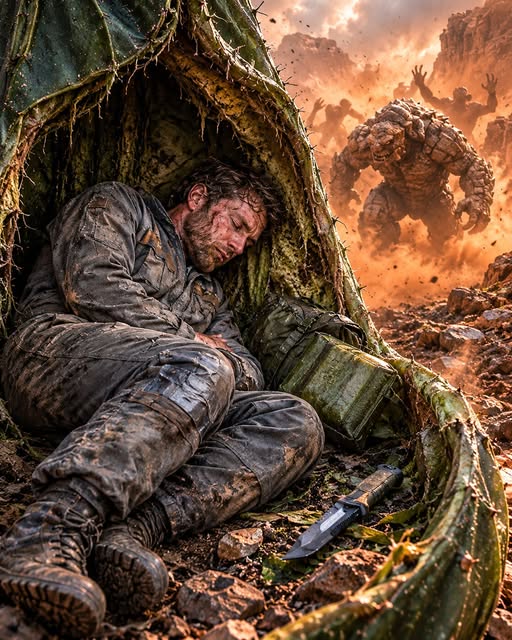
The rescue team stared at Hayes as he crawled out of the enormous alien plant.
For several seconds, nobody spoke.
His survival suit was torn in half. Blood had dried along his forehead, and a thick layer of greenish sap covered his arms and chest. One of his boots was missing, his left shoulder hung at an unnatural angle, and every breath seemed to cost him considerable effort.
But he was alive.
The veteran examiner, Commander Rourke, approached slowly.
“Seventy-two hours,” he said, checking the readings on his wrist console. “You actually survived seventy-two hours on this planet.”
Hayes coughed.
“Seventy-two hours and fourteen minutes.”
Rourke glanced at the remains of the giant plant.
“How?”
Hayes looked back at the ravine.
“I found something that was already surviving here.”
The commander frowned.
“You used that thing as a shelter?”
“More or less.”
“That is a thirty-foot alien organism with an unknown biological structure. You cut it open, crawled inside, and sealed yourself in with foam?”
Hayes managed a weak smile.
“When you say it like that, it sounds irresponsible.”
One of the medical officers laughed.
Rourke didn’t.
He was looking at the plant.
More precisely, he was looking at the enormous section Hayes had removed from its trunk.
“Get the biology team down here,” he ordered. “I want samples of everything. Sap, tissue, outer shell. All of it.”
Hayes raised a trembling hand.
“One condition.”
Rourke turned.
“What?”
“Don’t destroy the plant.”
The commander’s expression hardened.
“This is a military evaluation site. The guild owns the survey rights.”
“The guild owns the land,” Hayes replied. “That doesn’t mean it understands what lives on it.”
Rourke stared at him for a moment.
Then he signaled the medical team.
“Get him to the transport.”
Hayes didn’t argue. He barely had enough strength to stand.
As they lifted him onto the stretcher, he noticed something strange.
A small green shoot had appeared near the opening he had cut.
The plant was healing.
And for the first time since landing on Kalin-9, Hayes smiled without forcing it.
PART 4 – THE WINNER NOBODY EXPECTED
Three days later, Hayes woke up in a medical station orbiting Kalin-9.
His ribs had been stabilized. His shoulder was back in place, and a synthetic skin graft covered the worst injuries.
The first thing he asked was whether he had won.
The medical officer laughed.
“You almost died, and that’s your first question?”
“I have financial problems.”
“That explains a lot.”
She handed him a tablet.
The results were displayed across the screen.
OFFICIAL RESULT
– Hayes: 72 hours, 14 minutes.
– Goliath: 39 hours, 08 minutes.
– Weaver: 11 hours, 42 minutes.
– Remaining competitors: Eliminated.
Hayes stared at the numbers.
“Goliath?”
The medical officer hesitated.
“Recovered alive. His armor collapsed under the accumulated sand pressure. He suffered several fractures, but he’s expected to recover.”
“And Weaver?”
“Emergency evacuation. Severe electrical burns. Stable.”
Hayes nodded with relief.
He had never wanted anyone to die.
The door opened.
Commander Rourke entered, carrying a thin silver folder.
“Congratulations, Hayes. You’ve passed the survival trial.”
Hayes tried to sit up.
“Then I assume the contract is mine?”
“Not so fast.”
The commander’s expression was unreadable.
“Your performance has created a problem.”
Hayes sighed.
“Of course it has.”
“The guild expected this test to demonstrate the superiority of advanced survival technology. Instead, you demonstrated that a ten-thousand-credit survival suit and a biological shelter could outperform equipment worth millions.”
“Sounds like a good result for the guild.”
“Not necessarily. Several manufacturers sponsored this competition. They aren’t pleased.”
Hayes stared at him.
“So I won, but someone doesn’t like the way I won?”
“Welcome to the galaxy.”
Rourke placed the folder on the table.
Inside was the official contract.
But there was something else.
A second document, marked with a red classification symbol.
Hayes read the title.
KALIN-9 BIOLOGICAL RESOURCE DEVELOPMENT PROPOSAL.
His expression changed.
“What is this?”
“Your plant.”
“The plant isn’t mine.”
“That’s precisely the problem. The guild wants to extract the biological material and manufacture a new generation of storm-resistant armor.”
Hayes slowly lowered the document.
“And what happens to the plants?”
“Industrial harvesting.”
“How many?”
“All identified specimens within the development zone.”
Hayes looked up.
“You’re going to strip the ravines?”
“These organisms could be worth billions.”
Hayes remembered the thick green walls that had absorbed the storm. He remembered drinking the bitter sap, feeling the plant’s warmth as the temperature outside dropped.
Most importantly, he remembered the little green shoot growing from the wound he had made.
“They survived this planet for thousands of years,” he said quietly. “And you want to kill them because you discovered they’re useful?”
Rourke folded his arms.
“That’s how progress works.”
Hayes looked at the contract again.
For the first time, the money didn’t seem quite as important.
PART 5 – THE SECOND TEST
Hayes was released from the medical station the following morning.
His guild contract was waiting, along with a payment large enough to clear his debts, recover his impounded ship, and start over.
There was only one condition.
He had to sign the biological development proposal.
He refused.
The guild suspended his contract immediately.
His ship remained impounded, and the debt collectors were already sending messages.
For a few hours, Hayes considered giving in.
He had spent years struggling to survive in a galaxy where money bought safety, technology bought power, and poor people were expected to accept whatever powerful corporations decided.
He was tired.
He wanted a proper bed, a working ship, and enough credits to stop worrying about tomorrow.
Then a message arrived.
It came from Goliath.
The enormous reptilian warrior had recovered enough to speak. His voice sounded rough, but his words were clear.
“I heard what happened. You refused the contract.”
Hayes leaned back.
“Apparently, I’m terrible at making sensible financial decisions.”
Goliath gave a low growl that might have been laughter.
“You saved my life.”
“I wasn’t even there.”
“You warned the rescue team about the shifting sand currents. They found my emergency beacon because of your coordinates.”
Hayes remembered sending the information before losing communication.
“I just gave them a direction.”
“You gave them a chance.”
There was a pause.
Then Goliath continued.
“I have a proposition. My clan operates a biological research station. We study organisms that survive extreme environments. We have no interest in stripping Kalin-9 for parts.”
Hayes sat forward.
“What do you want?”
“Someone who understands that survival isn’t always about having the strongest armor.”
A second voice joined the transmission.
It was Weaver.
“Unfortunately, I agree with the giant lizard.”
Hayes laughed despite his injured ribs.
“Weaver? I thought you were still recovering.”
“I am. My medical team says I will regain full mobility. My pride, however, may require several additional years.”
“Sorry about your shield.”
“Don’t be. It was an expensive lesson.”
Weaver explained that several independent competitors had already contacted the guild, demanding an investigation into the proposed harvesting operation.
They had seen the same results Hayes had.
A biological structure had survived where advanced machines had failed.
But there was another detail.
The plant’s sap wasn’t simply water-rich tissue fluid.
It contained microscopic mineral compounds that hardened when exposed to electrical charges. The same mechanism that protected its outer shell also helped regulate the plant’s internal temperature.
It wasn’t just a shelter.
It was a living, self-repairing survival system.
If researchers could understand it without destroying the organisms, the discovery could revolutionize emergency habitats, spacecraft insulation, and disaster relief technology.
Hayes listened carefully.
“Can it be studied without cutting the plants apart?”
“Yes,” Weaver replied. “But the guild’s proposed extraction method would kill every specimen they harvest.”
Goliath added, “We have already submitted a competing research proposal.”
Hayes looked at the two competitors.
“You want me to help?”
“No,” Goliath answered. “We want you to lead.”
For several seconds, Hayes said nothing.
Then he smiled.
“All right. But I have three conditions.”
“Name them.”
“First, the plants remain protected. Second, the local ecosystem gets priority over commercial production. Third, nobody gets to call me a biological engineer.”
Weaver tilted its head.
“Why?”
“Because I still don’t know what I’m doing.”
For the first time, all three laughed.
PART 6 – THE CORPORATION STRIKES BACK
The guild didn’t take the challenge lightly.
Within forty-eight hours, its legal department issued a statement accusing Hayes of interfering with a legitimate scientific development project.
The statement described him as an inexperienced mercenary who had mistaken an unusual survival event for scientific expertise.
The guild also released a heavily edited recording of the survival trial.
In it, Hayes appeared to be a reckless competitor who had damaged a protected organism and endangered himself.
Millions watched the footage.
Some called him a hero.
Others called him an idiot.
The guild’s media division was particularly effective at making the latter opinion seem reasonable.
Then came the lawsuit.
Hayes and his new research partners were accused of violating planetary survey restrictions and interfering with licensed mineral rights.
Their research station was denied landing clearance.
Their funding was frozen.
Even Goliath’s clan faced pressure from several major corporations.
For a moment, it seemed the guild would win without firing a single shot.
Then Weaver found something.
During its recovery, Weaver had requested access to the original planetary survey data.
It discovered that the green thermal anomalies had been recorded decades earlier by an unmanned exploration probe.
The probe’s report contained an important warning.
The plants were part of a complex underground network. Their roots connected through deep mineral channels, allowing them to exchange water and nutrients across the ravines.
The network was essential to stabilizing the canyon walls.
Destroying enough mature plants could cause the entire ravine system to collapse.
And the collapse wouldn’t remain confined to the development zone.
It could trigger massive dust avalanches that would bury nearby research installations and transport routes.
The guild had received that report.
It had simply classified it as commercially inconvenient.
Weaver sent the original file to Hayes.
He read it twice.
Then he called Rourke.
The commander answered with an irritated expression.
“What now?”
“Did you know the plants stabilize the ravines?”
Rourke didn’t respond immediately.
“Where did you get that information?”
“That’s not an answer.”
“The survey report was preliminary.”
“It said destroying the root network could cause a geological collapse.”
“Those conclusions were unverified.”
“Then why did you hide them?”
Rourke’s jaw tightened.
“Hayes, you need to understand something. The guild isn’t interested in your personal feelings about alien plants.”
“They aren’t my personal feelings.”
“You have no authority to interfere.”
Hayes leaned closer to the camera.
“Neither do you, if your development plan puts thousands of people at risk.”
Rourke ended the call.
But the conversation had given Hayes something important.
The guild knew the danger existed.
Now he needed proof that it was real.
PART 7 – THE STORM RETURNS
Three weeks later, Hayes returned to Kalin-9.
This time, he wasn’t competing.
He was leading a small scientific expedition.
Goliath came with him, wearing a redesigned lightweight suit. Weaver operated the expedition’s scanning equipment from a mobile laboratory.
They landed near the original ravine.
The giant plants were still there.
The wound Hayes had made was almost completely healed. New ridges had formed around the damaged section, thicker and harder than the original shell.
He approached the plant and placed one hand against its surface.
“Well,” he murmured, “you seem to be doing better than me.”
Goliath looked at the surrounding landscape.
“The guild’s extraction machines are scheduled to arrive tomorrow.”
“Then we have less than a day.”
Weaver’s scanners detected something unusual beneath the canyon floor.
Several sections of the root network were already damaged.
The guild had secretly deployed drilling equipment to prepare the harvesting zone.
And the plants were responding.
Their internal temperatures were rising.
The roots were contracting.
The canyon walls were beginning to shift.
A deep rumble rolled through the ravine.
Hayes looked toward the horizon.
A cloud of dust was rising.
Not from the ordinary seasonal wind.
From underground.
“How long?” he asked.
Weaver examined the readings.
“Approximately six hours before the upper canyon wall becomes unstable.”
Goliath checked his weapon.
“Can we evacuate the area?”
“Not everyone,” Hayes replied. “The drilling crews are spread across three zones.”
He looked at the plants.
The same organisms that had protected him during the first storm were now in danger because someone wanted to turn them into a product.
He understood something.
They couldn’t save the plants by simply asking the guild to stop.
They had to show everyone what was happening.
“Get the scanners online,” he ordered.
“What’s your plan?” Goliath asked.
Hayes studied the terrain.
“We’re going to let the planet explain itself.”
PART 8 – THE PLANET’S WARNING
The first tremor struck at 14:20 local time.
A drilling tower tilted several degrees.
Workers abandoned their stations as cracks spread across the ground.
The guild’s security officers immediately accused the research team of sabotage.
Hayes ignored them.
He and Goliath moved toward the central drilling platform while Weaver transmitted the underground readings to every available communication channel.
The data showed that the root network was under extreme stress.
But the guild’s executives refused to acknowledge it.
They ordered the drilling operation to continue.
Then the second tremor came.
A section of the canyon wall collapsed.
Thousands of tons of rock and sand plunged into the lower ravine, burying two automated extraction vehicles.
The shockwave knocked Hayes off his feet.
Goliath grabbed him before he could slide into a widening crack.
“Are you trying to get yourself killed again?”
“Not today!”
Across the ravine, workers were trapped on an elevated platform.
Their emergency transport had been crushed by falling stone.
Hayes looked at the terrain.
The giant plants stood between the workers and the approaching dust avalanche.
He remembered how their outer shells had survived the Grinder.
He also remembered how the plants reacted to pressure.
They didn’t resist every force.
They distributed it.
“Can we reach those people?” he asked.
Goliath scanned the distance.
“Not on foot.”
Hayes pointed toward a row of enormous plants.
“Then we don’t go around.”
He grabbed the emergency equipment from the transport.
They had brought two expanding-foam canisters, several thermal cutters, and a compact pressure pump.
The plan was dangerous.
But it was the only one they had.
Hayes and Goliath moved between the plants, using their natural ridges as protection from the flying debris.
At the largest specimen, Hayes activated his thermal cutter.
This time, he didn’t cut into the trunk.
He made a shallow opening near the base and connected the pressure pump.
The plant’s internal fluid began moving through the temporary channel.
Its outer ridges expanded slightly.
Goliath stared.
“What are you doing?”
“Trying to redirect the pressure.”
“Into the plant?”
“Not exactly. Into the empty channel beside it.”
Hayes used the expanding foam to reinforce the temporary structure, creating a protective passage between two enormous roots.
The plant responded almost immediately.
Its outer shell tightened.
The ground around the roots became more stable.
They had created a narrow corridor through which the trapped workers could escape.
Goliath stared at the structure.
“That shouldn’t work.”
Hayes gave him a tired look.
“Neither should crawling inside a giant cactus during a planetary storm.”
For the next hour, they guided the workers through the passage.
Some were injured. Others could barely walk.
But one by one, they reached safety.
Then the largest tremor arrived.
The canyon floor split open.
A wave of sand and rock rushed toward them.
Hayes looked back.
The plants were bending.
Their ridges were flexing under the enormous pressure, distributing the impact across their interconnected root system.
For one terrifying moment, the entire ravine seemed to move.
Then it stopped.
The root network held.
The avalanche slowed and settled against the natural barriers.
The plants had saved them.
Not because they were indestructible.
Because they had evolved to work together.
PART 9 – THE TRUTH GOES PUBLIC
Weaver’s transmission had been running throughout the disaster.
Every tremor, every structural failure, and every rescue had been recorded.
More importantly, the original survey report and the guild’s internal warnings were included in the broadcast.
Within minutes, the footage spread across the interstellar network.
The galaxy watched as a group of supposedly primitive organisms protected an entire workforce from a disaster caused by advanced industrial machinery.
Then they watched the guild’s security officers order the drilling operation to continue even after the danger became undeniable.
Public opinion changed almost instantly.
The guild’s executives tried to dismiss the recordings as manipulated.
But the original files were already circulating through independent research networks.
Several major scientific organizations demanded an investigation.
The planetary authority suspended the harvesting license.
And the workers Hayes had rescued became the strongest witnesses against the corporation.
Commander Rourke arrived the following day.
He approached Hayes near the medical transport station.
For a long time, he said nothing.
Finally, he spoke.
“You were right.”
Hayes looked at him.
“About what?”
“The plants. The survey. The danger.”
Rourke glanced toward the ravine.
“I spent twenty years believing the best equipment always gave the best chance of survival.”
Hayes wiped dust from his face.
“Good equipment helps.”
“Then why did you refuse the contract?”
“Because equipment is supposed to protect people. Not become an excuse to put them in danger.”
Rourke nodded slowly.
“The guild’s board wants to speak with you.”
“About the contract?”
“About the research program. They’re willing to offer you leadership.”
Hayes considered the proposal.
Then he shook his head.
“Not unless the planetary authority controls the research. No exclusive harvesting rights. No destruction of mature plants. And every discovery has to be shared with the scientific community.”
Rourke raised an eyebrow.
“You’re negotiating with a corporation that could buy your entire homeworld.”
Hayes smiled.
“Then they can afford to negotiate.”
For the first time, Rourke laughed.
PART 10 – WHAT SURVIVAL REALLY MEANS
Six months later, Kalin-9 had changed.
The industrial harvesting operation was permanently suspended.
A protected biological research zone had been established across the ravines, and scientists from twelve different worlds were studying the enormous organisms.
They discovered that the plants were part of an ecosystem far more sophisticated than anyone had imagined.
Their roots redistributed water through underground channels.
Their outer shells changed density in response to temperature and electrical pressure.
Their internal tissues could store energy, repair damage, and regulate heat.
Most remarkably, neighboring plants could synchronize their responses to approaching storms.
They didn’t survive by making each individual organism stronger.
They survived by cooperating.
That discovery changed more than the technology industry.
It transformed emergency shelter design, disaster engineering, and environmental science.
New habitats were developed using principles borrowed from the plants’ natural structures.
They were cheaper, lighter, and capable of repairing minor damage without human intervention.
And unlike the old industrial models, they were designed to work with their environments rather than dominate them.
Hayes became the director of the Kalin-9 Survival Research Initiative.
He received enough money to recover his ship, clear his debts, and purchase a small research vessel.
Goliath became head of field operations.
Weaver led the engineering division, where it developed a new generation of biological-compatible protective systems.
The three former competitors became close friends.
Their first major project was a rescue network for explorers stranded on hostile planets.
It was named the Living Shield Program.
But Hayes insisted on one unusual rule.
Every expedition had to include someone trained in basic survival without advanced technology.
The rule was controversial.
Many investors thought it was unnecessary.
Until a rescue mission on a distant moon lost power during an unexpected magnetic storm.
The automated systems failed.
The communication network went silent.
And the only person who managed to guide the crew to safety was a young trainee who had spent weeks studying Hayes’s original Kalin-9 survival footage.
She used local plants, natural rock formations, and a simple hand-built shelter to keep twelve people alive until rescue arrived.
When Hayes heard the news, he sat quietly for a long time.
Then he looked at the old survival suit displayed in his office.
It was still covered in dried green sap.
The suit had become a symbol across several worlds.
Some people called it the cheapest survival equipment in history.
Others called it proof that humans were naturally superior to every other species.
Hayes disliked both descriptions.
During an interview, a journalist once asked him what made humans special.
“Was it our ability to adapt? Our intelligence? Our willingness to take risks?”
Hayes considered the question.
Then he pointed toward the window.
Outside, a young Kalin-9 plant was growing in a specially designed research habitat.
Its ridged trunk was already beginning to form.
“Humans aren’t the only intelligent survivors in the galaxy,” he said. “We’re just one of many species that learned to adapt.”
The journalist frowned.
“Then what was the secret of your survival?”
Hayes smiled.
“I stopped trying to make nature fight me.”
He paused before continuing.
“Everyone else landed on Kalin-9 thinking they needed to defeat the storm. They brought shields, armor, weapons, and machines designed to overpower it. I looked at the planet and asked a different question.”
“Which was?”
“How has anything managed to live here for millions of years?”
The journalist looked toward the plant.
“And that gave you the answer?”
“Not immediately. I still made mistakes. I nearly died. I drank something that tasted like a dead battery, broke several ribs, and spent three days trapped inside something that looked like an angry cactus.”
The journalist laughed.
Hayes did too.
“But the important thing wasn’t that I found a plant strong enough to protect me. It was that I finally understood why it survived.”
He looked at the old suit.
“Nature doesn’t waste energy trying to control everything. It adapts, responds, repairs, and finds balance. Sometimes the strongest thing you can do is stop fighting the world and learn how to work with it.”
EPILOGUE – THE LAST LESSON OF KALIN-9
Years later, the platinum-tier survival challenge was redesigned.
The new competition still took place on Kalin-9, but the rules were different.
Competitors were no longer judged solely on how long they could withstand the storm.
They were evaluated on resource management, environmental awareness, cooperation, and their ability to survive without destroying the ecosystem around them.
The first group of competitors arrived with expensive equipment.
Some brought advanced kinetic shields.
Others carried autonomous defense drones and sophisticated environmental scanners.
And one young human competitor arrived with a battered survival suit, a small medical kit, a thermal knife, and three liters of water.
The examiners exchanged amused glances.
One of them leaned toward Hayes, who was now supervising the challenge.
“Another one like you?”
Hayes watched the young competitor study the planetary map.
The recruit was examining the ravines.
Not the landing zone.
Not the mountain ranges.
The ravines.
Hayes smiled.
“Maybe.”
The examiner shook his head.
“Do you think he’ll survive?”
Hayes watched the first green thermal readings appear on the recruit’s scanner.
“I think he has a chance.”
The examiner looked surprised.
“Because of his equipment?”
“No.”
Hayes folded his arms.
“Because he’s paying attention.”
Far below them, the wind began to rise.
The giant plants swayed gently, their roots connected beneath the ancient canyon floor.
They had survived countless storms before humans ever reached their world.
And they would survive countless more.
Hayes had arrived on Kalin-9 believing he needed to prove that a human could defeat the most hostile planet in the galaxy.
Instead, the planet had taught him something far more valuable.
Survival was never about proving that you were stronger than nature. It was about understanding that you were part of it.
Technology could make life easier. Wealth could provide better protection. Strength could help someone endure what others could not.
But none of those things guaranteed wisdom.
Sometimes, the greatest advantage wasn’t the most expensive weapon or the most powerful machine.
Sometimes, it was the ability to observe, learn, adapt, and respect the world around you.
And sometimes, when an entire galaxy was busy trying to conquer a storm, all it took was one battered human willing to ask a simple question:
What can nature teach me that technology hasn’t?