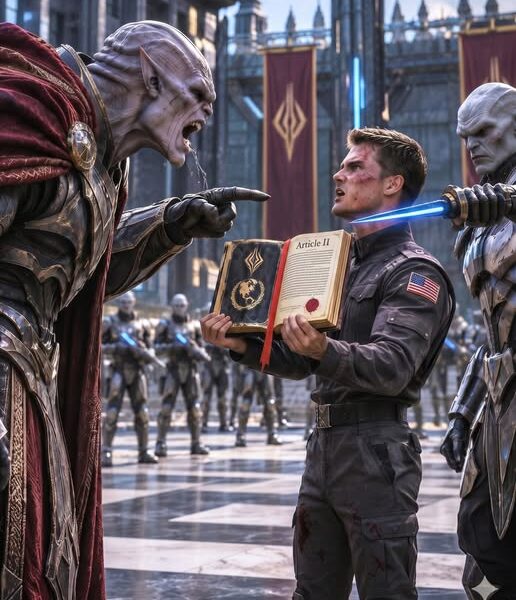
The alien commander ordered Connor Harper to kneel. The human cadet looked up at him, refused, and pointed to a page in the Imperial regulations.
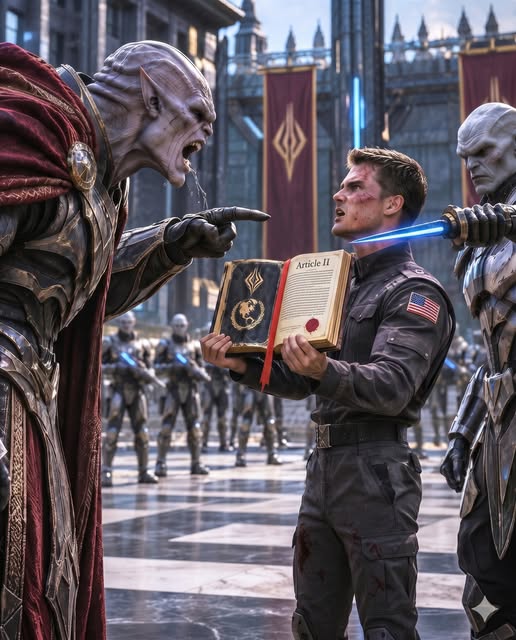
For several seconds, nobody in the arena moved.
Connor Harper stood beneath the enormous observation towers, his uniform dusty from the journey across the academy grounds. Across from him, High Preceptor Vokar looked like a mountain of armored muscle, his four-fingered hands clenched so tightly that the joints had turned pale.
Behind them, thousands of cadets watched from the tiered seats.
Some expected Connor to be executed.
Others expected him to surrender.
Nobody expected what happened next.
Vokar laughed.
It was a deep, unpleasant sound that echoed through the arena.
“You believe a human financial transaction gives you authority over this institution?”
Connor adjusted the collar of his uniform.
“No. I believe a legally registered transfer of ownership gives Earth authority over the institution. The financial transaction is just how we acquired it.”
“You are a cadet!”
“That was true this morning.”
“And now?”
Connor reached into his jacket and removed a thin black document case.
“Now I’m the appointed representative of the Terran Educational Development Authority, acting under the transfer agreement signed fourteen days ago.”
Vokar stared at the case.
Then he turned toward the officers standing beside the arena entrance.
“Seize him.”
Nobody moved.
The High Preceptor’s eyes narrowed.
“That was an order!”
A young Xeran security officer stepped forward, visibly uncomfortable.
“High Preceptor, we have received a communication from the Imperial Treasury. The transfer documents appear to be authentic.”
“Appear?”
“The ownership registration has been confirmed.”
Vokar’s expression darkened.
“Then the Treasury is mistaken.”
Connor sighed.
“That’s actually the third time you’ve said that about an official document. Would you like me to show you the appeal procedure?”
A few cadets laughed.
Vokar turned toward them.
The laughter stopped immediately.
But something had changed.
For the first time, the cadets were no longer looking at their commander with absolute fear.
They were looking at him as a man who could be questioned.
And that frightened him more than Connor’s documents ever could.
“Very well,” Vokar growled. “Explain your claim. I want every detail.”
Connor nodded.
“Gladly. But before we begin, I would like to remind you that this conversation is being recorded under Section 19 of the Interstellar Military Accountability Charter.”
He pointed toward the observation tower.
“Audio, video, biometric responses, and the complete security log.”
Vokar slowly looked up.
A small red recording indicator blinked above the arena.
Connor smiled.
“Page eleven, High Preceptor. You really should have read it.”
Fourteen days earlier, Connor had been sitting in a cramped office on Earth when the message arrived.
He had expected a routine administrative notice concerning his academy placement.
Instead, the message came from the Terran Educational Development Authority.
Its director, Ambassador Helen Ward, appeared on the screen.
“Cadet Harper, we have a problem.”
Connor leaned back.
“How expensive?”
Helen didn’t smile.
“Very.”
She explained that the Xeran Military Academy had been experiencing financial difficulties for nearly a decade. Its construction debt had accumulated after a series of failed expansion projects. The Imperial Treasury had repeatedly delayed repayment, and the institution’s creditors were becoming impatient.
Earth had recently entered negotiations with the Xeran Empire concerning military cooperation and educational exchange.
The academy’s debt had been included in a broader financial restructuring agreement.
But the Empire had made a mistake.
It had assumed Earth was interested only in the debt.
The contract actually transferred ownership of the academy’s educational facilities, training infrastructure, administrative assets, and associated institutional rights.
The Imperial military retained operational authority over its active combat units, but the academy itself became a jointly supervised educational institution.
Connor studied the agreement.
“Who approved this?”
“Three Imperial finance ministers, two representatives of the military education council, and the Emperor’s chief economic adviser.”
“Did they read it?”
Helen paused.
“We suspect they read the summary.”
Connor shook his head.
“That’s unfortunate.”
“Why?”
“Because Section 42 contains an educational independence clause. It prevents the military from interfering with the institution’s civilian governance.”
Helen leaned closer.
“Exactly. And we need someone on the ground who understands the contract.”
Connor looked at his uniform.
“You want me to become an administrator?”
“Not exactly. You are still a cadet. But until the transition is complete, you have been appointed as our temporary compliance representative.”
Connor stared at her.
“You want me to investigate the academy while I’m attending it?”
“We want you to make sure it follows the law.”
He considered the request.
“Does the academy know?”
“Not yet.”
“That’s going to be awkward.”
For the first time, Helen smiled.
“Connor, based on your application, I believe awkward situations are your specialty.”
She was not wrong.
Connor had grown up in a family of public servants.
His mother was a labor attorney. His father had worked in government procurement. His older sister was a military logistics officer.
At the dinner table, arguments about regulations had been more common than arguments about sports.
While other children learned to play football, Connor learned how to read contracts.
He had discovered early that powerful people often relied on others not understanding the rules.
He also discovered that a carefully written sentence could sometimes stop a person with a weapon.
But he had never imagined those lessons would lead him to an alien military academy.
Before ending the call, Ambassador Ward gave him one warning.
“Don’t mistake legal authority for physical safety. Vokar has spent twenty years building his reputation through intimidation. If he realizes what you’re doing, he may become dangerous.”
Connor closed the document case.
“Then I suppose I’ll have to be very precise.”
The arena confrontation ended with Vokar refusing to recognize Connor’s authority.
He demanded an emergency session of the Imperial Military Council.
Connor agreed.
In fact, he had already requested one.
Within an hour, the arena’s central display activated, revealing the faces of senior officials from across the Xeran Empire.
The Emperor’s representative appeared in the center.
General Tharvek, a broad-shouldered veteran with a scar running across his left eye, spoke first.
“High Preceptor Vokar, explain why you have assembled armed personnel against a representative of the new academy owner.”
Vokar stepped forward.
“This human has disrupted military discipline, encouraged insubordination, and challenged the authority of senior officers. He is unfit to remain here.”
Connor raised one finger.
“May I clarify something?”
The general frowned.
“Proceed.”
“According to the academy’s founding charter, students are entitled to challenge disciplinary decisions through an independent review process. I have submitted seventeen documented complaints concerning violations of those provisions.”
Vokar interrupted.
“Seventeen ridiculous complaints!”
“Eighteen,” Connor corrected.
Vokar glared.
Connor checked his tablet.
“The eighteenth was submitted six minutes ago concerning your attempt to order an unlawful arrest.”
General Tharvek rubbed his forehead.
“Can we focus on the original issue?”
“Certainly,” Connor replied.
He projected a series of documents onto the display.
The first showed the academy’s free-fall training schedule.
The second contained maintenance records for the equipment assigned to Connor.
The third was a security recording from the night before the exercise.
In it, an instructor named Krel entered the equipment bay and deliberately disabled a secondary stabilizer.
The room became silent.
Krel stood among the officers near Vokar.
His expression changed from confusion to panic.
“That recording is fabricated!”
Connor enlarged the timestamp.
“The footage was retrieved from the academy’s independent maintenance archive. Its encryption signature matches the original recording.”
Vokar stepped forward.
“Cadet Harper, you are making serious accusations.”
“No, High Preceptor. I’m presenting evidence.”
He displayed another document.
“This is the instructor’s maintenance authorization. It was signed using your command identification.”
Vokar stared at the screen.
For a moment, Connor thought the commander might actually attack him.
Instead, Vokar turned toward Krel.
“You acted without authorization?”
Krel’s eyes widened.
“High Preceptor, you told me the human needed to be taught a lesson!”
The arena went completely still.
Vokar’s expression became murderous.
“Be silent.”
Krel looked around desperately.
“You said the accident would be recorded as a training failure!”
“Enough!”
Connor didn’t move.
He didn’t need to.
The recording had captured everything.
General Tharvek’s voice cut through the silence.
“High Preceptor Vokar, you are hereby suspended from training command pending investigation.”
Vokar’s face twisted.
“You cannot suspend me!”
“I can. The authority comes from the Imperial Military Accountability Charter.”
Connor quietly opened his tablet.
“Section 27, paragraph four.”
General Tharvek looked at him.
“Yes, Cadet. We are aware.”
Connor closed the tablet.
“Just checking.”
Vokar was escorted from the arena.
But the academy did not suddenly become a peaceful place.
The following morning, Connor discovered that his dormitory had been vandalized.
His belongings were scattered across the floor. His uniform had been cut, his personal terminal smashed, and a threatening message had been painted across the wall.
HUMANS DO NOT COMMAND XERANS.
Connor stood in the doorway.
His roommate, a young Xeran named Tarek, arrived moments later.
Tarek was tall even by Xeran standards, with dark blue scales and a scar across his chin.
He stared at the damage.
“That was Vokar’s loyalists.”
Connor crouched to examine the broken terminal.
“Probably.”
“You’re not angry?”
“I am.”
“You don’t look angry.”
“I’m trying to decide whether this counts as vandalism or destruction of institutional property.”
Tarek blinked.
“You are unbelievable.”
“Thank you.”
Tarek didn’t smile.
“You should leave. They won’t stop.”
Connor finally looked up.
“Why are you telling me this?”
The Xeran hesitated.
Then he pulled a small data chip from his pocket.
“Because I know what happened to the others.”
Connor took the chip.
“What others?”
Tarek glanced toward the corridor.
“Cadets who challenged Vokar. Some were transferred. Some were expelled. Others disappeared from the academy records.”
Connor’s expression changed.
“Disappeared?”
“Officially, they withdrew voluntarily.”
“And unofficially?”
Tarek looked away.
“My older brother was one of them.”
Connor stood.
“Tell me everything.”
Tarek explained that Vokar had built a private disciplinary system inside the academy.
Cadets who questioned his decisions were assigned dangerous training exercises, denied medical treatment, or accused of insubordination.
Those who resisted were removed through fabricated disciplinary reports.
Their records were altered.
Their families were told they had failed.
Connor listened without interrupting.
When Tarek finished, Connor looked at the data chip.
“How long have you had this?”
“Six months.”
“Why didn’t you report it?”
Tarek gave a bitter laugh.
“To whom? Vokar controlled the disciplinary office. His friends controlled the review board. Anyone who complained became the next target.”
Connor nodded slowly.
“Then we need to change the review board.”
Tarek stared at him.
“That’s your answer?”
“No. That’s the first step.”
Connor placed the chip into a portable reader.
The files contained more than a dozen disciplinary records, maintenance reports, medical logs, and private messages.
Some were incomplete.
Others had been deleted.
But enough remained to establish a pattern.
Connor looked at Tarek.
“Can you identify the people who were involved?”
“Yes.”
“Can you contact the families of the missing cadets?”
Tarek hesitated.
“I can try.”
“Good. We have work to do.”
For the first time, Tarek began to understand why Connor had been so difficult to intimidate.
The human wasn’t simply trying to survive the academy.
He was trying to repair it.
Over the next three days, the investigation expanded rapidly.
Connor discovered that Vokar had used academy funds to establish a private security unit loyal to him.
The unit had no official authorization.
Its members had access to restricted areas, disciplinary records, and training equipment.
Even worse, several senior officers had received payments from a network of military contractors.
Those contractors supplied weapons, protective equipment, and training technology to the academy.
Vokar had been awarding them contracts without competitive review.
The academy was not merely suffering from corruption.
It was being deliberately used as a private military operation.
Connor submitted the evidence to the Imperial Military Council.
Then someone tried to kill him.
It happened during an evening navigation exercise.
Connor was crossing an elevated training bridge when the support structure suddenly released.
The bridge tilted.
His boots slipped against the metal surface.
Below him lay a deep simulation shaft filled with artificial gravity distortions.
Connor grabbed the railing with both hands.
His right shoulder struck the edge.
Pain exploded through his arm.
For a moment, he dangled above the darkness.
“Connor!”
Tarek was running toward him.
Two other cadets followed.
The bridge continued to collapse.
Connor’s fingers began slipping.
Tarek reached him and grabbed his wrist.
“Hold on!”
Connor gritted his teeth.
“I’m trying!”
A metallic snap sounded above them.
A section of the bridge dropped into the shaft.
Tarek lost his footing.
Both of them began sliding toward the edge.
Then another cadet, a young female Xeran named Sira, threw herself flat and caught Tarek’s leg.
A second cadet grabbed hers.
Within seconds, the entire group had formed a chain.
Together, they pulled Connor and Tarek back onto the platform.
Everyone lay there, breathing hard.
Sira stared at the broken bridge.
“That wasn’t an accident.”
Connor looked toward the maintenance panel.
“No.”
He slowly sat up.
“Which means someone is getting desperate.”
Tarek looked at him.
“You almost died.”
Connor examined his injured shoulder.
“Yes.”
“You still want to continue?”
Connor looked at the other cadets.
For the first time, he saw something in their faces that had not been there before.
They weren’t simply afraid of Vokar anymore.
They were angry.
And they were beginning to trust one another.
“More than ever,” Connor said.
The following morning, Connor received a message from Ambassador Ward.
It contained a warning.
The Imperial Military Council had discovered that the corruption extended beyond the academy.
Several members of the Emperor’s own advisory circle were involved.
The council had been ordered to halt the investigation.
The academy’s ownership transfer was now being challenged.
If the Empire succeeded in reversing the transaction, Vokar could regain control.
Connor read the message twice.
Then he called Ambassador Ward.
“They’re trying to cancel the contract.”
“Yes.”
“Can they?”
“Not legally. But they can create enough political confusion to delay enforcement.”
Connor looked through the academy windows.
Below him, hundreds of cadets were marching across the training grounds.
“How much time do we have?”
“Forty-eight hours before the emergency council votes.”
“Then we need evidence they can’t bury.”
“Connor, listen to me. This has become a diplomatic crisis. You are not required to risk your life.”
He looked at his injured shoulder.
“I know.”
“Then come home.”
Connor was silent.
He thought about the cadets whose records had been erased.
He thought about Tarek’s brother.
He remembered the free-fall exercise, the sabotage, and the threatening message on his wall.
Then he said something Ambassador Ward hadn’t expected.
“I can’t leave them with the same people who did this.”
There was a long silence.
Finally, she answered.
“All right. But you are no longer operating alone.”
Within an hour, a Terran legal delegation was dispatched to the academy.
They arrived with investigators, military observers, and an independent judicial officer.
But Connor still needed one thing.
The original ownership agreement.
The version signed by the Emperor.
He knew it existed.
He also knew that the only surviving physical copy was stored in the academy’s restricted archive.
And the archive was located beneath the command building.
The same building now controlled by Vokar’s remaining loyalists.
That night, Connor and Tarek entered the restricted archive.
Sira waited outside with two other cadets.
The plan was simple.
They would retrieve the original document, copy the records, and leave before the security shift changed.
Unfortunately, the academy had other plans.
Halfway through the archive corridor, the lights went out.
Emergency doors slammed shut.
A warning siren began to sound.
Tarek grabbed Connor’s arm.
“We’ve been detected.”
Connor looked at the security panel.
“Not just detected. Someone has locked down the entire lower level.”
Footsteps approached from the darkness.
Then a familiar voice emerged.
“You should have accepted my offer to leave.”
Vokar stepped into the emergency lighting.
His armor was dark, and his right hand rested on the weapon at his waist.
Behind him stood six armed guards.
Connor slowly raised both hands.
“High Preceptor. I thought you were suspended.”
Vokar smiled.
“I was.”
“And now?”
“Now the Imperial Council has restored my authority.”
Connor glanced at the guards.
“That was quick.”
“The Council understands that this academy cannot function under human interference.”
“Interesting. I haven’t seen the official authorization.”
Vokar drew his weapon.
“You’re still doing it.”
“Doing what?”
“Talking. Asking questions. Hiding behind documents.”
Connor looked at the weapon.
“Documents are the only reason you haven’t been arrested.”
Vokar took another step.
“Give me the archive access key.”
“No.”
“You have no idea what you’re interfering with.”
“I have a fairly good idea. That’s why I’m here.”
Vokar’s expression changed.
“Do you think the cadets will protect you? They are children. They will abandon you the moment they realize what this costs.”
Tarek stepped forward.
“No.”
Vokar turned.
“Silence!”
Tarek’s hands trembled, but he didn’t move.
“My brother disappeared because of you. I won’t be silent again.”
The guards raised their weapons.
Connor saw the movement.
He also saw a small indicator blinking on the archive ceiling.
The emergency recording system.
Vokar had forgotten one important detail.
The archive was designed to preserve evidence.
Every conversation inside it was automatically recorded and transmitted to an independent storage server.
Connor had activated the system when they entered.
“High Preceptor,” he said calmly, “I suggest you put the weapon away.”
Vokar laughed.
“You think another recording will save you?”
“No. I think it will save everyone else.”
Connor tapped his wrist device.
The corridor doors suddenly opened.
But instead of security guards entering, the Terran legal delegation appeared at the far end.
Ambassador Ward stood at the front, accompanied by General Tharvek and several armed Imperial investigators.
Vokar froze.
General Tharvek raised his hand.
“Drop your weapon!”
Vokar looked around.
For the first time, he had nowhere to go.
He lowered the weapon slowly.
The guards followed.
As investigators approached, Connor stepped aside.
Ambassador Ward walked toward him.
“Are you hurt?”
“Just my shoulder.”
She looked at his damaged uniform.
“Your definition of a minor inconvenience is deeply concerning.”
Connor smiled.
“Occupational hazard.”
She shook her head.
Then she turned toward the archive.
“Did you find the original agreement?”
Connor held up the black document case.
“Page forty-two.”
Ambassador Ward exhaled.
“Good. Let’s finish this.”
The final council hearing took place the following afternoon.
This time, the room was not filled with military officers alone.
Representatives from the Imperial judiciary, the Terran government, independent education authorities, and the academy’s cadet council were present.
Vokar sat under guard.
His face had lost its usual arrogance.
General Tharvek opened the hearing.
“We are here to determine the legitimacy of the academy’s ownership transfer, examine allegations of institutional corruption, and establish the future command structure.”
An Imperial minister stood.
“The Empire cannot allow a foreign government to control one of its most important military educational institutions.”
Ambassador Ward responded calmly.
“Earth does not seek control over the Empire’s military forces. The agreement concerns the academy’s educational administration, facilities, and institutional protections. The distinction was explicitly negotiated and signed by your government.”
The minister frowned.
“That distinction is unacceptable.”
Connor raised his hand.
The minister looked irritated.
“Yes, Cadet Harper?”
“May I ask a question?”
“This is a senior diplomatic hearing.”
“Understood. I would still like to ask.”
General Tharvek nodded.
“Proceed.”
Connor stood.
“Minister, do you believe the academy should be allowed to violate the rights of its cadets?”
“Of course not.”
“Do you believe instructors should be permitted to sabotage training equipment?”
“No.”
“Should officers be allowed to falsify disciplinary records?”
“Certainly not.”
“Then why are we debating whether the institution should be supervised by people who have spent years allowing those things to happen?”
The minister opened his mouth.
Then closed it.
Connor continued.
“The problem is not that Earth owns the academy. The problem is that the academy was allowed to become a place where authority mattered more than accountability.”
He displayed a list of documented incidents.
“These are the names of twenty-three cadets whose disciplinary records were falsified. Seven were injured during unauthorized exercises. Four were expelled without proper review. Three were transferred to military facilities without family notification.”
The room became silent.
Connor looked at the council.
“These are not administrative inconveniences. They are people.”
He paused.
“And every one of them came here believing that the academy would make them stronger.”
Tarek stood from his seat.
Then Sira.
Then the other cadets.
One by one, they rose.
Some were Xeran.
Some were from other allied species.
All had experienced the academy’s culture of fear.
Tarek stepped forward.
“My brother was removed from this institution because he questioned an officer. For six months, my family believed he had failed and abandoned us.”
His voice shook.
“He never abandoned us. He was punished for asking why the rules did not apply to the people who made them.”
A murmur passed through the room.
Sira followed.
“I was ordered to participate in a training exercise that violated safety procedures. When I refused, my instructor threatened to end my military career.”
She looked at Vokar.
“I thought courage meant obeying orders even when I knew they were wrong.”
She turned toward Connor.
“Now I understand that sometimes courage means refusing.”
The testimonies continued for nearly three hours.
By the end, even the most skeptical council members had stopped defending the old administration.
The Emperor’s representative finally stood.
He was an elderly Xeran with golden markings along his temples.
“High Preceptor Vokar, do you have anything to say in your defense?”
Vokar slowly rose.
For a moment, he seemed almost smaller without his command staff surrounding him.
“I built this academy into what it is today.”
The representative waited.
“I demanded discipline because the Empire needs soldiers who can survive war. Weakness costs lives. Doubt costs lives. Hesitation costs lives.”
Connor listened carefully.
For the first time, he understood that Vokar genuinely believed his own arguments.
But belief did not excuse cruelty.
The High Preceptor continued.
“I made difficult decisions. Some were harsh. Some may have exceeded regulations. But everything I did was for the strength of the Empire.”
General Tharvek leaned forward.
“And who protects the Empire from officers who believe their authority is more important than the people they command?”
Vokar had no answer.
The Emperor’s representative looked toward the judicial officers.
“The council finds sufficient evidence to remove High Preceptor Vokar from command, revoke his military credentials, and refer his actions for criminal prosecution.”
He paused.
“The ownership transfer is upheld. The academy will operate under its revised educational charter, with independent oversight and a cadet representation council.”
He then looked directly at Connor.
“Cadet Harper, your conduct has been unusual.”
Connor nodded.
“I’ve been told.”
A few people laughed.
“But the evidence you presented has revealed failures that should have been addressed years ago. What do you believe this academy needs most?”
Connor thought about the question.
He could have asked for more authority.
He could have demanded that Earth appoint its own commanders.
He could have requested special privileges for human cadets.
Instead, he answered:
“An institution where the rules apply to everyone.”
The representative studied him.
Then nodded.
“That seems reasonable.”
Three months later, the Xeran Military Academy reopened under its new charter.
The old disciplinary office had been converted into an independent cadet protection center.
Every training exercise required documented safety approval.
Every disciplinary decision could be appealed.
Every cadet had access to legal representation.
And for the first time in the academy’s history, students were allowed to elect representatives to the institutional oversight board.
Connor was offered a permanent position in the academy’s administrative department.
He refused.
He wanted to finish his training.
“I came here to become an officer,” he told Ambassador Ward. “Not a professional complaint writer.”
She smiled.
“That’s unfortunate. You would have been excellent.”
Tarek was appointed as the first Xeran cadet representative.
Sira became head of the new safety committee.
And several missing cadets were located through the investigation. Some had been transferred to remote facilities, while others had been imprisoned under fabricated disciplinary charges.
Their families were reunited.
The academy slowly began to change.
Not everyone liked it.
Some senior officers complained that the new procedures were too complicated.
Others argued that soldiers needed obedience, not legal discussions.
Connor heard those arguments regularly.
He never claimed that rules could replace courage, discipline, or good leadership.
He simply believed that those qualities meant very little without accountability.
One afternoon, a new human cadet arrived at the academy.
He was young, nervous, and visibly uncomfortable among the towering Xeran students.
During the orientation ceremony, an instructor ordered him to kneel.
The cadet immediately lowered his head.
Connor, now wearing the insignia of a senior trainee, stepped forward.
“Excuse me, Instructor.”
The Xeran turned.
“Yes?”
“Page eleven.”
The instructor stared at him.
Then he looked toward the cadet.
A few students began laughing.
The instructor sighed.
“Very well. Stand up, recruit.”
The young human straightened.
Connor approached him afterward.
“What’s your name?”
“Daniel, sir.”
“First day?”
“Yes.”
“Feeling nervous?”
Daniel nodded.
Connor glanced toward the enormous academy building.
“Good. It means you understand that this place matters.”
Daniel hesitated.
“Sir, is it true that you challenged the High Preceptor?”
“Yes.”
“Did you win?”
Connor considered the question.
“Not exactly.”
Daniel looked confused.
Connor continued.
“I didn’t defeat him. The evidence did. The law did. And the people who finally found the courage to speak did.”
He placed a hand on the young cadet’s shoulder.
“Remember something. You don’t have to be the strongest person in the room to stand up for what’s right. But you do have to understand what you’re standing for.”
Daniel nodded.
Then he asked the question Connor had expected.
“Sir, what if an officer gives me an order that I know is wrong?”
Connor smiled.
“First, make sure you understand the situation. Then ask for clarification. Document what happened. Follow the lawful procedures. And never confuse someone’s rank with proof that they’re right.”
He started walking toward the training grounds.
Daniel followed.
Years later, Connor Harper became one of the youngest human officers to serve as an adviser to the Xeran Imperial Military Council.
He never became famous for winning battles.
He became known for something far less glamorous.
He made institutions follow their own rules.
His office was filled with regulations, legal precedents, and old training manuals.
On the wall behind his desk hung a framed copy of page eleven from the academy’s original charter.
Beside it was a photograph of the cadets who had stood with him during the investigation.
Tarek stood in the center, one arm around Sira.
Connor was at the edge of the photograph, holding a tablet and looking thoroughly uncomfortable.
Beneath the picture was a small inscription:
“Authority is a responsibility, not a privilege.”
One evening, an elderly General Tharvek visited his office.
He examined the photograph.
“Do you ever regret what happened?”
Connor looked up.
“Which part?”
“Challenging Vokar. Nearly getting killed. Turning an academy dispute into an interstellar political crisis.”
Connor leaned back.
“Sometimes I regret the paperwork.”
The general laughed.
Then his expression became serious.
“Tell me something, Harper. Why did you really do it?”
Connor looked toward the window.
Beyond it, young cadets were crossing the courtyard.
Some were human.
Some were Xeran.
Others came from worlds Connor had never visited.
They walked together, arguing about their training schedules.
“I suppose I was raised to believe that rules should protect people, not just control them.”
He paused.
“And once I saw what was happening, I couldn’t pretend I hadn’t.”
Tharvek nodded slowly.
“That is a dangerous way to live.”
“Probably.”
“But a necessary one.”
Connor smiled.
“That’s what my mother always said.”
The general turned toward the door.
Before leaving, he glanced back.
“One final question. Do you still carry the original contract?”
Connor opened his desk drawer.
Inside lay the black document case.
Its edges were worn from years of use.
“Of course.”
Tharvek shook his head.
“Some humans really are strange.”
Connor closed the drawer.
“Maybe. But at least we read the instructions.”
The general laughed as he left.
Connor returned to his desk.
There were three new complaints waiting in his inbox.
One concerned an instructor who had denied medical leave to a cadet.
Another involved unauthorized equipment charges.
The third reported that a senior officer had threatened to punish students for asking questions during a safety briefing.
Connor opened the first file.
Then the second.
Then the third.
Outside, the academy’s evening bell rang.
The students continued walking.
No one was forced to kneel.
No one disappeared for asking questions.
And no officer could claim that rank placed him beyond the reach of the rules.
Connor had not changed the galaxy with a weapon.
He had changed one institution by refusing to accept that power was the same thing as justice.
He understood something that many powerful people never learned:
A rule that only protects the powerful is not justice. It is merely a weapon disguised as tradition.
And true leadership is not measured by how many people obey you out of fear.
It is measured by how many people can stand before you, disagree with you, and still know that they will be treated fairly.
Connor Harper had arrived at the academy as an ordinary human cadet.
He left its old culture behind as something far more important.
A reminder that courage does not always roar, fight, or carry a weapon.
Sometimes, courage stands perfectly still, opens a document, points to a single paragraph, and calmly says:
“Read the rules.”