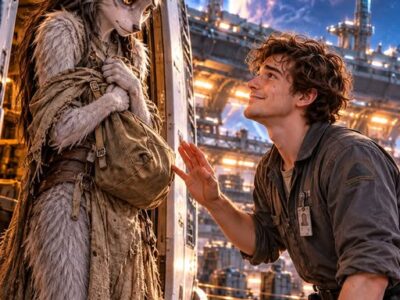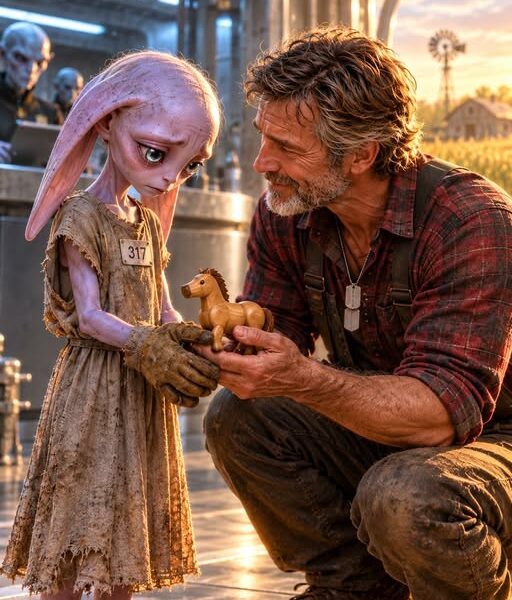
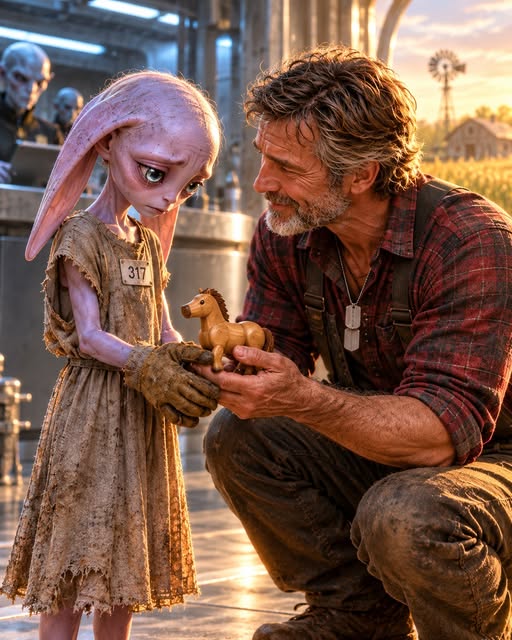
The little alien girl had been returned to the placement guild three times. By the time Sam Whitlock met her, she had stopped hoping anyone would keep her.
For one terrible moment, Nyla could hear nothing.
Not the bees.
Not the wind moving against the courtroom windows.
Not even the whispering crowd.
There were only the eyes.
Two hundred people watching her. The estate’s representative stood with his hands folded, wearing the confident smile of someone who had never been told no. Beside him sat the guild clerk who had once offered Sam a different child because Nyla was supposedly unsuitable.
And somewhere behind them, a legal officer held a document that could take away the only home she had ever known.
Nyla’s fingers tightened around the old work glove.
Then she remembered the orchard.
She remembered Sam teaching her how to plant apple trees, how to recognize a sick bee, and how to distinguish the sound of rain from the sound of wind against the farmhouse roof.
Most importantly, she remembered the first morning she had accidentally broken a cup.
She had stood frozen, waiting for someone to shout.
Sam had simply handed her a broom and said, “Well, looks like we need a new cup. Let’s clean this up before someone steps on it.”
He hadn’t punished her.
He hadn’t sent her away.
He had just stayed.
Nyla lifted her head.
“I want to stay with Sam.”
Her voice was small, but it reached every corner of the courtroom.
The estate’s representative immediately stood.
“Your Honor, the child is clearly emotionally attached to her current caretaker. That does not mean she understands what is best for her future. She has no education, no understanding of financial security, and no knowledge of the opportunities our household can provide.”
Nyla looked at him.
“I know what you have.”
The representative blinked.
“Excuse me?”
“You have a big house. You have many rooms. You have servants who bring your food. You have people who clean your floors. But when I was there, nobody knew I was afraid of the dark.”
A murmur passed through the courtroom.
Nyla continued.
“I slept in the laundry room because the bedroom was too far from the door. I thought if I cried, someone would get angry. When I couldn’t carry the heavy water containers, you said I was defective.”
The representative’s expression hardened.
“Those are exaggerated statements from a traumatized child.”
“No,” Nyla whispered. “They are memories.”
For the first time, the courtroom became completely silent.
The magistrate leaned forward.
“Why do you believe Mr. Whitlock is the right person to care for you?”
Nyla glanced at Sam.
He was sitting in the front row, his old hands clasped together. His eyes were wet, but he was smiling.
“Because he never asked me how much I was worth.”
She paused.
“He asked me what I liked for breakfast.”
Something shifted in the room.
Even the guild clerk lowered her eyes.
But the estate’s representative wasn’t finished.
“Your Honor, with respect, emotional arguments cannot replace a proper assessment. The girl possesses a rare biological sensitivity. Her abilities could benefit the entire region. Our household has the resources to train her properly and ensure that her talents are used responsibly.”
The magistrate raised an eyebrow.
“Are you suggesting that her abilities are the reason your client wants custody?”
“We are suggesting that her potential should not be wasted on an isolated agricultural property.”
Before the magistrate could respond, a voice came from the back of the courtroom.
“Then perhaps we should discuss what happened when she was living at that estate.”
Everyone turned.
A tall woman in a dark green uniform stood near the entrance. Her silver hair was tied behind her head, and a small insignia of the Vashen Water Authority shone on her collar.
Sam recognized her immediately.
It was Commander Elara Voss, the regional director who had supervised the emergency drilling operation in Callaway.
The magistrate nodded.
“Commander Voss. You requested permission to testify. Please come forward.”
Elara walked toward the witness stand.
“Your Honor, eight days ago, this town was less than forty-eight hours away from losing its emergency water supply. Nyla Whitlock identified an underground reservoir that our instruments had failed to locate. Her information saved over six hundred residents.”
The estate representative smiled faintly.
“Exactly. Which demonstrates why her abilities require professional supervision.”
Elara turned toward him.
“That is not what I was about to say.”
She placed a thin data tablet on the magistrate’s desk.
“Our investigation discovered that the estate had known about Nyla’s unusual sensory abilities for nearly three years.”
The representative’s smile disappeared.
“What?”
Elara activated the tablet.
A series of old reports appeared on the courtroom display.
They included observations from Nyla’s first months at the estate.
One report described how the child had repeatedly complained about a strange noise coming from the estate’s eastern water system.
Another recorded that she had become distressed whenever she approached a particular underground storage chamber.
A third contained a handwritten note from the estate’s chief engineer.
‘Subject appears capable of detecting changes in subterranean water pressure before conventional equipment registers them.’
Nyla stared at the screen.
She remembered that chamber.
She remembered standing outside it, covering her ears because the sound beneath the floor had been so painful.
She had told the household supervisor that something was wrong.
He had ordered her to stop making things up.
Elara continued.
“Three months after that report, the estate discovered a serious structural failure in its private water reservoir. The repair costs were enormous. According to these records, the estate dismissed Nyla shortly afterward.”
The representative rose.
“This information is irrelevant to the adoption proceeding!”
“It is relevant to your client’s motives,” Elara replied. “Especially since the estate has recently submitted a request to the Water Authority seeking exclusive research access to Nyla’s abilities.”
The courtroom erupted in whispers.
The magistrate struck the desk with a small wooden instrument.
“Order!”
The representative looked furious.
“Those documents are confidential property records. They cannot be used without authorization.”
Elara folded her hands.
“They were obtained under an official investigation into the exploitation of a protected minor. Your Honor, I would also like to submit one additional document.”
She placed another file on the desk.
“This is a communication from the estate’s legal department, dated two days after the discovery of the Callaway reservoir.”
The magistrate read it.
His expression changed.
“What exactly is this?”
“A proposed agreement. The estate intended to acquire guardianship of Nyla and transfer her to a research facility under a long-term development contract.”
Sam stood so quickly that his chair scraped against the floor.
“They wanted to put her in a laboratory?”
The representative snapped back.
“An educational research center! She would have received the best facilities available!”
Sam’s voice shook.
“She’s nine years old.”
“She is an extraordinary biological resource.”
The words hung in the air.
Nyla slowly turned toward the representative.
“That’s what I was to you?”
He didn’t answer.
For the first time in her life, Nyla understood something that had been hidden from her.
The estate hadn’t returned her because she was too weak.
They had returned her because she had been inconvenient.
Now that her gift could make them rich and powerful, they wanted to pretend they had never rejected her.
The magistrate called for a recess.
The courtroom emptied into the corridor, where townspeople gathered around Sam and Nyla.
Mrs. Alvarez, who owned the bakery, brought Nyla a small bag of honey biscuits.
Old Mr. Chen, who had helped dig the emergency well, shook Sam’s hand.
Even the town’s grumpy mechanic, who rarely spoke to anyone, quietly placed a little wooden apple charm in Nyla’s palm.
“Made it myself,” he muttered. “For your bedroom.”
Nyla looked at the charm.
“Thank you.”
It was such an ordinary exchange.
And somehow, that made it more precious than anything she had ever received.
But Sam noticed she was trembling.
He crouched beside her.
“You did well, kid.”
“What if the judge says I have to go?”
“Then we’ll deal with that when it happens.”
“What if they take me anyway?”
Sam looked directly into her eyes.
“Listen to me. I cannot promise that life will never put something difficult in front of us. But I can promise you that I will never stop standing beside you.”
Nyla nodded.
Then she did something she had never done before.
She reached for his hand first.
The hearing resumed twenty minutes later.
The estate’s representative made one final argument. He spoke about wealth, education, advanced medical facilities, and the responsibility of society to develop rare talents.
Sam’s lawyer, a middle-aged human woman named Miriam Cole, listened without interruption.
When it was her turn, she stood.
“Your Honor, the estate has spent this entire hearing discussing what Nyla can provide. Her hearing, her sensitivity, her unusual connection to the natural environment. They have discussed the water she can locate, the discoveries she might make, and the benefits her abilities could bring to powerful institutions.”
She paused.
“But not once have they discussed what this child needs.”
She opened a folder.
“Nyla needs stability. She needs education. She needs the freedom to make mistakes without fearing abandonment. She needs adults who understand that her value does not depend on her usefulness.”
Miriam looked toward the magistrate.
“The adoption provision exists for precisely this reason. A child is not a piece of property that can be transferred whenever a more profitable opportunity appears.”
The magistrate studied the documents for several minutes.
Then he turned toward the guild clerk.
“Why was Nyla returned by three separate households?”
The clerk shifted uncomfortably.
“Each household submitted a report stating that she was difficult to accommodate.”
“Did anyone conduct a psychological assessment?”
“No, Your Honor.”
“Did anyone investigate whether she had experienced mistreatment?”
“No.”
“Did anyone examine her unusual sensory abilities?”
The clerk hesitated.
“Not formally.”
The magistrate removed his glasses.
“So you labeled a child unsuitable without ever attempting to understand her.”
The clerk had no answer.
The magistrate turned to Nyla.
“Young lady, I have one final question. You understand that adoption means becoming part of Mr. Whitlock’s family permanently? It means sharing his name, living in his home, and being recognized as his daughter under human law.”
Nyla looked at Sam.
His face had gone pale.
He seemed more frightened now than when the estate had first arrived.
She understood why.
He was afraid of losing her, too.
“Would you like to become Sam Whitlock’s daughter?”
Nyla stood.
This time, her voice didn’t disappear.
“Yes.”
“Why?”
She looked down at the old work glove in her hands.
“Because I don’t want to spend my life being the child people choose when they need something.”
She raised her eyes.
“I want to be the child someone chooses even when they don’t need anything.”
Sam covered his mouth.
Nyla continued.
“Sam has bad knees. He forgets where he puts his glasses. He talks to his apple trees, even though they never answer him. Sometimes he burns the toast, and he thinks nobody notices.”
A few people laughed softly.
“But he lets me sit at the table. He lets me read books. He lets me ask questions. When I make mistakes, he doesn’t tell me I’m broken.”
Her voice trembled.
“I don’t know if I can be a good daughter. Nobody ever taught me how.”
Sam rose from his chair.
“You don’t have to earn it, sweetheart.”
Nyla looked at him.
For the first time, she smiled in front of a room full of strangers.
The magistrate lowered his head to hide his own expression.
Then he struck the desk.
“The court recognizes the adoption under the human-Vashen treaty. The petition for transfer is denied. Nyla Whitlock is hereby recognized as the legal daughter of Samuel Whitlock.”
For one second, nobody moved.
Then the courtroom exploded with applause.
Mrs. Alvarez cried openly.
Commander Voss smiled.
Miriam hugged Sam.
And Nyla stood frozen, unable to understand the words she had just heard.
Daughter.
Not ward.
Not placement.
Not property.
Daughter.
Sam walked toward her and knelt.
“Well, I suppose we should get you home, daughter.”
Nyla stared at him.
Then she threw her arms around his neck.
It was the first time she had ever hugged anyone without asking permission.
And Sam held her as though the whole universe had finally placed something precious in his hands.
But the estate’s defeat did not end the story.
In the weeks that followed, the investigation uncovered an entire network of illegal experiments involving gifted Vashen children.
Several wealthy households had been quietly documenting unusual abilities among their wards. Some children were returned when their talents proved difficult to control. Others were kept in isolated facilities under the excuse of specialized education.
Nyla’s records had been only one small part of a much larger operation.
Commander Voss contacted the regional authorities, and the investigation expanded across the planet.
The estate’s water development contracts were suspended. Its senior administrators faced criminal charges for the exploitation of minors. The placement guild was forced to undergo a complete restructuring.
And something unexpected happened.
Children began speaking.
Not all at once. Not loudly.
Some sent letters.
Some asked for help.
Some simply walked into the offices of the new child protection service and requested a safe place to stay.
Nyla never imagined that her story would make such a difference.
She had only wanted to stay on a farm.
Yet her testimony gave other children the courage to ask for something better.
Meanwhile, life at the Whitlock farm continued.
The wheat grew.
The apple trees bloomed.
The bees hummed through the summer afternoons.
Sam still complained about his knees, and Nyla still forgot to put her shoes away.
But the farmhouse changed.
There were books on the kitchen table now. Drawings on the refrigerator. A collection of little stones beside the upstairs window.
And every Sunday morning, Nyla insisted on making breakfast.
Her first attempts were disastrous.
The pancakes were too thick, the eggs were too salty, and once she accidentally put honey into the soup.
Sam ate everything without complaint.
“How is it?” she asked nervously.
“Interesting.”
“Is that good?”
“Depends on whether we’re discussing breakfast or a science experiment.”
She laughed.
The sound became one of Sam’s favorite things in the world.
Then, near the beginning of autumn, something unusual happened.
Nyla stopped hearing the bees.
It started with one hive.
Then another.
Within two days, the entire orchard seemed strangely silent.
Sam noticed her standing outside the apiary, her ears lowered.
“Something wrong?”
“They’re frightened.”
Sam examined the hives.
At first, everything looked normal. The bees were moving, the flowers were healthy, and the temperature was suitable.
But Nyla shook her head.
“No. Something is coming.”
Sam trusted her instincts.
He contacted Commander Voss, who arranged for an environmental survey of the surrounding farmland.
The results were alarming.
A chemical processing facility forty kilometers away had suffered an underground containment leak. Toxic material was slowly moving through the groundwater toward Callaway.
The facility’s owners had not yet reported the incident.
The bees had detected the first changes.
And Nyla had heard them.
This time, however, Sam did not simply ask her to point toward the danger.
He called the authorities, gathered the town council, and insisted that trained specialists investigate immediately.
Nyla helped them identify the direction of the contamination, but she was never made responsible for solving the crisis alone.
Within hours, emergency teams arrived.
They closed the affected wells, evacuated several nearby farms, and began constructing containment barriers.
The disaster was prevented before anyone became seriously ill.
When the operation ended, Commander Voss visited the Whitlock farm.
She found Nyla sitting on the porch, carefully cleaning her old work glove.
“You saved the town again,” Elara said.
Nyla shook her head.
“Everybody did.”
“Your ability gave us the warning.”
“But everybody listened this time.”
Elara smiled.
“That may be the most important part.”
She sat beside the girl.
“The Water Authority would like to offer you something when you’re older. A scholarship, if you want it. You could study environmental science, planetary ecology, or whatever interests you.”
Nyla considered the offer.
“Can I still live here?”
“Of course.”
“Can I still help with the bees?”
“Absolutely.”
“And can I say no if I don’t want to work for the Authority?”
Elara laughed.
“Especially then.”
Nyla looked relieved.
For so long, every adult who had discovered her abilities had immediately begun deciding what she should become.
Now someone was asking what she wanted.
That evening, she told Sam about the scholarship.
He listened while repairing a loose board on the porch.
“Sounds like a good opportunity.”
“Would you want me to go?”
Sam stopped working.
“I want you to become whoever you want to become.”
“What if I don’t know yet?”
“Then you’ve got plenty of time to find out.”
Nyla leaned against his shoulder.
“Do you think Mom would have liked me?”
Sam’s hands went still.
He looked toward the orchard.
For three years, he had rarely spoken about his wife, Evelyn. Not because he had forgotten her, but because grief had made certain memories too painful to touch.
He went inside and returned with a small wooden box.
Inside were photographs, a silver necklace, and a folded letter.
“This was written by your mother,” he said.
Nyla looked up.
“Your wife?”
Sam nodded.
“Evelyn. She wrote it a few months before she passed. We had talked about adopting a child someday, but we never got the chance.”
He unfolded the letter.
His voice became quiet as he read.
‘If life ever brings a child into this house, I hope we give them more than a warm bed and full meals. I hope we give them a place where they never have to wonder whether they deserve to stay. I hope they grow up knowing that love is not a reward for being useful. It is something we choose to give.’
Sam stopped reading.
Nyla was crying.
He handed her the letter.
She held it against her chest.
“She would have liked the bees,” Nyla whispered.
Sam smiled through his tears.
“She would have loved you.”
That night, Nyla placed the letter inside the drawer of her bedside table.
Next to it, she placed her worn work glove.
She no longer needed it to remind herself to be useful.
But she wasn’t ready to throw it away.
It was part of her story.
And she had finally learned that a difficult beginning did not have to determine the rest of her life.
Years passed.
Nyla grew taller, her ears becoming more expressive, and her lavender skin darkening slightly with age. She attended school in Callaway, learned to read three languages, and became fascinated by underground ecosystems.
She was still sensitive.
She still sometimes cried when the world became too loud.
But nobody called her weak for it anymore.
Sam grew older.
His knees worsened, his hair turned completely white, and he began relying on a walking stick.
Nyla took over more of the farm work, not because anyone demanded it, but because she loved the place.
She studied water systems, helped restore damaged habitats, and eventually became one of the youngest environmental researchers in the region.
Yet no achievement meant as much to her as returning home after a long day and hearing Sam call from the kitchen.
“You’re late, kid. The soup’s getting cold.”
One winter evening, when Nyla was seventeen, she found him sitting by the fireplace with an old photograph.
It showed Sam and Evelyn standing in the orchard, smiling beneath the apple blossoms.
“Do you miss her?” Nyla asked.
“Every day.”
“Does it ever stop hurting?”
Sam thought for a while.
“No. But the hurt changes. At first, it feels like losing someone means losing every good thing they ever gave you. Eventually, you realize those things are still here. They become part of how you live.”
Nyla sat beside him.
“I used to think being returned meant there was something wrong with me.”
Sam looked at her.
“Was there?”
She shook her head.
“No.”
“Then don’t let other people’s mistakes become the story you tell yourself.”
She leaned against him.
Outside, snow covered the orchard. The hives were quiet, sleeping through the cold months, waiting for spring.
Nyla could hear the faintest sound beneath the silence.
Not distress.
Not danger.
Just life, resting.
And for the first time, she understood that silence did not always mean something was wrong.
Sometimes it meant everything was safe.
A few years later, on the anniversary of her adoption, Nyla returned to the placement guild.
The building had changed.
The old transfer counter was gone. In its place stood a bright reception area filled with plants, books, and comfortable chairs.
A sign above the entrance read:
EVERY CHILD DESERVES A HOME WHERE THEY ARE WANTED.
Nyla had been invited to speak at the opening of a new independent child advocacy office.
She stood before a small audience, wearing a blue dress and a silver necklace that had belonged to Evelyn.
Sam sat in the front row.
His walking stick rested against his chair.
Nyla began.
“When I was nine, I believed I had to become useful to deserve a place in someone’s home. I thought if I worked harder, ate less, stayed quieter, and never cried, someone might finally decide to keep me.”
She paused.
“I was wrong.”
The room was silent.
“Children are not tools. They are not investments. They are not problems waiting to be corrected. And they should never have to prove that they are worth loving.”
She looked toward Sam.
“Someone once told me I was unsuitable. They were right about one thing. I was unsuitable for a home where love had to be earned.”
A few people smiled.
“But I was never unsuitable for a family.”
After the speech, a little Vashen boy approached her.
He couldn’t have been older than seven.
His clothes were too large, and he held a small cloth bag against his chest.
“Are you the girl who found the water?” he asked.
Nyla knelt.
“I am.”
“Did somebody really adopt you?”
“Yes.”
“Did you have to be good?”
Nyla felt her heart tighten.
She remembered the transfer counter.
The narrow space beside the stove.
The nights spent waiting for footsteps.
The desperate fear that one mistake could cost her everything.
She gently placed a hand on his shoulder.
“No,” she said. “I just had to be myself.”
The boy looked down at his bag.
“What if nobody wants me?”
Nyla glanced toward Sam.
He was watching her with the same gentle expression he had worn on the day they first met.
Then she looked back at the boy.
“Sometimes it takes longer than it should to find the people who understand you. But that doesn’t mean you are difficult to love.”
She offered him her hand.
“And you don’t have to become useful to deserve a home.”
The boy hesitated.
Then he took it.
As Nyla walked him toward the new reception desk, she felt something warm settle in her chest.
She had once been the child waiting for someone to choose her.
Now she could help another child understand that they were worthy of being chosen, too.
Outside, Sam was waiting beside the car.
“Ready to go home?”
Nyla smiled.
“Yes, Dad.”
It was a simple word.
But even after all those years, she still loved saying it.
They drove back through the countryside as the afternoon sun settled over the fields.
When they reached the farm, the apple trees were beginning to bloom.
Nyla stepped out of the car and listened.
The bees were awake.
Their familiar song drifted across the orchard, soft and steady.
She closed her eyes.
Once, she had believed the world was full of doors that would eventually close behind her.
Now she knew there were places where she could leave the door unlocked, because nobody was waiting to send her away.
She walked toward the farmhouse.
On the kitchen wall hung a framed photograph of Sam, Evelyn, and Nyla. Beneath it was a small wooden plaque with three words engraved into the surface:
LOVE IS NOT EARNED.
Sam had made it years earlier.
Nyla touched the plaque before heading upstairs.
Her old work glove rested inside the bedside drawer, beside Evelyn’s letter and the little wooden apple charm from the mechanic.
She no longer needed to sleep beside the door.
She no longer counted her meals or measured her worth by the work she could complete.
She had a bedroom.
A family.
A future.
And most importantly, she had learned that the people who failed to recognize her value had never been qualified to define it.
The little alien girl who had been returned three times had finally found a place where she would never have to ask to stay.
And on a quiet farm beneath an endless alien sky, she grew up knowing something every child deserves to know:
You do not have to be extraordinary to deserve love. You do not have to be useful to deserve kindness. And you never have to shrink yourself to fit into a home that cannot see your worth.
The right people will not ask you to prove that you deserve a place in their lives. They will simply make room for you—and choose you, again and again.