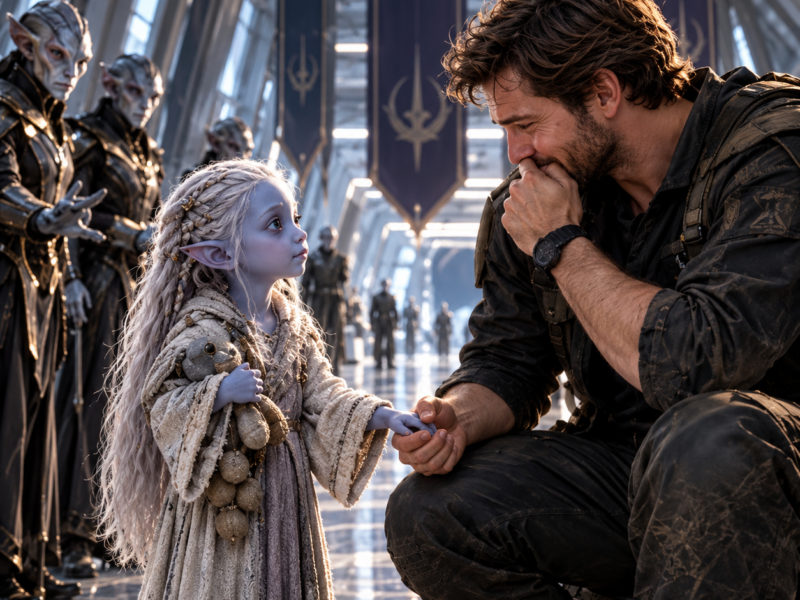
When the little alien girl collapsed beside the glass wall of the Denver Space Center, she slapped away every guard who reached for her, while the director coldly ordered me to leave her alone—yet when our eyes met, she quietly reached for my hand as if she already knew the secret everyone had buried.
The hum of the environmental control units was the only constant companion I had in the sub-basement levels of the Denver Space Center.
I was just Marcus, a late-night maintenance technician whose existence was defined by the jingle of brass keys and the smell of industrial floor cleaner.
People only noticed me when a hydraulic valve failed or a pressure seal hummed too loudly, and even then, their eyes usually drifted past my face.
That was fine by me.
I preferred the quiet machines over the loud ambition of the top-tier research staff.
Then the containment ward opened on Level 4.
They called her Subject Alpha, but behind closed doors, everyone referred to her as the alien child.
She had been brought in under heavy military escort after a crash recovery in the Nevada desert three weeks ago.
Or at least, that was the official narrative printed on the classified briefing memos pinned to the security bulletin board.
She was tiny, appearing no older than an eight-year-old human girl, with pale silver-gray skin and large, liquid-dark eyes that seemed to swallow the fluorescent light.
A oversized white medical gown draped over her frail frame, making her look even smaller behind the three-inch-thick reinforced glass wall.
The top brass, scientists, and armed guards had spent twenty-one days trying to get a reaction out of her.
She had fought them all, slapping away hands, knocking over medical trays, and retreating to the far corner of her cell whenever anyone entered.
She refused to eat unless the nutrient packs were left on the floor after the door was sealed.
She wouldn’t speak, wouldn’t make a sound, and stared blankly whenever they showed her satellite maps or linguistic charts.
My job was simply to replace the air filter unit mounted outside her primary observation window.
I tried not to look inside while I worked.
The guards stood nearby with their hands resting on their sidearms, their faces rigid with unnecessary tension.
Then my wrench slipped.
The heavy steel tool bounced off the metal casing and clattered against the tile floor with a noise like a gunshot.
The guards flinched, but I barely had time to apologize before a shadow moved inside the room.
The little girl had pressed herself directly against the glass wall.
I froze on one knee, holding the dropped tool, expecting her to scurry back into the dark corner.
Instead, she lifted a small, trembling hand and rested her thin fingers against the cold glass.
Her large dark eyes were locked entirely on mine, ignoring the armed men standing just inches behind me.
Without thinking through the breaches of security protocol, I stood up and slowly lifted my palm to meet hers from the outside.
The moment our fingers aligned through the thick barrier, her chest heaved with a quiet sigh.
And then her lips parted, currying upward into a fragile, unmistakable smile.
Director Hayes stepped out of the observation booth before I could even process what had just happened.
Heavy boots clicked sharply against the polished concrete as he marched down the hallway.
He grabbed my shoulder with a grip that bruised through my jumpsuit and dragged me away from the pane.
“Don’t do that again, Marcus,” he said, his voice dropping into a harsh, controlled whisper.
“I was just changing the filter, Director,” I replied, staring back at him. “Why shouldn’t I interact with her? She responded.”
His eyes narrowed into thin slits, the wrinkles around his jaw tightening.
“Because she isn’t responding to you,” he snapped coldly. “You’re a maintenance worker. Keep your eyes on the machinery and leave the research to the people with security clearances.”
He gestured to two guards, who immediately stepped between me and the glass, cutting off my view of her face.
I gathered my tools in silence, feeling her dark eyes watching my back until the heavy blast door hissed shut behind me.
Later that evening, long after the primary shift had left and the corridors were drained of daylight, I returned to clean up the workspace.
As I picked up my heavy metal toolbox from the floor beneath the window panel, something caught my eye.
A small piece of thick paper was tucked neatly under the rubber foot of the box.
It hadn’t been there when I dropped my wrench earlier.
I checked the quiet hallway before unfolding the coarse sheet.
It was a rough pencil sketch drawn with precision that didn’t belong to an eight-year-old child.
The drawing showed a tall human man holding the hand of a small child with oversized dark eyes.
Behind them in the background was a jagged mountain range and a burning, crumpled spacecraft.
At the bottom corner of the sheet, drawn with delicate lines, was a simple blue house with a sloped roof.
My chest tightened as I looked at the tall man in the picture; he was wearing the identical standard-issue maintenance coveralls I wore every single day.
I couldn’t sleep that night.
The next morning, driven by an unsettling gut feeling, I brought the drawing straight into Hayes’s glass-walled office on the top floor.
He looked up from his terminal, displeased by my presence, and took the folded paper from my hands.
He stared down at the drawing for several long seconds, his face completely devoid of emotion.
Then, slowly and methodically, he tore the paper right down the center, tore it again, and dropped the pieces into his desk shredder.
“You never saw this,” he said quietly, looking back at his monitor without offering a single word of explanation. “Return to your shift.”
A cold weight settled in my stomach as I left the director’s office.
The coldness in his voice wasn’t just authority; it was fear.
I didn’t return to the main workshop.
Instead, I headed straight for the sub-basement server room where the legacy maintenance archives were kept on physical magnetic drives.
Most of the personnel files from the current administration were locked behind encrypted biometrics, but the old infrastructure logs weren’t considered high-security.
They were just records of plumbing, air ducts, and structural modifications stretching back twenty years.
I sat down at the dusty terminal and began cross-referencing containment room 4B’s historical power draw.
If a specialized environmental chamber had been active, the power grid would reflect it.
The current file stated the capsule had been brought in three weeks ago.
But as I scrolled through the raw electrical output data, the numbers told a completely different story.
The extreme power consumption for room 4B hadn’t started three weeks ago.
It had been running continuously for eleven years.
I dug deeper into the altered maintenance logs, clearing through layers of overwritten system updates.
Someone had systematically scrubbed the names of the engineering staff from that period, replacing them with generic contractor codes.
Except for one incident report that had been archived on a corrupt sector of the hard drive.
It was an automated workplace injury log from over a decade ago.
Attached to the file was an unedited security camera snapshot taken in the old research wing.
My hands began to shake so hard I almost lost my grip on the mouse.
The photo showed a much younger version of me standing inside a containment chamber.
I was kneeling down on the tile floor, smiling.
And standing right beside me, holding onto my thumb, was the exact same silver-skinned girl.
She hadn’t aged a single day in eleven years.
And I had absolutely no memory of ever setting foot in that room.
The discovery sent my mind spinning into a terrifying void.
I stared at my own young face on the glowing green monitor, searching my mind for any trace of that moment.
There was nothing—just a blank wall where those years should have been.
I remembered applying for the job at the center, remembered working the night shifts, but large spans of my past felt like smooth glass with no edges to hold onto.
I closed the terminal, purged the local search cache, and walked back down the long subterranean hallways toward the containment ward.
The night shift guards were away on their scheduled perimeter walk, leaving the corridor outside room 4B unguarded for a short ten-minute window.
I used my master maintenance keycard to unlock the outer access chamber.
The heavy door unsealed with a soft pneumatic hiss that sounded unnaturally loud in the empty hallway.
Inside, the light was dim, casting long shadows across the reinforced floor.
The little girl was not cowering in the corner.
She was standing right in the center of the room, waiting for me as if she knew the exact second I would step through that door.
I walked toward her slowly, my heart hammering against my ribs like a trapped bird.
She didn’t back away.
She took three small steps forward, her tiny silver fingers reaching out until they touched my hand.
Her skin was cool, like smooth river stone, but her grip was surprisingly firm.
She looked up into my face, her dark eyes reflecting the faint emergency lights.
Her lips trembled slightly, and then she spoke in a voice that was soft, rhythmic, and perfectly clear.
“You’re late,” she whispered.
I choked on my breath, unable to process the sound of her voice after weeks of silence.
“Who are you?” I managed to ask, kneeling down so I was eye-level with her. “How do you know me?”
Before she could answer, a deep mechanical groan echoed through the concrete foundations of the building.
Every fluorescent panel in the ceiling flickered once, twice, and then went completely dark.
The emergency alarms didn’t sound.
Instead, a low, subsonic vibration started rolling up through the floorboards, vibrating through the soles of my boots.
In the pitch blackness of the chamber, the girl squeezed my fingers tighter.
“They told me you died,” she whispered into the dark.
The darkness inside the containment room felt heavy and suffocating.
Out in the main corridor, emergency red lights slowly pulsed into life, casting a deep crimson glow through the reinforced glass panel.
The low hum beneath the floor grew louder, shifting into a rhythmic pulse that felt like a giant heart beating deep within the earth.
“What is that noise?” I asked, my voice barely audible over the growing vibration.
“It’s the ship,” she said softly, her dark eyes catching the faint red light. “It’s waking up because you came back.”
“I don’t understand,” I said, my mind struggling to bridge the gap between my missing memories and the girl standing before me. “I’m just a technician.”
“They wiped your mind, Marcus,” she said, her voice entirely devoid of panic. “When you tried to take me out eleven years ago, they caught us at the perimeter.”
The realization hit me like a physical blow.
The missing years, the strange feeling of detachment I always felt toward my own life, the cold stare Director Hayes gave me—it all lined up.
Footsteps echoed down the hallway outside—heavy, synchronized, and moving fast.
“They’re coming,” I said, stepping between the girl and the door.
“They won’t let us leave this time either,” she replied quietly, resting her small hand on my arm. “Unless we reach the lower vault first.”
The heavy blast door of the containment chamber suddenly unlocked with a loud metallic clank.
The door swung open, revealing Director Hayes framed in the doorway, flanked by four heavily armed security officers carrying tactical rifles.
Hayes didn’t look surprised to find me there.
His face was cold, calculating, and illuminated by the red emergency lights behind him.
“I gave you an easy life, Marcus,” Hayes said, his voice quiet and steady despite the vibration shaking the room. “You were safe. You were quiet. You were content fixing pipes.”
“What did you do to my head?” I yelled, taking a step toward him, keeping the girl behind me.
“We saved your life,” Hayes replied smoothly. “You were convicted of high treason eleven years ago. Wiping your memory was the compromise we made to keep you out of a federal execution facility.”
He raised his hand, pointing a finger directly at my chest.
“Step away from the asset, Marcus. Right now.”
I looked back at the little girl standing behind me.
Her large dark eyes weren’t filled with fear; they were filled with trust.
Eleven years ago, I had tried to save her, and I had paid for it with my mind.
I wasn’t going to let them take everything from me a second time.
“No,” I said clearly.
Hayes’s eyes darkened.
“Take him,” he commanded the guards.
The lead security officer stepped forward, reaching out with a heavy gloved hand to grab my shoulder.
Before his fingers could touch my jacket, the little girl moved with incredible speed.
She slammed her small palm against the steel doorframe beside us.
A shockwave of blue electrical energy erupted from her hand, pulsing through the metal door and surging directly into the room’s power grid.
The heavy security door slammed shut with a deafening bang, instantly severing the guards from us.
The electronic lock melted into a fused mass of slag, trapping Hayes and his men in the hallway outside.
Heavy fists began hammering against the reinforced steel, but the barrier held firm.
“This way,” the girl said, grabbing my hand and pulling me toward a maintenance access grate at the back of the room.
“Where does that lead?” I asked, pulling off the metal cover with my crowbar.
“To the place where they buried the ship,” she said.
We scrambled into the narrow service tunnel just as the guards began using a thermal torch to cut through the front door.
The metal tunnel was dark, cramped, and smelled strongly of ozone and hot oil.
As we crawled through the darkness, memories began to flash in my mind like distant lightning strikes.
I remembered holding a torch just like the guards were using.
I remembered the cold metal of a foreign hull beneath my fingers.
And I remembered a soft, rhythmic voice telling me that the stars were much closer than I believed.
We emerged from the service shaft onto a narrow metal gantry suspended high above a massive underground cavern.
The space was immense, carved directly out of the bedrock hundreds of feet below the main space center.
And hanging in the center of the cavern, suspended by massive steel cables, was an incredible sight.
It was a smooth, teardrop-shaped vessel made of a dark, iridescent material that seemed to absorb the light around it.
It wasn’t a crashed wreck like the news reports claimed.
It was fully intact, glowing with faint veins of golden light that pulsed in rhythm with the floor’s deep vibration.
“You helped me build the containment shield for it,” the girl said, standing beside me at the railing. “Before they took your memories.”
“How long have you been down here?” I asked, looking down at the immense drop below us.
“Eleven of your years,” she replied softly. “They kept me suspended in a stasis lock to study my biology. They only woke me up when the ship’s core began to decay.”
“They needed you to fix it,” I realized aloud.
“They needed me to give them access,” she corrected. “The ship only responds to my DNA and the biological signature of the person who helped seal it.”
She looked up at me, her silver face glowing in the gold light from the vessel.
“You registered yourself as my guardian in the ship’s system before they wiped your mind, Marcus. That’s why they couldn’t open it without you.”
Shouts echoed from the catwalks far above us.
Flashlight beams swept across the dark walls of the cavern as Hayes’s security forces began descending the spiral staircases.
“They’re coming down!” I shouted, grabbing her shoulder. “How do we get to the ship?”
“We jump,” she said simply.
Before I could object, she gripped my hand tightly and pulled me off the edge of the metal platform into the empty air of the vault.
The sensation of falling lasted for only a fraction of a second.
Instead of plunging to the concrete floor hundreds of feet below, a warm, dense field of energy caught us mid-air.
It was like jumping into deep water, but without the weight or the cold.
The golden veins of light on the ship’s surface flared bright, reaching out like soft ribbons to wrap around us.
The energy pulled us gently toward a smooth, seamless hatch on the side of the hull that melted open like liquid glass as we approached.
We tumbled inside onto a floor that felt soft and warm, like polished leather.
The hatch immediately sealed behind us, cutting off the echo of gunfire and shouting guards from the outer cavern.
Inside, the ship was quiet, illuminated by warm, ambient light that seemed to emanate directly from the walls.
In the center of the chamber stood a round console made of dark glass.
Floating above the console was a glowing holographic projection of a blue house—the exact same house from the drawing she had left beneath my toolbox.
“You remembered,” I whispered, staring at the image.
“You drew that for me on my first day in the laboratory,” she said, coming to stand next to me. “You told me that when we escaped, you would take me to a place with a sloped roof where we could see the sky.”
A heavy thud rattled the outer hull.
On a nearby display panel, I could see Hayes standing on the gantry outside, directing a crew of technicians who were placing explosive charges against the vessel’s exterior access panels.
“They are going to breach the outer skin,” I said, a wave of panic rising in my chest. “Can this thing fly?”
“It never forgot how,” she said, placing her palm on the glass console. “It was just waiting for both of its keys.”
She looked up at me, holding out her small hand once again.
“Place your hand next to mine, Marcus. Take your life back.”
I didn’t hesitate this time.
I laid my broad, rough palm onto the glowing console right beside her tiny silver fingers.
The moment my skin touched the surface, a sudden surge of heat rushed through my arm and directly into my brain.
It wasn’t painful; it was like a dam bursting inside my mind.
The missing eleven years came flooding back in a blinding flash of clarity.
I saw the day the capsule landed in the desert.
I saw Director Hayes ordering the scientists to dissect the child’s technology.
I saw my younger self making the choice to sabotage the containment grid to protect her.
I remembered the taste of the truth, the weight of the betrayal, and the quiet promise I had made to a lonely little girl locked in a glass box.
“I remember,” I breathed out, my eyes snapping open. “I remember everything.”
The console beneath our hands flared into a brilliant silver-blue light.
Deep within the ship, an engine roared to life with a sound like a choir of crystal glass, vibrating through every cell in my body.
Outside, the steel support cables suspending the vessel snapped one by one under the immense anti-gravitational force generated by the core.
The explosive charges Hayes’s men had placed on the hull detonated, but the blast energy was instantly absorbed by the ship’s glowing force field, harmlessly dissipating into the air.
Through the forward viewscreen, I saw Hayes stagger back on the gantry, his hands covering his eyes to shield them from the blinding light.
The ship began to rise, moving upward through the bedrock cavern with effortless power.
The concrete ceiling of the facility cracked and crumbled as the vessel pushed through the physical earth, shattering layers of rock, steel, and concrete like thin ice.
We surged upward through the darkness of the mountain, breaking out into the cool night air of the Denver sky.
The House by the Stars
The ship hovered silently above the glowing grid of the city lights below.
Behind us, the Denver Space Center was illuminated by emergency floodlights and flashing red sirens, looking tiny and powerless from high above.
The sky above us was clear, filled with millions of cold, sharp stars that stretched out into the infinite blackness of space.
The little girl stood beside me, her small hand resting comfortably in mine.
Her silver skin reflected the gentle glow of the console lights, and for the first time since I had found her behind that glass wall, she looked completely at peace.
“Where do we go now?” I asked softly, watching the clouds drift past the viewscreen. “Up there?”
She looked down at the floating holographic projection of the blue house still resting above the glass console.
“First, we keep your promise,” she said with a small, quiet smile. “Then, we choose our own sky.”
I looked down at the controls, feeling the ship respond to the thoughts in my mind as if it were an extension of my own body.
The vessel turned smoothly toward the dark horizon, far away from military bases, classified archives, and men who tried to erase the truth.
As the engines engaged, accelerating us across the night sky like a falling star in reverse, I held onto her hand.
They had taken my past, my memories, and eleven years of my life.
But as the wind rushed past the outer hull and the earth faded into the distance below, I knew they could never take where we were going.









