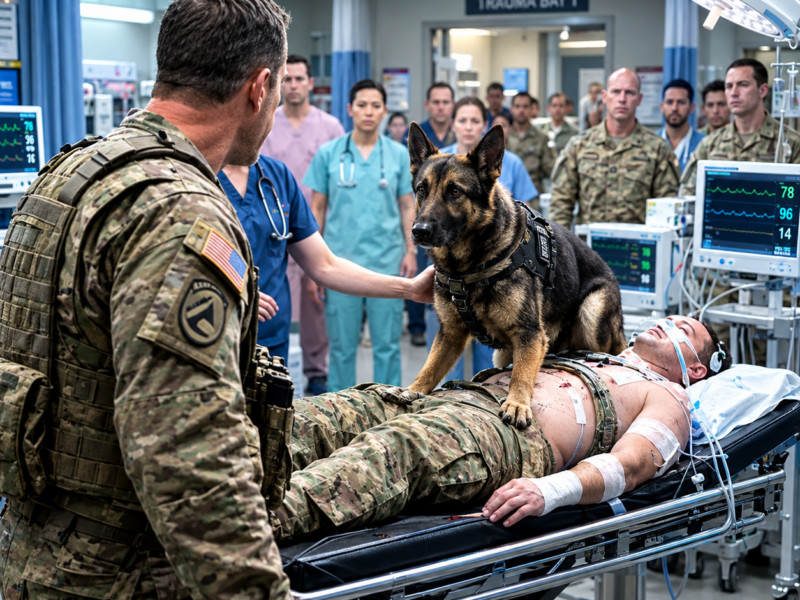
When the hospital director ordered a scarred military K9 euthanized in front of a room full of veterans, he sneered that the rookie nurse questioning him knew nothing about dangerous animals—until I knelt beside the trembling German shepherd, whispered a command no civilian should recognize, and watched the supposedly uncontrollable dog reveal a secret buried for years.
The harsh fluorescent light of the veteran’s hospital corridor hummed like a angry hornet.
I stood near the corner of the hallway, clutching a stack of patient charts against my chest.
My name is Megan Brooks, and I had worked at this veterans’ hospital in Colorado for only eleven days.
In eleven days, I had learned to navigate the maze of sterile white walls, the lingering scent of antiseptic, and the heavy sorrow that hung in the air.
Most of all, I had learned that this facility was run with an iron fist.
Dr. Richard Coleman, the hospital director, marched past me without a glance, his polished shoes clicking loudly against the linoleum.
He was a man who measured human suffering in budget reports and risk assessments.
Behind him, two orderlies pushed a heavy transport crate through the double doors.
Inside the crate, a low, ominous growl rattled the metal bars.
A group of elderly veterans sitting in the waiting area immediately looked up from their yellowed newspapers.
The air in the hallway turned cold and still.
I knew who was inside that crate before I even saw the torn, grey-muzzled snout.
It was Ranger.
He was a retired military working dog with a torn left ear, cloudy eyes, and a bite history that had frightened three different civilian handlers.
Dr. Coleman stopped in the center of the room, turning to face the gathering crowd with a cold, dismissive glare.
“Take him straight to holding room three,” Coleman ordered, his voice echoing off the tile walls.
“We are clearing the schedule for the afternoon,” he added. “The quiet injection is prepared.”
A soft, agonizing murmur swept through the room of elderly men.
Among them sat Arthur, a eighty-year-old Korean War veteran whose hands shook perpetually.
Arthur leaned forward on his wooden cane, his knuckles turning white.
“You can’t do that, Director,” Arthur said, his voice trembling with a mixture of grief and anger.
“He’s a decorated service animal,” the old man continued. “He gave his blood for this country.”
Coleman didn’t even turn his head fully toward the old soldier.
“That animal is a walking liability, Mr. Vance,” Coleman replied smoothly.
“He has attacked two staff members in forty-eight hours,” Coleman said, holding up a sleek tablet. “He is untrainable, unpredictable, and dangerous.”
Inside the crate, Ranger slammed his head against the door, the metal echoing like a gunshot.
The director frowned, stepping back half a pace.
“Execute the euthanasia order immediately,” Coleman snapped at the attending veterinary technician. “Before someone else gets hurt.”
My heart thumped violently against my ribs as I looked at the dog trapped inside that dark box.
I had read Ranger’s file on my very first morning at the hospital.
The official paperwork stated he had been medically retired after surviving a massive explosion overseas.
He had saved two soldiers from a collapsing building, pulling them out by their vests before the secondary charge went off.
Yet after his final mission, something had broken inside him.
He refused food for days on end, snapped wildly at anyone who stepped close to his run, and trembled uncontrollably whenever someone mentioned the word “home.”
Everyone thought he was broken beyond repair.
Everyone assumed he was just a violent, traumatized weapon whose time had run out.
“Wait,” I heard my own voice slice through the heavy silence of the room.
Coleman froze, slowly turning his head to look at me with deep disdain.
“Excuse me?” the director asked, narrowing his eyes behind his gold-rimmed spectacles.
I took two steps forward, my hands tight around the metal clipboard.
“You haven’t given him a chance to adjust,” I said, trying to keep my breathing steady.
“Look at him, Dr. Coleman,” I said, pointing toward the crate. “He isn’t attacking out of aggression.”
Coleman let out a short, hollow laugh that carried no warmth.
“You’ve been here less than two weeks, Nurse Brooks,” Coleman sneered, crossing his arms.
“You are a junior nurse, not a animal behaviorist,” he said coldly. “Do not lecture me on dangerous animals.”
Arthur, the old veteran, looked up at me with eyes full of desperate hope.
“I promised his handler we’d take care of him,” Arthur whispered into the quiet room. “I promised.”
Nobody answered the old man except the humming fluorescent lights.
I ignored Coleman’s sharp glare and stepped right up to the heavy metal crate.
Through the narrow steel grates, I saw Ranger pressed into the furthest, darkest corner.
His muscular body was completely rigid, his chest heaving with shallow, frantic breaths.
His grey, scarred muzzle was dripping saliva, but his milky, damaged eyes weren’t watching the room.
He wasn’t even watching the director or the technicians holding the long catch-poles.
He was watching their hands.
Every time a technician moved a finger or adjusted a grip, Ranger’s back muscles twitched with terror.
A sharp, electric jolt ran down my spine as a forgotten memory stirred in the back of my mind.
I turned back to face Dr. Coleman, my voice firm and unwavering.
“Give me five minutes,” I requested quietly.
“Give you five minutes to get your arm torn off?” Coleman mocked.
“If I fail, you can sign your paper,” I said, looking him dead in the eye. “Then let me fail before you kill him.”
Coleman glanced at his expensive gold watch, then down at the waiting veterans who were all watching him intently.
He knew a public scene would look terrible for the hospital’s next funding review.
“Five minutes, Nurse Brooks,” Coleman growled, signaling the orderlies to unlock the room door.
“And when he bites you, do not expect the hospital insurance to cover your negligence.”
The heavy steel door of holding room three creaked open.
I took a deep breath, leaving my clipboard behind, and stepped over the threshold into the dark chamber.
Behind me, the door didn’t close fully, leaving a narrow sliver of light where Coleman and the veterans watched.
Ranger was now out of his box, backed against the far concrete wall of the room.
His deep, rhythmic growl vibrated through the concrete floor, echoing off the bare walls.
His ears were pinned flat against his broad skull, his yellowed teeth bared in a desperate display of defense.
I didn’t move toward him directly.
Instead, I lowered my eyes, turning my body sideways to appear as small and non-threatening as possible.
I took a slow step backward toward the center of the room and sat down directly on the cold, dirty floor.
I kept both of my hands completely open, palm up, resting flat on my knees.
“Easy, soldier,” I spoke softly, keeping my pitch low and calm.
“Nobody’s leaving you behind today,” I whispered into the quiet room.
The growling didn’t stop immediately.
Ranger’s chest continued to heave, his posture remaining taut like a coiled steel spring.
Outside the observation window, Dr. Coleman tapped his foot impatiently against the floor.
“Your time is ticking, Brooks,” Coleman called out through the intercom, his voice distorted by static.
“He’s going to lunge,” the veterinary technician warned from the doorway. “Get out of there.”
I didn’t blink, nor did I break my relaxed posture on the floor.
I kept my eyes fixed on the blank space three inches to the left of Ranger’s paw.
Direct eye contact with a traumatized military dog was a declaration of war.
Ranger shifted his weight, his nose twitching as he caught my scent in the still air of the room.
The heavy, aggressive snarl slowly died down into a low, uncertain rumble deep in his chest.
He took one trembling step forward, his tail tucked tight between his hind legs.
He wasn’t aggressive; he was terrified, waiting for the punishment he expected to follow.
I reached slowly into my scrub pocket, taking out a clean, plain white hand towel I had grabbed from the supply cart.
Without making any sudden movements, I laid the towel completely flat on the concrete floor beside my left leg.
Then, I raised my right hand slightly and tapped the floor twice with my index and middle fingers.
“Check left,” I said softly, using a crisp, quiet tone.
The change in the dog was instantaneous and violent in its precision.
Ranger’s pinned ears snapped straight up, locking forward like two satellite dishes.
The cloudy film over his eyes seemed to clear as his posture shifted in a fraction of a second.
He dropped his belly to the concrete floor instantly, his body flattening into an flawless tactical crawl.
His snout slid along the floor, his entire body moving with the rhythmic, trained efficiency of a front-line operative.
He didn’t check the right side of the room; he kept his eyes locked entirely on the left corridor angle.
Behind the glass, the veterinary technician gasped aloud.
Coleman’s impatient foot-tapping stopped dead.
That specific phrase—”Check left”—was never taught in standard civilian obedience classes.
It wasn’t even part of basic police K9 training or modern search-and-rescue drills.
It was a highly specialized tactical command from a classified military protocol used exclusively by special forces teams operating in dense urban environments under heavy fire.
It was designed for situations where verbal noise had to be minimal, and a handler needed their dog to clear a blind fatal funnel before troops advanced.
My heart hammered against my ribs so hard it felt painful.
Ranger dragged his heavy body across the floor until his grey snout touched the edge of my white towel.
He didn’t bite.
He didn’t growl.
He raised his heavy, scarred head and pressed his wet forehead directly against my knee.
A long, shuttering, broken whine escaped his throat, sounding almost human in its grief.
I felt a tear slip down my cheek, hot against my cold skin.
I reached out with a trembling hand and buried my fingers in the thick, coarse fur behind his neck.
As my hand moved over his head, my thumb brushed against a distinct, star-shaped scar situated right above his left eye.
The moment my skin made contact with that jagged mark, the sterile hospital room around me seemed to vanish.
The smell of bleach and floor wax vanished, replaced instantly by the suffocating reek of burning diesel and desert dust.
The faint hum of the fluorescent lights transformed into the distant, rhythmic thumping of helicopter blades cutting through heavy night air.
I was no longer just a twenty-four-year-old nurse sitting on a cold hospital floor in Colorado.
My mind spun backward through three long, painful years of suppressed memories and buried trauma.
I remembered the blinding flash of fire cutting through the darkness of a desolate Afghan village.
I remembered the deafening roar of the mortar shell hitting our position without warning.
I remembered screaming for my squad lead, my mouth filled with copper and grit, my legs pinned beneath a shattered stone wall.
And I remembered the brown-and-black fur that had lunged through the suffocating grey smoke to grab my vest.
It had been Kilo Team, an elite forward reconnaissance unit that officially didn’t exist on standard deployment records.
I had been assigned to them as a tactical field medic, a rookie pulled straight from advanced training because of my specialized clearance.
On our last night in the valley, everything that could go wrong had gone catastrophically wrong.
An intelligence report had sent us directly into a hidden compound to secure high-value data servers.
The raid had been a set-up from the very beginning.
As soon as we breached the inner courtyard, heavy machine-gun fire rained down on us from the rooftops.
Our primary handler, Sergeant Miller, fell in the initial crossfire right in front of the courtyard gates.
Ranger, who was just a young three-year-old working dog at the time, had lost his handler in the opening seconds of the fight.
Panicked and wounded by shrapnel, the dog had run straight toward me as I crawled toward Miller’s motionless body.
I remembered pulling out my field kit while bullets tore through the mud-brick wall right above our heads.
Ranger had been bleeding heavily from a deep gash right above his left eye.
With shaking hands, I had held him down in the dirt and stitched that wound closed using heavy surgical thread while explosions rocked the ground beneath us.
“You stay with me, buddy,” I had screamed over the deafening noise of the battle. “You hear me? Stay with me!”
When the evacuation chopper finally touched down in the swirling dust, the courtyard was engulfed in flames.
A massive explosion shattered the secondary storehouse, throwing me clear across the stone patio and knocking me unconscious.
When I woke up three weeks later in a military hospital in Germany, my records had been completely wiped clean.
I was told that my unit had been wiped out, that Sergeant Miller was gone, and that Ranger had been vaporized in the secondary blast.
They handed me a honorable discharge paper citing severe blast trauma and memory loss, and sent me home to live a quiet life.
I had spent three years believing that everyone I served with had perished in that dusty, forgotten valley.
I had spent three years carrying the crushing weight of survivor’s guilt, assuming I was the lone ghost of Kilo Team.
Yet here he was.
Sitting on the cold floor of a Colorado hospital, his head resting in my lap, bearing the exact same star-shaped scar I had stitched under fire.
“You’re alive,” I whispered, my voice breaking as tears spilled freely down my face.
“You made it back, Ranger,” I sobbed quietly, wrapping both arms around his heavy neck.
Ranger leaned his entire body weight into me, letting out a deep, relaxed sigh that shook his frame.
The intense, violent posture he had maintained for months completely melted away.
He lifted his broad head and gently licked the tears running down my jaw.
Outside the room, the silence was deafening.
The veterans watching through the narrow glass panel were motionless, their faces filled with utter shock.
Arthur’s mouth hung slightly open, his old hands gripping his cane so tightly his knuckles were stark white.
“How… how did she do that?” the veterinary technician stammered, looking at Coleman.
Dr. Coleman’s face was no longer composed and arrogant; he looked utterly stunned, his jaw set in a hard, tight line.
Suddenly, his expression hardened, shifting from shock to pure, unadulterated fury.
He didn’t look pleased that a dangerous dog had been calmed without violence.
He looked terrified.
Coleman reached out, ripped the heavy metal key ring from the technician’s belt, and slammed the door of the holding room wide open.
“That is enough of this performance!” Coleman barked, his voice sharp and aggressive as he stepped into the room.
The sudden, loud movement shattered the fragile peace in the small chamber.
Ranger’s head snapped toward the director instantly, his ears pulling back and his lip curling up over his teeth.
He didn’t attack, but he shifted his heavy body directly in front of me, placing himself between me and Coleman.
“Get away from that animal immediately, Nurse Brooks,” Coleman ordered, pulling a heavy silver cell phone from his coat pocket.
“You are breaking safety protocols by interacting with a quarantined asset without protective armor,” he sneered.
“He isn’t a quarantined asset, Dr. Coleman,” I said, rising slowly to my feet while keeping one hand rested firmly on Ranger’s shoulder.
“He’s a survivor of Kilo Team,” I continued, looking directly into the director’s cold eyes.
“He was misdiagnosed, mistreated, and abandoned because your staff didn’t know how to speak to him.”
Coleman’s eyes flared with a sudden, dangerous light at the mention of the unit’s name.
“You don’t know what you are talking about,” Coleman said quickly, his voice dropping an octave into a low threat.
“You are an entry-level employee who has been here for less than two weeks,” he added, holding his phone tightly. “Your opinion on tactical assets is completely irrelevant.”
Before I could reply, heavy footsteps echoed down the concrete hallway outside.
Arthur, the old Korean War veteran, pushed past the stunned orderlies standing at the door and stepped directly into the room.
He wasn’t looking at the director, nor was he looking at the trembling dog.
His faded grey eyes were locked onto my face, staring at me as if he were looking at a ghost returned from the grave.
“I knew I recognized your face when you started working here last week,” Arthur whispered, his voice trembling heavily.
“You’re the medic,” Arthur breathed, pointing a shaking finger at my chest.
“You’re the young woman from the Kilo Team casualty list,” Arthur continued, his voice echoing out into the main corridor.
“The official Department of Veterans Affairs report said the medic died in the secondary blast at the compound,” Arthur said, turning his head to look directly at Coleman.
“They told us everyone in that courtyard was killed, including the handler and the medic,” Arthur added. “They said there were no survivors.”
A cold breeze seemed to sweep through the room as the old man’s words settled into the air.
I looked at Coleman, whose face had drained of all color, turning as white as his pristine lab coat.
“That report was classified,” Coleman stammered, his usual smooth delivery completely failing him.
“It was an administrative error,” Coleman tried to explain, his fingers twitching over his phone screen. “A misidentification of battlefield remains.”
“An administrative error?” I asked, taking a step forward while Ranger stayed locked at my hip.
“I was sent to a private rehabilitation center in Germany for six months,” I said, the hidden pieces of my past suddenly snapping into place.
“My medical records were sealed under executive order, and I was given a non-disclosure agreement to sign before I could return home,” I continued.
“They told me I was the only survivor,” I realized aloud. “But they lied.”
Coleman took a fast step back toward the door, his phone slipping slightly in his sweaty palm.
He pressed a button on the screen, attempting to hide the display, but not before I caught a quick glimpse of the incoming caller ID.
It wasn’t a local veterinary office or a city animal control department.
It was a private military logistics firm based out of Virginia.
“This conversation is over,” Coleman declared harshly, trying to regain control of the situation.
“Nurse Brooks, you are suspended immediately for insubordination and violating medical protocol,” he announced.
“Leave the premises before I have security escort you out in handcuffs.”
Ranger let out a low, vibrating growl that rattled the door frame.
The dog didn’t look at Coleman’s face, nor was he looking at the door.
His head tilted sharply, his ears turning toward the back corner of the holding room where a thick, locked steel supply cabinet stood bolted to the floor.
The cabinet was supposed to hold old medical supplies and discarded surgical tools.
Suddenly, Ranger trotted over to the cabinet, planted his front paws firmly against the steel doors, and began barking furiously.
The sound of Ranger’s sharp, piercing barks filled the small concrete room, bouncing off the walls.
“Quiet that dog down!” Coleman barked, his voice high-pitched and frantic.
“Orderlies, get in here and pull that animal away!” Coleman ordered, looking back toward the hallway.
None of the orderlies moved; they remained frozen in the doorway, staring at the sudden commotion.
Ranger didn’t back away.
He pressed his snout against the thin seam where the double metal doors of the cabinet met.
He let out a sharp, high-pitched whine, followed by two urgent, rhythmic paw scratches against the lock.
It was the specific alert sequence for a live-scent indication.
My pulse raced.
“There’s something in there,” I said, walking toward the cabinet.
“It’s just an old storage locker filled with expired pharmaceuticals!” Coleman yelled, stepping directly into my path.
“You have no authority to inspect hospital property, Brooks,” Coleman sneered, extending his arm to block me.
Before he could touch me, Ranger whipped his head around and let out a single, deafening bark that made Coleman jump back.
The room fell into an eerie silence for a second time.
And then, from deep inside the locked steel cabinet, came a faint, hollow sound.
Thump. Thump. Thump.
Three distinct, deliberate knocks echoed from the dark interior of the heavy metal locker.
Everyone in the room froze.
Arthur gasped, taking a step back while clutching his cane.
“Did you hear that?” Arthur asked the orderlies in the doorway. “There’s somebody inside there!”
Coleman’s face turned from pale white to a sickly, mottled red.
He reached instinctively into his jacket pocket, his fingers wrapping around a brass key ring.
“This is a restricted zone,” Coleman stammered, his authority completely crumbling. “It’s… it’s a structural air duct maintenance access point.”
“Open it,” I demanded, stepping around him.
“No,” Coleman refused, jamming his hands into his pockets. “I am the director of this facility, and I order you all to clear this room immediately!”
Ranger didn’t wait for permission.
The dog leaned his full weight against the cabinet doors, grabbing the long metal handle with his teeth and pulling back with tremendous force.
The cheap center latch snapped with a loud metallic crack.
The heavy steel doors swung open, revealing the dark interior.
It wasn’t a storage locker for medicine, nor was it an air duct.
It was a hidden, narrow alcove cut directly into the building’s concrete foundation, lit only by a single red battery indicator.
Inside sat a gaunt, emaciated man wearing dirty, faded military fatigues.
His hair was long and unkempt, his face covered in a thick, dark beard.
Around his ankles were heavy steel chains attached to a floor anchor.
In his lap lay a battered olive-drab tactical notebook covered in dense handwriting.
When the light flooded into the dark space, the man shielded his eyes with a thin, trembling arm.
Ranger immediately dropped to his knees, thrusting his nose into the man’s lap, his tail thumping wildly against the floor.
The man lowered his arm slowly, his cracked lips trembling as he saw the dog.
“Hey there, heavy foot,” the man rasped, his voice barely a breath. “You brought help.”
My knees almost buckled beneath me as I recognized the voice.
It was Sergeant Marcus Miller—the handler we had all been told died three years ago in the desert.
The Shadow Contractor
“Marcus?” I gasped, dropping to the floor beside the open cabinet door.
The man lifted his head slowly, his hollow, sunken eyes squinting in the bright room light.
It took him a moment to process my face through his blurred vision.
“Megan?” Marcus whispered, his cracked voice shaking with sheer disbelief.
“You… you’re alive?” Marcus asked, tears instantly cutting clean tracks through the dust on his face.
“They told me you died in the explosion,” he stammered, trying to lift his hand toward me, but the heavy iron chain clanked loudly against the metal floor anchor.
“They told everyone we were dead,” I said, my chest aching with a mixture of immense joy and terrifying rage.
I looked up over my shoulder at Dr. Coleman, who was slowly backing out of the room toward the exit.
“Stop him!” Arthur shouted from the doorway, raising his wooden cane to block the hallway.
The two young orderlies, finally realizing the horrifying scope of what was happening, stepped forward and grabbed Coleman by his coat sleeves.
“Let go of me!” Coleman shrieked, struggling frantically against the orderlies’ strong grip.
“You don’t know what you’re doing!” Coleman screamed. “You have no idea who is funding this facility!”
“I know who was funding the raid,” Marcus rasped from inside the cabinet, his weak voice cutting through Coleman’s frantic shouts.
Marcus held up the olive-drab tactical notebook he had been keeping hidden in his jacket.
“Vanguard Logistics,” Marcus said, looking directly at the trapped director.
“The private defense contractor that lost forty million dollars in unregistered equipment during our deployment,” Marcus explained, his breath ragged.
“They didn’t want a official military recovery team finding that compound,” Marcus continued, coughing heavily.
“They tipped off the local militia to destroy the site, but when Ranger and I survived, they couldn’t let us talk to the Department of Defense,” he said.
“They paid Coleman to keep me hidden in this facility’s off-grid isolation wing,” Marcus revealed, his eyes burning with quiet fury.
“They used this hospital as a holding site for witnesses who were supposed to be dead,” Marcus added.
I turned back to look at Marcus, my hands carefully inspecting his physical condition.
He was severely malnourished, dehydrated, and suffering from untreated infection, but his spirit was unyielding.
“Why didn’t they just kill you?” I asked quietly, clutching his cold hand.
Marcus looked down at the notebook in his lap.
“Because I have the encryption keys to their private server accounts written in code,” Marcus answered.
“Coleman tried to force me to give them up for three years,” Marcus said, glancing at the trembling dog resting beside him.
“And when Ranger kept trying to break into this wing to reach me, Coleman decided to label him as dangerous so he could put him down forever,” Marcus added.
A cold, deadly quiet descended upon the room.
The veterans standing in the hallway had gathered in large numbers now, crowding the entrance with dark, furious faces.
These were men who had shed blood for their country, men who had been taught to never leave a comrade behind.
To discover that a fellow soldier had been chained in a dark closet inside their own support hospital was a betrayal beyond comprehension.
Arthur stepped into the room, his eyes fixed on Coleman.
“You brought dishonor to this entire facility,” Arthur said, his voice dropping to a low, dangerous rumble.
“You turned a place of healing into a prison for heroes,” Arthur added, turning to the orderlies.
“Hold him right there,” Arthur ordered. “Don’t let him step one inch.”
I turned my attention back to Marcus, grabbing a pair of heavy bolt cutters from the emergency medical crash cart in the hallway.
“Hold still,” I told him, placing the steel jaws of the tool against the heavy chain link near his ankles.
With a hard press of my arms, the metal snapped with a sharp crack, freeing his legs from the floor anchor.
Ranger immediately let out a soft whine, climbing halfway into the small space to lick Marcus’s face repeatedly.
Marcus wrapped his thin arms around the dog’s thick neck, burying his face in his fur.
“I knew you’d come back for me, buddy,” Marcus sobbed quietly, his shoulders shaking with relief.
“He never stopped looking for you,” I said softly, helping Marcus slide out of the dark cabinet onto the clean floor.
“Every time he smelled this hallway, he knew you were somewhere nearby,” I realized.
“That’s why he was fighting the handlers,” I explained. “He wasn’t trying to bite them; he was trying to get through the locked doors to reach you.”
Arthur knelt down beside us, offering his jacket to cover Marcus’s shivering shoulders.
“We need to get him to a real medical unit,” Arthur said, looking at me with deep respect.
“Not this hospital,” I said firmly, standing up. “We can’t trust anyone on the administrative staff here.”
“I know a base commander at Fort Carson,” Arthur offered immediately. “He was in my old division. He’ll send an armed escort right now if I make the call.”
“Do it,” I requested, keeping my hand on Ranger’s neck.
Outside in the corridor, Dr. Coleman was still trying to negotiate with the orderlies holding his arms.
“You don’t understand!” Coleman pleaded, his voice cracking with panic.
“Vanguard Logistics has eyes everywhere!” Coleman warned. “If you report this, they will ruin every single one of you!”
I walked out of the room, stopping directly in front of the director.
I looked at his polished shoes, his pristine white coat, and the expensive tablet he had used to sign Ranger’s death warrant.
Without saying a word, I reached out and yanked the master key card off his neck lanyard.
“The only thing ruined here today is your career, Dr. Coleman,” I said calmly.
“Nurse Brooks,” Coleman stammered, trying to look imposing despite being held by two large orderlies. “You are making a massive mistake.”
“No,” I replied, holding up the tactical notebook Marcus had given me.
“The mistake was thinking you could hide a hero in the dark and expect nobody to come looking,” I told him.
Ranger walked out of the room right behind me, stepping into the center of the brightly lit corridor.
He didn’t growl, nor did he shrink back in fear.
His head was held high, his ears perked forward, and his posture was upright and proud.
The veterans lined up along the hallway slowly raised their hands to their brows, offering a silent, formal salute to the dog and his handler.
Ranger looked at the old men, letting out a single, confident bark that echoed through the entire facility.
Within forty-five minutes, the hospital parking lot was filled with the flashing red and blue lights of federal law enforcement vehicles.
Three heavy black SUVs from the Military Criminal Investigation Division screeched to a halt right in front of the main entrance.
Armed federal agents poured out of the vehicles, taking control of the building’s communication systems and securing all security records.
Dr. Coleman was led out through the front glass doors in heavy steel handcuffs, his head bowed as news cameras from local stations began to arrive.
The story was breaking across state networks faster than the administration could attempt to suppress it.
“Corrupt Hospital Director Arrested in Secret Detention Scheme,” read the banner headlines popping up on live phone feeds.
Marcus was placed gently onto a military transport stretcher, wrapped in warm blankets and given immediate IV fluids by federal medics.
He refused to let the medics load him into the ambulance until Ranger was sitting right beside his gurney.
“He goes where I go,” Marcus told the lead agent firmly.
“He’s cleared for transport, Sergeant,” the agent replied with a respectful nod. “He’s officially back on active status until your discharge paperwork is finalized.”
I walked alongside the stretcher as they pushed Marcus toward the waiting transport van.
The Colorado air was crisp and cool, carrying the sweet scent of mountain pine and fresh rain.
The suffocating atmosphere of the hospital hallway was finally gone.
Arthur stood by the double glass doors, watching us with a warm, proud smile on his weathered face.
I stopped beside the old veteran, extending my hand to him.
“Thank you, Arthur,” I said sincerely. “If you hadn’t spoken up about Kilo Team, I don’t know if I would have had the courage to push Coleman that far.”
Arthur took my hand, shaking it with a firm, warm grip.
“You didn’t need my help, young lady,” Arthur said, his eyes twinkling.
“You and that dog were already a team before you ever walked through those doors,” Arthur added, looking down at Ranger.
“Just make sure he gets a proper steak when all this legal mess is over,” the old man chuckled softly.
“I promise,” I smiled, feeling a deep, long-forgotten sense of peace settle into my chest.
Marcus looked up at me from the gurney, holding out his hand.
“What are you going to do now, Megan?” Marcus asked gently.
“Your medical credentials are cleared, but this hospital is going to be shut down for a long time during the investigation,” he pointed out.
I looked down at my scrubs, then down at Ranger, who was resting his heavy chin comfortably on my boot.
“I’m not leaving you guys again,” I said, looking Marcus straight in the eyes.
“The federal task force is going to need a witness who knows the whole story,” I explained.
“And after that, I think I’m going to start a rehabilitation facility specifically for retired working dogs and their handlers,” I added.
Marcus smiled, a genuine, wide grin that erased three years of suffering from his face in an instant.
“That sounds like a mission I can get behind,” Marcus said quietly.
Six months later, the bright Colorado sun reflected off the clear, glass windows of a newly built wooden cabin nestled in the foothills near Boulder.
The air was fresh and clear, filled with the soft rustle of pine trees swaying in the mountain breeze.
A wooden sign hanging near the front gate read: Kilo Sanctuary: Rest and Recovery for Veterans and Working K9s.
The legal battle against Vanguard Logistics had been swift and decisive once the encrypted data from Marcus’s notebook was turned over to federal prosecutors.
The firm had been completely dismantled, its executive board facing decades in federal prison for treason, kidnapping, and fraud.
Dr. Coleman had been convicted on multiple felony counts, ensuring he would spend the rest of his life behind bars far away from any position of power.
The veterans who had been mistreated at the old facility were transferred to state-of-the-art medical centers, funded entirely by the seized assets of the corrupt contractor.
I stood on the wide wooden porch of the sanctuary, holding a warm mug of coffee in both hands.
Out on the green grass of the front yard, Marcus was walking without the use of a cane, his strength almost fully restored.
He threw a bright yellow rubber ball high into the air, letting it bounce across the manicured lawn.
Ranger exploded across the grass with incredible speed, his powerful legs driving him forward without a single trace of hesitation or fear.
His coat was thick, shiny, and healthy, his grey muzzle gleaming in the afternoon sunlight.
He caught the ball effortlessly in mid-air, spinning around on his hind legs and trotting proudly back to Marcus with his tail wagging like a flag.
There were no chains here.
There were no dark closets, no cold concrete holding rooms, and no loud intercoms barking orders.
There were only open fields, blue skies, and people who understood the silent price of service.
Arthur was sitting in a comfortable rocking chair on the porch right beside me, holding a warm cup of tea.
“Look at him run,” Arthur remarked softly, taking a slow sip from his mug.
“You’d never know he was once considered untrainable,” Arthur added, turning his head to look at me.
“He was never untrainable, Arthur,” I replied, leaning back against the porch railing.
“He was just waiting for someone to listen to what he was trying to say,” I said, watching the dog lay the ball down at Marcus’s feet.
Marcus tossed the ball again, and Ranger took off like a bullet, barking with pure, unadulterated joy.
I looked down at the small silver dog tag hanging around my neck, resting right beside my old military medical ID.
The trauma of the past hadn’t vanished completely; the scars were still there, carved deep into our minds and bodies.
But as I watched Marcus laugh out loud under the clear sky, I knew that scars weren’t just reminders of pain.
They were proof that we had survived the storm, fought through the dark, and finally found our way back home.
The sun began to dip below the jagged peaks of the Rocky Mountains, painting the sky in deep shades of gold, orange, and purple.
A cool evening breeze swept down through the valley, bringing the scent of pine and fresh mountain earth.
Marcus walked up the wooden porch steps, wiping a light sheen of sweat from his forehead, looking happier than I had ever seen him.
Ranger followed close behind his heels, stepping up onto the deck with calm, effortless grace.
The dog didn’t look around nervously or check the corners of the porch for threats.
He trotted directly over to where I was standing, lowered his heavy body onto the warm wooden planks, and rested his head directly across my boots.
I lowered my coffee mug onto a nearby table and sat down beside him, running my fingers through his soft, clean fur.
Marcus sat down in the wooden chair next to Arthur, letting out a long, contented sigh as he looked out over the vast valley below.
“The new intake team arrives tomorrow morning,” Marcus mentioned softly, glancing over at me.
“Three more retired handlers coming in from Texas, along with two Belgian Malinois from the border patrol division,” he noted.
“Everything is set up in the main lodge,” I replied, turning my head to smile at him.
“We have enough food, medical supplies, and space for all of them,” I assured him.
“And most importantly, they’ll have time,” I added softly. “All the time they need to heal.”
Arthur nodded slowly in agreement, his eyes reflecting the warm glow of the setting sun.
“You gave these animals and these young men something money can’t buy, Megan,” Arthur said quietly.
“You gave them a place where they don’t have to explain their nightmares to people who weren’t there,” the old veteran added.
Ranger let out a low, peaceful sigh, closing his cloudy eyes as my hand moved gently over his ears.
The star-shaped scar above his eye was still visible, a permanent marker of the night everything had broken apart.
Yet it no longer represented a tragic end in a forgotten desert compound.
It was now the emblem of our survival, a mark that had led us through the darkest hallway of our lives and brought us out into the light on the other side.
I bent down slightly, pressing my forehead gently against the top of Ranger’s head, just like I had done in that cold hospital room six months ago.
“No one gets left behind,” I whispered softly into the quiet mountain air.
Ranger didn’t open his eyes, but his tail gave two slow, steady thumps against the wooden floorboards of the porch.
It was his final answer, a quiet command executed without words, confirming that the mission was finally complete, and we were home for good.
Would you like to explore what happens next as the new handlers arrive at the sanctuary, or focus on a specific aspect of Megan and Marcus’s ongoing mission?









