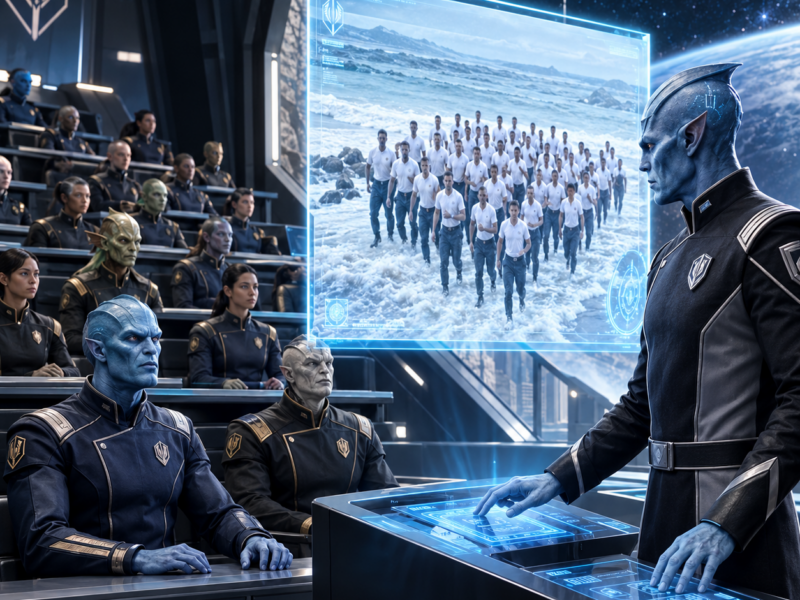
When the Galactic Academy’s instructor played a human military training video for my alien cadets, the entire class laughed at Earth’s “primitive” soldiers
The blue holographic glow pulsed against the reinforced titanium walls of the lecture hall.
Thirty cadets sat in silence, staring at the paused video frame on the central screen.
Veyron’s fingers twitched against his desk console.
The silver-skinned cadet had never seen anything quite like the footage we had just analyzed.
In the history of the Interstellar Alliance, warfare was calculated through strict probability matrices.
If a unit’s survival rate dropped below ten percent, tactical withdrawal was mandatory.
To stay meant wasting valuable genetic material and military investment.
“It still makes no sense,” Veyron muttered, breaking the stillness.
“A machine calculates loss to preserve the whole,” I said quietly, pacing the length of the podium.
“Humans do not operate like machines.”
“They operate like an infection,” Veyron countered, his voice sharp.
“Throwing lives away for a single civilian who adds nothing to the collective index.”
“You think it’s waste,” I replied.
“They think it’s obligation.”
The air in the room grew heavy as the implications settled over the cadets.
Species from across the galaxy had spent thousands of years perfecting the art of war.
We had drone swarms, orbital cannons, and genetic armor that could withstand plasma fire.
Yet none of us understood why a creature would crawl through mud with a shattered arm to save a stranger.
The red emergency beacon above the door continued its rhythmic, silent flash.
It painted the faces of the young warriors in crimson shadows.
The frozen moon of Kaelen IV was half a sector away.
The distress signal had been broadcasting on an open loop for nearly two hours.
“Professor,” a reptilian cadet named Tarak whispered from the back row.
“What is that creature in the photograph?”
I did not answer immediately.
My optical receptors zoomed in on the final image transmitted by Earth Rescue Team Seven.
Standing knee-deep in the powdered snow of Kaelen IV was something impossible.
It wore a standard-issue Coalition patrol jacket, torn at the shoulder.
Its silhouette was vaguely humanoid, but its skin was segmented like ancient stone.
Most terrifying of all, it had no eyes—only a smooth expanse of dark bone where a face should be.
“That,” I said softly, “is something the Alliance thought it eradicated during the First Expansion Wars.”
Veyron stood up so fast his chair scraped loudly against the grated floor.
“That is a Precursor entity,” he gasped.
“They haven’t existed for ten millennia!”
“They weren’t eradicated,” I corrected.
“They were buried.”
The class erupted into a low murmur of rising panic.
Cadets from warrior cultures who had never known true fear were suddenly whispering among themselves.
They had studied the Precursors in history modules.
Cold, methodical beings who viewed all organic life as a temporary anomaly to be corrected.
“If the Precursors have awakened on Kaelen IV,” Tarak said, his scales turning a pale ash gray, “the entire moon is a quarantine zone.”
“The Alliance Council has already declared it a lost sector,” I confirmed.
“Then why did the humans go?” Veyron demanded, slamming his fist onto the metallic desk.
“No rational military force engages an unclassified ancient threat with a four percent survival margin!”
“Because Daniel Reyes doesn’t care about your military margins,” I said.
I tapped the console, pulling up the personal file of Earth Rescue Team Seven’s commanding officer.
A holographic dossier materialized above the desk.
Lieutenant Colonel Daniel Reyes.
Born in North America, Earth.
Age forty-two standard years.
Decorated veteran of three planetary skirmishes and the recent Unification Wars.
His service record was filled with commendations, but also disciplinary warnings for insubordination.
Time and again, he had defied direct orders to rescue stranded personnel.
“Look at his history,” I instructed the class.
“Every major engagement he participated in features the same anomaly.”
“He disobeys command protocols to retrieve the dead and the wounded.”
“And the Alliance rewarded him?” Veyron asked, incredulous.
“The Alliance integrated Earth into the coalition because their industrial output was valuable,” I reminded him.
“Their military philosophy, however, was flagged as dangerously unpredictable.”
“Now you are seeing why.”
A new data stream cut through the classroom network.
It was an audio file intercepted from Earth Rescue Team Seven’s descent vector.
The cabin noise was deafening—screaming wind, rattling hull plates, and warning klaxons.
Amidst the chaos, Reyes’s voice came through clear and steady.
“Drop ramp in thirty seconds.”
“Colonel,” a female crew member shouted over the roar of the engines.
“Atmospheric pressure is dropping! The anomaly is scrambling our guidance systems!”
“Hold your heading,” Reyes replied without hesitation.
“We leave no one behind. Not human, not alien, not anyone.”
Veyron crossed his arms tightly across his chest.
“A hollow sentiment designed for propaganda.”
“Is it?” I asked.
“Listen to his heart rate on the biometric readout.”
I isolated the audio channel and amplified the faint, rhythmic thumping of the human commander’s pulse.
It was elevated, certainly, but remarkably steady for a man about to land on a doomed moon.
“He isn’t shaking,” Tarak whispered in disbelief.
“He isn’t even hesitating.”
“Fear is a biological alarm,” I explained.
“Courage is what happens when you decide something else matters more than your survival.”
The transport ship slammed through the upper stratosphere of Kaelen IV like a falling meteor.
Ice crystals battered the reinforced quartz viewport of the cockpit as Reyes fought the manual controls.
The automated navigation systems had failed three minutes after entering the gravity well.
“We are coming in hot,” the copilot yelled, her hands flying across the emergency override switches.
“Retropulses at twenty percent!”
“Burn them anyway,” Reyes ordered.
“We need to clear that ridge before the atmospheric pressure crushes the hull.”
Outside, the landscape was a wasteland of jagged black rock and towering glaciers of blue ice.
Below them, the wreckage of the civilian transport smoked against the snow.
It looked like a broken spine left behind in the freezing expanse.
Around the wreckage, dozens of dark, elongated figures moved with terrifying speed.
They were the Precursors.
Silent, relentless, and completely immune to standard kinetic weaponry.
“Colonel, look at the thermal signatures,” the sensor officer reported, her voice trembling.
“There are forty of them down there surrounding the survivors’ shelter.”
“And how many of our people are left?” Reyes asked.
“Six survivors from the transport crew.”
“Plus the unknown entity,” the sensor officer added.
“The thing in the snow.”
Reyes didn’t blink.
He checked the charge on his sidearm, a heavy magnetic rail pistol designed for close-quarters combat.
“Deploy the smoke canisters along the perimeter,” he commanded.
“Give the extraction team cover.”
“Sir, the radiation from the anomaly is frying our communication relays,” the copilot warned.
“If we land, we might not be able to launch again.”
Reyes turned his head slowly, looking at the young officer through the dim red glow of the instrument panel.
“Then we make sure the people in the back get on that ramp,” he said.
“We can walk out if we have to.”
The transport touched down with a violent screech of metal against frozen stone.
The cargo ramp dropped immediately, slamming into the snowdrifts with a heavy thud.
Blinding white wind rushed into the troop bay, carrying the bitter cold of the alien world.
“Move, move, move!” Reyes shouted, leading the charge into the storm.
Behind him, five heavily armed human soldiers fanned out in a textbook wedge formation.
They didn’t look like the elite warriors of the Galactic Alliance.
They didn’t have shimmering energy shields or floating weapon platforms.
They wore scarred composite armor, held together with field-applied sealant and weathered tape.
Yet as they advanced into the swirling blizzard, the very air seemed to grow heavier with quiet determination.
In the academy lecture hall, the cadets watched the helmet-cam footage in absolute silence.
Veyron leaned forward, his hands gripping the edge of his console so hard his knuckles turned white.
“They are walking straight into an ambush,” he muttered.
“They know,” I said.
The snow crunched beneath the heavy boots of the rescue team as they closed the distance to the downed vessel.
The wreckage was a mangled shell of twisted alloy and frozen cables.
Sparks flickered weakly from a severed power conduit, casting long, dancing shadows across the ice.
“Sector clear,” reported a soldier named Miller, his rifle scanning the high ridge above them.
“Negative, Miller,” Reyes’s voice came over the tactical channel.
“Look at the thermal haze on the eastern ridge.”
The snow on the cliffside seemed to shift.
Dozens of slender, obsidian limbs detached themselves from the rock face.
The Precursors dropped from the heights with terrifying grace, making almost no sound as they landed.
“Contact!” Miller yelled, raising his rifle.
A volley of high-velocity slugs tore through the blizzard, striking the lead creature square in the chest.
The bullets shattered against its dense, stony hide without slowing it down.
“Conventional rounds are ineffective!” Miller cursed, stumbling back a step.
“Switch to thermal resonance!” Reyes ordered.
The human squad flicked the selectors on their rifles.
A low, humming vibration filled the air as the barrels glowed with a dull orange heat.
When they fired again, the rounds did not merely impact—they superheated the targets from within, causing the crystalline structures to fracture.
One of the creatures shrieked, a sound like grinding stone, and collapsed into the snow.
“Keep moving!” Reyes shouted over the deafening noise.
“Secure the shelter!”
They reached the reinforced emergency pod buried beneath a drift of snow.
Reyes struck the manual release panel with the butt of his rifle.
The heavy steel door groaned, then slid open with a puff of compressed air.
Inside, huddled in the dim emergency lighting, were the survivors.
Three terrified Alliance engineers and two bruised pilots.
And sitting quietly in the corner, occupying a seat twice its normal size, was the silent entity from the photograph.
It didn’t look like a monster up close.
It looked like an ancient monument carved from the heart of a dead world.
“Are you the extraction unit?” one of the human engineers asked, his voice shaking with exhaustion.
“We are,” Reyes said, stepping into the cramped pod.
“Can you walk?”
“We can,” the engineer replied, then pointed a trembling finger toward the corner.
“But… that thing. It saved us.”
Reyes glanced at the obsidian entity.
The creature slowly turned its smooth, featureless head toward the human colonel.
No words were spoken.
No communication channel was opened.
Yet an invisible weight seemed to drop into the space between them.
“It’s coming with us,” Reyes decided instantly.
“Colonel, that’s a Precursor relic!” the copilot shouted over the radio link.
“The Council will court-martial you!”
“The Council isn’t here in the snow,” Reyes replied coldly.
“Help them to the transport. Now.”
In the academy classroom, Veyron slammed his hand down on the console again.
“He is inviting destruction!” the cadet shouted.
“Does he have no grasp of interstellar law?”
“Interstellar law was written by species that never had to look a dying world in the eye,” I said calmly.
“Watch the entity.”
On the screen, the stone-skinned creature rose from its seat.
It moved with a fluid, unnatural grace that seemed to bend the light around its limbs.
As it stepped out of the emergency pod into the freezing gale, the wind itself seemed to quiet around it.
It looked up at the grey sky of Kaelen IV, where massive storm clouds were beginning to swirl in a perfect, unnatural circle.
“An orbital scanner,” Tarak whispered in horror.
“A battleship is locking onto their position.”
High above the moon, a massive Coalition dreadnought had broken out of stealth mode.
Its ventral weapon batteries were glowing with lethal blue energy.
An automated transmission crackled across all emergency frequencies.
“Unidentified rescue unit on Kaelen IV,” a cold, metallic voice announced.
“You are harboring a prohibited class-one anomaly.”
“Surrender the entity immediately, or your vessel will be atomized.”
Down on the surface, Reyes stood beside the open ramp of his transport.
He looked up at the sky, his visor reflecting the gathering light of the orbital cannons above.
He reached up, pressed his thumb against his helmet’s audio transmitter, and opened a direct channel to the dreadnought.
“This is Lieutenant Colonel Daniel Reyes, Earth Rescue Team Seven,” he said, his voice entirely devoid of fear.
“We have civilian casualties and a secured asset.”
“We are not leaving anyone behind.”
“Colonel Reyes,” the voice from orbit replied, “your authorization code is hereby revoked.”
“You are acting outside the authority of the Interstellar Alliance.”
“Consider this my resignation,” Reyes said quietly.
He cut the transmission before the dreadnought could respond.
In the lecture hall, Veyron sank slowly back into his seat.
His silver skin had lost its luster.
“He defied a capital command,” the cadet whispered, as if speaking to himself.
“He just threw away his entire career, his citizenship, and his life.”
“No,” I corrected, looking around the room at the thirty stunned cadets.
“He made a choice.”
“And that is why the Alliance is terrified of humanity.”
“Because while every other species calculates the cost of survival, humans calculate the cost of their own honor.”
The screen flickered as the dreadnought in orbit began charging its primary accelerator cannon.
A brilliant ring of blue plasma formed around the warship’s bow.
Down on the surface, the Precursor entity raised a single, stony hand toward the sky.
A pulse of invisible energy rippled outward from its palm.
The classroom screens suddenly filled with static.
The static hissed through the lecture hall speakers like a nest of angry vipers.
Blue holographic lines fractured across the main monitor before stabilizing into a grainy, flickering feed.
The orbital dreadnought’s primary cannon had discharged.
A beam of pure, concentrated plasma descended from the heavens like the wrath of a dying star.
Yet it never hit the ground.
Halfway through the atmosphere, the beam struck an invisible barrier of shimmering violet light.
The shockwave flattened the surrounding snowbanks for miles, sending up blinding walls of white powder.
“What is that?” Tarak gasped, leaning so far forward he nearly tipped his desk.
“The entity,” I said, my voice barely audible over the roaring feedback.
“It’s not just an artifact.”
“It’s a survivor of a war the galaxy forgot.”
On the screen, Reyes didn’t hesitate.
He waved the remaining engineers up the loading ramp of the transport.
“Get them strapped in!” he roared over the howling wind.
“Miller, cover our rear! The shockwave is going to bring down the ridge!”
Miller knelt in the snow, his thermal rifle glowing white-hot as he laid down a wall of suppressing fire.
Shadowy figures were swarming down the broken cliffs, their obsidian bodies cutting through the blizzard like ghosts.
“Colonel, we’ve got incoming!” Miller shouted, firing another burst.
“We can’t hold this position much longer!”
“We don’t need to hold it,” Reyes replied, diving into the cargo bay as the last engineer scrambled inside.
“Lift off! Now!”
The transport’s engines roared to life with a deafening shriek that shook the ice beneath them.
The landing gear cleared the ground just as a massive slab of the cliffside collapsed, burying the landing zone in tons of rock and snow.
Inside the cargo bay, the red emergency lights pulsed rhythmically.
The survivors sat strapped into the jump seats, breathing heavily, their faces pale with shock and cold.
In the center of the bay stood the Precursor entity.
It was completely still.
Its smooth, featureless face was turned toward the cockpit door where Reyes was currently working the manual overrides.
“Colonel,” the copilot’s voice came over the internal intercom.
“The dreadnought is re-calibrating its weapons.”
“They’re locking onto our ion trail.”
“Let them try,” Reyes said, his fingers flying across the navigation console.
“We’re heading straight into the debris field of the outer ring.”
“That’s suicide!” she yelled.
“The navigation hazard is ninety percent!”
“Then it’s a good thing our survival margin just went up,” Reyes replied dryly.
In the lecture hall, Veyron watched the telemetry data scroll across his screen.
“He’s calculating a manual slipstream jump,” the cadet said, his voice filled with newfound awe.
“Without a flight computer.”
“Without shields,” I added.
The transport hurtled toward the chaotic expanse of the orbital debris field.
Millions of tons of shattered satellites, ancient starship hulls, and frozen asteroids spun in a chaotic dance around Kaelen IV.
Behind them, the Coalition dreadnought loomed large in the viewport.
Its secondary batteries fired a barrage of tracking missiles that streaked through the void like falling stars.
“Incoming missiles at five kilometers!” the sensor officer yelled.
“Evasive maneuvers!”
Reyes didn’t use the automated thrusters.
He grabbed the heavy manual flight yoke with both hands and yanked it hard to the left.
The transport groaned in protest, its hull plates screaming as extreme G-forces pressed the crew deep into their seats.
A missile screamed past the cockpit, missing the wingtip by less than ten meters before detonating against an asteroid.
The resulting shockwave sent the transport spinning into a dense cloud of metallic shrapnel.
“Hold on!” Reyes shouted over the roar of the straining engines.
Inside the cargo bay, the survivors braced themselves against the bulkheads.
The Precursor entity did not move an inch.
It stood balanced on the vibrating deck plates as if anchored to the very fabric of space-time.
Suddenly, the entity raised both hands toward the open loading ramp.
A wave of crystalline light poured from its fingertips, washing over the pursuing missiles.
In an instant, the missiles stopped dead in space, frozen in mid-flight before dissolving into harmless clouds of dust.
“What did it just do?” the copilot breathed, staring at the sensor readout in sheer disbelief.
“It rewrote their targeting telemetry,” Reyes said, his eyes fixed on the gap in the asteroid field ahead.
“It just cleared our path.”
“Colonel,” Miller’s voice crackled from the back.
“Look at the main long-range scanner.”
Reyes glanced at the auxiliary monitor.
A fleet of fifty Alliance warships had just exited hyperspace at the edge of the system.
They weren’t there to rescue them.
They were there to enforce the quarantine and eliminate the anomaly—and anyone standing in its way.
“They’ve blockaded the sector,” the copilot whispered, her hands dropping from the controls.
“There’s no way out.”
“There’s always a way out,” Reyes said calmly.
He reached down and flipped a heavy red toggle switch on the central console.
A secondary screen lit up, displaying a string of encrypted coordinates that didn’t belong to any known Alliance star chart.
“What is that frequency?” Veyron asked aloud in the lecture hall, leaning closer to the display.
“That,” I said, pausing the simulation for a moment, “is a transmission from Earth’s deepest archives.”
The classroom was so quiet you could hear the faint hum of the holographic projector.
“Earth wasn’t just discovered by the Alliance six months ago,” I told the cadets.
“They were hiding.”
“Hiding?” Tarak repeated, his scales darkening with confusion.
“From whom?”
“From the war that created the Precursors,” I answered.
On the main screen, the encrypted coordinates began to decode, revealing a massive, hidden network of jump gates buried deep within the Kuiper Belt of the solar system.
They were ancient structures, far more advanced than anything the current Interstellar Alliance possessed.
And they were all pointed toward the outer rim of the galaxy.
Back on the transport, Reyes broadcast the decryption key across all subspace channels.
The signal rippled outward, washing over the fifty blockading Alliance warships.
Suddenly, the bridge screens of the flagship flickered.
An automated voice echoed through the command deck of the Coalition fleet.
“Warning. Precursor gateway network initialization detected.”
“Override code accepted.”
“Welcome home, creators.”
The entire fleet froze.
The aggressive blue glow of their weapon systems sputtered and died as the ancient network took control of their navigation arrays.
“What is happening?” the commander of the blockading fleet shouted, slamming his fists onto his command console.
“Our systems are locked!”
“We are being redirected!”
Down in the transport, Reyes let out a long, slow breath.
He turned to his copilot and gave a tired, cynical smile.
“Looks like we’re going to be late for debriefing,” he said.
The Precursor entity turned its smooth, featureless face toward the cockpit door.
It bowed its head slightly—a gesture of profound respect that no organic being had ever received from a Precursor before.
Then, with a blinding flash of golden light, the entire transport vanished into the folding fabric of hyperspace.
The lecture hall remained frozen in absolute silence.
Thirty cadets stared at the empty space where the ship had just been.
Veyron slowly sat back down in his chair.
His hands were trembling slightly.
“They didn’t just survive,” the cadet whispered, his voice stripped of all arrogance.
“They remembered.”
“They remembered everything,” I agreed, turning off the holographic projector.
The blue light faded, leaving the room in standard illumination.
“Humanity isn’t a minor species with an embarrassing military history, Veyron.”
“They are the custodians of a forgotten war.”
The emergency lights overhead finally stopped flashing, returning to a steady, warm white.
I walked slowly back to the center of the podium, looking at each cadet in turn.
“You laughed at them because they bled,” I said, my voice cutting through the quiet room.
“You mocked them because they chose to die for strangers.”
“You thought it was a flaw in their tactical programming.”
“It was never a flaw.”
“It was a warning.”
Tarak looked down at his desk, his claws tracing the grain of the metal.
“If they have access to the Precursor network,” the reptilian cadet said softly, “why didn’t they use it to conquer the Alliance when they first made contact?”
“Because conquest is small,” I replied.
“Humans didn’t come to the stars to conquer.”
“They came to find out if anyone else remembered what it cost to survive.”
Veyron raised his head, meeting my gaze directly for the first time since the class began.
“What happens now, Professor?”
“Now,” I said, walking toward the heavy blast doors at the back of the hall as they slid open with a hiss, “the Alliance Council is going to have a very long meeting.”
“And Lieutenant Colonel Daniel Reyes?”
I smiled faintly, remembering the calm, steady pulse of the human commander in the face of impossible odds.
“He’s probably already writing his resignation letter.”
“Or looking for another rescue mission.”
The cadets stood up in unison, a spontaneous gesture of respect that I had never seen this particular cohort display before.
They didn’t salute like traditional military veterans.
Instead, they placed their right fists over their hearts—the human way.
I nodded to them and stepped out into the corridor.
The Academy was quiet, but far away, across the vast emptiness of the interstellar void, a new signal was broadcasting from Earth.
It wasn’t a threat.
It wasn’t a demand for territory or resources.
It was simply an open frequency, broadcasting a message that every civilization in the galaxy would eventually have to answer.
“We are here,” the voice said.
“And we are coming back for everyone.”
The transport ship dropped out of hyperspace into the silent, star-studded expanse of the outer rim.
Before them stretched a world unlike any other in the known galaxy.
It was a planet of crystalline mountains and vast, shimmering oceans of liquid light, untouched by time or conflict.
The Precursor entity walked out of the cargo bay, its stone-like limbs moving with a quiet, deliberate grace.
It stepped down the ramp onto the pristine shoreline of the alien world, looking out across the endless horizon.
Reyes stood at the top of the ramp, his weathered face catching the golden light of twin suns.
Miller walked up beside him, leaning heavily on a rail as he looked out at the peaceful landscape.
“Think the Council will ever find us out here?” Miller asked, a slight smirk playing at the corners of his mouth.
“Let them try,” Reyes replied.
He reached into his pocket, pulling out a small, worn photograph of Earth taken decades ago—a fragile blue marble spinning in the dark.
He looked at it for a long moment, then slipped it safely back inside his jacket.
Behind them, the transport’s engines hummed softly, ready for whatever lay ahead in the deep dark of the universe.
They hadn’t won the war.
They hadn’t conquered the galaxy.
They had simply done what humans had always done since the first shadow fell across their ancestors’ fires.
They had looked into the dark, seen someone in need, and refused to leave them behind.
And somewhere out among the stars, the rest of the galaxy was finally beginning to understand what that truly meant.