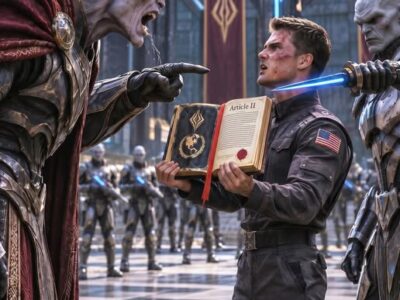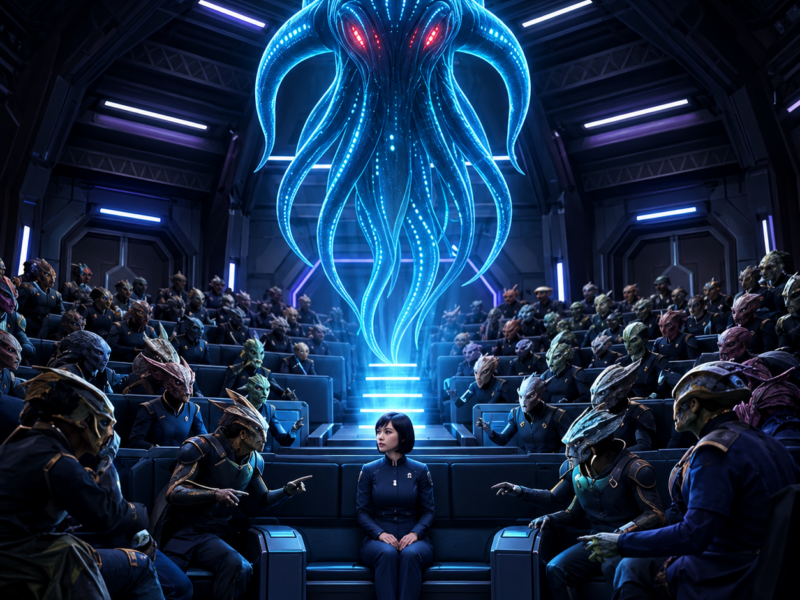
When the Galactic Academy’s final exam projected an alien invasion above the auditorium, every cadet identified the enemy except me, the silent human girl in the back row, and when the commander sneered that Earth had sent a child who couldn’t even speak, I realized the exam was hiding a massacre my mother had died trying to expose.
The black glass dome of the Solis Orion Academy rose three miles above the craters of New Geneva.
Inside the central amphitheater, two thousand cadets sat in tiered rows of cold white titanium.
They were the heirs of the Core Worlds, dressed in pressed gray wool and braided silver wire.
I sat in the very back row, where the heating vents never reached.
My uniform was three sizes too large, salvaged from Earth’s scrap-freight reserves and pinned at the shoulders with dull brass wire.
Down on the obsidian stage, Supreme Commander Sterling Vance stood behind a glowing crystal podium.
His chest was covered in bronze ribbons, each one honoring a pacification campaign across the rim worlds.
“For four hundred years, humanity has slept while the coalition protected our frontiers,” Vance’s voice rolled through the acoustic baffles.
“Today, only sixty of you will graduate into the high fleet. The rest will return to your colonial basins.”
He tapped the console with an armored thumb.
The ceiling flickered, died, and reignited into a violently realistic three-dimensional projection.
A star system materialized across fifty yards of empty air, spinning in cold indigo light.
Twin gas giants revolved around a pale dying dwarf, surrounded by dense belts of violet asteroid dust.
Within seconds, the dust cloud broke open.
Hundreds of jagged, triangular warships surged through the void like iron shards riding a wave of static.
They had no bridge windows, no running beacons, and no thermal exhausts.
Their hulls burned with an unnatural, sickly amber glow that warped the projection screens.
“Threat assessment!” Vance barked, his eyes sweeping across the bleachers. “Designate origin and class within ten seconds, or clear the floor!”
Around me, cadets hammered frantic sequences into their slate consoles.
“Vanguard cruisers of the Gorgon Sector!” shouted Julian Fox, the first-rank cadet sitting in row three.
“Sub-light siege carriers from the outer Perseus rift!” called out another from the North American Terran caucus.
Vance nodded with grim approval, his gaze shifting up the rows of rising benches.
“Correct tactical identification. Rapid comprehension is the only shield between order and total extinction.”
Then his gray eyes climbed higher, passing over the sons of planetary governors and trade barons.
They stopped directly on me.
“And you, Cadence Clarke,” Vance said, his voice dropping into a razor-thin drawl that echoed off the high rafters.
Every single cadet turned their head.
Two thousand faces stared upward, tracking the commander’s target.
“The Terran Assembly begged for a charity seat,” Vance said smoothly, resting his hands on the podium.
“They swore the daughter of their premier deep-space surveyor would carry the torch.”
I kept my hands flat against the cold surface of my desk.
My fingers were scarred from three years of cleaning atmospheric plasma scrubbers in the lower mechanical rings.
I did not move. I did not speak.
“Three months on this station,” Vance sneered, shaking his head. “And not a single audible word.”
A soft ripple of laughter ran through the front three rows.
Julian Fox leaned back, smirking over his pressed collar.
“Earth sent us a mute child,” Vance said, turning his back toward the stage to play to the gallery. “A scavenger who cannot even name the enemy that threatens to burn her home world.”
My heart hammered against my ribs like a trapped bird against iron mesh.
I wasn’t looking at Vance.
I wasn’t even looking at the mocking faces in the lower rows.
I was staring through the amber light of the projected warships.
Beneath the jagged exterior shells of the simulated attack cruisers, a secondary telemetry layer was bleeding into the academy’s feed.
It was faint, flickering at a frequency of eighty-two megahertz.
Humans couldn’t hear that frequency, but my right ear was an unshielded civilian prosthetic, fitted after the mining collapse on Ganymede.
Inside my skull, the frequency translated into a steady, rhythmic pulse.
It wasn’t an alien language.
It was an old commercial distress beacon, encrypted in a three-part harmonic code.
A code that had been invented by my mother twelve years ago, on the night her research ship vanished from the outer rim.
The light from the holographic ships washed over my face, cold and chemically blue.
My mother, Dr. Eleanor Clarke, used to carve glass prisms out of optical cable when we lived in the orbital docks of Chicago.
She would hold them up to the sodium lanterns and tell me that light never truly forgot what it passed through.
“If someone tries to erase a broadcast, May,” she would whisper, checking the door seals, “they just pile new fire on top of the old.”
“Look underneath the flame. The ash always leaves a footprint.”
Now, sitting three miles above the lunar crust, I looked beneath the digital flame Vance had summoned.
The attacking alien armada was a composite skin.
It was a brilliant graphic overlay, painted over an authentic combat recording from nine years ago.
The jagged edges of the enemy ships flickered whenever the virtual camera panned across their flanks.
Underneath the spikes, the hulls were blunt and rectangular.
They were standard Coalition logistics carriers, the kind built in the heavy industrial shipyards of Lake Superior.
I leaned forward, my knuckles turning white against the edge of the titanium desk.
Vance was still talking, his voice a drone of synthetic imperial pride.
“If you hesitate against the dark, the dark consumes you,” he declared, raising a hand toward the ceiling.
“Cadet Clarke, leave your terminal and report to the expulsion shuttles.”
I didn’t stand up.
Instead, I reached down to the auxiliary interface panel beneath my console.
It was covered in dust, intended only for diagnostic technicians repairing the bench monitors.
With my thumb, I popped the plastic latch.
Inside lay three exposed copper wires: power, ground, and video return.
I pulled the copper clip from my hair, letting my dark hair fall across my collar.
I wedged the clip between the ground wire and the video return line.
The screen in front of me sputtered, throwing a burst of static across my desk.
Down on the main stage, the massive hololith gave an audible whine.
The amber alien fleet shuddered.
For a fraction of a second, the jagged warship at the center of the formation turned completely white.
Its outer armor peeled back in the projection, revealing a registry number stamped in standard naval block font: USN-Ardent-449.
My chest tightened until I could barely draw air.
The Ardent was not an alien dreadnought.
It was the flagship of the Terran Medical Relief Corps.
It was the vessel my mother boarded when she answered an emergency call from the mining colonies on Caelum Four.
The records in the public archives claimed the Ardent suffered a catastrophic reactor rupture in deep space.
They said there were no survivors, no wreckage, and no black box.
Yet here it was, running in Vance’s simulation, dressed in false armor to teach children how to kill.
“Cadet Clarke!” Vance barked, his face darkening as he noticed the glitch in the overhead projection.
The light flickered again, and this time, the audio track slipped.
Beneath the synthetic alien war horns bellowing through the hall, a human voice crackled through the intercom.
“Mayday… this is Caelum Transport Seven… we are unarmed… the strike craft belong to—”
The sound was abruptly cut by a sharp squelch of static.
Vance’s hand slammed down onto the emergency kill-switch on his podium.
The simulation vanished, leaving the amphitheater bathed in stark, sterile white ceiling lamps.
Every cadet sat frozen, their eyes darting from the commander to the empty air where the ships had just burned.
“A system corruption,” Vance said immediately, his voice low, controlled, and deadly.
He didn’t look at the other instructors sitting along the back wall.
His eyes locked onto me like targeting lasers.
“Security detail three,” Vance commanded through his lapel mic. “Detain the cadet in bench 9-G.”
Two armed guards in dark blue composite armor stepped out from the rear tunnel doors, their stun lances already humming.
I didn’t wait for them to close the ten yards between the aisle and my desk.
I kicked my chair backward into the shin of the first guard, throwing him off balance against the sloped aisle.
The heavy titanium frame crashed against his knee plate with a hollow ring.
He cursed, stumbling sideways into the lap of a cadet from the Martian mining guilds.
The second guard swung his stun lance in a low arc, aiming for my collarbone.
I ducked beneath the crackling blue tip, smelling the sharp stench of scorched air.
When I lived in the lower bilge levels of the Solis station, I had spent six months mapping the conduit runs.
The engineers had built the academy over an abandoned titanium refinery from the first orbital expansion.
Behind every tier of auditorium seating ran a thirty-inch ventilation trench for atmospheric scrubbing.
I pulled the emergency release handle on the baseboard beneath my bench.
The floor panel gave way with a sharp hiss of pneumatic pressure.
I slid through the opening feet first, disappearing into the dark just as the guard’s hand grabbed my empty sleeve.
The panel snapped shut above me, cutting off the bright glare of the amphitheater.
I fell four feet onto an angled chute of galvanized tin, sliding fast into the warm, grease-scented gloom.
My boots hit the floor of the service trench with a heavy thud.
Up above, the muffled sound of alarms began to pulse through the metal superstructure.
The klaxons sounded three short blasts followed by a long siren.
Code Red: Unregistered security breach in the academic ring.
I pulled my hair back and tied it tight with a strip of hem torn from my jacket.
My ribs ached where they had clipped the chute, but there was no time to breathe.
Vance wouldn’t just send station security.
He had his own private cadre of combat operators, the Iron Vanguard, stationed in the lower hangar decks.
If they caught me in the utility tunnels, there would be no formal hearing, no board of inquiry, and no court-martial.
I would simply be another colonial orphan who suffered a fatal fall down an atmospheric exhaust shaft.
I pulled my personal data slate from my inside pocket.
The screen was cracked across the glass, but the connection icon was blinking green.
When I bridged the copper wires at my desk, I hadn’t just scrambled the display.
I had initiated a raw hardware dump from the hololith’s buffer memory into my slate’s storage drive.
The file was enormous, seventy terabytes of encrypted raw sensor telemetry.
I tapped the screen with trembling fingers.
The top layer of data was secured by an eight-point naval cipher, but the metadata was wide open.
The recording was dated August 14, 2197.
That was nine years ago, the exact day my mother’s final transmission reached Earth’s deep-space listening array.
The file wasn’t labeled as a combat simulation.
Its internal header bore a single administrative project name: Operation Pale Harvester.
Underneath the project title was a small, high-resolution thumbnail of the original sensor log.
It showed three massive planetary bombardment platforms orbiting above a burning world of green oceans and iron cities.
The cities were human.
The architecture was unmistakable: the broad, sweeping geodesic domes of Caelum Four.
And on the command deck of the lead bombardment platform, standing beside the firing controls, was a younger, unscarred Sterling Vance.
The service corridor smelled of stagnant hydraulic oil, recycled ozone, and damp insulation foam.
I moved quickly through the dark, keeping my left hand against the cold insulated water pipes.
Every hundred feet, an emergency light flickered with a faint, dying amber glow.
Behind me, the deep mechanical thrum of the station’s main elevators echoed through the floor plates.
They were descending rapidly toward the sub-levels.
Vance was sealing the sector, block by block.
I turned down a narrow access passage that led toward the old waste reclamation tanks of Sector Nine.
No one went down there except maintenance drones and the low-caste human laborers who cleared the filters.
It was the only place on the entire station where the central AI didn’t maintain optical surveillance.
I rounded a rusted support pillar and nearly slammed into a tall, broad-shouldered figure standing in the shadows.
A rough, heavy hand shot out, catching my jacket collar and dragging me violently into a maintenance alcove.
I reached for the sharp copper wire in my pocket, ready to drive it into his throat.
“Easy, kid,” a low voice rasped in the darkness. “Save the hardware for the guards.”
The light from a small handheld work lantern clicked on, casting hard yellow beams across the man’s face.
It was Chief Engineer Miller, an old Terran mechanic with greasy gray hair and a cybernetic eye that whirred as it focused on me.
He had worked the station’s boilers since before I was born.
He had also been my mother’s second cousin, the one who smuggled me onto Solis Orion on a falsified manifest.
“You lost your mind up there, May?” Miller whispered, his voice shaking with furious tension.
“The entire station is locked down. Vance declared you an insurgent operative.”
“He knows what was in that file,” I whispered back, my voice hoarse and raw from disuse.
Hearing myself speak aloud sounded alien, like dry leaves scraping over stone.
Miller froze, his good eye widening as he stared at me.
“You spoke.”
“I never had anything to say to them,” I said, leaning back against the steel bulkheads to catch my breath.
“Miller, the exam wasn’t a simulation.”
“It was the footage from Caelum Four.”
The old man went completely still, the mechanical hum of his artificial eye dropping an octave.
The shadows beneath his eyes looked like sunken coal pits.
“You saw it,” Miller murmured, his hand falling from my shoulder. “God help us, you actually pulled it down.”
“You knew?” I demanded, the anger rising fast and hot in my chest. “You knew they were using her murder as a training slide?”
“I didn’t know Vance kept the unedited master files,” Miller said, looking over his shoulder down the empty passage.
“We knew Caelum didn’t die of a plague. Everyone in the old engineering pool knew.”
“The miners found something in the deep trench under the southern ocean.”
“A mineral vein? A cache?” I asked.
“No,” Miller said softly, his voice dropping into the darkness. “Evidence.”
“They found the wreckage of six United Earth transport ships that went missing during the treaty negotiations.”
“Vance didn’t just suppress the colony, May.”
“He wiped out fifty thousand human pioneers because they discovered the high fleet had been manufacturing the alien border wars for thirty years.”
A cold shudder ran through my limbs, deeper than the chill of the station’s air ducts.
The alien armada that terrified the Core Worlds wasn’t real.
It was an endless, engineered phantom, designed to keep humanity compliant, taxed, and militarized under Vance’s command.
And my mother hadn’t died in an accident.
She had been sent to Caelum Four to ensure the silence stayed buried.
From the main corridor above our heads, the sharp, rhythmic clatter of magnetic boots echoed down the steel stairs.
The Iron Vanguard had arrived on Deck Nine.
“They have biometric trackers, Miller,” I whispered, pulling my data slate tighter against my ribs.
“If they corner us here, they’ll purge the entire sub-deck and call it an atmospheric pressure leak.”
Miller pulled a heavy keycard from his belt and shoved it into my palm.
“Take the emergency conduit to the agricultural ring,” he said, turning toward the main junction box on the wall.
“Hangar bay four has an automated soil freighter prepping for launch to the Iowa silos.”
“What about you?” I asked.
Miller gave a bitter, lopsided smile that showed his silver fillings.
“I’ve been drawing station rations for forty-five years, kid. My knees can’t run through conduits anymore.”
“I’ll cross the main power leads and trigger an auxiliary breaker surge.”
“It’ll blind their thermal sensors for eight minutes. That’s all you get.”
“Miller, no—”
“Go!” he snapped, his voice cracking with sudden authority. “Your mother spent her whole life trying to get this out.”
“Don’t let them make her a ghost twice.”
He shoved me toward the secondary access tube, a narrow round pipe lined with rusted rungs.
I climbed inside, the steel cold against my palms.
Behind me, Miller slammed the heavy iron hatch shut and locked the manual wheel from the outside.
Two seconds later, a violent flash of blue light illuminated the seams of the hatch door.
The high-voltage cables exploded with a deafening roar as Miller forced the main breakers into a feedback loop.
The ventilation fans shuddered, sputtered, and died.
Total darkness fell over the tube, broken only by the dim amber glow of my cracked slate.
I scrambled up the rungs, scraping my knuckles and knees against the jagged rivets.
Above me, the distant sound of plasma fire ripped through the lower deck.
Three heavy thuds followed, then the wet sound of a body hitting a metal deck.
Miller had bought my eight minutes.
I bit down on my lip until I tasted salt and iron, refusing to let the tears blur my vision.
I reached the top of the ladder and kicked through the flimsy plastic air filter that opened into the agricultural ring.
The smell changed instantly, shifting from burnt ozone to the rich, damp odor of wet loam, nitrogen, and damp grain.
Miles of artificial wheat fields stretched out beneath rows of ultraviolet lamps that hung from the ceiling like artificial suns.
It looked almost like the pictures my mother kept of the Nebraska plains before the dry storms ruined them.
I ran low through the tall, genetic stalks, keeping my head beneath the golden fringe.
At the far end of the greenhouse dome, the massive steel doors of Hangar Four hung open like a yawning mouth.
Inside the bay sat the soil freighter, a blunt, ugly brick of black iron covered in loading cranes.
Its engines were already spooling up, filling the bay with a deep, bone-rattling vibration.
Standing on the loading gantry directly in front of the boarding ramp, however, was not an automated loader.
Standing under the harsh halogen floods was Cadet Julian Fox, his dress uniform unbuttoned at the neck, holding a military-grade sidearm.
And behind him, stepping out from the shadows of the airlock, was Supreme Commander Sterling Vance.
“You move remarkably fast for someone who supposedly spent three years cleaning filters,” Vance said, his voice quiet, calm, and conversational.
He wasn’t wearing his formal parade cape anymore.
He wore a dark tactical vest over his tunic, his sidearm holstered securely at his hip.
Julian Fox stood slightly to his right, his young face pale, his grip on his pistol trembling with nervous tension.
“Did you think the access shaft was an oversight, Cadet Clarke?” Vance asked, taking a slow step toward me along the metal catwalk.
“Every pipe on this station was laid under my supervision thirty years ago.”
“I knew you were headed for Sector Nine before you hit the bottom of the seating chute.”
I stopped at the edge of the wheat field, twenty paces from the base of their gantry.
The wind from the freighter’s exhaust blew through my loose hair, whipping it across my face.
“Julian,” I said aloud, my voice clear and steady.
Julian’s eyes widened, his fingers twitching on the trigger.
“She… she really can talk,” Julian stammered, glancing sideways at Vance. “Sir, she’s speaking.”
“Silence, boy,” Vance said softly, not even looking at his best cadet.
“Cadence,” Vance continued, looking down at me with something resembling paternal regret. “Your mother was brilliant.”
“She was also sentimental. That is an unforgivable defect in an officer.”
“Sentimental?” I stepped out of the shadow of the crops, holding my slate in plain view against my chest.
“She found out you fired on the Caelum transports.”
“She found out you manufactured the entire Perseus offensive.”
“You murdered fifty thousand people to keep your fleet budget alive.”
Julian’s head jerked toward Vance.
“Sir? What is she talking about?”
“Lower your weapon, Julian,” Vance said coldly, never taking his eyes off mine.
“Cadet Fox, step back.”
“Commander,” Julian’s voice wavered, his aristocratic composure cracking. “The exam fleet… she said it was a transport ship.”
“The Ardent was supposed to have burned in a deep-space accident.”
“The Ardent was carrying a virus of ideas, Julian,” Vance said, his tone as chillingly matter-of-fact as a ledger entry.
“Do you know what happens to the Terran coalition if the border worlds realize there is no wolf at the door?”
“They stop paying for the walls.”
“They stop sending their sons to our academies. They fracture into a thousand petty merchant republics.”
“The threat of the alien is the only thing that has held humanity together for two centuries.”
“My mother gave you her research,” I said, my voice rising over the roar of the freighter’s pre-ignition sequence.
“She offered you an alternative to the endless draft.”
“And you used her ship for target practice in an academy quiz.”
Vance reached slowly toward his sidearm, his motion unhurried, graceful, and utterly confident.
“A training aid must evoke authentic terror, Cadence.”
“The panic in your mother’s voice during the bombardment was the most convincing audio asset our sound engineers could find.”
“It has trained twelve generations of commanders to strike without mercy.”
“And tonight,” Vance said, clearing his holster with a quiet snick of steel, “it will finally be retired.”
“Along with her daughter.”
The black barrel of Vance’s sidearm pointed straight at my forehead.
He didn’t hesitate. He was an officer of forty years’ standing; he had killed hundreds of men without flinching.
He pulled the trigger.
A crack of ionized air snapped through the hangar, followed instantly by a dull metallic scream.
The shot didn’t hit me.
Julian Fox had stepped forward, his heavy service slate swung outward like a crude shield.
The superheated plasma slug slammed into the slate’s ceramic face, shattering the screen and throwing Julian violently backward onto the metal decking.
The smell of melted fiberglass and scorched wool exploded into the air.
“Cadet!” Vance roared, his control finally fracturing into raw rage.
I didn’t waste the half-second Julian had bought.
I didn’t run toward the ship. I ran directly toward the gantry stairs.
I had spent my life climbing the scaffolding of scrap yards; I was faster on open iron than any high-born fleet admiral.
I cleared four steps at a time, vaulting over the twisted handrail to the upper platform.
Vance wheeled on his heel, raising the weapon again, but I threw my body weight into the gantry’s emergency decoupling lever.
The massive hydraulic arm that connected the gantry to the soil freighter released with an explosive boom.
The steel catwalk wrenched sideways, dropping three feet into empty air before catching on its safety chains.
Vance lost his footing, his heavy frame slamming hard against the outer rail.
His pistol slipped from his fingers, spinning down into the spinning fan blades of the lower atmospheric intakes below.
He caught the rail with both hands, his knuckles whitening as the gantry groaned under the uneven strain.
I pulled myself onto the freighter’s open cargo ramp, my slate still clutched in my left hand.
Julian lay groaning on the tilted platform behind us, clutching his burned forearm, his gray uniform charred black.
Vance hauled himself upright, his face red with fury, blood trickling from a shallow cut on his temple.
“You can’t escape this station, Clarke!” he shouted over the rising scream of the sub-light thrusters.
“Every relay is locked to my bio-signature!”
“The communication arrays won’t broadcast an external byte without my voice authorization!”
I stood on the edge of the rising cargo ramp as the automated freighter prepared to clear the outer airlock.
“I know,” I said, looking down at him through the whistling gale of vacuum seals breaking.
“That’s why I didn’t send it to Earth.”
“I sent it to the cadets.”
Vance’s face went from crimson to an awful, ash-gray pale.
“What?”
I held up my slate.
The screen showed the terminal interface of the station’s closed-circuit broadcast network.
When I lived in the ventilation tunnels, I hadn’t just learned where the pipes ran.
I had spliced an analog patch into the central public address line that fed the individual student monitors in the sleeping dormitories, the library docks, and the dining halls.
It didn’t need the external relay.
It didn’t need Vance’s voice authorization.
It was hardwired into the station’s private internal marrow.
“Two thousand cadets are sitting in the central amphitheater right now, Commander,” I said, my voice cutting through the roar of the engines.
“They’re watching the unedited feed from the Ardent.”
“They’re listening to my mother tell Caelum Four that the ships firing on them have the United Terran seal on their wings.”
“They’re listening to your orders, Sterling.”
“Word for word.”
The outer airlock doors of Hangar Four groaned as the heavy hydraulic rams pulled them apart.
Beyond the threshold lay the cold, absolute black of the lunar vacuum, dotted with ten thousand uncaring stars.
The soil freighter’s automated thrusters fired their first maneuvering pulse.
A concussive shockwave of blue fire pushed the ship back from the gantry, severing the final umbilical line.
Down on the platform, Vance reached desperately for his wrist comm, screaming into the open channel.
“Command deck! Cut the internal network! Kill the power to the entire academic wing!”
A burst of frantic static hissed back through his receiver, loud enough for me to hear across the narrowing gap.
“Commander… we can’t… the overrides are locked from a manual terminal in Sector Nine!”
“The cadets have broken the doors of the main hall… they’re storming the communications bridge!”
“Cadet Fox’s caucus… they’re demanding an immediate tribunal!”
Vance dropped his arm, his shoulders slumping as the reality collapsed upon him.
The empire he had built out of engineered fear was crumbling from the inside, shattered by the very children he had trained to be his wolves.
He looked up at me as the freighter drifted backward toward the open void.
His eyes were hollow, stripped of the imperial certainty that had ruled the fleet for thirty years.
“They won’t survive out there without an enemy, girl,” he called out, his voice cracked and thin against the rising wind of the hangar bay.
“Without the fear, they will tear each other to pieces.”
“Then we will learn how to build something else,” I said.
The heavy armored pressure door of the cargo hold slid downward, cutting off the view of the hangar, the gantry, and the broken commander.
Inside the hold, the air was warm, thick with the earthy smell of unplanted soil destined for the Terran breadbaskets.
I sat down against a sack of dried fertilizer, my legs finally refusing to hold my weight.
I pulled my knees against my chest and let my forehead rest against the cold casing of the data slate.
The screen was still running the master file.
On the small display, Dr. Eleanor Clarke was sitting at the communications desk of the Ardent, her sleeves rolled up, her short hair messy and bright with sweat.
The background was shaking with the impact of Vance’s orbital torpedoes, but her hands were steady on the transmission levers.
“If this reaches you, May,” her recorded voice spoke softly through the small speaker of my slate.
“Don’t be afraid of the silence.”
“The truth doesn’t need an army to defend it.”
“It just needs one person who refuses to look away.”
I closed my eyes and let the tears come, washing clean lines through the coal dust and oil grease on my cheeks.
The ship lurched as the main sub-light engines engaged, driving us away from the orbital ring and out into the vast, open lanes of the inner system.
Behind us, the lights of the Solis Orion Academy flickered against the lunar silhouette like a dying candle.
For the first time in nine years, the silence inside my head was gone.
And in its place was the steady, unending hum of the stars.
Forty-eight hours later, the soil freighter drifted into the high orbital parking orbit above North America.
Below the ship’s observation slit, Earth spun like a jewel of blue marble and marbled white cloud.
The war that had hung over humanity for two generations had not arrived.
Instead, the global comm arrays were buzzing with a storm of emergency sessions, military recalls, and civilian protests.
The footage from Caelum Four had bypassed every colonial firewall, jumping from ship to ship across the trade routes.
The Iron Vanguard had surrendered their weapons on Deck Nine without firing another shot.
Julian Fox, speaking from the academy infirmary with his arm in a sling, had delivered the opening deposition against Vance before the joint Terran senate.
Vance was currently being held in the brig of his own flagship, awaiting trial for high treason and crimes against the human frontier.
The cargo bay doors of the freighter hissed open, admitting the damp, heavy air of an auxiliary docking station above Chicago.
Two medical officers in white field jackets stood at the foot of the ramp, their faces filled with quiet shock as I walked out alone.
I was still wearing the oversized gray wool uniform, patched with scrap-wire at the shoulders.
I was still covered in the black oil of the atmospheric vents.
“Cadet Clarke?” the lead officer asked softly, stepping forward with an open blanket of silver thermal foil.
I stopped at the edge of the ramp, breathing in the smell of the Great Lakes, wet pine, and fresh rain.
“My name is May,” I said, my voice strong, steady, and clear in the morning air.
“And I have the rest of the records.”
I handed him the slate, its surface scratched, cracked, and warm with the memory of the light.
Beyond the station’s panoramic windows, the sun was rising over the Atlantic, washing the world in pale, brilliant gold.
It was not the synthetic amber of a projected battle fleet.
It was the clean, untamed light of a morning that belonged to everyone.
I walked down the ramp and stepped onto the soil of my home.