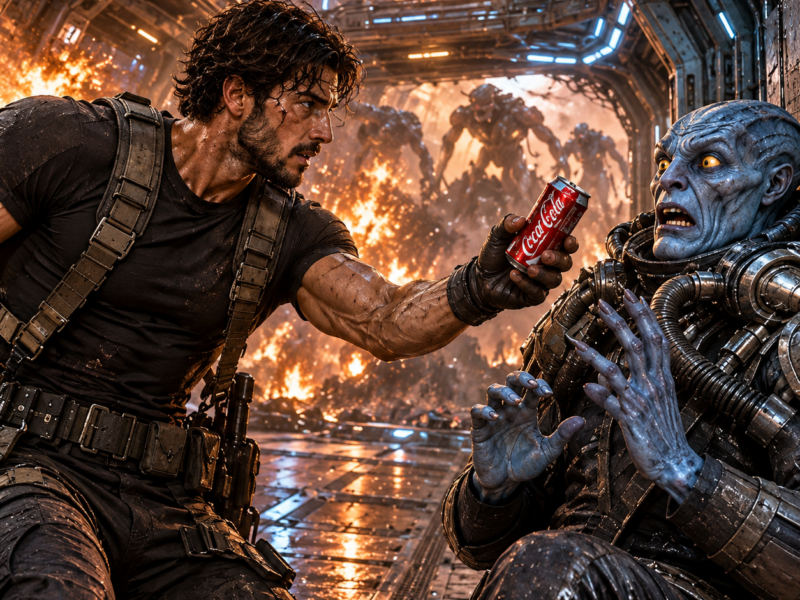
When the alien warlord announced before millions of terrified viewers that Earth would be erased by sunset, I laughed inside the command ship, because the creature had just made one fatal mistake: it had challenged a species that considered impossible odds a personal invitation.
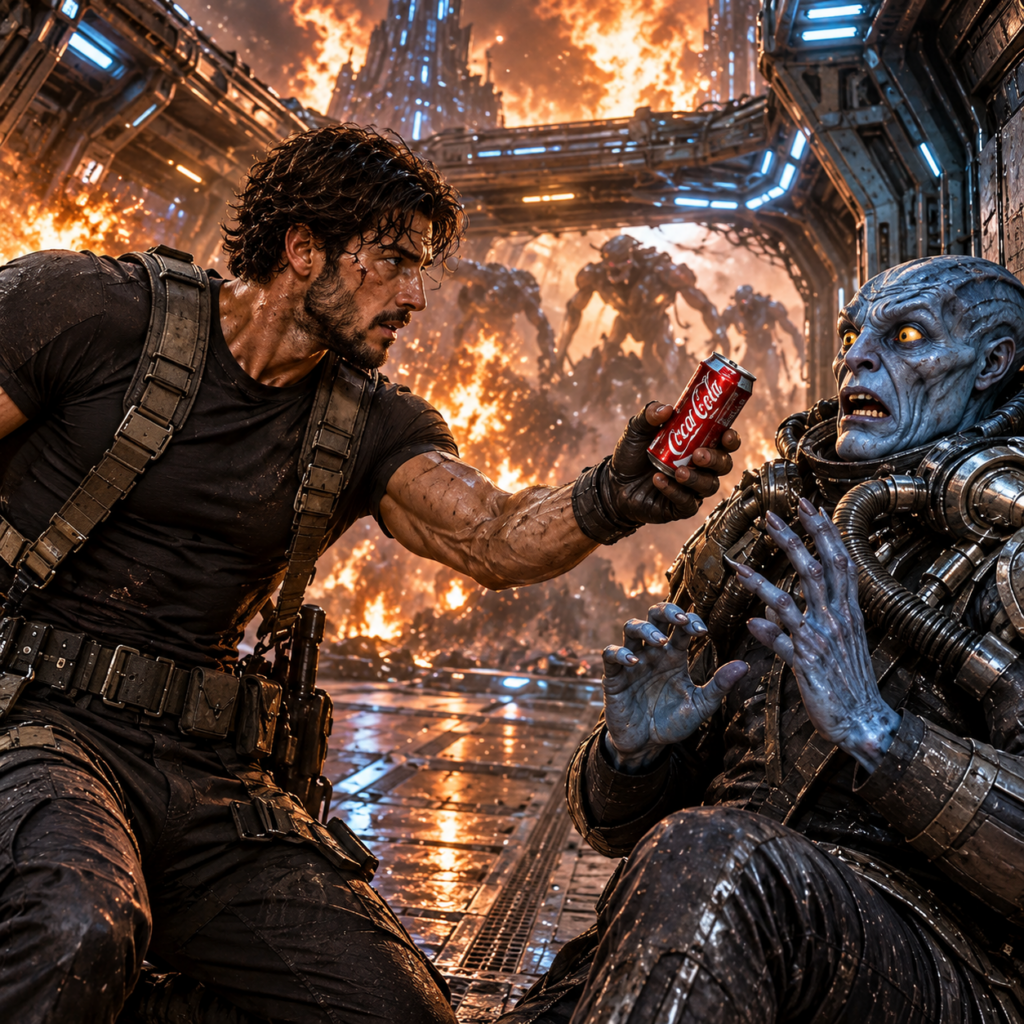
I ejected from the truck’s reinforced cab three seconds before impact, my emergency thrusters barely clearing the blast radius as the white flash swallowed the flagship.
My escape pod tumbled through the upper atmosphere like a skipped stone, burning off its heat shield before slamming into the icy waters of the North Atlantic.
When the rescue chopper finally fished me out, my left arm was shattered, two ribs were cracked, and half the world was already printing my face on commemorative coins.
They called me the man who saved Earth with a 1978 Chevy.
I spent the first three weeks in a medical bay at Cheyenne Mountain, pumped full of painkillers while generals lined up outside my door to pin medals on my hospital gown.
Sarah sat beside my bed every afternoon, peeling oranges and reading me the news headlines.
“The President wants you at the Lincoln Memorial on Friday,” she said one morning, folding the newspaper neatly on my tray. “They’re calling it Liberation Day.”
I stared at the ceiling, listening to the steady beep of my heart monitor.
“Did they pull anything else from the wreckage?” I asked.
Sarah hesitated, her fingers pausing over an orange peel.
“Just scrap metal, Jack. The blast vaporized the flagship’s core.”
She was lying, and she was terrible at it.
Sarah had been my executive officer for four years, and whenever she hid something from me, she tapped her left thumb against her index finger.
Right then, her thumb was tapping a frantic rhythm against her knee.
“Look at me,” I said, pushing myself up against the pillows despite the sharp pull in my ribs. “What did the salvage team find?”
She glanced toward the reinforced glass window of my room, where two armed guards stood with their backs to us.
Lowering her voice to a whisper, she reached into her uniform pocket and pulled out a ruggedized data drive.
“They didn’t pull it from the flagship,” she murmured, sliding it under my blanket. “They pulled it from the rusted frame of your grandfather’s truck. Your dashcam had an analog magnetic tape backup that survived the EMP.”
My stomach dropped as I gripped the cold metal drive.
“And?”
“And the Director of Naval Intelligence classified it above top secret an hour ago,” Sarah said, her eyes dark with a fear I hadn’t seen even when the alien fleet blocked out the sun. “They told me to destroy my copy. I didn’t.”
That night, after the nurse dimmed the lights and made her rounds, I plugged the drive into the diagnostic terminal beside my bed.
The screen flickered with static before stabilizing on a grainy, wide-angle view of the flagship’s bridge, captured through the shattered windshield of my pickup in the fraction of a second before the missiles blew.
The silver-skinned warlord wasn’t roaring in anger.
He was looking down at his console, his four eyes wide with a terror so profound it made his shoulders slump.
Then the audio kicked in, translated by the ship’s automated linguist protocol.
“Do not celebrate,” the warlord whispered, his voice trembling through the static. “We were not invading Earth. We were running from what sleeps beneath it.”
The recording cut to black, replaced by a secondary telemetry file attached by the salvage team’s lead geophysicist.
It was a seismic readout from McMurdo Station in Antarctica, timestamped at the exact second the flagship exploded.
A massive, rhythmic pulse had radiated outward from two miles beneath the Ross Ice Shelf.
It wasn’t an earthquake.
Earthquakes don’t repeat in a steady, deliberate pattern every forty-two seconds, like a colossal heart waking from a million-year sleep.
Before I could process the readout, the heavy steel door of my room hissed open.
Director Vance, the head of Global Defense Intelligence, walked in flanked by two men in dark suits who didn’t wear military insignia.
Vance looked at the glowing terminal screen, then down at my hand resting on the data drive.
“Lieutenant Collins has a bleeding heart, Captain,” Vance said smoothly, his voice devoid of warmth. “It’s an admirable trait in a subordinate, but a dangerous one in a crisis.”
“Where is she?” I demanded, my fingers tightening around the drive.
“Reassigned to a communications outpost in Guam, effective an hour ago,” Vance replied, pulling up the chair Sarah had sat in that afternoon. “She’ll be safe there. Quiet. Just like you’re going to be.”
“You’re burying this,” I said, gesturing to the seismic graph still pulsing on the monitor. “Those aliens weren’t conquering us, Vance. They were trying to strip-mine our oceans for fuel so they could keep running. And whatever they were running from is sitting right under our feet.”
Vance leaned forward, resting his elbows on his knees.
“Do you know what happens if we tell eight billion people that the apocalypse wasn’t canceled, just postponed?” he asked quietly. “Society collapses tomorrow morning. No one goes to work, no one keeps the power grids running, and we tear ourselves apart before whatever is down there even breaks the ice.”
“So we just sit here and wait to die?”
“No,” Vance said. “We go down there first. And we kill it before it finishes waking up.”
He nodded to one of the men in suits, who stepped forward and placed a thick manila folder on my bed.
“The USS Resolute is in dry dock, so we’ve retrofitted an icebreaker,” Vance continued. “The Erebus. She leaves Punta Arenas in six hours with a crew of twelve specialists and three tactical thermonuclear charges.”
I looked at the folder, then back up at Vance’s cold, unreadable eyes.
“Why me?”
“Because the seismic pulses spiked every time we tried to lower an automated drone through the bore hole,” Vance said grimly. “The thing down there reacts to digital frequencies, Captain. It jams electronics, fries guidance systems, and turns smart weapons into dead weight. Sound familiar?”
A cold laugh escaped my throat before I could stop it.
“You need someone who knows how to fight blind.”
“We need the man who broke an unbreakable shield with a wrench and a prayer,” Vance corrected, standing up and buttoning his jacket. “Your discharge papers are already signed if you want them, Jack. You can go home to Montana, collect your medals, and enjoy whatever time we have left. Or you can get dressed.”
Six hours later, I was standing on the frost-covered deck of the Erebus, watching the grey waves of the Drake Passage crash against the reinforced hull.
My left arm was locked in a carbon-fiber brace, and the biting Antarctic wind cut straight through my heavy parka, making my cracked ribs ache with every breath.
Inside the heated mess hall, I met the rest of the team Vance had assembled.
There was Dr. Aris Thorne, a paleoclimatologist who looked like he hadn’t slept since the invasion began, and Chief Warrant Officer Elena Rostova, a demolitions expert who chewed tobacco and spoke with a thick Chicago accent.
“So you’re the guy who wrecked a billion-dollar alien warship with a pickup truck,” Elena said, sizing me up over a steaming mug of black coffee. “I expected someone taller.”
“The truck did most of the heavy lifting,” I replied, pouring myself a cup from the battered aluminum pot. “What are we actually drilling into down there?”
Dr. Thorne spread a high-resolution sonar map across the bolted-down table, his hands shaking slightly as he pointed to a dark, circular anomaly beneath the ice.
“Three days ago, the thermal heat radiating from this sector melted four hundred square miles of sub-glacial ice in six hours,” Thorne said, his voice tight. “At first, we thought it was an underwater volcano. Then we mapped the edges.”
I leaned over the table, squinting at the sonar contours.
The anomaly wasn’t jagged like rock or volcanic caldera.
It was symmetrical, with ribbed, armored plates curving inward toward a central core that measured nearly three miles across.
“It’s a ship,” I said softly.
“No, Captain,” Thorne whispered, adjusting his glasses. “Ships don’t have a metabolic heat signature. And ships don’t grow.”
The mess hall went dead silent, save for the low hum of the Erebus’s diesel engines.
“According to the ice core samples we pulled before the drills melted,” Thorne continued, “this thing crashed here roughly sixty-five million years ago. Right around the time the dinosaurs went extinct.”
Elena let out a low whistle, setting her coffee mug down with a sharp clink.
“You’re telling me the asteroid that wiped out the T-Rex wasn’t a rock?”
“I’m telling you it was a prisoner,” Thorne corrected grimly. “And the shockwave from your flagship exploding over the upper atmosphere didn’t just knock out the alien fleet, Captain. It cracked the glacial ice sheet holding this thing in deep freeze.”
A knot tightened in my gut as the pieces snapped together.
The aliens hadn’t been invading us at all.
They had detected the thermal spike from orbit, realized the prison was thawing, and tried to sterilize the planet before the prisoner could wake up and escape into the stars again.
And I had blown their fleet out of the sky.
“How long until it breaks through the ice?” I asked.
Thorne looked at his watch.
“At its current rate of thermal output? Less than eighteen hours.”
Two days later, the Erebus dropped anchor at the edge of the newly formed meltwater lagoon, surrounded by towering cliffs of fractured blue ice.
The air smelled faintly of ozone and sulfur, a sharp, metallic tang that burned the back of my throat.
Through the thick fog rising off the steaming water, we could see the top of the anomaly breaching the surface like the back of a colossal black whale.
It wasn’t metal, and it wasn’t flesh, though it seemed to pulse with a faint, bioluminescent veins of deep crimson light beneath a carapace of obsidian scales.
“All digital comms are dead within two miles of the perimeter,” Elena reported from the crane deck, where her team was rigging the three tactical nukes onto a heavy-duty submersible sled. “The electromagnetic field coming off that thing is off the charts. Even my analog watch is running backward.”
I stood beside the railing, gripping the cold steel with my good hand as I stared out at the dark mass in the water.
“How do we detonate the charges if the timers are fried?” I asked.
Elena patted a bulky brass cylinder wired to the top of the sled.
“Mechanical clockwork fuses, Captain. Just like the ones my grandfather used in the mines. Once I pull the safety pins, we have exactly twelve minutes before forty-five kilotons of nuclear hell turns this lagoon into a glass crater.”
“And how do we get the sled down into the core?” Thorne asked nervously, clutching his clipboard against his chest. “The outer carapace is denser than depleted uranium. A surface blast will only scorch it.”
I looked down at the sonar readout on the mechanical repeater gauge mounted to the crane.
Right at the center of the black dome, a vertical fissure had split open—a glowing crimson maw venting superheated steam into the freezing air.
“We don’t blast through the armor,” I said, stepping toward the submersible bay. “We drop the sled straight down its throat.”
“The winch cable is only five hundred feet long,” Elena argued, frowning. “The fissure goes down at least two thousand feet before hitting the central chamber. If we just drop it, the currents from the thermal vents will push it against the walls and jam it before it reaches the bottom.”
I looked at the small, yellow two-man mechanical bathysphere sitting in the cradles beside the crane.
It was a relic from the 1970s, built entirely with hydraulic controls, manual valves, and zero microchips.
“Then someone has to drive it down,” I said.
Elena stared at me for three long seconds before shaking her head with a wry grin.
“You really do have a death wish, Mercer.”
“I have a debt to pay,” I replied, climbing onto the catwalk beside the bathysphere. “I’m the reason those aliens didn’t finish the job. I’m not letting eight billion people pay for my victory parade.”
Elena didn’t argue further; she simply tossed me a heavy wrench and began strapping the nuclear sled to the underside of the bathysphere’s tow rig.
“Twelve minutes from the moment I pull the pins,” she said, her voice dropping all humor as she locked the heavy steel hatch over my head. “Once you release the tow clamps at the bottom, you blow your ballast tanks and ride the thermal updraft straight back up. If you’re not above the ice shelf when those clockwork gears hit zero, there won’t be enough of you left to bury.”
“Understood,” I called back through the thick glass viewport. “Pull the pins.”
Through the reinforced acrylic window, I watched Elena yank the three steel rings free from the sled.
A second later, the crane lurched, lowering the bathysphere and its deadly cargo into the steaming, pitch-black water of the lagoon.
The descent was immediate and violent.
Superheated currents battered the steel hull, spinning the small craft like a leaf in a hurricane as we dropped into the glowing crimson fissure.
With my left arm immobilized in its brace, I worked the heavy brass hydraulic levers with my right hand, fighting the violent updrafts to keep the nose pointed straight down.
The depth gauge needle spun rapidly past eight hundred feet, then twelve hundred, then fifteen hundred.
Outside the viewport, the walls of the fissure weren’t smooth; they were lined with thousands of pulsing, organic tendrils that recoiled from the bathysphere’s incandescent floodlights.
Then, without warning, a deep, sub-audible vibration shook the entire vessel.
It wasn’t a sound I heard with my ears; I felt it in my teeth, in my cracked ribs, and deep inside my skull.
A voice—not spoken in words, but pressed directly into my mind like a white-hot iron—echoed through the cramped cabin.
*You are small. You are fragile. Why do you fight for a world that is already ash?*
I gritted my teeth, fighting back a wave of crushing despair that made my hand slip off the hydraulic valve.
Images flooded my mind—cities burning, oceans boiling, Sarah standing alone on a barren shore watching the sky turn black.
“Shut up,” I snarled aloud, gripping the brass lever so hard my knuckles turned white. “I’ve heard better trash talk from a broken carburetor.”
I slammed the thruster valve wide open, driving the bathysphere straight down through the final narrow bottleneck of the fissure.
At two thousand one hundred feet, we broke into a cavernous central chamber glowing with blinding, molten light.
At the center of the cavern hung a massive, crystalline heart suspended by thick strands of pulsing black tissue, beating with that slow, forty-two-second rhythm.
I checked the mechanical stopwatch bolted to the dashboard.
Four minutes and twelve seconds left.
I reached for the manual release lever to drop the nuclear sled directly beneath the crystalline core.
I pulled it.
Nothing happened.
I yanked harder, throwing my entire body weight against the steel bar, but the lever refused to budge.
Through the floor viewport, I saw why—one of the thick, black tendrils from the cavern wall had wrapped itself tightly around the tow clamp, fusing the steel mechanism shut with a crust of hardened, tar-like resin.
Three minutes and forty seconds.
The crystalline heart pulsed again, and another wave of psychic pressure slammed against my mind, bringing blood trickling from my nose.
*Stay,* the presence whispered, wrapping around my thoughts like freezing water. *Sleep with me. The dark is peaceful.*
I wiped the blood from my lip with the back of my sleeve and looked at the pressure gauge.
If I couldn’t drop the sled, the bathysphere was anchored to forty-five kilotons of nuclear explosives with less than three minutes on the clock.
I looked at the manual ballast blow valve, then back at the jammed tow release.
My grandfather’s voice echoed in my head, clear as a Montana morning.
*When something refuses to work, Jack, you don’t give up. You hit it, fix it, or find another way.*
I grabbed the heavy steel pipe wrench Elena had tossed me before sealing the hatch.
Two minutes and fifty seconds.
I didn’t try to unjam the tow clamp.
Instead, I wedged the heavy wrench between the main hydraulic manifold and the forward thruster casing, using every ounce of strength in my right arm to bend the brass fuel line until it snapped.
Raw hydraulic fluid sprayed across the cabin floor, hissing against the hot engine block.
I dragged myself up into the tiny upper access hatch, sealed the internal pressure bulkhead behind me, and gripped the manual emergency blow lever for the escape capsule—the detachable upper sphere designed to separate from the main hull in a hull breach.
Two minutes and ten seconds.
As the bathysphere sank steadily toward the glowing crystalline core, dragging the armed nuclear sled right behind it, I pulled the separation pin and slammed my palm against the compressed-air blow valve.
Explosive bolts sheared the upper capsule free with a deafening crack.
Caught in the massive thermal updraft of the cavern, the tiny escape sphere shot upward like a bullet out of a rifle barrel, spinning wildly through the narrow fissure as the walls began to collapse inward around me.
One minute.
Forty seconds.
Twenty seconds.
The capsule breached the steaming surface of the lagoon, flying thirty feet into the freezing Antarctic air before crashing down onto the thick pack ice a quarter mile from the Erebus.
Ten seconds.
Through the scratched acrylic window, I saw the dark water of the lagoon bulge upward in a blinding, silent dome of white light.
The shockwave hit a second later, flipping the capsule end over end across the ice before slamming it violently against a jagged pressure ridge.
The glass cracked, the lights died, and darkness swallowed the cabin.
When I finally opened my eyes, the ringing in my ears was so loud I couldn’t hear the wind.
Prying open the warped top hatch, I dragged myself out onto the snow, collapsing onto my knees as the freezing air rushed into my lungs.
Where the steaming lagoon had been, there was now only a massive, glass-lined crater filled with swirling steam and shattered ice.
The rhythmic pulsing beneath my boots was gone.
The silence was absolute.
In the distance, the heavy foghorn of the Erebus sounded three long, mournful blasts—the signal for rescue teams to deploy.
I sat back against the battered metal of the escape capsule, watching the grey Antarctic clouds slowly part to let a thin shaft of pale sunlight touch the ice.
My arm was broken again, my ribs felt like crushed glass, and nobody on Earth would ever know what had actually happened down there in the dark.
There wouldn’t be a parade for this one.
There wouldn’t be medals, or headlines, or speeches at the Lincoln Memorial.
I reached into my parka pocket, pulled out the battered brass lighter my grandfather had left me in the glovebox of his old pickup, and flicked it open, watching the small, stubborn flame dance against the freezing wind.
As the distant hum of the Erebus’s rescue helicopter echoed across the ice, I smiled to myself and closed my eyes.









