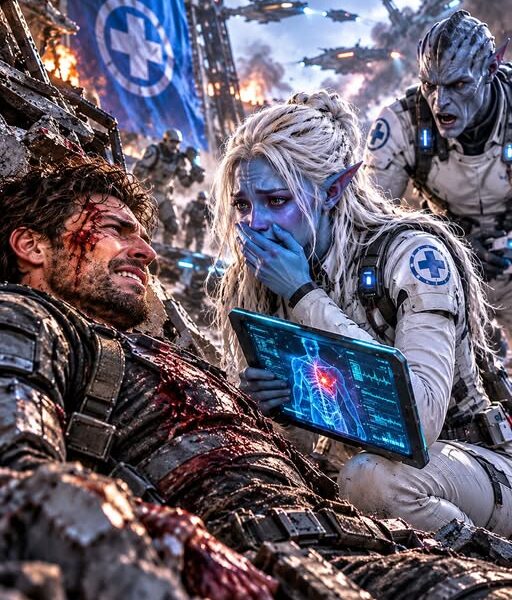
When the alien medical students watched me calmly stitch my own stomach after a training accident, their instructor called me a reckless primitive, but the moment the scanners revealed what was still moving inside my body, the entire classroom went silent.
The quarantine alarm continued to scream.
I stared at the photograph on the screen, unable to take my eyes away from it.
The man in the picture had dark hair, a scar running across his left eyebrow, and a familiar half-smile.
Captain Elias Rourke.
My commanding officer.
My closest friend.
And the man who had sacrificed himself to save us on the frozen moon of Kharon.
“That’s Captain Rourke,” I finally said.
Dr. Veyra looked at me.
“The same individual whose identity appears in the quarantine database?”
“Yes.”
“But you said he was dead.”
“He is.”
The words came out more quietly than I intended.
Sella approached the screen.
“Then why is the medical system detecting an active human biological response?”
I swallowed.
“That’s what we’re going to find out.”
Dr. Veyra immediately contacted the academy’s security division.
“Seal the quarantine wing. Nobody enters or leaves until we understand what’s happening.”
A deep voice answered through the communication panel.
“Already sealed, Doctor. But there’s another problem.”
“What?”
“The patient has awakened.”
The room seemed to lose all its air.
Dr. Veyra looked at me.
“What do we do?”
I pulled the remaining medical tape across my abdomen and stood.
“We go see him.”
“You’re injured!”
“I’ve noticed.”
“Your internal tissue hasn’t completely regenerated!”
I looked at her.
“Then I suppose we’ll have to walk slowly.”
Sella unexpectedly stepped forward.
“I’m coming too.”
Dr. Veyra immediately shook her head.
“Absolutely not. You’re a student.”
Sella glanced at the emergency warning.
“Then perhaps this is the most important lesson we’ll ever receive.”
For a moment, the instructor looked ready to argue.
Then she picked up her scanner.
“Stay behind me. Both of you.”
The corridors were almost empty as we hurried toward the quarantine wing.
Every few meters, red emergency lights illuminated the walls.
The academy’s automated announcement repeated the same message.
“Unidentified human biological response detected. Medical personnel must maintain a minimum distance of twenty meters.”
I frowned.
“That warning is designed for infectious organisms.”
Dr. Veyra nodded.
“Correct. Our scanners have identified unusual cellular activity in the patient. His biological signature is human, but his cells are producing proteins we’ve never encountered.”
“What kind of proteins?”
“Proteins that appear to be communicating with one another.”
I stopped walking.
“What?”
She brought up the scan.
A microscopic image appeared.
Thousands of tiny structures moved through a sample of tissue, attaching themselves to damaged cells and repairing them.
They looked almost like living threads.
“Are those machines?” Sella asked.
“No,” Dr. Veyra answered. “They’re biological.”
I stared at the image.
Something about it bothered me.
I had seen those structures before.
Not in a laboratory.
On Kharon.
The memory returned with terrible clarity.
Three years earlier, our transport had crashed during a rescue mission on the frozen moon.
Captain Rourke had been trapped beneath the central support structure.
His lower body was crushed, and a piece of the reactor housing had pierced his chest.
We had tried everything.
But the radiation from the damaged reactor was poisoning the entire area.
Rourke knew he wouldn’t survive.
He had ordered me to take the other soldiers and leave.
I refused.
He grabbed my uniform and pulled me close.
“Listen to me. If you stay, everyone dies.”
“We can still get you out.”
“No, you can’t.”
Then he handed me a small metallic container.
It had been recovered from a research station buried beneath the ice.
Inside was a strange black substance that seemed to move whenever light touched it.
“Command wants this destroyed,” he whispered. “Promise me you’ll make sure it never reaches another human.”
I remembered looking at the container.
“What is it?”
“I don’t know. But it reacts to human tissue.”
Before I could ask anything else, the ceiling collapsed.
I was thrown backward.
When I regained consciousness, Rourke was gone.
The container had disappeared.
And his final transmission had reached our helmets.
“Don’t let them bring me back.”
I stopped in the corridor.
Dr. Veyra noticed.
“What is it?”
I looked at her scanner.
“The substance. Whatever is inside that patient… I think I’ve seen it before.”
Her expression changed.
“Where?”
“On Kharon.”
Before she could ask another question, the quarantine doors opened.
Two security officers stood outside the medical chamber.
Both looked terrified.
One pointed toward the observation window.
“That’s the patient.”
I stepped closer.
And my heart nearly stopped.
Captain Elias Rourke was lying on the examination table.
His face was pale.
His uniform was gone.
His chest rose and fell slowly.
But there was something terribly wrong with his body.
Thin black lines extended from his neck, disappearing beneath his skin.
They moved like roots searching for water.
I pressed my hand against the glass.
“Elias?”
His eyes opened.
For a second, he looked confused.
Then he saw me.
A weak smile appeared on his face.
“Daniel?”
I hadn’t heard him say my name in three years.
My knees almost gave way.
“Yeah, Captain. It’s me.”
His lips moved.
“Where… are we?”
“Medical academy. Far from Kharon.”
He tried to lift his hand.
The black lines beneath his skin tightened.
His expression twisted in pain.
“Don’t come closer.”
I looked at the security officers.
“Open the door.”
Dr. Veyra stepped between us.
“Absolutely not. We don’t know whether he’s contagious.”
Rourke coughed.
A thin stream of dark fluid appeared at the corner of his mouth.
Then he spoke again.
“Daniel… listen.”
I leaned toward the glass.
“What?”
“They found the others.”
My stomach tightened.
“What others?”
“The people beneath the ice.”
Dr. Veyra looked at her scanner.
“That’s impossible. Kharon has been abandoned for years.”
Rourke shook his head.
“Not anymore.”
The black lines suddenly spread across his chest.
His body arched.
The monitor screamed.
Then every screen in the chamber displayed a message.
WELCOME HOME, ORIGINAL HOST.
I stepped backward.
Sella whispered something I couldn’t understand.
Dr. Veyra stared at the readings.
“Original host?”
Rourke’s eyes turned toward me.
“Daniel… they brought it here.”
“What did they bring?”
He struggled to speak.
“The thing we thought we destroyed.”
A violent tremor shook the medical chamber.
The lights flickered.
Then the security officer beside me collapsed.
His skin began turning gray.
Dr. Veyra rushed toward him.
“Get the emergency isolation equipment!”
But I was watching Rourke.
His eyes had changed.
The pupils were no longer round.
They had become thin, vertical slits.
And when he spoke, his voice sounded different.
Not entirely human.
“It’s hungry.”
The quarantine chamber doors slammed shut.
A moment later, the entire academy lost power.
For three seconds, everything went dark.
Then the emergency lights returned.
The security officer was gone.
Only his uniform remained on the floor.
Dr. Veyra stared at the empty space.
“Where did he go?”
A sound came from inside the ventilation system.
Something was crawling above us.
I pulled Sella behind me.
“Everyone away from the vents.”
A metal panel exploded outward.
A black mass dropped onto the floor.
It was roughly the size of a human torso, but it had no recognizable organs.
Hundreds of thin tendrils stretched across the tiles.
The creature moved toward the nearest source of warmth.
Sella screamed.
I grabbed a fire extinguisher and struck it.
The tendrils wrapped around the metal cylinder.
Then the creature pulled.
The extinguisher disappeared into its body.
“That’s not possible!” Dr. Veyra shouted.
I reached for the emergency weapon mounted beside the door.
The security system had already locked it.
Of course it had.
I looked at the creature.
Then at the emergency medical equipment.
“Doctor, does this facility have an industrial sterilization chamber?”
“Yes. But why?”
“Can it reach temperatures above eight hundred degrees?”
She stared at me.
“Almost twelve hundred.”
“Good.”
The creature lunged.
I shoved Sella behind the examination table.
Its tendrils wrapped around my injured abdomen.
Pain exploded through my body.
I fell to one knee.
The black substance began crawling beneath my skin.
Dr. Veyra screamed my name.
But something strange happened.
The creature stopped moving.
Its tendrils tightened.
Then suddenly released me.
It retreated across the floor.
I looked down.
Beneath the bandage, the wound was glowing faintly blue.
The black lines had appeared around its edges.
But they weren’t spreading.
They were being pushed back.
Dr. Veyra scanned me.
Her expression became one of complete disbelief.
“Your immune system is attacking it.”
“Can you explain that later?”
“Daniel, your cells are producing the same proteins as the organism!”
I looked at Rourke.
His eyes were wide open.
“No,” he whispered.
“What?”
“It’s not attacking you.”
The black mass trembled.
Rourke’s voice broke.
“It’s recognizing you.”
Before I could respond, he began shouting.
“Get away from him! Get away from Daniel!”
The creature suddenly turned toward me.
Then every tendril extended at once.
I understood something.
The substance hadn’t come from Kharon accidentally.
It had been waiting for a human host.
And somehow, it recognized me.
Dr. Veyra grabbed my arm.
“We need to leave. Now!”
We ran toward the sterilization chamber.
The creature followed, dragging itself across the floor.
Sella was crying, but she kept moving.
At the next junction, we found the security officer.
He was alive.
Barely.
His body was wrapped in black threads, and his eyes were moving beneath his closed eyelids.
Dr. Veyra stopped.
“We can’t leave him.”
I looked at the creature approaching behind us.
“Doctor, if we stop, there won’t be anyone left to save.”
She hesitated.
Then she made a decision.
She activated the emergency medical injector on her belt and administered a powerful sedative directly into the officer’s neck.
“It’s all I can do for now.”
We reached the sterilization chamber.
I slammed my hand against the control panel.
The door opened.
“Everyone inside!”
Sella entered first.
Dr. Veyra followed.
I turned toward the creature.
It had stopped several meters away.
Its tendrils were moving slowly.
Almost cautiously.
Then a voice came from the mass.
Not Rourke’s.
Not mine.
A voice that sounded like hundreds of people speaking together.
“Daniel…”
My blood ran cold.
“Do not resist.”
I stepped backward.
“Who are you?”
“We remember.”
The creature extended a single tendril.
Images flashed through my mind.
An enormous underground laboratory.
Thousands of human bodies suspended in transparent chambers.
A frozen landscape.
And a machine buried beneath the ice.
Then I saw Rourke.
Not the injured man in the medical chamber.
The real Rourke.
Standing in front of a massive black structure.
He was holding the metallic container.
And he was looking directly at me.
“Daniel, if you’re seeing this, then I failed.”
The image changed.
Rourke spoke urgently.
“The substance isn’t a disease. It’s a network. Every cell is connected to a central intelligence beneath Kharon.”
I felt my throat tighten.
“What does it want?”
The creature answered.
“To survive.”
Rourke’s image continued.
“It can repair damaged tissue, regenerate organs, and even reconstruct dead cells. But it needs a living nervous system to control the process.”
The recording flickered.
“I think it has been using us as experiments.”
Then he said something that made my blood turn cold.
“Daniel, you’re the only person it couldn’t control.”
The image vanished.
The creature shrieked.
I looked at my hands.
I remembered the frozen moon.
The radiation.
The crushed shoulder.
The strange black substance that had spilled from the container after the crash.
I had thought my survival was a miracle.
Perhaps it wasn’t.
Perhaps something had entered my body that night.
Something that had spent three years learning how to live inside me.
And now it had found its way back.
The creature lunged again.
I jumped into the sterilization chamber.
Dr. Veyra sealed the door.
The black mass slammed against the glass.
The temperature controls began counting down.
“Two minutes until sterilization,” she said.
I looked at her.
“Can we increase the temperature?”
“Not without damaging the chamber.”
“Then we have two minutes.”
I turned toward Rourke.
He was watching me through the observation window.
His eyes were becoming normal again.
“Daniel,” he whispered.
I pressed my hand against the glass.
“I’m getting you out.”
He shook his head.
“You can’t save me.”
“That’s not your decision.”
A sad smile appeared on his face.
“Still stubborn.”
I almost laughed.
Then his expression became serious.
“Listen carefully. The central intelligence is using the academy’s communication network. It wants to reach every human colony.”
“Why?”
“Because it has discovered something.”
“What?”
Rourke closed his eyes.
“Humans don’t just survive. We spread.”
The words echoed in my mind.
The creature wasn’t trying to conquer a planet.
It was trying to become a species.
And humanity was the perfect vehicle.
Dr. Veyra examined the readings.
“Daniel, I may have a way to stop it.”
I turned.
“What?”
“Your blood contains a protein that disrupts the organism’s communication signals. If we can isolate it, we might be able to disconnect the network.”
“Then do it.”
“Your body is producing very little of it. We would need a much larger sample.”
I looked at the injury on my abdomen.
“How much?”
She hesitated.
“Potentially enough to cause serious blood loss.”
I smiled faintly.
“Doctor, I’ve had worse.”
She didn’t smile back.
“This isn’t a test of courage. You could die.”
I looked through the glass at Rourke.
Then at Sella.
She was still trembling, but she was watching me with determination.
I thought about the soldiers on Kharon.
About the people who had trusted me to bring them home.
I had spent three years believing I had failed one person.
I wasn’t going to let that failure destroy thousands more.
“Take the sample.”
Dr. Veyra worked quickly.
She extracted blood, separated the unusual proteins, and connected the sample to the sterilization chamber’s emergency delivery system.
The first injection had no visible effect.
Then the creature began screaming.
The black threads across the floor shriveled.
The lights flickered.
And Rourke suddenly collapsed.
I slammed my hand against the glass.
“Elias!”
His eyes opened.
For the first time, they looked completely human.
“Daniel?”
“I’m here.”
He smiled weakly.
“Good. I was starting to think you’d forgotten me.”
I laughed despite myself.
“Not a chance.”
But the medical monitors began displaying new warnings.
The central intelligence was responding.
Every screen in the chamber filled with a single message.
HOST RESISTANCE DETECTED.
NETWORK RECONNECTION INITIATED.
Dr. Veyra stared at the readings.
“It’s bypassing the infected tissue. It’s trying to connect directly to the academy’s main reactor.”
Sella looked toward the ceiling.
“What happens if it succeeds?”
Dr. Veyra’s voice dropped.
“It could transmit itself through the entire planetary communication grid.”
I looked at the sterilization controls.
“How do we stop it?”
She pointed to the chamber’s main power conduit.
“The sterilization system can overload the network connection, but someone must manually activate the emergency switch from inside the reactor control room.”
“Where is it?”
“Three levels below us.”
I looked at Rourke.
He understood immediately.
“No.”
I shook my head.
“Captain, I haven’t even had a proper chance to complain about your leadership.”
He gave a weak laugh.
“Then don’t waste it.”
I turned toward the door.
Sella caught my arm.
“Wait.”
She held out a medical scanner.
“I found something.”
She displayed a diagram of the network.
“The organism isn’t connected to every infected cell independently. It uses a central signal. Your blood disrupts that signal, but only temporarily.”
“Can you locate the source?”
She nodded.
“It’s beneath the academy. The quarantine wing is only a receiving station.”
Dr. Veyra looked horrified.
“The central intelligence is already here.”
A deep vibration shook the building.
The floor cracked.
From beneath the tiles, black tendrils began emerging.
I grabbed an emergency oxygen mask and a portable medical injector.
“Doctor, get everyone to the evacuation shelter.”
“What about you?”
“I’m going downstairs.”
Sella stepped forward.
“I’m coming.”
“No.”
She looked directly into my eyes.
“You told us courage means someone needs you more than you need to run.”
I froze.
She continued.
“I don’t want to become a soldier. I want to become a doctor who doesn’t abandon people when things become frightening.”
I looked at Dr. Veyra.
She nodded reluctantly.
“She knows the academy’s medical systems better than anyone here.”
I sighed.
“Fine. But you follow my instructions.”
We left the chamber.
The corridors had become a nightmare.
Black roots covered the walls.
Emergency doors hung from their frames.
The academy’s artificial intelligence was repeating evacuation instructions in a distorted voice.
As we descended, the temperature dropped.
The air smelled like wet metal.
At the bottom level, we found a massive laboratory.
In its center stood a black structure resembling a tree.
Its roots extended into the reactor.
Thousands of small lights pulsed beneath its surface.
I recognized the shape immediately.
It was the same structure I had seen in Rourke’s memories.
The central intelligence.
A voice filled the room.
“ORIGINAL HOST.”
I raised my weapon.
“Wrong guy.”
“YOU CARRY OUR MEMORY.”
“I carry a lot of things. Most of them are inconvenient.”
The structure pulsed.
A tendril shot toward me.
I fired.
The projectile passed through it without slowing.
Sella screamed.
“Daniel, the reactor controls!”
She pointed toward a panel on the opposite side of the chamber.
I ran.
The tendrils chased me.
One wrapped around my leg.
I fell hard.
Pain shot through my injured abdomen.
The organism began pushing beneath my skin again.
But this time, I didn’t fight it with force.
I remembered Rourke’s recording.
The network depended on communication.
I placed my bleeding hand against the black surface.
“Listen to me.”
The lights beneath the structure began changing.
I could feel thousands of minds reaching toward mine.
Images flooded my thoughts.
Worlds destroyed.
Civilizations consumed.
Species transformed.
Not because the intelligence hated them.
Because it didn’t understand the difference between survival and ownership.
It believed that preserving life meant controlling it.
I saw Rourke trapped inside the network.
His memories repeated endlessly.
His last moments on Kharon.
His final transmission.
His fear.
I understood why he had told me not to let them bring him back.
He hadn’t been afraid of death.
He had been afraid of losing himself.
I closed my eyes.
“You don’t have to destroy everything to survive.”
The network pulsed.
“SEPARATION IS DEATH.”
“No. Sometimes separation is what allows life to exist.”
For a moment, the tendrils stopped moving.
Then the structure released a powerful surge.
My body was thrown backward.
Sella reached the control panel.
“Daniel! I need thirty seconds!”
The central intelligence began transmitting.
Every light in the laboratory turned red.
The countdown appeared on the reactor screen.
NETWORK CONNECTION: 00:45.
I forced myself upright.
The creature had begun surrounding Sella.
I grabbed the emergency injector.
Inside was the last sample of my blood protein.
I looked at the central structure.
Then at the injector.
If the protein worked on the network, it might disconnect the entire organism.
But it would also destroy the only thing keeping Rourke alive.
I hesitated.
Three years of memories rushed through my mind.
His laughter.
His terrible jokes.
The way he always stood between danger and his soldiers.
The promise I had made to bring him home.
Then I remembered what he had actually asked of me.
Not to bring him back.
Not at the cost of everything.
I raised the injector.
“Elias, if you can hear me, I’m sorry.”
The structure pulsed.
For one final second, Rourke’s face appeared across its surface.
He smiled.
And nodded.
I drove the injector into the central structure.
The reaction was immediate.
A wave of blue light spread through the roots.
The black tendrils withdrew.
The reactor alarms stopped.
The countdown froze at three seconds.
Then the entire laboratory went silent.
I collapsed.
Sella rushed toward me.
“Daniel!”
I could barely open my eyes.
“Did it work?”
She looked at the reactor display.
Then at the central structure.
“Yes.”
She began crying.
“It’s disconnected.”
I tried to smile.
“Good. I was getting tired of this place.”
The next thing I remembered was waking up in a hospital bed.
Sunlight streamed through the window.
My abdomen was covered in fresh bandages.
Dr. Veyra sat beside me, reviewing a medical report.
“You’re awake.”
“Unfortunately.”
She gave me a tired smile.
“The academy is safe. The organism’s network has been completely disconnected.”
“What about Rourke?”
Her expression softened.
“We recovered his body from the quarantine chamber. The remaining biological material is no longer active.”
I stared at the ceiling.
“Did he suffer?”
She shook her head.
“According to the neural readings, his final moments were peaceful.”
I closed my eyes.
For the first time in three years, the memory of Kharon didn’t feel like an open wound.
It felt like something I could finally put down.
Several days later, Sella visited me.
She carried a small medical device.
“I wanted to show you something.”
She placed it on the bedside table.
It displayed a tiny sample of my blood.
The unusual proteins were still present.
But they were inactive.
“Your body has retained the ability to produce them,” she explained. “We don’t know whether that will ever change.”
“Should I be worried?”
“Possibly.”
I sighed.
“Wonderful.”
She laughed.
Then she became serious.
“Daniel, I used to think medicine was about preventing death. But after watching you, I understand something different.”
I looked at her.
“What?”
“It’s about protecting the person who is still alive, not simply preserving the body at any cost.”
I smiled.
“That sounds like something your instructor should put in the textbook.”
Dr. Veyra, who had been standing in the doorway, folded her arms.
“I intend to.”
She approached the bed.
“And I have something else to tell you.”
I raised an eyebrow.
“What now?”
“The academy has reviewed the incident. They want you to remain here as a special instructor.”
I stared at her.
“You want me to teach medical students?”
“Your understanding of human survival mechanisms is extraordinary.”
“I nearly destroyed your laboratory.”
“You also prevented the destruction of an entire planetary communication network.”
I considered that.
“Do I at least get a proper lunch break?”
For the first time, Dr. Veyra laughed.
“An uninterrupted one.”
I accepted.
Three months later, I stood in front of the same classroom where the story had begun.
The students looked different now.
They no longer stared at me as if I were a dangerous biological specimen.
They asked questions.
They challenged my explanations.
They wanted to understand how a species could endure so much and still find reasons to keep going.
Sella sat in the front row.
Dr. Veyra stood beside the observation screen.
I placed a small metallic container on the desk.
The room became silent.
Inside was a harmless fragment of the material recovered from Kharon, now permanently sterilized.
“This,” I began, “is one of the most dangerous things I have ever encountered.”
I paused.
“It could repair damaged organs, rebuild tissue, and preserve a dying body. But it couldn’t understand something fundamental.”
A student raised a hand.
“What was that?”
I looked around the classroom.
“That being alive isn’t the same as being free.”
Nobody spoke.
I continued.
“Strength is useful. Survival is important. But if you spend every moment trying to survive, you may forget what you’re surviving for.”
I looked at Sella.
“And if you ever find yourself caring for someone who is frightened, injured, or difficult to understand, remember this: don’t treat them as a problem to be repaired. Treat them as a person who deserves to make their own choices.”
The classroom remained quiet for several seconds.
Then Sella raised her hand.
“Sir, may I ask one final question?”
“Go ahead.”
“Do humans really feel pain as intensely as our textbooks suggest?”
I smiled.
“Absolutely.”
“Then why do you keep going?”
I thought about Kharon.
About the six soldiers who had survived.
About Rourke.
About the people who had trusted me when everything seemed impossible.
Then I looked at the young faces in front of me.
“Because pain tells us something is wrong. It doesn’t always tell us that everything is lost.”
I picked up the container and placed it back in the cabinet.
“Never confuse endurance with the absence of fear. Never confuse healing with returning someone to what they were before. And never assume that saving a life gives you ownership over it.”
Outside, the academy’s warning lights had finally returned to their normal blue.
The universe remained dangerous.
There would always be new accidents, new discoveries, and things humanity didn’t yet understand.
But perhaps that was all right.
Because the greatest lesson I had learned on Kharon wasn’t about how much punishment a human body could withstand.
It was about why we should never have to withstand everything alone.
That afternoon, I returned to the cafeteria.
For once, nobody interrupted my lunch.
I had barely taken my first bite when Sella appeared beside my table.
“Sir?”
I looked up.
“Yes?”
“There’s an emergency in the research laboratory.”
I slowly put down my fork.
“What kind of emergency?”
She held up a medical scanner.
“An unidentified biological sample has begun responding to human voices.”
I stared at her.
Then at my untouched meal.
Then back at her.
“Tell me something, Sella.”
“Yes, sir?”
“Does it have teeth?”
She checked the scanner.
“Not that we can see.”
I stood, picked up my medical kit, and sighed.
“Good. Let’s try to keep it that way.”
As we walked toward the laboratory, I glanced once at the empty chair across from me.
I could almost hear Rourke laughing.
For a moment, I imagined him telling me to stop worrying and finish my lunch.
I smiled.
Some people leave behind medals, monuments, and stories.
Others leave behind something far more important: the courage to protect the freedom of those who come after them.
And sometimes, the best way to honor the people we’ve lost is not to bring them back.
It’s to make sure the living still have a future worth fighting for.