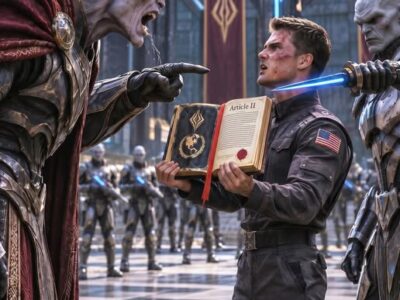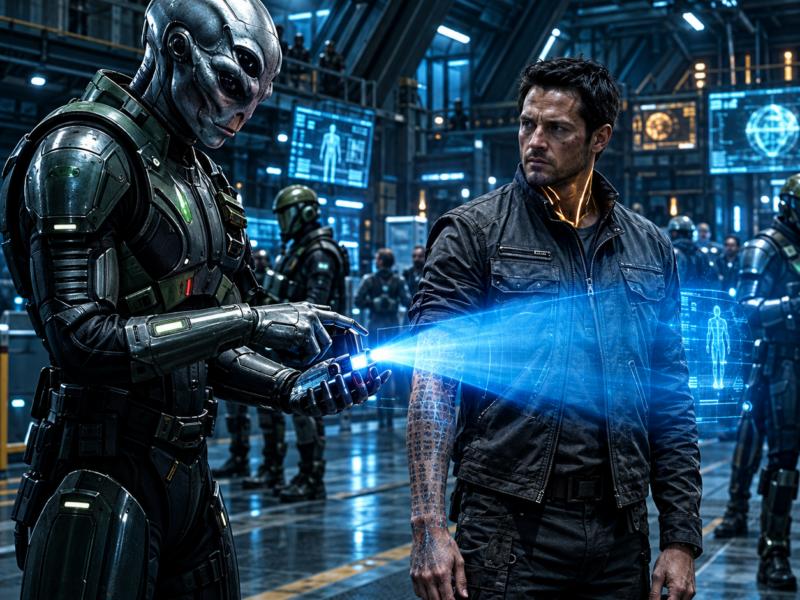
When the alien guards dragged me through the security gate of the Orion Detention Station, their commander laughed at my faded tattoos and called me a primitive human, but the moment his scanner touched the black markings across my chest, every alarm on the station screamed, and the system displayed a message that made him drop his weapon.
The air inside the holding chamber tasted of oxidized copper and recycled nitrogen.
Every breath stung the lining of my throat like inhaled sand.
The alarm sirens did not stop.
Instead, their harsh, rhythmic screeching dropped an octave, settling into a low, pulsing thrum that rattled my ribs.
Commander Threx’s sidearm hit the metal grating with a sharp clatter.
The heavy plasma pistol skittered across the floor, coming to rest near my bare feet.
None of the guards moved to retrieve it.
Their six-fingered hands remained frozen on their shock lances, their pale gray skin taking on a mottled, sickly tint under the strobe of the red emergency strobes.
“Step back,” Threx rasped, his voice whistling through his breathing apparatus.
I did not move.
I could not move.
My eyes were locked on the terminal display hanging suspended in midair between us.
The glowing amber letters burned through the haze of the chamber:
DECEASED COUNT EXCEEDS LIMIT.
And beneath that, carved in pristine military typeface from an era that had ceased to exist three centuries ago:
ANCHOR RECOVERED. RESURRECTION SEQUENCE CONTINUING.
My chest burned.
It was not an imaginary heat.
The black ink of the twenty-seven tattoos etched across my collarbone, rib cage, and forearms felt hot against my flesh, like freshly branded iron.
“Jackson?”
The voice spoke again from the overhead speakers.
It was soft, cracked at the edges, and carried the faint, rhythmic rasp of someone breathing through a cracked helmet seal.
It was Sarah.
It was impossible.
I had watched her die inside the breach beyond the Kuiper Belt.
I had watched the decompression seal rupture, tearing our cruiser down the centerline while the void dragged her out into an endless ocean of stars.
I remembered the cold of that moment.
I remembered the frost forming on her visor as the radio link severed into static.
“Sarah?” I whispered, my voice rough from three centuries of chemical slumber.
The station’s primary deck plates groaned underfoot.
The floor shuddered once, violently, knocking two of the guards off balance.
Threx lunged backward, his taloned fingers frantically scratching at the emergency console on the bulkhead.
“Override!” Threx screamed into the comm-grid. “Station central, kill the local power grid! We have a Class-Four cognitive hazard in Sector Seven!”
The intercom did not answer him with dispatch codes.
The intercom answered with the steady sound of boots marching in cadence.
Left, right, left.
The sound echoed through the metal vents, reverberating through the ventilation ducts above our heads.
The heavy hydraulic gates at the far end of the processing hall began to cycle open without input.
The locking bolts retracted one by one with deafening mechanical clangs.
Threx looked at the door, then turned his wide, lidless black eyes back to me.
“What was that ship?” he stammered, backing toward the wall. “Your intake papers said you were found in an unmapped drifting hulk!”
“We were on patrol,” I said quietly.
“That was no patrol craft!” he shouted, panic breaking his voice. “The reactor core on that wreck wasn’t generating energy. It was generating a pulse field!”
The temperature in the room plunged instantly.
My breath misted into white clouds in front of my face.
Frost bloomed outward from the scanner console, racing across the metal tables and crystallizing along the cuffs around my wrists.
The magnetic locks holding my wrists clicked.
They fell away, clattering loudly against the deck.
I held up my hands, staring at my fingers.
The ink under my skin was glowing with an unnatural, pale blue luminescence.
Thin lines of light traced the veins running up my forearms, connecting each name like an electrical circuit.
Miller. Hayes. Brooks.
Each syllable burned against my nerve endings, whispering half-forgotten voices into the back of my skull.
“Jackson,” Sarah’s voice crackled through the comm again, closer this time, as if coming from the corridor just outside the gate.
“The anchor has to hold,” she said.
“If you break the line, none of us come through.”
A shadow fell across the frosted threshold of the security door.
The Ghosts in the Iron
The shadow did not belong to a living being.
It was an outline of jagged armor and wide shoulders, cast by a harsh blue light that smelled of ozone and scorched copper.
Threx scrambled across the floor, grabbing his discarded plasma weapon with trembling hands.
“Fire!” he shrieked to his remaining guards. “Neutralize the perimeter!”
The two guards discharged their shock lances simultaneously.
Arcs of blinding yellow electricity tore through the freezing fog, striking the doorway directly.
The energy did not detonate.
The bolts of lightning curved abruptly midair, bending inward like water drawn down a drain, disappearing into the dark silhouette standing in the hall.
The air popped with a hollow implosion.
A soldier stepped into the light.
He was wearing standard United States Orbital Marine issue heavy armor, battered and scarred by micrometeorite impacts.
The chest plate bore the faded white stencil of a snarling bulldog.
Corporal Marcus Hayes.
I knew the dent in the left shoulder bell; he had taken that dent during a boarding drill off Ganymede six weeks before our final jump.
His visor was cracked from top to bottom, but through the glass, there was no flesh.
There was only a swirling vortex of crystalline blue mist and two pinpricks of bright, conscious light where his eyes should have been.
“Corporal Hayes,” I breathed.
The armored figure turned its helmet toward me.
The mechanical vocalizer on his collar clicked, grinding with static before finding a frequency.
“Sergeant Reed,” the construct said, its voice flat, metallic, and painfully familiar.
“We’ve been holding the defensive perimeter for a very long time, sir.”
Threx raised his sidearm and pulled the trigger.
A heavy ball of superheated plasma erupted from the barrel, illuminating the corridor in blinding emerald light.
The shot struck Hayes squarely in the center of his chest.
Hayes did not stumble.
The plasma energy washed harmlessly over his armor, absorbed into the lattice of blue light beneath the plating.
Hayes took one slow step forward.
He reached out with a gauntleted hand, gripped the barrel of Threx’s weapon, and crushed the reinforced alloy into a twisted mass of scrap metal.
Threx shrieked, falling backward and curling against the reinforced wall like a frightened animal.
“Demon,” the alien whimpered, his talons clawing at the deck plating. “Ancient war demon!”
“Not a demon,” Hayes said, looking down at him without malice.
“Eighth Fleet. Second Recon Battalion.”
Two more figures stepped out of the freezing mist behind him.
Captain Thomas Miller, his sidearm still holstered at his hip, and Private First Class Daniel Brooks, carrying the long chassis of a heavy rail rifle that possessed no battery pack.
Both of them were translucent at the edges, their forms wavering like heat shimmer on asphalt.
Miller looked at me, raising his right hand in a sharp, crisp salute.
“Sergeant Reed,” Miller said, his tone carrying the calm authority that had once guided us through three system campaigns.
“Status report.”
My throat locked up.
I swallowed hard, trying to reconcile the sight before me with the cold reality of physics and time.
“Captain,” I managed to say. “Three hundred years have passed. Earth… we’re three centuries out of our era.”
Miller lowered his hand slowly.
The two points of light behind his faceplate shifted, glancing around the sterile alien architecture of the Orion station.
“Time is irrelevant to the carrier wave, Jackson,” Miller replied softly.
“What matters is the tether. You are still breathing.”
“I don’t understand,” I said, looking down at my glowing arms. “What did you do to me before the ship broke apart?”
Brooks stepped forward, his rifle resting across his chest.
“You didn’t just volunteer to carry our memory, Sarge,” Brooks said, a faint trace of his Ohio accent bleeding through the speaker.
“You became the hard drive.”
Miller pointed a finger toward the corridor behind them.
“We have twenty-four more signatures trying to resolve into this physical layer,” the Captain said.
“The station’s power reactor is attempting to purge the anomalous energy signature.”
“If the reactor purges,” Hayes added, “the tether snaps.”
“And if the tether snaps?” I asked.
Miller looked at me with those hollow, burning eyes.
“Then the twenty-seven of us cease to exist forever,” Miller said.
“And Sarah never makes it out of the dark.”
We moved through the central corridor of Sector Seven in a tight, disciplined wedge.
It was muscle memory.
Even after three centuries of stasis, my body fell naturally into position behind Miller’s right shoulder, watching the high angles while Hayes covered our rear.
The station’s automated defenses were waking up.
Red warning runes flared along the arched ceiling, and ceiling-mounted autoguns dropped from recessed compartments every fifty paces.
“Turrets,” I barked instinctively.
Brooks did not aim his rifle.
He simply raised his left hand toward the ceiling.
A wave of blue electromagnetic distortion rippled outward from his gauntlet, washing over the automated guns.
The turrets sparked, their sensor eyes spinning wildly, before locking up with loud mechanical squeals and freezing in place.
“Alien firmware is surprisingly basic,” Brooks muttered through the comm.
“Too much reliance on optical sensors.”
I walked beside them, still half-naked, clad only in the rough prisoner trousers the intake guards had thrown at me.
Yet I did not feel the freezing cold that clung to the bulkheads.
The air around me remained strangely neutral, insulated by the field radiating from my own skin.
“Miller,” I said as we crossed an observation mezzanine overlooking the secondary docks.
“Explain the protocol. How are you here?”
Miller didn’t turn around, but his voice came through clearly inside my head, bypassing my ears entirely.
“The anomaly we encountered beyond Neptune wasn’t a spatial distortion, Jackson,” Miller said.
“It was a storage node. Left behind by something far older than humanity or this Federation.”
“An archive,” I whispered.
“A consciousness archive,” Miller corrected.
“When our hull collapsed, the wave front hit us. It digitized everything it touched: our thoughts, our neural pathways, our memories, our souls.”
“Then why didn’t you wake up in bodies like mine?”
Hayes paused at an intersection, checking both flanks before waving us forward.
“Because our physical forms were pulverized by the kinetic decompression, Sarge,” Hayes said quietly.
“You were in the sealed medical isolation pod when the hull split. Your tissue remained intact.”
“The entity running the node needed a baseline,” Miller explained.
“It needed one living biological system to anchor the quantum state of the other twenty-seven.”
Miller stopped and turned to face me.
He reached out, his gauntleted finger gently touching the tattoo over my sternum.
The skin beneath his touch sparked with a gentle, harmless static.
“You loved this squad,” Miller said softly.
“You carried our guilt, our names, our faces. That emotional imprint became the map.”
“Every tattoo was a set of quantum coordinates,” I said, the horrifying brilliance of it dawning on me.
“Yes,” Miller replied.
“When you got those markings on Earth, you thought you were grieving. But you were unconsciously compiling the registry.”
“And now?” I asked. “What happens when all twenty-seven are resolved?”
Miller looked down the long corridor leading toward the station’s primary fusion core.
“We don’t know,” Miller admitted.
“The archive’s programming is automated. It seeks restoration.”
“Wait,” I said, remembering the second line of text from the security terminal.
“The screen said twenty-seven subjects located. But it also said one subject was still missing.”
Hayes and Brooks stopped dead in their tracks.
The blue fire within their visors flickered erratically.
“Sarah,” I said, my heart slamming against my ribs like a trapped bird.
“She was on the command deck with you, Miller. Why is she missing?”
Before Miller could answer, the bulkheads on either side of the hallway buckled inward with a terrifying screech of torn metal.
Heavy blast doors dropped from the ceiling, slamming down between us.
Miller was cut off on the other side.
Brooks was shoved against the wall by a sudden gravitational surge that inverted the room’s orientation.
Through the reinforced viewport of the blast door, I saw Commander Threx standing on a command catwalk, surrounded by dozens of heavily armored Federation shock troopers.
Beside him stood an officer wearing black ceremonial robes, holding a strange, crystalline staff that pulsed with purple energy.
“Sergeant Reed!” Miller shouted through the comm, his signal degrading rapidly.
“They’re isolating the carrier signal!”
The alien in the black robes pointed his staff directly at me.
“The host is isolated,” the robed alien announced through the PA system, his voice deep and resonant.
“Commence deep harmonic disruption. Cleanse the human vessel.”
The Frequency of Pain
The beam from the crystalline staff did not strike like a bullet or a blade.
It hit like sound.
A high-pitched, harmonic vibration slammed through the glass of the blast door and struck me square in the chest.
I fell to my knees, gasping for air that wouldn’t enter my lungs.
It felt as if my blood were boiling from within, each red blood cell vibrating at a violent frequency.
The glowing blue tattoos on my skin began to flicker, turning from brilliant cobalt to a sickly, smoldering gray.
Across the corridor, Private Brooks cried out in agony.
His armored form began to unravel, peeling away like ash caught in a windstorm.
“Brooks!” I screamed, clawing at the deck, trying to crawl toward him.
“Hold… hold the line, Sarge,” Brooks wheezed.
His rifle slipped through his fingers, dissolving into particles of light before it even hit the floor.
“I can’t… see Cleveland anymore,” Brooks whispered, his vocalizer warping into an unrecognizable digital whine.
“Brooks, don’t let go!” I roared, forcing myself onto my hands and knees despite the crushing pressure in my skull.
“Remember the river! Remember the bridge!”
I focused every ounce of my will on the memory of the young kid from Ohio who used to show everyone pictures of his family’s farm back in Dayton.
I pictured his crooked smile, the cowlick in his brown hair, the way he complained about military rations every single morning at zero-six-hundred.
The tattoo on my left bicep—PFC D. Brooks—flared white-hot.
The pain tore a scream from my throat, but the fading particles of Brooks’s body suddenly snapped back together.
His form reconstituted, solidifying once more into scarred composite armor.
Brooks hit the floor hard on his hands and knees, panting digital breaths of static.
“Got you,” I gasped, blood dripping from my nose onto the steel floor.
“I got you, kid.”
On the command catwalk above, the robed alien narrowed his four eyes in genuine astonishment.
“Remarkable,” the alien spoke through the station speakers.
“The biological host maintains a localized coherent wave through emotional resonance alone.”
“Increase output to maximum,” Threx ordered, his voice laced with venom.
“Burn the human out! We cannot allow a ghost army to commandeer this station!”
The purple beam intensified.
The air around me began to ionize, filling the corridor with the smell of scorched ozone and burning hair.
My vision doubled.
The tattoos across my chest felt as if they were being peeled away with hot razor blades.
I saw Captain Miller on the other side of the glass, hammering his gauntlets against the reinforced viewport, trying desperately to breach the seal.
“Jackson!” Miller yelled, his voice breaking through the static in my ears.
“You have to cut the connection! If they burn you out, the entire archive will collapse into entropy!”
“No!” I shouted back, spitting a mouthful of blood onto the floor.
“I left you behind once! I’m not doing it again!”
“Reed, that’s an order!” Miller barked.
“I don’t report to you anymore, Captain!” I snarled, pushing myself up to one knee.
“I’m the only one left with a heartbeat!”
I gripped the edge of a structural pillar and dragged myself upright.
Every muscle in my body trembled with exhaustion and agony.
I looked directly up at the robed alien on the catwalk.
The purple light was blinding, but behind it, I felt something else stirring in the deep network of the station’s systems.
It was a cold, deliberate presence.
A mind navigating through the alien databanks with surgical precision.
A digital signature that didn’t belong to the station’s security protocols.
A message flashed across the retinal display of my field vision, projected directly into my optic nerve:
FIREWALL DEFEATED. ACCESSING PRIMARY LIFE SUPPORT.
The purple beam abruptly shut off.
The crystalline staff in the robed alien’s hands shattered into a thousand jagged fragments, slicing across his face.
The alien shrieked, clutching his bleeding eyes.
The heavy blast doors separating me from Miller hissed open with a rush of equalized pressure.
Miller rushed forward, catching me by the shoulder before I could collapse back onto the deck.
“Who did that?” Miller asked, his visor scanning the ceiling.
From every speaker in the corridor, a voice echoed with terrifying clarity:
“I told you I’d always cover your flank, Jackson.”
Sarah.
The Ghosts in the Machine
The station’s primary gravity generator fluctuated, dropping to half-weight for a sickening three seconds before stabilizing.
The lights in the hallway shifted from red to a cool, sterile white.
Commander Threx and his remaining security forces scrambled backward down the catwalk, retreating through the secondary blast doors toward the command bridge.
They knew they were no longer defending against an escape.
They were defending against an invasion.
Miller helped me lean against the wall while Brooks kept his rail rifle leveled at the empty catwalk above.
“Where is she, Captain?” I asked, wiping the blood from my chin with the back of my hand.
“Why isn’t she here with you?”
Miller’s visor turned down toward the floor, the bright lights behind the glass dimming slightly.
“When the transport was torn apart, Sarah wasn’t in the troop bay,” Miller said softly.
“She was in the navigation core.”
My stomach dropped.
“She was trying to manually align the jump drive,” I recalled, the memory surfacing through the haze of three centuries.
“She stayed behind to give the rest of us time to reach the pods.”
“Yes,” Miller said.
“Because of that, her consciousness was absorbed differently. We were pulled into the archive as complete, static files.”
“Snapshots of who we were the second we died.”
“And Sarah?” I asked, afraid of the answer.
“Sarah was integrated into the operational core of the anomaly itself,” Miller answered.
“She wasn’t archived, Jackson. She became part of the processing system.”
The implications hit me like a physical blow.
“She’s been awake?” I whispered, horror rising in my chest.
“For three hundred years?”
“Not awake in the human sense,” Miller said, trying to soften the blow.
“She was distributed. Bound to the carrier wave. When the Federation salvage crew brought your pod and the wreck onto this station, she slipped into their mainframe.”
A nearby display monitor flickered to life.
Lines of green code scrolled down the screen at blinding speed, replaced instantly by a low-resolution rendering of Sarah’s face.
Her hair was tied back in the practical regulation style she had always worn.
Her eyes were sharp, intelligent, and exhausted beyond comprehension.
“I heard that, Captain,” Sarah’s voice came through the monitor’s audio pickup.
I stumbled toward the screen, placing my hand against the cold glass.
“Sarah,” I said, my voice cracking.
She looked at my reflection in the monitor, a faint, sad smile touching the corners of her lips.
“You look terrible, Jackson,” she said gently.
“You’ve looked better yourself, Lieutenant,” I replied, managing a hollow laugh.
“How do we get you out? How do we build a body for you like Miller and the others?”
Her smile faded.
“You can’t, Jackson.”
The air went still.
“What do you mean, I can’t?” I demanded, anger flaring through my chest.
“The protocol restored Miller! It restored Brooks! There are twenty-five more names on my skin, and we’re going to pull every single one of them back!”
“They have bodies because their consciousness patterns are finite,” Sarah explained, her digital image wavering as the station’s subroutines fought for control.
“They can be projected through the hard-light matrices of the carrier wave.”
“My pattern is too large now. I’ve integrated with centuries of telemetry, alien navigational charts, galactic history.”
“If I try to compress back into a physical vessel, my mind will burn out in seconds.”
“Then we leave you in the system!” I argued desperately.
“We steal a ship, download your core, and figure it out later!”
“Jackson, listen to me,” she said, her voice dropping to an urgent whisper.
“Threx isn’t trying to capture you anymore.”
“He has initiated the station’s self-destruct sequence.”
“He’s going to overload the sub-space reactor to incinerate this entire sector before we reach the docks.”
“And there’s only one way to stop the overload.”
I looked at the screen, understanding instantly what she wasn’t saying.
“You have to stay in the reactor core,” I said, cold dread washing over me.
“I have to manually suppress the reaction from the inside,” she answered softly.
“And you have to get our people out of here.”
The floor beneath us groaned as secondary explosions rippled through the lower decks.
Threx was not taking chances.
He was systematically purging the station’s modules, venting atmospheres, and severing magnetic transit lines to buy his bridge crew time to reach the executive escape shuttles.
“We don’t have much time, Sergeant,” Miller said, racking the slide of his sidearm.
I turned away from the monitor, looking down the long corridor leading toward the primary hangar bay.
“How many names do we have left to wake up?” I asked.
“Twenty-four,” Miller said.
“Then let’s wake them,” I said.
I closed my eyes and reached inward, past the exhaustion, past the throbbing agony in my ribs and lungs.
I thought of Sergeant First Class Raymond Alvarez, who had taught me how to read telemetry when I was a raw recruit on Mars.
Alvarez.
The tattoo across my left collarbone flared with white light.
Beside me, the air twisted into a violent spiral of blue sparks.
Alvarez materialized out of the mist, his combat shotgun already resting in the crook of his arm, his scarred jaw set in a grim line.
“About damn time, Reed,” Alvarez grunted, racking a round into the chamber.
I thought of Corporal Elena Chen, our combat medic, who had patched three shrapnel wounds on my abdomen during the siege of Titan.
Chen.
The ink on my right forearm burned like a live wire.
Chen appeared in full field gear, medical scanner humming softly at her hip, her dark eyes scanning the room instantly.
“Sergeant,” Chen said, nodding curtly.
“You look like you need twenty units of synth-blood and a week in a regeneration tank.”
“No time, Doc,” I said, smiling through the pain.
One by one, I called them.
Vance. Kowalski. Henderson. Washington. Lindqvist.
With every name I spoke, a wave of fire tore through my nervous system, but I did not stop.
The hallway began to fill with the dead.
Twenty-four armored figures resolved into reality, their boots hitting the deck plates in terrifying unison.
They were not ghosts; they were a full combat platoon of United States Orbital Marines, manifested from light, memory, and an unbreakable promise.
The corridor was blindingly bright with the glow of their armor.
The air smelled intensely of ozone, burnt wiring, and human sweat.
Miller stepped to the front of the formation, his command aura commanding absolute silence.
“Listen up, Eighth Fleet,” Miller’s voice boomed down the corridor, carrying the weight of a professional commander who had never lost a unit in battle.
“The Federation command on this station has designated us hostile anomalies.”
“They have initiated a terminal reactor purge.”
“Our mission is simple: secure Hangar Bay Alpha, secure transport, and cover the primary reactor until our commander completes her override.”
The platoon did not shout or cheer.
They simply adjusted their weapons, checked their seals, and fell into flanking columns.
These were men and women who had spent their entire lives facing impossible odds on the frozen moons of the outer solar system.
A station full of terrified alien mercenaries was nothing new.
“Sergeant Reed,” Miller said, turning to me.
“You take the vanguard with Alvarez and Hayes.”
“Secure the hangar control room.”
“Understood, Captain,” I said.
Alvarez handed me a standard-issue kinetic rifle, formed from the same hard-light energy as his own armor.
The weapon felt cold, heavy, and perfectly balanced in my hands.
“Let’s move,” I said.
We hit the security checkpoint at the end of the corridor like an avalanche.
The heavy armored doors were barricaded from the inside, but Alvarez didn’t bother using breach charges.
He simply stepped forward, planted his armored shoulder against the seam, and fired three point-blank concussive slugs into the locking mechanisms.
The doors tore inward with a deafening screech of rending titanium.
Beyond the threshold lay the central concourse of the Orion station.
Hundreds of alien soldiers, armored in black composite plates and armed with heavy particle cannons, stood waiting behind fortified barricades.
At the center of their line stood Commander Threx, his hand hovering over a remote detonation trigger.
“Halt!” Threx screamed through an external amplifier, his voice hysterical with terror.
“Halt or I vent the entire sector into the vacuum!”
Captain Miller did not break his stride.
“Orbital Marines,” Miller whispered over our shared tactical frequency.
“Advance.”
The concourse erupted into absolute chaos.
Particle beams and plasma fire saturated the wide boulevard, carving deep, smoking gouges into the polished stone floors and shattering structural pillars into falling debris.
The enemy had superior numbers and higher ground.
They had heavy emplacement turrets mounted on the upper tiers of the concourse.
It did not matter.
My platoon advanced in a methodical, relentless line, firing in disciplined, three-round bursts that punched through the aliens’ energy shielding.
Brooks knelt behind a shattered fountain, firing his rail rifle with mechanical rhythm.
Every crack of his rifle was followed by the catastrophic failure of an alien turret above us.
Alvarez led the center assault, his shotgun blasting through barricades and sending alien shock troopers scattering across the floor.
Whenever an enemy particle beam struck one of our soldiers, the blue light beneath their armor flared violently, absorbing the kinetic shock before dissipating into the surrounding air.
They could not be killed by conventional weapons.
They were tied to me, and as long as my heart kept beating, their forms remained anchored in the physical realm.
The strain on my body was immense.
Every shot that struck Miller, every plasma blast that scorched Hayes’s armor, echoed as a sharp, agonizing ache in my own chest.
My vision began to swim with gray static.
My knees buckled twice, but each time, Chen was there, her hard-light gauntlet gripping my shoulder, supporting my weight until I found my footing.
“Stay with us, Jackson,” Chen muttered in my ear.
“Keep your eyes forward.”
We pushed through the barricades, driving the Federation defenders back toward the blast doors of Hangar Bay Alpha.
Commander Threx scrambled up the stairs toward the hangar observation booth, his eyes wild with terror as he watched his entire security battalion crumble before an enemy that refused to bleed.
“Monster!” Threx screamed, pointing his sidearm down at me from the catwalk.
“You’re already dead! All of you are dead!”
I raised my kinetic rifle, leveled the sights on his chest, and squeezed the trigger.
The round struck his shoulder plate, spinning him around and sending him crashing against the observation booth window.
He dropped the remote detonation switch.
The device skittered across the metal grating and fell through the gap, tumbling thirty feet down to the concourse floor, where Alvarez crushed it under his boot.
Threx lay against the glass, clutching his shattered shoulder, his purple blood staining the pristine white wall behind him.
I climbed the metal stairs slowly, one step at a time, the weight of the rifle pulling at my exhausted arms.
When I reached the top of the catwalk, I stood over him.
Threx looked up at me, his chest heaving, his dark eyes reflecting the blue glow emanating from my skin.
“What are you going to do?” he whispered in broken English.
“Kill me?”
“No,” I said, lowering the rifle.
“We’re taking a ship.”
“You won’t make it,” Threx wheezed, a faint, bitter sneer returning to his lips.
“The reactor core is already in supercritical divergence.”
“The entire station will be dust in less than four minutes.”
“You didn’t save your ghosts, human.”
“You just brought them back to watch them burn again.”
A low, deep vibration hummed through the soles of my boots.
The sound wasn’t an explosion.
It was the smooth, harmonized hum of a fusion reactor dropping down to baseline output.
The red emergency lights in the observation booth flickered, turned green, and settled into a calm, steady glow.
The station’s automated diagnostic voice chimed over the PA:
REACTOR CONTAINMENT RESTABILIZED. COOLANT FLOW AT ONE HUNDRED PERCENT.
Threx’s jaw dropped.
“That’s… that’s impossible,” he stammered.
“The access codes were scrubbed!”
On the primary terminal inside the observation booth, Sarah’s face appeared once more.
She looked tired, her digital form fraying slightly at the edges, but her eyes were bright and victorious.
“I told you, Jackson,” Sarah said through the booth’s speaker.
“I’m the station now.”
The Weight of the Machine
The massive pressurized doors of Hangar Bay Alpha slid open with a deep, hydraulic hiss.
Inside sat a long-range Federation blockade runner, its sleek, triangular hull gleaming under the pristine floodlights.
Miller and the rest of the platoon moved into the hangar, fanning out to secure the gangway and perimeter.
I walked into the observation booth, standing directly in front of the terminal where Sarah’s image was projected.
“The ship is fueled and flight-ready,” Sarah said, her voice soft and intimate despite coming from an industrial intercom.
“I’ve pre-programmed the navigational coordinates for an unmapped sector near the edge of the Perseus Arm.”
“It’s far away from Federation space.”
“Humanity has outposts there. Small colonies that slipped through the cracks over the last two centuries.”
“You can live there, Jackson.”
“Not without you,” I said, resting my hand against the monitor casing.
“We can extract your core file. We have the transport’s computer banks. We can load your program onto the ship’s mainframe!”
Sarah shook her head slowly.
“The moment I disconnect from this station’s reactor grid, the suppression field collapses,” she explained.
“The core will immediately restart its runaway reaction.”
“I have to stay here to hold the magnetic bottles closed until you reach jump distance.”
My hands curled into tight fists.
“Three hundred years, Sarah,” I choked out, tears finally burning my eyes.
“I spent three hundred years asleep, and the only thing that kept me sane in that dark was the thought that somehow, somewhere, I’d find you.”
“You did find me,” she said, her digital hand reaching toward the screen, matching the position of mine against the glass.
“And you kept your promise, Jackson.”
“You brought everyone home.”
Miller walked up the steps into the observation booth, his heavy boots silent on the grating.
He stood behind me, placing an armored hand on my shoulder.
He didn’t say a word.
He didn’t have to.
The Captain’s silent presence was a reminder of duty, of the twenty-six other lives that were currently balanced on the knife-edge of my survival.
If I died here, they vanished with me.
If the station detonated before the ship cleared the sector, Sarah’s sacrifice would be entirely in vain.
“Jackson,” Sarah whispered.
“You have to go.”
“Look at me.”
I forced myself to look into the digital representation of her eyes.
“I’m not dying alone in the dark anymore,” she said, a peaceful, radiant smile spreading across her face.
“I’m woven into the stars now.”
“Every time your ship makes a subspace jump, every time you calculate a drift vector, that’s me guiding your hand.”
“Sarah…” I pleaded.
“Go, Sergeant,” she said, her voice shifting into the crisp, clear tone of a superior officer giving her final order.
“Lead your platoon home.”
Miller tightened his grip on my shoulder and gently pulled me backward.
“Come on, son,” Miller said softly.
“We’re leaving.”
I couldn’t tear my eyes away from the screen as Miller guided me down the stairs toward the hangar floor.
Brooks and Alvarez stood at the base of the ship’s boarding ramp, saluting crisply as we approached.
The rest of the platoon was already aboard, securing the jump seats and taking over the flight control consoles.
I walked up the ramp, each step heavier than the last.
When I reached the top of the gangway, I turned back one last time.
The high-resolution monitors lining the hangar walls all flickered simultaneously.
On every single screen, Sarah stood tall, wearing the dress uniform of the United States Orbital Marines.
She raised her hand to her brow, delivering a crisp, flawless salute.
The heavy hydraulic ramp of the transport ship hissed closed, sealing us inside the dark, humming belly of the vessel.
The blockade runner’s engines thrummed to life with a low, deep vibration that resonated through the deck plates.
Hayes was in the pilot’s seat, his armored hands moving across the alien controls with surprising dexterity.
“Primary sub-light thrusters online,” Hayes reported, his voice steady over the cabin comms.
“Hangar bay doors opening.”
Through the forward cockpit canopy, I watched the massive blast doors of the Orion station part, revealing the vast, indifferent void of space.
Stars glittered like diamond dust against velvet blackness.
The ship slid forward, clearing the magnetic field boundary of the hangar and drifting out into the open void.
Behind us, the Orion station sat like a sprawling metal spider against the backdrop of a distant nebula.
Small bursts of venting plasma leaked from its lower rings, but its primary structure held firm, stabilized by the invisible, digital will of the woman holding its dying heart together.
“Sergeant,” Alvarez said, walking up beside my chair on the command deck.
“Incoming transmission on a tight-beam frequency.”
“Put it through,” I said.
A single line of text appeared on the center console:
DRIFT VELOCITY CALCULATED. JUMP WINDOW OPEN IN TEN SECONDS. I LOVE YOU, JACKSON.
The ship’s automated navigation system engaged on its own.
The throttle pushed forward without human input.
“Hold on to something!” Hayes shouted.
The stars outside the cockpit stretched into brilliant, blinding lines of white light as the subspace jump drive engaged.
The ship lurched, tearing through the fabric of space-time and hurling us across light-years in the fraction of a heartbeat.
In the final split-second before the jump completed, I saw the Orion station vanish behind a blinding flare of pure white energy as its reactor finally released its pent-up fury into the void.
Then there was only the smooth, silent drift of hyperspace.
I sat back in the command chair, closing my eyes as the adrenaline drained from my system, leaving behind an unbearable, hollow ache.
The bridge was quiet.
Miller stood near the tactical display, watching the green lines of our jump trajectory.
Brooks and Chen sat along the bulkhead, their weapons resting across their knees, their armored forms solid and still.
I looked down at my arms.
The black ink of the tattoos was still there, dark and permanent against my skin.
Miller. Hayes. Brooks. Alvarez. Chen.
Every single name remained etched into my flesh.
Except one.
Over my heart, where the name Lieutenant Sarah Mitchell had once been branded into my skin, the ink was gone.
In its place was a pale, smooth scar shaped like an open compass pointing toward the stars.
I touched the scar with trembling fingers.
The skin felt warm to the touch.
Not the violent, burning heat of the station’s disruption field, but the gentle, reassuring warmth of a hand resting over mine.
“Where are we heading, Sarge?” Brooks asked quietly from the corner of the bridge.
I looked up at the main forward screen, where the blue streams of hyperspace were already beginning to decelerate, preparing to drop us back into real space.
A star system appeared on the navigational radar.
Three small terrestrial planets orbiting a warm, golden sun.
A world where no one knew our names, where no Federation records existed, and where twenty-seven ghosts could finally lay their weapons down.
“Home, Brooks,” I said softly.
“We’re going home.”
The transport ship touched down on the edge of a vast, sweeping grassland on the third planet of the Kepler-452 system.
The air outside was clean, smelling of damp earth, sweet clover, and incoming rain.
It was the first time I had smelled living soil in three hundred years.
We built our settlement near the foothills of a low mountain range, using the salvaged plating from the transport ship to construct permanent shelters.
The local human colonists, descendants of a sleeper ship that had drifted off-course two centuries earlier, welcomed us without asking questions.
In this forgotten corner of the galaxy, everyone had a past they were running from.
No one cared that my companions never took off their helmets in public.
No one questioned why the twenty-six soldiers living on the ridge never seemed to eat, sleep, or grow old.
They only knew that our settlement was the safest place in the territory.
Whenever raiders or wandering alien scavengers threatened the farming valleys, a line of armored soldiers would appear along the ridge, standing silent and immovable against the sky.
The raiders never attacked twice.
Years passed.
The gray hair at my temples turned white, and the lines around my eyes deepened with age.
I lived a full life.
I worked the land, helped build a schoolhouse in the valley, and sat on the porch of my cabin in the evenings, watching the sun dip behind the purple mountains.
My soldiers were always there.
Miller would sit on the edge of the porch, whittling scraps of pine with a hard-light combat knife that never grew dull.
Alvarez and Hayes would walk the perimeter of the fields, their heavy boots kicking up dust in the twilight.
They were tethered to me, bound by the heartbeat that had carried them across the abyss of time.
I knew what would happen when that heartbeat finally stopped.
I knew that the day I drew my last breath, the carrier wave would collapse, and their long, three-century watch would finally come to an end.
They knew it too.
Yet none of them ever spoke of it with regret.
One evening, when the autumn air was crisp and the first stars were beginning to pierce the violet sky, I sat in my rocking chair with a heavy wool blanket pulled over my lap.
Breathing was becoming difficult.
My chest felt light, hollowed out by time, the rhythm of my heart slowing to a gentle, quiet cadence.
Captain Miller stepped onto the porch.
He didn’t have his helmet on.
For the first time in three centuries, the hard-light projection resolved his true face: a man in his late forties, with kind, tired gray eyes and a dusting of stubble along his jaw.
Behind him, Hayes, Brooks, Alvarez, and the others gathered in the yard.
All of them were bareheaded now.
They looked young, proud, and at peace.
“It’s time, isn’t it, Jackson?” Miller asked gently, sitting on the steps beside my chair.
“I think it is, Captain,” I whispered, my voice barely audible above the rustle of the dry grass in the wind.
“I’m sorry I couldn’t keep you here longer.”
Miller smiled, shaking his head.
“You gave us fifty years of open sky, Jackson,” Miller said.
“You gave us a victory when we were supposed to be forgotten in an unmarked grave beyond Neptune.”
“You did your duty, Sergeant.”
I closed my eyes, feeling the warmth of the evening sun fading from my skin.
My heartbeat skipped once.
Then twice.
The names tattooed across my arms and chest began to dissolve, the dark ink lifting from my skin like fine black dust carried away on the evening breeze.
I felt no pain.
Only a profound, weightless release.
From the dark edge of the porch, footsteps approached.
Light, steady, and familiar.
I opened my eyes one last time.
Standing at the bottom of the steps, bathed in the soft, golden light of the setting sun, was Sarah.
She wasn’t a digital ghost or a flickering projection on an alien screen.
She was wearing her old flight jacket, her hands resting in her pockets, her dark hair catching the warm mountain breeze.
She looked at me, her smile bright and whole, and held out her hand.
“Jackson,” she said softly.
“Your watch is over.”
I looked down at my hands.
The wrinkles, the scars, and the faded ink were all gone.
I stood up from the chair, young and strong again, and walked down the steps to take her hand.
Her fingers were warm.
Behind us, Miller, Hayes, and the twenty-four soldiers of the Eighth Fleet snapped to attention, their salutes held high and proud under the open sky.
Then, together, we turned our backs on the war, the station, and the long drift of time, and walked out into the vast, unending dawn.