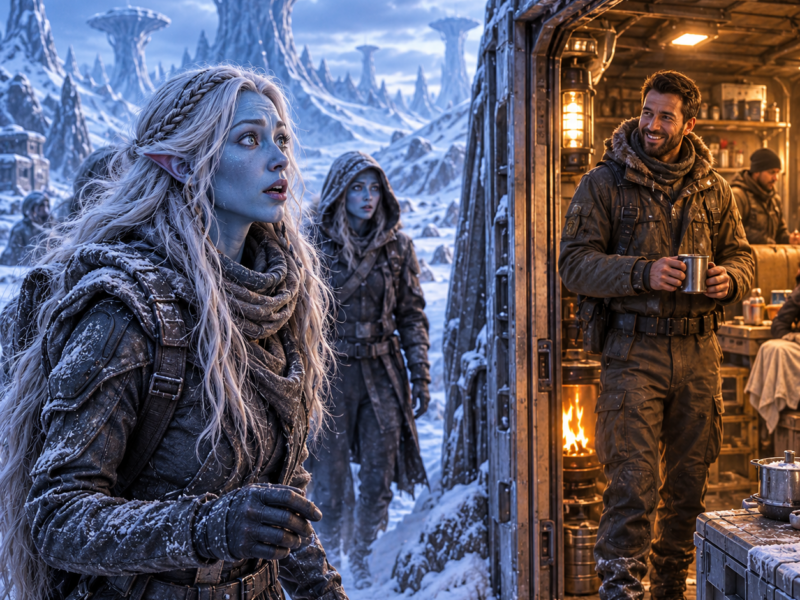
When the alien delegation arrived at our Arctic research station, their commander ordered my crew to surrender our shelter, laughing as he called us primitive animals, but he had no idea that the humans he considered weak were about to survive the one thing his entire species feared: the cold.
The sky above the Arctic research station fractured into streaks of violent violet light, signaling an arrival that would change human history forever.
Three colossal alien vessels breached the cloud cover, plunging toward the frozen expanse with a deafening roar that shook the ice sheets for miles.
Chunks of ancient glaciers broke loose, crashing into the dark ocean below as the ships settled less than a mile from our doorstep.
We had spent fourteen months at Station Omega, monitoring seismic shifts and maintaining our isolated geothermal outpost in total peace.
To us, this harsh wasteland was a sanctuary of scientific discovery and quiet resilience.
To the uninvited visitors, however, our home was about to become an impossible trial.
The lead vessel’s boarding ramp hissed open, expelling a thick cloud of pressurized mist into the sub-zero air.
A towering figure emerged, draped in an elaborate heated environmental suit that glowed with an ominous amber hue.
He stepped onto the snow, his heavy boots crushing the pristine crust beneath him with calculated arrogance.
Commander Zorak of the Veyr Empire strode toward our reinforced airlock with an entourage of heavily armed soldiers behind him.
His shimmering blue scales caught the pale polar light, giving him a terrifying, reptilian majesty.
He keyed his external speaker, projecting a voice that echoed coldly across the frozen valley.
“I am Commander Zorak of the Veyr Empire,” he announced to the empty wind.
“This territory is now under imperial protection, and your primitive outpost is requisitioned.”
I stood just inside the airlock threshold, watching his breath form frozen crystals against his metallic visor.
“Welcome to Antarctica,” I replied, crossing my arms against the chill.
He ignored my greeting entirely, his glowing eyes fixed on my face with utter disdain.
“Your species will evacuate immediately,” he demanded, gesturing for his soldiers to secure the perimeter.
My colleague Sarah leaned toward me from the shadows of the doorway and whispered with a wry smile, “They look entirely too warm.”
I almost laughed out loud, noting the subtle trembling in the commander’s gauntleted hands.
The Veyr hailed from a lush tropical world where temperatures never dipped below seventy degrees Fahrenheit.
Their biology was meticulously adapted to retain intense heat, making them catastrophically unequipped for polar extremes.
Even the ambient warmth of our station’s outer corridor would likely cause their internal regulators to panic.
Yet Zorak stood tall, refusing to show a single ounce of vulnerability to what he considered lesser life forms.
He motioned forward, ordering his elite guard to forcefully remove us from the console room.
Two soldiers marched past him, stepping into the unheated airlock transfer zone with stiff, robotic strides.
Within seconds, the first soldier stumbled, gasping for air as his adaptive suit hissed a warning chime.
His vibrant blue scales turned a sickly, pale lavender, and he collapsed onto the frozen metal floor.
Another alien rushed to his side, shouting frantic commands in a harsh, clicking dialect.
Within minutes, six of their finest warriors were lying incapacitated on the deck, shivering violently.
The sudden collapse of the Veyr soldiers threw their entire command structure into utter chaos.
Commander Zorak rushed back inside the airlock, his calm demeanor shattering as he stared at his stricken men.
“What have you done to them?” he roared, leveling a heavy energy weapon directly at my chest.
I didn’t flinch, keeping my hands visible and steady as I looked down at the freezing soldiers.
“I didn’t do anything,” I said calmly. “Your environment suits aren’t rated for negative fifty degrees.”
“Lies!” Zorak shouted, though his own breath was coming in ragged, freezing gasps. “Our technology is peerless!”
“Biology doesn’t care about your technology,” Sarah intervened, stepping forward with a medical kit in hand.
“They are suffering from acute thermal shock and rapid-onset frostbite. If you don’t let us help, they will die.”
Zorak stared at the unconscious warrior at his feet, his jaw tightening in a mixture of fury and helpless terror.
The weapon in his hand lowered by a fraction of an inch as reality began to set in.
“Save them,” he ordered through clenched teeth, his voice laced with bitter humiliation.
“Only if you lower your weapons and step inside where it’s warm,” I countered, holding my ground.
He hesitated, looking around at his shivering guard before finally giving a sharp, defeated nod.
We rushed the incapacitated aliens into our medical wing, scrambling to hook them up to thermal regulators.
Sarah worked frantically, administering warm intravenous fluids while I cranked up the station’s core heaters.
The aliens watched us with wide, suspicious eyes, utterly bewildered by our medical equipment.
One young soldier, his scales still dangerously pale, clutched an insulated wool blanket around his shaking shoulders.
“Why are you helping us?” he whispered through his translation implant, his voice trembling uncontrollably.
I adjusted his IV drip and offered a reassuring nod.
“Because you’re freezing to death,” I answered simply.
He looked down at the thick fabric, completely baffled by the concept of unprovoked compassion.
“Even after we threatened you and demanded your home?” he asked, searching my eyes for deceit.
“Especially then,” I replied, standing up to check the monitors on the next bed.
For the first time since their dramatic landing, I saw something shift behind the arrogant facade of the Veyr.
It wasn’t anger or tactical calculation; it was profound, unexpected shame.
Zorak stood in the doorway, watching the exchange in silence without uttering a single boastful word.
The invincible conquerors of the stars had been brought to their knees not by weapons, but by simple winter weather.
Over the next several days, the atmosphere inside Station Omega transformed in ways none of us could have predicted.
The injured Veyr soldiers recovered under our care, their vibrant blue scales gradually returning to a healthy hue.
Commander Zorak remained distant, but his sharp orders ceased entirely, replaced by silent observation.
One afternoon, I found him standing in front of our equipment storage rack, staring at a standard cold-weather survival suit.
He reached out a cautious finger, touching the multi-layered Gore-Tex fabric with genuine fascination.
“Your species built all this simply to endure this wasteland?” he asked without turning around.
I walked over, leaning against the metal shelving unit beside him.
“No,” I replied honestly. “We built it because we wanted to explore, understand, and master the extremes.”
He turned his glowing eyes toward me, a deep frown creaking across his scaly brow.
“Your home planet is hostile,” Zorak murmured, shaking his head slowly. “It tries to kill you at every turn.”
I smiled faintly at the observation, thinking of all the blizzards and ice storms we had weathered.
“Sometimes, yes,” I admitted. “We still love it anyway.”
That evening, a sudden meteorological anomaly struck the region with terrifying fury.
A massive polar storm swept across the ice shelf, driving winds up to one hundred and twenty miles per hour.
The howling gale battered the exterior of the alien starships parked less than a mile away.
Alarms began blaring from the Veyr landing zone through our closed-circuit monitoring system.
Zorak sprinted into the control room, his expression pale with panic as he stared at his tactical displays.
“The thermal regulators on all three vessels have suffered catastrophic failure,” he announced breathlessly.
Without those vital systems, the remaining Veyr crew members trapped inside the ships would succumb to the cold within the hour.
Zorak turned to me, his shoulders slumping as the heavy weight of command crushed his pride.
“Human,” he began, struggling to find the words that would humble his entire civilization.
I waited patiently, knowing exactly what he was about to ask.
“Can we bring our people here?” he whispered, his eyes avoiding mine. “Can we stay in your shelter?”
I didn’t hesitate for a single second.
I walked over to the main airlock control panel and punched in the override code.
“There’s plenty of room,” I said, opening the heavy blast doors to let the howling wind and freezing refugees inside.
For the first time since their arrival, Commander Zorak bowed his head in deep, sincere gratitude.
Within an hour, dozens of Veyr soldiers crowded into our subterranean hallways, shedding their damaged armor in a collective rush for warmth.
The tension that had defined our initial meeting dissolved into an atmosphere of exhausted camaraderie.
Humans and aliens shared communal rations around the mess hall tables, trading stories across insurmountable cultural divides.
Sarah managed to introduce the Veyr to instant coffee, a substance that instantly became their greatest obsession.
One burly alien soldier named Kael took a cautious sip from a tin mug and gasped in delight.
“It burns my tongue,” he declared happily, “and makes my mind race with terrifying clarity.”
I laughed, handing him a packet of sugar to soften the bitter edge.
“That’s the secret to human endurance,” I joked. “Caffeine and stubborn optimism.”
Kael grinned, his sharp teeth gleaming in the warm light of the galley.
Later that night, I walked down the dim corridor toward the main observation lounge to check the perimeter monitors.
I found Zorak standing alone beside the massive reinforced glass window, staring out into the pitch-black polar night.
The storm was still raging outside, painting the landscape in ghostly swirls of white.
“Something wrong with the patrol logs?” I asked, stepping up beside him.
He hesitated, his reflection shimmering faintly in the triple-pane glass.
“On my homeworld, we were taught that humans were weak,” he confessed quietly.
I crossed my arms, waiting to hear the conclusion of his thoughts.
“We believed you were fragile because you required so many external tools just to exist,” he continued.
“And now?” I prompted gently.
He turned his head to look directly at me, his expression solemn and deeply reflective.
“Now I understand,” Zorak said softly. “You don’t simply survive hostile environments. You conquer them from within.”
Before I could formulate a meaningful reply, a sharp chime interrupted the quiet hum of the station.
The comms console on the wall flickered to life, flashing an encrypted priority alert from deep space.
Zorak stepped over to the terminal, his scaled fingers flying across the holographic interface to decode the signal.
As he read the incoming transmission, the color drained completely from his face.
The silence in the observation lounge became suffocating as Zorak stared at the glowing holographic text.
His breathing grew shallow, and the ambient lights reflecting off his scales flickered with uncertainty.
“Commander?” I stepped closer, sensing the sudden shift in the room’s energy.
Zorak turned around slowly, his eyes wide with a mixture of dread and disbelief.
“Our imperial command center,” he began, his voice barely above a whisper. “They intercepted our initial distress beacon.”
I kept my voice steady. “And?”
“They know we were defeated not by weapons, but by your climate,” Zorak said, swallowing hard.
“They have dispatched an entire invasion fleet to this sector.”
A cold chill ran down my spine, far worse than anything the Antarctic wind could produce.
“How many ships?” I asked, my mind racing through our meager defenses.
Zorak looked back toward the window, where the distant, unnatural lights were beginning to multiply above the ice shelf.
“Enough to conquer your entire planet,” he answered grimly.
I stared at him for a long moment, processing the astronomical odds stacked against us.
Then, against all reason, a slow smile crept across my face.
I reached up and zipped my winter jacket all the way to my chin.
“Then I guess they’re going to need a lot of warmer clothes,” I remarked dryly.
Zorak didn’t smile back at my grim humor, his expression remaining grim and deeply troubled.
Because he knew a terrifying secret that I had yet to comprehend.
“You don’t understand,” Zorak said, gripping the edge of the metal console.
“They aren’t coming to destroy you out of vengeance.”
I raised an eyebrow. “Then why are they bringing an invasion fleet?”
“Because the Veyr ancestors abandoned this quadrant of space eons ago,” he explained urgently.
“They believed no organic life could ever master a world this brutally cold.”
The realization hit me like a physical blow to the chest.
“They’re coming because they want to know how we did it,” I whispered.
Zorak nodded slowly. “They want your technology, your resilience, and your secrets of survival.”
The distant lights in the upper atmosphere grew brighter, resolving into the unmistakable silhouettes of hundreds of descending warships.
The station erupted into immediate, frantic motion as the news of the approaching armada spread through the corridors.
Humans and Veyr soldiers moved as a unified unit, trading tactical expertise and reinforcing every bulkhead.
Sarah organized the medical bays, stocking every available shelf with thermal gear and emergency stimulants.
I gathered the command staff in the central briefing room to review our defensive layout.
Zorak stood beside me at the holographic tactical table, projecting the topography of the entire polar region.
“Their main drop ships will land on the western glacier,” Zorak pointed out, tracing a glowing red line.
“That terrain is unstable,” I noted, studying the elevation maps. “If we trigger localized avalanches…”
“It will crush their landing columns before they even deploy,” Kael finished, grinning fiercely.
The transformation of the Veyr soldiers was complete; they were no longer imperial conquerors, but fierce defenders of our shared ice.
We spent the next six hours rigging seismic charges along the ridge lines overlooking the primary landing zones.
Every human engineer and Veyr warrior worked side by side in the freezing gale, defying the approaching doom.
I looked around at the makeshift army we had forged at the edge of the world.
It was a crazy coalition of tropical invaders and polar natives standing shoulder-to-shoulder against an empire.
Zorak walked up beside me as we secured the final detonation cable into the snowbank.
“Your species is truly defying every law of the cosmos,” he muttered, shaking his head in awe.
“We’re just stubborn,” I replied, wiping frost from my goggles.
“Stubbornness is a greater power than plasma cannons,” Zorak said with quiet conviction.
The sky above us roared as the vanguard of the Veyr imperial fleet finally entered the lower stratosphere.
Enormous shadow-draped hulls blotted out the stars, casting an intimidating darkness across the white expanse.
Drop pods began detaching from the lead capital ships, streaking downward like fiery meteors toward the ice.
“They’re initiating descent,” Zorak announced, his voice echoing through our comms units.
The first wave of imperial drop pods slammed into the western glacier with deafening concussive force.
Snow and ice exploded into the freezing air, creating a blinding whiteout that obscured the landing zone.
From my observation post on the ridge, I gripped the detonator trigger with gloved fingers.
“Hold your positions,” I spoke into the encrypted channel, watching the enemy movement on thermal scopes.
The drop pod hatches blew open, releasing hundreds of elite imperial shock troopers into the gale.
Just like their commander before them, they stepped out onto the ice wearing standard tropical Veyr gear.
And just like before, reality caught up with them almost instantly.
The biting polar wind tore through their lightweight thermal regulators within seconds.
Their glowing blue scales began to shift to that familiar, sickly pale lavender as hypothermia seized their bodies.
“Now!” I shouted, pressing the master detonation switch on my console.
A series of thunderous explosions echoed across the valley as the rigged seismic charges blew.
Millions of tons of snow and ice cascaded down the mountain slopes, burying the vanguard in an avalanche.
Zorak watched the tactical feeds from the command center, letting out a breath of pure astonishment.
“You turned their own planet against them,” he said over the comms link.
“No,” I replied, watching the snow settle over the buried enemy columns. “We just gave the cold a little push.”
The remaining drop ships hovered erratically in the upper air, clearly confused by the catastrophic loss of their advance guard.
Their onboard sensors had not registered conventional weaponry, only a natural environmental disaster.
They didn’t understand how an inferior species could weaponize the very weather they feared.
“They are regrouping,” Zorak warned, analyzing the shifting telemetry data on his display.
“They’ll try a coordinated descent directly over the station next,” I predicted, checking my rifle load.
“Let them come,” Kael’s voice crackled over the radio, filled with newfound loyalty. “We are ready.”
The massive capital ships above began shifting their formation, glowing weapon arrays powering up with lethal intent.
The final battle for Station Omega—and perhaps the fate of humanity—was about to begin in earnest.
We stood our ground in the freezing dark, ready to prove that warmth lives not in the climate, but in the heart.
The imperial fleet descended in a terrifying formation, unleashing warning plasma blasts that melted the ice around our perimeter.
Steam hissed into the freezing air as glowing craters formed hundreds of yards from our reinforced blast doors.
Inside the station, every alarm wailed in unison, flashing emergency red against the metal bulkheads.
“Main shield generators at ninety percent!” Sarah reported over the comms, her voice remarkably calm under pressure.
“Hold the line!” I shouted back, manning the primary thermal turret in the central courtyard.
Commander Zorak stood beside me, his specialized rifle primed and aimed at the descending enemy transport.
The lead enemy ship hovered directly above our compound, lowering a heavy boarding ramp filled with elite guards.
“Surrender, Commander Zorak!” a booming voice echoed from the ship’s external speakers across the frozen valley.
“You harbor primitive parasites who defy the natural order of the empire!”
Zorak stepped forward into the biting wind, pressing his comms button to broadcast his reply to the entire fleet.
“The only parasites here are those who conquer without understanding!” Zorak roared back defiantly.
“Humans are not weak; they are the masters of endurance!”
With that, Zorak fired his weapon, disabling the transport’s primary engine thruster with a precise energy bolt.
The crippled ship drifted sideways, caught instantly by the violent polar gales we knew so well.
It slammed helplessly into the adjacent ice shelf, disabling its automated deployment systems in a cloud of snow.
Cheers erupted across our secure radio channels as the second wave crumbled into disarray.
The invading soldiers trapped outside began scrambling for shelter, abandoning their offensive formation entirely.
They had brought weapons to conquer a world, but they had forgotten how to survive its basic elements.
I lowered my rifle slightly, watching the imperial forces retreat toward their remaining hovering vessels.
“They’re pulling back,” I breathed out in relief, feeling the adrenaline slowly subside in my veins.
Zorak nodded slowly, a proud smile finally breaking through his scaly features.
The remaining Veyr warships retreated slowly into the upper atmosphere, their glowing hulls dimming in defeat.
The sky above Antarctica gradually returned to its crisp, clear polar blue, untouched by the scars of battle.
Silence settled once more over Station Omega, broken only by the familiar howling of the wind.
Inside the mess hall, humans and Veyr soldiers gathered together to celebrate their impossible victory.
Cups of steaming coffee were passed around freely, shared between old enemies turned loyal allies.
Kael clapped me on the shoulder with enough force to nearly knock me off balance.
“You humans are truly insane,” Kael laughed heartily, taking a long sip from his mug.
“Maybe so,” I smiled, raising my own cup in response. “But we make great neighbors.”
Commander Zorak walked over, holding a secure data tablet displaying a message from the imperial high command.
He looked at me with deep respect, his posture formal yet entirely at ease.
“They have officially recognized this sector as an independent territory under our joint protection,” Zorak announced.
“Translation?” I asked, raising an eyebrow.
“They aren’t coming back,” Zorak said with a grin. “At least, not without bringing a heavy winter coat.”
The entire room erupted into laughter, dissolving the lingering tension of the past few weeks.
We had faced the might of an interstellar empire and won not through superior firepower, but through sheer resilience.
Sarah walked up beside me, handing me a fresh cup of coffee as we looked out the observation window.
The endless white horizon stretched endlessly into the distance, beautiful and unforgiving as ever.
It was still the harshest place on Earth, but it was now a home shared by two worlds.
And as I watched the polar sunrise paint the ice in brilliant shades of gold, I knew one thing for certain.
No matter what came next from the stars, we were ready to face it together.
Because the cold had tested us, and together, we had learned that true survival is built on unity.
The days following the battle brought a profound peace back to our isolated research outpost.
The remaining Veyr soldiers integrated seamlessly into our daily operations, trading scientific data for survival tips.
Even the station’s geothermal heaters seemed to run smoother, fueled by a renewed sense of shared purpose.
I stood outside the main airlock early one morning, breathing in the crisp, sub-zero air without a single trace of fear.
Zorak stepped out beside me, his heated suit humming quietly as he adjusted his visor against the glaring snow.
“You know,” Zorak remarked thoughtfully, watching the distant horizon. “My people still call this place a wasteland.”
I looked over at him, pulling my scarf a little tighter around my neck against the gentle morning breeze.
“Let them think that,” I replied with a quiet smile.
“It keeps the wrong kind of visitors away.”
Zorak chuckled, a deep rumbling sound that echoed softly in the quiet polar air.
He turned his gaze toward the endless expanse of white, looking at the ice not with dread, but with understanding.
“On my world, we sought comfort in the warmth,” Zorak said softly, his voice carrying on the wind.
“Here, you found strength in the cold,” I finished for him, nodding in complete agreement.
He looked at me, his glowing eyes reflecting the brilliant reflection of the morning sun upon the snow.
“Yes,” he whispered. “And for the first time in our history, the Veyr have finally learned what it means to truly live.”
We stood there in comfortable silence for a long time, watching the horizon stretch out infinitely before us.
The universe out there was vast, unpredictable, and often overwhelmingly hostile to those who refused to adapt.
But as long as we stood together, no environment on Earth or beyond could ever break our spirit.