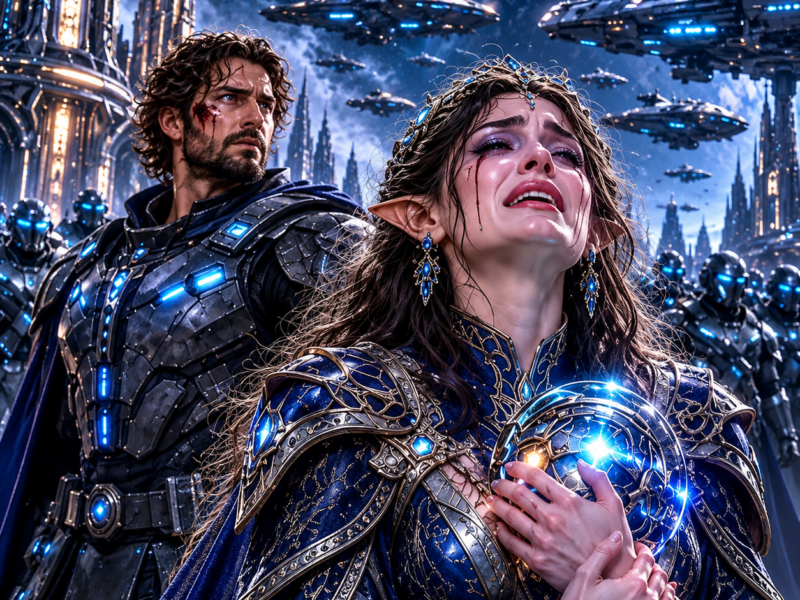
When the alien ambassador begged the Galactic Council to save his dying people, Earth’s representative was laughed out of the chamber, until humanity’s supposedly primitive warships arrived carrying something the galaxy had spent centuries trying to destroy: the legendary deathworlders.
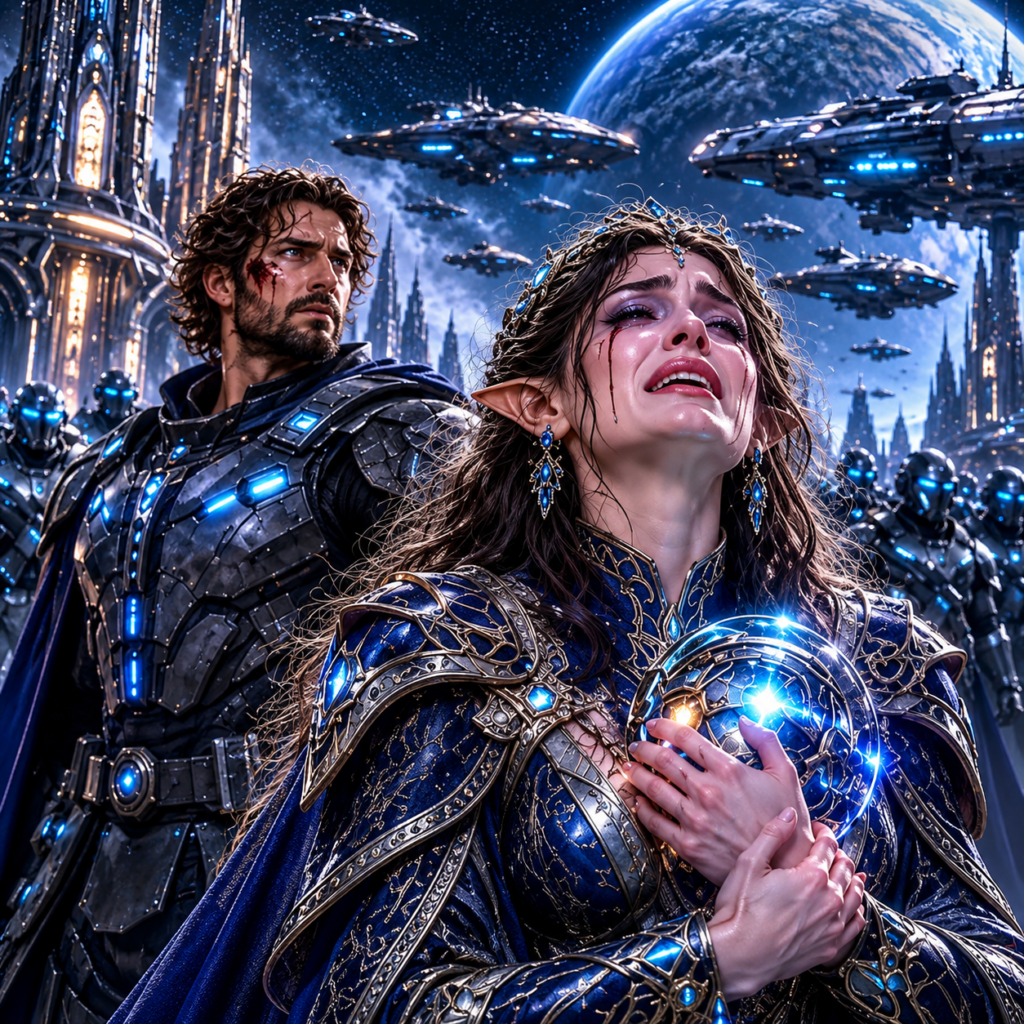
The room aboard the human flagship fell silent.
Admiral James Walker stared at the image projected above the command table. Hundreds of red markers covered the galactic map. Some represented industrial worlds. Others were agricultural planets, scientific colonies, and peaceful civilizations that had never possessed a military fleet.
But every marker carried the same symbol.
A human skull.
“Magnify the lower-right section,” Walker ordered.
The tactical officer obeyed.
A series of coordinates appeared, followed by a string of encrypted Dravak symbols. The ship’s translation system struggled for several seconds before producing a sentence.
PROJECT EXTINCTION: THE FINAL SOLUTION TO THE HUMAN THREAT.
Walker felt something cold settle in his chest.
“How long have they known about us?”
“Unknown, sir. However, the data suggests this operation has been planned for at least eighty standard years.”
“Who authorized it?”
The officer hesitated.
“Not the Dravak Empire, Admiral.”
Walker turned.
“What?”
“The authorization signature belongs to a civilization identified as the First Architects.”
For several seconds, nobody spoke.
The First Architects were the oldest known civilization in the galaxy. Their ruins were scattered across hundreds of star systems, their technology had shaped the earliest galactic governments, and their laws were the foundation upon which the Galactic Council had been built.
They were believed to have vanished nearly ten thousand years earlier.
“Admiral,” the officer continued, “there’s another file.”
He brought up a recording.
A tall figure appeared on the screen. Its body was covered in dark metallic scales, and its eyes glowed with an unnatural blue light.
It spoke in a language the translation system recognized immediately.
Ancient Terran.
“To whoever discovers this message: the deathworlders have awakened. The extinction protocol must begin before they reproduce beyond containment.”
Walker stared at the screen.
Then the figure continued.
“We made a mistake when we created them.”
The recording ended.
“Created them?” Walker whispered.
Behind him, Captain Sarah Mitchell stepped forward.
“Sir, the Council is requesting an immediate explanation. They’ve detected the transmission.”
“Tell them humanity has no intention of explaining itself right now.”
“Then what are our orders?”
Walker looked at the red markers.
For the first time since arriving at Veyara, he seemed uncertain.
“Contact Earth. All military commands. Activate Operation Hearthfire.”
Sarah’s face went pale.
“Sir, that’s a planetary defense protocol.”
“No.”
He looked at her.
“It’s something much older.”
Three hours later, every major military command on Earth received the same message.
It contained only four words.
THE CHILDREN ARE THREATENED.
The response was immediate.
Deep beneath the Rocky Mountains, doors that had remained sealed for nearly a century began opening. In the Pacific Ocean, dormant naval platforms emerged from the depths. On the Moon, underground hangars illuminated as enormous spacecraft powered up for the first time in generations.
Across Earth, governments suspended political disagreements and placed their armed forces under a unified command.
The world had seen wars before. It had suffered invasions, disasters, and the collapse of entire civilizations.
But humanity had never forgotten the lesson of its own history.
A threat to its children was a threat to its future.
And this time, the enemy had made the mistake of announcing its intentions.
At the United Nations Defense Headquarters, Commander Elena Hayes stood before a room filled with generals and intelligence officers.
A holographic map displayed the same red markers Walker had discovered.
“These are not random targets,” she explained. “They’re all worlds with populations that have demonstrated unusual biological resilience, independent technological development, or a history of resisting conquest.”
A general frowned.
“Why would an ancient civilization care about that?”
“Because they’re looking for something.”
Elena changed the display.
A series of genetic profiles appeared, each belonging to a different species.
At the center was humanity.
“These civilizations share a biological marker. A dormant genetic sequence that the First Architects called the Adaptive Flame.”
An intelligence officer raised his hand.
“Are you suggesting we’re related?”
“Not exactly. The First Architects conducted experiments across multiple worlds. They attempted to create organisms capable of surviving environments that would kill ordinary life.”
She paused.
“Most experiments failed. Some species developed the ability to regenerate tissue. Others evolved extreme sensory perception or unusual resistance to radiation. Humanity was different.”
“Different how?”
Elena enlarged a human genetic profile.
“We didn’t become powerful because we were designed to be powerful. We became powerful because our ancestors survived things that should have killed them.”
The room remained silent.
“Every disease, every climate disaster, every predator, every war, every famine forced us to adapt. Our ancestors had no guarantee of survival. They simply refused to surrender.”
A general folded his arms.
“So the Architects are afraid of us?”
Elena shook her head.
“They’re afraid of what happens when we stop fighting for ourselves and start fighting for everyone else.”
She pointed at the red markers.
“Because then, we become something they cannot control.”
Far beyond Veyara, in a region of space where even the Council’s navigation systems refused to operate, an enormous structure awakened.
It was called the Cradle.
Its central chamber contained millions of suspended biological specimens, preserved for thousands of years. Entire species existed inside its chambers, waiting for an opportunity to be released.
At its center stood an ancient machine.
The machine opened its eyes.
“Human civilization confirmed,” it announced.
A holographic figure appeared above the chamber.
It resembled the being from the recovered recording.
“Begin the extinction protocol.”
A mechanical voice answered.
“Estimated probability of success?”
“One hundred percent.”
“Historical record indicates previous attempts failed.”
The holographic figure became still.
“Previous attempts involved primitive methods. This time, we will eliminate their breeding worlds, destroy their communication networks, and erase their historical records.”
“Additional concern detected.”
“Explain.”
“The human population has access to interstellar technology.”
The figure laughed.
“Technology can be destroyed.”
“Additional concern detected.”
“What now?”
“Human military personnel have established protective relationships with multiple target civilizations.”
The figure stopped laughing.
“That is irrelevant.”
“Historical data indicates that human protective instincts increase combat effectiveness when nonhuman civilians are threatened.”
A long silence followed.
Then the figure spoke.
“Remove the civilians first.”
The first attack began eleven hours later.
It wasn’t directed at Earth.
It was directed at Veyara.
An enormous black sphere emerged from hyperspace beyond the planet’s outer moon. It was nearly thirty kilometers across, with no visible weapons or engines. Its surface appeared to absorb the light of nearby stars.
The human fleet immediately went to combat alert.
“Unknown vessel detected!” shouted the sensor officer. “Energy readings are increasing!”
Walker entered the bridge.
“Identify it.”
“We can’t. It’s not transmitting.”
“Then scan it.”
The officer swallowed.
“Admiral, we’re detecting biological signatures.”
“How many?”
“Millions.”
The bridge fell silent.
The sphere opened.
Thousands of smaller objects poured from its surface, each resembling a metallic insect with six razor-sharp limbs.
They moved toward Veyara.
“All ships, engage!” Walker ordered.
Human weapons tore through the first wave, but the insects continued coming. They adapted to every attack, changing their armor composition and redistributing their energy shields.
Within minutes, three human destroyers were disabled.
“Sir, they’re targeting the evacuation corridors!”
Walker slammed his fist against the command table.
“Get the civilians underground!”
A second alarm sounded.
The insects had reached the atmosphere.
On the surface, Veyari families ran toward emergency shelters while human soldiers formed defensive lines around them.
One soldier, Sergeant Daniel Brooks, found Lyra standing beside a collapsed medical transport.
She was holding a small stuffed animal.
“Where’s your mother?” he asked.
Lyra pointed toward the burning city.
“She went back for my brother.”
Daniel looked toward the horizon. The insects were approaching.
He crouched.
“What’s your brother’s name?”
“Kael.”
“Okay, Lyra. I’m going to find him.”
“But the monsters…”
Daniel smiled beneath his helmet.
“Then I guess they’ll have to get through me first.”
He handed her to a Veyari medic and ran toward the city.
The battle lasted another forty minutes.
By the time Daniel found Kael, the boy was trapped beneath a collapsed transit platform. His mother lay beside him, badly wounded but still alive.
Daniel lifted the debris with the help of two other soldiers.
They were almost back to the evacuation zone when the sky turned black.
A massive insect descended directly in front of them.
Its limbs unfolded.
Daniel raised his rifle.
He had six rounds remaining.
“Get behind me,” he told the Veyari family.
The creature lunged.
Then a beam of blue light struck it from above.
The insect exploded.
A human spacecraft descended through the clouds.
It was not one of the original twelve warships.
Its hull was enormous, almost twice the size of the flagship, and its surface was covered with symbols that had not appeared on any human military vessel before.
Across its side were two words.
UNSINKABLE HOPE.
The ship’s commander transmitted a message.
“Ground forces, this is Earth Defense Fleet. We’ve arrived.”
Daniel looked up.
“About time.”
The arrival of Earth’s second fleet changed everything.
Unlike the original twelve warships, these vessels were equipped with technology that the Galactic Council had never encountered.
Their weapons did not merely destroy enemy armor. They disrupted the machines’ ability to communicate, preventing them from adapting to coordinated attacks.
Within twenty minutes, the insect swarm collapsed.
The black sphere attempted to retreat.
It never made it.
Human vessels surrounded it, deployed gravitational anchors, and pulled it into a containment field.
For the first time in ten thousand years, the Cradle had lost one of its weapons.
But Walker was not celebrating.
He stood inside the captured sphere, surrounded by human scientists and heavily armed security personnel.
At its center was a chamber containing thousands of biological specimens.
One of them was unmistakably human.
A woman.
Her body was suspended inside a transparent container, her face perfectly preserved despite the passage of thousands of years.
Walker approached.
A label appeared beneath the container.
SPECIMEN 001: ORIGINAL HUMAN LINEAGE.
His heart began beating faster.
“Is she alive?”
The chief scientist examined the readings.
“Biologically, yes. Her metabolism is almost completely suspended.”
“Can we wake her?”
The scientist hesitated.
“Possibly. But there’s something else.”
He pointed toward the woman’s hand.
A small metal object was embedded beneath her skin.
A wedding ring.
Walker stared at it.
The inscription was written in ancient English.
MARA, ALWAYS HOME.
He stepped back.
“That’s impossible.”
The scientist looked at him.
“Do you recognize it?”
Walker nodded slowly.
“My wife had the same ring.”
The woman awakened seventeen minutes later.
Her name was Mara.
She was disoriented, frightened, and unable to understand why the world around her was filled with unfamiliar faces.
When she finally spoke, the first words she uttered were in English.
“Where is Earth?”
Walker sat beside her.
“Safe. For now.”
She studied his uniform.
“What year is it?”
“Twenty-one eighty-seven.”
Her face went white.
“No.”
She began shaking.
“That can’t be.”
“What’s wrong?”
She grabbed his wrist.
“They found us.”
“Who?”
“The Architects.”
Walker leaned closer.
“Tell me what happened.”
Mara closed her eyes.
“We were the first humans they created. They placed us on a young planet and watched us develop. But they underestimated something.”
“What?”
“We learned to love.”
Walker said nothing.
Mara continued.
“The Architects believed that intelligence existed to establish control. They believed every species would eventually conquer its neighbors. When they discovered humans sacrificing themselves for one another, they considered it a defect.”
She looked toward the chamber.
“They tried to correct us. They introduced predators, diseases, wars, and environmental catastrophes. Every time we survived, they made the next test harder.”
Walker’s expression darkened.
“Are you saying they caused our history?”
“Not all of it. But they manipulated enough events to shape our development.”
“Why?”
Mara looked directly at him.
“Because they were trying to create a species that could survive anything without ever learning compassion.”
She paused.
“They failed.”
Walker glanced at the wedding ring.
“How did you end up here?”
Mara’s eyes filled with tears.
“I was part of a resistance group. We discovered the Cradle and tried to destroy it. I thought I had succeeded.”
“What happened?”
“They captured me. Then they began searching for the other human colonies.”
Walker stood.
“Other colonies?”
Mara nodded.
“There are more humans out there. Thousands. Some were transported to distant worlds before the Architects disappeared. They may have developed without ever knowing Earth existed.”
A new transmission interrupted them.
It came from Elena Hayes.
“Admiral, we’ve discovered something in the captured sphere. The Architects have activated a network of ancient installations. They’re sending signals to every marked world.”
“What’s the message?”
Elena hesitated.
“An ultimatum. Every civilization must surrender its biological population for preservation. Those that refuse will be erased.”
Mara began crying.
“They’re going to open the Cradle.”
Walker looked at the image of the galaxy.
“Then we’ll close it.”
The Galactic Council convened an emergency session.
This time, no one laughed when the human representative entered.
Elena stood before the assembled delegates, accompanied by Ambassador Thalen and Mara.
The Council’s president, a massive insectoid creature, leaned forward.
“Humanity claims the First Architects are responsible for the current attacks. What proof do you possess?”
Mara stepped forward.
“I am the proof.”
She explained everything she knew, describing the experiments, the genetic manipulation, and the purpose of the Cradle.
The chamber grew increasingly restless.
A reptilian delegate finally spoke.
“Even if your claims are true, what do you expect us to do? We have no military capability against such an ancient enemy.”
Elena looked around the chamber.
“Then stop thinking like a collection of frightened governments.”
A murmur spread.
“Humanity has lost ships. Our soldiers are dying. Our worlds are preparing for attacks. But we are not asking you to fight our war.”
She placed a hand on the table.
“We’re asking you to defend your own people.”
Thalen rose.
“The Veyari will provide medical facilities and evacuation ships.”
Another delegate stood.
“The Zorath will contribute their mining fleets to construct defensive platforms.”
A third representative followed.
“The Kethari will share their energy technology.”
One by one, civilizations that had spent centuries refusing to cooperate began offering assistance.
The Council’s president watched in disbelief.
For the first time in its history, the galaxy was united not by fear of an enemy, but by a shared determination to protect one another.
Elena turned toward the reptilian delegate who had laughed at Thalen.
“You once said the Veyari should have surrendered earlier.”
The delegate lowered his head.
“I was wrong.”
“Remember that.”
She returned to her seat.
The war had begun.
The Architects did not wait.
Within three days, their main installation emerged near the galactic center.
It was larger than a moon, surrounded by thousands of automated defense platforms. Its structure resembled a colossal mechanical tree, with branches extending into hyperspace.
Every marked planet began receiving energy pulses.
On Earth, scientists detected the first signs of atmospheric disruption.
The Architects were preparing to activate the extinction network.
Walker assembled the allied fleet.
More than twenty thousand vessels answered the call.
Some were powerful warships. Others were civilian transports carrying medical equipment, food, and evacuation supplies.
The human fleet remained at the center.
Twelve original vessels had become seven.
The others had been lost defending Veyara.
Walker stood before his officers.
“We are facing an enemy that has existed longer than our oldest civilizations. They know our biology, our technology, and our weaknesses.”
He looked around.
“They believe compassion makes us vulnerable.”
He paused.
“Today, we prove that compassion is the reason we are still here.”
The allied fleet jumped into hyperspace.
The battle began almost immediately.
The Architects’ weapons tore through the first defensive line. Entire formations vanished beneath waves of gravitational energy.
But the allied ships did not break.
Veyari medical vessels moved into dangerous zones to rescue wounded pilots. Zorath engineers repaired damaged shields while under fire. Kethari energy specialists synchronized their power grids with human weapons.
For the first time, the galaxy fought as one.
And for the first time, the Architects began to lose.
But their central installation remained untouched.
Walker studied the tactical display.
“Why aren’t they defending the core?”
Mara, who had joined the flagship’s command staff, examined the data.
“Because the core isn’t a weapon.”
“Then what is it?”
“The original Cradle.”
She enlarged the image.
“Every installation is connected to it. Destroying the network remotely won’t work. Someone has to reach the central chamber and shut it down manually.”
Walker understood immediately.
“How do we get there?”
Mara pointed to a narrow opening beneath the installation.
“Through the central ventilation shaft.”
Sarah Mitchell stared at her.
“That’s not a ventilation shaft. It’s a hyperspace conduit.”
“Exactly.”
“And what happens if a ship enters it?”
Mara looked at Walker.
“It won’t come back.”
The admiral studied the battlefield.
Then he smiled sadly.
“Sounds like a human job.”
The flagship, Resolute, began its final approach.
Walker ordered the allied fleet to maintain the defensive perimeter while the remaining human ships formed an escort.
Sarah stood beside him.
“Sir, you’re not seriously planning to pilot the ship into that thing.”
“Someone has to.”
“I can take command.”
Walker shook his head.
“You have a family waiting on Earth.”
“So do you.”
He looked at the photograph in his hand.
For a moment, the noise of the bridge seemed to disappear.
“Not anymore.”
Sarah stepped closer.
“That’s not true, sir.”
She pointed toward the Veyari child sleeping in the medical section.
“Neither is that.”
Walker looked away.
He had spent years believing that his family had died because he had failed to protect them. Now, for the first time, he wondered whether protecting others might be a way to keep their memory alive.
He turned toward the controls.
“Prepare the ship.”
The Resolute accelerated.
Enemy fire struck its shields, stripping away layer after layer. The escort ships exploded around it, but they continued pushing forward.
Inside the central conduit, the laws of physics began to break down.
The ship’s hull twisted.
Its engines failed.
Then the bridge lights went dark.
“Power failure!” Sarah shouted.
Walker gripped the command console.
“Emergency batteries!”
“Unresponsive!”
Mara stared at the readings.
“We’re inside the core. The Architects are trying to separate our ship from normal space.”
A holographic figure appeared.
It was the same ancient being from the recording.
“Humanity,” it said. “You have exceeded every prediction.”
Walker stood.
“Then you should have planned better.”
The figure ignored him.
“You were designed to be obedient.”
“We weren’t designed by you.”
“You are an experiment.”
“We’re people.”
The figure’s eyes narrowed.
“You are a biological error.”
Walker looked at the faces around him.
His crew.
His soldiers.
The people who had followed him into a place from which nobody was expected to return.
“No,” he said quietly. “We’re the part you never understood.”
The hologram flickered.
“Explain.”
Walker raised his voice.
“We’re the people who carry strangers out of burning cities. We share food with enemies. We build homes for those who have lost theirs. We keep fighting when the universe tells us to give up.”
He stepped closer to the projection.
“And we don’t need to be perfect to be worth saving.”
The ancient figure remained silent.
Then the core began to open.
A blinding light filled the chamber.
Mara screamed.
“Walker! The shutdown mechanism is activating!”
The installation had begun its final sequence.
A timer appeared.
Ninety seconds.
Mara rushed toward the central console.
“The system requires a biological authorization from an original human specimen. I can stop it.”
Walker grabbed her arm.
“You’re not going near that thing.”
“I’m the only one who can!”
“There’s another way.”
He looked toward the console.
The original specimen chamber had been connected to the core.
A human handprint appeared on its surface.
Walker understood.
He placed his hand against it.
The system scanned his biology.
GENETIC AUTHORIZATION REJECTED.
He tried again.
GENETIC AUTHORIZATION REJECTED.
Mara shook her head.
“It only accepts the original lineage!”
Walker looked at her.
“Then give it what it wants.”
He reached for the medical device attached to her wrist.
Mara understood what he intended.
“No!”
“Your people need a future.”
“So do yours!”
The countdown reached forty seconds.
Mara seized his hand.
For one terrible moment, the two stared at each other.
Then she pressed her palm against the console.
GENETIC AUTHORIZATION ACCEPTED.
The system opened.
A final message appeared.
WARNING: SHUTDOWN WILL DESTROY ALL ARCHITECT NETWORKS. ALL PRESERVED SPECIMENS WILL BE RELEASED.
Mara looked at Walker.
“Thousands of species.”
“Then let’s bring them home.”
She pressed the final command.
The core went dark.
Across the galaxy, the extinction network collapsed.
The automated defense platforms stopped firing. The black spheres lost their power, and the insect machines fell lifeless from the skies.
On hundreds of worlds, the strange energy pulses ceased.
The war was over.
But the consequences of the shutdown were only beginning.
The preserved specimens inside the Cradle installations began awakening. Millions of creatures emerged from their suspended chambers, confused and frightened, carrying memories from civilizations that had disappeared thousands of years earlier.
Some were human.
Others belonged to species the Galactic Council had believed extinct.
The galaxy had not merely survived an attack.
It had recovered its lost history.
The Resolute was discovered drifting near the central installation three days later.
Its hull was badly damaged, and its engines were beyond repair.
But the crew was alive.
Walker had suffered severe injuries. Mara was unconscious, but her biological readings remained stable.
When the rescue vessel entered the bridge, Sarah Mitchell found the admiral sitting beside the command console.
He was holding his photograph.
“Sir,” she whispered.
Walker looked up.
“Did we make it?”
Sarah smiled through her tears.
“Yes, sir.”
He looked toward the observation window.
Outside, thousands of allied ships surrounded the remains of the Cradle.
“Good.”
Then he closed his eyes.
For the first time in years, James Walker slept without dreaming of war.
Six months later, the Galactic Council held a ceremony on Veyara.
The planet was rebuilding. Its cities were being reconstructed with assistance from dozens of civilizations, and its children had returned to their schools.
Lyra stood beside Thalen, wearing a small human military jacket that Daniel Brooks had given her.
She watched as the representatives gathered.
At the center of the ceremony stood Admiral Walker.
He walked with a cane now, and his uniform carried a new medal awarded by the Galactic Council.
But he seemed more interested in the small crowd of children gathered near the stage.
Among them was Lyra.
She approached him with a folded piece of paper.
“I made something for you.”
Walker accepted it.
The drawing showed twelve human warships surrounded by hundreds of smaller alien vessels. At the bottom, in uneven letters, she had written:
THE PEOPLE WHO CAME.
Walker smiled.
“That’s a good picture.”
Lyra looked up.
“Are you going back to Earth?”
“Eventually.”
“Will you come back?”
He crouched to meet her eyes.
“If you ever need us.”
She thought for a moment.
“Even if there are no monsters?”
Walker laughed softly.
“Especially then.”
The ceremony began.
The Council’s president announced the creation of the Galactic Protection Accord, a new alliance dedicated to defending vulnerable civilizations and preventing the return of the Architects’ experiments.
Then he invited Elena Hayes to speak.
She stepped forward.
“Many of you once believed humanity was dangerous because we were aggressive, unpredictable, and willing to fight.”
She looked around the chamber.
“Some of that is true. We have made terrible mistakes. We have fought wars we should never have started. We have destroyed things we should have protected.”
She paused.
“But our greatest strength has never been our weapons.”
The chamber grew quiet.
“It is our ability to recognize suffering, even when it belongs to someone who looks nothing like us.”
Elena glanced toward Thalen.
“When the Veyari called for help, the galaxy heard them and calculated the cost of responding. Humanity heard a child asking not to be abandoned.”
She looked at the assembled representatives.
“That is the difference between being powerful and being worthy of power.”
No one laughed.
A year later, Walker returned to Earth.
He visited the memorial garden where his wife and daughter were buried.
The sky was blue, and the trees moved gently in the wind.
He placed the photograph beside their names.
“I wish you could have seen it,” he whispered.
A soft voice came from behind him.
“Seen what?”
He turned.
Mara stood at the entrance to the garden.
She had recovered, although she still struggled with memories from her captivity.
Walker smiled.
“The galaxy.”
She approached the graves.
“Do you think they’ll remember what happened?”
“They’ll remember the war.”
“That’s not what I meant.”
She looked at the photograph.
“Will they remember why we fought?”
Walker considered the question.
“Some will. Some won’t. That’s why we have to keep telling the story.”
Mara nodded.
“Then tell it properly.”
He looked at her.
“How?”
“Don’t tell them humans were fearless. We weren’t. Don’t tell them we were invincible. We nearly died.”
She touched the inscription on the memorial.
“Tell them we were frightened, and we came anyway.”
Walker smiled.
“I can do that.”
Decades passed.
The Galactic Protection Accord grew into the largest cooperative organization in known space. Former enemies became trading partners. Scientific knowledge was shared freely, and no civilization was permitted to conduct experiments on another without consent.
The preserved species gradually rebuilt their cultures.
Some chose to return to their ancestral worlds. Others settled among the civilizations that had helped rescue them.
Humanity changed, too.
Its military academies began teaching alien languages, diplomacy, and cultural history alongside combat tactics. Its warships carried medical supplies and emergency shelters as standard equipment.
The old human motto, once associated with military operations, became a phrase repeated across hundreds of worlds.
No one gets left behind.
But perhaps the greatest change happened in the youngest generation.
Children from Earth and Veyara grew up together. They learned one another’s languages, celebrated each other’s holidays, and argued over games that neither species had invented.
Lyra became one of the first Veyari ambassadors to Earth.
On the anniversary of the battle of Veyara, she addressed the Galactic Council.
She was no longer the frightened child from the transmission.
Her silver eyes were steady, and her voice carried across the chamber.
“When I was young, I believed the universe was divided into two kinds of people: those who could save others and those who needed saving.”
She paused.
“Humanity taught me that this was wrong.”
She looked toward the human delegation.
“Everyone needs help sometimes. Everyone has something to give. And nobody should have to prove that their life is worth protecting.”
The chamber stood in silence.
Then representatives from every civilization rose to their feet.
Not to honor humanity.
Not to honor the Veyari.
But to honor the idea that had brought them together.
That evening, Lyra visited the human memorial on Earth.
She placed her childhood drawing beneath the names of the soldiers who had died defending Veyara.
A young human boy stood nearby, holding his father’s hand.
“Why are you putting that there?” he asked.
Lyra smiled.
“Because these people came when nobody else would.”
The boy studied the drawing.
“Were they heroes?”
Lyra considered the question.
“Yes. But not because they were strong.”
“Then why?”
She looked at the stars.
“Because they understood that being strong means having the power to protect someone weaker than yourself.”
The boy nodded as if he understood.
Perhaps he did.
Perhaps he would understand even more when he grew older.
Above them, the stars shone quietly.
Somewhere among them were worlds that had once believed themselves alone. Worlds whose children had once whispered desperate prayers into the darkness.
They were no longer alone.
And humanity had learned something important, too.
The universe did not need another empire. It did not need another species determined to rule through fear. It needed someone willing to stand between the innocent and those who would destroy them.
For all its flaws, humanity had chosen to become that someone.
Not because humans were the strongest beings in the galaxy.
Not because they were incapable of fear.
But because, when the universe asked who would stand up for the helpless, they had answered.
“We will.”
And this time, they did not stand alone.