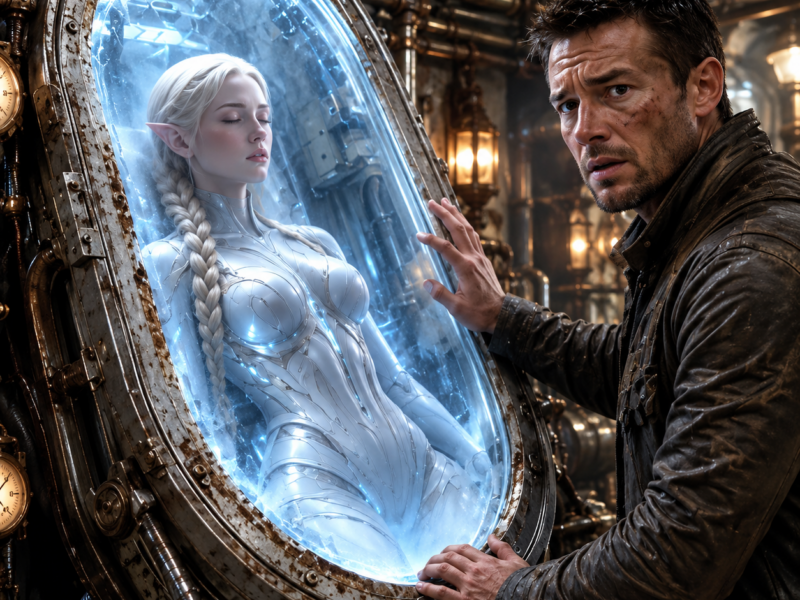
When I spent my last credit on a rusted escape capsule at a lunar scrapyard, the merchant laughed and called it dead junk, but when I connected a power cell, the battered shell began speaking my name—and something inside whispered that humanity had been declared extinct three thousand years ago.
The heavy plasma charges hit the ridge behind my workshop before the alarms even had time to scream.
Vibration rattled through my boots, shaking loose decades of iron dust from the corrugated rafters.
The three black-hulled raiders didn’t drop landing gear; they hovered like bloated wasps above the jagged craters of the northern lunar plain.
“Warning,” the capsule’s synthesized voice repeated, calmer than any machine had a right to be. “Impact vectors converging on this location.”
I grabbed the silver cylinder from the capsule’s undercarriage and slammed it into my field pack.
“You couldn’t have warned me five minutes ago?” I shouted over the rising whine of the capsule’s cooling coils.
“My diagnostic subroutines were offline,” the console flickered, blue light washing over the cracked visor of my flight suit. “And your survival probability drops by eighty-two percent if you remain inside this structure.”
The roof tore open with a sound like ripping steel.
Search beams sliced through the blinding dust, cutting across the workbench where my mother’s photograph was still frozen on the secondary terminal.
I didn’t look back at the room I’d spent ten years rotting in.
I hauled the heavy cylinder over my shoulder, smashed the emergency release on the rear airlock, and threw myself out into the low-gravity dark.
A Harvest of Rust and Ash
The airlock blew outward, carrying me with it into the freezing shadows of the scrap trench.
I hit the regolith hard, rolling through jagged piles of discarded thruster bells and shattered solar arrays.
Above me, the workshop erupted into a column of white-hot plasma that turned the lunar dust to liquid glass.
The heat hit the back of my suit like a physical wall, driving the breath from my lungs.
I hugged the silver cylinder tight against my chest, feeling the strange, impossible warmth beneath its metallic casing.
“Jack Hayes,” the capsule’s voice drifted through my helmet comms, piggybacking on my suit’s short-range frequency. “The raiders are deploying ground units.”
“I can see them,” I grunted, crawling behind the rusted hull of an old cargo hauler.
Two heavy dropships parted from the main raider vessel, their searchlights sweeping the trenches like white scythes.
These weren’t the local lunar police, and they weren’t the salvage cartels who ran the black markets out of Mare Tranquillitatis.
Their ships were seamless, finished in a matte-black material that seemed to swallow the glare of the distant sun.
“They aren’t scanning for life signs,” the voice said in my ear. “They are scanning for the resonance frequency of the archive.”
“The archive?” I asked, pulling my suit’s magnetic clamps tight around the cylinder.
“The cylinder you carry,” the voice replied. “It holds the neural signatures of three billion human souls, including the commander who hid it.”
“My mother,” I whispered.
“Commander Elena Hayes,” the voice corrected. “And if they acquire it, the final trace of your species will be permanently scrubbed.”
Whispers from the Outer Darkness
I kept low, moving through the shadow of the scrap heaps where the sun’s glare couldn’t reach.
Every step sent plumes of static-charged dust floating into the air, bright as diamonds under the stars.
Behind me, heavy mechanical footsteps crushed the metal wreckage of my former life.
The invaders didn’t speak across open radio bands; they communicated through high-frequency pulse bursts that buzzed inside my helmet like angry hornets.
“How did she survive?” I asked, my lungs burning as I pushed myself deeper into the maze of dead ships.
“She did not survive on Earth,” the voice said. “The primary colonies were dissolved three millennia ago when the Mandate concluded its census.”
“Census?” I almost tripped over a rusted anchor chain. “They wiped us out over a headcount?”
“You were classified as an invasive biomass,” the voice replied without emotion. “Unstable. Destructive. Incapable of long-term equilibrium.”
“And what about me?” I slammed my back against a bulkhead, holding my breath as a searchlight swept overhead. “What about the people on the moon?”
“You are anomalies,” the voice said. “Remnants left in the margins, forgotten because you were deemed incapable of leaving this rock.”
The searchlight paused directly above my hiding spot.
A shadow fell over the metallic hull beside me—tall, angular, and distinctly un-human.
I drew my salvage torch from my belt, my thumb hovering over the ignition switch.
“Jack,” the voice warned softly. “If you ignite that torch, the atmospheric venting will pinpoint your position.”
“I don’t plan on venting atmosphere,” I whispered.
I slammed the torch straight into the exposed wiring harness of the cargo hauler beside me.
The Engine of Lost Days
A blinding blue arc flashed across the scrap trench as forty thousand volts of residual power surged through the hauler’s dead capacitors.
The creature above me screeched—a sound like metal grinding against glass—and fell backward as the electrical surge blew its optical sensors.
I didn’t wait to see what it looked like up close.
I lunged out of the shadow, vaulting over the smoking frame and sprinting toward the far edge of the scrapyard where my old shuttle was moored.
The Dust Hopper was a thirty-year-old utility vessel, held together by duct tape, weld-seams, and sheer bad luck.
It was slow, loud, and ugly, but its engines were buried deep beneath thick lead shielding that kept them off most standard sensors.
I slapped my palm against the hatch controls, waiting four agonizing seconds for the pneumatic seal to hiss open.
Behind me, heavy fire tore through the scrap heaps, melting tons of copper and iron into glowing slag.
I threw the silver cylinder onto the navigator’s chair, jumped into the pilot’s harness, and slammed the manual ignition levers forward.
“Warning,” the ship’s onboard computer chimed. “Reaction mass at fourteen percent. Engine core requires service.”
“Override!” I screamed, punching the emergency fuel bypass.
The Dust Hopper groaned, its frame shaking as if it were about to shake itself to pieces.
The primary thrusters roared to life, kicking up a massive cloud of lunar soil that blinded the raiders behind us.
We tore away from the surface, rising into the black expanse of space just as a high-yield plasma beam vaporized the pad where we’d been sitting.
Shadows in the Slipstream
The lunar surface shrank below us, a broken gray pearl floating in the dark.
My hands were shaking so hard I could barely flick the switches to align our orbital trajectory.
“We aren’t clear,” I panted, checking the rear scanner array.
The three black ships had already broken orbit, turning gracefully to lock onto our exhaust trail.
“Their propulsion systems far exceed this vessel’s capability,” the archive voice spoke from the silver cylinder on the seat beside me.
“Thanks for the news flash,” I said, pulling the ship into a tight turn toward the orbital debris field above the moon’s far side. “Got any actual solutions?”
“The coordinates locked in my memory core require a jump vector through the Saturnian ring system,” the cylinder said.
“Saturn?” I stared at the console in disbelief. “This ship barely has enough fuel to reach Mars, let alone the outer rim.”
“You do not require fuel for the entire distance,” the voice replied. “You only require enough to reach the relay station at Jupiter’s lagrange point.”
“There is no relay station at Jupiter,” I said. “Just dead space and radiation belts.”
“It was hidden before the census,” the cylinder answered. “Built by your mother’s division.”
A sudden impact rattled the hull, blowing out the starboard attitude thrusters.
The red warning light on the dash blinked erratically, bathing the cockpit in a bloody glow.
“They’re locking tractor beams on our stern,” I shouted, wrestling with the flight stick.
“Jack,” the voice said, its tone shifting slightly, sounding eerily like a human breath. “Look at the core.”
The Silver Key
I glanced down at the silver cylinder.
Its smooth surface was unfolding, peeling back like the petals of a metallic flower to reveal a glowing crystal sphere at its center.
The light was warm, golden, and completely unnatural in the cold blue glow of the cockpit instruments.
“Touch it,” the voice commanded.
“Last time I touched something unexpected, my house got blown up,” I muttered.
“Touch it, Jack,” the voice repeated, and this time, the inflection was undeniably my mother’s.
My heart hammered against my ribs.
I reached out, my thumb brushing the edge of the crystal.
A sharp prick ran through my finger—a medical sensor taking a DNA sample.
The entire console of the Dust Hopper died instantly.
Every display went dark, every light flickered out, leaving us drifting in absolute darkness.
Then, the crystal flared.
Thick, gold conduits of light erupted from the cylinder, spreading across the floorboards, crawling up the walls, and embedding themselves directly into the ship’s dead control systems.
The ship shuddered, not with the violence of an attack, but with an immense, sudden surge of clean power.
The dead engine gauges pinned to maximum.
“Interface complete,” the suit comms hummed. “Sub-light drive altered. Target locked: Titan Gate.”
Through the Shattered Gate
Space around the Dust Hopper didn’t warp; it stretched.
The black raider ships shooting toward us suddenly seemed to freeze in time, their plasma bolts hanging in the void like motionless droplets of orange glass.
Then the universe folded sideways.
The stars flattened into long, blinding streaks of white light, and the pressure slammed me backward into the pilot’s chair with the force of ten gravities.
I couldn’t breathe.
I couldn’t scream.
Images flashed across my retinas, projected directly into my optic nerve by the glowing golden lines crawling across the cockpit canopy.
I saw giant cities built floating inside gas giants.
I saw fleets of vast, wooden-hulled ships sailing through nebulae held together by glowing force fields.
I saw my mother, younger now, sitting at a desk made of dark oak, writing in a paper journal while stars drifted past her window.
“Hold on,” her voice whispered directly into my brain.
Then the pressure released all at once, and my chest heaved as I gasped for vacuum-cold air.
The light faded.
The stars snapped back into stationary points of light.
Outside the front canopy, Saturn filled the sky—a terrifyingly huge marble of gold and amber, its massive ring system casting long, dark shadows across the clouds below.
And sitting directly in the shadow of the rings was something that shouldn’t have existed.
The Graves of the Stars
It was an architecture of bone and steel, miles long, floating silent and forgotten against the gold dust of the rings.
A dead fleet.
Hundreds of human ships, ranging from small scrap haulers like mine to massive colony transports five miles long, all docked around a central ring station that burned with faint, dying purple light.
“What is this place?” I whispered, my hand still resting on the cool surface of the cylinder.
“The graveyard of the First Fleet,” the archive answered. “The ones who refused to be cataloged.”
“Is she… is my mother here?”
“Her ship is docked at section four,” the archive replied. “The Aegis.”
I brought the Dust Hopper in low, weaving between the frozen carcasses of ancient starships.
Many of them showed giant, clean holes burnt through their hulls—the mark of the Mandate’s weapons from three thousand years ago.
This wasn’t just a hiding place; it was a battleground where humanity had made its final, desperate stand before being driven into the shadows of history.
I aligned our docking hatch with the airlock of the Aegis, the heavy steel clamps catching with a hollow thud that echoed through the dead metal of both ships.
I grabbed my torch, sealed my helmet, and stepped across the threshold into the dark.
A Legacy Built on Scraps
The interior of the Aegis was preserved in absolute zero, frozen in the exact moment its power had failed three millennia prior.
Floating emergency lights sat dormant in the corridor, covered in a fine layer of white frost.
My suit’s boots clacked against the deck plating as I walked down the central gangway, the beam of my helmet light cutting through the absolute dark.
Every wall was covered in handwriting.
Names.
Thousands of names, scrawled in marker, scratched into paint with knives, etched into steel with welding torches.
Sarah Miller, Chicago.
David Chen, New Shanghai.
Marcus Vance, Luna.
It was a wall of the dead, left behind by the last survivors who knew the end was coming.
I reached the bridge door, which stood half-open, jammed by a collapsed overhead support beam.
I squeezed through the gap, my helmet light sweeping across the dead consoles, the frozen chairs, and finally settling on the central command deck.
Sitting in the primary captain’s chair was a suit of armor, its visor dark and frosted over.
Beside the chair sat a small, battery-operated audio recorder, plugged into an external antenna that ran down into the floorboards.
My hands trembled as I reached out and wiped the frost from the chair’s nameplate.
CAPTAIN E. HAYES.
The Voice in the Static
I didn’t open the visor.
I couldn’t bring myself to see what was behind the dark glass.
Instead, I picked up the small audio recorder from the console.
Its small red standby light flickered, drawing power from the cylinder I had brought aboard.
I pressed play.
Static hissed through my helmet speaker, slow and rhythmic, like the sound of distant waves hitting a rocky shore.
Then, her voice came through—clear, tired, but steady.
“Jack,” she said.
I fell to my knees on the deck plating, pressing the speaker against my helmet’s audio receiver.
“If you’re hearing this, it means the automated pod reached the scrap markets on Luna,” she continued, her breathing heavy in the recording. “It means you survived.”
“I’m here, Mom,” I choked out, tears warm against my cold cheeks. “I’m here.”
“The Mandate thinks they finished us,” the recording said. “They think they scrubbed the galaxy clean of human thought, human art, human pain.”
“They were wrong,” she said, her voice rising with a quiet, furious pride. “We didn’t die here, Jack. We hid.”
“This fleet isn’t a graveyard,” the voice said as a low rumble began to build deep within the hull of the Aegis. “It’s a cradle.”
Behind me, the consoles on the bridge suddenly burst into brilliant golden light, line by line, ship by ship across the entire frozen armada.
Outside the viewport, thousands of dead hulls began to glow as secondary reactors awakened after three thousand years of darkness.
“The coordinates in the cylinder aren’t for a home in the past,” my mother’s voice whispered through the speaker. “They are for the gate to the uncharted sector.”
“Rise and shine, Captain,” the recording finished with a faint, bittersweet laugh. “You’ve got a fleet to command.”
Far off in the dark beyond Saturn’s rings, three black raider ships slipped out of warp, their weapons charging for the kill.
I stood up, wiped the tears from my eyes, and placed my hand on the main throttle of the Aegis.
“Let them come,” I said.