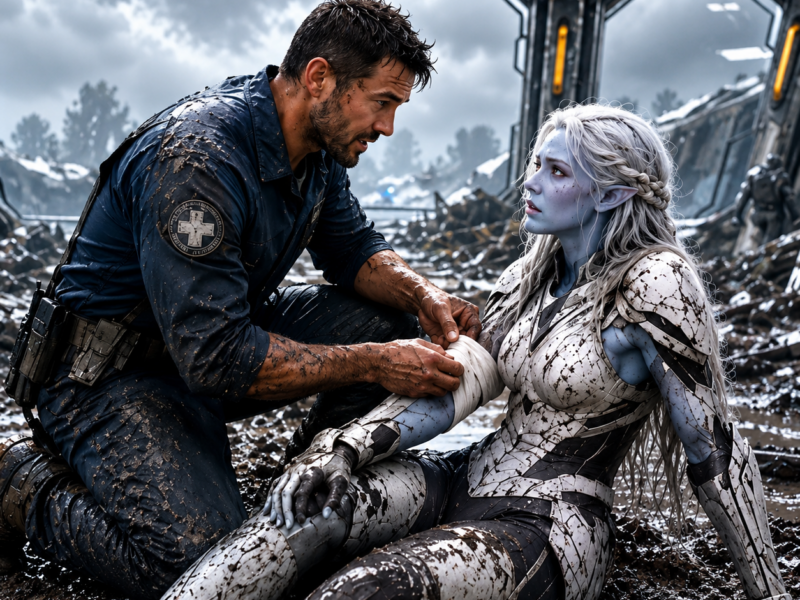
When I found a dying woman buried beneath the wreckage of my repair station on Mars, her soldiers ignored my orders and treated me like dirt, but after I repaired her shattered armor and touched the strange insignia on her chest, every armed alien in the valley suddenly dropped to their knees.
The red dust never stopped howling against the reinforced glass of the outer bay.
I wiped a layer of grease off my forehead with the back of a calloused hand.
Mars was a cold, miserable graveyard, and I was just the janitor keeping the lights on.
My job was simple enough: fix the atmospheric scrubbers, patch the ice-cutters, and ensure the local mining haulers didn’t leak hydraulic fluid into the soil.
I wasn’t a soldier, a hero, or some high-paid corporate surveyor.
I was Jack Vance, an engineer who preferred the sound of a roaring wrench to the sound of human voices.
Then the eastern horizon exploded into white flame.
The shockwave hit the workshop three seconds later, rattling my tool racks and throwing half my spare coils onto the concrete floor.
I grabbed my heavy thermal coat and a diagnostic scanner, stepping out into the freezing gale.
Smoke billowed over the jagged ridge half a mile out, mixing with the crimson squalls of the Martian night.
I scrambled up the rocky incline, my boots slipping on loose volcanic slate.
When I reached the crest, the sight took the air straight out of my lungs.
A vessel lay shattered in the ravine below, but it wasn’t one of ours.
It looked like a broken obsidian spear, its hull made of smooth black metal that absorbed the faint light of the stars.
The wreckage was hot enough to melt the permafrost underneath, sending thick clouds of steam into the night sky.
I slid down the steep bank, clutching my emergency cutter as I approached the smoking crater.
That was when I heard the low, jagged sound of someone choking on their own blood.
She was pinned beneath a massive piece of the shattered hull, her body twisted at an unnatural angle.
Her suit was unlike anything manufactured in the Sol system—pitch black, laced with delicate silver circuitry that pulsed with dying electricity.
“Hold on,” I grunted, wedging a hydraulic jack beneath the structural beam. “I’m going to get you out.”
The beam groaned as the jack extended, taking the weight off her crushed chest.
I dragged her free, pulling her across the jagged red earth toward my tracked utility rover.
Her visored helmet was cracked, revealing a faint glimpse of pale skin slick with sweat and crimson stains.
“Please,” she whispered.
Her voice was barely audible through the internal speaker, strained and raspy.
“Save your breath,” I told her, lifting her onto the back platform of the rover. “You’re bleeding out.”
The storm swallowed the wreckage behind us as I drove back to the station, the engine roaring against the rising gale.
I carried her into the pressurized workshop, clearing off my primary worktable with a single sweep of my arm.
Gears, copper wiring, and digital calipers clattered across the floor.
Her suit was locking up, the internal life support clicking as it failed.
I reached for the quick-release latches near her neck, but her hand suddenly shot up and grabbed my wrist with terrifying strength.
“Don’t touch it,” she gasped, her eyes fluttering open.
“If I don’t take this chest plate off, you’re going to suffocate on your own fluids,” I snapped, wrenching my wrist free.
I cut through the damaged armor seals using a thermal scalpel, carefully peeling back the scorched metal.
Underneath, a jagged piece of shrapnel was embedded deep in her shoulder, barely missing the subclavian artery.
The blood pooling beneath her wasn’t alien or strange—it was bright, warm human red.
Blood Beneath the Worn Crucible
I worked through the night while the gale battered the reinforced walls of the station.
Every cut of my scalpel required absolute precision, but fixing broken things was the only language I truly understood.
I removed the metal fragment, cauterized the arterial tear, and sealed her chest wound with medical foam.
Her pulse was wild and thready, but as the hours ticked by, her breathing stabilized into a steady rhythm.
Her armor lay scattered across my main workbench like the remains of a mythical creature.
The metal was fascinating; it self-healed minor scratches when exposed to ambient electrical currents, a technology decades ahead of anything the United Nations Space Command possessed.
At the center of the broad chest plate was a raised, intricate symbol burned deep into the obsidian weave.
It looked like a crest—a stylized phoenix entwined around three weeping stars.
On the third morning, I was recalibrating the power conduits on her right gauntlet when I felt her gaze on me.
She had pushed herself up against the cot’s backrest, watching my hands with cold, hyper-alert eyes.
“Where am I?” she asked quietly.
“Outer Sector Four, Cydonia Basin,” I replied without looking up from the solder torch. “My workshop.”
She shifted slightly, wincing as her ribs protested the movement. “You shouldn’t have touched my armor.”
I stopped the torch and let out a dry, exasperated laugh.
“You were dying,” I said. “A few more minutes in that trench and you would have frozen into a permanent monument.”
She turned her head, looking away toward the heavy blast doors that sealed us off from the barren desert.
“You don’t know what you’ve done,” she muttered softly.
For the next two days, an uneasy truce existed between us.
She never offered her name, and I didn’t press her for one—out here, everyone was running from something.
Instead, she sat in the corner of the shop, her faint blue eyes tracking every movement of my wrench as I repaired her suit’s burned wiring.
She moved with the guarded grace of a predator that had spent its entire life waiting for an ambush.
“You’re not afraid of me,” she said abruptly on the fourth morning as I laid the fully repaired chest plate near her cot.
“I don’t know you,” I shrugged, wiping grease off my pliers. “Hard to be terrified of someone I had to carry over my shoulder like a sack of ore.”
“That may be why you’re still alive,” she said smoothly, though a flicker of amusement touched her lips.
Before I could ask what she meant, the emergency lights overhead flickered violently from white to amber.
The diagnostics board pinged wildly, showing multiple heavy air-transports dropping out of low orbit directly over the basin.
The floor beneath our feet began to vibrate with the low, heavy thrum of military-grade ion engines.
I grabbed my heavy rifle from the gun rack near the door, racking a round into the chamber. “We have company.”
She stood up instantly, ignoring the pain in her side, and reached for her suit. “Do not shoot at them.”
“If those are pirate scavengers, they aren’t here to negotiate,” I said, looking out the reinforced viewport.
Dozens of heavy landers had set down in the red dust, kicking up a blinding cloud of sand.
armored warriors poured from the ramps, dressed in sleek obsidian gear almost identical to hers, carrying high-frequency plasma rifles.
They moved in lethal fire-teams, converging on my small workshop like a pack of wolves closing in for a kill.
Shadows Over the Red Valley
I stepped out through the airlock door into the howling wind, holding my rifle high against my shoulder.
“State your business!” I yelled through my helmet speaker. “This is private property belonging to the Martian Mining Guild!”
The lead warrior didn’t stop or announce himself.
He raised his heavy plasma rifle, locking a bright blue targeting laser directly onto the center of my visor.
“Move aside, scavenger,” a harsh, digitized voice growled through his helmet communicator. “Or we paint the sand with your blood.”
“She’s inside!” I shouted back, holding my ground despite the trembling in my knees. “She’s alive!”
The commander didn’t lower his weapon; he flicked his wrist, signaling his squad to breach the main perimeter doors.
Before the soldiers could take another step, the heavy pneumatic seals of my workshop hissed loudly, and the main bay doors slid open.
The woman stepped into the harsh sunlight of the Martian plain.
She wore her armor now, completely restored to its original glossy sheen, the custom repairs I had crafted blending seamlessly with the obsidian frame.
As she raised her chin, the faint silver lines running down her suit suddenly lit up with a brilliant, blinding blue light.
The crest on her chest plate blazed like a miniature star in the middle of the red dust storm.
The silence that followed was instantaneous and absolute.
The lead soldier froze mid-step, his targeting laser flickering off as his arms visibly began to shake.
He didn’t just lower his weapon—he tossed it aside into the dirt as if holding it were a death sentence.
The commander dropped heavily onto his knees, slamming his right fist against his heart plate.
Behind him, all thirty heavily armed warriors fell to their knees in unison, bowing their heads low until their visors almost touched the freezing soil.
I stared back and forth between the kneeling army and the woman standing beside me, my hands dropping down to my waist.
“What is happening here?” I demanded, my voice cracking slightly in the crisp air.
She looked at me, a single tear cutting a clear path through the red dust clinging to her cheek.
“They thought you were repairing an ordinary soldier,” she whispered softly.
She placed her hand over the glowing symbol on her chest, her fingers trembling slightly against the warm metal.
“You repaired their ruler.”
The wind seemed to die down, leaving only the soft hum of the hovering transports above us.
“You’re their queen?” I asked, taking an involuntary step back from her.
She shook her head slowly, her expression clouded with an ancient, unbearable sorrow.
“Not a queen,” she said, her voice barely carrying over the quiet hum of the engines. “Something much older.”
The Forgotten Bloodline of Earth
The kneeling soldiers remained completely motionless, their heads bowed as if waiting for a executioner’s blade or a blessing.
The woman reached up and unlatched the helmet seals around her collar, letting the cold Martian air hit her face.
She took a deep, jagged breath of the thin atmosphere, her pale skin contrasting sharply with the dark armor.
“Stand,” she commanded softly.
The entire unit rose in perfect, terrifying synchronization, stepping back to form a defensive perimeter around us.
She turned back to face me, her blue eyes fixed on mine with an intensity that made my chest tighten.
“I rule the last surviving human civilization beyond Mars,” she revealed quietly.
I blinked, trying to process the words through the haze of confusion. “Human? You’re not… you’re not from the outer colonies?”
“We are from Earth,” she said, stepping closer to me. “Or rather, our ancestors were.”
“That’s impossible,” I stammered, shaking my head. “The deep space expansion programs failed three centuries ago. The long-range ships were destroyed in the Great Collapse.”
“That is the history your corporate councils taught you,” she replied, her tone dripping with bitter disdain. “They didn’t fail. They were betrayed.”
She explained how humanity’s old governments had used the colony fleets as meat shields during the resource wars, abandoning millions to die in the void when the trade routes collapsed.
Her people had survived in the deep, dark reaches beyond the Kuiper Belt, building an empire in the shadow of uncharted stars, hiding from the light of Sol.
“We cut ourselves off to survive,” she said gently. “We learned to hate the home world that left us to starve.”
“Then why come back here?” I asked, looking around at the desolate red rocks. “Why risk everything to come to Mars?”
She didn’t answer with words; instead, she reached into a hidden compartment built inside the thick lining of her chest armor.
She pulled out a small, worn object wrapped in clear protective plastic and held it out toward me.
“Because of this,” she said simply.
I took the object from her gloved hand, my fingers brushing against hers.
It was an old chemical photograph, its edges yellowed and cracked with age, preserved only by the vacuum seal.
In the picture, a man in a faded military uniform stood proudly in front of a flickering video screen displaying an old American flag.
He had dark, messy hair, a jagged scar across his chin, and a crooked smile that I knew better than my own face.
My heart slammed against my ribs so hard it felt like a physical blow.
“This… this is Arthur Vance,” I choked out, my voice barely a whisper. “This is my grandfather.”
Grave of the Red Horizon
My hands shook so violently that the small photograph almost slipped from my fingers into the freezing dust.
“This doesn’t make any sense,” I breathed, staring down at the face of the man who had loomed over my entire childhood like a ghost. “He died fifty years ago in a shuttle crash off Jupiter. My father had his service medals buried in an empty grave.”
“He didn’t die off Jupiter, Jack,” she said, using my actual name for the very first time.
The sound of my name on her lips sent a sharp cold chill down the back of my neck.
“How do you know who I am?” I demanded, stepping back and tightening my grip on my rifle. “Who gave you that picture?”
“He did,” she answered calmly, holding her ground without fear. “He gave it to my mother before he went into the deep vaults beneath the basin.”
She took a step closer, her hand outstretched in a gesture of peace.
“Your grandfather didn’t perish in some tragic accident. He was the chief engineer who built the stealth drives that allowed my ancestors to escape the Earth’s blockades. He saved hundreds of thousands of lives while your world burned.”
I stared at the photograph, my mind racing as pieces of my family’s fractured history suddenly locked into place.
I remembered my father’s late-night rants about corporate lies, the hidden blueprints buried under our old house in Chicago, and the mysterious pension checks that kept coming long after Arthur was declared dead.
“He lied to us,” I muttered, a wave of hollow anger washing over me. “He abandoned my grandmother, my dad… he left us behind to play savior to a fleet of ghosts.”
“He didn’t abandon you to save himself,” she corrected gently, her eyes softening with genuine sympathy. “He stayed behind because he discovered what was waiting underneath the surface of this planet.”
Before I could ask what she meant, a low, guttural vibration shuddered through the soles of my boots.
It wasn’t the sound of engines or atmospheric storms.
It was deep, violent, and subterranean—a tectonic grind that rattled the teeth inside my jaw.
Across the basin, three miles away, the flat plain of dust began to buckle and split open in a massive linear tear.
Thick plumes of pressurized gas erupted into the thin sky, blowing red dust thousands of feet into the air.
The kneeling soldiers immediately stood up, forming a defensive shield around the two of us with their energy shields flared to maximum output.
“It’s time,” she said, looking toward the expanding chasm with a mix of dread and awe.
“Time for what?” I yelled over the deafening roar of grinding rock.
“The vault is unlocking,” she said, grabbing my arm firmly. “And you are the only one who has the biometric key to open the final door.”
Echoes from the Deep Earth
The ground groaned like a dying beast as a massive obsidian structure began to rise from the widening fissure.
It wasn’t a ship or a building—it was a monolithic tower, hundreds of feet wide, covered in the same silver circuitry as her armor.
“We need to reach the lift before the security automated grid wakes up,” she shouted, pulling me toward the largest transport vehicle.
I didn’t argue; the sheer scale of the structure rising out of the sand stripped away any rational resistance I had left.
We piled into the back of the armored transport as the engines roared to life, racing across the cratered terrain toward the erupting chasm.
Inside the troop compartment, the soldiers sat in rigid, silent discipline, their visors locked onto me with a eerie mix of reverence and caution.
“I don’t even know your name,” I said, leaning closer to her over the deafening rumble of the transport’s treads.
“I am Lyra,” she replied, re-securing her helmet’s neck seals. “Commander of the Vanguard Fleet, Regent of the Seventh Ark.”
“Well, Lyra, if my grandfather locked that door fifty years ago, what makes you think my blood is going to open it now?”
“Because Arthur Vance was paranoid,” she said with a dry, bitter smile that flashed beneath her visor. “He knew the corporate conglomerates on Earth would eventually track us down. So he encoded the primary override to his direct lineage.”
The transport slammed to a halt at the edge of the newly formed crater.
We stepped out onto a wide metal platform that had risen directly out of the bedrock.
Before us stood a massive triangular doorway, easily forty feet tall, sealed shut with thick interlocking plates of cold black alloy.
At the center of the door was a glowing interface panel shaped like a human handprint, pulsing with a faint, amber light.
“Put your hand on the scanner,” Lyra instructed, stepping back to give me space.
I approached the panel, the cold wind whipping my hair across my eyes.
My hand hovered an inch above the glowing glass, my heart hammering against my chest like a trapped bird.
If I touched this panel, whatever life I had built as a simple Martian mechanic would be gone forever.
I pushed my palm against the cool surface.
A high-pitched chime echoed through the valley, and the amber light instantly flashed a brilliant, burning green.
Biometric match confirmed: Vance, Lineage Primary, a flat synth-voice spoke from the air around us. Welcome home, Director.
The Door to Forgotten Stars
The massive triangular doors groaned as hydraulic pressurized seals released after half a century of silence.
Clouds of preserved frost poured out from the opening, smelling heavily of ozone, recycled air, and old lubricating oil.
The heavy metal plates slid back into the mountain wall, revealing a vast, dimly lit corridor that stretched deep into the dark heart of Mars.
Lyra signaled her soldiers to stay outside and maintain the perimeter, taking only her top two squad leaders inside with us.
We stepped into the gloom, our flashlights cutting bright white beams through the ancient dust hanging in the air.
The walls were lined with row upon row of massive cryogenic pods, thousands of them, extending as far as the eye could see into the deep gloom.
“Are those… people?” I asked, shining my light onto the frost-covered glass of the nearest container.
“The rest of our civilian population,” Lyra confirmed, her voice echoing off the metallic walls. “Over two hundred thousand men, women, and children held in stasis until a permanent home could be secured.”
“Why didn’t you wake them?”
“Because Mars wasn’t safe,” she said softly. “The atmospheric processors weren’t complete, and the Earth fleets were still hunting for us. Your grandfather built this vault to keep them invisible until the time was right.”
We walked further into the complex, coming to a stop at a high observation gallery overlooking a massive central hub.
In the center of the subterranean cavern sat a starship that defied everything I knew about naval architecture.
It was vast, shaped like a curved crescent moon, its hull shimmering with active energy fields that had remained fully charged for fifty years.
“The Aegis Prime,” Lyra whispered, stepping up to the glass railing. “The colony flagship.”
“It’s magnificent,” I admitted, mesmerized by the flawless design of the drive core hanging beneath the ship’s tail.
“It’s incomplete,” a voice rasped from the dark shadow of the control console behind us.
We all spun around, weapons raised, our flashlight beams intersecting on an old, high-backed command chair.
The chair slowly rotated around to face us.
Sitting in it was an old man hooked up to a complex web of medical tubes and diagnostic monitors, his skin pale and thin as parchment.
His bright blue eyes looked past the weapons, locking directly onto my face.
“You took your sweet time getting here, kid,” the old man wheezed, a faint, familiar crooked smile touching his lips.
Ghosts of the Iron Deep
My knees buckled, and I had to grab the railing to keep from falling onto the metal floor.
“Grandfather?” I managed to choke out, my throat feeling completely dry.
“In the flesh… what’s left of it anyway,” Arthur Vance croaked, waving a feeble, thin hand toward the medical monitors blinking behind him. “Though if you had taken another week, you would have been talking to a corpse.”
I stepped toward him, my mind spinning into complete chaos. “How… how are you still alive? It’s been fifty years!”
“Stasis cycles, boy,” Arthur said, coughing softly into a cloth. “I wake up for a month every decade to check the power grid and clear the dust filters. Keeps the heart ticking, but it wears out the soul.”
Lyra stepped forward, kneeling beside the old man’s chair with deep respect. “Director Vance. The seal has been opened.”
“I see that, Lyra,” Arthur said, reaching out to pat her armored shoulder gently. “And I see you brought my grandson. I hope he wasn’t too much of a pain in the ass.”
“He fixed my armor,” she said softly, looking up at him. “He has your hands.”
“He’d better,” Arthur grunted, turning his gaze back to me. “I didn’t leave those schematics under the floorboards in Chicago just for him to become a low-rent wrench-monkey on a corporate mining rock.”
“You left us,” I said, the shock finally giving way to a surge of deep, built-up anger. “You let Dad grow up thinking you were burned to ash in a Jupiter ditch! Do you have any idea what that did to our family?”
Arthur’s smile faded completely, replaced by a heavy, hollow exhaustion that made him look even older than he was.
“I know,” he said quietly. “Every single day I sat in this dark hole, I thought about walking out into the dust and letting the cold take me.”
He leaned forward, his frail hands gripping the armrests of his chair.
“But if I came back, the Earth Cartel would have tortured the location of this vault out of my head,” he continued, his voice trembling with emotion. “I had to choose between my family’s happiness and two hundred thousand innocent lives sleeping in these tubes.”
He pointed a thin finger toward the glowing starship in the bay below.
“I chose to save them, Jack. And I paid for it with every second of my miserable life.”
The Crucible of the Red Planet
The silence between us was thick and suffocating, broken only by the rhythmic beep of Arthur’s life-support heart monitor.
I looked at the old man, seeing the heavy burden of a secret war etched into every deep line on his face.
The anger in my chest didn’t vanish, but it softened into a strange, heavy pity.
“What happens now?” I asked softly, stepping closer to his chair.
“Now… we finish the job,” Arthur said, pressing a button on his control armrest.
The main displays lit up, showing planetary long-range scans of the Martian orbital grid.
Red warning icons were flashing all along the upper atmosphere—dozens of heavily armed corporate dreadnoughts were breaking out of warp space, converging on our location.
“They tracked Lyra’s crash,” Arthur explained, his face turning pale in the harsh glare of the monitors. “The United Earth Cartel knows the vault has been located. They’re dropping orbital strike platforms to destroy this site before we can launch the flagship.”
“We can’t defend this valley against a full orbital bombardment,” Lyra said, her hand instantly going to her sidearm. “Our ground forces are light recon units.”
“We don’t need to fight them on the ground,” Arthur said, turning his head toward me. “The Aegis Prime is ready to launch, but its main drive core requires an manual ignition sequence from the secondary lower engine chamber.”
He grabbed my wrist, his grip surprisingly firm for a man near death.
“My heart won’t last the trip down those ladders, Jack,” he whispered urgently. “You’re the only engineer left who knows how to manually bypass a dark-matter coil without blowing us all to kingdom come.”
“I’ve never worked on a dark-matter engine,” I stammered, looking out at the massive starship.
“You’re a Vance,” Arthur said, a flicker of pride returning to his tired eyes. “You’ve been reading those drive schematics in your head since you were seven years old. Don’t play dumb with me now.”
Lyra looked at me, her blue visor lifting to show her fierce, unyielding gaze. “If you do this, Jack, there is no coming back. The Cartel will burn your workshop to ash. Your old life is over.”
I looked back at the blast doors leading out to the small, cold garage where I had spent years fixing broken garbage for corporate bosses who didn’t even know my name.
Then I looked at my grandfather, and at the woman who had brought an entire army to their knees just by touching her chest.
“Lead the way,” I said.
Stars Beyond the Crimson Dust
The floor shuddered violently as the first wave of orbital missiles struck the ridge above the valley.
Dust and shattered rock rained down from the ceiling of the cavern, setting off loud red alarm sirens throughout the complex.
“Move! Move!” Lyra barked into her comms, coordinating her soldiers as they initiated the emergency wake-up protocols for the colony pods.
I sprinted down the narrow catwalks of the central bay, trailing behind Arthur’s mechanized chair as Lyra provided rear guard cover.
We reached the lower maintenance deck of the Aegis Prime, where the colossal dark-matter drive core hung suspended in a magnetic containment ring.
The core was cold, its massive conduits dark and lifeless.
“The primary fuel valves are rusted shut!” I yelled over the deafening sound of explosions echoing from the surface above.
I grabbed a heavy pneumatic spanner from a tool rack, leaping onto the central drive housing.
I slammed the wrench onto the manual release valve, leaning my entire body weight into the lever.
The metal groaned, resisting, as another orbital strike rocked the cavern, sending a shower of sparks cascading down around us.
“Come on, you piece of junk!” I screamed, slamming my boot against the wrench handle.
With a loud metallic crack, the valve turned, and a roaring stream of liquid plasma flooded into the core conduits.
The dark-matter engine roared to life with a deep, resonant sound that vibrated straight through my bones.
The crescent ship lit up from nose to stern, its navigation lights flashing brilliant silver against the dark cavern walls.
Above us, the ceiling began to collapse as the main mountain ridge gave way under the relentless bombardment.
“The roof is coming down!” Lyra yelled, firing her plasma rifle into the falling debris to clear a path. “We have to launch right now!”
Arthur rolled his chair to the main pilot console, his trembling fingers flying across the controls with practiced ease.
“Hold on to something!” the old man roared, a wild, victorious laugh bursting from his throat. “We’re taking this bird to the outer rim!”
The massive planetary thrusters erupted with blinding white fire, melting the surrounding bedrock into glass in a split second.
The Aegis Prime shot forward, tearing through the falling mountain debris and bursting out from the red surface of Mars like an ancient god breaking free from a grave.
I stood on the bridge catwalk, looking out through the broad forward viewport as the red planet fell away beneath us.
The corporate dreadnoughts tried to turn their heavy guns toward us, but our ship was already accelerating past the speed of light, bending space-time around its silver hull.
Lyra walked up beside me, placing a cool hand on my shoulder as the red dust of Mars faded into the infinite black void of space.
“Where are we going?” I asked softly, looking out at the millions of unfamiliar stars stretching before us.
“Home,” she said simply. “To the world your grandfather built for us.”
I turned back to see Arthur leaning back in his pilot seat, his eyes closed, a peaceful, contented smile resting on his worn face as the ship sped into the dark.
For the first time in my life, I wasn’t just fixing someone else’s machine.
I was driving it into the future.









