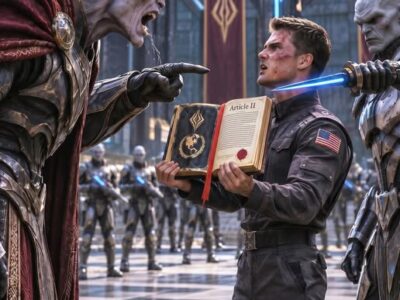
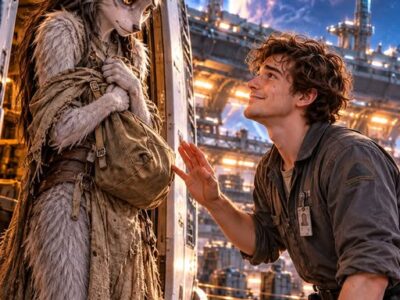
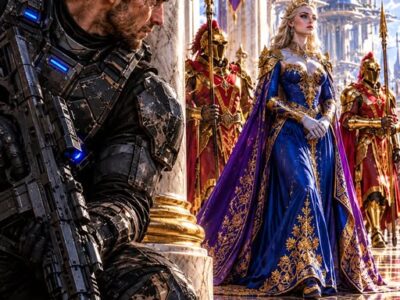
When I collapsed inside the Galactic Medical Center, alien nurses rushed to remove my blood-soaked uniform, but the moment they saw hundreds of scars covering my body, the head physician ordered everyone to step away and whispered, “This human isn’t a soldier… he’s the survivor of a program our entire civilization was warned never to investigate.”
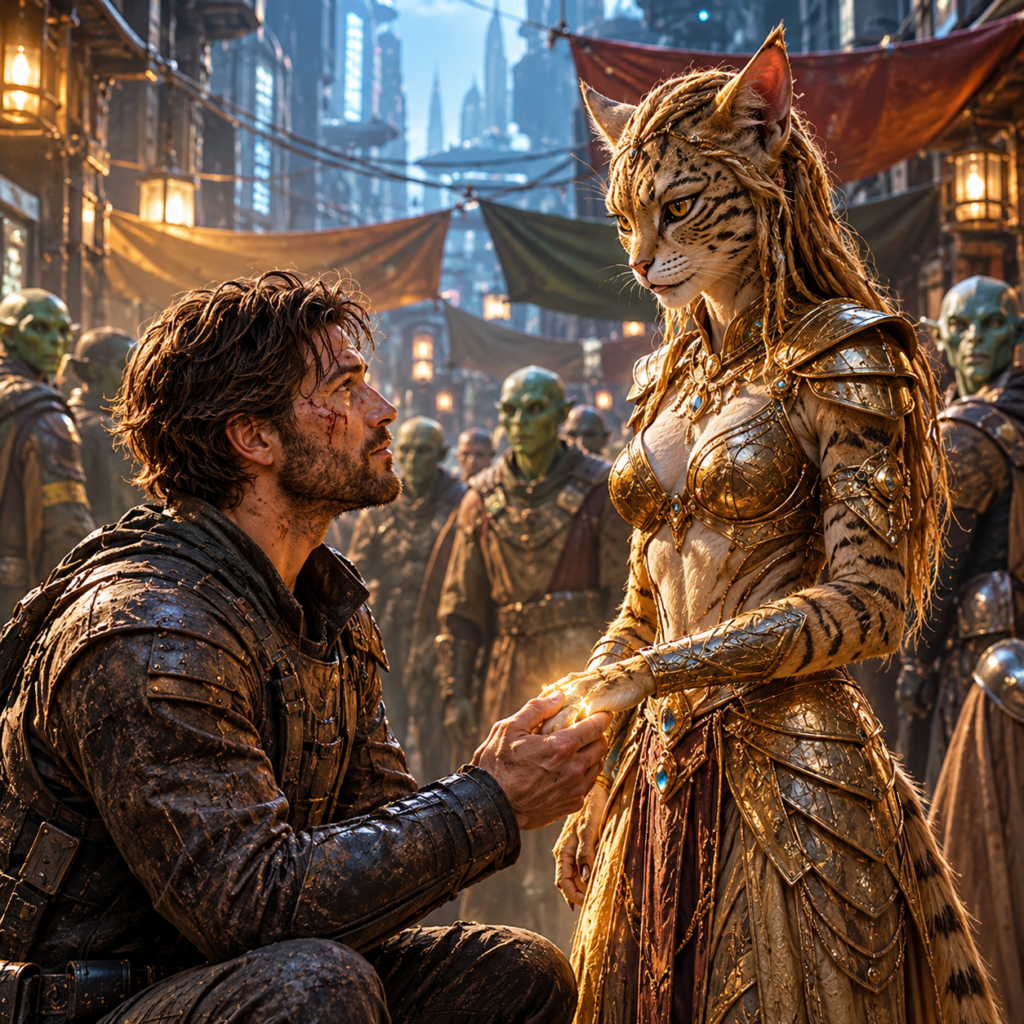
The silence that followed was suffocating, broken only by the rhythmic hum of the station’s atmospheric cyclers.
Dr. Vael remained kneeling on the cold floor, his silver eyes wide and fixed on the floorboards as if looking directly at me might bring down the wrath of the heavens.
“Get up,” I rasped, gripping the edge of the bio-bed.
My muscles burned with exhaustion, every scar along my ribs flaring with a prickly, electric heat that felt less like pain and more like waking up from a decade-long sleep.
He did not stand.
“Commander… you do not understand the treaties of the Core,” Vael whispered, his voice trembling through the station’s universal translator.
“I don’t care about your treaties,” I told him, swinging my legs over the side of the platform.
“That fleet,” he pointed toward the viewing glass, his gray finger shaking violently, “belongs to the Sovereign Dominion of the First Accord.”
“They vanished three centuries ago, long before your species ever split an atom.”
“Our civilization believed they were gods, or wardens, or ghosts.”
“And yet here they sit, answering a boy who bled in the dirt of an Appalachian facility.”
Outside the observation window, the colossal warships hung in low orbit above Earth, their dark geometric hulls blocking out the sun like obsidian mountains suspended in vacuum.
The emblem etched into their forward command towers was an interlocking spiral surrounded by seven concentric rings.
I looked down at my bare chest.
The raised, keloid tissue just below my collarbone formed the exact same geometric spiral, carved into my skin before I even knew how to write my own name.
The intercom speaker chimed a low, harmonic chord that resonated deep within my chest cavity, causing the microscopic implants along my spine to hum in return.
“Hangar Bay Seven,” the synthesized voice echoed, smooth and entirely devoid of human cadence.
“Docking clamps secured.”
“Welcome home, Vanguard Seven.”
The station alarms went silent, not cut off by an operator, but deactivated by an external override that completely bypassed the orbital station’s planetary defenses.
“We have to secure you,” Vael stammered, finally rising to his feet and backing toward the emergency panel on the wall.
“If the Earth Defense Command finds out what is happening—”
“They already know,” I interrupted, staring past him down the sterile white corridor visible through the frosted glass doors.
Bootsteps echoed against the metal decking, heavy and rapid.
Three human military personnel in the black uniforms of Earth’s Special Intelligence Directorate rounded the corner, carbines raised, followed by two armed Praetorian shock troopers.
Leading them was Colonel Marcus Vance, a man I had served under during the Siege of Orion’s Gate six years ago.
I had watched Vance order air strikes that wiped out entire mercenary regiments without blinking an eye.
Right now, his weathered face was pale, his eyes darting toward the fleet outside before landing squarely on my chest.
“Daniel,” Vance said, his voice unusually strained as he raised his sidearm, keeping it centered on my sternum.
“Vance,” I replied, standing fully upright despite the weakness in my knees. “Mind telling me why my old CO is pointing a kinetic rifle at me in an alien hospital?”
“Step away from the window, son,” Vance demanded, gesturing with the barrel. “Step away, and put on the hospital smock.”
“Cover that mark.”
“Why?” I asked, taking a half-step forward instead. “Because it belongs to them?”
“Because it doesn’t belong to a human,” Vance spat, his knuckles whitening around his grip.
“For twelve years, you were the perfect ghost, Carter.”
“A frontline private who walked away from artillery barrages that turned tanks into slag.”
“A scout who survived poison atmospheres and nerve strikes that liquefied whole platoons.”
“You thought it was luck.”
“You thought you were just tough.”
“I was surviving,” I said, my teeth clenched. “I was fighting for the colonies.”
“You were an incubator,” Vance said, his cold pragmatism returning like armor.
“Blackridge wasn’t a research bunker.”
“It was a salvage site.”
“Thirty years ago, our deep-core drilling teams in the Shenandoah Valley dug up a vessel that crashed before mankind discovered fire.”
“Inside was a nursery of biological keys.”
“Biochemical transmitters designed to summon the owners whenever Earth’s technology reached orbital capability.”
“Your mother was the lead geneticist on that project, Daniel.”
“She didn’t run away to protect you from the government.”
“She fled because she realized that if those beacons activated while humanity was still fragile, our civilization wouldn’t be allied with the stars.”
“We would be harvested.”
The air in the room grew noticeably colder.
“She called me her sweetheart,” I whispered, the image of her face on the holographic terminal burning behind my eyelids.
“She didn’t sound like someone who saw me as an incubator.”
“She was a scientist who compromised planetary safety for maternal sentiment,” Vance countered coldly.
“When the Council discovered she had bonded the primary network to your neural stem, they ordered Blackridge wiped off the maps.”
“We thought the fire took you both.”
“Imagine our surprise when an enlisted dog named Daniel Carter popped up eight years later with the highest trauma survival rate in the entire defense force.”
“You kept me in the field,” I realized, the puzzle pieces clicking together with sickening clarity.
“Every suicide mission.”
“Every forward vanguard.”
“You weren’t testing my loyalty.”
“You were trying to see if my body would break.”
“We were trying to burn out the transmitters before they could broadcast,” Vance admitted without a hint of remorse.
“Every blast, every scar, every biological trauma was logged by our telemetry.”
“We hoped severe tissue damage would sever the neural connections.”
“We were wrong.”
“The trauma didn’t destroy them,” Dr. Vael interjected softly from the corner, his silver eyes flashing with sudden diagnostic clarity.
“It calibrated them.”
“The network uses adrenaline, cortisol, and cellular regeneration as a battery.”
“Twelve years of war didn’t kill the signal.”
“It charged it.”
The realization hit me like physical blunt force.
Every trench, every bullet wound, every burn I thought I had survived through sheer grit and willpower had simply been the ignition sequence for the armada floating outside the glass.
“Lower your weapon, Colonel,” I said softly.
“I can’t do that, Daniel,” Vance said. “The fleet is demanding an audience with Vanguard Seven.”
“If you walk onto that shuttle, Earth loses whatever leverage it has.”
“If you die here, the signal dies with you.”
“And what happens to the fleet if you shoot me?” I asked, gesturing toward the hundreds of void-black ships hanging in orbit.
Vance didn’t answer.
He didn’t have to.
His finger tightened on the trigger.
Before he could squeeze, the heavy blast doors at the end of the medical corridor buckled inward with a deafening screech of warping alloy.
The shockwave threw the two intelligence guards into the wall, their weapons clattering across the floor.
Through the smoking breach stepped a figure tall, slender, and entirely enclosed in polished dark obsidian plate that seemed to absorb the light around it.
The visitor carried no weapon, but as it moved, the medical monitors along the walls flared with violet static.
The helmet’s faceplate dissolved like liquid mist, revealing a countenance that was unmistakably human in its architecture, yet distinctly alien in its perfection.
High cheekbones, pale alabaster skin, and eyes that held the exact same brilliant silver hue as the stars outside.
Beside me, Dr. Vael dropped back to both knees, trembling uncontrollably.
“First Accord…” he breathed.
The figure ignored the physician entirely, stepping over the groaning intelligence officers and walking directly toward the bed.
Vance spun around, bringing his rifle up, but the moment he leveled the barrel, the metal within his hands glowed cherry red.
The Colonel cried out in agony, dropping the superheated weapon as the polymer casing melted against his palms.
The armored figure stopped three paces from me.
For a long, agonizing moment, neither of us spoke.
The figure raised a gauntleted hand, touching its own chest plate over the left collarbone.
A soft mechanical hum engaged, and the armor retracted slightly to reveal skin covered in identical, raised, circular scars forming the exact same spiral pattern as mine.
“You took your time waking up, brother,” the stranger said.
The voice was layered, vibrating with dual frequencies, but the accent—beneath the resonance—carried the unmistakable, soft cadence of an Appalachian drawl.
My voice felt like dry sand. “Who are you?”
“My name was Thomas before the facility burned,” he answered quietly.
“Our mother called me Tommy.”
“I was the first child she placed in the cradle beneath the mountain.”
“The first key.”
My breath hitched in my throat.
Memories long buried beneath a decade of frontline concussions and military reconditioning began to surface with terrifying clarity.
A wooden porch in the autumn woods.
A boy older than me, teaching me how to skip flat stones across the creek behind an old research cabin.
A night filled with sirens, burning pines, and our mother pushing me into the hollow trunk of a fallen oak while soldiers shouted in the dark.
“Tommy…” the name tasted ancient on my tongue. “They told me you died in the fire.”
“They believed that,” Thomas said, his silver eyes softening with something that looked remarkably like human sorrow.
“Our mother hid me aboard the core ship before the strike teams reached the lower levels.”
“The ship’s automated systems entered emergency jump protocol when the bunker collapsed.”
“It brought me to the rendezvous point.”
“To the fleet.”
“Where I spent twenty years learning what we truly are.”
“And what are we?” I asked, looking between him and the burning city of ships outside. “Vance says we’re weapons.”
“He says we’re harvesters.”
Thomas turned his gaze toward Vance, who was clutching his blistered hands against his chest, backed against the wall like a trapped animal.
“The people of this world have always viewed power through the lens of conquest,” Thomas said calmly.
“When our ancestors built the First Accord, they didn’t conquer the stars to rule them.”
“They built an automated shield to protect younger worlds from the void-scourge that consumes dormant galaxies.”
“They left beacons behind on their seed-worlds, woven into the genetic lineage of their own kin.”
“Not to conquer Earth, Daniel.”
“To defend it.”
“Then why the secrecy?” I demanded, pointing at my own scarred chest. “Why the surgeries?”
“Why did she let them carve these into our skin if it was all for some noble ancient duty?”
Thomas took a slow, heavy breath, looking away toward the blue curve of the Earth below.
“Because the signal could not be inherited naturally without burning out the human brain,” he explained.
“Our mother discovered that the human nervous system was too fragile to channel the command frequencies of the fleet.”
“The only way to adapt our biology was through controlled trauma and artificial conduits.”
“The scars aren’t decorations, Daniel.”
“They are bypasses.”
“Every time your body was damaged, the neural network routed your pain, your survival instinct, and your bio-electrical output into the implants, slowly bridging the gap between your mortal mind and the Accord’s collective matrix.”
“She didn’t do it out of cruelty.”
“She did it because she knew the strike teams were coming to wipe out the lineage.”
“She gave you the only armor that could keep you alive long enough for me to find you.”
A cold realization washed over me.
The twelve years of war.
The miraculous recoveries that the army doctors could never explain.
The sudden instincts that told me where artillery shells would land seconds before they struck.
It had never been luck.
It had been the ship’s tactical network slowly integrating with my brainstem, feeding me survival data disguised as intuition.
“And our mother?” I asked, my voice cracking slightly. “Where is she?”
Thomas hesitated.
That hesitation hurt more than any shrapnel I had ever pulled from my flesh.
“She stayed behind to buy time for the jump drives to spin up,” Thomas said softly.
“She knew the Directorate would capture her.”
“She knew what they would do to extract the coordinates.”
I turned my eyes back toward Colonel Marcus Vance.
The older officer was staring at the floor now, his breathing shallow, his face drained of every ounce of military authority.
“Where is she, Marcus?” I asked, dropping his rank.
Vance swallowed hard, his voice trembling for the first time since I had known him.
“She didn’t break, Daniel,” he whispered.
“Thirty years in the Blacksite Omega facility under the Pacific trench.”
“She never gave us the operational frequencies.”
“She kept saying the same thing over and over until her lungs gave out three months ago.”
My chest seized, a sharp, cold knot forming in the center of my gut.
“What did she say?”
Vance looked up, his eyes bloodshot with guilt and terror.
“‘My boys will hear the horn, and they will come to settle the debt.'”
A deep, vibrating resonance echoed from deep inside my chest, perfectly matching the hum of the fleet outside.
The monitors across the room flickered, their screens displaying real-time telemetry from the Pacific floor, revealing an underwater military complex heavily reinforced with automated gun batteries and human defense drones.
Thomas stepped forward and placed a hand on my shoulder.
His touch was cool, but through the fabric of the hospital gown, I could feel the microscopic implants in his fingers connecting with the transmitters in my neck.
A flood of data poured into my consciousness: ship names, weapon yields, tactical vectors, and the quiet, steady breathing of two thousand Accord crew members waiting for orders.
For twelve years, I had fought other people’s wars.
I had bled for politicians who saw me as an expendable asset to be spent in muddy trenches on forgotten moons.
I had worn their uniform, obeyed their commands, and buried my brothers in unmarked mass graves across three solar systems.
Now, looking out at the dark hulls flanking the orbital station, I realized I was no longer a soldier taking orders.
I walked over to the observation window, placing my scarred palm against the reinforced glass.
The fleet responded instantly.
Every vessel along the perimeter shifted its heading, aligning its primary thrusters toward the blue waters of Earth’s southern hemisphere.
“Daniel,” Thomas said quietly from behind me. “The decision is yours.”
“The Accord answers to the Vanguard.”
“We can leave this world to its own devices, or we can bring down the gates.”
I looked at Colonel Vance, cowering against the bulkhead, clutching his ruined hands.
Then I looked down at the tiny coordinates pulsing on the holographic display beneath my mother’s final medical file.
“Prepare the descent shuttles, Tommy,” I said, my voice steady, calm, and colder than the vacuum outside.
“We’re going to bring our mother home.”