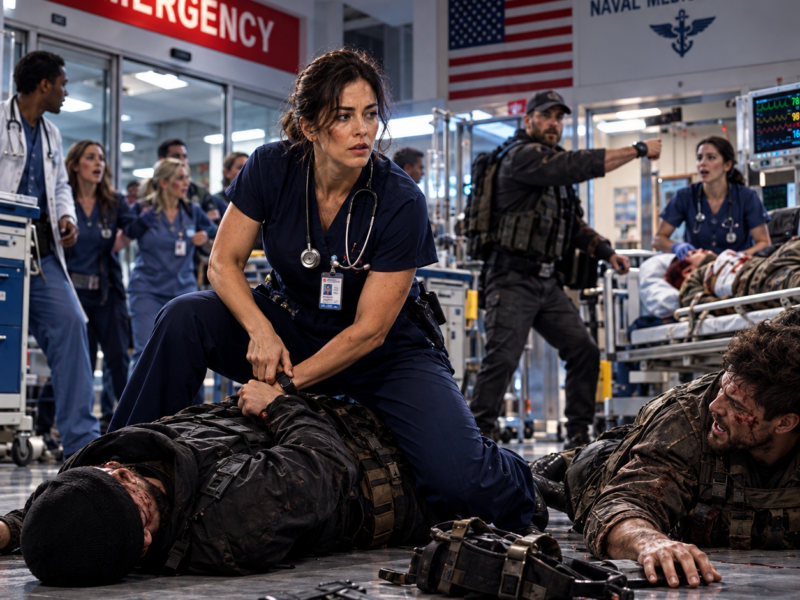
When armed men stormed Mercy General’s emergency room, Dr. Harris ordered me to the floor and sneered that a frightened little nurse should know her place, but the moment their leader saw the scar beneath my collar, he lowered his weapon and whispered the name I had spent three years trying to bury.
The fluorescent lights of the emergency room flickered, buzzing with a persistent, low hum that usually faded into background noise.
On Thursday nights, Mercy General in Baltimore was normally a haven for broken wrists, high fevers, and the quiet exhaustion of night-shift workers.
I wiped down the triage counter with steady, methodical movements, keeping my eyes low and my shoulders slightly slouched.
To everyone working the floor, I was just Emily Brooks, the quiet nurse who never complained about taking double shifts or covering holidays.
I made the coffee, brought extra blankets to frightened patients, and apologized whenever Dr. Harris lost his temper over missing charts.
It was a simple, harmless existence, and that was precisely why I had chosen it three years ago.
Dr. Richard Harris walked past the desk, his white coat pristine, his steps sharp and full of self-importance.
He paused near my station, tapping his fingers against his clipboard as his gaze swept over my worn scrubs.
“Emily, make sure room four is cleared before the midnight shift arrives,” he said, his tone dripping with condescension.
“And leave the trauma assessments to the residents tonight. You’re good with simple bandages, but we need people who don’t freeze under pressure.”
I swallowed the sudden knot in my throat, keeping my face completely blank as I nodded.
“Of course, Dr. Harris,” I replied softly, my voice barely above a whisper.
He offered a patronizing smile, satisfied with my submission, and walked toward the staff lounge.
He had no idea what pressure truly felt like, nor did he know what it had cost me to stand in this quiet hallway.
He didn’t know about the sound of metal tearing through cold mountain air, or the weight of a dying soldier’s hand slipping from mine in a dust-choked tent.
For three years, I had deliberately shrunk myself into someone small, fragile, and utterly unmemorable.
I wanted the world to forget I existed, because remembering meant facing the nightmare I had left behind in the mountains of Afghanistan.
Suddenly, the air pressure in the room seemed to drop, and a heavy, artificial chill swept through the automatic doors.
The outer glass sliding doors opened, but it wasn’t an ambulance crew wheeling in a stretcher.
Heavy combat boots slammed against the polished linoleum floor, shattering the midnight quiet with terrible efficiency.
Four men stepped into the lobby, dressed in tactical gear and carrying heavy, dark assault rifles.
A woman holding her sick child shrieked, the sound echoing off the high ceilings before being cut short by a harsh command.
“Everyone on the ground! Now!” the lead intruder barked, his weapon sweeping across the room in a practiced arc.
Dr. Harris immediately dropped behind the counter, burying his head in his hands, his previous arrogance vanishing in a fraction of a second.
Panic spread like wildfire through the lobby as patients scrambled beneath plastic chairs and nurses backed away into dark corners.
I slowly dropped into a crouch behind the main counter, my pulse spiking not from panic, but from an old, buried reflex.
My heart beat in a steady, rhythmic rhythm as my mind instantly began analyzing the room without my permission.
The leader held his weapon with a firm grip, but his left thumb twitched rhythmically against the safety catch.
The man guarding the double doors favoured his right leg, leaning his weight heavily against the frame to hide a severe limp.
The third intruder wasn’t looking at the people on the floor; his eyes remained fixed on the ceiling cameras, searching for blind spots.
They weren’t common criminals looking for prescription drugs or quick cash from the administrative vaults.
These men were operating under a tight, disciplined tactical formation, and they were hunting for something specific.
“Where is the soldier?” the leader shouted, his voice rough and strained under his mask.
Nobody moved, the silence in the room stretched thin and fragile like drawn glass.
The leader stepped forward, his boots crushing a discarded plastic cup as he approached a young nurse huddled near the desk.
He grabbed her by the collar, dragging her upright and pressing the warm barrel of his rifle against the side of her temple.
“Ask me again,” he warned, his eyes burning with a desperate, chaotic intensity, “and someone in this room dies.”
Echoes of a Forgotten Command
The young nurse began to sob hysterically, her frame shaking violently as the rifle pressed deeper into her neck.
Dr. Harris stayed pinned to the floor beside me, his hands clamped over his ears, his teeth chattering in silent terror.
“Don’t look at them, Emily,” he whimpered, his voice pathetic and entirely stripped of authority. “Just stay down and pretend you’re invisible.”
I looked at the nurse’s terror-stricken eyes, and the quiet persona I had carefully built over three years fractured into pieces.
The fear was still there inside me, cold and sharp, but beneath it, an ancient, instinctual authority roared back to life.
I didn’t think about my quiet life in Baltimore, or my small apartment, or the fake name on my hospital badge.
I only saw an innocent civilian about to be executed by men who had forgotten the code they once swore to uphold.
I stood up slowly from behind the counter, making my movements deliberate, smooth, and entirely unthreatening.
“Let her go,” I said, my voice cutting through the heavy silence with flat, absolute calm.
The leader snapped his weapon toward me, his eyes widening slightly as he processed my sudden movement.
“Get on the floor, nurse,” he sneered, though his barrel wavered for a fraction of a second.
I didn’t drop to my knees, nor did I raise my hands in surrender.
Instead, I took a half-step forward, adjusting my balance and locking my eyes directly onto his.
“Vanguard six, lower your muzzle and hold perimeter,” I said, using the exact, clipped vocal cadence of military command.
“Rear guard, secure the secondary breach. You’re exposing your flank to the south corridor.”
The words cut through the room like a physical blow, cold, precise, and impossible to misunderstand.
The man guarding the door instantly snapped his head toward me, his hands tightening on his rifle in pure reflex.
The intruder watching the cameras froze, his eyes locking onto me as if he had just seen a ghost standing in scrubs.
Dr. Harris looked up from the floor, his face pale and bewildered as he gaped at me.
“Emily, what are you doing?” he hissed, his voice trembling with panic. “Are you insane?”
“I’m keeping your patients alive, Doctor,” I replied without breaking eye contact with the leader. “Now shut up and stay down.”
I turned slightly, gesturing toward two terror-stricken nursing assistants crouching near the corridor.
“Move the pediatric patients into the secure radiologic vault,” I commanded softly. “Lock the heavy steel doors behind you.”
They didn’t hesitate; the absolute authority in my voice compelled them to move instantly, sliding past the guards like shadows.
I looked at a senior surgical resident who was frozen near the triage doors.
“Get the critical patients behind the reinforced trauma bay doors,” I added. “Now.”
The resident nodded blindly and began pushing stretchers down the hallway with sudden, focused urgency.
My voice was no longer the soft, hesitant tone I used to comfort frightened children in the pediatric ward.
It was the tone that had echoed through radio headsets across hostile valleys, commanding respect when men were dying.
The leader stepped closer to me, his heavy tactical boots clicking sharply on the clean floor.
He didn’t raise his rifle to shoot me; instead, he lowered it slightly, his posture shifting from aggressive to intensely cautious.
He studied the posture of my shoulders, the stance of my feet, and the complete lack of fear in my eyes.
His eyes drifted downward, settling on the visible edge of a pale mark peeking out from the neckline of my scrubs.
The Name in the Dark
He stepped closer, his breathing heavy beneath his tactical mask as he reached out with a gloved hand.
I didn’t flinch as he used the tip of his barrel to pull down the collar of my blue scrub top.
There, resting just beneath my collarbone, was a jagged, raised white line where shrapnel had torn through flesh and bone years ago.
It was a mark that didn’t exist in any medical record at Mercy General, a scar born in a fire that officially never happened.
The leader’s eyes widened in profound disbelief, and the cold aggression in his stance completely collapsed.
He pulled off his mask with a trembling hand, revealing a weathered face lined with deep exhaustion and old scars.
“Commander Hayes?” he whispered, his voice cracking on the final syllable.
The sound of that title hit me harder than any bullet ever could, sending a sharp wave of ice straight down my spine.
I hadn’t heard that name spoken aloud in three long, agonizing years.
To the military, Commander Sarah Hayes was a disgraced officer who had abandoned her post after a disastrous operation.
To my family back in Ohio, I was a broken veteran who had suffered a severe mental breakdown and disappeared into the night.
To the rest of the world, Sarah Hayes was effectively dead, buried under mountains of classified paperwork and false reports.
Dr. Harris slowly pulled himself up from the floor, holding onto the edge of the desk, his eyes darting between us.
“Commander?” he repeated, his voice small, confused, and filled with a sudden, deep hesitation. “Emily… who are you?”
I didn’t answer him; my mind was racing back to that dreadful midnight operation in the Korengal Valley.
Six soldiers had died in an ambush that should have been avoided if our intelligence had been accurate.
When the military court convened, the official report laid the blame squarely on my shoulders, citing poor tactical decisions under fire.
They claimed I had panicked, that I had ordered my unit into a kill zone without proper air support.
I had accepted the dishonorable discharge, signed the non-disclosure agreements, and walked away without defending myself.
I had taken the fall voluntarily to protect a young lieutenant whose testimony would have exposed a massive, corrupt network within the command structure.
I had sacrificed my rank, my career, and my entire life so that the truth wouldn’t destroy five other innocent families.
And now, standing in an ER lobby in Baltimore, one of the survivors of that horrific night was looking at me like a ghost.
“You’re supposed to be dead,” the man whispered, his rifle barrel now pointing harmlessly at the floor. “The agency said you died in a vehicle crash two years ago.”
“I needed to disappear, Miller,” I said, recognizing his face through the thick layers of age and stress. “Why are you here?”
Miller took a deep, shuddering breath, looking back toward the glass doors where the rain was beating against the pavement.
“We didn’t come here to hurt civilians, Commander,” he said, his voice trembling with an emotion I hadn’t expected to see.
“We came here because Colonel Vance is alive.”
My chest constricted, catching the air in my throat like a physical obstruction.
Colonel Arthur Vance had been my direct commanding officer, the man who had signed off on the false report that ruined my life.
He was the man who had handed me my discharge papers with a cold, unfeeling expression, telling me to forget I had ever served.
“Vance?” I managed to say, my calm facade threatening to crumble. “Vance is dead. He died of heart failure last year.”
“It was a cover,” Miller said softly. “He’s been in hiding for eighteen months, running from the same people who set us up.”
“Why come to me?” I asked, my knuckles turning white as I gripped the counter behind me.
“Because he’s dying for real this time,” Miller said, looking directly into my eyes. “And he’s finally ready to tell the truth.”
The word echoed through the silent emergency room, heavy with three years of pain and buried anger.
The truth was something I had abandoned long ago, choosing quiet survival over a fight I knew I couldn’t win.
Dr. Harris stepped forward, his cowardice suddenly replaced by a sharp, defensive authority as he pointed at Miller.
“I don’t care who you people are or what military drama you’re running from,” Harris barked, trying to regain control.
“This is a civilian hospital! You have armed men in my lobby, and I am calling the police right now!”
Miller didn’t even look at him; he simply raised his hand, pointing his rifle casually toward the floor near Harris’s feet.
“Shut your mouth,” Miller said coldly. “If the local police step foot in this parking lot, the men trailing us will blow this entire block to hell.”
Harris froze, the color draining instantly from his face as he swallowed his remaining words.
I stepped between Miller and Dr. Harris, my eyes narrowing as I processed Miller’s warning.
“Who is trailing you, Miller?” I demanded, my voice sharp and imperative. “Speak clearly.”
“Blackwood’s group,” Miller replied, a dark shadow passing over his face. “The private contractors who supplied the false intel three years ago.”
“They found out Vance was moving tonight,” Miller continued, his breath coming in short, erratic hitches. “They know he has the original ledger.”
The original ledger was the holy grail of our former unit—the hard data proving that the ambush had been orchestrated to hide weapon smuggling.
If that ledger was exposed, high-ranking military officials and defense contractors would face life sentences for treason.
“Where is Vance now?” I asked, my mind instantly calculating escape routes and defensive positions.
Miller turned his head slightly, gesturing with his chin toward the rain-slicked ambulance bay outside the automatic doors.
“He’s in the back of the armored transport parked in the bay,” Miller whispered. “He refused to step inside until I verified you were here.”
My throat tightened, a sudden wave of conflicting emotions washing over my chest.
Arthur Vance had destroyed my reputation, allowed my name to be dragged through the dirt, and watched me walk away in disgrace.
Yet he was also the man who had pulled me out of a burning humvee five years prior, saving my life when no one else would.
“He told us to bring you to him, Emily,” Miller said, his voice dropping so low that only I could hear it.
“He said he couldn’t die with your blood still on his hands.”
I looked back at Dr. Harris and the few remaining staff members hiding behind the central counters.
They were staring at me as if I were a stranger, someone they had worked alongside for three years without ever truly seeing.
“Dr. Harris,” I said, turning to him with absolute authority. “Take the staff and move deeper into the building.”
“Lock the surgical wing security doors and stay away from the front glass,” I ordered. “Do not open them for anyone except local authorities after I give the clearance.”
Harris opened his mouth to protest, but the sharp, unyielding look in my eyes made him stop.
He simply nodded, turning around and ushering the remaining nurses down the dark hallway without another word.
I turned back to Miller, my decision already made before my heart could object.
“Take me to him,” I said.
Miller nodded, but as he reached for the door handle, he paused, his face suddenly pale under the harsh ER lights.
A terrible, unnatural hesitation washed over his features, his hand hovering over the door lock.
“What is it, Miller?” I asked, sensing the sudden shift in his pulse.
He turned back to look at me, his eyes filled with a dark, suffocating terror that went beyond the fear of an incoming gunfight.
“He made us promise one thing before we brought you out there,” Miller whispered, his voice trembling uncontrollably.
“What promise?” I asked, stepping closer, my hand hovering near his arm.
Miller swallowed hard, his throat moving painfully as he stared through the rain-spotted glass doors.
“He made us promise not to let you see what he’s carrying,” Miller whispered, his voice barely audible over the sound of thunder.
Before I could ask what he meant, a sudden, blinding flash illuminated the parking lot outside the glass doors.
The heavy, metallic thud of a high-caliber sniper rifle echoed across the asphalt, shattering the quiet night.
The glass side-panel of the emergency room entrance blew inward, showering us in thousands of tiny, sparkling shards.
Miller reacted instantly, grabbing my shoulder and dragging me behind the thick concrete support pillar near the desk.
“They’re here!” the guard at the door shouted, firing a short burst of suppressed automatic fire into the dark parking lot.
Engine roars echoed through the storm as two black SUVs spun into the ambulance bay, blinding us with their high beams.
Men dressed in unmarked tactical gear spilt out of the vehicles, taking up disciplined firing positions behind the concrete barriers.
“Blackwood’s team!” Miller yelled over the deafening noise of shattering glass and gunfire. “They tracked our signal!”
I slid down behind the concrete pillar, my eyes sweeping the floor until they found a heavy iron torque wrench left by a maintenance worker.
I grabbed it, feeling the familiar weight of cold steel in my palm, my instincts completely taking over my body.
“How many rounds do you have left?” I shouted at Miller, my voice completely steady despite the chaos around us.
“Two mags each!” Miller yelled back, ducking as a spray of bullets chipped off pieces of the concrete pillar above us. “We can’t hold them off in the open!”
“We don’t need to hold them,” I said, looking toward the side exit that led directly into the ambulance bay. “We need to get to Vance’s transport.”
I looked at the guard near the double doors, who was taking heavy fire from the left flank.
“Covering fire on my mark!” I ordered, my voice rising over the deafening noise of the skirmish.
“Three! Two! One! Go!”
The two guards opened fire simultaneously, forcing the attackers outside to duck behind their vehicles for three brief seconds.
I sprinted across the ruined lobby, staying low, my feet moving with automatic, practiced agility over the slick tile floor.
I hit the emergency crash bar of the side door, bursting out into the cold, torrential rain of the Baltimore night.
The wet wind hit my face, washing away the smell of hospital sanitizer and replacing it with the sharp scent of ozone and gunpowder.
Parked in the center of the ambulance bay was a heavily retrofitted, matte-black transport vehicle, its reinforced doors closed tight.
I sprinted toward the rear doors, keeping low behind the concrete retaining wall as bullets kicked up sparks against the pavement.
I slammed my hand against the heavy steel back door of the transport, punching the standard military emergency access code into the keypad.
The heavy electronic lock clicked open with a deep pneumatic hiss, and the doors swung outward into the rain.
Inside the dimly lit interior, illuminated only by the faint red glow of emergency tactical lights, sat Colonel Arthur Vance.
He was slouched against the wall, his face hollow, his skin an unnatural, sickly grey under the harsh red light.
His uniform was torn, soaked in water and blood, but his eyes were bright, burning with an intense, desperate energy.
In his lap sat a heavy, metallic briefcase locked to his wrist with a thick steel security cable.
“Sarah…” he breathed, his voice a raspy whisper that barely carried over the sound of rain falling on the roof.
“You actually came.”
I stepped into the cramped, metallic interior of the transport, pulling the heavy door closed behind me to block out the gunfire.
The sudden silence inside the armored vehicle was deafening, broken only by the rhythmic clicking of the cooling engine.
“Colonel,” I said, my voice cold, guarded, and devoid of the affection I had once felt for my former mentor.
“Miller said you wanted to talk. He said you were ready to give up the ledger.”
Vance offered a weak, bitter smile, his bloodied lips pulling back to reveal stained teeth.
“Always direct, Commander,” he rasped, coughing violently as a smear of dark blood appeared at the corner of his mouth.
“You haven’t changed at all, despite the blue scrubs and the quiet life you tried to build.”
“I built that life because you destroyed my real one,” I said, stepping closer, my hands clenched into tight fists at my sides.
“You let them call me a traitor, Vance. You let them say I panicked and killed six of my own men.”
“I know,” he whispered, his eyes casting downward as a heavy tear cut a path through the grime on his cheek.
“It was the only way to keep you alive, Sarah.”
“Don’t lie to me!” I snapped, my calm finally cracking as years of buried grief roared to the surface.
“You saved your own skin! You signed the discharge papers! You sat in that air-conditioned room while I was dragged through the dirt!”
“If I hadn’t taken the deal with Blackwood, they would have executed you in that staging base!” Vance yelled back, his voice surprisingly strong for a dying man.
“They were going to put a bullet in the back of your head and claim it was an enemy sniper!”
He reached out with a trembling, blood-stained hand, pointing toward the heavy metal briefcase sitting on his lap.
“Blackwood owned the entire regional command,” Vance continued, his chest heaving as he fought for air.
“They were selling high-grade military hardware to local warlords, and your team accidentally stumbled right onto their primary supply route.”
“The ambush wasn’t a mistake, Sarah… it was a cleanup operation planned by our own command staff.”
I froze, the cold air in the transport suddenly feeling thick enough to choke on.
For three years, I had believed that our intelligence had simply failed us, that a terrible miscalculation had led us into that deadly valley.
To hear that my team had been deliberately led into an execution pit by our own leaders turned my stomach into ice.
“They needed a scapegoat,” Vance whispered, his breathing growing shallow and uneven.
“Someone with enough tactical authority to make the blame believable, but without the political connections to fight back.”
“I took the blame,” I whispered, my voice trembling as the horrifying realization fully settled in my mind.
“You took the blame to save the surviving men,” Vance said softly. “And I let you take it because it was the only way Blackwood would let you walk out of that country alive.”
He reached down to the briefcase, his fingers fumbling with the heavy combination dial on the heavy steel lock.
“For three years, I’ve been gathering the hard digital evidence,” Vance said, his eyes locking onto mine with desperate urgency.
“Every transaction, every name, every signed order from the command structure is stored on a hard drive inside this case.”
“Why give it to me now?” I asked, looking down at the metallic box. “Why risk coming here?”
“Because my time is up, Sarah,” Vance whispered, pulling back the edge of his heavy coat to reveal a deep, jagged wound in his abdomen.
The blood was dark, almost black, soaking through layers of makeshift bandages that were completely saturated.
“And because the men who ruined us are coming through those doors right now.”
A massive explosion rocked the outside of the transport, sending a heavy shockwave through the thick steel floorboards.
The impact threw me against the padded wall of the vehicle, the metallic ring in my ears drowning out all other sounds.
Through the small, reinforced viewport in the rear door, I saw bright orange flames engulfing Miller’s tactical SUV.
Blackwood’s men were moving up under the thick smoke, firing heavy automatic weapons into the hospital lobby.
Miller was down near the concrete wall, clutching his shoulder as he fired his sidearm with his remaining good hand.
They were overwhelming our tiny defensive perimeter, using heavy firepower to force their way into the facility.
“They won’t stop until everyone who knows about this drive is dead,” Vance rasped, pressing a heavy key into my hand.
“The drive is encrypted with your old tactical callsign,” he said, coughing heavily. “Only you can unlock the main file.”
I looked down at the cold brass key in my palm, feeling the overwhelming weight of my past returning all at once.
I couldn’t hide in Mercy General anymore; the quiet nurse named Emily Brooks was gone, destroyed by the flames outside.
“Sarah,” Vance said, his hand clutching my wrist with a sudden, surprisingly fierce grip.
“Do not let them take this case. If Blackwood gets his hands on this drive, the truth dies forever, and your name remains disgraced.”
“I’m not going to let them take it,” I said, my voice dropping back into the terrifying calm of a field commander.
I reached down to my belt, pulling out the secondary sidearm Miller had given me before we stepped outside.
I checked the magazine with a quick, practiced movement—fifteen rounds of high-velocity ammunition ready to go.
“Stay down, Colonel,” I ordered, chambering a round with a sharp, metallic click. “I’m clearing our exit route.”
I hit the door release button, and the heavy rear doors swung open once again into the rain-drenched madness of the bay.
A contractor dressed in black tactical gear stepped around the corner of the transport, raising his rifle directly toward my chest.
I didn’t hesitate, taking a quick step forward and bringing my sidearm up in a smooth, fluid arc.
I fired two shots into his central chest plate before he could pull his trigger, dropping him instantly to the slick asphalt.
I stepped out into the rain, using the side of the transport as cover as I surveyed the chaotic battlefield.
Three contractors were advancing toward the main hospital entrance, trying to flank Miller’s position behind the wall.
“Vanguard position!” I shouted over the storm, my voice ringing out like a thunderclap across the parking lot.
“Miller, duck!”
Miller instantly dropped flat against the wet pavement as I leaned out from behind the transport and fired three precise shots.
The lead contractor collapsed, his rifle clattering against the concrete as his two teammates scrambled for cover behind a pillar.
“Commander!” Miller yelled, dragging himself toward me using his elbow. “We have heavy reinforcements arriving from the north!”
I looked down the street and saw three more black vehicles speeding toward the hospital entrance with their lights off.
We were completely outnumbered, outgunned, and running out of tactical options inside the open parking area.
“We fall back inside the building!” I ordered, grabbing Miller by his tactical vest and pulling him to his feet.
“Move into the radiologic corridor! The steel walls will block their thermal imaging!”
We dragged Miller through the shattered glass doors of the lobby, leaving a dark trail of blood across the white tile floor.
The lobby was completely destroyed, the ceiling tiles hanging down in ragged strips, the air thick with smoke and dust.
Dr. Harris was cowering behind the main administrative desk, his face covered in white plaster dust and tears.
When he saw me dragging Miller while holding a smoking sidearm, his eyes opened wide in absolute, primitive horror.
“Emily… please don’t shoot me,” he whimpered, holding his hands up in a desperate plea for mercy.
I stopped beside the desk, looking down at the man who had patronized me for three years, calling me weak and useless.
“Get up, Harris,” I said softly, my tone showing neither anger nor satisfaction, only absolute authority.
“Take the emergency keys and unlock the heavy access doors to the basement medical archives.”
“The basement?” Harris stammered, his body shaking uncontrollably. “There’s no exit down there! It’s a dead end!”
“It’s a reinforced fallout shelter built in nineteen-sixty,” I corrected him sharply, remembering the building blueprints I had studied when I took the job.
“The doors are four-inch solid steel, and the radio signals can’t penetrate the concrete ceilings.”
“It’s the only place in this entire hospital that Blackwood’s team can’t blow open with light explosives.”
Harris scrambled to his feet, grabbing the heavy ring of master keys from beneath the counter with trembling fingers.
“Follow me!” he shouted, his survival instincts finally overcoming his terror as he sprinted toward the rear service corridor.
I turned back to the glass doors, watching through the smoke as the black vehicles pulled up to the curb outside.
A tall man in a long dark coat stepped out of the lead vehicle, holding a heavy suppressed pistol at his side.
It was Blackwood himself—the former special forces officer turned mercenary chief who had orchestrated the entire cover-up.
He paused near the shattered entrance, looking down at the fallen contractors on the ground with a cold, disgusted sneer.
Then his gaze drifted through the smoke, locking directly onto mine across the ruined lobby.
A slow, terrifying smile spread across his face as he recognized me through the haze of rain and powder smoke.
“Commander Hayes,” he called out, his voice amplified by a handheld bullhorn that echoed off the high ceilings.
“I must admit, I was surprised to hear you were still breathing after all these years.”
“You should have stayed buried in Ohio, Sarah,” Blackwood continued, taking a slow, calm step into the lobby.
“Give me the drive Vance brought you, and I promise your hospital friends walk out of here alive.”
I didn’t answer him; I simply raised my sidearm, fired one shot into the central light fixture above his head, and plunged the entire lobby into total darkness.
“Move!” I barked to Miller, grabbing his vest and pulling him down the service corridor as gunfire shattered the dark behind us.
We sprinted down the narrow, dimly lit service hallway, the heavy steel doors slamming shut behind us as Harris locked them.
The heavy lock clicked into place with a solid, reassuring thud that echoed down the long concrete staircase.
We descended into the cool, damp air of the hospital’s lower levels, where the sound of the storm above faded into a dull, low rumble.
The basement archives were massive, filled with rows of tall steel shelving units containing thousands of old paper medical records.
Miller collapsed against a concrete pillar, clutching his bleeding shoulder as he gasped for air in the dim fluorescent light.
“We’re trapped down here, Commander,” Miller rasped, looking up at the heavy ceiling above us. “They’ll cut through those steel doors in ten minutes.”
“They won’t need to cut through them,” I said, putting the heavy metallic briefcase down on an iron reading table.
I pulled out the brass key Vance had given me and inserted it into the secondary lock on the side of the case.
“What are you doing?” Harris asked, shrinking back into the shadows near the rows of file cabinets.
“I’m finishing what started three years ago,” I replied, turning the key with a firm, decisive click.
The heavy lid of the steel briefcase popped open, revealing a compact satellite transmitter unit and an encrypted hard drive.
The digital screen on the unit lit up with a bright blue glow, displaying a single prompt for an access code.
I didn’t hesitate; my fingers flew across the mechanical keypad, entering the eight-digit tactical callsign of my former unit.
V-A-N-G-U-A-R-D-6
The screen flashed green, and a progress bar immediately appeared: UPLOADING SECURE FILES TO DEPARTMENT OF JUSTICE MAIN SERVERS.
“It’s broadcasting directly to the federal inspector general’s office,” I said softly, watching the blue percentage numbers rise.
“Every single document, every encrypted communication, and every financial transaction is being sent right now.”
Above us, a heavy metallic boom echoed down the concrete stairwell as Blackwood’s men began setting explosive charges on the upper door.
“They’re breaching!” Harris shrieked, pressing his back against the cold concrete wall in absolute terror.
“Let them breach,” I said, pulling a fresh magazine from Miller’s tactical vest and slapping it into my sidearm with a hard smack.
“The file upload will be finished in sixty seconds.”
I stepped away from the table, taking up a firing stance behind a heavy steel file cabinet facing the stairwell door.
My heart was no longer beating with the cold, isolated fear I had carried for three agonizing years.
I was no longer hiding; I was no longer running from the ghost of a soldier who had taken the fall for monsters.
The heavy steel door at the top of the stairs blew inward with a deafening roar, showering the upper landing with sparks and dust.
Heavy tactical boots began descending the stairs, three men moving in tight formation with their weapons raised.
Blackwood stepped onto the landing, his weapon pointed directly down the long aisle toward the bright blue light of the satellite case.
“It’s over, Sarah!” Blackwood shouted, his voice echoing off the concrete walls of the basement archive. “Shut down the transmitter!”
“It’s already done, Blackwood,” I called back, my voice completely steady, ringing out through the dusty room like a bell.
The small screen on the table flashed bright green with a final, definitive message: TRANSMISSION COMPLETE. FILES VERIFIED AND SECURED.
Blackwood looked at the screen, his face draining of all color as he realized what had just occurred.
The leverage he had held for three years, the power he had used to ruin lives and murder innocent people, was gone in an instant.
Outside, in the distant streets above us, the low, rising wail of dozens of federal law enforcement sirens began to cut through the heavy storm.
The Department of Justice had received the automated priority alert, and federal marshals were converging on Mercy General from every direction.
Blackwood stood on the bottom stair, his face twisted in a silent, furious rage as the sirens grew louder outside.
His men looked at each other in sudden panic, realizing their window of operation had completely closed.
“Drop your weapons!” a booming voice echoed from the upper landing as federal tactical agents flooded the stairwell behind them.
“Department of Justice! Put your hands on your heads! Now!”
Blackwood hesitated for one long, terrifying second, his eyes locking onto mine with pure, unadulterated hatred.
Then, slowly, he opened his fingers, allowing his heavy suppressed pistol to clatter uselessly onto the cold concrete floor.
His men followed suit, throwing their weapons aside as federal agents swarmed the landing, pinning them to the walls and sliding plastic flex-cuffs onto their wrists.
A senior federal agent stepped down the stairs, his weapon lowered, his eyes sweeping over the quiet basement room.
He looked at the open satellite case, then looked at Miller, before finally turning his attention to me.
He pulled a physical file from his tactical vest, opening it to reveal a dusty photograph of a woman in a military dress uniform.
“Commander Sarah Hayes?” the agent asked, his voice filled with a quiet, solemn respect.
“I am Commander Hayes,” I said, slowly lowering my sidearm and placing it on the steel table beside the briefcase.
The agent closed the folder, standing at attention and offering a crisp, formal salute that echoed through the quiet room.
“The Inspector General just received the files, Commander,” the agent said clearly. “All charges against you have been officially dismissed.”
“The Attorney General has ordered an immediate federal investigation into the entire former command structure.”
Dr. Harris slowly crept out from behind the file cabinets, looking at me with wide, completely transformed eyes.
He looked at the federal agents saluting me, then looked down at the pale scar showing beneath my scrub collar.
“Emily…” Harris stammered, his voice choked with embarrassment and deep, unearned shame. “I… I had no idea.”
I turned to look at him, offering a small, sad smile that contained no bitterness, only the deep exhaustion of a long war finally ended.
“My name isn’t Emily, Doctor,” I said softly, stepping past him toward the stairs. “And I don’t work the night shift anymore.”
I walked out of the dark basement into the early morning light that was beginning to cut through the rain clouds over Baltimore.
The storm had finally passed, leaving the air fresh, clear, and clean as the sun began to rise over the city skyline.
I stood on the steps of Mercy General, feeling the cold morning wind against my skin as the rain ceased completely.
For three long years, I had walked through the dark as a ghost, carrying the weight of a disgraced name in silence.
Now, standing in the cold light of a new day, I took my first real breath of freedom, ready to step back into the world.
The hospital parking lot was filled with red and blue emergency lights, but the heavy oppressive fear that had held the facility hostage was entirely gone.
Medical teams were moving calmly between stretchers, treating the minor injuries of the staff and ensuring the patients were safe.
Miller was being loaded into an ambulance, his face pale but relieved as he gave me a simple, knowing nod of his head.
He was going to survive, and for the first time in three years, he was going to live without running from shadows.
Inside the armored transport, paramedics were working quietly over Colonel Vance, who lay still against the padded wall.
I stepped up to the open rear doors of the vehicle, looking down at the man who had given everything to correct his final mistake.
His eyes opened weakly, catching mine through the dim morning light, a faint sense of peace resting on his weathered features.
“It’s done, Colonel,” I whispered, reaching out to touch his cold hand. “The truth is out. You can rest now.”
A soft, faint smile touched his lips, and he closed his eyes as the paramedics continued their quiet, respectful work.
I walked away from the ambulance bay, heading toward the small park across the street where the green trees were dripping with fresh rainwater.
I sat down on a wet wooden bench, taking off my blue hospital badge and holding it in the palm of my hand.
The name printed on the plastic read Emily Brooks – Registered Nurse, a simple label for a life that had served as my sanctuary.
I had hated the quiet at first, but over time, I had grown to love the simple act of helping people without a weapon in my hand.
I didn’t need to completely destroy the person I had been for the last three years to accept the commander I used to be.
I dropped the plastic badge into my pocket, looking up into the bright, clear morning sky as the golden sun broke through the clouds.
I wasn’t just Sarah Hayes, the disgraced officer who had taken the blame for her unit.
And I wasn’t just Emily Brooks, the timid nurse who hid in the shadows of an emergency room to escape her past.
I was a woman who had survived the fire, fought through the dark, and walked back out into the light with her head held high.
A high-ranking federal officer walked across the grass toward my bench, holding a crisp manila envelope containing my reinstatement papers.
“Commander Hayes,” he said respectfully, stopping two steps away. “Washington wants to know when you’ll be ready to return to active service.”
I took a deep, full breath of the clean morning air, feeling the warm sunlight on my face for the first time in years.
I looked back at the doors of Mercy General, where a young nurse was gently guiding a frightened patient out into the light.
I stood up from the bench, holding out my hand to receive the envelope, my decision already clear in my heart.
“Tell Washington I have a few things to finish here first,” I said with a warm, steady smile. “And tell them I’ll be taking my time.”









