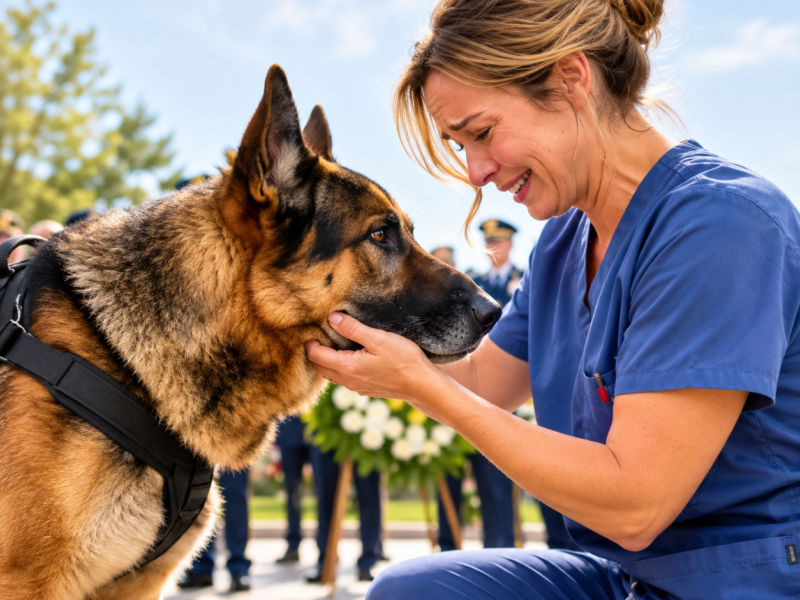
When a blind K9 suddenly broke formation at a packed Arlington memorial and ran straight toward me, the decorated captain shouted for someone to restrain him, but the dog pressed his nose against my hands as if remembering something everyone else had been ordered to forget.
The chilly October wind swept across the pristine grounds of Arlington, carrying the faint scent of damp earth and polished marble.
I stood near the back edge of the crowd, wrapped tightly in a dark coat, squeezed between a row of off-duty trauma nurses and grieving family members.
Ahead of us, one hundred police officers and military honor guards stood in immaculate formation under the heavy Virginia sky.
Their dark blues and crisp whites stood out sharply against the pale stone memorial wall that bore the names of the fallen.
A chaplain’s voice droned over the loudspeaker, echoing across the quiet hills, but I couldn’t hear the words.
My eyes were fixed entirely on the second column, halfway down, where my fiancé’s name had been freshly chiseled into the stone.
Sergeant Daniel Brooks.
Eighteen months had passed since two uniformed officers had knocked on my apartment door in Alexandria to tell me he wasn’t coming home.
They told me his unit had been caught in a catastrophic structural collapse during an overseas rescue operation.
They told me he died a hero, saving three of his men while the building came down around them.
And they told me his body had been recovered and laid to rest with full military honors in a closed-casket ceremony I was barely conscious enough to survive.
A sharp bark shattered the quiet dignity of the service.
Near the front row, a heavily scarred German Shepherd suddenly lurched forward, straining against a thick leather lead.
It was Ranger, Daniel’s former K9 partner, who had been retired from active duty after surviving the same blast that took Daniel.
The young handler holding his leash stumbled, his boots skidding across the wet grass as he tried to regain control.
“Stay!” the handler ordered, his voice tight with sudden embarrassment. “Ranger, heel!”
The dog ignored the command completely, his ears pinned back, his graying snout raised high into the cold air.
His milky, clouded eyes stared into total darkness, yet he moved with absolute, terrifying purpose.
He wasn’t reacting to a sound or a scent in the wind; he was locked onto a frequency only he could hear.
“Restrain that dog!” a commanding voice barked from the front row.
It was Captain Marcus Vance, the decorated unit commander who had delivered the folded flag to my lap eighteen months ago.
Vance turned, his sharp jaw set, his dark eyes flashing with anger as the crowd began to murmur.
“Get him back in formation immediately,” Vance commanded, stepping toward the handler.
But Ranger snapped his leash clean out of the young officer’s grip with a sudden, desperate violent yank.
The crowd gasped as the old dog broke into a heavy, uneven stride, surging directly through the gap between the officers.
People scrambled backward, clearing a path, assuming the distressed, blind animal was charging in panic.
Someone gasped, and a woman nearby grabbed her child’s arm in fear.
I stood frozen, my heart pounding against my ribs like a trapped bird.
Ranger didn’t turn left toward the street, nor right toward the memorial wall.
He ran straight at me.
He slowed his pace just inches away, his heavy chest heaving, his breath coming in ragged, warm puffs in the cold air.
Slowly, carefully, the blind dog pressed his wet snout directly into the open palms of my trembling hands.
It wasn’t an aggressive gesture; it was a desperate, agonizing plea for recognition.
The entire gathering went dead silent, the chaplain’s microphone buzzing uselessly in the wind.
I sank to my knees on the damp grass, completely unconcerned with the dirt staining my dress.
My hands cupped his scarred face, feeling the familiar ridge of bone above his left eye where shrapnel had torn through.
“Ranger?” I whispered, my voice breaking into a sob.
The old dog let out a low, whimpering sigh that sounded almost human, letting his heavy head drop onto my shoulder.
His tail gave two weak, rhythmic thumps against the ground.
The young handler hurried over, his face flushed red with anxiety as he reached for the dangling leash.
“Ma’am, I am so sorry,” the handler stammered, pulling gently on the lead. “He’s never done anything like this. He’s been completely unresponsive to civilian crowds since his medical discharge.”
“Leave him,” I said quietly, unable to take my eyes off the dog.
I stroked his fur, my fingers tracing the worn canvas of his tactical collar.
Hanging beside his official military identification tag was a second, smaller piece of metal—a silver dog tag stamped with Daniel’s service number.
I had given that tag to Daniel the night before his final deployment.
My fingers brushed against something thick and hard tucked underneath the collar’s heavy buckle.
It was a small, black waterproof pouch, wrapped tightly in industrial electrical tape and secured with a rusted steel clip.
It had been hidden so deeply against the underside of his neck that no one inspecting the dog from above would ever notice it.
My hands began to shake violently as I worked the rusted clip free.
“What is that?” the handler asked, stepping closer with a frown.
Before I could answer, heavy footsteps crunched rapidly against the gravel path behind us.
“Step away from the dog, miss,” Captain Vance’s voice boomed, sharp and cold as steel.
I glanced up to see the captain towering over us, his hands clasped tightly behind his back, his jaw muscles clenching.
“That animal is government property undergoing medical evaluation,” Vance said, his tone leaving no room for argument. “Hand over whatever you just removed from his collar.”
I didn’t answer him.
Instead, I peeled back the heavy electrical tape with fingernails that were bleeding from the effort.
Inside the waterproof casing was a tightly folded sheet of waterproof field paper, stained with grease and dried mud.
I unfolded it with trembling hands, recognizing the jagged, hasty slant of Daniel’s handwriting immediately.
My eyes scanned the first line, written in dark black ink:
*If you are reading this, Clara, they lied about how I died.*
The breath left my lungs all at once, as if I had been struck in the chest with a hammer.
The gray sky overhead seemed to tilt, the voices of the crowd fading into a dull, distant roar.
I clutched the paper to my chest, staring at the captain through a blur of sudden, scalding tears.
Vance took a sharp step forward, his hand extending toward my face.
“Give me that paper, Clara,” Vance ordered, his voice dropping an octave, losing every trace of its official ceremony. “It’s classified operational material. You don’t know what you’re dealing with.”
Ranger suddenly stood up between us, his upper lip curling back over his teeth.
A deep, guttural growl vibrated through the dog’s chest—a sound so filled with pure, lethal threat that Vance instinctively froze in his tracks.
“Ranger, down!” the handler shouted, shocked by the sudden turn in the dog’s demeanor.
The dog didn’t budge, standing like a wall of muscle and bone between me and the commander of Daniel’s unit.
I lowered my eyes back to the folded paper, my eyes racing across the remaining lines of text written in the dark.
*They told you it was a rescue, but it was an ambush set up from the inside,* Daniel had written.
*We found what they were smuggling across the border, and when I refused to bury the logbooks, the Captain called in the strike on our own position.*
*I hid the drive with Ranger. If he brought this to you, it means he survived, and it means they think I’m deep underground.*
*Do not trust anyone wearing the silver star.*
A cold chill ran down my spine, freezing the blood in my veins.
I looked up slowly, my eyes sweeping across the officers standing at attention along the perimeter of the lawn.
Pinned above the left pocket of every single commander in the brigade was a polished silver star emblem denoting their command status.
Captain Vance wore one right over his heart.
He saw the realization hit my face, and his expression hardened into something terrifyingly cold.
“Hand it over, Clara,” Vance repeated, reaching into his coat lining. “Right now.”
Before he could take another step, Ranger spun around toward the giant granite memorial wall.
The blind dog lunged forward, pressing his front paws against the smooth face of the stone, right beneath Daniel’s name.
He began to scratch frantically at the narrow seam where the marble slab met the damp soil, his claws tearing into the dirt.
“He’s trying to dig something up,” the young handler whispered, his voice trembling as he looked between me and the captain.
I stared at the base of the monument, where a tiny, freshly broken piece of black plastic was visible beneath the displaced earth.
It wasn’t a empty grave.
It was a drop site.
And Ranger had just brought me the key to open it.
**A Truth Buried in Stone**
The silence that fell over the memorial ground was suffocating.
Captain Vance took a subtle half-step to his right, his body angling to block the sight of the monument from the rest of the gathering.
“Lieutenant,” Vance said sharply to the young handler, “take this dog into the transport vehicle immediately. That’s a direct order.”
The young handler hesitated, his eyes flicking from his captain’s rigid back to the bleeding claws of the blind dog.
“Sir, he’s unearthing something,” the handler stammered. “If there’s evidence buried at a fallen officer’s marker—”
“I said move the dog!” Vance barked, his hand dropping closer to his side holster.
I didn’t wait for the handler to decide.
I dropped to my knees beside Ranger, shoving my bare fingers directly into the freezing dirt beneath the marble slab.
My nails scraped against sharp gravel and broken stone, but I ignored the stinging pain.
“Clara, stop!” Vance demanded, reaching out to grab my shoulder with a vice-like grip.
The moment his fingers clamped onto my coat, Ranger turned with blinding speed.
He didn’t bark; he snapped his jaws shut just inches from Vance’s wrist, the air popping with the force of his bite.
Vance recoiled instantly, cursing under his breath as he stumbled back onto the paved walkway.
My fingers hooked around a hard, rectangular object buried four inches into the mud.
I pulled it free with a wet suction sound.
It was a heavy, ruggedized military hard drive, encased in shockproof rubber and sealed with heavy-duty wax.
Etched directly into the rubber casing were three simple initials cut with a pocketknife: *D.B.*
“That drive contains sensitive military intelligence,” Vance said, his voice dropping into a dangerous, measured whisper that didn’t carry to the crowd behind us. “If you walk off this field with it, you are committing a federal offense.”
“He was my fiancé,” I said, rising to my feet, holding the muddy drive against my ribs. “You told me he died in a collapsing wall.”
“He died a hero,” Vance spat back, his eyes darting toward the edge of the crowd where two uniformed military police officers were beginning to notice the commotion. “And heroes don’t leave mess behind for civilians to clean up.”
“You killed him,” I whispered, the weight of the realization crashing down on me like lead.
Vance didn’t deny it.
He simply stared at me, his eyes dead and unblinking, the silver star on his chest gleaming under the dull gray clouds.
“You have five seconds to give me the drive, Clara,” Vance said softly. “Or things get very complicated for everyone here.”
Ranger let out another low, rattling growl, stepping in front of my legs once more.
“Lieutenant,” Vance called out calmly over his shoulder, raised just enough for the nearest MPs to hear. “We have a civilian disturbing a military gravesite and acting aggressively toward officers. Restrain her.”
The two military police officers immediately broke formation, their heavy boots thumping against the turf as they moved toward us.
The young handler looked at me, then at the hard drive in my hand, his eyes wide with confusion and rising horror.
“Ma’am,” the handler whispered under his breath so Vance couldn’t hear. “Get out of here. Run.”
“What?” I asked, my voice barely a squeak.
“I served with Daniel,” the handler murmured, subtly stepping his boots over the lead so it slipped free completely. “He saved my life in Kabul. Go.”
Before Vance could react, the handler deliberately bumped hard into the captain, throwing his balance off just enough to buy me three seconds.
“Ranger, go!” I screamed, turning on my heel and running toward the perimeter tree line as fast as my legs could carry me.
Behind me, I heard Vance yelling furious orders, the sharp whistle of a police command, and the frantic shouting of guards.
Ranger bounded right beside me, his nose low, tracking my footsteps through sheer instinct and memory of my voice.
We plunged into the dense thicket of oaks and pines that bordered the western edge of the cemetery grounds.
Branches whipped against my face and tore at my coat, but I didn’t slow down, clutching the muddy drive tight against my heart.
The sounds of shouting began to fade behind us, replaced by the heavy pounding of my own pulse in my ears.
We hit a steep, muddy embankment that sloped down toward a secondary access road.
My foot slipped on a wet root, and I tumbled sideways, sliding down the dirt incline until I hit the bottom with a jarring thud.
The hard drive knocked against a stone, cracking the outer rubber casing slightly.
I sat up, gasping for air, my hands covered in mud and blood.
Ranger slid down the slope right behind me, nudging his cold nose against my cheek to check if I was still moving.
“I’m okay, boy,” I sobbed, wrapping my arm around his thick neck. “I’m okay.”
I looked down at the cracked rubber on the hard drive.
Through the fracture, I could see a tiny LED indicator light blinking a slow, steady red.
It wasn’t just a storage drive.
It was actively transmitting a signal.
And as I heard the faint sound of tires crunching on gravel further down the access road, I realized Vance wasn’t just chasing me.
He was tracking the drive directly to my location.
**The Cold Signal**
The faint hum of an engine grew louder from around the bend of the narrow access road.
I scrambled behind a thick cluster of wild blackberry bushes, dragging Ranger down with me into the damp pine needles.
“Shh, Ranger, quiet,” I whispered, holding his muzzle gently with my trembling hand.
The old dog remained perfectly still, his body tense, his ears twitching at every micro-sound in the woods.
A sleek, unmarked dark SUV rolled slowly past our hiding spot, its tires kicking up tiny stones from the gravel path.
Through the tinted side window, I caught a glimpse of Captain Vance in the passenger seat, a radio receiver pressed tightly against his ear.
He was holding a hand-held directional antenna, its small digital screen glowing green in the dim interior of the vehicle.
They were sweeping for the frequency emitting from the broken casing in my lap.
The SUV slowed to a crawl less than fifty feet ahead of us, its brake lights casting a long, red glare across the wet trees.
“They’re going to find us in seconds,” I thought, my chest tightening so hard I could barely draw breath.
I looked at the drive.
The small red light continued to pulse rhythmically—every two seconds, a tiny beacon broadcasting our exact coordinates.
I needed to disable the transmitter without destroying the internal storage disk.
My hands searched my coat pockets frantically, finding nothing except my keyring, a half-empty pack of tissues, and an old brass pen.
I unscrewed the metal barrel of the pen, revealing the sharp, narrow steel tip of the internal ink tube.
Holding the drive close to my chest to muffle any sound, I jammed the steel tip directly into the tiny hole next to the blinking LED light.
There was a tiny spark, a faint smell of ozone, and the red light flickered twice before going completely dark.
I held my breath.
Fifty feet away, the dark SUV ground to a sudden halt.
I saw Vance lean out of the passenger door, holding the signal reader up into the air, his brow furrowed in frustration.
“Lost the signal,” a voice barked faintly from inside the vehicle. “It just cut out completely.”
“She couldn’t have disarmed it that fast,” Vance’s voice rang out, sharp and angry. “She’s nearby. On foot. Search the woods!”
Two doors slammed shut simultaneously.
Heavy footsteps began to trek down the embankment toward the brush line.
“Come on,” I breathed into Ranger’s ear, touching his flank to signal him to move.
We crawled on our hands and knees through the dense underbrush, keeping low to the ground as we moved away from the road.
Ranger moved with incredible stealth for a large, blind dog, choosing his footsteps with uncanny precision based on the texture of the soil.
We moved deeper into the woods, heading toward the northern boundary fence that separated the cemetery grounds from a residential neighborhood.
Rain began to fall in earnest now, a steady, freezing downpour that soaked through my coat and turned the forest floor into slick mud.
My hands were numb with cold, and every breath burned in my throat like swallowed glass.
After twenty minutes of agonizingly slow progress, we reached the tall, rusted chain-link fence marking the edge of the property.
At the base of the fence, a small drainage culvert offered just enough clearance for a person to squeeze under.
“Through here, Ranger,” I whispered, guiding his front paws toward the muddy opening.
The dog lowered himself into the culvert without hesitation, wriggling his heavy frame under the rusted metal mesh.
I shoved the hard drive deep into my inner coat pocket, zipped it tight, and dragged myself through the freezing mud behind him.
We popped out on the other side into a quiet, suburban alleyway lined with wooden fences and overflowing trash cans.
I stood up, shaking with cold and exhaustion, my clothes caked in dark Virginia clay.
I had no car, no purse, and my phone was sitting on the front seat of my sedan back in the main cemetery parking lot—miles away.
I was stranded in the middle of a storm with a blind dog and a hard drive that contained the truth about a military cover-up.
Ranger nudged my hand, turning his head toward the end of the alley where the streetlights were just beginning to flicker on.
He let out a short, soft bark, then nudged me again, pushing me toward a specific house at the corner.
I looked at the house.
It was a small, two-story brick cottage with a yellow light burning in the front window.
Parked in the driveway was a battered blue pickup truck with an old military veteran sticker displayed on the rear bumper.
I recognized that truck.
It belonged to Marcus “Doc” Miller, a retired Army medic who had been Daniel’s closest friend before he left the service.
Daniel had mentioned him dozens of times in his letters—the man who had stitched him up twice in the field and sworn to keep his secrets.
Ranger walked straight up the short driveway, stopping right at the side door of the garage and scratching his paw against the wood.
Before I could even reach the porch steps, the wooden door swung open with a sharp creak.
Standing in the doorway was a tall, lean man with a graying beard, holding a heavy tire iron across his chest.
His eyes widened in utter disbelief as he looked from the mud-drenched dog to me.
“Clara?” Doc whispered, his voice dropping into shock. “What in God’s name are you doing here?”
Before I could answer, Ranger pressed his head against Doc’s knees, letting out a long, weary sigh.
Doc dropped the tire iron onto the concrete floor with a loud metallic clatter.
He looked past us into the pouring rain, his eyes scanning the empty street with practiced, hyper-vigilant paranoia.
“Get inside,” Doc said urgently, grabbing my arm and pulling me into the warm garage. “Right now.”
He slammed the heavy door shut, threw two deadbolts into place, and pulled down the thick black window shades.
“They said Ranger was put down three months ago,” Doc said, his breath coming quick as he grabbed a dry towel and tossed it to me. “They said he went crazy from brain trauma.”
“They lied,” I said, my voice trembling as I reached into my coat and pulled out the muddy hard drive. “They lied about everything, Doc.”
Doc stared at the drive in my hands, his face draining of all color as he recognized the handwritten initials on the casing.
“Where did you get that?” Doc asked quietly, his hands visibly shaking.
“Ranger brought it to me,” I replied. “At the memorial. Vance was there. He tried to take it from me.”
Doc closed his eyes for three long seconds, taking a slow, deep breath through his nose.
When he opened his eyes again, the shock was gone, replaced by a cold, deadly focus.
“Then Vance knows you have it,” Doc said. “And if he knows you have it, this house has about fifteen minutes before his men come through that door.”
**The Medic’s Cellar**
Doc led us down a narrow set of wooden basement stairs that smelled of old oil and damp concrete.
He flipped a switch, turning on a single bare bulb hanging from the ceiling, illuminating a cluttered workbench covered in ham radio equipment, tools, and old military trunks.
Ranger immediately walked to the corner of the room, curling his large body onto a pile of canvas military blankets as if he knew the space well.
“Sit,” Doc said, pushing an old folding chair toward me.
He walked over to a workbench, swept a pile of loose copper wire aside, and pulled a ruggedized laptop out from a steel cabinet.
“Is that… can you read what’s on this?” I asked, holding out the muddy hard drive.
Doc took the drive from my hands, using an air nozzle from his compressor to blow the wet dirt out of the connection ports.
“Daniel built this drive himself,” Doc said, examining the reinforced seals. “He used custom encryption protocols we developed while we were deployed in the Valley.”
He plugged a thick black cable from the drive directly into his laptop.
The computer screen flickered, instantly displaying a dark command prompt asking for a twenty-four-digit alphanumeric passkey.
“Do you know the key?” Doc asked, looking up at me over his reading glasses.
“No,” I said, my heart sinking. “He never gave me a code.”
“He wouldn’t have written it down,” Doc muttered, his fingers hovering over the keyboard. “Daniel was too paranoid for that. Think, Clara. Did he ever give you a string of numbers? A date? A phrase he repeated before he left?”
I closed my eyes, trying to force my terrified mind back through eighteen months of grief and hazy memories.
I thought of his last phone call from the staging base in Germany.
He had spoken in a hushed, rushed tone, his voice breaking through static.
“Remember the date on the back of the watch, Clara,” he had told me right before the line went dead. “No matter what happens, remember the date.”
I reached under my sweater, pulling out the silver wrist watch I had worn every single day since his funeral.
It was Daniel’s old field watch, recovered from his personal effects after his death.
I unbuckled the leather strap and flipped the heavy stainless steel casing over.
Engraved on the backplate was a single date, followed by a set of coordinates: *04.12.19 – 34.521, -69.178*.
“Try this,” I said, handing the watch to Doc.
Doc typed the numbers and decimals into the terminal screen without hesitation.
The laptop screen paused for two agonizing seconds, the fan inside the casing whirring up to a high-pitched scream.
Then, a green checkmark flashed across the display, followed by a long list of video files and scanned document PDFs.
“We’re in,” Doc whispered, his voice hushed with reverence.
He clicked on the top file—a video recording timestamped just forty-eight hours before Daniel’s reported death.
The screen went dark, then flickered to life, showing Daniel’s face illuminated by the harsh glow of a tactical flashlight inside a concrete bunker.
He looked exhausted, his face covered in soot and sweat, a fresh bandage wrapped around his right forearm.
“Clara,” Daniel’s voice came through the small laptop speakers, clear and intimate, sending a shockwave of grief through my chest.
“If you’re watching this, it means I failed to get out, and Ranger did his job.”
I pressed my hand against my mouth to stifle a cry, tears instantly spilling down my cheeks.
“Two weeks ago, our unit intercepted an unmanifested cargo shipment coming across the border,” Daniel explained on the recording, his eyes shifting nervously off-camera. “It wasn’t weapons or drugs. It was classified military hardware—advanced guidance chips stolen from our own supply depot in Qatar.”
He leaned closer to the camera lens.
“Captain Vance isn’t running a military operation out here. He’s running a black-market syndicate selling military tech to foreign buyers.”
“When I documented the serial numbers, Vance realized I knew. He tried to pay me off, then he realized I wouldn’t take the money.”
Daniel took a deep, ragged breath on the screen.
“Tomorrow, he’s sending my squad into an abandoned warehouse district under the pretense of a hostage rescue. I know it’s a trap. I know we aren’t all coming back.”
“I hid the original telemetry logs and the financial ledger on this drive. I’m burying the secondary copy at the Arlington site during our pre-deployment honors sweep.”
Daniel looked directly into the camera, his dark eyes filled with unbearable tenderness and apology.
“I am so sorry, Clara. I couldn’t let them sell out our country. I love you. Stay safe. Trust Doc.”
The video cut to black, leaving only the soft hum of the laptop fan in the quiet basement.
I sat completely frozen, my heart shattered into a thousand jagged pieces.
He had known he was walking into a trap.
He had walked into it anyway to make sure the evidence survived.
“My God,” Doc whispered, his hand shaking as he scrolled through the accompanying PDF files. “It’s all here. Bank account numbers, shipping manifests, wire transfers directly into Vance’s private accounts in the Caymans.”
Suddenly, Ranger stood up from his blankets, his body going rigid, his ears angling toward the top of the basement stairs.
A low, warning rumble started deep in his chest.
Above us, the faint sound of a heavy footstep crunched across the wooden floorboards of the kitchen.
Doc slammed the laptop shut and grabbed a heavy shotgun resting against the workbench.
“They’re inside,” Doc whispered, racking the slide with a sharp *clack*.
“How did they find us so fast?” I panicked, stepping behind him.
Doc looked up at the ceiling, his eyes narrowing as he heard the distinct sound of tactical boots moving slowly down the hallway directly above our heads.
“They didn’t track the drive,” Doc said grimly. “They tracked my truck.”
**Shadows in the Kitchen**
The floorboards above our heads groaned under the weight of multiple heavy boots.
“Stay behind me,” Doc whispered, his voice deadly calm as he aimed the shotgun barrel upward toward the top of the cellar stairwell.
Ranger stood at my hip, his ears flat against his head, every muscle in his scarred body coiled like a steel spring.
The heavy wooden door at the top of the stairs creaked open an inch.
A high-powered tactical flashlight beam cut through the darkness, casting a blinding white beam down the narrow steps.
“Doc!” Vance’s voice echoed down the stairwell, cool, detached, and utterly cold. “I know you’re down there. And I know Clara is with you.”
Doc didn’t answer. He kept his finger resting lightly against the trigger.
“You’re making a massive mistake, Doc,” Vance continued from above. “You’ve been out of the loop for two years. You don’t understand the scope of what’s happening here.”
“I understand enough, Marcus,” Doc called back, his voice cutting through the dark. “I just watched Daniel’s tape.”
A brief silence hung in the air, heavy and suffused with tension.
“Then you know that tape can never leave this house,” Vance said softly.
A second later, a small, heavy metal canister bounced down the wooden stairs, clattering against the concrete floor at our feet.
White chemical smoke began to pour out of the canister with a violent, hissing roar.
“Tear gas!” Doc yelled, grabbing my arm and pulling me toward the back of the basement. “Cover your mouth!”
The acrid, burning gas hit my lungs instantly, searing my throat and making my eyes burn with excruciating pain.
I choked, coughing violently as dense gray smoke filled the basement in seconds, blinding us completely.
Ranger let out a sharp, distressed bark, coughing as the harsh chemicals filled his sensitive nose.
Above us, the sound of boots kicked the wooden door wide open, and heavy steps began descending the stairs rapidly.
“Go to the coal chute!” Doc shouted through his shirt, shoving me toward a small, square iron door set low in the back stone wall.
He raised his shotgun and fired two deafening shots into the smoke toward the stairwell.
The roar of the shotgun inside the enclosed concrete basement was deafening, the flashes of light momentarily illuminating two armored figures dropping to the floor.
Doc yanked open the heavy iron coal chute door, revealing a narrow, sloping metal tunnel that led up to the side yard outside.
“Push the drive into your coat and crawl!” Doc ordered, his face streaming with tears from the gas. “I’ll hold them off!”
“I’m not leaving you!” I cried, grabbing his sleeve.
“If they catch you, Daniel died for nothing!” Doc roared, shoving me headfirst into the iron opening. “Move!”
I scrambled into the narrow dark chute, pulling Ranger’s leather collar with my left hand to guide him into the tunnel behind me.
The blind dog squeezed his large body into the narrow space, pushing forward with frantic strength as more gunshots rang out in the basement behind us.
The air inside the chute was cold and smelled of old coal dust, but it was free of the burning tear gas.
I dragged myself upward through the slippery metal shaft, my knees and elbows banging painfully against the sides.
I burst out through the external wooden hatch on the outside of the house, tumbling onto the wet grass in the side yard.
Ranger scrambled out right behind me, shaking the coal dust from his wet fur and panting heavily.
Behind us, inside the house, another heavy gunshot echoed, followed by the sound of glass shattering and a heavy thump.
“Doc!” I screamed, turning back toward the cellar hatch.
Before I could move toward the house, a dark figure rounded the corner of the garage, holding a suppressed handgun trained directly on my chest.
It was one of Vance’s tactical operators, clad in black gear, his face hidden behind a dark gas mask.
“Don’t move,” the man growled through his mask filter, his voice muffled and mechanical.
I froze on my knees in the cold rain, the hard drive pressed tightly against my ribs inside my soaked coat.
Ranger didn’t hesitate.
Though completely blind, the dog launched himself from the wet grass with terrifying power, striking the armed man directly in the chest.
The operator let out a strangled gasp as seventy pounds of muscle slammed into him, knocking him backward off his feet.
The handgun flew from his grip, landing in the mud with a soft splash.
Ranger pinned the man to the ground, his jaws locked onto the heavy ballistic material of the man’s vest, snarling savagely.
“Clara! Run!” Doc’s voice screamed from the broken basement window nearby.
I grabbed the dropped handgun from the mud, scrambled to my feet, and ran out of the yard into the dark, rain-swept street.
Ranger released the operative and bounded after me, his heavy paws slapping against the wet asphalt as we disappeared into the night.
**The Cold Highway**
The rain turned into a blinding downpour as we ran through three blocks of quiet suburban streets.
My lungs were burning, my legs felt like lead, and the bitter taste of tear gas still lingered in the back of my throat.
I checked behind us every five seconds, expecting the headlights of Vance’s black SUV to cut through the darkness at any moment.
We took shelter under the wide overhang of a closed gas station near the entrance to the interstate highway.
I sank onto a dry wooden bench, gasping for air, clutching the suppressed pistol in my lap with numb, trembling fingers.
Ranger collapsed at my feet, his heavy tongue hanging out, his flanks heaving rapidly as he fought off exhaustion.
I reached down and stroked his wet head, feeling the intense heat radiating from his tired body.
“We can’t stay on foot,” I thought desperately, my mind racing. “They have cameras everywhere on the main roads.”
I looked down at the gun in my hands, then at the hard drive tucked safely inside my zipped coat.
Doc had tried to protect us, but I didn’t know if he was alive or taken.
I was completely alone, armed with a weapon I barely knew how to use, holding evidence that could bring down a high-ranking military officer.
I needed to get this drive to someone outside Vance’s chain of command.
I remembered Daniel mentioning a federal prosecutor—Special Agent Sarah Lin at the Department of Justice field office in downtown Washington, D.C.
She was the officer Daniel had intended to contact before his unit was deployed overseas.
Her office was twelve miles away, across the river.
Twelve miles through a city that was currently being swept by Vance’s men.
A horn honked softly from the edge of the gas station lot.
I jumped, bringing the heavy pistol up with both hands, my finger resting nervously near the trigger.
A yellow taxicab pulled slowly up to the curb under the gas station lights, its windshield wipers slapping back and forth rhythmically.
The driver, an older man with gray hair and a warm face, rolled down his window an inch.
“Miss, you okay out there?” the driver asked, looking at my mud-soaked clothes and the blind dog huddled beside me. “You look like you just survived a shipwreck.”
I quickly shoved the handgun deep into my heavy coat pocket, holding the collar closed to hide the weapon.
“I need to get to the Federal Plaza in D.C.,” I said, my voice cracking with desperation. “Right now.”
The driver hesitated, looking at Ranger. “Dogs aren’t usually allowed in the cab, lady.”
“Please,” I begged, stepping closer to the window, pulling my ring off my finger—a diamond band Daniel had given me three years ago. “Take this. It’s worth two thousand dollars. Just take us to D.C.”
The driver looked at the diamond ring in my palm, then looked into my bloodshot, tear-filled eyes.
He unlocked the rear door with a heavy *click*.
“Keep your ring, kid,” the driver said quietly, waving his hand. “Get that dog in the back before you both freeze to death.”
I didn’t wait for him to change his mind.
I opened the rear door, guided Ranger onto the floorboards of the back seat, and slid in beside him, pulling the door shut behind us.
The warmth of the cab’s heater washed over us instantly, making my frozen skin sting with sharp, prickling pain.
The taxi pulled out onto the empty, rain-slick highway, accelerating toward the glowing skyline of Washington, D.C. in the distance.
I turned in my seat, looking out the rear window through the rain-streaked glass.
A half-mile behind us, three dark SUVs pulled onto the highway on-ramp, their high beams cutting through the mist as they began to accelerate.
They had caught up to us.
**The Crossing**
The driver saw the three black SUVs accelerating behind us in his rearview mirror.
“Friend of yours?” the driver asked, his voice suddenly sharp with concern as he noticed the aggressive speed of the trailing vehicles.
“No,” I said, my heart sinking into my stomach. “Don’t stop. Whatever you do, please don’t stop.”
The driver stomped on the gas pedal, and the old sedan surged forward, its engine roaring as we crossed the bridge over the dark, swollen waters of the Potomac River.
Behind us, the lead SUV flashed its high beams twice—a tactical signal demanding us to pull over.
“Lady, who are those guys?” the driver shouted, his knuckles turning white on the steering wheel. “Are those feds?”
“They’re bad men,” I replied, pulling the suppressed pistol out of my coat and holding it down near the seat cushion where the driver couldn’t see it. “Just get us across the bridge!”
The lead black SUV swerved suddenly into the left lane, speeding up to match our pace, attempting to box the taxi against the concrete barrier of the bridge.
The heavy vehicle slammed its passenger side into our front fender with a terrifying crunch of tearing metal and shattering glass.
The taxi fishtailed wildly across the wet asphalt, the tires screaming against the road as the driver fought to maintain control.
Ranger let out a deep, furious bark, bracing his front paws against the back of the front seat.
“They’re trying to push us off the bridge!” the driver screamed in terror.
The dark SUV slammed into us a second time, harder this time, forcing the taxi’s front bumper toward the rusted steel guardrail overlooking the river below.
I rolled down my window three inches, the freezing rain blasting into my face.
I raised the heavy pistol, aimed directly at the front tire of the black SUV pushing against us, and pulled the trigger twice.
The suppressed gun let out two soft, metallic *thuds*.
The SUV’s heavy front tire exploded in a sudden shower of shredded rubber and sparks as the wheel rim slammed into the concrete road.
The dark vehicle veered sharply to the left, spinning out of control across three lanes before crashing violently into the center divider wall.
“Holy hell!” the taxi driver yelled, staring at me in total shock through the mirror.
“Drive!” I screamed.
The driver jammed his foot to the floorboards, speeding off the end of the bridge into the grid of city streets surrounding Federal Plaza.
Behind us, the remaining two SUVs were forced to slow down as they maneuvered around their wrecked lead vehicle.
The taxi took three sharp, frantic turns through the narrow concrete canyons of the government district, tires screeching around every corner.
“There!” I pointed toward the massive, brightly lit stone facade of the Federal Building ahead.
A line of heavily armed uniformed Federal Protective Service officers stood under the wide front awning, guarding the main security entrance.
The taxi slammed to a halt right in front of the plaza steps, its smoking tires leaving long black marks on the stone.
Before the car had even completely stopped, I threw the rear door open and slid out onto the pavement.
Ranger leaped out right behind me, his milky eyes fixed toward the lit entrance.
“Thank you!” I yelled to the terrified taxi driver, tossing a stack of wet bills from my pocket onto the front seat.
I ran up the wide marble steps toward the security guards, holding the muddy hard drive high above my head.
“I need Special Agent Sarah Lin!” I screamed at the top of my lungs, my voice echoing across the wide concrete plaza. “I have military evidence! Call the Department of Justice!”
Two federal guards immediately drew their sidearms, stepping down the stairs to intercept me.
“Ma’am, drop to your knees! Put your hands up!” one guard commanded through a bullhorn.
Behind us, at the base of the plaza steps, two dark SUVs screeched to a halt, their doors flying open simultaneously.
Captain Vance stepped out onto the wet pavement, flanked by three armed men dressed in dark tactical gear.
“Stand down, officers!” Vance shouted, holding up a high-level military credential badge. “That civilian is wanted for the theft of classified defense materials! Hand her over to military custody immediately!”
The federal guards hesitated, their eyes flicking between my mud-stained clothes and Vance’s official credentials.
Ranger stepped in front of me, his heavy chest heaving, a deep, earth-shaking growl echoing across the plaza.
The blind dog turned his head toward Vance, his ears locked onto the commander’s voice with absolute, unwavering precision.
He was waiting for my command.
And for the first time in eighteen months, I knew I wasn’t running anymore.
**The Arlington Ledger**
The standoff on the wide marble steps of the Federal Building was absolute.
Rain poured down over us, gleaming on the polished weapons of the four federal security guards and Vance’s three tactical operatives.
“Lower your weapons,” Vance commanded, taking two slow, deliberate steps up the bottom stairs. “She is a confused civilian suffering from severe grief-induced trauma. She broke into a secure military memorial site today.”
“That’s a lie!” I screamed, stepping forward so the federal guards could see the drive in my hands. “I am Clara Vance—no, Clara Reed! My fiancé was Sergeant Daniel Brooks! Captain Vance murdered his own men to cover up illegal arms trafficking!”
The lead federal guard looked at the heavy, military-grade hard drive in my hand, then looked at Vance’s cold, unblinking face.
“Sir, stay where you are,” the federal guard said, aiming his weapon directly at Vance’s chest. “Nobody moves until my supervisor clears this.”
“I don’t answer to federal building guards, son,” Vance said coldly, reaching into his heavy jacket.
Before his hand could clear his lapel, the glass double doors at the top of the plaza steps burst open.
A tall woman in a sharp dark suit flanked by four armed federal agents strode out into the rain.
It was Special Agent Sarah Lin.
“Captain Vance!” Lin’s voice rang out like a whip over the sound of the storm. “Step away from that woman!”
Vance froze, his hand still inside his coat, his jaw tightening as he realized he had run out of time.
“Agent Lin,” Vance said smoothly, turning his head slightly. “This is a military matter under the jurisdiction of the Department of Defense.”
“It was a military matter,” Lin corrected, holding up a digital tablet displaying an active federal warrant. “Until twenty minutes ago, when Marcus Miller’s backup server transmitted Daniel Brooks’ encrypted log files directly to my field office.”
I gasped, a wave of pure relief washing over me as tears filled my eyes.
Doc had survived. He had uploaded the backup.
“We have the financial ledgers, Captain,” Lin said, stepping down the stairs and placing herself directly between Vance and me. “We have the wire transfers. And we have the full audio log of your command team ordering the strike on Sergeant Brooks’ position.”
Vance’s face turned completely gray.
The three tactical operatives behind him slowly raised their hands into the air, stepping away from their commander to disassociate themselves from the falling collapse.
“Drop your weapon, Marcus,” Lin said quietly. “It’s over.”
Vance looked at Lin, then at the four federal agents training their weapons on him.
Finally, his eyes drifted to me, and then down to the blind German Shepherd standing by my knee.
Ranger stood tall, his scarred snout raised high into the cold rain, his ears forward, watching Vance through the dark.
Vance slowly removed his hand from his coat, holding his empty palms up in the air as two federal agents stepped forward and slammed heavy steel handcuffs around his wrists.
As they dragged Vance down the steps toward a waiting federal vehicle, he passed within inches of Ranger.
The old dog didn’t bark. He didn’t growl.
He simply stood his ground, letting Vance feel the cold brush of his fur as the captain was pushed into the back of the transport.
Agent Lin walked over to me, taking off her warm woolen coat and draping it gently over my shaking shoulders.
“You did it, Clara,” Lin whispered gently, taking the hard drive from my numb fingers. “He’s never going to hurt anyone again.”
I sank down onto the wet marble steps, burying my face in Ranger’s wet fur, sobbing hysterically as eighteen months of grief and terror finally tore out of my heart.
The old blind dog wrapped his head over my lap, holding me tight in the freezing rain as the blue and red lights of a dozen law enforcement vehicles illuminated the dark Washington sky.
**The Names on the Wall**
Three months later, the cold gray sky over Arlington was replaced by the crisp, bright light of an early winter morning.
The memorial grounds were peaceful, the grass clean and dry, covered in a light dusting of fresh white frost.
I walked slowly down the paved path, wearing a heavy blue coat, holding a leather leash loosely in my left hand.
Beside me, Ranger walked with a slow, proud stride, his coat brushed smooth, his eyes still clouded with blindness, but his head held high.
His old military collar was gone, replaced by a soft leather harness bearing a small silver badge that read: *Honorary Service K9 – Retired*.
We stopped in front of the second column of the gray granite memorial wall.
The stone where Daniel’s name had once been engraved had been replaced with a fresh slab of polished marble.
His name was still there, but the official military inscription beneath it had been changed.
It no longer read: *Killed in Action – Structural Collapse.*
It now read: *Medal of Honor Recipient – Distinguished Service Cross – Defender of Truth.*
I reached out and touched the newly carved letters with my fingers, feeling the smooth, cold stone beneath my skin.
Behind us, a soft set of footsteps approached down the path.
I turned to see Doc walking toward us, dressed in a clean brown coat, walking with a slight limp, but carrying a warm smile on his face.
He held two warm paper cups of coffee in his hands, handing one to me as he stopped beside Ranger.
“How’s he doing today?” Doc asked quietly, kneeling down to give the dog a heavy rub behind his ears.
“He slept through the night for the first time,” I smiled, watching Ranger lean happily into Doc’s hand. “No nightmares.”
Doc looked up at the wall, his eyes lingering on Daniel’s name for a long moment.
“Lin told me this morning that Vance signed a full confession,” Doc said softly. “He and four others are going away for the rest of their natural lives.”
I nodded, taking a slow sip of the warm coffee, feeling the cold wind lift my hair.
“What about the rest of the squad?” I asked.
“The three men Daniel saved were fully exonerated,” Doc replied. “They’re coming here next week to pay their respects to him. To you.”
I looked down at Ranger, who suddenly turned his head toward the open lawn behind us.
The old dog raised his snout into the crisp winter air, his tail giving two soft, rhythmic thumps against the gravel path.
He didn’t bark, and he didn’t pull against the lead.
He simply stood quietly beside me, leaning his heavy shoulder against my leg as if he could feel a familiar warmth standing right beside us in the morning light.
I reached down and rested my hand on his head, looking up at the clear blue sky over the hills of Virginia.
“He’s home now, Ranger,” I whispered into the cold air. “He’s finally home.”
**The Quiet Vigil**
We stayed at the memorial until the sun reached its highest point in the winter sky, casting long, clean shadows across the marble markers.
People passed by us throughout the morning—grieving relatives, visiting veterans, and young soldiers in uniform who paused as they walked past.
Every officer who walked past us stopped, removed their hat, and offered a quiet nod of respect to the old blind dog sitting faithfully at my side.
They knew who Ranger was now.
The story of the blind K9 who had broken formation to deliver his fallen handler’s final truth had spread across every precinct and military base in the country.
He wasn’t just a retired service animal anymore.
He was a living legend—a symbol of an unbroken bond that not even death or corruption could tear apart.
Doc walked back to his truck around noon, leaving Ranger and me to spend a few quiet moments alone at the base of the wall.
I sat on a small stone bench near the flower beds, watching Ranger lie down on the dry grass with his chin resting peacefully on his front paws.
For eighteen months, I had lived in a cold, dark room of grief, believing that Daniel’s life had ended in a meaningless, tragic accident in a forgotten corner of the world.
Now, sitting under the warm sun with his dog beside me, I knew the truth.
He hadn’t been a victim.
He had been a warrior who fought until his very last breath to make sure justice prevailed, placing his trust in the one creature who would never let him down.
Ranger let out a long, contented sigh, his ears twitching as a soft breeze rustled the autumn leaves overhead.
I smiled, reaching into my pocket and pulling out Daniel’s silver wrist watch.
I turned it over, tracing the coordinates engraved on the back with my thumb.
Then I fastened the watch around my wrist, pulling my coat sleeve down over the stainless steel casing.
“Come on, boy,” I said softly, standing up from the bench. “Let’s go home.”
Ranger immediately stood up, shaking his heavy coat, his tail wagging smoothly as he stepped into position right beside my left knee.
He didn’t need eyes to see where we were going.
He knew the way by heart.
We walked down the long, paved avenue together, leaving the stone wall behind us under the bright, clear sky, moving forward into the light of a new day.