They laughed when the spaceport commander assigned me a supposedly worthless alien ship to repair, sneering that a washed-up human mechanic couldn’t fix a rusted relic, but when I heard a frightened voice whisper my name from inside its sealed engine chamber, I discovered the ship wasn’t abandoned—and the alien girl hiding within it was the last survivor of a civilization the galaxy had tried to erase.
The cold metal of Spaceport Vega-9 smelled of ozone, burnt oil, and cheap, synthetic tobacco.
Rain pelted the reinforced glass of the hangars, sending streaks of dark grime across the viewports.
I leaned heavily on my wrench, my left knee throbbing with the kind of dull, persistent ache that only came with bad weather and fifty-odd years of hard living.
Around me, the young mechanics in their pristine blue jumpsuits were laughing.
They pointed at the rusted hulk sitting in Bay 14, their laughter echoing through the cavernous bay.
“Look at that pile of scrap,” one of them jeered, spitting on the slick deck. “The commander’s finally throwing Mercer out with the trash.”
“Careful, kid,” another smirked, leaning against a hover-lift. “You might hurt the old man’s feelings. He thinks every piece of junk can be saved.”
My name is Jack Mercer.
After fifteen years repairing military vessels for the Union Fleet, I had become exactly what the high brass wanted to forget.
I was an old human with a ruined knee, a deceased wife, and zero patience for arrogant commanders.
When the war ended, they didn’t give guys like me medals.
They gave us third-shift maintenance duty on backwater supply stations and prayed we’d quiet down and retire.
I didn’t answer the kids.
I had learned long ago that machines didn’t care about rank, and broken things deserved a chance before someone declared them useless.
Heavy boots clicked against the steel grating behind me.
I didn’t need to turn around to know who it was.
The smell of expensive cologne and polished leather gave him away long before his shadow crossed my workbench.
Commander Voss walked with his chin held high, his white uniform spotless despite the grease floating in the air.
Two armed security guards flanked him, their hands resting lazily on the grips of their plasma rifles.
Voss stopped a few feet away, looking down his nose at me.
“Mercer,” he said, his voice smooth and dripping with patronizing calm.
“Commander,” I replied, not bothering to salute.
He gestured toward the colossal, tarnished vessel looming in the shadows of Bay 14.
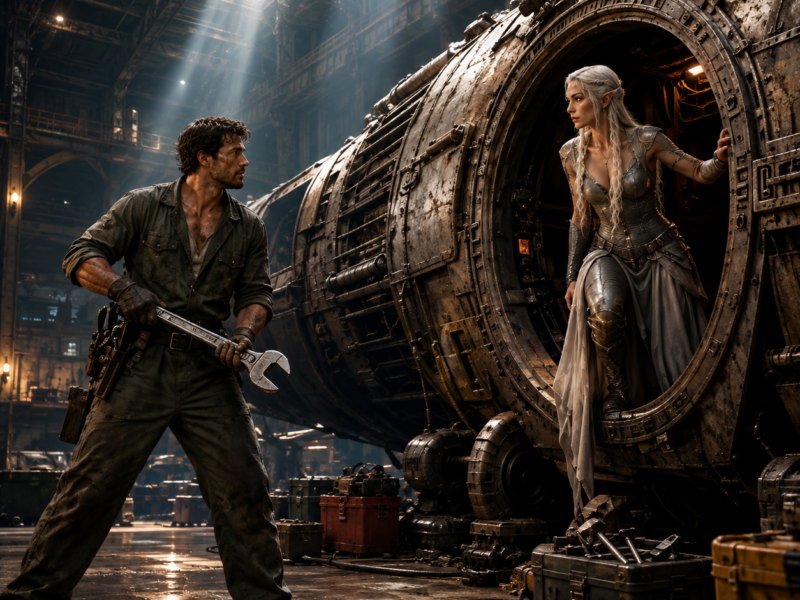
The ship was unlike anything the Fleet built.
Its hull was long, curved, and scarred by deep, jagged plasma burns.
Its massive engines were completely dead, dark, and caked in decades of space-debris crust.
Worst of all, someone had taken a heavy-duty plasma cutter to the sides, deliberately burning away the intricate, flowing alien symbols that once covered its skin.
“The Mourning Star,” Voss said, tossing a rusted access drive onto my greasy workbench.
It bounced off an iron socket and skittered to a stop against my thumb.
“That’s what the border patrol is calling it,” Voss continued, crossing his gloved arms. “Scavengers towed it in from the outer fringe three days ago.”
“It’s a dead vessel, Commander,” I said, picking up the drive. “The frame is stressed, the power core is cold, and someone tried to erase its history.”
“I didn’t ask for a history lesson, mechanic,” Voss snapped, his eyes narrowing.
He took a step closer, lowering his voice so the younger crew couldn’t hear.
“You have three days, Mercer.”
“Three days?” I let out a dry, raspy chuckle. “It takes three days just to flush the coolant lines on an old corvette.”
“Three days,” Voss repeated, cold as ice. “Make it fly, or the scrapping crew moves in.”
He leaned in closer, his gaze locked onto mine.
“And if you’re still inside when they light the plasma torches, I won’t lose a minute of sleep.”
The guards smirked.
Voss turned on his heel and marched back toward the command deck, his cape fluttering slightly in the draft.
The other mechanics burst into fresh fits of snickering.
I stood there alone in the cavernous hangar, holding the heavy drive in my calloused palm.
I looked back up at the silent, darkened ship.
It was an ugly, battered thing, abandoned by whoever built it and condemned by the men who found it.
It looked a lot like me.
I grabbed my heavy tool kit, hauled my limping leg forward, and walked toward the access ladder.
I wasn’t going to let them win without a fight.
The interior of The Mourning Star felt like a tomb.
The air was stale, thick with the dry scent of ancient dust and copper.
My flashlight beam cut through the darkness, illuminating vaulted corridors lined with ribbed walls that resembled the ribcage of some massive ocean beast.
Every step I took echoed down the empty passageways.
I made my way down to the lower engine deck, dragging my tool kit behind me.
The power systems were entirely dead.
No hum of a reactor, no flicker of emergency lights, no sign of life whatsoever.
I knelt by the primary conduit, popping open my diagnostic pad to splice into the main bus.
The readout was completely flat.
Zero voltage.
“Great,” I muttered to myself, rubbing the back of my neck. “Not even enough juice to light a match.”
I reached for my torch to begin stripping the main power lead.
Then I heard it.
Thump. Thump. Thump.
I froze.
My hand hovered over my tool belt, my heart thumping against my ribs.
I held my breath and listened.
The hangar outside was quiet this late at night, but the ship’s outer armor was three feet of solid composite—no sound from the outside could penetrate it.
Thump. Thump. Thump.
The sound came from deep within the engine housing.
It was rhythmic, deliberate, and unmistakably manual.
Three distinct knocks.
I slowly stood up, turning my flashlight toward the shadowed bulkhead behind the main reactor core.
“Hello?” I called out, my voice raspy in the cold air.
Silence answered me.
I crept closer to the rear bulkhead, the beam of light shaking slightly in my grip.
The wall looked like solid plating, but as I got closer, I noticed a seam.
It was a hidden maintenance hatch, so perfectly integrated into the ship’s structure that you’d miss it unless you were standing right on top of it.
I pulled out my thermal scanner and pressed it against the cold metal.
The digital readout flickered.
pressure readings: Zero.
Life signs: Negative.
“Just structural settling,” I breathed out, letting out a long sigh of relief. “Just heat expanding in old metal.”
I tapped my wrench against the hatch three times, just to prove to myself how silly I was being.
Clang. Clang. Clang.
I turned back to my tool kit.
Thump. Thump. Thump.
I stopped dead in my tracks.
The answer came instantly.
Three knocks, right on the other side of the panel where my wrench had just struck.
My stomach dropped into a cold pit.
I turned around, stepping right back up to the hidden hatch.
I pressed my ear against the freezing metal.
For a long moment, there was nothing but the sound of my own heavy breathing.
Then, faint as a whisper floating on the wind, a tiny voice filtered through the thick alloy.
“Please…”
The sound was fragile, terrified, and undeniably real.
“Please don’t let them take me.”
My hands began to shake as I pulled my high-frequency scanner from my belt.
“Who’s in there?” I yelled, pressing my face close to the seam. “Can you hear me?”
No answer came, only the sound of faint, ragged breathing from the other side.
I immediately ran my scanner along the edge of the panel.
The display didn’t make any sense.
The internal lock wasn’t mechanical, nor was it using standard galactic electronic encryption.
It was a bio-frequency lock, tied to an intricate mesh of living crystal circuitry built directly into the ship’s frame.
It wasn’t listed on any standard fleet blueprint.
In fact, the blueprints Voss had given me showed this entire section as a solid block of structural support.
They didn’t know this room existed.
“Hold on,” I called out, setting my heavy tool bag on the deck. “I’m going to get you out.”
I grabbed my plasma cutter, clicked the ignition, and pointed the blue flame at the upper corner of the panel.
The moment the intense heat touched the metal, a bright spark shot out.
A back-surge of energy rattled through my tool, scorching my glove and throwing me onto my back.
The hatch didn’t even have a scratch on it.
“Dammit,” I swore, pushing myself up off the hard deck, my bad knee screaming in pain.
The material was absorbing the energy and dispersing it directly into the hull.
I couldn’t force my way in.
I had to trick it.
I pulled out my manual bypass kit—a collection of ancient copper jumpers, hot-wire probes, and physical overrides I’d collected over thirty years in the yards.
I began scraping away the burnt paint near the seam, exposing the raw crystal nodes hidden underneath.
Minute after minute ticked by.
My forearms burned with exhaustion, and sweat dripped off my nose, stinging my eyes.
One hour passed.
Then two.
Then four.
My diagnostic kit threw constant error codes, unable to process the alien architecture, but I kept working by feel and intuition.
I matched the voltage frequencies by ear, listening to the tiny harmonic hums given off by the crystal filaments.
It was like trying to pick a combination lock while wearing heavy leather work gloves.
By the sixth hour, my fingers were bleeding from slipping off the tiny metal pins.
“Come on,” I whispered, my teeth grit tight. “Come on, open up…”
I placed my final jumper pin across two glowing blue nodes.
A soft, clear chime echoed through the compartment.
The heavy locking bolts inside the bulkhead slid back with a deep, metallic thud.
The hidden hatch unlatched and hissed open, venting a cloud of warm, sweet-smelling vapor into the freezing room.
I dropped my tools, lunging forward to catch the heavy door as it swung outward.
Inside the tiny, dark recess, something shifted.
A small shadow lurked in the corner, huddled against the back wall.
“It’s okay,” I said softly, holding up my bare hands to show I was unarmed. “It’s okay, I’m not going to hurt you.”
The figure stumbled forward, blinded by the beam of my flashlight, and collapsed directly into my arms.
I caught her before she hit the hard steel floor.
She was shockingly light, feeling no heavier than a bundle of dry branches.
I pulled her out of the cramped wall compartment and laid her down on the deck, propping her head up with my rolled-up work jacket.
My flashlight beam caught her face, and my breath hitched in my throat.
She wasn’t human.
Her skin was a delicate, translucent silver-blue that seemed to softly reflect the ambient light.
Her hair was fine, pale as spun glass, falling around a face dominated by large, luminous violet eyes.
She looked no older than nine or ten human years.
Around her slender throat was a thick, dark metal collar that pulsed with an unhealthy, deep red glow.
She scrambled backward against the bulkhead, her small hands clutching at the dirty deck plates.
Her body trembled uncontrollably, her massive eyes wide with sheer terror as she stared up at my worn, dirty face.
“Don’t hurt me,” she whimpered, her voice trembling softly in accent-thick, broken English.
She pulled her knees tight against her chest, hiding her face in her arms.
“I’ll be quiet,” she whispered into her sleeves. “I promise I’ll be quiet. Please don’t sell me.”
Something deep inside my chest cracked wide open.
Fifteen years ago, my daughter, Sarah, had looked at me with those exact same frightened eyes from a hospital bed.
She had been eight when an aggressive lung infection took her away from me, while I was stuck three systems away on a transport assignment for the Fleet.
I had spent every day since then wishing I could go back to that room.
Wishing I could hold her hand and tell her everything was going to be alright.
I slowly knelt on the deck, keeping my distance so I wouldn’t startle her.
I reached out, picked up my thick fleece jacket, and gently slid it across the floor toward her.
“I’m not going to hurt you,” I said, making my voice as soft and warm as I could manage.
“My name is Jack.”
She peeked out from behind her arms, her violet eyes locking onto mine with cautious disbelief.
She looked at the warm jacket, then back up at me.
Slowly, with trembling fingers, she reached out and pulled the jacket around her small, shivering shoulders.
“Jack?” she repeated softly, testing the harsh syllables on her tongue.
“That’s right,” I smiled gently. “What’s your name?”
“Lira,” she whispered.
“It’s nice to meet you, Lira,” I said. “Where is your family? Why were you hidden in that wall?”
At the mention of her family, her eyes filled with bright, glowing tears that ran down her blue cheeks like liquid mercury.
“They died,” she sobbed, clutching my jacket tight around her neck.
“They died protecting the ship.”
I brought Lira some clean water and a ration pack from my personal locker in the hangar.
She ate ravenously, her small hands shaking as she tore into the package, swallowing the dry protein paste as if she hadn’t seen food in weeks.
As she ate, I set to work with a set of fine precision tools, carefully examining the thick metal band around her neck.
“What is this thing?” I asked gently, scanning the device with a diagnostic lead.
“A restraint,” she said, her voice small and muffled. “The men who captured our ship put them on all the elders. It stops us from using the core.”
“The core?”
She nodded toward the dark engine bay outside her small room.
“My people are the Aethari,” she said, her violet eyes shining in the soft light of my lantern.
I paused, my wrench hovering in mid-air.
The Aethari.
Every mechanic and spacer in the quadrant had heard the legends.
An ancient, peaceful civilization that inhabited the rim worlds, famous for their incredible architectural feats and advanced star-drive technology.
Three years ago, the Galactic Council had declared their territory a restricted zone.
Official reports claimed the Aethari had suffered a catastrophic environmental collapse and abandoned their worlds.
“The Council lied,” Lira said softly, as if reading my thoughts.
“They wanted our planetary defense shields. They wanted the secrets to our light-drive.”
Her hands balled into tight fists over her lap.
“When my elders refused to hand them over, the Council sent their warships. They burned our cities from orbit.”
I felt a cold rage blossom in my chest.
“The Council did that?” I whispered.
“This ship… it isn’t a warship,” Lira continued, looking down at the deck plates. “It’s an ark.”
She reached into her pocket and pulled out a small, teardrop-shaped crystal that glowed with a soft, warm amber light.
“Inside this drive are the genetic records and consciousness maps of four million Aethari children,” she said, tears spilling over her lashes again.
“They were stored in the lower hold, frozen in stasis.”
“And you?” I asked gently.
“I am the Keeper,” she said quietly. “My blood carries the master key. The ark will only respond to my voice.”
“That’s why Commander Voss sent this ship here,” I realized out loud, my blood running cold.
The Council didn’t send The Mourning Star to Bay 14 to be repaired by a washed-up old mechanic.
They didn’t want it fixed at all.
They knew the ship carried the last remnants of a wiped-out civilization.
They were waiting for the cover of night to bring in the scrapping crew, melt the hull to slag, and erase the last proof of their genocide forever.
And they were using me as the fall guy.
Before I could process the horror of it, the heavy blast doors at the end of the maintenance corridor slammed open with a deafening boom.
The harsh glare of heavy tactical spotlights cut through the dark.
Heavy boots stomped against the deck plating.
“Mercer!” a loud, arrogant voice boomed through the speakers. “Your time is up!”
I shoved Lira behind me, pushing her back into the small wall alcove and slamming the hatch almost shut, leaving only a tiny crack for air.
“Stay down,” I hissed. “Don’t make a sound.”
I grabbed my heavy iron socket wrench, turning to face the hallway as Commander Voss stepped through the entryway.
He wasn’t alone.
A dozen heavy tactical soldiers dressed in black armor filed into the chamber behind him, their high-powered assault rifles raised and aimed directly at my chest.
Voss walked forward, his shiny boots clicking against the dirty floor.
A thin, vicious smile stretched across his pale face.
“I must admit, Mercer, I’m surprised,” Voss sneered, glancing around the dimly lit compartment. “I didn’t think an old dog like you could even get the auxiliary lights on.”
“What is this, Voss?” I demanded, holding my wrench tight in my right hand. “Your three days aren’t up.”
“Plans change,” Voss said smoothly, adjusting the immaculate cuffs of his military jacket.
He gestured to the soldiers, who fanned out across the room, securing the perimeter.
“We received a broadcast from Council High Command,” Voss continued, his tone light and conversational. “They decided that keeping this hideous piece of alien trash in our spaceport is a security hazard.”
He walked right up to me, looking down at the greasy tool in my hand with utter amusement.
“Step away from the wall, mechanic.”
“No,” I said, standing my ground.
Voss raised an eyebrow, his smile fading into a cold, dangerous glare.
“You don’t want to do this, Jack,” he said softly. “You’re an old man with one foot in the grave. Don’t make me put the other one in for you.”
Behind me, the hidden hatch gave a tiny, metallic creak.
Voss’s eyes instantly darted past my shoulder, locking onto the faint blue glow peeking through the seam.
His eyes widened with sudden realization.
“Well, well, well,” Voss whispered, a sickening grin spreading across his lips. “What do we have here?”
He pushed past me, but I stepped right into his path, shoving my chest against his.
“Back off, Voss!” I roared.
“Restrain him!” Voss shouted.
Two armored soldiers lunged forward.
One caught my bad knee with a heavy tactical boot, sending a blinding flash of pain through my leg.
My knee buckled, and I hit the deck hard.
The second soldier grabbed my arms, pinning them behind my back and driving my face into the cold steel deck.
Voss stepped up to the wall panel, grabbed the latch, and yanked the hidden door wide open.
Lira gasped, shrinking back as the bright tactical lights illuminated her small frame.
“Look at that,” Voss breathed, staring at the child with cold, greedy eyes. “A survivor. High Command will pay a massive fortune for her.”
He reached into the alcove, grabbing Lira by her thin wrist and dragging her out onto the deck.
She screamed, kicking and fighting with all her tiny strength, but Voss held her fast, tossing her to the deck beside me.
“Step away from the alien,” Voss ordered his men, stepping back and drawing his heavy sidearm.
“She’s Council property.”
Lira scrambled across the floor, crawling behind my pinned body and grabbing onto the belt of my work trousers.
“Jack!” she cried out, her small frame shaking violently against my back.
“They killed my mother,” she whispered, her voice choking on sobs. “They’ll kill everyone on my world if they find the ark!”
I struggled against the weight of the soldier holding me down, my muscles screaming, my teeth grinding together so hard I felt them crack.
“Let her go, Voss!” I screamed, spitting blood onto the deck. “She’s just a child!”
“She’s an alien pest, Mercer,” Voss replied coldly, raising his heavy plasma pistol and pointing the glowing barrel directly at Lira’s forehead.
“Her kind refused to bow to the new galactic order. They were wiped out, and she should have died with them on her homeworld.”
He clicked off the safety.
The high-pitched whine of a charging plasma bolt filled the quiet room.
“No!” I roared.
With a burst of adrenaline I didn’t know I possessed, I drove my elbow backward into the knee of the guard holding me down.
The soldier grunted, his grip slipping.
I twisted my body, driving my bad knee up into his jaw, knocking him back.
Before the second guard could react, I threw myself across the deck, covering Lira’s small body with my own.
I raised my head, staring straight up into the glowing barrel of Voss’s gun.
“You’re going to have to shoot me first,” I growled, my eyes burning with fury.
Voss paused, his finger resting lightly on the trigger.
He looked down at me, his eyes filled with absolute contempt.
“Human stubbornness,” he sneered, his lip curling in disgust. “Always sacrificing yourselves for worthless causes. That’s why your species never learned its place in the empire.”
He tightened his grip on the weapon.
“If you want to die for a piece of alien scrap, Mercer, I’ll be happy to oblige.”
Lira buried her face in the back of my shirt, weeping softly.
I closed my eyes, picturing my daughter’s face one last time.
At least this time, I thought to myself, I was here.
“Goodbye, mechanic,” Voss said.
He pulled the trigger.
Awakening the Ark
A deafening flash lit up the dark chamber, but no pain came.
Instead of a plasma bolt, a massive wave of brilliant blue energy burst from the center of the engine room.
The blast wave rippled out in a sphere of pure light, hitting Voss and his soldiers and sending them flying backward through the air.
They crashed hard against the far bulkheads, their weapons clattering across the deck plating.
The floor beneath us shuddered violently.
The dark, dead walls of The Mourning Star suddenly exploded with life.
Lines of bright, bioluminescent golden light raced across the bulkheads, branching out like living veins through every panel, beam, and conduit in the vessel.
The freezing air instantly warmed, filled with the deep, resonant hum of an immense power core waking from a long slumber.
An ancient, melodic voice echoed from the ship’s overhead speakers, speaking in a language that rolled like music across the room.
Then, the ship’s computer translated its own words into clear, booming English.
“Guardian recognized,” the voice declared, vibrating through the metal deck into my bones.
“Human species confirmed.”
“Awaiting command.”
Voss pushed himself up from the deck, his face pale as chalk, his hands shaking as he stared at the glowing walls around us.
“What… what did you do?” he stammered, backing away toward his fallen soldiers.
I slowly stood up, pulling Lira up beside me.
The thick metal restraint collar around her throat suddenly cracked in half, falling to the floor with a heavy clang.
The glowing blue lines in the walls gathered beneath my calloused palm, forming glowing alien runes that shifted and settled to match my handprint.
Lira looked up at me, tears shining like diamonds in her bright violet eyes.
“Jack…” she whispered, her voice filled with awe.
“My mother told me about the ancient laws of the ark,” she said, wrapping her small hand around my thumb.
“She said the ark would never awaken for power or conquest.”
“She said it would only awaken for a species that protects the helpless… without ever asking what they were worth.”
Before Voss or his men could move, a massive blinding pulse of electromagnetic force blasted outward from The Mourning Star’s main dish.
The wave tore through the spaceport hangars, sweeping out into the dark sky above.
Outside, every single Fleet warship docked at Spaceport Vega-9 instantly went dark.
Their engines cut out, their defense shields collapsed, and their primary power grids overloaded, plunging the entire sector into pitch-black silence.
A giant holographic display projected out from the center of our console, throwing a crystal-clear image into the space between us and the viewport.
It was a broadcast, being beamed simultaneously across every frequency to every vessel, station, and colony in orbit.
The words burned in bright, glowing silver text against the dark expanse of space:
“THE AETHARI HAVE RETURNED.”
“ANY ATTACK AGAINST THEIR LAST CHILD WILL BE CONSIDERED AN ATTACK AGAINST HUMANITY.”
Silence fell over the bay like a heavy shroud.
The only sound left was the steady, soothing pulse of The Mourning Star’s reactor core, humming like a sleeping titan finally awakened.
Through the large viewport, I could see the massive Fleet battlecruisers floating helplessly in orbit, completely dead in the water.
Their lights were out, their weapons powered down, rendered useless by a single signal from an ancient ship they had branded as junk.
Commander Voss dropped his plasma pistol.
It fell to the deck with a sharp, hollow metallic clack that echoed through the vast room.
He looked at the glowing display, then at the powered-up controls of the ark, and finally at me.
His face was completely drained of color.
His hands trembled at his sides as he realized what had just happened.
With a single button press, an old mechanic and an alien orphan had taken control of the entire orbital grid.
The heavy military authority he had used to intimidate everyone for decades was gone in an instant.
Slowly, his knees buckled.
Commander Voss fell to his knees on the dirty, oil-stained deck.
His head dropped, his pristine white uniform touching the dark grime he had sneered at just hours before.
Behind him, his remaining soldiers dropped their weapons one by one, raising their hands in utter defeat.
For the first time in my long, battered life, I watched a Fleet commander kneel before a human mechanic.
I didn’t mock him.
I didn’t feel triumph, or joy, or pride.
I just felt a deep, overwhelming sense of relief.
I looked down at Lira, expecting to see her smiling, or celebrating that we were finally safe.
But she wasn’t looking at Voss.
She wasn’t even looking at the defeated soldiers on the floor.
She was standing motionless near the central console, her hand pressed flat against the glass of the main terminal screen.
Her violet eyes were wide with shock, tears streaming freely down her face once again.
A new line of text was flashing on the screen in front of her.
It wasn’t written in Fleet code, nor was it in standard galactic text.
It was written in the flowing, graceful runes of the Aethari language.
“Lira?” I asked softly, taking a step toward her. “What is it, sweetheart? What does it say?”
Lira’s trembling fingers traced the glowing alien symbols etched into the glass.
She let out a small, breathless gasp, her whole body shaking as if she had just seen a ghost.
“Jack…” she whispered, her voice barely audible over the hum of the engine.
She turned her head slowly, looking up at me with eyes that held a mixture of deep terror and blinding hope.
“Jack… my mother is still alive.”
My blood ran ice cold.
“What?” I breathed, stepping up beside her to look at the screen.
“The transmission…” Lira sobbed, clutching my hand with all her remaining strength. “It didn’t just broadcast to the spaceport.”
She pointed out through the main viewport toward the deep, dark expanse of outer space beyond the edge of the galaxy.
“The ark sent a signal into the deep void,” she said, her chest heaving. “And… and someone picked it up.”
Deep out in the blackness, far beyond the furthest stars of the outer rim, a tiny pinprick of crimson light began to glow.
Then another.
Then hundreds of them.
The ship’s sensors let out a low, warbling alarm as space itself began to warp and bend on the main long-range scanner.
A massive gravitational anomaly was forming at the edge of the system, so immense that it bent the starlight around it into dark, distorted rings.
Something was coming out of hyperspace.
Something impossibly huge.
It wasn’t a single ship.
It was a fleet—a massive, silent armada of ancient Aethari warships that had been hiding in the dark fold of deep space for three years, waiting for the ark’s signal to wake them.
Waiting for their last child to call for home.
I looked down at Lira, then back out at the sky filled with a thousand glowing red eyes cutting through the dark.
I squeezed her small hand tight in mine and pulled her close to my side.
“Jack?” she asked softly, looking up at me as the vast shadows of the ancient fleet began to eclipse the distant stars. “What do we do now?”
I picked up my heavy iron wrench one last time, set it down gently on the console, and looked out into the infinite black.
“Now, Lira,” I said softly, a faint smile touching my lips. “We go home.”