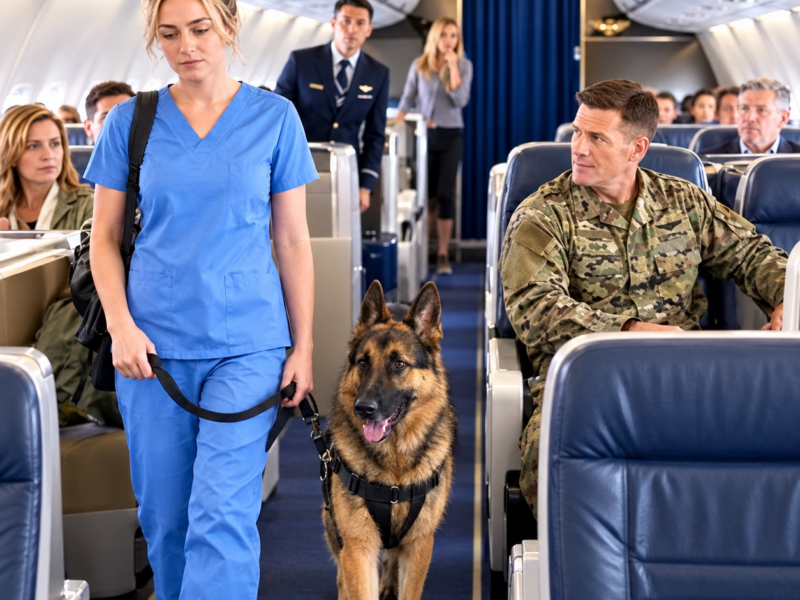
They laughed at me in the first-class lounge at Seattle-Tacoma Airport when my K9 sat beside my wheelchair and a wealthy couple called us “security theater,” but their smiles disappeared when an Army commander recognized the classified insignia hidden beneath my dog’s harness.
I had learned long ago that people rarely notice a woman until they decide she is beneath them.
Sit in a wheelchair long enough, and you become invisible. Put on a plain, worn navy uniform without a chest full of ribbons, and you become part of the background.
That morning, I was traveling home after months away. Seattle-Tacoma Airport was buzzing with the low, steady hum of early morning travelers. Rain smeared the high glass windows of the first-class lounge, blurring the gray runway outside.
Ranger rested his heavy head against my leg. He was a Belgian Malinois with a silver service tag clipped to his vest, a deep scar across his ribs, and dark, watchful eyes that never stopped searching the crowd.
Every few seconds, his ears would twitch toward a loud voice or a rolling suitcase. But he stayed grounded beside my right knee, his warmth pressing through my trousers.
Across the sleek glass coffee table sat a couple wrapped in designer coats. The man wore a gold watch that caught the low light every time he checked his phone. The woman was sipping a latte, looking at me with the kind of polished, polite pity that felt heavier than an insult.
They had been whispering since I wheeled myself in.
Finally, the man smirked, not bother to keep his voice down.
“Does the airline really let pets sit here?”
His wife let out a soft, sharp laugh, taking another sip of her drink.
“He probably has better manners than she does.”
I said nothing. I kept my eyes fixed on the gray tarmac outside, my fingers lightly resting on the strap of my carry-on bag.
I didn’t owe them an explanation. They saw a broken girl and a big dog taking up too much space in a room built for executives and frequent flyers.
Ranger simply lifted his head. His dark eyes flicked toward the man, quiet and unbothered.
Then, without warning, his whole body stiffened.
The loose, relaxed weight of his shoulder turned into pure iron against my knee. His ears pointed straight toward the carpeted hallway behind us.
I felt the shift instantly. It was a language we had spoken together in dark rooms and dusty valleys thousands of miles away.
“Ranger, stay,” I muttered, my voice barely a breath.
He didn’t move an inch. But his deep chest began to expand as he pulled in air, analyzing a scent no one else in that luxury lounge could smell.
A young airport employee appeared around the corner, pushing a black metal equipment case on a low cart. He was wearing a high-visibility vest, but his movement was wrong. His shoulders were too tight, his steps too fast.
Ranger gave one low growl, deep in his throat. It wasn’t a bark. It was a warning.
The employee froze instantly, his hands clutching the handle of the cart.
The wealthy man across from us rolled his eyes and tossed his phone onto the table.
“See, this is exactly why people shouldn’t bring animals into public places.”
Then a hard, authoritative voice spoke from directly behind my shoulder.
“Everyone step away from the case.”
I turned my wheels slowly.
An Army commander stood at the entrance of the lounge. He wore a crisp dress uniform, his jaw tightly set. Flanking him were two armed airport security officers, their hands hovering near their belts.
His eyes scanned the room, bypassing the couple, bypassing the employee, and landed straight on Ranger’s harness.
Then his gaze drifted up to my face.
The color seemed to drain from his skin. The rigid posture of a senior officer cracked for a fraction of a second.
“Sergeant Hayes?”
I nodded once, keeping my hands resting flat on my lap.
“Sir.”
The commander walked closer, ignoring the wealthy couple who were now watching with open mouths. He lowered his voice, stepping into my personal space with a look of pure disbelief.
“I thought you were still overseas.”
“So did everyone else,” I whispered.
My voice was rough. I hadn’t used it much in the last six months. Not since the hospital in Germany. Not since the dark room where they asked me questions for three days straight before handing me a ticket back to the States.
The couple had stopped laughing entirely. The woman set her cup down so fast the liquid sloshed over the rim, staining the white marble table.
The commander lowered his eyes to Ranger, who was now sitting bolt upright, his gaze locked onto the officer’s polished boots.
“Is that the same dog?”
“Yes, sir.”
The commander swallowed hard, his throat moving as he looked back at the black case sitting on the cart.
“Then I know why he reacted.”
He motioned to the two security officers.
“Open it. Now.”
The young employee backed away, his hands raised in the air, his face turning pale.
“I—I was just asked to move it to the gate,” the boy stammered.
“Shut up,” one of the security guards snapped, stepping forward and flipping the heavy steel latches on the black case.
The hinges creaked as the lid was pulled open. Inside lay specialized electronic hardware, tangled wires, and thick black frame components that had no business being inside a commercial airport terminal.
And beneath the metal machinery sat a sealed leather folder.
Stamped right in the center of the leather was a small, silver symbol—a circle broken by three diagonal cuts.
It was the exact same classified insignia hidden beneath the custom fabric flap of Ranger’s service harness.
The lounge went dead quiet. Even the ambient hum of the terminal outside seemed to fade into a muffled roar.
The wealthy man who had mocked us stepped backward, nearly tripping over his wife’s designer luggage. His confidence was completely gone, replaced by a sudden, nervous sweat on his forehead.
“Who is she?” he asked, his voice shaking slightly as he looked between me and the officer.
The commander didn’t even turn his head.
“You don’t need to know,” he said coldly.
Then he looked down at me again, his eyes filled with a heavy, dangerous weight.
“I thought your unit was gone, Sergeant. I was told there were no survivors from the ridge.”
I felt my throat tighten, a cold knot forming in the center of my chest.
“It was gone, sir.”
Memory pulled at me like a heavy current. The sound of mortar fire in the dark. The smell of burning diesel and pine. The feeling of blood soaking through my sleeves as I held Ranger’s neck in the mud, begging him to keep breathing while the sky fell apart around us.
They told me everyone else was dead. They told me the team had been wiped out to cover up a mistake made by men sitting behind desks in Washington.
The commander stared at Ranger for a long, agonizing moment.
“Then why is he still carrying the evidence?”
My fingers closed tightly around the fabric of Ranger’s harness. My knuckles turned white.
I had spent six months believing the mission was over. I had spent six months learning how to navigate a world without my legs, telling myself that the men who died on that mountain had finally been allowed to rest.
But Ranger hadn’t forgotten the scent.
And he had just smelled it on a black box sitting in the middle of a commercial lounge in Seattle.
“Sergeant,” the commander said softly, stepping back and clearing a space for my chair. “I need you to come with me. Right now.”
As I pushed my wheels forward, I caught the eyes of the wealthy couple.
The man wasn’t looking at me anymore. He was staring at the small silver insignia on Ranger’s harness with a look of sheer terror.
He didn’t look confused. He looked recognized.
That was when the chill in my spine deepened into something far worse.
The airport wasn’t where the secret was going to be hidden. It was where someone was trying to buy it.
We walked in silence down a long, glass-paneled corridor that was closed off to the public.
The commander walked on my left. Two armed officers walked behind us, pushing the cart with the black case. Ranger kept his nose close to my wheel, his tail held low and rigid.
“Where are we going, sir?” I asked quietly.
“Sub-level four,” the commander replied, his eyes fixed straight ahead. “The port authority thinks it’s an old maintenance room. It isn’t.”
“Who was the kid pushing the cart?”
“A temp,” he said. “Paid five hundred dollars in cash by a man in a gray suit to leave that case near Gate 12. He didn’t know what was inside.”
“And the couple in the lounge?” I asked, keeping my voice steady.
The commander paused for a fraction of a second before continuing his stride.
“We’re checking their passports now. But if they recognized that mark, Clara, then the breach is wider than we thought.”
He called me Clara. Not Sergeant Hayes.
That meant we weren’t on the record anymore.
We reached a heavy steel door marked with a red warning sign. The commander pulled an electronic keycard from his coat and swiped it. The lock clicked open with a heavy pneumatic hiss.
Inside, the air was cool and smelled of concrete and old dust. A single fluorescent bulb hummed overhead, casting harsh shadows across a steel table and four folding chairs.
“Sit,” the commander said, pointing to the table.
I wheeled myself up to the edge. Ranger immediately lay down under my chair, his body pressed firm against my ankles.
The commander pulled the leather folder out of the black case and laid it flat on the metal surface.
“Six months ago, your unit went off the grid in Northern Iraq,” he began, leaning both hands on the table. “Official report says an insurgent cell ambushed your outpost. Official report says the site was destroyed by an airstrike to prevent compromise.”
He looked directly into my eyes.
“Why didn’t you die in that airstrike, Clara?”
I closed my eyes for a second, and the noise of the airport vanished completely.
I saw the fire again.
“Because the strike didn’t come from the sky,” I said softly.
The commander didn’t flinch. He just kept watching me.
“It came from inside the perimeter,” I continued, my voice hollow. “Captain Vance got the order to pack up the drive. The one containing the entire signal layout for the border grid. He told us we were evacuating.”
I looked down at my hands. They were trembling slightly, so I clenched them into fists.
“Then the first explosion hit the comms tent. It wasn’t a mortar. It was a claymore. Placed right at the doorway.”
“Vance?” the commander asked.
“Vance,” I confirmed. “He set the charges himself. He thought he got all of us. But Ranger caught his trail before the blast went off. Ranger dragged me into the drainage trench under the eastern wall.”
I touched the scar behind Ranger’s ear. He sighed softly against my foot.
“My legs were crushed under the masonry. Vance thought I was dead. I watched him carry that leather folder out to an unmarked truck.”
“Then how did it get here?” the commander whispered, pointing at the table.
“Because Vance didn’t work alone,” I said, looking up. “He had a buyer back home. Someone with enough money to clear custom checks and enough influence to hide an entire military squad’s records.”
The commander reached out and slowly opened the leather folder.
Inside were stacks of yellowed papers, hand-written signal codes, and satellite coordinates.
And on the top page, written in dark black ink, was a list of names.
My name was at the bottom. It had a single black line drawn through it.
Above my name were four others—the men from my squad. All crossed out.
Except one.
At the very top of the page, the name was untouched.
Captain Miller Vance.
Below his name was an address right here in Washington State.
“He’s alive,” I whispered.
“We knew someone survived,” the commander said quietly. “We just didn’t know who was holding the leash.”
“The couple in the lounge,” I said, the pieces suddenly snapping together in my head like teeth in a trap. “The man’s watch. He was wearing an old unit ring on his left hand. I saw it when he reached for his phone.”
The commander’s face hardened.
“What kind of ring?”
“West Point, Class of ’08,” I said. “Same as Vance.”
Before the commander could answer, the door to the sub-level room slammed open with a sharp metallic bang.
One of the security guards rushed in, his radio buzzing with static.
“Sir! The lounge is clear!” he shouted. “The two subjects just bypassed the TSA checkpoint using emergency diplomatic credentials!”
“Where are they going?” the commander barked, stepping away from the table.
“Gate B4. The private charter to Geneva is boarding right now.”
The commander pulled a sidearm from his shoulder holster and checked the action with a smooth, practiced motion.
“They’re moving the final key,” he said, looking back at me. “The folder in this case was just the index. The actual codes are on the server drive they’re carrying aboard that flight.”
I reached down and unclipped the safety latch on Ranger’s leash.
“They think I’m in a chair,” I said, looking at the commander with a cold, clear focus I hadn’t felt in six months. “They think I’m broken.”
“Clara, you’re out of service,” he said, his voice firm. “You can’t go out there.”
“Ranger doesn’t care about service status, sir,” I replied, my voice dropping an octave. “And neither do I.”
I reached under my uniform jacket and pulled a heavy black keycard from my inner pocket—the one I had taken off Vance’s desk before the building blew up.
“He forgot one thing on that mountain,” I said.
The commander looked at the keycard, then at Ranger, whose body was vibrating with silent tension.
“What?” the commander asked.
“He forgot that the dog doesn’t stop trailing until he gets the command to drop.”
We didn’t take the elevators. We took the service ramps.
My hands flew over the rubber rims of my wheels, pushing with every ounce of strength left in my shoulders. Ranger ran right alongside my left wheel, his claws clicking rhythmically against the polished concrete.
The noise of the main terminal hit us like a wave as we burst through the emergency doors.
Crowds of passengers scattered as they saw an Army commander marching double-time behind a woman in a wheelchair with a Malinois leading the way.
“Out of the way! Clear the concourse!” the security guard yelled, waving his hands.
Ahead, past the long corridor of duty-free shops, sat Gate B4.
Through the massive glass windows, I could see the sleek, white nose of a gulfstream jet idling on the rainy tarmac.
Standing at the jet bridge entrance was the man from the lounge. His coat was unbuttoned, his tie loose, his face flushed red with panic.
His wife was already halfway down the glass tube toward the plane, holding a heavy silver briefcase close to her chest.
“Vance!” I screamed across the concourse.
My voice ripped through the crowded terminal like a gunshot.
The man froze. He turned his head toward us, his eyes wide with disbelief.
When he saw me—when he saw the wheelchair and the dog charging down the polished floor—his hand darted inside his coat.
“Security!” the commander shouted, drawing his weapon. “Drop your hand!”
Passengers screamed. People dropped to the carpet, covering their children. Suitcases slid across the floor as chaos exploded across the gate area.
The man didn’t drop his hand. He pulled a compact black pistol from his jacket and aimed it straight at my chest.
“Clear!” I yelled to Ranger.
I jammed my hands against the rubber tires, sending my chair into a sharp sideways slide.
A shot cracked through the terminal, shattering a glass display case behind me into a million sparkling fragments.
Ranger didn’t flinch at the sound of the gun. He had been trained through heavy artillery and mortar rain.
Before the man could adjust his aim for a second shot, Ranger launched himself off the hard floor.
His body flew through the air, eighty pounds of muscle and instinct, clearing the distance over a row of terminal seats in a single, fluid bound.
He hit the man in the chest full force.
The gun went flying, skidding across the slick tile floor toward a set of closed doors.
The man hit the ground with a dull, heavy thud, gasping for air as Ranger pinned his right arm to the carpet, his jaws locked firmly onto the heavy fabric of the man’s coat sleeve.
“Hold!” I yelled, rolling my chair up to them.
Ranger instantly stopped pulling, but he kept his grip fixed, his deep growl vibrating against the man’s pinned wrist.
The commander rushed up, stepping heavily on the dropped pistol and kicking it away before kneeling on the man’s back to slap a pair of steel cuffs around his wrists.
“It’s over, Vance,” the commander growled into his ear.
The man gasped, spitting a trace of blood onto the floor. He looked up at me, his eyes wild and bloodshot.
“You… you were supposed to be on that hill,” he choked out, his voice cracking with rage. “The report said you burned!”
I leaned forward in my chair, looking down into the face of the officer who had left my squad to die in the mud six months ago.
“The report was wrong,” I said softly.
Down the jet bridge, two more security officers were leading his wife back up the hall in handcuffs, the silver briefcase gripped tightly in an officer’s gloved hand.
She was crying now, all her polished elegance completely gone, her expensive coat ruined by the drizzle blowing through the open jet bridge door.
The commander stood up, hauling Vance to his feet by his collar.
“Take him down to the holding cells,” the commander ordered the security team. “Notify Federal Law Enforcement. Tell them we have the primary subject in custody.”
As they dragged Vance away, he kept his eyes locked on Ranger, who stood calmly at my side, his ears perked, watching the traitor be led into the dark hallway.
The terminal slowly settled back into a low, frightened hum as airport security began clearing the area and reassuring the panicked passengers.
The commander walked over to where I sat, carrying the heavy silver briefcase he had taken from Vance’s wife.
He set it down on a nearby bench and popped the digital locks using a master override code from his radio unit.
The lid lifted with a soft click.
Inside lay three black encrypted hard drives, sealed in anti-static bags, along with four passports under different names—all bearing Vance’s photograph.
“Everything is here,” the commander said softly, scanning the contents. “The entire network map. The names of the buyers in Zurich. All of it.”
He shut the case and looked down at me, his eyes showing a deep, quiet respect.
“You brought down an entire treason ring from a wheelchair, Clara.”
“No, sir,” I said, reaching down to stroke Ranger’s ears. “We just finished the job we were assigned six months ago.”
The commander stood at attention and gave me a long, crisp salute right there in the middle of the crowded airport terminal.
I sat up as straight as my broken body would allow and returned it.
“Where will you go now?” he asked, lowering his hand.
“Home,” I said, looking out the giant window toward the gray runways of Seattle. “My sister has a place in the mountains. Wood stove. Big yard.”
I looked at Ranger, who was resting his chin on my knee, his tail giving a soft, single thump against the floorboards.
“He’s earned a yard,” I added softly.
An hour later, the terminal had returned to its normal pattern.
The blood had been cleaned from the tile. The broken glass had been swept away. The announcements over the loudspeaker continued in their steady, monotonous tone, calling passengers to distant cities across the world.
I sat near the window, watching the rain beat against the heavy glass.
The commander had arranged a private transport for us—a military van that would take us straight down the coast to my sister’s house, avoiding any more public terminals or security checks.
Ranger lay beside me, his body relaxed at last, his heavy paws stretched out across the carpet.
I reached down and unclipped the silver service tag from his harness, holding it up to the pale light coming through the window.
It was scratched and dull from wear, but the numbers stamped into the steel were still clear.
K9-402. ACTIVE DUTY.
I took a deep breath, feeling the cool air fill my lungs, cleaner than it had felt in a long time.
The weight in my chest—the dark, suffocating guilt of surviving when everyone else had been lost—was finally starting to lift.
We hadn’t just survived. We had closed the loop.
“Come on, boy,” I said quietly, unlocked the wheels of my chair. “Let’s go home.”
Ranger stood up instantly, giving one short, soft bark that bounced against the high glass ceiling.
He stepped into position right beside my right wheel, his shoulder pressing warm against my leg, his eyes turned toward the open exit doors leading out into the cool rainy air.
Nobody laughed as we walked through the lobby this time.
People stepped aside, making a wide, quiet path for the woman in the navy uniform and the scarred dog with the silver tag.
They still didn’t know our names. They still didn’t know what had happened in the dark corners of the world to keep their skies clear.
And as we stepped out into the crisp Pacific Northwest air, I realized it didn’t matter if they knew or not.
The secret was safe.
And for the first time in six months, so were we.









