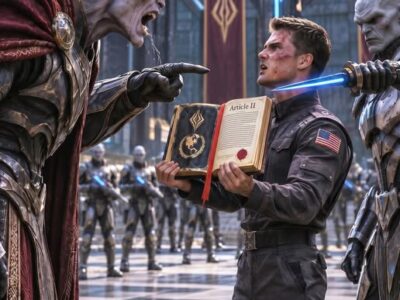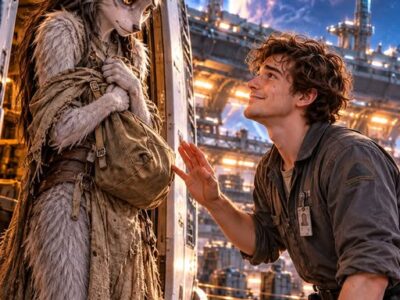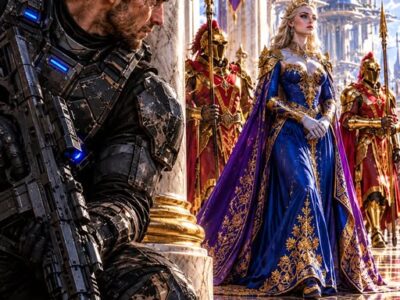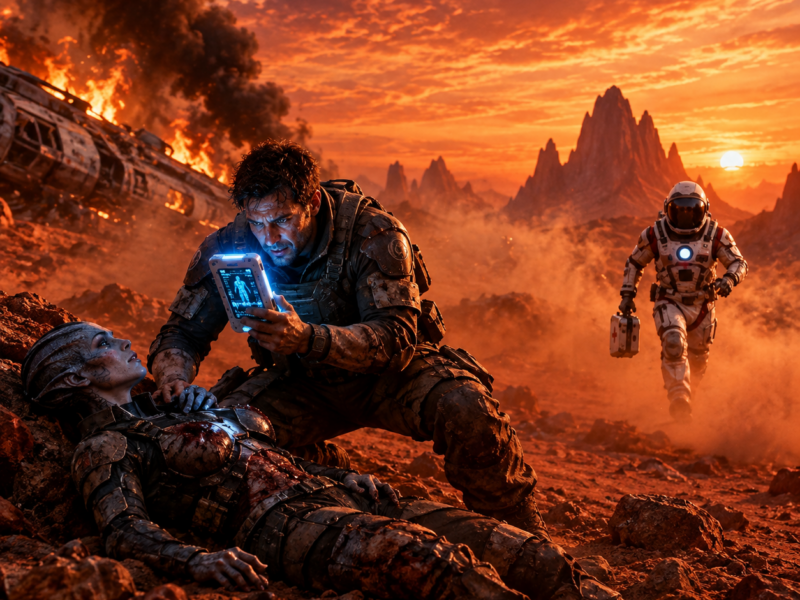
They abandoned the wounded alien woman on the frozen battlefield outside Fort Haven, and when the commanding officer laughed at my decision to turn back for her, he called me a foolish human who would die for a creature that couldn’t even speak our language—but he didn’t know she had once saved an entire human colony.
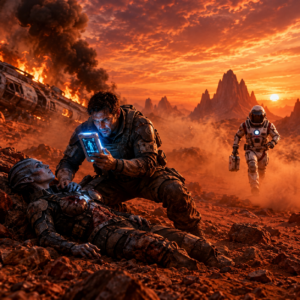
The wind howling through the broken steel frames of the observation outpost felt like a living creature trying to tear through the rusted plating.
I kept my hand firmly clamped over the heating coil, waiting for the dull orange glow to spread through the small, subterranean bunker.
My breath came in ragged, frosty clouds that vanished into the darkness above our heads.
Lyra’s grip on my wrist had not loosened.
Her skin felt impossibly cold, like marble pulled from deep beneath winter ice, yet there was a desperate, electric strength running through her fingers.
“He didn’t die on New Hope,” she repeated, her voice cracking against the dry mountain air.
I knelt in the dirt beside her makeshift cot, completely frozen from the inside out.
For twelve years, I had stared at an empty bronze plaque mounted on the memorial wall back home in Colorado.
Twelve years of quiet holidays, looking at an untouched place setting, telling myself that Leo had gone quickly when the planetary shields collapsed.
“That’s impossible,” I whispered, though my throat felt so dry the words scraped like sandpaper.
“We recovered the personal beacon from his scout chassis. The military issued the death certification ourselves.”
Lyra shook her head slightly, her silver eyes catching the faint, flickering ember of the heating coil.
“Beacons can be severed, Carter. Beacons are meant to give an army closure, not the truth.”
She winced, pressing her hand over the synth-mesh bandage I had hastily sealed across her abdomen.
Dark purple fluid seeped through the weave of the fabric, staining her fingers and the edge of her silver battle armor.
“The armada didn’t arrive to evacuate a civilian city,” she breathed, fighting the tremor in her chest.
“We arrived to extract a child whose neural imprint could override the ancient orbital gate.”
Outside, the low hum of atmospheric thrusters rumbled through the bedrock beneath our boots.
It wasn’t the clean, whining pitch of human military transports.
It was a jagged, oscillating vibration that vibrated deep in my dental fillings and made my stomach drop into freefall.
I stepped away from the cot, keeping low to the floor, and crept toward the narrow slit of the observation window.
The glass had long since cracked, coated in a spiderweb of thick hoarfrost that blurred the world outside into smears of gray and white.
Through the gaps in the frost, across the sprawling tundra of Ridge Point, the darkness was being torn apart.
Dozens of high-intensity searchlights swept through the falling snow like sweeping blades.
Sleek, gunmetal gunships drifted twenty feet above the frozen drifts, their hulls bearing the sharp, predatory lines of Vanguard enforcers.
“Harris left them a beacon,” I muttered, my hands tightening on the edge of the sill until my knuckles turned white.
“That son of a bitch didn’t just leave us behind. He sold our coordinates before his transport even cleared the stratosphere.”
Lyra let out a short, hollow laugh that turned into a ragged cough.
“Harris does not possess the clearance to contact those ships, soldier.”
I turned back to her, my rifle still slung over my shoulder, the weight of it suddenly feeling entirely useless.
“Then who are they?”
“The Dominion Directorate,” she said quietly, her silver irises contracting into needle points.
“They do not serve your federation. Nor do they answer to the Council of Stars that sent my people to New Hope.”
She struggled to prop herself up on one elbow, her teeth gritted against the tearing pain in her side.
“They are the architects of the war. They engineer the conflicts so both sides consume each other in the border worlds.”
“And my brother?” I asked, stepping back to her side, unable to stop the sudden, furious pounding in my temples.
“Where is Leo?”
She looked up at me, her gaze steady despite the agony radiating from her wound.
“He is the key to their entire perimeter defense network. They have kept him suspended in an installation beneath the Ash Ridge basin for over a decade.”
The ground beneath us shuddered violently as an ordnance flare detonated three hundred yards away, bathing the bunker in brilliant, blood-red light.
A mechanical voice echoed across the open snowfields, amplified through heavy acoustic arrays:
“Human insurgent Carter Vance. Surrender the asset designated Lyra-9. Comply, and your civilian status will be reinstated.”
Lyra reached out, her fingers brushing the hem of my tactical vest.
“Take your sidearm, Carter,” she whispered, her voice fading to a fragile hiss.
“Shoot me through the core of my armor, take their amnesty, and walk away. If they take you alive, they will dismantle your mind to ensure your brother never wakes.”
I looked down at the faded emblem on her chest—the blue star surrounded by seven silver circles that had once guarded my family’s survival.
I racked the bolt of my pulse rifle and stepped away from the light.
“I spent twelve years grieving a ghost,” I said, locking the heavy pressure door behind us.
“I’m not trading his life or yours for a ticket home.”
A heavy kinetic shell struck the outer reinforcement of the outpost, tearing the iron hinges completely off the frame.
The ceiling began to collapse in a shower of concrete and ice.
And through the widening breach, the first armored silhouette stepped into the dust.
A Debt Written in Blood
The muzzle blast of my rifle lit the ruined interior of the bunker in rapid, strobing flashes of blue and white.
The first armored figure staggered backward as high-velocity slugs shattered the sensor cluster on its helmet.
It collapsed into the snow, its suit leaking pressurized coolant with a sharp, hissing shriek.
“Move!” I shouted, throwing my shoulder beneath Lyra’s arm and dragging her toward the secondary ventilation hatchway.
She stumbled, her boots scraping uselessly against the frozen deck plates, but she forced herself forward with terrifying willpower.
“The secondary tunnel leads down into the old mining shafts,” she whispered, her head rolling toward my shoulder.
“They cannot bring their heavy armor down there. The ceiling is unstable.”
“Then we collapse it behind us,” I grunted, firing a three-round burst over my shoulder into the blinding glare of the entry breach.
More searchlights poured through the hole, illuminating the swirling clouds of snow and pulverized concrete.
Bullets chipped into the stone pillars around us, sending stinging fragments of rock slicing across my cheek.
I kicked open the rusted grating of the drainage shaft and lowered her down feet-first into the dark.
“Hold onto the maintenance ladder,” I instructed, leaning over the rim.
She caught the rungs, but her strength gave out after three steps, and she tumbled down into the darkness.
I heard her body hit the packed dirt floor ten feet below with a sickening thud.
Cursing under my breath, I pulled an incendiary grenade from my chest webbing, pulled the pin with my teeth, and tossed it toward the main doorway.
I dropped into the hole just as the charges ignited.
A deafening roar rolled overhead, followed by the deep, structural groan of the observation station folding in on itself.
Tons of rock, metal girders, and packed permafrost slammed down into the vertical shaft, sealing off the sky above us.
I landed heavily on my feet, rolling onto my side to absorb the shock, before scrambling through the pitch-black tunnel toward Lyra.
“Lyra!” I called out, keeping my voice down to a harsh whisper.
A faint click echoed through the dark, and a tiny, bioluminescent crystal in the palm of her glove began to radiate a soft, emerald glow.
She was curled against the damp rock wall, her face slick with cold sweat, the purple stain on her torso growing wider.
“I am still functional,” she managed to say, her breath shallow and fluttering.
“You’re bleeding out,” I said bluntly, dropping my pack and ripping open a second sterile compression pack.
“Human medical supplies are not entirely compatible with my biology,” she said, wincing as I pressed the pad against the torn flesh.
“Your coagulants will only slow the process for another hour. Perhaps two.”
“Then we have two hours to get off this mountain,” I replied, tightening the strap around her waist with practiced efficiency.
“You’re remarkably stubborn, Carter Vance.”
“Runs in the family,” I said, checking my rifle’s battery pack. Twenty-two rounds left. Not nearly enough.
She looked at me through the dim green light, her expression unreadable.
“Your brother possessed the same defiance. Even when they strapped him to the neural relay at New Hope, he refused to initiate the purge sequence.”
The air in the tunnel felt damp and thick with sulfur, smelling of old, dead iron and stagnant water.
“Tell me everything,” I said, helping her sit upright against a rotting wooden timber.
“Why did they want an eight-year-old boy? What could he possibly do that an entire military computer couldn’t?”
Lyra closed her eyes, gathering her strength.
“The gate system spanning this sector was not built by humans, nor was it built by my kind.”
“It is Precursor technology,” she continued, each word measured and heavy.
“It responds only to very specific, rare neural resonance patterns. One in ten billion minds possesses the genetic harmonic needed to control it.”
She looked up at me, her silver eyes piercing the gloom.
“The Directorate spent centuries scouring the colonies, looking for that signature.”
“When they found it on New Hope, they didn’t just want to evacuate the planet. They orchestrated the entire siege to cover their extraction.”
A cold fury settled into my chest, chilling me far more than the sub-zero air of the frozen peaks above.
“The attack on New Hope wasn’t an invasion,” I realized, the pieces finally slotting together with horrifying clarity.
“It was a harvesting operation.”
“Yes,” Lyra whispered. “And my team was dispatched to stop them. We thought we were executing a rescue mission.”
She looked down at her gloved hands, which trembled with quiet rage.
“We arrived too late to save the colony, but we managed to intercept the transport carrying your brother.”
“During the dogfight, his ship crash-landed in the Ash Ridge trench system. The Directorate locked down the entire continent.”
“I stayed behind to find him,” she said. “I have been hunting that facility for twelve human years.”
Before I could answer, a dull rhythmic sound vibrated through the rock beside my head.
Thump. Thump. Thump.
It wasn’t artillery.
It was the steady, rhythmic impact of mechanical tracking hounds digging their way through the collapsed rubble above us.
Lyra grabbed my wrist once more, her voice desperate.
“They have deployed the Stalkers. The scent of my blood is mapped to their targeting arrays.”
“They will tear through that rock fall in five minutes,” she warned.
I stood up, hoisted her back to her feet, and slung her arm over my shoulder once more.
“Then we’d better make sure we’re not around to welcome them.”
We moved deeper into the winding subterranean darkness, leaving the faint emerald light behind us as the ceiling groaned under the weight of the hunt.
Descent Through the Dead Iron
The mine shafts descended at a steep, treacherous angle, slick with decades of frozen condensation and mineral runoff.
Every step was a battle against gravity and exhaustion.
Lyra’s weight grew heavier with every yard we crossed, her breathing turning into a wet, rattling wheeze that echoed off the jagged stone walls.
“There used to be an ore refinery at the base of this canyon,” I said, keeping my rifle tucked under my right arm while I supported her with my left.
“My father worked these seams when I was a kid, back before the Dominion established their extraction zones.”
“Does the lower depot have power?” she asked, her voice barely audible over the sound of our scraping footsteps.
“Doubtful. But it has heavy maintenance loaders, and more importantly, it connects to the regional magma conduits.”
“Heat,” she murmured, shivering violently against my coat.
“My species cannot sustain organ function when the core body temperature falls below seventy degrees. I am failing, Carter.”
“Just hold on,” I barked, refusing to let the panic bleeding into my voice take over.
“You didn’t survive twelve years on this rock just to freeze to death in an abandoned coal chute.”
Behind us, far up the winding corridor, a metallic howl split the damp silence.
It was a synthetic, multi-tonal shriek that vibrated straight through the stone floor.
“The Stalkers have breached the cave-in,” Lyra said, her head hanging low.
“They are quadrupedal combat units. They will close the distance within three minutes on this gradient.”
I looked ahead into the pitch-black tunnel.
My night-vision optic was flickering, the battery corrupted by the EMP pulse from the earlier orbital barrage.
We reached a wide junction where the old tracks split into three different tunnels, each vanishing into the ink-black depths of the mountain.
Beside the tracks stood a heavy, rusted track-switching station and a half-collapsed timber bulkhead.
I lowered Lyra gently onto a pile of discarded conveyor belts, out of the direct line of sight from the upper tunnel.
“Stay here,” I instructed, stepping back into the center of the junction.
“What are you planning?” she asked, her hand weakly reaching toward me.
“Setting up a roadblock.”
I unhooked my tactical rig.
I had four standard fragmentation mines, a spool of tripwire, and two canisters of industrial blasting solvent I had spotted sitting in an old supply locker near the junction.
Working with frantic speed, my fingers numb and stiff from the biting subterranean chill, I rigged the solvent drums to the support beams of the ceiling.
I ran the tripwire at knee-height across the primary corridor, connecting the detonator pins to the pressure plates of the mines.
“Carter,” Lyra called out, her voice suddenly tight with warning.
I looked up.
Around the bend of the upper shaft, two glowing crimson optical sensors appeared in the darkness.
Then another pair.
And another.
Three Stalkers.
They moved with unnatural, fluid grace, their titanium-alloy limbs clicking against the stone like monstrous spiders.
Their central torsos mounted twin rotating flechette cannons that whirred to life with a rising electric whine the moment their optics locked onto me.
I didn’t run.
I waited until the lead unit bounded forward, its hydraulic legs launching it across a twenty-foot gap in a single, terrifying leap.
Its forward claw struck the tripwire.
Click.
The explosion didn’t just rip through the lead machine—it triggered the solvent canisters overhead.
A wall of brilliant, blinding fire erupted across the junction, tearing through the wooden bulkheads and igniting the pockets of old methane gas trapped in the ceiling.
The blast wave threw me violently backward across the stone floor, slamming my head against the iron rail of the cart tracks.
My vision flared into white sparks, then dissolved into a dull, ringing gray.
The ceiling of the upper tunnel collapsed in a catastrophic cascade of boulders, crushing the two trailing Stalkers beneath hundreds of tons of solid granite.
The lead unit, however, was already in mid-air when the blast detonated.
It crashed through the flames, its armor plating scorched and blackened, one of its rear limbs severed at the joint.
It dragged itself across the floor toward me, its flechette cannon ruined, but its primary titanium mandible snapping open with murderous intent.
I scrambled backward, reaching for my sidearm, but the holster was empty—the weapon had been thrown clear during the blast.
The machine pinned my leg to the deck, its cold, sensor-studded head descending toward my throat.
A burst of brilliant, searing blue light burned through the darkness.
A high-density plasma bolt slammed directly into the creature’s optic block, melting the steel faceplate into slag.
The machine twitched violently, its legs thrashing against the rocks before collapsing dead across my chest.
I pushed the smoking, mechanical carcass off my legs and looked toward the corner of the junction.
Lyra sat against the conveyor belts, holding a smoking alien sidearm she had concealed beneath her chest armor.
Her arm fell limp to the floor, the weapon clattering against the stone.
“That was my last reserve charge,” she said, her chest heaving as she coughed up a small drop of dark purple fluid.
I got to my feet, my head spinning, blood trickling down the back of my neck from where I’d hit the rail.
I retrieved my pulse rifle from the rubble, checking the chamber.
“That makes us even for the transport,” I said, offering her my hand.
She looked at my outstretched palm, her expression softening into something fragile and human.
“We are far from even, Carter Vance.”
Before I could help her up, the distant sound of rhythmic, synchronized boots echoed from the middle tunnel to our left.
Not machines.
Humans.
Tactical flashlights sliced through the smoke, illuminating the uniform patches of Federation black-ops recovery teams.
And walking at the head of the formation, his sidearm drawn and a cold smirk on his scarred face, was Lieutenant Harris.
The Price of Loyalty
Harris stepped through the drifting smoke, his heavy boots crunching over the shattered shale and burning debris.
Four Federation mercenaries flanked him, their assault weapons raised and trained directly on my chest.
“I have to give you credit, Carter,” Harris said, his voice dripping with condescending amusement.
“Most men would have died in the snow ten minutes after the transport left.”
“Instead, you drag an alien corpse three miles down a rat hole and blow up a multi-million-dollar scout asset.”
I kept my rifle lowered, but my finger remained locked over the guard.
“You knew,” I said, the words coming out cold and level.
“You knew she was connected to New Hope before we even landed on this ridge.”
Harris chuckled, shaking his head as he stopped ten paces away.
“Of course I knew. Do you think High Command gives a damn about territorial skirmishes in this wasteland?”
“We were sent here for one reason: to clean up the Directorate’s loose ends.”
He pointed his weapon toward Lyra, who lay barely conscious against the conveyor belts.
“She’s been broadcasting encrypted distress signals across three star systems for six months.”
“If those signals reached the civilian Council, people would start asking why the New Hope salvage lists didn’t match the body count.”
“My brother is alive,” I said, taking half a step to position myself between Harris and Lyra.
Harris’s smile vanished, replaced by an expression of cold, professional detachment.
“Your brother was an acceptable operational asset, Carter. Nothing more.”
“He’s kept the sector’s defensive relays stable for twelve years. Do you have any idea how much shipping revenue that generates for the core worlds?”
“Billions,” I muttered, my stomach turning with revulsion.
“Trillions,” Harris corrected.
“And you threw away your career, your retirement, and your life because you couldn’t let go of an empty grave.”
He raised his pistol, leveling the sights directly between my eyes.
“Step away from the alien, Vance. If you walk toward my men right now, I’ll tell the tribunal you were suffering from acute combat psychosis.”
“You’ll spend six months in a medical brig, and then you’ll be discharged with a full pension.”
I looked at Harris, then glanced back at Lyra.
She was watching me, her silver eyes calm, resigned to the inevitable betrayal she had seen a thousand times before from humanity.
“And what happens to her?” I asked quietly.
“She gets loaded onto a cargo hauler, dissected by the Directorate’s research division, and discarded.”
“Just business, Carter.”
“Yeah,” I said, my voice barely above a whisper.
“That’s what you told the families on New Hope.”
With a motion faster than thought, I didn’t raise my rifle toward Harris.
I fired a single round directly into the corroded, pressurized magma conduit running along the wall beside his mercenary squad.
The pipe ruptured with a deafening screech.
Superheated geothermal steam, held at four hundred pounds per square inch, roared into the narrow corridor like a volcanic explosion.
The blinding white vapor instantly engulfed Harris and his men.
Screams of agony tore through the tunnel as the scalding fog melted tactical visors and seared exposed skin.
“Fire! Blind fire!” Harris’s voice cracked through the roaring steam, followed by frantic, uncontrolled bursts of automatic weapons.
Rounds ricocheted wildly off the stone ceiling, throwing showers of sparks through the whiteout.
I grabbed Lyra by the collar of her armor and dragged her backward into the third tunnel—the deep drainage vent that led directly toward the lower canyon floor.
We tumbled down a steep, gravel-covered decline, rolling through the dark as the heat from the ruptured conduit washed over our backs.
Behind us, a secondary explosion rumbled as the conduit ignited the remaining pockets of fuel oil left in the refinery tracks.
The entrance to the third tunnel collapsed in a roar of flame and twisted iron, sealing Harris and his screaming mercenaries on the other side.
We slid to a halt at the bottom of the embankment, landing in an inch of ice-cold runoff water.
I lay on my back, coughing violently, my lungs burning from the sulfur and steam.
Beside me, Lyra was completely still.
“Lyra?” I rasped, rolling onto my stomach and shaking her shoulder.
Her armor was burning hot to the touch from the steam, but her face was gray, almost translucent.
I pressed two fingers against the side of her throat, feeling for the faint, double-beat pulse of her vascular system.
It was there, but it was fading rapidly.
She opened her eyes slowly, the silver light within them flickering like a dying candle.
“You… chose… the ghost,” she whispered, her lips barely moving.
“I chose my family,” I corrected, pulling her upright and wrapping my arms around her torso to lift her.
Ahead of us, the tunnel opened out into the vast, cavernous belly of the abandoned refinery.
And suspended from the ceiling above the central smelting platform was a long-range civilian freight shuttle, untouched for decades.
But painted along the side of its rusted hull was a single, freshly sprayed Directorate warning marker.
They were already inside.
The Iron Sanctuary
The silence of the subterranean refinery was far more terrifying than the roar of gunfire.
Vast smelting vats, cold and dead for half a century, rose into the gloom like ancient iron monuments.
Chains the thickness of tree trunks hung from the vaulted ceiling, swaying gently in the drafts created by the underground vents.
I carried Lyra across the catwalks, staying low beneath the rusted railings.
Every joint in my body screamed in protest.
My knee had been twisted during the slide down the gravel embankment, and a steady stream of blood had dried into a crust along my jawline.
“Set me down,” she murmured, her voice losing its cadence.
“We’re almost at the crane platform,” I whispered back, not stopping.
“The shuttle is docked to the primary umbilical. If the automated fuel reserves haven’t leaked away, I can hotwire the sub-orbital drives.”
“Carter… look at the cockpit,” she said, her fingers weakly digging into my collar.
I stopped in the shadow of a massive processing hopper and looked up at the freighter.
The entry ramp was lowered.
Soft, amber operational lights were glowing from within the interior cabin, casting long, geometric shadows across the landing stage.
Someone had already powered up the pre-flight diagnostics.
“Harris didn’t come alone,” I said, drawing my combat knife and securing my rifle against my shoulder.
“He couldn’t have bypassed the conduit controls without a specialist.”
“It is not a specialist,” Lyra breathed, her body suddenly going rigid in my arms.
“It is a Keeper.”
“What does that mean?”
“The Directorate does not trust human mercenaries with high-value assets,” she said, her silver eyes wide with an emotion I hadn’t seen in her yet: true, unadulterated terror.
“They engineer their own enforcers. Synthetic minds grafted to biological frames.”
“They don’t feel pain, Carter. They do not negotiate. And they do not miss.”
Before the words had completely left her mouth, a sharp, metallic whip-crack shattered the silence of the refinery.
A high-velocity sniper round tore through the steel railing four inches from my head, spraying molten metal shavings across my neck.
I threw myself sideways, hitting the iron grating with Lyra tucked securely against my chest.
A second round punched through the grating beneath my boots, leaving a clean, two-inch hole that glowed bright cherry-red around the edges.
The shooter was positioned on the crane assembly eighty feet above us.
“Stay flat,” I hissed, sliding her behind the reinforced base of a hydraulic piston.
I peeked through the drainage holes in the catwalk floor.
Perched on the narrow girder of the overhead crane was a slender, humanoid figure clad in matte-black composite armor.
Unlike Harris’s men, it carried no tactical gear, no webbing, and no extraneous equipment.
Its head was entirely smooth—a featureless, polished obsidian dome that reflected the amber lights of the shuttle below.
It held an anti-materiel rail-rifle braced against its shoulder with robotic stability.
“It has thermal tracking,” Lyra whispered, shivering violently.
“The cold steel will only hide us for a few moments until our body heat warms the plating.”
“Can you fire your sidearm again?” I asked, checking my rifle’s battery.
“The power cell is depleted,” she said, her eyes half-closed.
“I am at the end, Carter. The cold… it has entered my marrow.”
I looked at the shuttle ramp forty yards away.
Across that distance lay an open, exposed iron catwalk with zero cover.
To run was suicide; the Keeper would put three rounds through my spine before I took five steps.
“Listen to me,” I said, grabbing her face gently with my gloved hand and forcing her to look at me.
“You kept my brother alive for twelve years. You held onto his secret while everyone else left him to rot.”
“I am not leaving you in this foundry.”
She smiled faintly, a heartbreakingly gentle expression on her alien face.
“You humans… you build your entire lives around promises you cannot keep.”
“Watch me,” I said.
I pulled two smoke canisters from the bottom of my pack—the last tactical ordnance I possessed.
I didn’t throw them onto the catwalk.
Instead, I pulled the pins and jammed both canisters directly into the maintenance intake of the hydraulic crane platform beside us.
Within three seconds, the high-pressure ventilation fans sucked the dense, chemical smoke up through the machinery and blasted it out across the upper girders.
A thick, blinding cloud of gray fog billowed directly across the sniper’s perch, cutting off its thermal line of sight.
The Keeper fired twice blindly, the heavy rounds slamming harmlessly into the empty smelting vats below with the sound of church bells.
I hoisted Lyra into my arms with a feral roar, launched myself out from behind the piston, and sprinted across the open catwalk toward the shuttle.
Every step felt like running through wet cement.
My lungs were screaming, my knee threatening to buckle with every impact against the iron mesh.
A rail-round grazed the calf of my boot, ripping the leather open and sending a bolt of agony shooting up my leg.
I didn’t stop.
I hit the shuttle’s hydraulic ramp at full speed, tumbling inside the pressurized airlock and slamming my fist against the emergency closure pad.
The heavy titanium ramp ground upward and locked with a resounding, pneumatic hiss.
Outside, three heavy impacts rattled the exterior hull as the Keeper fired into the armored plating.
I collapsed onto the deck of the cargo hold, gasping for air, clutching my bleeding leg.
Lyra lay beside me, her breathing so faint I had to lean close to hear it.
“We’re in,” I choked out, wiping the blood from my eyes.
The cargo hold lights flickered, and from the open cockpit door, a small, mechanical voice crackled over the intercom:
“Warning. External power umbilical severed. Primary engines cycling. Destination locked: Ash Ridge Installation.”
I froze.
The shuttle hadn’t been powered up by the sniper.
The flight path had already been programmed from the inside.
The Ghost in the Cockpit
I pulled myself up using the bulkhead handles, my rifle raised and ready, despite the trembling in my forearms.
The air inside the shuttle smelled of ozone, old leather, and antiseptic—a stark contrast to the sulfurous decay of the refinery below.
I moved down the narrow companionway, each step silent despite the heavy combat boots on my feet.
The door to the cockpit was half-retracted.
Inside, bathed in the cool cyan glow of the navigation displays, sat a figure in an oversized, worn flight suit.
It wasn’t a soldier.
It was a boy—no older than fourteen in appearance—with pale skin, hollow cheeks, and tangled dark hair that fell over his eyes.
He didn’t turn around when I entered.
His hands were buried inside two glowing, hemispherical interfaces built directly into the center console, his fingers twitching in strange, rhythmic sequences.
Across his neck and temples ran a delicate tracery of silver implants, pulsing with the same rhythm as the shuttle’s primary reactor core.
My rifle slipped down an inch.
“Leo?” I whispered, the name catching in my throat like a jagged hook.
The boy’s head tilted slightly, but he didn’t remove his hands from the glowing globes.
“Leo Vance died on New Hope, Carter,” the boy said, his voice flat, melodic, and chillingly devoid of emotion.
“I am the Core Interface. Unit Seven.”
The words struck me harder than any kinetic round.
I stepped into the cockpit, my eyes searching his face, looking for the boy who used to build crude solar collectors out of scrap metal in our backyard.
The scar through his left eyebrow was still there—the one he got when he fell out of the cedar tree when he was six.
“Look at me,” I demanded, my voice breaking.
“Leo, look at your brother.”
The boy’s eyelids fluttered, and for a fraction of a second, the cold cyan light in his pupils flickered out, replaced by a sudden, terrified flash of brown.
“Carter…?” he whimpered, the sound so small, so young, that my heart nearly shattered in my chest.
Then his body seized violently.
The silver implants across his temples flared with brilliant white light, and his head snapped back against the headrest.
“Warning,” a mechanized voice emanated from his throat, completely overriding his vocal cords.
“Neural integrity compromised. Biological host exhibiting emotional resonance.”
“Override initiated by Directorate Central Command.”
The shuttle’s engines roared to life outside, the deck plating vibrating as the maneuvering thrusters fired, lifting the craft off the refinery stage.
Through the forward viewport, I saw the roof of the cavern begin to pull away as the automated launch sequence took control.
Lyra appeared in the doorway of the cockpit, clinging to the frame with both hands, her face white with agony.
“Leo!” she cried out in her native tongue—a sequence of musical, clicking vowels that sounded like glass striking glass.
The boy gasped, his back arching off the seat as if an electric current were coursing through his spine.
“Lyra… she’s… she’s hurt,” Leo muttered, fighting the machinery, his fingers straining against the hemispherical locks.
“They’re inside my head, Carter! They’ve been inside my head for twelve years!”
“I’m going to get you out,” I said, lunging forward and reaching for the interface consoles.
“Do not touch them!” Lyra screamed, lunging forward with the last ounce of her strength and grabbing my arm.
“If you sever the neural link while the thrusters are cycling, the feedback loop will liquefy his brain!”
I stopped, my hands hovering inches from the controls, my mind spinning into a blind panic.
“Then how do we stop it? How do we free him?”
“The manual override key,” she gasped, pointing a trembling finger toward the boy’s chest.
“There is an analog kill-switch integrated into his collar. It was designed to terminate the unit if capture was imminent.”
“It has a secondary bypass mode, but it requires a genetic match to confirm authorization.”
I didn’t hesitate.
I leaned over the console, pulling a small utility blade from my pocket and slicing through the palm of my hand.
I grabbed the silver medallion hanging around Leo’s neck, smearing my blood across the intricate, micro-engraved surface.
A tiny, green LED flared to life on the face of the medallion.
“Genetic confirmation: Vance, Carter. Sibling match: ninety-four percent,” the console chimed.
“Authorization granted. Decoupling interface in five… four…”
“Hold on, Leo!” I yelled, wrapping my arms around his shoulders to brace him.
“…three… two…”
A deafening acoustic screech tore through the cockpit speakers.
The hemispherical interface globes shattered inward with a flash of sparks, releasing Leo’s hands.
The boy collapsed into my chest, limp and unconscious, his skin burning with fever.
The shuttle plunged into sudden, terrifying silence as the primary engines died.
We were three hundred feet in the air, drifting through the cavernous refinery ceiling, our momentum dying with every passing second.
And through the forward viewport, crashing straight through the reinforced glass of the observation deck above, came the matte-black form of the Keeper.
It landed heavily on the forward hull of the shuttle, its rail-rifle pointed directly through the cockpit glass at my face.
The Edge of the World
The glass of the cockpit windshield spiderwebbed under the impact of the Keeper’s magnetic boots.
Its featureless obsidian dome was inches from mine, separated only by two inches of reinforced poly-carbon.
It raised its rail-rifle, charging the linear accelerators with a high-pitched whine that rose like a siren.
I held Leo tightly with one arm, shielding his small body with my own torso, while my free hand scrambled desperately across the dead controls.
“Lyra! The secondary hydraulics!” I shouted, not knowing if the systems were even online.
Lyra didn’t answer with words.
Dragging herself into the copilot’s seat, she slammed her entire weight down onto the manual landing-gear deployment lever.
Beneath the shuttle, the massive forward landing struts slammed open with explosive force.
The sudden shift in the craft’s center of gravity caused the nose to pitch violently downward, dropping the shuttle forty feet in a terrifying freefall.
The Keeper lost its magnetic purchase on the angled hull.
It slid down the smooth composite nose of the shuttle, its clawed fingers shrieking as they tore gouges through the heat shielding.
For a second, it hung from the edge of the cockpit canopy, its blank faceplate staring directly into mine.
I drew my sidearm from the holster I had retrieved from the catwalk floor and fired three point-blank rounds through the cracked windshield.
The slugs punched through the damaged poly-carbon, shattering the Keeper’s optic dome into a thousand jagged shards of synthetic glass.
The machine let out no cry, no sound of defeat.
It simply let go, tumbling down into the roaring darkness of the smelting vats hundreds of feet below.
A second later, our shuttle crashed into the mountainside.
We cleared the upper vents of the refinery, bursting out through the snow-choked mouth of the canyon into the open sky of Ridge Point.
Without engine power, we were nothing more than a fifty-ton glider plummeting through a blizzard.
The belly of the ship slammed into a massive snowdrift, sending a violent shockwave through the cabin that threw me against the ceiling.
Metal shrieked, structural beams twisted and tore, and the world spun into a blinding blur of white, ice, and deafening thunder.
We skidded for nearly a quarter of a mile along the frozen shelf of the plateau before the remains of the port wing sheared off against a granite outcropping.
The shuttle spun three times, finally slamming sideways into the sheer rock wall of the mountain and coming to a dead, groaning halt.
Silence returned, absolute and heavy.
Smoke trickled through the shattered cockpit windows, immediately whipped away by the sub-zero gale outside.
I lay pinned beneath the collapsed co-pilot console, my breath coming in short, agonizing gasps.
Every rib on my left side felt broken, and my vision was tunnel-narrow.
“Leo…?” I coughed, the taste of copper thick in my mouth.
Beside me, curled beneath the navigation station, the boy stirred.
He blinked slowly, the unnatural silver light completely gone from his eyes, replaced by the soft, warm brown I remembered from childhood.
He looked at his hands, then looked at me, tears cutting clear channels through the soot on his cheeks.
“Carter… you came back,” he whispered, his voice trembling like a leaf in the wind.
“I told you I would,” I managed to choke out, reaching through the wreckage to touch his shoulder.
A soft groan came from the deck behind us.
Lyra was slumped against the bulkhead door, her body half-covered in snow drifting through the shattered windshield.
Her lips were a deep, bruised blue, her breathing so shallow it barely moved her torn armor.
“Lyra,” I grunted, using my good arm to lever the heavy console off my chest with a scream of pain.
I crawled across the canted deck to her side, pulling the emergency thermal blanket around her shoulders.
Her skin was like dry paper.
“The shuttle… is down,” she murmured, her gaze unfocused, looking out through the hole in the hull toward the vast, snow-covered expanse below.
“We made it out of the facility,” I said, checking her pulse once more.
It was barely a flutter—a dying engine that had run out of fuel.
“You saved him, Carter. You brought the key… back to the world.”
“You did this,” I said, gripping her frozen hand tightly between both of mine.
“You held the line for twelve years. Don’t you quit on me now. Don’t you dare quit.”
She looked at Leo, who had crawled to her side, his small hands resting over hers.
“The blue star… does not abandon its people,” she whispered, a faint, peaceful smile touching her face.
“We held… the line.”
Her head tilted back against the metal bulkhead, and her silver eyes drifted closed.
Her pulse stopped.
“No,” Leo cried out, pressing his forehead against her armor.
“No, no, no! Lyra, wake up! Please wake up!”
I pulled the boy to my chest, burying his face in my jacket, unable to hold back the burning tears that froze against my cheeks the moment they fell.
Across the vast, silent valley of Ridge Point, the blizzard began to clear, revealing the jagged peaks rising like white teeth against a violet sky.
And then, breaking through the low-hanging cloud deck, came three massive starships.
Not the sleek, predatory black of the Dominion Directorate.
Not the faded, battered transports of the human military.
They were colossal, crescent-shaped dreadnoughts of polished silver, their hulls gleaming with brilliant blue light.
And emblazoned across the central prow of each vessel was a massive, radiant symbol:
A blue star surrounded by seven silver circles.
The armada had arrived.
The Reckoning of the Stars
The drop-ships descending from the alien dreadnoughts made no sound as they displaced the freezing mountain air.
They hovered ten feet above the shattered remains of our shuttle, their ventral gravity-rings glowing with a serene, azure light that warmed the snow beneath them.
Armored medics—their armor gleaming in pristine silver, their faces hidden behind translucent shields—flooded through the breached hull of our ship.
They moved with impossible precision and speed.
Two of them gently lifted Lyra onto a floating medical cradle, immediately attaching complex neural stabilizers and synthetic perfusion lines to her chest.
“Her core temperature is critically low,” I yelled over the rush of the wind, still clutching Leo’s hand as we were escorted toward the light.
“Her biology can’t handle human coagulants!”
One of the alien officers turned toward me.
He retracted his helmet visor, revealing sharp, noble features and silver eyes identical to Lyra’s, though etched with deep lines of age and command.
“We know her physiology, soldier,” the officer said in perfect, unaccented English.
“I am Fleet Commander Vaelen. Lyra is my daughter.”
The shock rooted me to the spot, the cold air freezing the breath in my throat.
“Your daughter?” I echoed, looking toward the cradle where medics were already initiating advanced resuscitation protocols.
“She volunteered for the New Hope extraction twelve cycles ago,” Vaelen said, his voice thick with a father’s long-buried grief.
“When her scout ship was reported lost, the Council ordered us to withdraw. They declared this sector closed.”
He looked at Leo, his gaze softening as he observed the neural implants along the boy’s neck.
“She refused to obey the withdrawal order. She knew that if the Directorate secured the child, the balance of power across fifty systems would collapse into tyranny.”
Leo pressed closer to my side, his fingers digging into my coat.
“She kept me safe,” the boy said, his voice clear and brave despite his trembling frame.
“Whenever they plugged me into the machine, I could hear her thoughts in the network. She kept telling me to hold on. She told me my brother was coming.”
Vaelen placed a massive, armored hand on Leo’s shoulder, a gesture of profound respect that bridged two entirely different species.
“She spoke the truth, little one. Your brother did what an entire fleet failed to do.”
A medical officer stepped forward from the cradle, her face solemn as she spoke to Vaelen in their lyrical, clicking dialect.
Vaelen closed his eyes for a long, agonizing moment.
My heart plummeted into ice.
“Is she…?” I couldn’t bring myself to say the word.
Vaelen looked back at me, a single, glowing tear tracking down his weathered cheek.
“Her brain activity has stabilized. Her heart has resumed its cadence.”
“She will live, Carter Vance.”
A long, ragged breath escaped my chest, and for the first time in twelve years, the crushing weight that had sat upon my shoulders dissolved into the mountain air.
“Commander,” an ensign called out from the edge of the plateau, pointing toward the southern horizon.
Four human military gunships were screaming across the tundra, their weapons armed, flying beneath the official banner of the Federation High Command.
Leading the flight was the heavy assault transport carrying Lieutenant Harris.
They flared their thrusters, attempting to establish a perimeter around the wreckage, their loudspeakers blaring with aggressive authority:
“Unidentified alien vessels! You are in violation of Federation airspace! Surrender the human assets and stand down immediately!”
Vaelen did not even draw a weapon.
He looked up at the sky, tapped a control on his wrist console, and spoke two words:
“Neutralize them.”
From the belly of the massive dreadnought orbiting miles above, a single pulse of invisible, focused electromagnetic energy cascaded down through the clouds.
It didn’t destroy the human gunships.
It simply extinguished them.
Every light, every engine, every navigational array on Harris’s squadron died simultaneously.
The gunships dropped like lead weights, their emergency skid-plates slamming into the deep snowdrifts a thousand yards away, spinning harmlessly into the banks.
Through my binoculars, I saw the cockpit canopy of the lead ship pop open.
Harris stumbled out into the waist-deep snow, his weapon dead in his hands, staring up in absolute, paralyzing terror at the colossal silver warship that filled the sky above him.
“What will you do with them?” I asked, watching the disgraced officer fall to his knees in the freezing drifts.
“The Council will present the evidence of the Directorate’s harvesting operations to your civilian leaders,” Vaelen said, his tone turning to cold iron.
“Those who profited from the blood of New Hope will answer to their own people. The stars will no longer be silent.”
He gestured toward the open ramp of the primary alien shuttle.
“Come, Vance. Both of you. You have spent enough of your lives in the cold.”
I looked down at Leo, who looked up at me with eyes full of hope and a future that had once seemed completely lost.
“Ready to go home, kid?” I asked.
Leo smiled, taking my hand tightly in his.
“I’m already there.”
We walked up the ramp into the warmth of the silver ship, leaving the frozen wasteland of Ridge Point behind us forever.
Echoes Across the Horizon
The journey aboard the dreadnought Astraea felt like stepping out of a dark, narrow corridor into an endless garden of light.
Unlike the cramped, utilitarian iron of human naval vessels, the alien ship was designed with curving, organic corridors of silver-white alloy and vast observation lounges that opened out to the stars.
Leo had spent three days in the vessel’s primary medical wing.
The alien surgeons had worked with breathtaking skill, delicately decoupling the microscopic neural filaments that the Directorate had woven into his brainstem.
For the first time in twelve years, the boy slept without the hum of machines, without the cold nightmare of the network whispering in his thoughts.
I sat in the observation bay, staring out at the great, swirling arm of the Orion sector drifting past our viewport.
Beside me, dressed in a simple, flowing tunic of dark blue weave, sat Lyra.
Her skin had regained its soft, pearlescent luster, though a long, silver scar remained along her side—a permanent reminder of the bayonet wound she had taken outside Fort Haven.
“You’re quiet, Carter,” she said, her voice smooth and strong once more.
“Just thinking about the memorial wall,” I answered, turning to look at her.
“In two days, they’re going to hold an open session of the Coalition Senate. They’re taking down the names.”
“They are rewriting the history,” she corrected gently.
“Because of you.”
“Because of us,” I said.
“If you hadn’t stayed behind on New Hope, Leo would have been discarded the moment his mind burned out from the gate frequency.”
Lyra looked out at the distant constellations, her silver eyes reflecting the light of a thousand suns.
“My people have a saying,” she whispered.
“The thread that binds two souls across the dark cannot be severed by distance, nor by war, nor by time.”
“Sounds like a human saying,” I chuckled softly.
“Perhaps we are not as different as your Lieutenant Harris believed,” she replied, a faint smile playing at the corners of her lips.
The door to the observation lounge slid open with a soft chime.
Leo ran into the room, wearing a civilian tunic that was still a little too large for him, holding a small holographic projector in his hands.
“Carter! Look!” he shouted, skidding to a halt beside my chair.
He activated the projector, and a three-dimensional star chart blossomed into the air between us.
“Commander Vaelen said this is the new frontier. Beyond the border colonies. There are worlds out there that have never seen a war.”
I looked at the map, then looked at my brother’s face—bright, vibrant, and alive.
“Is that where you want to go?” I asked, ruffling his hair.
Leo looked at Lyra, then looked at me, his expression suddenly very serious.
“I want to go wherever we don’t have to hide anymore.”
Lyra reached out, her cool, graceful fingers resting over Leo’s hand on the projector base.
“You will never have to hide again, little brother. The fleet will guard your skies.”
A soft chime sounded from the ship’s communication array, and Commander Vaelen’s voice echoed through the lounge:
“Approach vector established for Earth orbit. Federation diplomatic transports are requesting permission to dock.”
I stood up, stepping toward the panoramic viewport.
Ahead of us, hanging like a brilliant blue and white marble in the black velvet of space, was our home.
The planet I thought I had abandoned forever when I jumped from Harris’s transport into the snow outside Fort Haven.
I had jumped expecting to die in the cold for a stranger whose voice I barely understood.
Instead, that single step into the storm had brought my brother back from the grave, exposed a conspiracy that spanned a galaxy, and forged an alliance that would rewrite the future of two species.
Leo walked up beside me, slipping his small hand into mine.
On my other side, Lyra stood tall, her silver armor replaced by the robes of an ambassador, her hand resting gently on my shoulder.
“Are you ready to face them, Carter?” she asked.
I looked down at the world below, taking a deep, steady breath of clean, warm air.
“Let them come,” I said, my voice echoing with absolute certainty.
“We have nothing left to fear.”
And as the great silver ship descended into the light of the rising sun, the stars behind us seemed to shine just a little brighter, their ancient silence broken at last by the voices of those who chose to turn back.