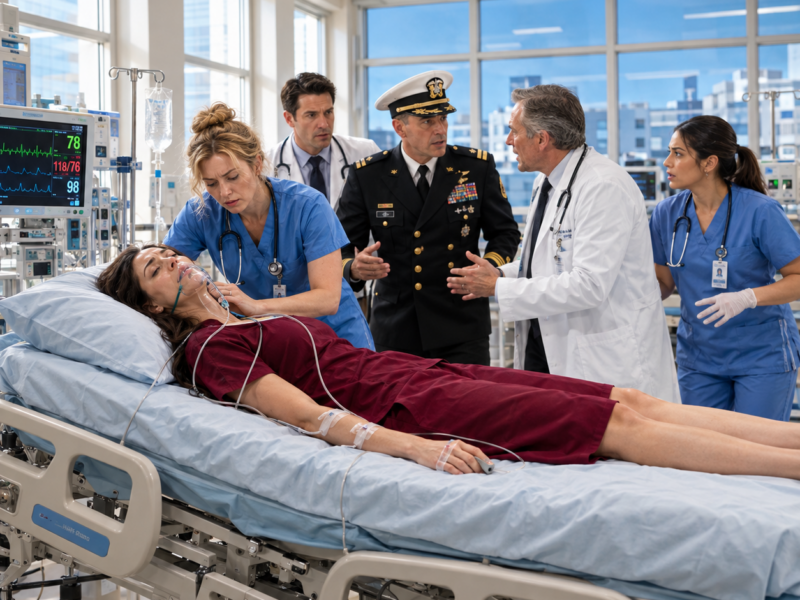
The moment they zipped my patient into a black body bag at Arlington Memorial, the hospital director coldly ordered me to leave the room, but I had already noticed one impossible detail: the dead woman’s fingers were still warm, and the technique I learned years ago told me she was not dead at all.
The harsh fluorescent lighting of Trauma Bay 4 buzzed above us like a trapped hornet.
The air smelled heavily of ozone, copper, and antiseptic, thick enough to coat the back of my throat.
I stood at the edge of the stainless-steel table, my rubber boots glued to the tile floor.
Dr. Reynolds didn’t look back as he unbuckled his face shield and tossed it into the biohazard bin.
“Time of death, zero two fourteen,” he announced to the empty room.
The automated voice on the telemetry monitor echoed his words, dropping into a monotone silence as the final green line went flat.
Two orderlies stepped forward, unrolling a heavy black vinyl bag with a coarse, mechanical zip that split the silence of the room.
They lifted Claire Walker’s body into the dark plastic liner, moving with the practiced indifference of men who had done this a thousand times.
“Clear the bay,” Reynolds snapped, rubbing his tired eyes. “The family is outside. Director Vance wants this room sanitized immediately.”
I stood frozen beside the cart, staring down into the opened zipper before they could pull it over her head.
My fingers brushed against her hand, left exposed outside the black plastic edge.
I froze.
Her fingertips were not cold with the stiff, clay-like chill of a corpse.
They were warm.
I leaned down, my heart hammering against my ribs, and stared closely at the fingers resting against the dark vinyl.
Beneath the nail bed of her index finger was a thin, distinct streak of cobalt blue ink.
It was a crude, hastily drawn line, faded slightly around the cuticle, but unmistakable to anyone who had seen it before.
It was the blue band mark used by forward combat medics to designate an extreme hypothermic state—a survival reflex where the body shuts down peripheral circulation to save the core.
I knew that mark because my father had drawn it on injured soldiers in the frozen mud of Afghanistan when I was just a boy.
“Wait,” I said, my voice cutting through the hum of the air scrubbers.
Reynolds turned around at the door, his hand resting on the chrome handle, his brow furrowed in deep annoyance.
“What is it, Miller? We have three incoming MVAs from I-95.”
“Look at her pupils,” I said, pulling back her left eyelid with my gloved thumb. “They aren’t fixed and dilated.”
“She’s been flatlined for four minutes,” Reynolds barked, stepping back into the room with crossed arms. “She’s gone.”
“I know what the monitor says,” I replied, my voice dropping an octave as muscle memory took over. “But her brainstem hasn’t surrendered.”
Reynolds took a slow, menacing step toward me, pointing a finger directly at my chest.
“You’re a travel nurse who has been in this hospital for three weeks. Don’t lecture me on clinical death.”
“Before I was a nurse, I was a battlefield combat medic with the 75th Ranger Regiment,” I said quietly.
The two orderlies stopped mid-motion, their hands resting on the edges of the body bag.
The quiet in Trauma Bay 4 became absolute.
I pressed two fingers deep into the soft hollow beneath Claire’s jaw, right beside her windpipe.
For three agonizing seconds, there was nothing but the sound of my own blood rushing in my ears.
Then, buried deep beneath the chilled skin, I felt it.
A pulse so faint it was like a single drop of water falling on dry sand.
It was a slow, subterranean rhythm, separated by long, agonizing intervals of silence.
“Get the forced-air warming blankets,” I ordered, looking directly at the senior orderly. “Now.”
“Don’t you touch those controls,” Reynolds interjected, his voice rising in panic. “If Vance sees us attempting resuscitation on a declared dead civilian—”
Before Reynolds could finish his sentence, Claire Walker’s left hand flexed.
Her fingers curled inward, brushing against the sleeve of my scrubs.
Reynolds stepped back so fast his heels struck the stainless-steel supply cart, sending a tray of scalpels clattering to the floor.
“What the hell was that?” he whispered.
I didn’t waste time answering.
I reached for the manual resuscitation bag, hooking it to the high-flow oxygen port and securing the mask over her nose and mouth.
I began squeezing the bag slowly, synchronizing each pulse of air with the tiny, invisible rhythm I felt beneath my fingertips.
“Her body went into deep neurogenic shock from the crash impact,” I explained, my eyes locked on her chest. “Her core temperature plunged, freezing her peripheral nervous system into a state that mimics rigor mortis.”
I began working the warming blanket over her shoulders, manually massaging her central arterial pathways to move heated blood back to her heart.
One minute passed.
Two minutes.
The red numbers on the temperature probe didn’t move from eighty-nine degrees.
Reynolds backed toward the wall, reaching for the wall-mounted phone to call security.
“You’re tampering with a dead body, Miller,” he muttered, his voice shaking. “This is insane.”
“Look at the screen,” I grunted, my forearms burning from the steady, rhythmic pressure on her chest.
A tiny, irregular bump appeared on the flat green line of the cardiac monitor.
Then another.
Then, with a wet, gasping sound that tore through the room, Claire Walker’s chest surged upward.
She sucked in a lungful of oxygen, her body shivering violently under the warm air blankets as her eyes snapped wide open.
“She’s alive!” the orderly yelled, dropping to his knees to secure the suction line.
Before Reynolds could drop the phone receiver, the double doors of the bay slammed open against the wall with a deafening crash.
The Ghosts of Arlington
Three men stepped into the room, their silhouettes dark against the bright hallway lights.
In the center stood an elderly man wearing a dark blue military dress uniform adorned with four silver stars on each shoulder strap.
His face was carved from granite, lined with deep furrows around his mouth and eyes, but his posture was as straight as a steel rod.
Behind him stood two broad-shouldered men in tailored dark suits, their coats cut wide enough to hide shoulder holsters.
General Arthur Walker stopped dead in his tracks, his eyes darting from the trembling body of his daughter to the warm-air tubing, and finally to me.
His chest heaved once, a silent crack in his rigid military armor.
“Claire,” he rasped, his voice sounding like grinding stones.
He took three slow steps forward, ignoring Dr. Reynolds, who immediately began backing out of the room.
The general stopped at the side of the bed, his dark eyes locked onto my face with an intensity that made my pulse race.
“Who taught you that core-rewarming technique?” he asked, his voice low and dangerous.
I stepped back, pulling off my blood-stained latex gloves and tossing them into the bin.
“My father,” I said simply.
General Walker’s eyes narrowed, his gaze shifting to the small blue ink mark still visible beneath Claire’s fingernail.
The color seemed to drain completely from his weathered face, leaving him looking frail for a single second.
“Your father?” he repeated. “What was his name?”
“Marcus Miller,” I replied, clutching the edge of the stainless-steel bed. “He was a flight surgeon with the 160th SOAR.”
“He died in a helicopter crash outside Kandahar twelve years ago,” I added, the familiar words coming out automatically.
The general slowly reached inside his inner jacket pocket.
The two suit-clad agents behind him shifted their stances, their eyes scanning the room for secondary threats.
Walker pulled out an old, worn leather wallet, sliding a faded color photograph from behind a plastic sleeve.
He held it out to me with a hand that trembled almost imperceptibly.
I took the photograph.
My heart stopped.
Unwritten Service Records
The photo was taken in bright sunlight against the backdrop of an olive-drab field ambulance.
Standing on the left was a young General Walker, wearing desert camouflage without his general officer pins.
Standing right beside him, holding a five-year-old girl with dark curly hair on his shoulder, was my father.
He was smiling, wearing the same faded olive flight jacket he used to hang in our hallway at home.
“Where did you get this?” I whispered, my thumb tracing the worn edge of the paper. “My mother was told his records were classified because of the crash location.”
General Walker looked past me at his daughter, who was breathing rhythmically now, her eyes rolling beneath closed lids as the sedation took hold.
“Your father wasn’t on that helicopter, Son,” the general said softly.
The room seemed to shrink around me, the loud hum of the hospital equipment fading into a distant, muffled roar.
“What are you talking about?” I demanded, taking a step toward the four-star officer. “I attended his funeral at Arlington. I stood there while they folded the flag!”
“You buried an empty casket filled with thirty pounds of pig iron,” Walker said, his voice cold and flat.
I stared at him, my mouth opening, but no sound came out.
“Marcus didn’t die in Afghanistan,” Walker continued, stepping closer so that only I could hear his words. “He was pulled out of the field by a specialized dark-budget unit working out of Eastern Europe.”
“Why?” I choked out.
“Because he discovered something inside the medical supply chain that wasn’t supposed to exist,” Walker whispered. “And my daughter was helping him track the money.”
Before I could process his words, Claire’s hand shot up from the bed, grabbing the front of my scrub top with surprising strength.
Her dark eyes locked onto mine, completely clear, completely lucid despite the trauma her body had just endured.
She pulled me down until her lips were inches from my ear.
“Your father isn’t dead,” she whispered, her voice raspy and choked with dried blood. “He sent me to find you.”
Suddenly, a loud, metallic whine echoed through the walls of the hospital.
The lights in Trauma Bay 4 flickered once, twice, and then extinguished completely, plunging the room into absolute darkness.
The emergency backup generators failed to kick in.
The silence that followed the loss of power was heavy and immediate, broken only by the sharp click of weapon safeties being disengaged in the dark.
“Protect the asset,” General Walker’s voice barked from the shadows.
A red laser sight swept across the far wall, illuminating dust particles floating in the air.
“Miller, get down,” one of the suit-clad men shouted, his hand shoving me toward the floor beside Claire’s bed.
Footsteps echoed down the main hallway outside—heavy, synchronized, and moving with terrifying speed.
These were not the steps of confused hospital staff or security guards reacting to a blackout.
They were the tactical strides of men wearing combat boots.
A heavy object struck the double doors of Trauma Bay 4, making the steel frame groan.
“They brought down the grid,” General Walker muttered, pulling a compact nine-millimeter pistol from his shoulder holster with practiced ease. “They know she survived the crash.”
“Who are they?” I whispered, staying low against the cold tile floor while keeping one hand on Claire’s pulse.
“The same people who staged your father’s death,” Walker replied.
The glass window beside the bay doors shattered inward in a shower of sharp fragments.
A metal cylinder bounced across the floor, rolling to a stop right beneath the surgical cart.
“Grenz!” Walker shouted. “Cover your eyes!”
A blinding white flash illuminated the room, accompanied by a concussive boom that rattled my teeth in my skull and filled my mouth with the taste of sulfur.
My ears rang with a high-pitched whine as smoke instantly filled the dark room.
Through the haze, I saw shadow figures moving through the ruined doorway, their silhouettes outlined by the dim emergency lighting of the far corridor.
I reached up, grabbing Claire by her shoulders, and dragged her off the high bed, pulling her down into the narrow gap between the wall and the heavy equipment cart.
A burst of suppressed automatic gunfire tore through the air, sending plaster and metal shards flying over our heads.
One of Walker’s security men collapsed against the wall, his weapon clattering to the floor.
General Walker returned fire, his shots loud and unsuppressed in the tight space, forcing the intruders to take cover behind the doorway frame.
“Take her!” Walker roared at me through the smoke, dropping his empty magazine and slapping a fresh one into his sidearm. “There’s a service elevator through the rear utility door!”
“I can’t leave you!” I yelled back, my voice lost in the thunder of another gunshot.
“She has the drive, Miller!” Walker screamed, turning to fire two round bursts down the hall. “If they get her, your father dies for real this time!”
I didn’t wait for another order.
I wrapped my arms around Claire’s waist, hauling her limp, shivering body over my shoulder in a firefighter’s carry.
She groaned against my neck, her hands weakly clutching my hair as I ducked beneath the smoke line.
I lunged toward the small stainless-steel utility door at the back of the bay, shoving it open with my hip.
The door led into a dark, narrow service corridor filled with heavy steam pipes and exposed electrical wiring.
Behind us, the sound of intense gunfire reached a terrifying climax, followed by the dull thud of a heavy body hitting the floor.
I sprinted down the concrete hallway, the weight of Claire’s body pressing heavy against my lungs as my rubber boots slapped against the wet floor.
“In… inside,” Claire rasped against my ear, her warm breath smelling of iron. “My jacket…”
“Save your strength,” I snapped, turning a sharp corner into a stairwell lit only by the faint red glow of an emergency exit sign.
“No,” she insisted, her fingers digging violently into my collarbone. “Inside the lining… of my leather jacket… on the floor…”
My heart sank.
The jacket had been left behind in Trauma Bay 4, cut off her body by the paramedics who brought her in.
“We can’t go back,” I said, beginning to descend the stairs two at a time, my knees aching under the dual weight.
“It has the access keys…” she whispered, her voice growing weaker as her head drooped over my shoulder. “To the facility in Shenandoah…”
Suddenly, the stairwell door three floors above us blew open with a loud bang.
Shouted orders in clear, unaccented English echoed down the concrete shaft.
“Target is moving toward the basement loading dock! Non-lethal on the woman, terminate the medic!”
I picked up my speed, taking the last flight of stairs in two massive bounds and hitting the heavy crash bar of the basement door with my entire body weight.
The door swung open into the cold night air of the hospital’s rear loading bay.
Rain was pouring down in sheets, bouncing off the asphalt and reflecting the blue strobes of distant police cruisers heading toward the main entrance.
A black SUV sat idling near the trash compactors, its headlights completely off.
As I hesitated in the doorway, the driver’s side window rolled down.
A man leaned out, his face obscured by the collar of a heavy raincoat, holding a silenced pistol pointed directly at my chest.
“Get in,” a deep, familiar voice called out over the sound of the falling rain. “Before they put a hole in your back, Ethan.”
My boots froze to the damp concrete of the loading dock platform.
The voice was older, rougher, and worn down by years of fatigue, but I would have recognized it anywhere on earth.
It was the same voice that had read me bed-time stories when I was seven years old.
The same voice that had sworn over my mother’s grave that he would always protect our family.
“Dad?” I choked out, my arms instinctively tightening around Claire’s waist.
“Get in the car, Ethan! Now!” my father shouted, waving the barrel of his weapon toward the open rear door of the vehicle.
A spray of automatic rifle fire struck the metal doorframe right beside my head, sending sparks cascading over my hair and shoulders.
I lunged off the platform, throwing Claire onto the leather bench seat of the back cabin and diving in after her.
My father slammed the transmission into reverse before I could even pull my feet inside.
The heavy SUV accelerated backward with a screech of tires, hitting a plastic dumpster and sending it flying across the dark alleyway.
He spun the wheel sharply, launching the vehicle forward onto the wet city street just as two armed men burst out of the loading dock doors, firing wildly at our rear window.
The reinforced glass cracked into a spiderweb pattern but held firm against the bullet strikes.
I scrambled up into a sitting position, my hands shaking so violently I could barely grab the back of the driver’s headrest.
My father was watching me through the rearview mirror.
His hair was almost entirely gray now, cut short in a tight military style, and a deep, jagged scar ran from his right ear down into his collar.
“You’re alive,” I breathed, tears hot against my cold, wet cheeks. “You were dead… twelve years…”
“I was never dead, Ethan,” he said, his eyes flicking back to the rain-slicked highway ahead. “I was just hidden.”
“You let me live a lie!” I screamed, the rage suddenly overwhelming the shock as I gripped the seat cushion. “You let Mom die thinking you were blown to pieces in the desert!”
My father closed his eyes for a split second, his jaw clenching tightly as he hit the gas, sending the heavy vehicle flying over a set of rusted railroad tracks.
“If I had come back, they would have killed both of you before the month was out,” he said, his voice deadly quiet. “Your mother died of cancer, Ethan. I watched her funeral from a sniper hide three hundred yards away in the tree line.”
I slumped back against the seat, completely drained, the sound of the rain beating against the roof like a drumbeat.
Claire groaned beside me, reaching out to grab my hand in the dark.
“Is he… is he real?” she whispered, her eyes half-open as she looked at my father’s reflection in the mirror.
“He’s real,” I muttered, staring at the man who had abandoned his life to become a phantom. “Where are you taking us?”
“Out of Virginia,” my father replied, checking his side mirrors as we entered a dark stretch of two-lane highway heading toward the mountains. “General Walker’s men were compromised three weeks ago. He thought he could pull Claire out using standard hospital channels, but he underestimated how deep the network goes.”
“What network?” I demanded. “What is all of this? Why did Claire have your blue combat mark on her finger?”
My father reached into his pocket and tossed a small black USB drive into my lap.
“That mark was our signal,” he said. “When I trained Claire six years ago, I told her if she was ever captured or trapped, she needed to induce a deep hypothermic state using a specific nerve-block combination, then mark her skin so I would know she was still alive.”
“You trained her?” I asked, looking down at the pale girl sitting beside me.
“She was my handler inside the Department of Defense,” Claire rasped, sitting up slowly and leaning her head against the headrest. “Your father found out that a private defense contractor was using military trauma centers to field-test synthetic biological agents on wounded veterans.”
I stared at her in utter horror.
“Arlington Memorial was one of their central hubs,” she continued, wiping a line of dried blood from her lip. “They were using fake death declarations to move live subjects into underground research labs.”
“That’s why Reynolds was so eager to zip her into that bag,” I realized aloud, the pieces falling into place with terrifying clarity. “She wasn’t supposed to go to the morgue. She was going to their lab.”
“Precisely,” my father said, his tone turning ice-cold. “And you ruined their entire timeline by bringing her back to life in front of a dozen witnesses.”
Suddenly, the bright high-beams of two heavy trucks flickered on in the darkness directly behind us.
The two trucks were unlit black pickups, fitted with heavy steel bull bars on their front bumpers.
They accelerated rapidly up the incline of the mountain road, closing the gap between us in seconds.
“Hold on!” my father yelled, slamming his foot down on the accelerator.
The SUV surged forward, the tires protesting as we navigated a tight, dangerous turn along the edge of a deep ravine.
The lead pickup slammed into our rear bumper with massive force, sending our vehicle fishtailing across the wet asphalt.
My father wrestled with the steering wheel, his muscles straining against the hydraulic resistance as he brought the SUV back under control.
“Ethan, reach into the glove box!” he ordered.
I reached forward over the center console, pulling open the compartment to find two small smoke grenades and a heavy black electronic jammer.
“Flip the red toggle on the jammer!” he commanded. “It will fry their localized radio frequencies for fifty yards!”
I hit the switch.
A tiny green light flickered to life on the device, and instantly, the bright headlights of the trucks behind us flickered and dimmed as their electrical systems struggled against the impulse signal.
“Claire,” I said, turning to her as another impact rattled our frame. “Where is the main data stored?”
“It’s… it’s locked in a dark server at the old ridge bunker in Front Royal,” she gasped, clutching her chest. “If we get there… we can broadcast the raw files to every news outlet in the country.”
“We aren’t going to make it to Front Royal,” my father said grimly, looking at the dashboard gauges. “They punctured our fuel line with that last bump. We have maybe three miles before the engine starves.”
He looked at me through the mirror, his dark eyes filled with an emotion I hadn’t seen since I was a child.
It was pride mixed with deep, crushing sorrow.
“Ethan,” he said softly. “You’re a good nurse. You’re better than I ever was.”
“Don’t talk like that,” I said, my chest tightening with immediate dread. “We stay together.”
“There’s an abandoned fire road coming up on the right,” he said, ignoring my plea. “It leads down into the ravine toward the river. You and Claire take the jammer and the drive and hit the woods.”
“And what about you?” I shouted.
My father pulled a heavy steel pin from a small box beside his seat, arming a device beneath the floorboards.
“I’m going to make sure they stop following you,” he said simply.
“No!” I yelled, reaching forward to grab his shoulder. “I just got you back!”
“You got the truth back, Ethan,” he replied, slamming on the brakes so hard the seatbelts locked across our chests.
The SUV skidded to a halt sideways across the narrow fire road entrance, completely blocking the path for the approaching trucks.
My father reached back, shoved the heavy utility door open, and manually unbuckled my belt.
“Move!” he roared, his voice carrying the absolute authority of a commanding officer on a battlefield. “Get her down the ridge! Now!”
Claire grabbed my arm, her strength returning through sheer adrenaline as she pulled me out into the pouring rain.
We hit the muddy slope of the ravine, slipping and sliding down into the thick brush as the rain battered against our faces.
Above us, the high beams of the two black pickups illuminated the trees in bright, jagged white.
I turned back just as four armed men jumped out of their vehicles, weapons raised as they approached my father’s idling SUV.
Through the rain, I saw my father sitting upright in the driver’s seat, his hands resting calmly on the steering wheel.
He turned his head toward the ridge where I was hiding, meeting my eyes through the wet glass one last time.
He gave me a single, crisp military salute.
Then he pressed a small button on his console.
A massive blinding fireball erupted into the night sky, throwing a wave of intense heat across the ridge that knocked me onto my back in the mud.
The shockwave rattled through the mountain trees, sending burning debris raining down into the dark waters of the river below.
I lay in the wet earth, my eyes wide, my throat raw from a scream I didn’t even realize I was making.
Claire pulled me down into the mud, holding her hand firmly over my mouth as the remaining sounds of popping ammunition echo through the burning wreckage.
“We have to go,” she whispered, tears cutting clean lines through the soot on her cheeks. “Ethan… we have to make his sacrifice matter.”
We walked through the dark, frozen woods for three hours, using the dense canopy to shield us from the rain and the threat of drone surveillance.
By the time the horizon began to turn a pale, bruised purple, we reached the rusted perimeter fence of the abandoned Front Royal communications depot.
Claire used an old key card hidden inside her boot to unlock the heavy steel door of the underground concrete bunker.
The interior smelled of stale dust, motor oil, and dry paper.
I helped her sit down at an old, heavy metal console, her body shaking from exhaustion and the onset of cold.
I immediately brought out the thermal blankets from the emergency kit on the wall, wrapping them tightly around her shoulders while I checked her pulse once more.
It was strong. Steady. Alive.
She plugged the black USB drive into the console terminal, her fingers flying across the mechanical keyboard with practiced speed.
Lines of blue code flooded the heavy green monitor, unlocking gigabytes of encrypted medical logs, transfer orders, and covert autopsy reports going back over a decade.
At the very bottom of the directory was a single video file marked with my father’s military identification number.
Claire hit enter.
My father’s face appeared on the cracked screen, illuminated by the dim ambient light of an unknown room.
“If you are watching this,” his recorded voice echoed through the cold concrete bunker, “it means my son succeeded in bringing Claire back from the dark.”
I leaned against the console, my throat tight, listening to every cadence of his voice.
“Ethan,” the recording continued, “I spent twelve years hiding in the shadows so you could grow up in the light. Everything I did, every choice I made, was to keep the monsters away from your door.”
“The files on this drive will tear their system down to the foundations,” he said, looking directly into the camera lens. “Don’t hide from them, Son. Use the truth. Put it out where everyone can see it.”
“You are a healer,” he whispered as the video began to grain. “Never forget that. Finish the work.”
The screen blinked out, leaving behind a simple prompt: Initiate Global Broadcast?
Claire looked up at me, her hand hovering over the heavy rubber enter key.
Outside the bunker, the distant sound of helicopter blades began to chop through the morning fog, growing louder with every passing second.
I reached down, placed my hand over hers, and pressed the key together.









