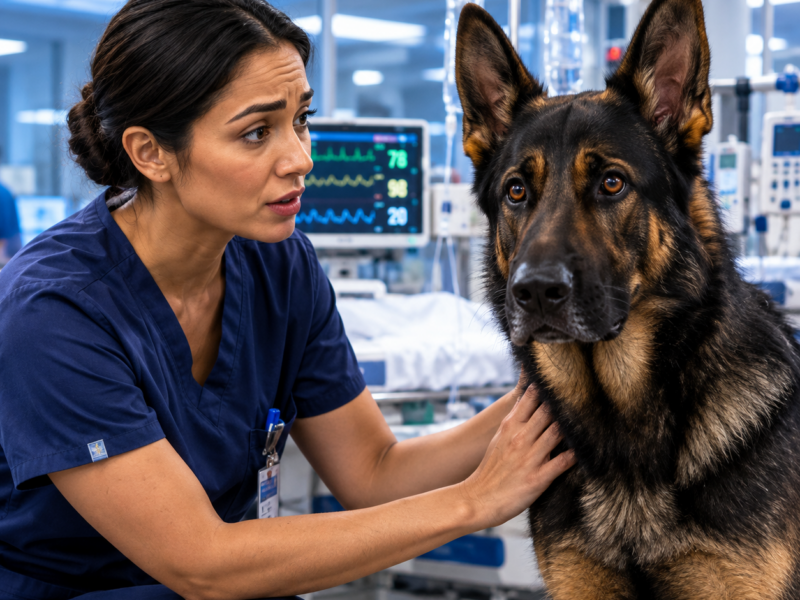
The moment the unconscious Navy SEAL was wheeled into the emergency room, his K9 attacked anyone who came near him, and when the hospital chief ordered me to sedate the animal and threatened to fire me for refusing, I recognized the tattoo on the soldier’s wrist—and realized someone had brought him here to keep a deadly secret buried.
The heavy double doors of the emergency room burst open with a sound like thunder, letting in a swirl of freezing rain and the sharp tang of copper.
Paramedics rushed a gurney through the entrance, their boots skidding on the wet linoleum floor.
On the stretcher lay a man in soaked, torn fatigue pants, his bare chest bruised and smeared with mud.
Beside him, leaping alongside the rolling wheels, was a massive German Shepherd.
The dog’s coat was matted with grime, and his jaw was set in a fierce, desperate snarl that echoed off the high ceiling.
“Get back! Everyone stay clear!” one of the paramedics yelled, struggling to keep his grip on the gurney.
The moment the wheels locked into place near the trauma bay, the dog sprang upward, landing heavy paws on the metal frame.
He stood directly over the unconscious man, his dark eyes darting frantically across the room.
When a nurse stepped forward with a tray of IV supplies, the dog lunged forward, snapping his jaws inches from her hand.
She gasped and dropped the tray, metal crashing against the tile floor.
Dr. Harris pushed his way through the gathering crowd, his white coat pristine despite the chaos around him.
“What is the meaning of this?” Harris demanded, his voice sharp enough to cut through the noise of the monitors.
“He came in off the highway,” the paramedic breathed heavily. “John Doe. Found collapsing near the tree line. The dog won’t let us attach a monitor.”
The dog let out a low, guttural growl that vibrated through the cold air of the room.
His body was tense, trembling with a mixture of rage and sheer exhaustion.
“Get that animal under control!” Dr. Harris shouted as nurses backed away from the stretcher.
The SEAL lay motionless beneath the fluorescent lights, his face pale, his breathing dangerously shallow.
The K9 ignored every command, snapping at anyone who reached for the man.
I pulled off my medical gloves and stepped out from behind the central desk, my pulse pounding in my ears.
I had worked emergency medicine for eleven years, but I had never seen a dog look so terrified of losing someone.
“Give me a minute,” I said, keeping my voice low and steady as I moved forward.
Dr. Harris grabbed my arm, his fingers digging hard into my scrubs.
“You have patients waiting, Nurse Carter, and I will not let a military dog run my emergency department.”
I pulled free from his grip and kept my gaze fixed on the trembling animal.
“He isn’t trying to hurt anyone,” I replied quietly. “He’s guarding his post.”
I slowly knelt several feet from the animal, lowering my posture so I didn’t appear as a threat.
The scent of rain, blood, and damp fur washed over me.
“Hey, buddy,” I whispered. “I’m not here to hurt him.”
The dog growled, the skin above his snout wrinkling tight, but he didn’t attack.
His eyes stayed locked on mine, as if he were trying to tell me something no one else understood.
I took a slow, deliberate breath and extended my right hand, palm upward.
“It’s okay,” I murmured. “Let me help him.”
I reached toward the soldier’s wrist to check his pulse, keeping my movements completely predictable.
That was when the harsh light caught the inner skin of the man’s forearm.
That was when I saw the tattoo.
Three black lines crossed by a small silver star were etched deep into his skin, dark against his pale wrist.
It was the insignia of a special operations unit I had spent years trying to forget.
My fingers went numb, hovering an inch above his cold skin.
I knew that mark because my younger brother, Ethan, had worn the exact same one over his heart.
He had been declared dead after a classified mission in the mountains of Afghanistan six years earlier.
The military had sent my family a folded flag, a shiny medal, and a heavily redacted report.
No body was ever returned to us.
No final goodbye was ever permitted.
Just a single, cold sentence saying his remains could not be recovered from the crash site.
I stared at the unconscious man’s face, searching for something familiar beneath the dark bruises and dried blood.
He was broad-shouldered, with a jagged scar running from his temple down to his jawline.
He wasn’t Ethan, but he had belonged to the same unit, the same ghost team that was never supposed to exist.
A sudden, soft touch against my wrist made my breath catch in my throat.
The K9 had lowered his head and pressed his wet muzzle directly into my open palm.
As he shifted his posture, the overhead light caught the edge of his left ear.
A tiny, crescent-shaped scar ran along the dark fur near the tip.
My chest tightened so hard I couldn’t draw in air.
I had seen that exact scar years ago in a crumpled photograph Ethan had mailed home from his first deployment.
He had been holding a broad-chested puppy with oversized paws and a notch in his ear.
“Ranger?” I whispered, the name slipping out before I could stop it.
The dog’s growl vanished instantly.
He dropped his ears back against his head and lowered his forehead against my hand, his massive frame trembling violently.
He let out a high, mournful whine that seemed to fill the entire trauma bay.
Behind me, the sound of hurried footsteps came to a sudden halt.
Dr. Harris went strangely quiet, his eyes fixing on the dog’s sudden compliance.
“Step away from the patient,” he ordered, his voice cold, flat, and entirely void of its usual irritation.
I slowly looked up at him, my heart hammering against my ribs.
“Why?” I asked, standing up straight. “He’s stabilized enough for an IV. We need to run a trauma panel immediately.”
“Because this case is restricted,” Harris said, taking a step toward the head of the bed.
A chill crawled down my spine, cold as the storm raging outside the windows.
“How do you know that?” I asked, watching his face carefully. “He hasn’t even been identified yet.”
He didn’t answer me.
Instead, he reached for the soldier’s medical chart hanging from the end of the bed and tore off the white identification label.
He crumpled the paper in his fist and shoved it deep into the pocket of his lab coat.
“Security will handle him,” Harris muttered, refusing to look me in the eye.
Before I could demand an answer, the monitor above the bed began to beep erratically as the soldier stirred.
His hands twitched, his fingers tightening blindly around the rough hospital blanket.
His chest heaved as he fought against the plastic mask strapped across his face.
His lips moved beneath the clear plastic, working desperately to form words that wouldn’t come out.
I stepped closer to the edge of the bed, completely ignoring the warning glare from Dr. Harris.
“Sir, can you hear me?” I asked, leaning down until my ear was inches from his mouth. “You’re in a hospital. You’re safe.”
The man’s eyelids fluttered, heavy and swollen from impact wounds.
His eyes opened for barely a second, clouded with pain and medication.
He locked his gaze directly onto mine, a sudden, piercing clarity shining through the haze.
He reached up with a trembling, mud-stained hand and grabbed the cuff of my scrubs.
Then he pulled the mask down slightly and whispered, “Ethan said you’d come.”
My heart stopped beating entirely.
The room seemed to tilt around me, the bright lights washing out into a blinding glare.
“What did you say?” I gasped, leaning in closer. “Where is Ethan?”
The soldier’s grip on my sleeve went slack, his eyes rolling back as unconsciousness dragged him under once more.
The heart monitor resumed its slow, rhythmic beep, but the silence inside my own head was deafening.
Before I could process his words or check his vitals again, heavy footsteps echoed down the main corridor.
Two men in dark, tailored suits entered the emergency room, their faces expressionless and their eyes sweeping the room with clinical precision.
They moved with a practiced, military efficiency that immediately drew the attention of every staff member present.
Dr. Harris immediately obeyed their unspoken authority, stepping back from the bed and raising his hands in a placating gesture.
“He’s right here,” Harris said to the taller of the two men. “We haven’t administered any sedatives yet.”
The taller man didn’t look at Harris; his focus was entirely on the dog and me.
Ranger instantly reacted to their presence, his body going rigid as he planted himself squarely beside the stretcher, refusing to move an inch.
A deep, low vibration rattled in the dog’s chest, his ears flattened against his skull.
The second man reached inside his coat, his hand lingering near his belt line in a movement that was unmistakable to anyone paying attention.
The taller man held up a hand, stopping his partner, and approached me with measured steps.
He stopped just short of Ranger’s strike zone and spoke softly enough that only I could hear above the ambient noise of the ER.
“Your brother is alive, Nurse Carter.”
My knees nearly gave way right then and there, and I had to grab the guardrail of the gurney to keep from falling.
“Where is he?” I managed to choke out, my throat dry as dust.
The man glanced down at the unconscious SEAL lying on the bloody sheet.
“Somewhere he was never supposed to escape from,” he answered flatly.
He reached into his breast pocket, pulled out a small, wrinkled photograph, and placed it directly into my trembling hand.
The image was worn at the edges, as if it had been carried through water and dirt for months.
It showed Ethan standing in front of a dark stone wall beside the very soldier lying on the bed before me.
Both men were thin, bruised, and wearing tattered clothes, but their eyes were fierce with survival.
I flipped the photo over with shaking fingers.
On the back, written in black ink that had bled slightly into the paper, were five words in my brother’s unmistakable, sharp handwriting.
“Don’t trust anyone wearing a badge.”
I stared at the words, the ink burning into my memory.
“Who are you?” I asked, looking up at the man in the suit. “What happened to him?”
“That photograph is all you get, Nurse Carter,” the man said, his voice completely devoid of emotion. “Now step away from the patient.”
He made a subtle gesture to his partner, who immediately pulled a heavy silver briefcase from his side.
“We are taking custody of this individual under federal security protocols,” the second man announced to the room.
Dr. Harris nodded rapidly, waving his hands at the rest of the nursing staff.
“Clear the room, everyone,” Harris called out. “Let these gentlemen do their jobs.”
I looked at Harris, then down at the unconscious soldier, and finally at Ranger, who was growling louder now, his body trembling with rage.
Something inside me shifted—a sudden, absolute refusal to let them close the curtain on my brother again.
“I’m the head trauma nurse on this floor,” I said, stepping between the tall man and the gurney. “He’s in acute distress. Moving him right now will cause fatal brain swelling.”
The tall man’s jaw tightened, a flash of annoyance breaking his calm exterior.
“This is not a request, Nurse,” he said softly, taking one step closer.
Ranger snapped, his heavy jaw coming together with a sharp crack inches from the man’s leg.
The man didn’t flinch, but his hand moved back toward his jacket.
“If you harm this dog,” I said, my voice dropping to a harsh whisper, “I will scream so loud every officer in this building will be in this bay in five seconds.”
The man paused, his eyes narrowing as he evaluated me.
“You’re making a mistake,” he said. “Your brother sent him here to bring you a message, not to drag you down with him.”
“What message?” I demanded.
Before he could answer, the fire alarm overhead began to blare, its screeching horn echoing through the corridor as bright red lights flashed across the ceiling.
Panicked shouts echoed from the main hallway as smoke began to pour through the ventilation grates near the ceiling.
Nurses and technicians started scrambling toward the exits, pushing carts out of the way in a sudden wave of confusion.
Dr. Harris cursed aloud and turned toward the doors, coughing as the thick grey haze began to fill the trauma bay.
The two men in suits didn’t look surprised; they instantly shifted their positions, moving to block the exit doors of the room.
“Secure the package,” the taller man commanded, drawing a dark pistol from beneath his coat.
I didn’t hesitate.
I reached down and grabbed the heavy manual override lever at the base of the gurney, unlocking the wheels with a loud kick.
“Ranger, move!” I yelled.
The dog didn’t need to be told twice; he bounded forward, slamming his heavy chest into the second man’s knees and knocking him backward into a stack of metal trays.
I shoved the gurney with all my strength, pushing it through the side door that led to the restricted surgical corridor.
The heavy doors slammed shut behind us, cutting off the sharp shouts of the men in suits.
The hallway ahead was dimly lit, the red emergency lights casting long, eerie shadows down the narrow tile path.
I ran as hard as I could, pushing the heavy bed while Ranger trotted beside me, his nose low, scanning every doorway we passed.
My mind was racing, Ethan’s handwritten warning repeating over and over in my head.
Don’t trust anyone wearing a badge.
Dr. Harris had torn the name off the chart before anyone even knew who the soldier was.
He knew those men were coming.
He had been waiting for them.
The hospital wasn’t a safe haven for this soldier; it was the trap designed to finish what started six years ago.
The gurney bounced heavily as we rounded a corner, leading toward the underground loading docks and maintenance tunnels.
The soldier groaned loudly, his hand flailing out to catch the metal frame.
“Hold on,” I breathed, gasping for air as my lungs burned from the run. “I’ve got you.”
He turned his head slowly, his dark eyes squinting against the harsh red strobe lights.
“The drive…” he croaked, his voice raw and raspy. “Inside… the collar.”
I stopped the gurney instantly beneath a dim utility bulb.
I reached down to Ranger, my fingers digging through his thick, matted fur until I felt the heavy leather strap around his neck.
Tucked tightly into the inner lining was a small, metallic object no larger than a fingernail.
Unseen Threads
I pulled the tiny flash drive free from the leather lining, my fingers slick with cold rain from the dog’s fur.
It was a military-grade encrypt, heavy and cold in my palm.
“What is this?” I asked, leaning down over the soldier.
He coughed violently, a line of dark blood appearing at the corner of his lip.
“Evidence,” he whispered, struggling to keep his eyes open. “Ethan… found the supply lines. They weren’t soldiers… they were contractors.”
My blood ran cold.
“Who?”
“The men in suits… they run the operation,” he breathed, his hand clutching my wrist with surprising strength. “Your brother… he’s still in the facility… north of the border.”
“Why did he stay?” I choked back a sob. “Why didn’t he come back with you?”
“Because he couldn’t leave the others,” the soldier replied, his grip loosening as his body gave out under the weight of his injuries. “He said… you were the only one who could get this to the prosecutor.”
Footsteps echoed from the far end of the hallway—heavy, fast, and tactical.
They were already tracking us through the hospital’s internal security network.
I shoved the drive into the hidden pocket of my scrub top and grabbed the handles of the gurney once more.
We couldn’t reach the main vehicle bay; they would have every exit covered by now.
Instead, I pushed the bed into the service elevator, slapping the button for the sub-basement level where the old boiler rooms connected to the city sewer access.
The heavy steel doors closed just as the sound of boots rounded the far corner.
Inside the quiet box of the elevator, the only sound was the heavy breathing of the dog and the faint hum of the motor carrying us down.
I looked down at the soldier’s face, taking in every bruise, every line of exhaustion.
He had crossed an ocean, survived a crash, and run through miles of forest with a bullet wound in his shoulder just to deliver five words written on a scrap of paper.
“What’s your name?” I asked gently, wiping a smudge of dirt from his forehead.
“Marcus,” he murmured, his eyes closing completely. “Captain Marcus Vance.”
The elevator jolted to a sudden stop, the bell chiming with a hollow tone.
When the doors slid open, a figure was standing in the darkness of the basement corridor, holding a heavy flash light pointed directly at my face.
I pulled back, stepping in front of the bed, while Ranger lowered his head and prepared to spring.
“Put the dog down, Clara,” a familiar voice said from behind the beam of light.
The light lowered slightly, revealing the pale, sharp face of Dr. Harris.
He was holding a heavy syringe in one hand and a radio in the other, his white coat stained with grey soot from above.
“You shouldn’t have gotten involved in this,” Harris said, his voice entirely devoid of the anger he had shown upstairs.
Instead, he sounded tired, calm, and utterly detached.
“You’re one of them,” I said, taking a slow step back into the elevator cage. “You’ve been helping them hide what happened to Ethan’s unit.”
Harris let out a long, dry sigh and shook his head.
“You don’t understand how deep this goes, Clara,” he said, taking a step toward us. “Your brother’s unit stumbled onto something that wasn’t meant for public eyes. Certain contracts were signed at the highest levels.”
“He was a soldier!” I yelled, my voice echoing off the concrete walls of the basement. “He was your country’s soldier!”
“And he became an inconvenience,” Harris countered coolly. “Just like this man on your gurney. Give me the drive, Clara. I can make sure you walk out of this building tonight unharmed.”
“You’re lying,” I said.
I looked down at the floor, spotting the heavy steel fire extinguisher mounted on the wall beside the elevator door.
Without taking another breath, I grabbed the metal cylinder off its hook and swung it with all my strength, slamming it into the heavy breaker panel beside Harris.
Sparks erupted in a blinding flash of blue and bright orange, showering the hallway in hot light.
The lights in the basement went completely dark, plunging us into absolute blackness.
Harris shouted in surprise as the sudden blindness took him off guard.
Ranger lunged through the darkness, his massive weight slamming into Harris and knocking the doctor to the cold concrete floor.
The syringe clattered loudly against the floor, rolling away into the dark.
“Go!” I yelled, grabbing the front rail of the gurney and pulling it blind through the hallway.
Ranger let out a final warning bark before turning and running alongside us into the subterranean gloom.
I knew this basement like the back of my hand after eleven years of night shifts.
I guided the heavy wheels toward the old emergency exit that opened into the drainage alley behind the hospital’s power plant.
Behind us, the heavy metal doors at the top of the stairwell slammed open, and the beams of tactical flashlights cut through the rising smoke.
We burst through the crash doors into the pouring rain, the freezing air hitting my face like a physical blow.
The storm was raging harder now, water cascading off the metal awning above the loading dock.
An old medical transport van was parked near the trash compactors, its engine idling quietly in the dark.
The driver’s side door opened, and a man stepped out into the rain, his silhouette framed by the yellow streetlights of the alley.
I froze, my hands tightening on the steel bar of the gurney, prepared to fight with whatever I had left.
“Clara!” a voice called out over the roar of the wind.
The man pulled down his dark hood, revealing a face lined with deep scars and a thick, grey-streaked beard.
His right eye was milky white with blindness, but his left eye was sharp, clear, and full of recognition.
It wasn’t Ethan.
It was Sergeant Miller, Ethan’s former commanding officer—the man who had personally delivered the folded flag to my mother’s house six years ago.
“Get him in the back, quickly!” Miller shouted, running toward us with a heavy canvas tarp.
“You told us he was dead!” I screamed at him through the pouring rain. “You sat in my mother’s living room and lied to us!”
“I had to make them believe I accepted the story,” Miller said, his voice raw with emotion as he helped me lift the heavy gurney into the back of the van. “If I had asked questions then, they would have killed me, and they would have killed Ethan that same night.”
Ranger leaped into the back of the vehicle without hesitation, curling his body around Marcus’s cold form to keep him warm.
“Is he really alive?” I choked out, grabbing Miller’s coat as rain poured down my face. “Is Ethan really out there?”
Miller looked at me, his single good eye wet with tears that had nothing to do with the storm.
“He’s been waiting six years for us to get the key,” Miller said, pointing to the tiny drive I was still clutching in my fist. “And you just brought it out.”
Behind us, the heavy metal doors of the hospital swung open again, and three men in suits rushed out into the alley, their weapons drawn.
“Get in!” Miller yelled, shoving me into the passenger seat before sliding into the driver’s side.
The tires screeched against the wet asphalt as Miller slammed the van into reverse, backing out of the alley at full speed.
Bullets smashed into the heavy metal side panels of the van with loud, terrifying thuds, shattering the rear window into a thousand tiny crystals.
Ranger barked wildly from the back, shielding Marcus with his own body as glass showered over them.
Miller swung the wheel hard, pulling the vehicle out onto the main boulevard and blending into the thick midnight traffic under the pouring rain.
My heart was hammering against my ribs so hard I couldn’t breathe.
I pulled the tiny flash drive from my pocket and held it up to the faint green light of the dashboard.
“What is on this?” I asked, my voice shaking violently.
“Names,” Miller said, staring straight ahead at the wet highway. “The names of every officer, every doctor, and every politician who took money from the private contractor that ran that facility.”
“They kept an entire squad buried alive for six years just to protect their profit margins?” I asked, horror wash over me.
“It wasn’t just profit,” Miller replied darkly. “They were using them for unauthorized field ops off the grid. Men who don’t exist don’t leave a paper trail.”
From the back of the van, Marcus let out a soft groan and slowly sat up against the metal wall.
Ranger immediately rested his heavy chin on the soldier’s knee, his tail giving a single, slow thump against the floor.
“Nurse,” Marcus whispered, his voice faint but steady.
I turned around in my seat, looking back at him through the dim cabin light.
“You need to know something about Ethan,” Marcus said, his chest heaving with the effort to speak.
I held my breath, afraid to move, afraid to hear the next words.
“He never stopped talking about you,” Marcus said, a small, painful smile breaking through his bruised lips. “Every night in that place… he told us you were the smartest person he ever knew. He said if anyone could read his signal… it would be you.”
Tears finally overflowed, hot against my rain-soaked cheeks.
We drove for hours through the blackness of the night, leaving the city far behind as the storm slowly turned into a heavy, grey fog.
The road wound upward into the dense pine forests near the northern border, where the trees grew thick and the highway narrowed to two lanes.
Miller pulled the van off the main road, driving down a hidden dirt trail that led deep into a deserted logging camp.
An old wooden cabin stood among the trees, its windows dark and covered with heavy wooden shutters.
As the van came to a halt, the sky began to lighten with the faint, cold pink of dawn.
Miller turned off the engine, the sudden quiet filling the vehicle like a heavy blanket.
Marcus was awake now, sitting up fully with his arm wrapped around Ranger’s neck, his pulse steadying under the care I had provided from the emergency kit in the back.
“We upload the files from here,” Miller said, pulling a ruggedized military laptop from beneath the driver’s seat. “Once this hits the federal prosecutor’s secure line, it triggers an automatic rescue protocol.”
“How long do we have?” I asked, looking out the shattered rear window at the quiet woods.
“Not long,” Miller said quietly. “They’ll track the van’s registration within the hour.”
I stepped out of the van into the cold morning air, the scent of pine and damp earth sharp in my lungs.
Ranger hopped down beside me, his ears pricked forward as he scanned the perimeter of the clearing.
I looked at the photograph again, staring at Ethan’s face under the faint light of the rising sun.
Six years of grieving, six years of staring at an empty casket, six years of believing a lie told to me by men in polished shoes and white coats.
He was out there, holding on in the dark, waiting for the signal to come home.
I plugged the flash drive into the laptop Miller held out to me, my hand steady now, completely free of fear.
The screen flickered to life, line after line of encrypted text scrolling rapidly across the dark interface.
Then a single prompt appeared in the center of the display, asking for a final confirmation code to transmit the files to the Department of Justice.
A Flame in the Dark
My fingers hovered over the keyboard as I looked at the prompt screen.
The system required a passkey—a phrase that only the person who placed the drive in Ranger’s collar would know.
I looked down at the back of the crumpled photograph in my hand once more.
Don’t trust anyone wearing a badge.
I typed the five words slowly into the command box, hitting the enter key as the last letter settled onto the screen.
The progress bar immediately lit up in bright green, reading: TRANSMISSION CONFIRMED. SPECIAL OPERATIONS TASK FORCE DISPATCHED.
A profound, quiet stillness settled over the clearing as the morning sun finally broke through the heavy canopy of the trees.
Beside me, Ranger let out a short, sharp bark and turned his head toward the deep woods to the north.
Marcus stepped out of the back of the van, leaning heavily against the door frame, but his face was set in a firm, unbroken line.
“They’re moving,” Marcus said softly, watching the sky. “The rescue unit is already in the air.”
I looked up at the grey clouds breaking apart above us, hearing the faint, distant thrum of heavy helicopter blades echoing over the mountain ridge.
The secret was out.
The lie that had consumed six years of my life was tearing apart at the seams, exposed to the light of a new day.
I reached down and rested my hand on Ranger’s head, feeling the warm, steady pulse of his breathing beside me.
We had survived the hospital, the storm, and the dark forces that tried to bury the truth in the mud.
Now, all that was left was to wait for the chopper to come down through the trees and bring my brother back from the grave.
How would you like to handle the final reunion scene between Clara and Ethan?