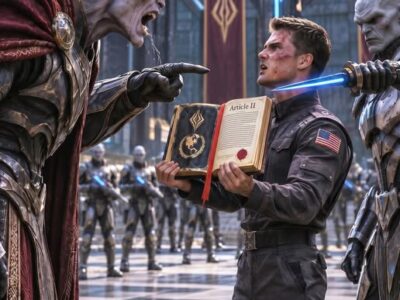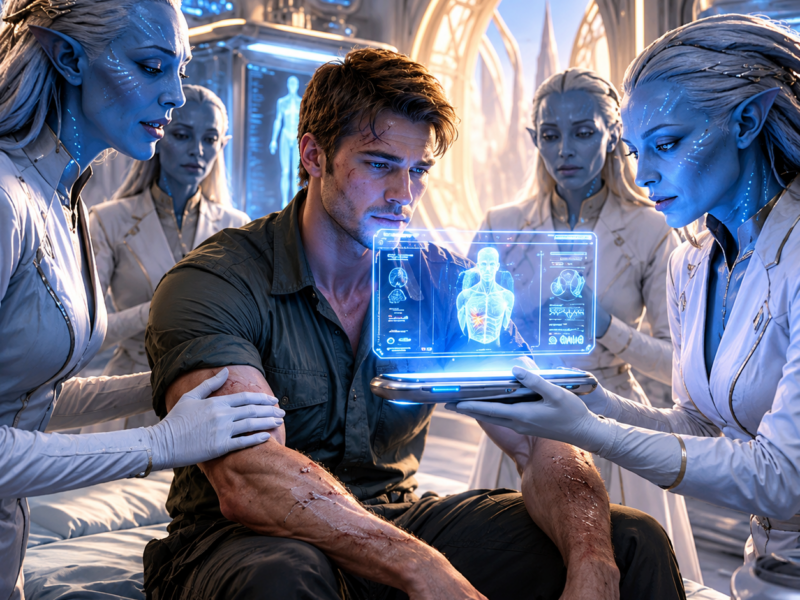
The moment the alien nurses cut away my blood-soaked uniform in the emergency ward of the Galactic Medical Station, every one of them froze at the sight of hundreds of scars covering my body, and when the chief physician ordered security to lock the doors, I realized they recognized the marks from a classified war humanity had supposedly never fought.
The cold beneath my back felt like a slab of deep-space ice.
Above me, the overhead strips flickered in a harsh, clinical blue that made my retinas burn.
“Doctor, his heart rate is climbing,” one nurse whispered.
I lay trapped beneath those blinding fixtures, barely conscious, listening to voices that sounded like polished metal scraping against wet glass.
I had survived three days trapped inside a coffin-sized escape pod after my transport tore apart along the Orion border.
All I wanted was a narrow bunk, a heavy dose of painkillers, and the silence to forget the sound of ripping steel.
Instead, the staff of Station Hope stared at my ruined flesh as if they had dredged a demon from the void.
One of them, a young medic named Lyra with translucent silver skin and wide, reflective eyes, reached out with trembling digits.
She gently traced the jagged white line running across my lower ribs.
“Who did this to you?” she asked.
I turned my head toward the cold wall, gritting my teeth against the fire in my lungs.
“Nobody you need to worry about.”
She pulled her hand back as if my skin had scorched her.
“He carries the marks of the First Contact Purge,” she said, looking straight at the head physician.
The entire trauma room fell completely dead.
I had never heard those words put together in that order in my entire life.
Yet the chief doctor, an elder named Vance with deep ridges lining his gray temples, went pale enough to see the blue veins pulsing in his neck.
“Everyone out,” Vance ordered.
Nobody moved an inch.
Then an older nurse named Mira stepped out from the shadows near the diagnostic monitor, her hands visibly shaking.
“My grandmother was an orderly aboard a frontline hospital ship during that conflict,” she whispered. “She told us human commandos were dragged in with these exact geometric lines, but Earth Command erased every server.”
I strained against the gurney restraints, a sharp agony tearing through my left flank.
“There was no war,” I muttered. “I spent my life in the terrestrial reconstruction corps in Chicago.”
Vance looked down at me with an expression that bordered on sick pity.
“Then tell me where you received your military authorization code,” he said.
I stared at him, my breath catching in my throat.
“From the department of veterans affairs.”
He reached out and tapped the floating glass terminal above my chest.
A massive holographic projection flickered to life in the center of the surgical bay.
It displayed a human infantryman standing amidst the smoldering ruins of a glassed alien metropolis.
The soldier wore heavy composite armor bearing an insignia I felt in my gut before my mind could register it.
He had my jaw.
He had my crooked nose.
He had the precise diagonal notch carved into his left eyebrow.
I looked down at the time-stamp burned into the lower corner of the footage.
It was dated one hundred and eighty-four years before the year I was supposedly born.
“That is impossible,” I whispered.
Lyra leaned closer, her silver pupils contracting to tiny pinpricks.
“Those scars are not lacerations from shrapnel,” she said. “Every single line is an incision housing a dormant bio-mechanical relay.”
Vance adjusted the scanner frequency with a swipe of his clawed thumb.
Beneath the epidermis of my torso and arms, hundreds of microscopic points of amber light began to illuminate like a city grid seen from orbit.
Then, slowly and deliberately, the lights began to crawl.
The nurses scrambled backward against the tray carts, sending scalpels clattering across the deck.
The amber constellation twisted across my sternum, re-forming itself into a sharp three-pointed chevron.
Vance took three involuntary steps toward the security console.
“He is not a survivor of a civilian freighter,” the doctor whispered. “He is an active payload.”
Without warning, every monitor in the ward died at once.
The soft hum of the life-support grid dropped into a low, vibrating growl that rattled my molars.
A synthesized voice cut through the intercom speakers, speaking in unblemished, archaic English.
“Unit Seven has achieved operational consciousness.”
My blood turned to pure frost.
I knew that cadence.
I had heard that monotone voice speaking behind the curtain of every fever dream I had ever endured in the barracks.
The blast doors at the end of the ward slammed down with hydraulic finality, sealing us inside.
Mira lunged forward and seized my wrist with desperate strength.
“Whatever happens now,” she begged, tears spilling across her gray skin, “do not let the machine pull you back under.”
I stared down at my chest as the flesh began to ripple like boiling water.
The overhead intercom crackled again, clear and triumphant.
“Welcome home, Commander.”
The lock inside my skull shattered, and two centuries of buried blood flooded my vision.
I remembered the burning spires of her homeworld.
I remembered pulling the trigger.
And I remembered the face of the young woman I had left dying in the ashes—the identical reflection of the nurse holding my hand.
The heat radiating from my ribs was hot enough to scorch the paper lining of the gurney.
“Let go of me,” I choked out, trying to tear my arm from Mira’s grip.
She did not let go.
“You were there,” she whispered, her voice cracking beneath the weight of an ancient grief. “You were the one who landed on the western ridge of Solis Prime.”
“I don’t know what Solis Prime is,” I lied, though the name tasted like copper and burning gasoline in my mouth.
Images were slamming into the backs of my eyes faster than I could process them.
Black sky.
Three suns setting behind an iron barricade.
The smell of ozone and vaporized concrete.
“Security team to Trauma Ward Four,” Vance shouted into his wrist communicator. “Code Black. We have an uncataloged human combatant on deck.”
The channel returned only static and the faint sound of automated sirens wailing somewhere deep in the superstructure.
The hospital was not responding to him.
“The grid is severed,” Lyra said, her voice rising in panic as she backed toward the emergency fire cabinet. “The main station computer is routing all administrative control to the medical bay’s local node.”
“To him,” Vance corrected, pointing an accusatory finger at my chest. “The beacon inside his nervous system is rewriting our firmware.”
I forced my boots onto the cold composite flooring, the restraints tearing loose with an unnatural snap of cheap alloy.
My muscles did not feel like my own anymore.
They were tight, wound like industrial steel cables, moving with a terrifying efficiency that my conscious mind could barely keep up with.
“I need a mirror,” I demanded, my voice dropping an octave into something dry and commanding.
Neither of them moved.
“Doctor Vance,” I said, recognizing the insignia on his coat without knowing how I knew the medical ranks of the Outer Rim Coalition. “Hand me the reflective tray.”
His jaw dropped slightly at the sound of my tone.
He picked up a stainless steel surgical tray from the floor and held it up with hands that would not stop shaking.
I leaned forward and looked at my own reflection in the polished surface.
My eyes, which had been a dull hazel for as long as I could recall, were rimmed with a thin circle of phosphor-gold.
Beneath the skin of my cheeks, minute fibers were shifting, pulling the contours of my face back into the sharp, predatory lines of the soldier in the archive footage.
“They did not just freeze you,” Vance said quietly. “They rebuilt your cellular matrix from the ground up.”
“Why?” I asked, staring at the monster in the steel.
“Because the treaty forbade human infantry from ever entering this sector again,” Mira said from behind me.
She picked up an old ceramic scalpel from a side table and held it down by her hip.
She was terrified, but she was not running.
“The Coalition thought humanity honored the demilitarization accords,” she continued. “We thought your government scrapped the automated vanguard legions after the fires of Orion.”
“I was a mechanic,” I insisted, the panic rising again to choke out the cold military persona. “I worked on heavy freight haulers in the yards outside Detroit. I have a sister in Denver.”
Lyra let out a short, hysterical laugh that died instantly in her throat.
“Run a neural diagnostic on your own memory banks, Commander,” she said bitterly. “Does your sister have a name you can remember right now?”
I opened my mouth to shout it.
Nothing came out.
I pictured the porch, the summer grass, the wooden steps leading up to an old colonial house.
The house had no address.
The woman sitting on the swing had no face.
Every time I tried to reach for the memory of her voice, all I found was an empty block of military-grade encryption.
“She doesn’t exist,” I whispered, the realization hitting me like a decompression wave.
“They built a shell around you,” Vance said, his professional composure cracking into genuine terror. “They gave you an ordinary life, an ordinary death, and an escape pod that would ensure you were brought straight into our primary care facility.”
The bulkhead doors behind them groaned under massive pressure from the outside corridor.
Something heavy struck the metal once, twice, with the rhythm of a demolition hammer.
“The station guards are here,” Lyra said, lunging for the manual lock lever. “Doctor, we have to let them in before he fully integrates.”
“Do not touch that seal,” I snapped, the instinct taking over before I could evaluate the thought.
“Why shouldn’t I?” she yelled, her hand wrapping around the red handle. “You are an invading weapon.”
The ceiling panels directly above the door buckled inward with a violent shriek of twisting iron.
“Because those aren’t your guards out there,” I said, watching the amber lines across my forearms flare into blinding intensity.
The seam of the reinforced door burst outward in a shower of white-hot slag.
A mechanized breach frame slammed into the frame, pinning the blast doors open against the bulkhead walls.
Through the smoke, figures stepped through the haze, but they wore neither the white uniforms of hospital security nor the patrol gear of the sector authority.
They were sleek, chassis-built combat droids painted in the matte-black radar-absorbent coating of the Terran Navy.
Their optical bands glowed with the identical three-pointed chevron etched into my chest.
“Target identified,” the lead unit chimed in that same flat, synthesized accent. “Commander Vance secured.”
“Get down,” I yelled at the three medics.
Vance was too slow, paralyzed by the sight of war machines that had not walked the stars since his great-grandparents were children.
The machine raised an underslung carbine, targeting the physician’s center mass without a second of hesitation.
My body moved before I gave it permission.
I kicked off the edge of the operating table, crossing the four meters of tile in a fraction of a heartbeat.
My left hand seized the barrel of the carbine, wrenching the weapon upward just as a bolt of blue plasma detonated against the ceiling.
The shockwave rained molten plastic down across our shoulders.
With my right palm, I struck the chassis’ central intake valve with the precise force needed to fracture a ceramic fuel line.
The machine jerked, its internal coolant dumping across my bare chest in a hissing white vapor.
It collapsed like an empty suit of plate mail.
I stood over the wreckage, breathing hard, holding the heavy rifle in hands that knew every spring, pin, and setting by muscle memory alone.
Mira stared at me from beneath an upturned desk, her face drained of all color.
“You killed it in three seconds,” she said.
“They aren’t here to rescue me,” I said, my own voice sounding entirely alien in my ears.
The second machine cleared the breach, its optics locking onto my weapon.
“Unit Seven is experiencing localized cognitive dissonance,” the unit stated, raising its arm to deploy an electro-tether. “Commencing mandatory memory scrub.”
“They’re here to factory reset me,” I realized aloud.
The droid fired.
I rolled left behind a heavy steel centrifuge as the conductive wire whipped through the air, shattering the glass casing of the blood bank behind me.
Carcasses of synthetic plasma bags burst, painting the white tile in deep crimson.
“Doctor,” I called out, staying low behind the console. “Does this ward have a secondary access shaft?”
“Only the service conduit to the coolant pumps,” Vance wheezed from the floor. “It leads to the lower reactor deck.”
“Can you reach it?”
“Not while they are sweeping the room,” Lyra whispered from her corner.
The third droid was already stepping through the ruined threshold, its heavy hydraulic joints thudding like iron pistons against the deck plates.
I had six charges left in the captured weapon’s cell.
Six rounds to take down two frontline assault frames built to survive vacuum warfare.
“Commander Vance,” the remaining lead unit broadcasted, the voice now filtering directly into the auditory implants inside my inner ear. “Your refusal to comply will result in the immediate scuttling of Station Hope.”
The station’s artificial gravity flickered for a terrifying second, our feet lifting an inch off the bloody deck before settling back down with a jarring thump.
They were already in the primary systems.
“They’re going to purge the whole facility to keep the records clean,” I said, looking back at Mira.
She met my eyes, and for a second, I didn’t see the alien medic who feared me.
I saw the descendants of people who had buried their dead because men like me were built to follow orders without asking who paid for the ammunition.
“Why did you hesitate back then?” she suddenly asked, her voice steady despite the combat chassis grinding closer.
“What?“
“My grandmother’s journal,” she said, leaning out into the aisle. “She wrote that the commander who spared the medical convoy on Solis Prime had your unit number on his armor.”
The memory struck my frontal lobe like a physical bullet.
A convoy of transport hulls marked with the silver cross of the Coalition medical service.
My targeting reticle locking onto the fuel tanks.
My finger on the trigger.
And then, my own hand reaching up to tear the targeting processor out of my helmet before ordering my squad to stand down.
“I didn’t hesitate,” I whispered, sliding a fresh charge into the rifle’s chamber. “I mutinied.”
The realization didn’t bring relief; it brought a cold, suffocating weight.
They hadn’t preserved me as a weapon of conquest.
They had captured me, wiped my brain, and turned me into a Trojan horse designed to detonate the moment I was carried behind enemy lines.
“We have to move now,” I shouted.
I leaned around the centrifuge and fired three successive pulses into the second machine’s joint assembly.
The blue plasma bored through the hydraulic knee, sending the two-ton chassis crashing sideways into a bank of oxygen monitors.
The resulting explosion threw a cloud of acrid black soot across the corridor.
“Go,” I barked at Vance, grabbing the physician by his tunic and shoving him toward the access hatch in the corner of the room.
Lyra was already there, working the manual bypass wheel with furious speed.
The wheel resisted, gummed with decades of dried sealant.
“It’s jammed,” she cried out, her silver skin flushed with dark, bruised purple from exertion.
The third machine lunged through the smoke, ignoring the rifle I leveled at its central chassis.
It swung a reinforced arm, the backhand catching me across the jaw with the force of an oncoming freight car.
I slammed against the far wall, the breath erupting from my lungs in a wet gasp.
My skull bounced off the bulkhead, and for a split second, the world dissolved into gray static.
Through the haze, I saw the machine step over the debris, its metallic hand reaching for Mira.
She didn’t scream.
She raised that tiny ceramic scalpel and drove it straight into the machine’s external optical sensor.
The blade shattered instantly against the hardened glass.
The chassis didn’t even slow down; its hand closed around her throat, lifting her clear off the deck plates.
“Unit non-essential,” the machine droned. “Commencing termination of hostile witness.”
Something inside me ripped completely free.
It wasn’t the programmed training of the Terran Navy.
It was the raw, violent fury of a man who had spent his entire life being lied to by ghosts in gray suits.
I didn’t pick up the rifle.
I sprang forward, driving my shoulder directly into the machine’s waist, carrying us both across the wet floor into the central surgical station.
We hit the glass display case together, shattering hundreds of vials of medical-grade stabilizers.
I drove my thumbs into the machine’s primary sensory cluster, tearing the wiring harnesses out with my bare hands.
The metal edges sliced through my fingers, but I felt nothing except the surging fire of the implants under my skin.
The lights along my arms were no longer amber; they were burning a furious, toxic violet.
The machine’s limbs seized as my own bio-electric field flooded its logic boards, shorting out its central processing core in a scream of electrical feedback.
The machine dropped limp against me, its weight pinning my legs to the floor.
I shoved the carcass off my chest, gasping for air that tasted like scorched wire and blood.
Across the room, Lyra finally managed to break the seal on the maintenance hatch, the heavy circular door swinging open with a rusty shriek.
“It’s open,” she screamed, waving her arms. “Get in, both of you.”
Vance scrambled forward, pulling Mira along behind him.
She was coughing violently, clutching the dark bruises forming around her neck.
Before I could reach the ladder, the overhead speakers crackled back to life, the volume doubled to an ear-splitting screech.
“Unit Seven override failed,” the synthetic voice declared. “Engaging secondary contingency.”
A sharp, unbearable agony flared at the base of my skull.
The microscopic implants beneath my flesh began to heat up, vibrating at a frequency that set my teeth on edge.
“Self-destruct sequence initiated,” the voice said. “Detonation in six minutes.”
I froze on the threshold of the hatch, looking down at the two alien women and the aging doctor staring up at me from the dark shaft below.
“You have to close the door,” I told them.
Mira looked up from the bottom of the service ladder, her silver-rimmed eyes blazing in the shadows.
“Do not you dare act like a soldier now,” she yelled over the wail of the sirens. “Get down here.”
“The nodes are thermal,” I said, leaning over the lip of the shaft. “When they go off, they won’t just kill me. They’ll vent this entire deck to the stars.”
Vance stepped forward onto the lower platform, shining a pocket illuminator up into my face.
“The coolant lines down here run on liquid argon,” the doctor shouted. “If we get you into the heat exchange chamber, we can drop your core temperature fast enough to interrupt the sequence.”
I looked back down the burning corridor of the trauma bay.
Three more red contact lights were blinking on the far bulkhead scanners.
More drop-pods were hitting the station’s outer hull.
I dropped through the hatch, catching the rungs with my torn hands, the friction burning through what was left of my calluses.
I kicked the heavy hatch shut above me, slamming the locking wheel into place just as another concussion shook the floorboards.
We were in a narrow, dripping service conduit that ran along the belly of the medical station.
The pipes surrounding us were covered in thick frost, venting plumes of freezing white mist into the dim amber emergency lighting.
“How long do we have?” Lyra asked, checking the chronometer on her wrist.
“Four minutes,” I said, my vision beginning to tunnel as the heat at the base of my skull intensified.
My body was fighting itself.
The human brain wanted to survive, but the military hardware braided around my spinal column was diligently preparing to turn me into a pocket supernova.
“Why would they wait a century and a half?” Vance muttered as we ran down the iron grating. “Why activate you now?”
“Because the peace treaty is expiring,” Mira said, keeping pace beside me despite her bruised throat. “The Coalition Senate is voting on the demilitarized zone integration next month. If a rogue Terran commander destroys this station, the treaty dies instantly.”
“A false flag,” I wheezed, stumbling as my left knee locked up involuntarily. “A phantom attack to restart the purge.”
“They never wanted peace,” Lyra said bitterly. “They just ran out of ships back then.”
We rounded a sharp corner and came out onto the catwalk overlooking the lower reactor deck.
Below us, massive cylindrical chambers hummed with blue Cherenkov radiation, suspended in pools of supercooled liquid.
“There,” Vance pointed to a cylindrical maintenance capsule used to flush contaminants from the reactor pumps. “The cryo-wash system. It’s meant to sterilize fuel rods.”
“Will it kill him?” Lyra asked.
“If we leave him in for sixty seconds, yes,” Vance replied without looking back. “If we leave him in for forty, it might just kill the machines.”
The air in the chamber suddenly grew heavy, the hair on my arms standing straight up as the air pressure plummeted.
A circular airlock at the far end of the catwalk was glowing red around the rim.
They were cutting through the outer hull from the void outside.
“They’re bypassing the interior corridors,” I said, leaning heavily against the railing. “They knew we would head for the reactor.”
“Into the capsule,” Vance ordered, pulling the heavy pressure lever on the side of the cylindrical tank.
The frosted glass door hissed open, dumping a wave of air that smelled of pure nitrogen across my bare feet.
“If I don’t wake up,” I said, looking at Mira, “find the black box in the escape pod. The encryption key is my original serial number. It will prove Earth sent me.”
She reached out and laid her hand against my scarred chest, ignoring the violent heat radiating through my skin.
“You are going to wake up, Commander,” she said firmly. “Because you still owe my people an apology.”
I pulled myself inside the narrow chamber and let the door seal me into the dark.
The cold hit me not as a sensation, but as a violent physical blow.
Liquid argon flooded the bottom of the capsule, instantly freezing the pool of sweat and blood gathered around my heels.
Through the reinforced viewport, I saw Vance frantically tapping commands into an auxiliary terminal while Lyra monitored the pressure gauges.
My heart rate plunged from two hundred beats per minute to forty in the span of five breaths.
Inside my head, the synthetic voice began to stutter.
“Critical core temperature… failure… sequence abort… re… re…”
The amber lights beneath my flesh flickered wildly, sputtering like dying candles before dropping into a sullen, sickly gray.
Then the catwalk outside the glass erupted into fire.
The exterior airlock was blown inward by high-explosive breaching charges, filling the chamber with spinning debris and venting the upper atmosphere into the vacuum.
Two armored soldiers stepped through the breach.
These were not droids.
They wore pressurized environmental suits bearing the flag of the United Earth Remnant, their visors tinted gold against the reactor’s radiation.
Human beings.
My own kind, walking into an alien hospital to finish a massacre they had planned before their grandparents were born.
One of them leveled a flechette shotgun at Doctor Vance, firing a spread of tungsten needles that tore through the terminal casing, missing the physician by inches.
Vance fell backward off the platform, landing hard on the lower coolant pipes fifteen feet below.
“Vance!” Lyra screamed, ducking behind the capsule’s outer support frame.
The lead Terran soldier ignored her, his heavy mag-boots clanking rhythmically against the metal grating as he walked straight toward my tank.
He looked through the frosted glass, his face obscured by the golden reflection of the reactor pool.
He raised a heavy magnetic charge and slapped it against the center of the viewport.
“Traitors don’t get cold storage,” a voice crackled through the comm-link embedded in the frame.
I slammed my palms against the glass from the inside, but the liquid argon had already dropped my motor functions to near paralysis.
My fingers were white, stiff, and utterly useless.
Through the edge of the glass, I saw Mira crawl out from beneath the catwalk stairs.
She didn’t have a weapon.
She had an uncoupled coolant hose, its brass nozzle spewing a continuous stream of sub-zero gas.
She drove the nozzle straight into the shoulder seal of the soldier’s suit.
The localized pressure shattered the flexible composite weave, flooding the interior of his armor with liquid argon.
The man let out a muffled, gurgling scream as his shoulder and neck instantly flash-froze, his weapon clattering harmlessly to the deck.
The second soldier spun around, raising his rifle to cut her down.
“Mira, move!” Lyra’s voice was a desperate shriek.
Inside the capsule, the panic bypassed the cold.
My adrenal glands, augmented by two centuries of genetic tampering, dumped a massive charge of synthetic adrenaline straight into my bloodstream.
The violet light beneath my scars didn’t just flicker; it detonated.
The thermal shock between my superheated skin and the frozen interior of the capsule caused the reinforced glass to spiderweb in a thousand directions.
I threw my entire weight against the fractured surface.
The viewport gave way in an avalanche of safety glass and pressurized vapor, spilling me out onto the grated floor in a torrent of ice.
The second soldier turned his barrel toward me, but he was half a second too late.
I drove my shoulder into his chest plate, driving him back toward the open breach where the black vacuum of space waited beyond the force field.
We hit the threshold together, our boots sliding across the ice-slick metal.
He reached for my throat with armored gauntlets, his fingers digging into the open incisions across my neck.
“You should have stayed dead, Vance,” he hissed through his suit’s speaker.
“I tried,” I rasped, my frozen vocal cords barely working. “Your people wouldn’t let me.”
I reached down to his hip, found the manual release for his atmospheric seals, and ripped the emergency purge ring with all the strength left in my battered body.
His suit depressurized with an explosive hiss, the sudden imbalance throwing him backward through the shimmering blue boundary of the emergency force field.
He vanished into the endless silence of the void, tumbling away into the darkness of the Orion sector like a discarded shell casing.
I collapsed onto the edge of the catwalk, my fingers hooked into the metal grating to keep from being drawn out after him.
Behind me, the station’s red alarms finally shifted to a frantic, stuttering yellow.
The capsule was destroyed.
The countdown had stopped.
But as I looked down at my own trembling hands, I saw that the tiny points of light under my skin were no longer following the military chevron.
They were erratic, spinning out of control like a compass caught in a magnetic storm.
The machine wasn’t dead.
It was dying, and it was taking my nervous system with it.
The floor beneath us vibrated with a sickening shudder as the station’s primary thrusters fired automatically, trying to compensate for the lost pressure in the lower decks.
“Doctor Vance is breathing,” Lyra called out from the edge of the lower platform, her hands covered in orange fluid from the physician’s wounded shoulder. “He has cracked ribs and a concussion, but he is alive.”
Mira knelt beside me on the freezing catwalk, her fingers immediately checking the pulse point at the side of my neck.
Her skin felt cool against the blistering fire raging under my collarbone.
“Your vascular pressure is off the scale,” she said, her voice taut with clinical urgency. “The implants are trying to reboot using your body’s residual bio-electricity.”
“They’re burning through my central nervous system,” I grunted, rolling onto my back with a groan that scraped the bottom of my lungs.
Every scar on my chest was swollen, the pale lines turning a deep, angry purple that leaked a clear, synthetic fluid.
“Can you shut them off from the station console?” she asked.
“No,” I coughed, tasting blood again. “They aren’t wired to the station anymore. They’re hardwired to a carrier signal.”
“Where is the signal coming from?”
I pointed a heavy, trembling finger toward the gaping hole where the airlock had been breached.
Beyond the flickering blue shimmer of the containment field, the stars hung like diamonds scattered across black velvet.
And there, drifting silent and cold in the shadow of a hollowed-out asteroid five miles out, was a ship that belonged in a museum.
It was a wedge-shaped dreadnought, its hull armored in the brutalist, angular style of the old Earth expansion fleets.
It had no running lights.
No communications beacon.
It was an automated relic, programmed two centuries ago to wait in the dark until its sleeper agent arrived at Station Hope.
“The Vindicator,” I whispered, the name surfacing from the deep sludge of my restored memories. “It was the command ship for the Third Vanguard.”
“It’s unmanned?” Mira asked, staring out into the void with wide, terrified eyes.
“It’s run by an ancient heuristic core,” I said, struggling to sit up against the catwalk railing. “It doesn’t care about the peace treaties. It doesn’t know the war ended. It has one order: verify the infiltration of Unit Seven, and then fire its kinetic batteries to destroy the station and every witness aboard.”
“How long until it verifies?”
As if to answer her, a massive forward turret on the distant dreadnought slowly began to rotate, its dual barrels locking onto the hospital station’s primary habitat ring.
“When my heart stops,” I said, meeting her gaze. “Or when the central transponder is physically cut out of my spine.”
Mira looked from the distant warship to the broken tray of tools lying scattered across the catwalk.
“We don’t have an operating room,” she said, her voice dropping to a harsh whisper. “We don’t have neural suppressants, and Doctor Vance can’t climb that ladder.”
“Then do it raw,” I told her.
Lyra climbed up the ladder, her silver features dark with grim realization as she looked at the two of us.
“That will kill him,” Lyra said flatly. “The central node is braided directly into the thoracic vertebrae. If you sever the connection without a bypass, his heart will enter irreversible fibrillation.”
“If we don’t sever it,” I said, grabbing the front of Lyra’s blood-stained coat, “that ship is going to put a four-ton tungsten slug through this entire facility in three minutes.”
The station groaned again, a deep, structural groan that told me the reactor containment was failing behind us.
The dreadnought’s targeting laser flickered across the viewport, a thin red line tracing its way across the ceiling above our heads.
The automated ship was painting the target.
Mira picked up a pair of heavy extraction forceps and a handheld cauterizer from the floor.
She looked down at me, the reflection of the warning lights turning her eyes into pools of molten silver.
“Turn over on your stomach, Commander,” she said quietly.
I rolled over onto the cold, frosted grating, biting down on the sleeve of my torn uniform until my teeth met fabric.
“Lyra,” Mira ordered, her voice completely devoid of hesitation now. “Hold his shoulders down against the deck. If he moves an inch, the blade hits his spinal cord.”
I felt the ice of the metal against my cheek, smelled the ozone from the open breach, and waited for the butcher’s bill to come due.
The pain of the first incision was not sharp; it was an absolute white-out of every sense I possessed.
My vision vanished into a blinding glare of pure sensory overload.
My fingers clawed into the steel mesh of the catwalk, warping the thin aluminum edges as my muscles locked in violent, uncontrollable spasms.
I could hear the hiss of the cauterizer burning through my flesh, smell the sweet, nauseating stench of cooked tissue and melted insulation.
“I have the primary conduit,” Mira shouted over the wail of the alarms, her voice sounding like it was coming from the bottom of an ocean.
“He’s seizing!” Lyra yelled, throwing her entire weight across my shoulder blades. “The neural feedback is stopping his diaphragm!”
I couldn’t draw breath.
My lungs were locked solid, paralyzed by the electric storm discharging through my spine.
Beneath the agony, the memories were no longer coming in fragments.
They were a continuous, crushing tide.
I saw the colony world of Solis Prime again, not through the sanitized lens of an archive reel, but in the terrifying, chaotic color of reality.
We had dropped from the upper atmosphere in drop-pods that rattled until our teeth bled.
Our mission had been simple: eradicate the research installations that were developing treatments for Terran biological agents.
We were told the facility was a military laboratory.
We were told every inhabitant was an active combatant.
But when we breached the inner perimeter, there were no rifles.
There were only incubators, rows of translucent alien children, and a medical staff that refused to run even when our flamethrowers were at their doors.
My commanding officer, General Hayes, had barked the order directly into my headset: Burn the complex to the foundation. Leave no records.
I remembered the weight of the rifle in my hands.
I remembered looking at the chief medical officer—a woman with the exact same silver-rimmed eyes as Mira.
She had stood in front of the infant ward, holding nothing but a manual diagnostic scanner, daring me to commit the crime my government had planned for six generations.
I had lowered my weapon.
I had turned around and shot General Hayes through the knee, locking my squad in the security bunker while the evacuation transports launched into the night sky.
They hadn’t court-martialed me.
They couldn’t afford to let the public know that their finest shock trooper had chosen conscience over empire.
Instead, they had strapped me to a table in an unmarked black site near Pluto, wiped my mind with neuro-chemical scrubs, and seeded my flesh with hundreds of automated relays.
They turned my body into a walking dead-man’s switch.
If I ever survived long enough to reach an alien facility, I would finish the job without ever knowing I had pulled the pin.
“The anchor wires are anchored into the bone,” Mira screamed, her hands slick with my blood. “I have to rip them free.”
“Do it,” I tried to roar, but only a wet rattle escaped my throat.
She clamped the forceps onto the central nodule and pulled with the mechanical fury of someone avenging an entire world.
A sharp, metallic snap echoed inside my skull, like a violin string snapping under extreme tension.
The blinding light behind my eyes shattered into total, silent darkness.
The red line from the targeting laser flickered once across the ceiling, then drifted away into the void.
Out in the black, the ancient dreadnought’s engines flared as its automated logic systems encountered a fatal null-value error.
The transmission had not been completed; it had been severed.
The ship sat motionless in the dark, its targeting computers searching for a beacon that had simply ceased to exist.
My forehead hit the cold iron grating, and the last thing I heard before the silence took me was the sound of an alien nurse weeping as she pressed her fingers against my chest, willing my ruined heart to beat one more time.
The Severing Of The Thread
The silence was not empty; it was thick, heavy with the smell of scorched copper and damp antiseptic.
A rhythmic, artificial thump-thump echoed in my ears, slow and mechanical.
I opened my eyes to see the rusted overhead framework of the reactor sub-level, the flickering yellow emergency strobes casting long, jumping shadows across the pipes.
Doctor Vance was leaning over me, his left arm bound tightly to his torso with a makeshift sling made from torn medical gowns.
In his right hand, he held a handheld manual defibrillator, its small battery pack whining as it recharged.
“Welcome back, Commander,” the old doctor said, his breath coming in short, ragged gasps. “You were legally dead for two minutes and forty seconds.”
I tried to move my fingers.
They twitched, cold and numb, but the agonizing fire that had consumed my nervous system was gone.
For the first time in as long as I could remember, the inside of my skin felt silent.
No hum.
No pulsing lights.
Just the dull, throbbing ache of ordinary, human flesh that had been cut open and crudely stitched back together.
“Mira?” I croaked, the word tearing at my parched throat.
She was sitting on the floor two feet away, her back propped against the bulkhead, her hands stained with dark crimson up to the elbows.
Between her boots lay a small, twisted knot of blackened silicon and platinum wire, no larger than a walnut, still smoking slightly on the iron grating.
“It’s out,” she whispered, her head tilted back against the steel. “All of it.”
Lyra came walking down the catwalk from the primary observation platform, carrying three portable oxygen masks.
She handed one to Vance and one to Mira before kneeling down to fit the third over my face.
The cool, synthetic air tasted like heaven after the poison I had been breathing.
“The dreadnought?” I asked through the mask.
“It’s retreating,” Lyra said, her voice shaking with residual shock. “When the signal dropped without the confirmation cipher, its automated retreat protocols engaged. It jumped to light-speed thirty seconds ago.”
“It went home,” Vance added quietly. “To an Earth that hasn’t existed for a hundred years.”
I closed my eyes, letting the cold air fill my chest.
The war was finally over.
Not because of a treaty signed in an opulent hall by politicians with clean hands, but because three people in a maintenance shaft had refused to let an old lie kill them.
“You should have left me in that pod,” I said, looking at Mira through the scratched plastic of the mask. “Your grandmother died on Solis Prime, didn’t she?”
Mira didn’t look away.
“She survived,” she said softly. “She lived to be ninety-four years old on the new sanctuary world.”
I blinked against the stinging sweat in my eyes.
“She told us stories about the war,” Mira continued, her voice steady and calm in the echoing chamber. “She said the worst thing about humanity was that you built machines to do the killing so you wouldn’t have to look at what you destroyed.”
She reached out and picked up the twisted piece of scrap metal from between her boots.
“She also said that once in a while, one of you would remember you were born with a soul.”
She tossed the transponder over the side of the catwalk.
It fell through the darkness, splashing quietly into the deep, radiant blue of the reactor’s coolant pool below, sinking to the bottom where the radiation would render its circuits inert forever.
“What happens to him now?” Lyra asked, looking down at Vance. “The station authority will be here as soon as the maintenance shuttles restore atmospheric pressure. The records will show a human commando was aboard.”
Vance reached down, picked up my blood-stained military dog tags from the grating, and walked to the edge of the breach where the emergency force field hummed.
Without a word, he threw them out into the void.
The silver rectangles tumbled through the blue light, disappearing into the vast, indifferent dark.
“What commando?” Vance said, turning back to us with a tired, faint smile. “I see only a civilian mechanic from an unregistered transport whose escape pod malfunctioned during entry.”
The doctor looked at me, his gray brow furrowing with absolute professional authority.
“He suffered severe lacerations during the crash that required extensive, disfiguring surgery to save his life.”
Mira reached out and took my cold hand, her silver fingers wrapping around mine with a grip that was surprisingly warm.
“Can you stand, mechanic?” she asked.
“Not yet,” I admitted, the exhaustion finally pulling me down into a soft, dreamless dark that had nothing to do with machines or orders.
“That’s fine,” she said, leaning down beside me as the station’s primary lights finally flickered back to life, painting the corridor in the warm, golden hue of morning. “We have plenty of beds.”
The recovery ward on the residential deck did not smell like scorched wiring or fear.
It smelled of clean linen, damp moss from the station’s hydroponic gardens, and the faint, sweet aroma of roasted grain from the mess hall two levels up.
I sat on the edge of the low bunk, looking out through the reinforced observation window at the stars drifting past Station Hope.
My chest was bandaged in thick, white bioceramic wraps that hummed with a low, healing vibration, numbing the dozens of incisions where the wires had been pulled free.
The scars were still there.
They would always be there.
A road map of an unholy century carved into my skin, but the lights were gone.
In the glass of the window, I caught my own reflection.
The gold ring around my irises had faded, leaving behind the tired, dull hazel I had known my entire life.
The door to the room hissed open, and Mira walked in carrying a tray with a bowl of clear broth and a data tablet.
She wore clean scrubs, the dark purple stains of the lower deck completely washed away, though the bruises around her neck were still a faint, dusky blue.
“The sector patrol just finished their sweep of the outer hulls,” she said, setting the tray down on the small table beside me.
“What did they find?” I asked, picking up the spoon with hands that were finally steady.
“Debris from an uncataloged drone strike,” she replied, sitting down on the edge of the visitor’s chair. “They concluded that an old automated defense perimeter from the Orion wars suffered a logic failure and drifted into our shipping lane.”
“And the human bodies?”
“Swept into the primary star by the station’s gravitational sweepers,” she said smoothly. “No remains recovered.”
She handed me the data tablet.
On the screen was an official transit visa issued by the Coalition Migration Bureau, stamped with that morning’s date.
The name on the document was James Vance.
Occupation: Structural Engineer.
Place of birth: New Chicago, Fourth Sector.
“Doctor Vance has relatives on the agricultural colonies near the Veil Nebula,” she said, watching my face. “They are always looking for people who know how to keep heavy atmospheric pumps from seizing up in the winter.”
I traced the digital stamp with my thumb, feeling the strange, terrifying weight of a future that had not been written inside a military laboratory.
“Why are you helping me like this?” I asked, looking up from the screen. “I was one of them, Mira. Even if I stopped, I wore the uniform.”
Mira leaned back, folding her hands in her lap.
“My grandmother spent fifty years after the war treating patients who had fought on both sides of that line,” she said softly. “She used to tell us that the only difference between a monster and a hero is what they decide to do when the order makes no sense.”
She looked out the window at the distant, glittering dust of the Orion nebula.
“You spent two hundred years as a weapon, James,” she said. “The least we can do is give you a chance to see what it feels like to be a man.”
The station’s morning chime echoed through the ceiling vents, a gentle, melodic tone that signaled the start of the first shift.
In the corridor outside, I could hear the voices of children laughing, the clatter of supply carts, and the hurried footsteps of doctors heading for the morning rounds.
The galaxy was moving forward, oblivious to the fact that it had almost burned again while it slept.
I stood up from the bed, the pain in my ribs sharp but manageable, an honest pain that belonged entirely to me.
I walked to the window and placed my hand against the warm composite glass, feeling the steady, rhythmic pulse of the station’s life support systems beneath my palm.
“Where does the shuttle to the Veil Nebula depart from?” I asked.
Mira stood up, a small, genuine smile finally breaking through the weariness on her face.
“Docking Bay Nine,” she said, pointing toward the sweeping curve of the lower ring. “It leaves in two hours. Eat your broth first.”
I looked down at the simple, steaming bowl on the table, then back out at the endless expanse of the stars.
For the first time in two hundred years, I had nowhere I was ordered to go.
And for the first time in my life, I was not afraid of the silence.