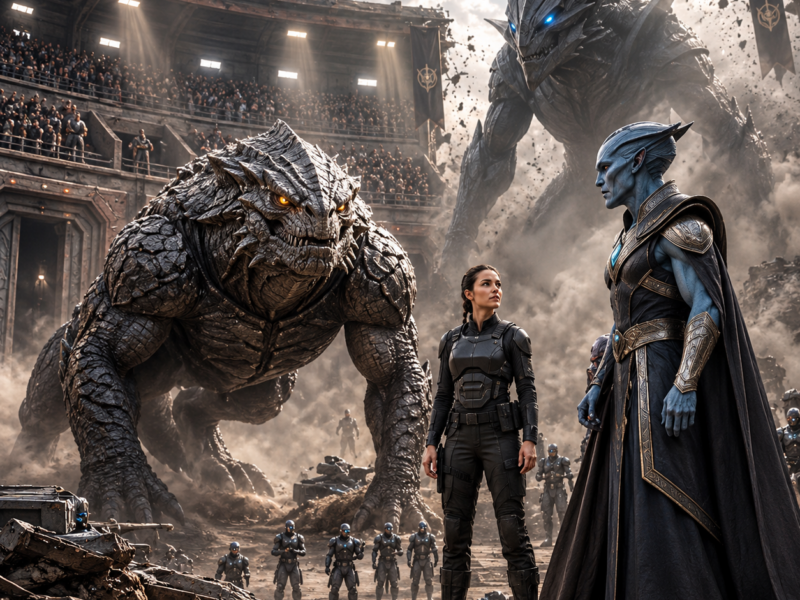
The moment the alien commander released his Apex Beast into the center of the Geneva Combat Arena, the crowd rose screaming, and when I laughed instead of running, he called me a delusional little human—because nobody there knew what was waiting beneath my old military jacket.
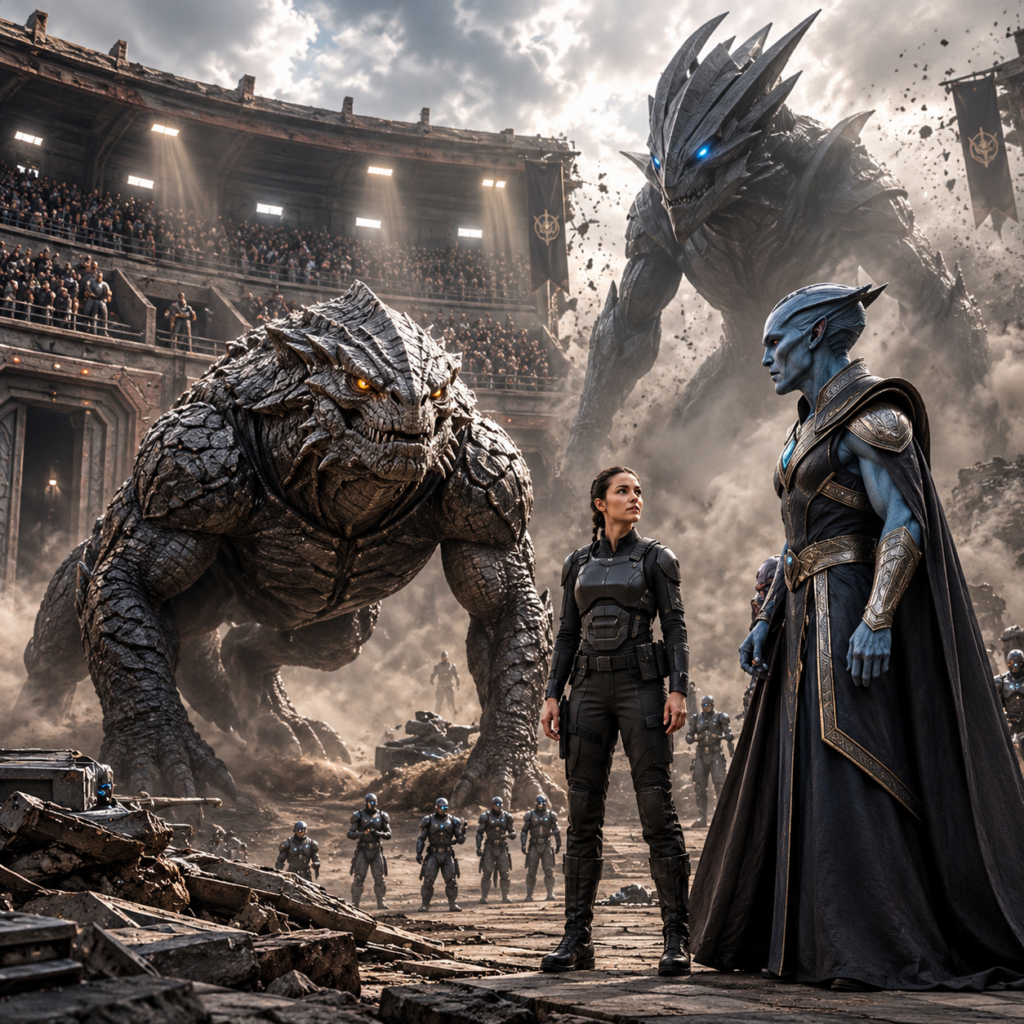
The low, vibrating rumble that rose from Mercy’s chest rattled against the reinforced floor plates.
It wasn’t the frantic snarl of a cornered stray, but a rhythmic, tectonic frequency that set the sand shivering across my boots.
Above us, behind the reinforced transparent alloy of the observation booth, Commander Vark didn’t move away.
He leaned closer, his long, segmented fingers pressing against the pane until the pressure seals flared a faint, sickly green.
Beside him stood Lieutenant Miller, the courier who had just brought down the tablet, his hand trembling so violently that the screen’s backlight cast jagged blue pulses across his collar.
“Hayes,” Miller’s voice crackled through the arena’s auxiliary audio relay, thin and reeking of panic. “Get out of the pit. You need to come up to the staging bay right now.”
I didn’t answer him.
My eyes stayed fixed on the blurred face on that small screen forty feet above me.
For eight years, the story had been carved into every war memorial from New Denver to the lunar shelters.
Corporal Julian Hayes, third squad, Seventh Orbital Infantry, found torn to pieces in the ash-fall outside Chicago while the retreat transports took off.
They told me a shock-hound had broken through the perimeter wire.
They told me they found his sidearm empty, melted by digestive acid, and that the only reason the pup beside him had survived was because the swarm was already gorged on human flesh.
I looked down at Mercy.
The thick, silver-tipped fur along her spine had begun to split, parting down the center like dry earth before an eruption.
Underneath, the skin wasn’t pale or pink; it gleamed with the dull, oil-sheen luster of dark bioluminescence, pulsing in time with the thrum of her ribs.
The Apex Beast—the twelve-foot dreadnought Vark had bred to chew through reinforced barricades—was still flattened against the bloodstained grit, its four yellow eyes rolling backward in their sockets.
It wasn’t just submitting.
It was hyperventilating, its chest plates clicking like loose shingles as it fought the instinct to vomit up its own stomach lining.
“Stand it up, Commander,” I said, my voice quiet, though the overhead arrays caught every breath. “I thought this was a demonstration of dominance.”
Vark’s throat sac dilated, a bright, defensive violet blotching beneath his grey chitin.
“Kill that mongrel,” he snarled through the comms, his voice losing its polished diplomatic cadence. “Handler unit three, activate the neural dampener on the primary unit! Now!”
High in the catwalks, two tech-sergeants in heavy vacuum gear threw a manual switch.
An arc of white-hot current snapped between two discharge pylons mounted on the arena rim, driving downward into the collar welded around the Apex Beast’s thick neck.
The animal screamed, a sound like tearing sheet metal, but instead of rising to attack Mercy, it slammed its heavy skull against the floor again and again, trying to smash the collar against the concrete to stop the agony.
Mercy took one slow step toward it.
She didn’t run.
She didn’t crouch.
She simply closed the distance, her gray pads making no sound on the grit, until her wet black nose touched the creature’s lower horn.
The electrical discharge jumping across the scales didn’t singe her whiskers; it simply dissipated, grounding into her pelt like rain soaking into shale.
The beast stopped thrashing.
Its breathing hitched, then slowed, falling into the same heavy cadence as the gray wolf standing over it.
“You didn’t find her in the ruins, did you, Elena?”
Vark’s voice had changed.
The smug arrogance of the winning empire’s viceroy was gone, replaced by the dry, clinical precision of an inspector reviewing an overdue ledger.
“You were twenty-two,” Vark continued, leaning his forehead against the viewport. “A scout sergeant with four field citations and a dead brother. You took an unregistered biological prototype from the black-site laboratory beneath Sector Four and you walked three hundred miles through an active kill-zone with it tucked inside your parka.”
“She wasn’t a prototype,” I said, my fingers sliding into the collar of my jacket, loosening the brass buttons one by one. “She was Julian’s dog.”
“She was Julian’s project,” Vark corrected. “Julian wasn’t a scout, Captain. He was our Chief Geneticist for the Eastern Hemisphere pacification effort. And he wasn’t killed by an invader. He was executed by his own department because he refused to give us the master-sequence.”
The arena felt suddenly very cold, the artificial air filters whistling through the ventilation shafts like wind through empty teeth.
Behind Vark, Miller shrank back into the shadows of the command box, clutching the tablet against his ribs like a shield.
“You’re lying,” I said, though the words tasted like iron filings in the back of my mouth.
“Look at the date-stamp on the raw telemetry, Hayes,” Vark said softly. “The Seventh Infantry didn’t retreat from Chicago. They were ordered to clean up the facility. Your brother called in the airstrike on his own installation to keep the progenitor strain from reaching our flagship. He died because he wouldn’t let us have what’s currently standing between your legs.”
I didn’t look at the tablet.
I looked at Mercy’s ears.
There was a notch in the left one, an old, jagged tear that had healed into a hard knot of cartilage years before the evacuation sirens had ever sounded over the Great Lakes.
I remembered Julian holding the lantern in our father’s basement while I cleaned that tear with warm water and iodine, both of us twelve years old, smelling of damp cedar and lake mud.
*She ran into the rosebushes again, El,* he had laughed, his knuckles bloody from pulling the thorns out of her paws. *She thinks anything that pricks her is just playing back.*
“He didn’t build her,” I said to the glass. “She was born behind the barn on County Road Nine.”
“The shell was,” Vark agreed, his mouth curling into an imitation of a human smirk that looked grotesque on his wide, mandible-framed jaw. “The biological chassis was Earth-native. Julian had a sentimental streak that proved… inconvenient for his career. But the marrow? The neural architecture? That was ours. He took the seed from our vanguard vessels and he poured it into a common earth carnivore because he thought it would make her live longer. He couldn’t bear to watch his childhood pet die of old age while the world burned down around them.”
The Apex Beast let out a small, shuddering whine, shifting its bulk until its flanks rested against Mercy’s flank.
Mercy didn’t look at it.
Her eyes, once a cloudy, milk-tinged amber from cataract scars, had cleared entirely.
They weren’t yellow anymore.
They were the deep, flat, bottomless purple of an engine exhaust, reflecting the cold light of the floodlamps like two drops of crude oil.
“He didn’t want you to have her,” Vark said. “He knew what she’d do if she ever caught the scent of her own lineage. Why do you think he hid her from the military police? Why do you think he kept you on the outer perimeter?”
The glass of the observation box creaked.
It wasn’t a loud noise, just the sharp *tink* of tempered silicate taking a stress load it wasn’t engineered to bear.
A hairline fracture, thin as a strand of cobweb, had appeared directly beneath Vark’s splayed palm.
He glanced down at it, his three-lidded eyes narrowing.
“The arena seals are locked from this console, Captain,” he said, though his hand lifted from the partition with deliberate slowness. “You cannot leave this sand. And while your… heirloom may command that beast by biological rank, she cannot command the orbital battery currently targeted on this quadrant.”
“She doesn’t have to,” I said.
I took off my jacket.
The heavy wool, stiff with salt and old diesel grease, dropped to the sand with a dull thud.
My arms were bare under the sleeveless undershirt, scarred with the faded, cross-hatched marks of twenty years of combat maneuvers, but along the inside of my left forearm, running from the wrist to the crook of the elbow, was a seam of silver wire that Julian had stitched into my skin three days before he died.
He had told me it was an emergency locator beacon.
He had told me that if I ever got separated from the regiment, I just had to press the lead into an open circuit and the rescue craft would follow the signal home.
I looked down at the Apex Beast’s collar, where the burnt wires of the neural harness were still sputtering against the dirt.
“Elena,” Miller shouted, his voice cracking entirely. “Don’t! The whole sector will flag it as an insurgent breach!”
“Julian was never good at keeping things alive, Vark,” I said, walking past Mercy until I was within reach of the twitching harness. “He tried to keep our mother alive with kidney transfers that failed. He tried to keep his squad alive with rations he stole from the officers. And he tried to keep this dog alive because she was the last thing that remembered our house before the sky turned red.”
I knelt beside the beast.
It didn’t growl.
It didn’t snap.
It merely turned its great, horned head aside, baring the soft, vascular flesh of its throat in complete, terrifying submission.
I reached out and shoved the silver wire under my skin directly into the sheared end of the high-voltage coupling.
The pain didn’t feel like burning; it felt like ice water dumped down the back of my skull.
My vision flared into a flat, blinding green, and for three seconds, the arena disappeared.
I saw the Chicago basin from fifty miles up—not as a map, but as a dense, glowing web of nerve clusters, hundreds of thousands of living signals pulsing beneath the concrete ruins, buried under five meters of slag and alien sediment where the old military silos used to be.
They weren’t dormant warheads.
They were nests.
Thousands of them, identical to the beast in the ring, identical to the ones Vark had used to sweep the southern provinces, all waiting for a single, primary pulse from the Alpha node Julian had spliced into his sister’s wrist.
*If they ever corner you, El,* Julian’s voice drifted back to me, clear as if he were sitting on the tailgate of his old Chevy with a beer between his knees, *don’t run. Just tell the pack that dinner’s ready.*
The lights across the Geneva Combat Arena died all at once.
The emergency sirens didn’t even have time to wind up to their full pitch before the main generators beneath the lake exploded with a muffled, subterranean roar that lifted the sand six inches off the ground.
The observation deck plunged into darkness, illuminated only by the faint, purple glow radiating from Mercy’s throat.
She had grown.
Not by feet or yards, but by presence—the shadows around her legs were stretching, twisting, thickening until the floor of the arena looked less like sand and more like the surface of a deep, black pond.
“Security!” Vark’s voice was stripped of all calm now, shrieking into the dead comm lines. “Full lethal response! Vent the atmosphere! Vent the whole ring!”
“The doors aren’t responding, sir!” someone screamed in the box.
A sound began outside the complex.
It wasn’t coming from the corridors.
It was coming from the lake.
Lake Geneva, frozen over with three feet of industrial ice since the winter of forty-two, was groaning.
Long, booming reports, like artillery shells cracking against stone, echoed through the drainage ducts.
Something was coming up through the intake pipes, something heavy enough to displace thousands of tons of black water, drawn toward the faint silver beacon humming against my bone.
I stood up, the pain in my arm fading into a dull, cold numbness that felt remarkably like peace.
Mercy walked past me, her shoulder brushing against my hip.
She didn’t look back at the Apex Beast, which had already scrambled to its feet, falling into line two paces behind her left flank like a well-drilled recruit.
She approached the glass of the observation deck.
Forty feet above, Commander Vark was frantically tapping at a dead terminal, his secondary arms twitching against his carapace as the glass between us began to vibrate with that same, terrible frequency.
Mercy sat down.
She looked up at him through the darkness, her head tilted slightly to the side, exactly the way she used to look at Julian when he held a piece of salt pork just out of her reach.
“Captain Hayes,” Miller’s voice came down through an unpowered acoustic pipe, thin and weeping. “Please. We didn’t know what was in the silo. They said it was just decommissioned stock.”
“It was,” I called back, my voice flat in the dead air. “My brother decommissioned it.”
Mercy opened her jaws.
The sound that came out wasn’t a bark.
It wasn’t a roar.
It was a clean, pure, harmonic tone that hit the resonant frequency of the reinforced alloy pane with the precision of a diamond-tipped drill.
The glass didn’t shatter into fragments.
It dissolved into a fine, white spray of silicate powder that drifted down through the beams of the red emergency lights like early snow over a Michigan highway.
Vark froze, his grey skin pale in the crimson glare, staring down at the floor of the pit where his invincible creation stood shoulder-to-shoulder with a three-legged Earth mutt and an underpaid scout captain with dirt on her face.
“Your terms,” Vark whispered, his mandibles clicking together in involuntary spasms. “We can… we can negotiate the territorial rights for the Northern Sector.”
I reached into my pocket, found the battered silver lighter Julian had given me for my eighteenth birthday, and flicked the wheel.
The tiny yellow flame danced between my fingers, small and fragile against the immense dark of the ruined arena.
“No terms, Commander,” I said, stepping onto the iron ladder that led up into the shattered box. “You wanted to see what an apex predator looked like when it was hungry.”
Mercy bounded upward, her claws catching the steel rungs with a heavy, rhythmic clang that sounded like the ticking of an old kitchen clock.
“You should have let the dog die,” I whispered to the empty air behind me.
And from the dark depths of the lake outside, five hundred miles of buried bone and iron began to answer.