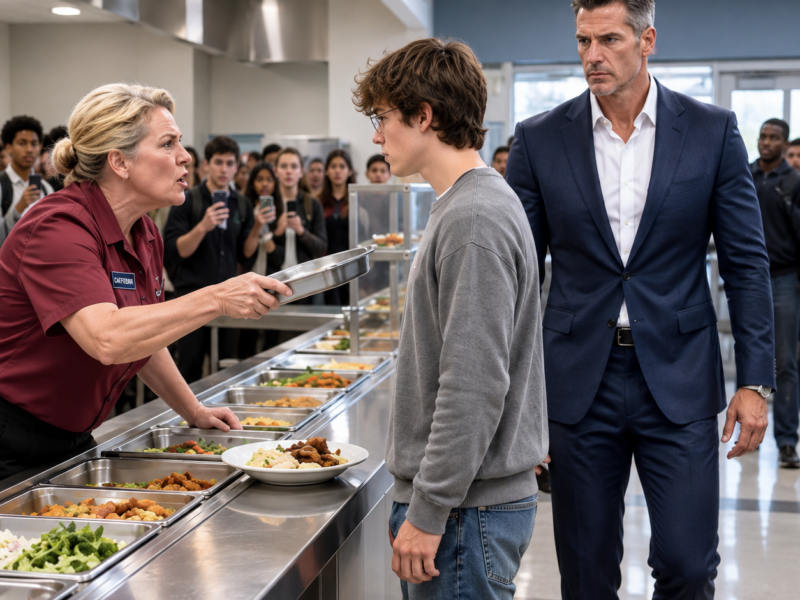
The moment I walked into my son’s school cafeteria carrying his forgotten lunchbox, dozens of children suddenly went silent, and the principal stared at me with cold suspicion before whispering, “You need to leave,” but then I heard my son say six words that made my entire world collapse.
The plastic lunchbox felt strangely light in my hand as I pushed through the heavy glass doors of Oakridge Elementary.
It was painted with bright red race cars, the corners scuffed from months of being dragged across playground concrete.
I had driven back across town during my lunch break just to deliver it, worried that my seven-year-old son would spend his afternoon hungry and distracted.
The entrance hall was quiet, smelled faintly of floor wax and floor cleaner, and echoed with the muffled sounds of distant chatter.
I took a deep breath, adjusting my jacket, and turned down the long hallway that led straight to the cafeteria.
The double doors were slightly propped open, leaking the familiar hum of clinking trays and background noise.
I smiled to myself, picturing Noah’s face when he realized I had brought his favorite apple slices.
But the second I stepped over the brass threshold into the room, the noise died.
It did not fade out slowly like a fading radio song.
It snapped off instantly, cut clean by a sudden and eerie silence.
Dozens of young faces turned in my direction, their small plastic forks hovering in midair.
Teachers stood frozen beside the long folding tables, their smiles vanishing into tight, uneasy lines.
My footsteps felt unnaturally loud as I took two steps further onto the linoleum floor.
Near the center of the room, standing beside the tray drop, was the principal, Mr. Carter.
His face was pale, his posture stiff inside his gray suit, and his eyes locked onto mine with a cold, intense suspicion.
He didn’t greet me, nor did he offer the polite smile he usually reserve for parents.
Instead, he began walking toward me with fast, hurried strides, his shoes squeaking against the polished floor.
“Mr. Bennett,” he said, his voice dropping into a tense whisper that barely carried over the silence. “You need to leave.”
I halted, holding up the bright red lunchbox between us like a peace offering.
“He forgot this on the kitchen counter,” I said, trying to keep my tone light and reasonable. “I just wanted to drop it off.”
Mr. Carter’s eyes narrowed, shifting nervously toward the rows of quiet children watching us.
“Please leave now,” he repeated, his tone firm, unyielding, and laced with an urgency that made my stomach knot.
Something was deeply wrong, a sudden shift in the air that made the hair on the back of my neck stand up.
I looked past his shoulder, searching the rows of yellow tables for my son.
Noah was sitting all the way at the far end, completely alone at a table meant for twelve kids.
His tray was untouched, his milk carton unopened.
His small shoulders were drawn tight, trembling softly under his blue hoodie.
“Buddy?” I called out, my voice cutting through the heavy stillness.
Noah didn’t look up immediately, his hands clenched tightly in his lap.
“Daniel, don’t,” Mr. Carter warned, placing a heavy hand on my arm to block my path.
I shook his hand off instantly, stepping around him with my heart beginning to hammer against my ribs.
Noah slowly lifted his head, his face pale and his eyes red-rimmed from crying silently.
He looked at me not with relief, but with a terrifying, raw dread that paralyzed me in my tracks.
Then his small, trembling lips moved, and he whispered six words that shattered everything I knew.
“Dad, don’t tell them where Mom is.”
The air left my lungs completely, leaving me breathless and cold in the middle of the crowded room.
My wife, Sarah, had been dead for three long, agonizing years.
I had sat in the waiting room of a county hospital while doctors told me her car had spun out on a slick highway.
I had identified the charred remains of her silver sedan, buried her under a cold granite stone, and wept until I had no tears left.
I had spent every single day since then rebuilding our shattered lives from the ground up, trying to be both mother and father to our boy.
I dropped the lunchbox, and the sharp crack of plastic against tile sounded like a gunshot in the silent room.
“Noah… what did you say?” I asked, my voice cracking under the weight of sudden terror.
Mr. Carter immediately stepped into my line of sight, his arms raised to block me from taking another step toward my son.
“That’s enough, Daniel,” the principal said, his voice hard, almost threatening. “You need to walk out those doors right now.”
I shoved past him, my hands shaking so violently I could barely clench them into fists.
“Where did you hear that name, Noah?” I shouted, ignoring the gasps from the teachers around us. “Who said that to you?”
Noah burst into open, terrified tears, hiding his face behind his small hands.
“She came to my classroom,” he sobbed, his chest heaving. “Before lunch.”
A cold sweat broke out across my forehead, my vision narrowing until all I could see was my weeping child.
“Who came, Noah? Tell me!”
He pulled his hands down slowly, pointing one small, trembling finger past me, toward the dark hallway I had just walked through.
“Mom,” he gasped. “She was here.”
The cafeteria seemed to rotate on its axis, the walls blurring into a mass of staring eyes and muted colors.
“That’s impossible,” I whispered, though the words barely formed on my lips. “Sarah is gone, Noah. You know she’s gone.”
Noah shook his head fiercely, wiping his wet nose with the sleeve of his hoodie.
“It was her, Dad! She had her silver key necklace, and she smelled like vanilla!”
My blood ran completely cold at the mention of the necklace.
It was a custom piece of jewelry I had given Sarah on our fifth anniversary, a small silver key with an intricate design.
It was supposed to have been destroyed in the fire three years ago along with everything else in that car.
I turned on Mr. Carter, stepping into his space until we were nose-to-nose.
“Who was in this school?” I demanded, my voice dangerously low. “Who spoke to my son?”
Mr. Carter’s composure cracked, his eyes darting toward the main office at the end of the hall.
“No one unauthorized entered the building, Mr. Bennett,” he said quickly, though his voice lacked conviction. “Your son is stressed. He’s had a difficult week.”
“Don’t lie to me!” I yelled, the anger tearing through the haze of my shock. “Look at him! He’s terrified!”
Noah slid off his bench and ran to my side, grabbing the fabric of my jeans with a desperate grip.
“She told me not to trust the principal,” Noah cried, his voice echoing off the high ceiling. “She said he was hiding her letters!”
At those words, Mr. Carter’s face drained of every last drop of color.
His jaw tightened, and for a fraction of a second, I saw genuine fear flash in his eyes.
That was the exact moment I realized this was not a child’s grief-driven delusion or an overactive imagination.
Something sinister was happening, and the man standing in front of me was right in the middle of it.
“Noah, come with me,” I said, scooping him up into my arms and holding him tight against my chest.
“You can’t take him off school grounds right now,” Mr. Carter said, stepping in front of the exit doors, his voice laced with an authoritative edge. “We have procedures—”
“Get out of my way,” I said, my voice so cold it surprised even me. “Or I swear to God I will drag you through those doors myself.”
He hesitated, reading the raw violence in my eyes, and slowly stepped aside.
Instead of leaving the building immediately, I turned left, heading straight toward the administrative office.
“Daniel, wait!” Mr. Carter called out, his footsteps rapidly trailing behind us. “You don’t know what you’re doing!”
I kicked open the wooden door to the principal’s private office and slammed it shut behind us, clicking the lock into place just as Carter rattled the handle from the outside.
“In here,” Noah whispered, pointing toward a large, dark-oak cabinet tucked behind the main desk.
“What about it, buddy?” I asked, setting him down on a chair near the door.
“That’s where she put it,” Noah said, his voice trembling again. “She pointed at it through the window while he was out of the room.”
I walked over to the cabinet and grabbed the heavy brass handle, but it was locked solid.
Desperation took over; I grabbed a heavy metal paperweight from the desk and smashed it against the cheap lock mechanism.
The wood splintered with a loud crack, and the door swung open, revealing rows of thick manila folders.
Right in the center sat a plain white envelope with no stamp, labelled with a name that made my heart freeze.
Written in faint, familiar cursive was my name: Daniel Bennett.
Outside, Mr. Carter began pounding relentlessly on the frosted glass of the office door.
“Daniel, open this door right now!” he shouted. “You’re interfering with school property! I’m calling the police!”
I ignored him entirely, my shaking hands reaching out to pull the envelope from the shelf.
Inside was a single folded sheet of stationery, accompanied by three color photographs.
I unfolded the paper, my breath hitching in my throat as I recognized the handwriting instantly.
Daniel, if you’re reading this, I am alive. But they told me you were dead.
The words on the page danced before my eyes, refusing to settle into reality.
My hands shook so violently that the photographs slipped from the envelope and scattered across the dark wood of the desk.
I forced myself to look down at them.
The first picture showed a small, sterile hospital room with gray walls and a single high window.
Lying in the bed was a woman with pale skin, dark circles under her hollow eyes, and short cut hair.
It was Sarah.
She was older, exhausted, and visibly thin, but it was undeniably her.
The second photo showed a close-up of her right wrist, clearly displaying a hospital bracelet with a recent date printed on it—just six months ago.
The third photo was taken outdoors, showing a blurry view of our city’s downtown district from inside a parked car.
My throat felt tight, as if I were drowning in dry air.
“Daniel, open this door!” Mr. Carter shouted again, the metal handle jiggling violently as he tried to force his way in. “We can talk about this! You don’t understand the full situation!”
I picked up the letter again, reading the sharp, hurried strokes of Sarah’s handwriting.
They made me believe you and Noah died in the crash, Daniel. They kept me in a facility three hours north. They told me I had nothing left to go back to.
I only found out the truth last month when I saw a news article about your company. I escaped three days ago.
Don’t trust the police. Don’t trust Carter. They were paid to keep me hidden.
I am coming for Noah.
I dropped the paper onto the desk, my head spinning with a mix of fury, horror, and an unbelievable, overwhelming hope.
Three years.
Three agonizing years I had spent mourning a woman who was sitting in a hospital room, being told that her husband and son were buried in the ground.
“Dad?” Noah’s quiet voice broke through the noise in my mind.
He was standing by the large office window that overlooked the school’s front drop-off zone and the busy street beyond.
“Dad, look,” he whispered, pointing a small finger through the blinds.
I rushed over to the window, pulling the plastic slatted blinds down with one hand.
Parked across the four-lane street, idling near a city bus stop, was a dark gray sedan.
Standing beside the passenger door was a tall woman wrapped in a heavy gray wool coat.
Her dark hair was pulled back into a simple knot, and her face was turned directly toward the principal’s window.
Even across the distance of four lanes of traffic, even through the glare of the afternoon sun, I knew that face better than my own.
It was Sarah.
My breath caught in my chest, a sob tearing at the back of my throat.
She wasn’t a ghost, and she wasn’t a memory; she was standing right there, breathing, real, and looking directly at me.
As our eyes locked through the glass, she slowly lifted one hand, pressing her palm flat against the cold air between us.
Her lips moved slowly, deliberately, enunciating three clear words through the distance.
Run with Noah.
Before I could react, the heavy glass window of the office door behind me shattered into a dozen pieces.
The sound of breaking glass shattered the quiet room like an explosion.
I threw my body over Noah, locking him beneath me as shards of frosted glass rained down onto the carpet.
A thick wooden bat jammed through the empty frame of the door, striking the internal lock until the metal handle snapped off.
The door swung wide open.
Mr. Carter stepped into the room, but he was no longer the soft-spoken, nervous school administrator I had known for two years.
Behind him stood two heavy-set men in dark industrial uniforms, their faces rigid and unreadable.
Neither of them looked like school staff, and neither carried any official badges.
“I tried to make this easy for you, Daniel,” Mr. Carter said, his voice completely devoid of its usual polite tone. “You were supposed to just drop the lunch off and leave.”
I pulled Noah up behind me, stepping between my son and the three men filling the doorway.
“Who are you?” I demanded, my hand reaching blindly behind my back for the heavy metal desk lamp. “What did you do to my wife?”
Mr. Carter took a slow step forward, stepping over the broken glass on the carpet.
“Your wife was involved in something far larger than a simple traffic accident,” he said calmly, adjusting his cuffs. “Her survival was an inconvenience. Her discovery of the truth is an active threat.”
“You kept her locked away for three years!” I shouted, my knuckle turning white as I gripped the cool brass of the lamp base.
“We protected an enterprise,” Carter corrected, his eyes cold and empty. “And now, you’re making things very complicated. Give me the file, Daniel.”
” Dad, I’m scared,” Noah whimpered, burying his face into the back of my coat.
“Hold onto my belt, buddy,” I whispered down to him, keeping my eyes locked on the two men stepping up behind the principal. “And don’t let go, no matter what.”
One of the men in uniform reached into his jacket, pulling out a dark metallic object that was definitely not a piece of school security equipment.
“Take the child,” Carter ordered, stepping back into the hallway. “We’ll handle the father in the basement.”
Panic, violent and blinding, surged through my veins.
I didn’t think; I moved on pure instinct.
I ripped the heavy brass lamp off the desk, tearing the cord straight out of the wall, and swung it with all the strength in my body.
The solid metal base struck the first man full in the chest, knocking the breath out of him with a dull thud.
He stumbled back into the hallway, colliding with the second man.
“Run!” I screamed, grabbing Noah by the wrist and yanking him through the doorway before they could recover.
We burst into the main hallway, our shoes slipping on the smooth floor as we sprinted toward the rear emergency exit.
Behind us, heavy footsteps echoed off the lockers, accompanied by the sharp shouting of men who were no longer trying to hide their intentions.
“Lock the doors!” Carter’s voice yelled down the hall. “Don’t let them reach the street!”
We sprinted past closed classroom doors, the muffled voices of teachers reading stories completely cut off from the nightmare unfolding in the corridor.
Noah was crying heavily, his small legs pumping as fast as they could to keep up with my long strides.
“Almost there, buddy!” I yelled, reaching out toward the red panic bar of the rear fire door.
I threw my entire weight against the metal bar, expecting the heavy door to burst open into the bright sunlight of the parking lot.
It didn’t move.
The metal bar depressed, but the heavy steel door remained locked tight in its frame, secured from the outside by a thick iron chain looped through the handles.
“No, no, no!” I screamed, slamming my shoulder against the heavy wood again and again.
“Dad, they’re coming!” Noah sobbed, pointing back down the hallway.
The two men in dark uniforms rounded the corner fifty feet away, their heavy boots thundering against the floor tile.
There were no other exits on this side of the building except for the service stairs leading down to the maintenance basement or up to the roof access.
I grabbed Noah under his arms, scooping him up, and ducked into the dark stairwell leading downward, slamming the heavy fire door shut behind us.
The air in the stairwell was cold, thick with the smell of rust, moisture, and old dust.
We hurried down the concrete steps into the darkness below, the sound of our ragged breathing echoing loudly off the bare concrete walls.
Above us, the fire door slammed open with a metallic bang.
“They went down!” a heavy voice shouted from the landing above. “Block the basement exit to the alley!”
I paused at the bottom of the stairs, my heart pounding like a trapped bird inside my chest.
The basement was a labyrinth of rusting pipes, old boilers, and stacks of discarded wooden desks.
Dim yellow bulbs hung from frayed cords, casting long, twisted shadows across the damp concrete floor.
I ducked behind a massive steel boiler unit, pulling Noah down into the shadows beside me.
“Listen to me, Noah,” I whispered, holding his small face between my trembling hands. “I need you to be as quiet as a mouse right now. Can you do that for me?”
He nodded slowly, tears rolling down his dust-stained cheeks, his teeth biting down hard on his lower lip to stop from crying out.
“Where is she?” I thought desperately, my mind racing back to the woman in the gray coat standing by the street. “Did she know this was going to happen?”
Footsteps slowly descended the concrete stairs, heavy and deliberate.
The metal door at the bottom clicked open, and the slow, rhythmic sound of boots on wet concrete began to move closer to our hiding spot.
“Daniel,” Mr. Carter’s voice echoed through the vast, dark space, sounding smooth and unbothered. “You can’t get out through the alley. The doors are locked from the outside.”
I pressed my back against the warm metal of the boiler, pulling Noah deeper into the shadows.
“Your wife was smart, Daniel,” Carter continued, his voice drifting closer. “She ran for three weeks before we located her. But she made one critical mistake.”
The footsteps stopped just on the other side of the boiler unit, less than ten feet from where we crouched.
“She thought she could come back for you,” Carter said softly. “She brought you right into the middle of this.”
I held my breath, every muscle in my body pulled tight as steel wire.
Noah pressed his face into my chest, his tiny fingers clutching the fabric of my shirt so hard his knuckles were white.
Through the narrow gap between the boiler and the brick wall, I could see the polished dark shoes of the principal.
He was holding a small silver device in his hand, a sleek electronic reader that hummed with a low, high-pitched frequency.
“She was an auditor, Daniel,” Carter said, his voice dropping into a conversational tone that felt terrifyingly cold. “A mid-level accountant for an international logistics firm. Do you know what happens when a mid-level accountant finds fifty million dollars moving through fake school construction accounts?”
My mind reeled as the pieces of the last three years began to crash together.
Sarah hadn’t just been in an accident; she had uncovered a massive, criminal money-laundering network operating right under our noses, disguised as public education development funds.
“She wouldn’t take the payout,” Carter continued, stepping closer to our side of the boiler. “She wanted to go to the federal prosecutors. So, we had to create a distraction. A tragic single-car collision on a wet highway.”
“You tried to kill her,” I whispered under my breath, my knuckles turning white with rage.
“We tried to erase her,” Carter corrected smoothly. “But the car caught fire before we could secure her files, and she survived. We kept her in a private medical facility, waiting for her memory to return so we could find where she hid the drive.”
He took another slow step forward, his shadow stretching long across the floor right up to my boots.
“And then today, your son brings a piece of her work to school in his backpack.”
I froze.
My eyes shot down to the bright red lunchbox lying on the floor three feet away, where I had dropped it when we ran into the basement.
It hadn’t just been a forgotten lunch.
Sarah had somehow slipped something into Noah’s bag before he left for school this morning, knowing Carter would search it if he suspected anything.
“She didn’t come to save him, Daniel,” Carter chuckled softly. “She used him as a drop point.”
A wave of confusion and shock washed over me, but before I could process the thought, a sharp, metallic screech echoed from the far end of the basement.
The heavy steel maintenance door leading out to the back alley was being forced open from the outside.
A loud, grinding noise cut through the silence as an iron crowbar bit into the metal frame.
Carter turned sharply toward the sound, his weapon raising slightly. “Who is that?”
The heavy door burst open with a deafening bang, crashing against the concrete wall.
Silhouetted against the bright daylight of the alley stood the figure in the long gray coat.
She didn’t hesitate for a single second.
She raised a heavy crimson fire extinguisher in her hands and pulled the safety pin.
A blinding cloud of white chemical powder erupted into the dark basement, expanding instantly into a thick, suffocating fog.
“Get down!” I yelled, pulling Noah flat against the floor as the cloud washed over us.
Shouts and heavy coughing echoed through the thick dust as Carter and his men were instantly blinded by the dense plume.
Through the white haze, a firm, warm hand grabbed my jacket sleeve with incredible strength.
“Daniel! Noah! Move!”
The voice was rough, choked with emotion, but I would have recognized it anywhere in the universe.
I looked up through the stinging dust into the face of my wife.
She had a deep scar running along her hairline, her skin was pale, and her eyes were fierce, filled with a wild, desperate energy I had never seen before.
“Sarah!” I gasped, the word tearing out of my throat.
She didn’t waste time on a greeting; she pulled Noah into her arms, wrapping him tightly against her chest, and yanked me toward the open alley door.
“Run! Out the back!” she screamed over the sound of Carter coughing and shouting in the fog behind us.
We burst out of the dark basement into the blinding glare of the afternoon sun, stumbling into the narrow concrete alley behind the school.
Waiting at the end of the brick corridor was a dented yellow delivery van, its engine idling with a loud, rough rattle.
“Get in the back!” Sarah urged, pushing Noah through the sliding side door before scrambling in right behind him.
I leaped into the back cargo area, slamming the heavy sliding door shut just as Carter’s two men burst out of the basement exit, weapons raised.
The van hit the gas before my door was even latched, the tires screaming against the asphalt as we lurched forward into the main street traffic.
I fell backward against a stack of wooden crates, my chest heaving, my heart hammering like a trapped drum.
Noah was sobbing, buried deep in his mother’s arms, his small hands clutching the lapels of her gray wool coat as if he were afraid she would dissolve into smoke.
Sarah held him tightly, her face pressed into his hair, tears streaming silently down her pale cheeks as she kissed the top of his head over and over again.
“I’m sorry,” she wept softly, her voice shaking violently. “I’m so sorry, my baby. I’m so sorry.”
I dragged myself up onto my knees, my mind completely fractured by the absurdity and raw emotion of the moment.
I reached out a trembling hand, touching her face, feeling the warmth of her skin, the real, solid reality of her presence.
“Sarah… is it really you?” I whispered, tears filling my own eyes.
She looked up from Noah, her green eyes locking onto mine with an intensity that made the world around us disappear.
“It’s me, Daniel,” she said, her voice dropping into a desperate whisper. “I swear to you, it’s me.”
“How?” I choked out, a wave of three years of grief crashing into me all at once. “They said you were dead. I buried a body…”
“It wasn’t me in that car,” she said, her expression darkening with a cold, sharp horror. “They set the crash up, but I wasn’t in the vehicle when it burned. They snatched me off the shoulder before the fire hit.”
“Why didn’t you come home?” I demanded, the confusion turning into a sharp, painful ache. “Why did you leave us alone for three years?”
Sarah looked down at the floor of the van, a tear landing on the worn canvas of her coat.
“Because if I came back to you,” she said softly, “they said they would kill you both.”
The van swerved sharply around a corner, throwing us all against the metal side wall of the cargo area.
Up front, the driver was a dark-haired man with a thick beard who kept his eyes glued to the side mirrors.
“We’ve got two cars behind us,” he called back through the partition window. “Black SUVs. They were parked two blocks down waiting for the ping.”
Sarah looked up, her face setting into a hard, determined mask that looked completely foreign to the gentle woman I had married.
“Did you get it out of the lunchbox?” she asked me suddenly.
I reached down to my coat pocket, pulling out the small white envelope I had grabbed from Carter’s office cabinet.
“I have the letters,” I said, holding them out. “And the photos from the medical facility.”
“Not that,” she said, reaching over to Noah’s small red lunchbox, which had somehow stayed clutched in my left hand through the entire escape.
She popped open the plastic latch and pulled out the top thermos layer.
Underneath the plastic divider, taped to the bottom of the insulating foam, was a sleek, silver micro-USB flash drive no bigger than a fingernail.
“This is the entire financial trail,” Sarah said, holding the tiny piece of plastic between her fingers. “Every shell company, every corrupt official, every offshore account Carter used to move their money.”
“Is that why they kept you locked up?” I asked, watching her carefully. “To get this?”
“They thought I hid the physical server keys in our old house before the crash,” she explained, her voice tight. “I let them believe that for three years while I recovered my strength, waiting for a chance to break out of that facility.”
“Why did you contact Noah at the school today?” I asked, my voice rising slightly as the anger fought through my shock. “You put him right in the middle of a war zone, Sarah! He was terrified!”
She looked at me, her eyes brimming with a terrible, desperate grief.
“I had no choice, Daniel,” she whispered. “Carter found out I escaped three days ago. He sent men to our house this morning, but you had already left for work. I knew he was going to the school to secure Noah as leverage against me.”
I went cold. “He was going to kidnap our son?”
“He was going to take him before you even knew I was alive,” she said, grabbing my hand and squeezing it with a terrifying force. “I had to get to the school first. I had to plant the drive in his bag and leave that note in Carter’s office to force Carter to reveal himself to you.”
“You used us as bait,” I said, the realization sinking in like a cold stone in my gut.
“I used myself as bait to draw them away from you,” she corrected fiercely. “I knew if Carter was focused on hiding his paper trail from you in that office, he wouldn’t look out the window until my team arrived.”
“Your team?” I looked up at the driver in the front seat. “Who are these people, Sarah?”
Before she could answer, a loud, metallic smash echoed through the floorboards as a heavy bumper slammed into the back of our van.
The vehicle fishtailed violently across the asphalt, the engine roaring as the driver fought to keep control.
Through the rear windows, the dark grille of a massive black SUV was less than three feet from our bumper.
“Hold on!” the driver yelled from the front, turning the steering wheel hard to the left.
The van skidded sideways down a quiet industrial strip, the tires smoking against the hot road surface.
The black SUV rammed us a second time, shattering the rear windows and showering the cargo area with dark glass shards.
Noah screamed, burying his head beneath my arm as I threw myself over both him and Sarah.
“We can’t outrun them in this heavy rig!” the driver shouted back. “They’ve got more power!”
Sarah pulled a heavy black radio from her coat pocket, clicking the side button with her thumb.
“Unit Two, this is Sarah,” she said, her voice calm, precise, and completely controlled. “We are on Industrial Parkway heading north. Execute the block now.”
“Copy that, Unit Two moving,” a deep voice crackled back through the radio speaker.
Two seconds later, a massive red dump truck pulled out from a side driveway fifty yards ahead, blocking all three lanes of the industrial road completely.
The yellow delivery van slammed on its brakes, skidding to a halt just inches from the dump truck’s heavy steel side.
Behind us, the black SUV tried to swerve to avoid us, but it was moving too fast.
It hit the curb at fifty miles an hour, flipping onto its side with a deafening screech of grinding metal and throwing a shower of sparks fifty feet into the air.
It slid to a halt on its roof, steam and smoke pouring out from beneath the crushed hood.
Silence fell over the street, broken only by the ticking of our van’s hot engine and the sound of our heavy breathing.
“Is everyone okay?” the driver asked, turning around in his seat.
“We’re fine,” Sarah said, her voice dropping into a low sigh as the adrenaline began to bleed away.
She turned to look at me, her eyes searching my face for something she seemed afraid she wouldn’t find.
“Daniel… I know you have a thousand questions,” she whispered, her hands trembling as she reached for mine. “I know you think I’m a monster for dragging you into this.”
I looked at the woman sitting in front of me.
She wasn’t the quiet, mild-mannered accountant I had said goodbye to three years ago on a rainy morning.
She was someone who had survived three years of captivity, built an underground network, organized an escape, and saved our son from a crew of dangerous criminals.
“I don’t think you’re a monster,” I said, my voice thick with emotion as I pulled her close, wrapping my arms around her and our son together. “I just thought I was never going to see you again.”
She broke down, leaning her forehead against my neck, her whole body shaking as three years of held-back terror finally spilled out in tears.
“It’s over now,” she sobbed. “The federal task force is raiding Carter’s office right now. The files on that drive are already uploading to the Justice Department.”
I held her tight, watching the smoke rise from the overturned car in the street behind us.
“Is it really over?” I asked softly.
She pulled back slightly, her eyes meeting mine with a quiet, solemn intensity.
“It’s over for them,” she said, holding the tiny flash drive up between us. “But we have a lot of years to make up for.”
An hour later, we were sitting in the back of a unmarked federal command vehicle parked three blocks from the school.
Red and blue light bars flashed silently against the brick walls of the surrounding buildings, reflecting off the damp asphalt.
Uniformed officers were carrying boxes of files out of Oakridge Elementary, loading them into the back of armored transport trucks.
I watched through the tinting of the rear window as Mr. Carter was led out of the building in handcuffs, his expensive suit rumpled, his head hung low in defeat.
Noah was fast asleep on the bench seat beside us, exhausted by the day’s terror, wrapped tightly in a thick wool blanket provided by the paramedics.
Sarah sat right beside him, her fingers gently stroking his hair, her eyes never leaving his face for more than a few seconds.
“The federal prosecutor just verified the drive,” a tall woman in a dark suit said, leaning into the open side door of the van. “It’s all here. Every account, every bribe, every name involved in the facility where they held you.”
Sarah looked up, nodding slowly. “How many people were involved?”
“Dozens,” the prosecutor replied, her face grim. “Including three high-ranking members of the regional school board. They were using the school system as a front for a massive offshore tax evasion operation.”
She looked at me, her expression softening slightly.
“Mr. Bennett, your family is going to be under federal protection for the next few weeks until the indictments are unsealed. But the threat is neutralized.”
“Thank you,” I said softly, my hand finding Sarah’s under the heavy blanket.
The prosecutor smiled gently, closed the door, and walked back toward the bustling scene outside the school.
The interior of the vehicle fell quiet again, save for the soft, rhythmic sound of Noah’s breathing.
“I kept every single birthday card you made for me,” Sarah whispered suddenly, looking down at her hands. “In that hospital room. I drew pictures of our old kitchen on the back of paper towels so I wouldn’t forget what home looked like.”
I reached over, gently pulling her closer until her head rested against my shoulder, just like it used to on quiet Sunday afternoons.
“You don’t have to draw pictures anymore,” I said, my voice steady and warm. “Home is right here.”
She closed her eyes, letting out a long, shuddering breath that seemed to carry away the weight of three long years in the dark.
Outside, the afternoon sun began to dip below the horizon, painting the sky in deep shades of gold and purple.
The city was returning to its normal rhythm, but inside the small, dark space of the transport van, our world had been completely rebuilt from the ashes of a tragic lie.
Two weeks later, the morning air was crisp and fresh as I stood on the porch of a small, sunlit house near the coast.
The federal protection detail had relocated us to a safe facility while the final court proceedings took place in the city.
The ocean waves crashed gently against the rocky shoreline a few hundred yards away, sending a cool mist drifting through the pine trees.
Behind me, the screen door creaked open softly.
Noah stepped out onto the wooden deck, carrying his bright red race car lunchbox in one hand and a half-eaten slice of toast in the other.
“Dad?” he called out, shielding his eyes from the bright morning sun. “Is Mom almost done packing?”
“She’s just getting the last of the bags, buddy,” I said, smiling down at him as I bent to adjust his jacket collar. “How are you feeling today?”
He looked down at the lunchbox in his hand, a small, thoughtful frown appearing on his face before turning into a wide, bright smile.
“I like this school better,” he said simply. “The principal here smiles.”
I laughed softly, pulling him into a quick hug just as Sarah stepped out onto the deck behind us.
She was wearing a simple blue sweater, her dark hair glowing in the morning light, her face full of color and life for the first time in three years.
She looked at us, her eyes sparkling with a bright, beautiful hope that made all the lingering shadows of the past month fade into nothingness.
“Ready for your first day at the new school, Noah?” she asked, walking over and kneeling down beside him.
“Yep!” Noah nodded eagerly, holding up his lunchbox. “And I checked it three times. There are no secret drives in here today, just peanut butter sandwiches.”
Sarah laughed, a clear, ringing sound that filled the cool morning air, and pressed a soft kiss to his cheek.
“Good,” she whispered, looking up at me with tears of pure joy shining in her eyes. “Because we’re done with secrets.”
I reached down, taking her hand in mine, feeling the solid, unbreakable warmth of the family we had fought so hard to rebuild.
As we walked down the wooden steps toward the car together, the sun broke fully over the blue horizon, burning away the last of the morning fog and lighting the long, open road ahead of us.