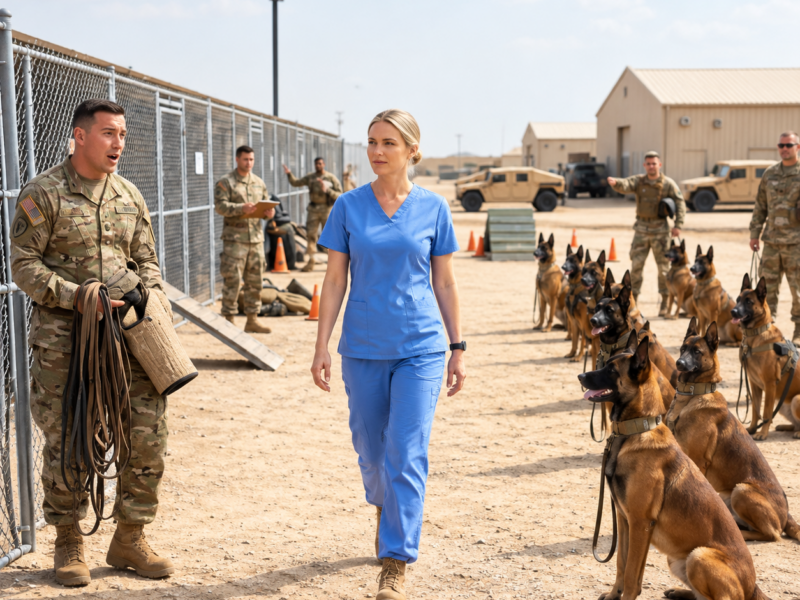
The kennel master laughed when I dropped the leash at Fort Liberty’s training field and told everyone I would never control a military K9, but the dog suddenly ignored his commands, pressed its nose against my hand, and exposed a secret I had spent ten years trying to bury.
The morning mist hung heavy over Fort Liberty’s tactical training grounds, clinging to the damp clay and the tall pine needles like gauze.
I stood near the edge of the chain-link fence, adjusting the strap of my civilian medical bag until the nylon bit into my collarbone.
To everyone watching from the bleachers, I was just Nora Hall, a thirty-two-year-old trauma nurse from Womack Army Medical Center sent to monitor heat vitals.
They saw sensible rubber-soled shoes, sterile nitrile gloves poking from a canvas pocket, and eyes that kept low to avoid notice.
Kennel Master Sergeant Marcus Cole was running the morning drills with the sharp, merciless cadence of a man who believed the world yielded only to force.
He unclipped a seventy-five-pound Belgian Malinois with a coat like scorched copper and a chest built for shattering ribs.
“Pay attention to the civilian, boys,” Cole yelled, his voice echoing across the perimeter gravel.
“She thinks a field bandage cures fear.”
The junior handlers near the shade canopy chuckled on cue, eager to stay on their sergeant’s good side.
I adjusted my grip on my clipboard, feeling the cold metal press against my knuckles, and kept my mouth closed.
“Nurses freeze the second teeth show,” Cole said, stepping directly in front of me with the leather lead dangling loose in his calloused fingers.
“Take the leash, Nurse Hall. Let’s see if your bedside manner holds up against eighty pounds of pure kinetic energy.”
I hesitated, intentionally allowing my fingers to tremble just enough to satisfy his expectations.
When he shoved the looped leather into my hand, I intentionally let it slip.
The heavy brass clasp hit the gravel with a hollow clatter.
Cole let out a booming laugh, throwing his head back toward the pale sky.
“Just like I said. You wouldn’t last thirty seconds out here.”
Before the handlers could finish their laugh, the dog broke.
Ranger surged forward, his hind legs throwing red dirt three feet into the humid air.
“Ranger, halt!” Cole bellowed, the laughter dying in his throat like a snuffed match.
The Malinois didn’t hesitate, his ears flat, his dark eyes locked entirely on my face.
Shouts erupted down the perimeter line as three handlers reached instinctively for their sidearms and bite sticks.
I didn’t flinch.
My pulse slowed to a cold, steady thrum that belonged to an entirely different lifetime.
Ranger closed the distance in half a second, his paws churning the dirt, coming straight for my throat.
Then, six inches from my boots, his momentum died.
He slid into a textbook tactical sit, his front paws squared, his chest rising and falling against my shins.
The entire training yard fell dead silent.
Nobody breathed.
Cole took two slow, rigid steps forward, his hand hovering over his utility belt.
“Ranger, heel,” Cole commanded, his voice tight and defensive.
The dog didn’t even twitch an ear.
Instead, Ranger leaned into my right knee, tilted his broad muzzle upward, and pressed his damp nose firmly against the palm of my hand.
A quiet shock ran straight through my chest, cold and electric.
“Do it again,” Cole ordered under his breath, glaring at the dog as if he had been betrayed by his own flesh and blood.
“Ranger, break! Heel!”
Ranger remained anchored to my leg, his amber eyes searching mine with an intensity that made the hair on the back of my arms stand up.
I slowly crouched down, letting my knees sink into the damp grass, and laid my bare palm against the thick ridge of his shoulder muscles.
Underneath my fingers, his shallow, agitated breathing softened into a rhythmic, steady sigh.
Cole looked around at his subordinates, his jaw working as his face darkened with embarrassment.
“Maybe he smells your fear,” Cole muttered, trying to reclaim the room. “Sometimes the volatile ones track weakness.”
I looked up at him through the humid haze.
“He doesn’t smell weakness, Sergeant.”
“Then what is he doing, Nurse?”
Before I could answer, the dog rose to his feet, turned toward the dense pine line behind the obstacle course, and let out a single, low whine that vibrated through my ribs.
The midday sun burned away the fog, leaving the North Carolina air thick, sweltering, and tasting of pine sap and exhaust.
Cole had ordered the second phase of the evaluation: a simulated explosives detection sweep through the abandoned mock village on Range Four.
The village was a cluster of weather-beaten cinderblock buildings, meant to mimic foreign outposts, their window frames empty and gaping like open wounds.
Ranger was supposed to run a standard zigzag grid across the courtyard, searching for planted scent canisters.
Instead, the moment Cole unclipped the lead, Ranger ignored the perimeter cones completely.
He sprinted past the mock market stalls, past the burned-out vehicle chassis, and headed straight for the old munitions storehouse at the far edge of the tree line.
“What is wrong with this animal today?” Cole shouted, breaking into a sprint across the hard-packed gravel.
“Ranger, out! Return!”
Ranger didn’t turn.
I abandoned the medic table, my boots pounding rhythmically against the dirt, keeping pace twenty yards behind Cole.
“Stay back, Hall!” Cole barked over his shoulder without breaking stride. “That building isn’t cleared for civilians!”
I didn’t answer him.
My eyes were glued to the way Ranger moved: his tail held low, his head swaying in short, methodical arcs, checking high corners before low ones.
That wasn’t the sweep pattern of a detection dog.
It was the sweeping pattern of a combat search-and-rescue point dog trained for structural collapse.
Ranger hit the rusted metal door of the storehouse with his shoulder, forcing it open against its hinges with a loud screech.
The inside was dim, smelling of mildew, dry rot, and old hydraulic fluid.
By the time Cole and I stepped through the door frame, Ranger was already in the far corner, his front paws scratching frantically against the bottom drawer of an olive-drab steel storage cabinet.
“Down! Ranger, down!” Cole reached for the dog’s harness, but Ranger bared his teeth just enough to issue a sharp warning click of his jaws.
Cole recoiled, genuinely startled.
“He’s never snapped at a handler in two years of service,” Cole whispered, his hand resting on his holster.
“Step back, Sergeant,” I said quietly.
My voice had shifted without my permission, losing its timid, civilian softness and carrying the quiet, indisputable weight of an operator on point.
Cole glanced at me, his eyes narrowing in suspicion.
“Excuse me?”
“Move away from him,” I repeated, stepping directly between Cole and the agitated dog.
Ranger immediately leaned against my hip, his tail giving two slow thumps against the floor.
I knelt by the steel cabinet and grabbed the rusted latch.
It was secured with an old brass padlock, but the latch hasp was loose from years of neglect.
I braced my heel against the bottom frame and pulled with both hands until the rusted screws tore out of the dry pine backing with a splintering crunch.
Inside the drawer lay a weathered canvas go-bag, gray with a decade of dust, and an unsealed manila folder curled at the edges.
Cole hovered over my shoulder, his breathing heavy.
“That’s base property from the old detachment. You can’t touch that.”
I ignored him and lifted the folder.
Inside was a single laminated photograph, stained by moisture along the corners.
The image showed three military working dogs standing in the bed of an open truck in the dry mountain dirt of the Helmand Province.
Kneeling in front of them was a twenty-two-year-old woman in desert digital camouflage, her sleeves rolled up, tactical goggles resting on her helmet, and a dog collar wrapped twice around her left wrist like a bracelet.
She had dirt smeared across her cheekbone and a quiet, unyielding focus in her eyes.
The woman was me.
Cole stared over my shoulder at the photograph, then looked down at my face, his mouth slightly open.
The color drained from his weathered cheeks.
“You were a handler?” he asked, the arrogance completely gone from his tone.
I felt my throat tighten until it felt like raw iron.
“A lifetime ago.”
“Who gave you this assignment? Why are you here as a nurse?”
I didn’t answer his questions because my attention had fallen to the handwritten grease-pencil note on the back of the photograph.
Beneath the date of October 14, 2016, a single word had been scrawled in faded black ink: Atlas.
My vision blurred at the edges as my fingers began to tremble against the slick laminate.
Ranger let out another low, mournful whine and turned his head toward the open doorway behind us.
The floorboards near the entrance groaned.
A tall figure stepped out of the blinding sunlight and into the shadowed room, blocking the only exit.
The man wore a faded M-65 field coat, despite the oppressive midday heat, with no rank insignias and no name tape across the chest.
His hair was iron-gray, cut down to the scalp, and his right arm hung slightly stiff at his side, the sleeve pinned back at the wrist.
His eyes were gray, weathered by years of sandstorms and sleepless watches, and they settled on my face with an unsettling intensity.
“You haven’t changed much, Vance,” the man said.
His voice was like gravel churning under a heavy tire.
I stood up slowly, the photograph clutched tightly in my hand, my heart hammering against my ribs so hard it made my chest ache.
Nobody had called me Vance in nearly ten years.
To the hospital staff, to the military doctors, to the entire civilian register in Raleigh, I was Nora Hall.
Elena Vance was a ghost listed on a medical retirement sheet filed away in a basement in St. Louis.
Cole immediately squared his shoulders, reaching toward his duty belt.
“Identify yourself. This range is active and restricted to authorized personnel.”
The older man didn’t even look at Cole.
He reached into his pocket with his left hand, pulled out a laminated black identification badge, and held it out without a word.
Cole squinted at it, stiffened suddenly, and dropped his hand from his sidearm.
“Command Sergeant Major Miller,” Cole stammered. “I didn’t know… nobody informed us there was an inspection.”
“It’s not an inspection, Sergeant,” Miller said, keeping his eyes locked entirely on me.
“Leave us.”
Cole hesitated, glancing between me, the dog, and the mysterious visitor.
“Sergeant Major, that dog is currently under my command, and this civilian—”
“Take a walk, Marcus,” Miller interrupted, his tone dropping an octave into pure command.
“And close the exterior gate on your way out.”
Cole swallowed hard, gave a stiff nod, and backed out of the doorway.
His boots crunched rapidly across the gravel until the sound faded into the distant hum of highway traffic beyond the base boundary.
The room grew suffocatingly quiet, save for the panting of Ranger, who was now sitting directly between Miller and me.
Miller stepped forward, his boots making no sound on the dusty concrete.
“You did a good job disappearing, Elena. Five years in Germany, four years in Atlanta, and then tucked away in the trauma ward at Womack.”
“I wasn’t hiding,” I said, my voice shaking despite my best efforts to steady it.
“You walked away from your pension, your decorations, and your team,” Miller replied.
“I buried my partner,” I spat back, the old venom rising to the surface before I could stop it.
“I left because there was nothing left to bring home.”
Miller reached into his field coat and pulled out an object wrapped in a torn strip of faded OD-green parachute cord.
He held it out across the dim space between us.
“You left because you believed what they wrote in the after-action report.”
“I was there, Miller,” I whispered, stepping back until my calves hit the steel cabinet.
“I was trapped under three tons of collapsed masonry in the Sangin valley. I felt the shockwave tear the breath out of my lungs. I listened to Atlas dig until his paws were down to the bone.”
Tears, hot and long-buried, burned behind my eyelids.
“And then the second charge detonated. I woke up on a MEDEVAC bird bound for Landstuhl. They told me David was gone, and they told me Atlas was killed in the secondary blast.”
Miller unwrapped the parachute cord with his left hand and let the heavy object drop into my open palm.
It was an old, scarred nylon collar, scorched along the edges, its brass D-ring warped by heat.
Riveted to the center was a stamped metal plate.
K9-4412. ATLAS.
Beneath the service number was a second date, crudely scratched into the brass with a knife tip: NOVEMBER 12, 2018.
Two full years after the explosion that supposedly took his life.
“Your dog didn’t die in Sangin,” Miller said softly.
I couldn’t draw a breath.
The air in my lungs felt like broken glass.
“What did you do?” I whispered.
“Atlas survived the second blast,” Miller said. “He dug David out before the ceiling came down completely.”
My vision swam.
“David died on that mountain.”
“David was captured,” Miller said. “And the dog stayed with him.”
Bloodlines and Broken Promises
The silence in the storehouse was so heavy I could hear the dry leaves scraping across the metal threshold outside.
My fingers curled around the scarred brass collar, the jagged metal edges biting deep into my skin until I could feel my own pulse against the plate.
“David was taken?”
The words came out as barely more than an exhale.
For ten years, I had carried the memory of David Miller—no relation to the Sergeant Major, just an unlucky boy from Ohio who loved classic cars and bad coffee—as a closed chapter of grief.
I had visited his mother in Columbus.
I had stood in front of an empty casket draped in an American flag while an honor guard fired three volleys into a gray autumn sky.
“The unit was operating off the grid,” Miller explained, his face cast in deep shadow.
“Special Operations Command couldn’t acknowledge the cross-border footprint without sparking a diplomatic catastrophe. When the safe house went down, the official record was sealed.”
“You let his mother bury an empty box,” I said, fury surging through the numbness.
“We traded for him fourteen months later,” Miller said without flinching.
“Fourteen months in a hole in the mountains. By the time we pulled him out, he had lost seventy pounds and half his teeth, but he was breathing.”
“And Atlas?”
My voice broke completely on the name.
Atlas had been my shadow, my protector, the only living soul who could sense my panic attacks before they even registered behind my eyes.
When you spend three years sleeping on dirt floors with eighty pounds of muscle pressed against your back, your heart rhythms synchronize.
Miller nodded toward the dog sitting at my feet.
“Atlas was retired to the breeding facility at Lackland. His hips were shot from the blast concussions, and his left ear was deaf, but his working drive was intact.”
I looked down at Ranger.
The dog looked up at me, his head tilted at an angle that sent an icy shiver down my spine.
“This is his pup,” I said, the realization falling into place.
“Atlas’s last litter,” Miller confirmed.
“Every other dog from that line was assigned to conventional patrol, but Ranger failed every standard obedience test in the inventory. He washed out of two regional commands.”
“Why?”
“Because he wouldn’t bond,” Miller said.
“The trainers thought he was dull, stubborn, or broken. Cole spent six months trying to break his will with prong collars and isolation drills.”
Miller stepped closer, his boots finally touching the patch of light near the metal cabinet.
“Ranger wasn’t broken, Elena. He was waiting.”
“Dogs don’t hold memories through generations,” I argued, shaking my head, trying to preserve some thread of logic.
“That’s romantic nonsense. Scent memory doesn’t pass down through bloodlines.”
“Maybe not,” Miller said.
“But handler techniques do. The way you stand. The cadence of your breath when you drop into a ready stance. The scent of the sulfur-based liniment you used to rub into Atlas’s shoulders every night after a fourteen-mile patrol.”
I froze.
I instinctively reached into my pocket and touched the small glass vial of herbal arnica salve I still carried for my own arthritic wrists.
I had used it this morning before heading to the range.
“He knew you before you even touched the leash,” Miller said.
“He’s been looking for the person who built his sire.”
Ranger stood up, rested his chin on my forearm, and let out a soft, deep rumble in his chest that sounded identical to the sound Atlas used to make when we sat on the runway in Bagram waiting for the dawn bird.
I buried my face in Ranger’s coarse fur, the scent of dust, cedar shavings, and clean canine warmth washing over me.
Ten years of carefully constructed walls collapsed in three seconds.
“Why are you here, Miller?” I asked, wiping my eyes with the back of my hand.
“You didn’t drive out to Fort Liberty just to deliver an old collar and give me a family reunion.”
Miller’s face grew cold again, the brief flash of warmth disappearing behind a mask of operational steel.
“David didn’t stay in Ohio after the trade,” Miller said.
“He couldn’t adjust to civilian life. He went private, taking overseas security contracts through third-party firms in DC.”
My stomach dropped into freefall.
“Where is he?”
“Three days ago, a transport convoy went missing in the mountains two hours west of here, off the federal reservation boundary,” Miller said.
“David was running point.”
The interior of Miller’s unmarked Chevy Suburban was lined with secure tactical radios, surveillance monitors, and hard-shell gear cases.
Ranger sat between the front bucket seats, his chin resting comfortably on the center console, his eyes scanning the tree-lined highway as the wipers beat away a sudden summer rainstorm.
“A convoy disappeared two hours from Fort Liberty?” I asked, leaning forward from the back seat.
“This isn’t the Hindu Kush, Miller. This is North Carolina.”
Miller steered with his left hand, his face lit by the green glow of the encrypted dashboard monitor.
“The Department of Energy runs classified materials transfers through the Pisgah National Forest along old logging routes,” he said.
“Specialized couriers. No markings, no escorts, completely low profile. David’s company was hired for perimeter route security.”
“What were they moving?”
“You don’t need to know that,” Miller said flatly.
“I’m not an active soldier anymore,” I retorted, leaning closer to his ear.
“If you want me to help you track your ghost, you don’t get to feed me redacted briefing slides. What was in the trucks?”
Miller was quiet for three miles, the hum of the mud tires loud against the wet asphalt.
“Experimental guidance telemetry for tactical warheads,” he finally said.
“Stolen from a contractor facility outside Charlotte. A rogue paramilitary group ambushed the convoy in the gorge during the thunderstorm on Tuesday night.”
“And David?”
“His truck was pushed over the ridge into the ravine,” Miller said.
“The state police found two drivers dead at the scene, shot point-blank. David wasn’t in the cab. There was a blood trail leading up the drainage culvert toward the old copper mines.”
I looked down at Ranger, whose ears perked at the sound of Miller’s voice.
“Why haven’t you sent in the Hostage Rescue Team? Why haven’t you flooded the mountain with federal marshals?”
“Because the people who took that convoy have an inside tap on the state tactical network,” Miller replied, his knuckles whitening on the wheel.
“The moment federal frequencies light up, the ambush team moves the package across state lines and executes any survivors. The only way in is quiet, off-grid, and from the ground.”
“You want Ranger to track him.”
“Ranger won’t track for anyone at the kennel,” Miller said.
“You saw him. He’d tear Cole’s throat out before he worked a cold mountain trail under pressure.”
“And you think he’ll work for me?”
“He’s already working for you,” Miller said, nodding toward the dog.
Ranger had shifted his body, curling his front paws around my knee, his dark eyes watching me with steady patience.
An hour later, the pavement gave way to rutted red clay, and the Suburban climbed steeply into the dense, rain-soaked shadows of the Blue Ridge mountains.
The trees grew thicker, hemlocks and mountain laurels closing in over the trail like a vaulted ceiling, blocking out the gray afternoon light.
Miller pulled the truck into a concealed turn-off behind an abandoned forestry service shed and cut the engine.
The sudden silence was deafening, broken only by the steady drumming of raindrops on the metal roof.
I opened my medical kit and transferred the trauma supplies into a lightweight tactical vest Miller handed me from the cargo area.
Hemostatic gauze, chest seals, morphine auto-injectors, IV catheters.
My hands worked on pure muscle memory, checking expiration dates and packing shears into MOLLE webbing without needing to think.
Miller buckled a tracking harness onto Ranger, who stood completely motionless, accepting the gear with quiet professionalism.
I clipped a ten-foot nylon lead to the dorsal ring, took a deep breath of the cold mountain air, and looked at Miller.
“Give me his scent article,” I said.
Miller reached into an airtight plastic pouch and pulled out an old green watch cap, stained with sweat and faded at the brim.
I held the cap out to Ranger.
“Ranger, check.”
The dog buried his muzzle into the wool, his nostrils flaring as he took three deep, deliberate scent draws.
His head jerked up toward the steep, rhododendron-choked ridge above the shed.
His tail went rigid.
A single, sharp breath whistled through his nostrils.
“Find,” I whispered.
Ranger lunged into the brush, tearing through the wet undergrowth with silent, terrifying speed, pulling me up into the darkening forest.
The mountain rose at a brutal forty-five-degree angle, slick with rotting oak leaves and red mud that gave way under every third step.
Ranger moved like a ghost through the dense thicket, never barking, never snapping branches, his body low to the earth as he followed a scent trail that was already forty-eight hours old.
Miller followed twenty paces behind us, moving with surprising agility for a man carrying thirty years of shrapnel and a pinned wrist.
He carried a suppressed carbine low across his chest, his eyes scanning the ridgeline for movement.
The rain turned into a cold, persistent drizzle that clung to my eyelashes and ran down the back of my neck.
My lungs burned with the altitude, but the old adrenaline—the cold, chemical clarity that kept me alive through three combat deployments—had taken full possession of my mind.
Every sense was dialed to maximum.
The snap of a twig fifty yards away.
The direction of the wind blowing downhill from the northwest, carrying the faint, unmistakable odor of woodsmoke and wet canvas.
Ranger suddenly dropped his chest to the dirt, sliding behind a massive moss-covered boulder.
I dropped beside him, one hand resting on his flank, feeling the rapid, controlled vibration of his ribs.
Miller slid in behind us, his rifle already up, the muzzle pointing toward a natural rock shelf thirty yards ahead.
“What do you have?” Miller breathed into my ear.
“Fresh disturbance,” I whispered, pointing toward a broken branch of mountain laurel five feet off the ground.
“Someone heavy moved through here within the last two hours. Boot prints in the clay: Vibram soles, lug pattern matches standard commercial tactical gear.”
Ranger turned his head and gave my wrist a gentle nudge with his nose, then directed his gaze toward the mouth of an old drainage adit half-hidden behind a curtain of wild blackberry brambles.
Above the entrance, a rusted steel cable hung slack from an old wooden derrick, swaying slightly in the breeze.
I leaned close to the dog’s ear.
“Ranger, stay.”
He didn’t move a muscle.
I crawled forward on my elbows, the wet gravel grinding into my knees, until I could peer through the brambles into the black mouth of the mine.
Ten feet inside the entrance, half-submerged in a pool of standing reddish mine water, lay an empty combat boot.
The laces had been severed with a knife.
Beside the boot was a strip of white field bandage, stained dark brown with dried blood.
I recognized the handiwork immediately: a high-and-tight pressure dressing applied using an Israeli bandage with the tension bar locked at an angle.
It was the exact technique I had drilled into David Miller during our pre-deployment workups at Fort Bragg a decade ago.
“He’s in there,” I whispered, sliding back toward Miller.
“He’s injured. Left lower leg, judging by the discarded boot and the drag marks in the silt.”
“Is he alone?” Miller asked, checking the chamber of his weapon.
“No,” I said, pointing toward the mud near the entrance.
“Three sets of tracks going in. Two sets coming out, walking light and fast. One set stayed inside.”
“Guard detail,” Miller muttered, his face grim.
“They left one shooter to watch him while the rest of the crew prepped the transport.”
Ranger suddenly let out a tiny, nearly inaudible chuff of air through his teeth—his alert signal for an approaching threat.
From inside the darkness of the mine adit came the distinct, metallic clack of a rifle bolt chambering a round.
A rough voice echoed out from the blackness, carrying an accent from somewhere in the deep rural south:
“I hear you breathing out there, buddy. You take one more step toward this hole, and your friend gets another hole in his chest.”
Whispers Across the Wire
The voice from the mine was tight, frayed by exhaustion and adrenaline, the kind of voice that pulled triggers without thinking.
Miller raised two fingers, signaling for me to hold position while he began an flanking maneuver around the mossy rock shelf to get an angle on the entrance.
I looked at Ranger.
The dog was vibrating with tension, his gaze locked on the mouth of the tunnel, but his training held.
He didn’t make a sound.
“Hey in the cave!” I called out, intentionally letting my voice sound high, frightened, and winded.
“Don’t shoot! I’m just a hiker! My dog slipped his leash near the old logging road!”
A long, tense silence followed my shout.
Inside the mine, water dripped with a steady, maddening cadence into the drainage pool.
“Turn around and walk down the ridge, lady!” the voice yelled back, less sure of itself now.
“Right now, or you’re going to get hurt!”
“I can’t!” I shouted, edging closer to the brambles while keeping my body behind the thick roots of a fallen hemlock.
“He’s a big dog, a Malinois! If he gets onto the highway, he’ll cause an accident! Did he run in there?”
Miller had reached the crest of the rock shelf directly above the adit entrance, his rifle leveled down through the tangled vines, waiting for a clean target.
He gave me a single head nod.
He couldn’t see deep enough into the tunnel to take the shot without risking David.
“I told you to get lost!” the voice snarled, closer this time.
The shooter was moving toward the light, drawn out by the confusion of dealing with a panicked woman instead of a federal assault team.
I unclipped the lead from Ranger’s harness.
I leaned down until my lips touched the warm fur of his upright ear.
“Atlas,” I whispered, the name tasting like smoke and memories.
“Take the point.”
Ranger didn’t bark.
He didn’t growl.
He exploded through the blackberry brambles like an artillery shell, his claws finding purchase on the slick shale, disappearing into the darkness of the tunnel mouth before the man inside even realized the brush had parted.
A terrified scream shattered the quiet of the mountain.
“What the—get off me! Get—!”
A single shot cracked inside the stone chamber, the muzzle flash lighting up the jagged rock walls in a brief, violent strobe of orange.
The shot went wild, ricocheting off the ceiling slate with a high-pitched whine that sent stone chips raining into the pool.
Then came the heavy thud of a body hitting wet stone, followed by the terrifying, rhythmic thrashing of a trained patrol dog executing a dominant bite on an armed hostile.
Miller dropped down from the rock shelf like a falling shadow, clearing the entrance in two strides, his rifle raised.
“Clear!” Miller bellowed two seconds later.
I scrambled through the brambles, my medical bag clutched against my stomach, and entered the damp, cold darkness of the mine.
Ten yards inside, the armed guard was pinned flat on his back in six inches of muddy water, his rifle lying out of reach on the shale.
Ranger had a crushing bite locked onto the man’s heavily padded tactical jacket forearm, his weight driving the man’s shoulder into the stone floor, his dark eyes fixed on the man’s throat with terrifying composure.
“Out, Ranger,” I commanded, stepping forward.
The dog instantly released the hold, stepped back two paces, and sat, his chest heaving, his muzzle flecked with red silt from the pool.
Miller kicked the fallen rifle away and dropped a heavy knee into the man’s lower back, securing his wrists with heavy zip-ties before the guard could even draw breath.
I looked past them, into the deeper reaches of the adit where the tunnel narrowed into an old timbered crawlspace.
Propped against a rusted ore cart, his face pale as chalk under a layer of coal dust and dried blood, sat David.
He looked older, his hair streaked with silver and his jawline hollowed by years of hardship, but his eyes were wide and lucid.
He stared past me, past Miller, straight at the Belgian Malinois sitting calmly in the shadows.
“Atlas?” David rasped, his voice cracked with dehydration.
“Am I… am I dreaming again?”
I dropped to my knees in the freezing mud beside David, my hands immediately tearing open the wrapper of a sterile trauma dressing.
“You’re not dreaming, David,” I said, my voice cracking as I pressed my fingers against his carotid artery.
His pulse was thready and fast, running at nearly one hundred and thirty beats a minute, his skin clammy with impending hypovolemic shock.
David turned his head slowly, his eyes focusing on my face through the grime.
“Elena?”
He tried to smile, but his split lip began to bleed again.
“They told me… they told me you were at Walter Reed for two years after the mountain fell.”
“Six months in Germany, six months in rehab,” I said, wrapping a tactical tourniquet high and tight around his upper left thigh, above the jagged entrance wound that was still seeping dark venous blood.
“I can take it,” David groaned, his head falling back against the ore cart as I cranked the windlass down until the bleeding stopped.
“Turn the rod. Don’t worry about me.”
Miller hauled the zip-tied guard out toward the entrance, throwing him against the stone wall where he could be watched, then hurried back with an emergency foil blanket from his pack.
“How bad is he?” Miller asked, shining a low-lumen red flashlight across David’s legs.
“Bullet went through the calf, shattered the fibula, and he’s got two broken ribs on the left side from the vehicle rollover,” I said, already spiking an IV bag of saline and pushing a wide-bore catheter into the back of David’s hand.
“He’s lost two units of blood, maybe more. We need a dust-off bird right now, Miller.”
“No birds,” David muttered, grabbing my wrist with surprisingly strong fingers.
“Elena… listen to me. No helicopters. The telemetry box… it isn’t with this crew.”
Miller stiffened, leaning down until his face was inches from David’s.
“What are you talking about? The convoy was hit by the group from Charlotte.”
“The convoy was a decoy,” David whispered, his breathing rattling against his damaged ribs.
“The contractor… Vance Dynamics… they orchestrated the ambush themselves. They staged the theft to cover a private sale to an overseas buyer.”
I froze with the IV tube between my teeth.
“Vance Dynamics?”
The company had been named after my grandfather’s logistics firm, sold to a private equity syndicate five years after I joined the Army.
I hadn’t thought about that name in a decade.
“They’re using the base kennel network at Fort Liberty to move the gear,” David said, each word costing him an agonizing effort.
“They needed a handler with civilian clearance to sign off on the medical transport crates for the retired K9 transfers. That’s how they move the hardware off-post without military police inspections.”
The pieces slammed together in my mind with sickening clarity.
My sudden reassignment from the hospital to the K9 training field.
Sergeant Cole’s insistence on testing my nerve, trying to push me to quit the rotation before I noticed the shipping seals on the heavy transport crates stacked in the rear staging bay.
“Cole,” I breathed.
“Cole is the inside man,” David confirmed, his eyelids fluttering as the saline began to flow into his veins.
“He’s scheduled to load the crates onto a private transport van at twenty-two-hundred tonight. If those crates clear the gate, the telemetry disappears forever.”
Miller checked his watch.
The luminous hands read eight-fifteen PM.
“We have less than two hours,” Miller said, his jaw tightening like an iron clamp.
“And forty miles of mountain roads between here and the main gate.”
Ranger stood up from his post near the tunnel entrance, stepped over the discarded gear, and pressed his forehead against David’s chest, letting out a soft, steady sigh.
David reached up with a trembling, blackened hand and buried his fingers in the dog’s thick ruff.
“He looks just like him, Elena,” David whispered, tears cutting clean tracks through the coal dust on his cheeks.
“He smells just like him.”
“We’re getting you out of here, David,” I said, taping the IV line securely to his forearm and wrapping the silver foil blanket around his shivering frame.
“All three of us.”
We moved fast, carrying David between Miller and me on a makeshift canvas litter improvised from the go-bag straps and two lengths of rusted mine pipe.
Ranger ran point ten yards ahead, clearing the dark forest trail with silent precision, pausing at every bend to check the wind before signaling us forward with a low tail drop.
By the time we loaded David into the back of the Suburban and concealed him beneath a pile of wool utility blankets, the mountain rain had turned into a torrential summer deluge.
The tires fought for traction on the muddy logging road as Miller drove without headlights, relying entirely on night-vision goggles to navigate the drop-offs.
“State police are still tied up three ridges over,” Miller said, monitoring the silent bursts of encrypted text on his console.
“Cole thinks the guard at the mine is still holding David. He doesn’t know we’re coming.”
I sat in the back with David, checking his vitals every five minutes while Ranger kept his head rested across David’s good leg, providing warmth and stability against the jarring bumps of the suspension.
“Elena,” David whispered, his voice clearer now as the fluids pushed his blood pressure back toward normal.
“The shipping manifest… it’s listed under K9-4412.”
I looked at him in disbelief.
“They’re using Atlas’s dead file as the transit cover?”
“It’s an inactive record that still carries high-priority flag status from the old Special Operations pool,” David explained.
“No young MP at the gate is going to search a sealed kennel crate marked with a deceased war dog’s service designation. They just salute the flag on the crate and wave it through.”
A cold, vicious anger settled over me, burning out the last lingering traces of fear and hesitation.
They hadn’t just stolen weapons.
They had taken the memory of my partner, the sacrifice of my dog, and the blood of every handler who had ever bled on foreign sand, and turned it into a smuggling pass for corporate profit.
“We aren’t calling this in, are we?” I asked, looking up at Miller’s reflection in the rearview mirror.
Miller smiled, a thin, dangerous razor of a smile that showed the wolf beneath the gray hair.
“The command chain is compromised until we secure the hardware on base grounds. Once the crate is opened on military soil in front of the Provost Marshal, the whole network unravels.”
“And if Cole fights?”
Miller reached beside the driver’s seat and lifted a heavy tactical sidearm, racking the slide with a clean, metallic snap before handing it back to me.
“You qualified Expert six years straight, Vance,” Miller said.
“Let’s see if your hands remember.”
I took the weapon, feeling the familiar, comforting balance of the polymer frame against my palm, checked the chamber, and slid it into the waistband of my tactical pants.
We hit the perimeter fence of Fort Liberty at twenty-one-forty.
Miller bypassed the main visitor checkpoint, using an old contractor service pass to access the secondary gate near the training ranges, where the motion-activated security lights threw harsh white cones across the wet asphalt.
The rear staging building of the K9 compound was illuminated by floodlights.
Parked near the loading bay was an unmarked black commercial van with its rear doors swinging wide.
Two men in civilian mechanic jumpsuits were using a hand truck to wheel a large, aluminum kennel transport crate toward the back bumper.
Standing on the loading dock, wearing his field uniform with an umbrella held over his head, was Sergeant Cole.
Ranger let out a low, terrifying growl from the floorboards of the Suburban, his teeth bared in the darkness.
Miller cut the engine fifty yards from the loading bay, coasting the heavy vehicle into the shadow of the wash racks where the rain beat against the metal roof like machine-gun fire.
“David stays in the truck,” Miller ordered, unholstering his weapon.
“We take the dock fast. Secure the crate before they can lock the van.”
I unlatched the passenger door, keeping my hand on Ranger’s harness.
“Ranger takes Cole,” I said.
Miller glanced back at me, saw the look in my eyes, and nodded once.
“Move.”
We broke from the shadows together, our boots splashing through the ankle-deep puddles on the concrete apron.
The two workers near the van spotted us first, dropping the handles of the hand truck with a loud clatter that sent the heavy aluminum crate slamming against the tailgate.
“Hey! Range is closed!” one of them shouted, reaching beneath his canvas jacket for a concealed weapon.
“Federal agents! Don’t move!” Miller roared, his suppressed rifle coming up to his shoulder with lethal speed.
The worker froze, his fingers caught inside his coat, staring down the barrel of a weapon held by a man who had cleared rooms before the worker was even born.
Cole spun around on the dock, his umbrella flying out of his hand into the wind, his eyes widening in pure shock as he saw me running through the rain.
“Nurse Hall? What the hell are you doing out here?” Cole reached for his radio on his chest harness.
“Ranger, hit!” I screamed, releasing the nylon collar.
The Belgian Malinois crossed the twenty yards of open concrete in three heartbeats, launching himself off the edge of the puddle and striking Cole directly in the chest before the sergeant could unclip the mic.
The impact drove Cole backward onto the concrete dock with a wet, bone-jarring crash.
Ranger didn’t take an arm.
He didn’t take a leg.
He planted his massive front paws on Cole’s collarbones, his jaws hovering three inches above the sergeant’s throat, a guttural, earth-shaking roar vibrating through his chest that made Cole’s entire body freeze in terror.
“Call him off! Hall, call him off! He’ll kill me!” Cole shrieked, his hands splayed out on the wet concrete, his face pale as paper under the blinding floodlights.
I walked up the concrete steps of the loading dock, the rain plastering my hair to my forehead, my hand resting calmly on the grip of the pistol at my waist.
“He’s not a nurse’s dog, Sergeant,” I said, my voice cutting through the roar of the downpour with ice-cold clarity.
“He’s a combat asset. And he knows an enemy when he smells one.”
Miller had the two workers zip-tied against the side of the van within thirty seconds, their weapons kicked under the undercarriage.
He stepped onto the loading dock, walked over to the aluminum shipping crate, and used a crowbar from the van’s tool set to pop the heavy security rivets off the side inspection panel.
Inside the reinforced insulation, nestled between two lead-lined protective sleeves, lay the olive-drab tactical guidance console, its digital seals still pulsing with live battery power.
Stamped into the metal casing above the serial number was the unit designation: TASK FORCE ATLAS.
The sound of multiple sirens began to echo across the base, the blue and red flashing lights of the Provost Marshal’s tactical response vehicles cutting through the storm from the main gate road.
Miller had tripped the base-wide silent alarm five minutes before we crossed the perimeter.
Cole looked at the flashing lights, then looked up at me, his eyes full of defeat and disbelief.
“Who are you?” he choked out, Ranger’s hot breath washing over his chin.
I leaned down until he could see the cold, unyielding resolve in my eyes—the same look from the photograph taken ten years ago in the dust of Helmand.
“Sergeant Elena Vance,” I said softly.
“K9 Handler, retired. And this is my dog.”
I gave a two-finger whistle against my teeth.
“Ranger, off.”
The Malinois stepped back instantly, returning to my left heel, his shoulder pressing against my wet pants leg as the military police cruisers screeched to a halt around the perimeter of the bay, their doors flying open.
Twenty minutes later, the rain began to taper off into a soft, quiet mist.
The MPs had Cole and the contractors in the back of the transport vans, while the base medical team transferred David onto a wheeled gurney under the shelter of the bay roof.
David had a clean dressing on his leg and an oxygen mask over his mouth, but as they wheeled him past, he reached out and took my hand.
“We did it, Elena,” he whispered through the plastic mask.
“We brought the team home.”
I looked down at Ranger, who was watching the gurney with calm, watchful eyes, his tail giving a single, steady sweep against the wet concrete.
The ghost that had haunted my chest for ten long years—the suffocating weight of the rubble, the silence of the empty casket, the guilt of walking away from the uniform—finally lifted, disappearing into the cold night air like mist before the dawn.
I knelt down in the puddle beside Ranger, wrapped my arms around his broad, muscular neck, and buried my face in his coat.
He leaned into me with all his weight, warm, steady, and alive.
We weren’t ghosts anymore.
We were home.