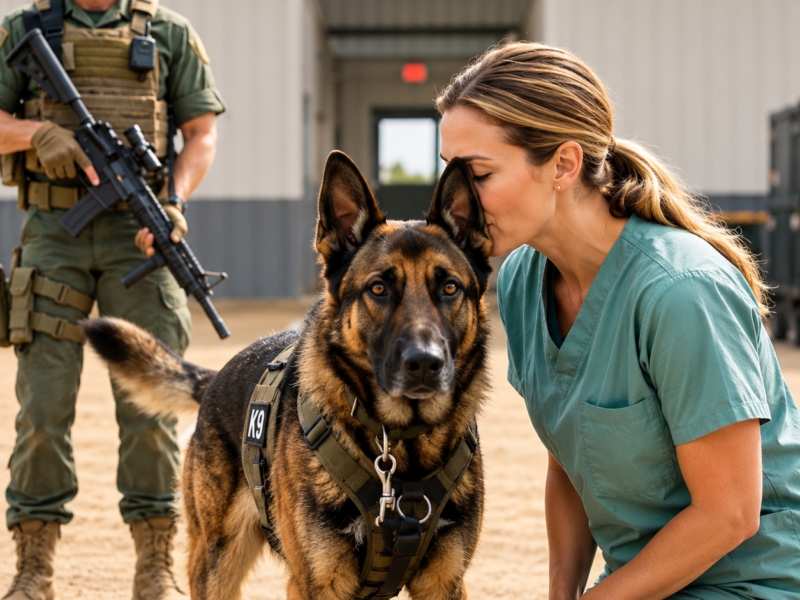
The K9 failed every drill at Fort Bragg while his handler called him useless in front of everyone, but when I quietly whispered a word I had never been taught, the supposedly broken dog froze, looked straight into my eyes, and revealed why he had refused every command.
Rain hammered the training field at Fort Bragg, turning the clay soil into a thick brown slick that sucked at the boots of every handler on the line.
Ranger sat motionless beside his handler, Sergeant Cole Bennett, while three other K9 teams completed the high-wall obstacle course without hesitation.
“Again,” the lead instructor ordered, his voice cutting through the deluge with practiced indifference.
Cole pointed a gloved finger toward the gaping entrance of the concrete crawl tunnel.
“Go,” Cole snapped, the frustration bleeding through his tone.
Ranger did not move an inch.
The Belgian Malinois just sat in the mud, his dark eyes fixed entirely on the treeline at the perimeter.
Cole’s jaw tightened until the muscles in his cheek twitched.
“You are embarrassing me in front of the entire detail,” Cole growled under his breath.
The dog lowered his head, pressing his body closer to the soaked earth, but his tail remained stiff.
Behind the spectator barricade, a young private leaned against the fence and whispered to his companion, “He is finished.”
“They will ship him to the shelter by Friday,” the second soldier replied without pity.
I was only there as a civilian volunteer nurse, sitting at the field medical tent to tape sprains and treat minor injuries after the high-stress drills.
Watching Ranger tremble against the wet clay made something deep inside my chest ache with a sudden, suffocating intensity.
Working dogs did not look afraid of training drills; they were built for them, wired for the work.
They only ever looked like this when they were afraid of people.
Cole yanked hard on the heavy tactical leash, trying to force the dog to his feet.
Instead of standing, Ranger suddenly shifted his balance and turned his dark brown eyes toward me.
Our eyes locked across thirty feet of open mud.
For a strange, surreal moment, the harsh shouting of the instructors and the pounding rain seemed to disappear into total silence.
I didn’t think about protocol, nor did I consider the armed military personnel surrounding the boundary.
I slowly crouched down in the slush, holding my palms flat against my knees.
“Easy, buddy,” I called out gently, my voice soft against the gale.
Ranger’s sharp ears immediately lifted, pointing directly toward me.
Cole laughed bitterly, shaking his head as he wiped rain from his brows.
“Don’t bother, lady,” Cole sneered. “He doesn’t trust strangers, and he sure as hell doesn’t trust nurses.”
I didn’t answer him.
Instead, an ancient, forgotten memory surfaced from the deepest corner of my childhood—a memory I hadn’t thought about in over a decade.
My father used to bring home strange stories from his classified military deployments, back when I was just a little girl sleeping with a hall light on.
There was always one specific word he had told me never to forget.
A single word he claimed could calm even the most broken, furious working dog when nothing else in the world could reach them.
As a child, I had never understood why he insisted on teaching me military dog commands before bedtime.
I looked directly into Ranger’s desperate, intelligent eyes and whispered that single word into the storm.
“Bluebird.”
The dog stopped breathing instantly.
His posture locked rigid as if an electric current had passed through his massive frame.
Then, slowly and deliberate, Ranger stood up from the mud and began walking directly toward me.
Cole went completely pale, his hands dropping to his sides as the heavy lead slipped from his fingers.
“Where did you hear that word?” Cole asked, his voice suddenly hollow and stripped of all authority.
I felt my heart pounding violently against my ribs like a trapped bird.
“My father,” I managed to say, my breath hitching.
“What was his name?” Cole demanded, taking three rapid steps closer to me.
“Daniel Carter,” I replied, standing up to meet his gaze.
The remaining color drained entirely from Cole’s face, leaving him looking like a ghost under the grey rain clouds.
Ranger reached my side and pressed his enormous, soaked head squarely against my chest.
He was trembling so violently that I instinctively wrapped both of my arms around his muscular neck.
“He knows you,” Cole whispered, his hand shaking as he pointed at the dog.
“No,” I said, staring back at the sergeant with rising dread. “He doesn’t know me… he remembers something.”
Cole turned his head and looked toward the empty darkness of the surrounding woods.
Slowly, without saying another word, Cole unbuckled the heavy nylon collar from around Ranger’s neck.
Beneath the thick black strap lay a pale, hairless scar encircling the dog’s throat like an old rope burn.
Attached to a hidden leather loop beneath the fur was a faded, scratched metal tag I had never seen on standard military issue gear.
I bent down close, wiping away a smear of wet dirt from the brass surface.
My father’s initials—D.C.—were deeply hand-engraved on the back.
My breath caught in my throat, and I suddenly felt completely weightless.
“Your father trained him,” Cole whispered, his voice trembling now.
My knees weakened, forcing me to lean heavily against Ranger’s broad shoulders for support.
“My father died twelve years ago in an overseas accident,” I said, my voice cracking under the weight of the past.
Cole swallowed hard, looking me directly in the eyes.
“That is what they wanted you to believe.”
Before I could process the nightmare implied by those words, Ranger suddenly broke his silence with a low, menacing growl.
He spun on his hind legs, barking furiously toward the dark tree line beyond the perimeter fence.
Cole grabbed my upper arm with an iron grip.
“Don’t move,” Cole commanded softly.
A figure stepped out from between the towering pine trees.
He wasn’t wearing a military uniform or civilian rain gear.
He simply stood there in the downpour, a tall, shadowy silhouette watching us from fifty yards away.
Then Ranger broke free from my grasp and sprinted at full speed straight toward the woods.
The stranger didn’t run; he merely reached up with a pale hand and whispered something into the wind.
Ranger instantly skidded to a dead stop in front of the man, dropping into a deep, obedient sit.
The stranger slowly reached up with both hands and pulled down the hood of his dark jacket.
My heart shattered long before my rational mind could process the image staring back at me across the mud.
The man had my father’s face.
He stood at the edge of the treeline, his face lined with deep, unfamiliar scars, but his eyes were unmistakably my father’s.
“Dad?” the word tore from my throat before I could stop it.
Cole grabbed my forearm tightly, pulling me back half a step.
“Maya, stay behind me,” Cole warned, his hand moving instinctively toward the sidearm holstered at his hip.
“Get your hand off your weapon, Bennett,” the man called out, his voice a low, gravelly rascal that tore through the rain.
The sound of his voice hit me like a physical blow, instantly transporting me back to our small kitchen in North Carolina.
“Dad… they told us you died in Kandahar,” I sobbed, taking a step forward despite Cole’s restraining grip.
“They had to tell you that, sweetheart,” my father said, his eyes softening for a split second as he looked at me. “To keep you safe.”
Ranger sat at his left heel, completely calm now, his tail making small, rhythmic sweeps against the wet fallen pine needles.
The very dog that had spent six months failing every basic drill at Fort Bragg was now executing flawless tactical patience.
“Why is he here?” I asked, looking between the dog and the father I had buried in an empty casket twelve years ago.
“He wasn’t failing his drills, Maya,” my father said softly. “He was waiting.”
Cole stepped forward, his posture rigid and defensive.
“Daniel, you’ve been off the grid for over a decade. The brass thinks you were killed during Operation Blackbird.”
“The brass set up Operation Blackbird to clear the room, Bennett,” Daniel replied, his eyes narrowing. “And you know it.”
Cole hesitated, his chest rising and falling heavily under his soaked uniform jacket.
“I didn’t know,” Cole said quietly. “I was just a corporal back then.”
“You were there when they brought the dog back to the states,” Daniel countered. “You knew he only responded to classified triggers.”
A loud metallic click echoed from the far side of the training field, breaking the tense standoff.
Two white utility vans with blacked-out windows were pulling onto the muddy access road, their headlights cutting through the dimming rain.
“They tracked the collar’s passive chip,” Daniel said, his face hardening as he looked past us toward the vehicles.
“Who tracked it?” I asked, panic rising rapidly in my throat.
My father looked at me, a tragic, fierce love shining in his weathered eyes.
“The people who paid for my funeral,” he said.
“Run, Maya!” my father yelled, but before I could turn, two armed men in plain dark tactical gear bolted from the side doors of the vans.
Cole didn’t hesitate; he unholstered his sidearm and fired two warning shots into the dirt at the men’s feet.
“Base security! Stand down!” Cole roared, but the men ignored the command entirely, advancing with suppressed carbines raised.
Ranger lunged forward with a ferocious, gut-wrenching bark, leaping directly at the lead man’s shoulder.
The man swung his rifle barrel, striking Ranger hard across the ribs and sending the heavy dog sliding through the mud.
“Ranger!” I screamed, dropping to my knees beside the whimpering animal.
Daniel closed the distance between us in seconds, grabbing my shoulder and hauling me to my feet with terrifying strength.
“We have to move now,” Daniel said, his hand sliding under my arm.
Cole fired three more rounds, forcing the intruders to take cover behind the rear wheels of their van.
“Get her out of here, Daniel!” Cole shouted, retreating backward while keeping his weapon trained on the vehicle. “I can hold them off for three minutes before base MP arrives!”
“They control the MP shift tonight, Bennett!” Daniel barked back. “Don’t go back to your quarters!”
Daniel grabbed Ranger’s tactical harness, dragging the bruised dog to his feet, and shoved me toward the deep treeline.
We sprinted into the thick underbrush, the sharp pine branches clawing at my face and arms as we plunged into total darkness.
Behind us, the muted pop-pop-pop of suppressed gunfire cut through the sound of falling rain.
I ran until my lungs felt like they were burning with liquid fire, my wet sneakers slipping on the carpet of decayed leaves.
Ranger ran right beside me, his shoulder constantly bumping my hip as if physically herding me through the dark forest.
After twenty minutes of blind sprinting, Daniel pulled us into the mouth of a hidden concrete drainage culvert beneath a highway overpass.
We collapsed against the curved concrete wall, listening to the muffled roar of traffic passing high above us in the storm.
Ranger dropped instantly, panting heavily, his nose tucked directly under my cold, shivering hand.
“Are you hurt?” my father asked, his rough hands instantly checking my arms and shoulders for injuries with practiced medical efficiency.
“I am fine,” I gasped, tears finally overflowing and washing the dirt from my cheeks. “Dad… please… what is happening?”
He sat back against the dark concrete, his face illuminated only by the distant, rhythmic flash of passing car headlights.
“Twelve years ago, my unit recovered something inside a hardened facility in Afghanistan,” he began, his voice barely a whisper. “It wasn’t intelligence. It was a person.”
I stared at him in disbelief, clutching Ranger’s cold, wet fur.
“Who?” I asked.
“The son of a senior defense contractor,” Daniel said. “And the men who left him there are the same men currently standing on that training field.”
My father leaned his head back against the concrete, closing his eyes as if trying to erase the memories burned into his mind.
“When I realized my own command structure had orchestrated the drop to start a lucrative private security contract, I refused to sign the mission debrief,” he said softly.
“They couldn’t just fire you,” I realized, the horror dawning on me.
“They tried to eliminate the whole team,” Daniel said. “Car bomb in Kabul. I barely survived it, but I was blinded in one eye and burned over half my torso.”
He reached up and gently traced the thick, jagged line of scar tissue running down the side of his neck into his collar.
“I knew if I came home to you and your mother, they would use you as leverage to make sure I stayed quiet,” he continued.
“So you let us bury a empty pine box,” I said, a wave of anger suddenly washing over the shock. “You let Mom die believing you were gone!”
“Your mother’s heart failed six years ago, Maya,” he said, his voice breaking with genuine, unvarnished agony. “I sat in a stolen sedan across the street from the funeral home and watched you walk behind her casket alone.”
I pressed my face into my hands, my shoulders shaking violently as twelve years of unaddressed grief finally broke through my composure.
Ranger rested his heavy chin on my lap, letting out a long, shuddering sigh that mirrored my own.
“Why the dog, Dad?” I asked through my tears. “Why Ranger?”
“His real name isn’t Ranger,” my father said, reaching out to stroke the dog’s scarred neck. “His code name was Vanguard. He was trained under a specialized bio-behavioral protocol I developed for high-threat recovery operations.”
“The trigger word,” I whispered. “Bluebird.”
“It wasn’t a command to attack or search,” Daniel explained. “It was an override phrase designed to break conditioning. It tells the dog that the person standing in front of him is family—a hard zero on all threat assessments.”
“That’s why he failed all those drills with Cole,” I said, realizing the truth. “He wasn’t broken. He was refusing to obey commands from anyone who didn’t know the code.”
“He was waiting for me,” Daniel said. “Or for you.”
Suddenly, Ranger’s head snapped up, his dark ears pitching forward toward the open mouth of the drainage tunnel.
A faint, metallic scraping sound echoed off the wet concrete walls from the direction of the highway ditch.
Daniel immediately reached into his jacket and pulled out a matte-black sidearm, his finger resting lightly along the frame.
“They found the drainage trail,” my father whispered, standing up silently like a shadow. “Maya, stay behind Ranger.”
A dark figure crouched at the entrance of the culvert, illuminated briefly by a passing lightning strike.
“Don’t shoot, Carter,” a familiar voice called out from the dark.
Cole Bennett stepped into the tunnel, dripping wet, holding a blood-stained cloth against his left shoulder.
My father didn’t lower his weapon, his gaze locked firmly on Cole’s face.
“You followed us, Bennett,” Daniel said coldly.
“I followed your dog’s tracks,” Cole corrected, staggering slightly before leaning against the concrete wall. “Your daughter dropped her medical kit fifty yards back near the fence.”
I reached instinctively for my belt, realizing with a sudden spike of fear that my small red canvas pouch was indeed missing.
“Are they behind you?” Daniel asked, his eyes scanning the open field visible beyond Cole’s silhouette.
“No,” Cole panted, pressing the rag tighter against his shoulder wound. “I directed the contractor team toward the south gate. Told them I saw a stolen civilian vehicle heading toward the interstate.”
“Why would you do that?” I asked, stepping out from behind my father. “You could have turned us in.”
Cole looked at me, his eyes filled with a deep, lingering exhaustion.
“Because twelve years ago, Sergeant Carter saved my life in a ditch outside Fallujah,” Cole said quietly. “And because when I took charge of this dog six months ago, I was given strict orders to report any ‘unusual cognitive responses’ directly to a private military contact, not base command.”
“Project Aegis,” Daniel said, his voice dripping with venom.
“I didn’t know what it meant until tonight,” Cole admitted. “When Ranger reacted to Maya… when he looked at her… I knew the reports I was filing were going to get both of them killed.”
Ranger walked over to Cole, gently sniffing the bloody cloth on his shoulder before giving his hand a single, brief lick.
“He forgives you for the tunnel drill,” I said softly.
Cole let out a ragged, breathless laugh, tears welling in his eyes as he patted the dog’s broad head.
“I am sorry, boy,” Cole whispered to the dog. “I thought you were just stubborn.”
“They won’t stay fooled by the south gate distraction for long,” Daniel said, lowering his gun slightly. “When the contractor lead realizes there’s no stolen car, they’ll circle back to the perimeter.”
“Where can we go?” I asked, looking between the two men. “They control the base, they control the local authorities…”
“They don’t control the federal magistrate in Raleigh,” Cole said, reaching into his pocket and pulling out a small, encrypted flash drive. “I pulled the contract logs from the base server before I ran. Every dollar path leads straight back to Aegis Security.”
“It’s not enough to go on the run, Maya,” my father said, looking at me with dead seriousness. “We have to expose the entire network, or they will hunt you for the rest of your life.”
Ranger suddenly let out a low, vibrating growl from deep within his chest, his dark eyes fixed on the slope above the tunnel mouth.
“They are above us,” Daniel whispered instantly.
A heavy black boot crashed through the thin corrugated metal covering a storm grate directly above our heads.
Dust and dried concrete chips showered down on us as two heavy flashbang grenades clattered down the incline, bouncing toward our feet.
“Cover!” my father roared, throwing his body over mine just as the devices detonated with a blinding flash and a deafening, bone-shattering roar.
The world went instantly white, a high-pitched, agonizing ring filling my ears as the concussion slammed the air out of my lungs.
Through the haze of smoke and blinding white light, I saw shadow figures rappelling down the steep embankment at the tunnel entrance.
Cole was already firing, his pistol flashes illuminating the thick smoke in quick, rhythmic bursts.
Ranger lunged through the blinding fog like a dark missile, slamming into the chest of the first armed operator and carrying him backward out of the tunnel mouth.
“Maya, move!” my father pulled me by my jacket collar, dragging me toward the far exit of the culvert that opened into a deep, wooded ravine.
Gunfire echoed violently inside the confined space of the concrete pipe, the sound deafening and terrifyingly close.
I looked back just in time to see Cole hit the ground, his weapon slipping from his bloody fingers as a contractor stepped over him.
“Cole!” I screamed, trying to turn back.
“Keep moving!” my father commanded, his iron grip dragging me into the freezing rain outside.
Ranger burst out of the tunnel behind us, blood dripping from his shoulder, but his drive unbroken as he took the lead, guiding us down into the dark, brush-chilled ravine.
We scrambled down the muddy slope, slipping on wet rocks and crashing through dense briars that tore at our clothes.
Behind us, shouts and the sharp beam of high-powered tactical flashlights cut through the falling rain, sweeping across the trees above us.
“They’re flanking the ravine!” a voice shouted from the ridge. “Do not let the girl get to the secondary road!”
My father stopped at the base of a massive oak tree, breathing heavily, his face pale under the moonlight.
He looked down at the encrypted flash drive Cole had given him, then looked at Ranger, whose ears were pinned back in pure combat focus.
“Maya,” my father said, grabbing both my hands in his. “You need to take the dog and the drive and head down this creek bed. It leads straight to the county highway, two miles south.”
“No!” I cried out, shaking my head violently. “I am not leaving you again! Not after twelve years!”
“Listen to me!” he snapped, his voice filled with an authority that commanded absolute obedience. “They are tracking my movement. I am the target they want. If you stay with me, none of us survive the night.”
The Sacrifice at the Ridge
“I won’t lose you again, Dad,” I sobbed, tears cutting hot paths through the mud on my cheeks.
“You aren’t losing me, Maya,” he said, forcing a faint, broken smile as he pressed the cold metal flash drive into my palm. “You’re saving what I fought for.”
He looked down at Ranger, reaching out to cup the dog’s powerful jaw in his scarred hand.
“Vanguard,” my father said in a deep, resonant voice that command silence. “Protect her. Code Red. Protect her.”
The Belgian Malinois let out a single, low whimper, leaning his broad forehead against my father’s chest for a fleeting second before turning his body entirely to shield me.
“Go now!” my father ordered, turning around and running back up the steep slope of the ravine, firing his sidearm into the air to draw the search lights toward himself.
“Dad!” I screamed, but Ranger grabbed the sleeve of my heavy jacket in his teeth, tugging with tremendous, undeniable force toward the creek bed.
I turned and ran, the icy water of the stream splashing over my boots as Ranger ran shoulder-to-shoulder with me through the pitch-black ravine.
Behind us, a deafening volley of automatic gunfire erupted near the top of the ridge, accompanied by the harsh shouting of men and the sudden flare of a tactical flare lighting up the sky.
I wanted to stop, I wanted to turn back and scream into the night, but Ranger kept pushing against my hip, forcing me forward with relentless, ancient purpose.
We ran through the cold water for what felt like hours, the sound of the storm drowning out the distant chaotic noises of the tactical engagement behind us.
My legs felt like lead, my chest burning with every ragged breath, but the constant, reassuring presence of the dog kept me from collapsing into the mud.
Finally, the thick timber gave way to a rusted barbed-wire fence, beyond which lay the dark, slick asphalt of a two-lane county road.
I scrambled over the wire, tearing my jeans, and collapsed onto the gravel shoulder of the highway, my body completely spent.
Ranger vaulted the fence effortlessly, landing softly beside me and immediately scanning the dark, empty road in both directions.
Far down the highway, the faint glow of red taillights was visible through the pouring rain, approaching slowly from the north.
I squeezed the metal drive tightly in my fist, my heart beating frantically against my ribs as the vehicle drew closer.
Ranger stepped directly in front of me, his posture locked, waiting to see if the approaching lights brought safety or destruction.
The vehicle slowed as it approached, the high beams cutting through the heavy rain before dipping into low beams.
It was a dark green civilian pickup truck, rusted along the wheel wells, moving with a cautious, slow pace.
The truck pulled onto the gravel shoulder twenty feet away, its engine idling with a heavy, mechanical hum.
The driver’s side door opened, and a man in a worn canvas jacket stepped out into the rain, holding his hands visibly empty at his sides.
“Maya?” the man called out, his voice rough but undeniably calm.
I shrank back against the wooden fence post, Ranger instantly dropping his head and letting out a low, dangerous warning growl.
“Easy, girl,” the driver said, taking one small step forward. “My name is Marcus. Your father sent a short-range signal from the ridge ten minutes ago.”
“How do I know you’re with him?” I demanded, my voice shaking uncontrollably as I held the flash drive behind my back.
Marcus didn’t answer with words.
Instead, he reached into his jacket, pulled out a small, laminated photograph, and held it out into the beam of the truck’s headlights.
It was an old, faded picture of my father in his dress uniform, holding me as a toddler on his shoulders at an airfield.
On the back, written in fresh black marker, were three simple words: Trust the bird.
Tears filled my eyes again as the tension in my spine finally snapped, and I sank lower against the wet gravel.
Ranger approached the man slowly, sniffing his boots before lowering his ears and stepping back to my side.
“Where is my father?” I asked, looking toward the dark forest behind us.
“He bought us the time we needed,” Marcus said softly, his face unreadable in the dim light. “The contractors think they captured him, but Daniel knows how to vanish from an extraction zone better than anyone I’ve ever served with.”
“They captured him?” I gasped, horror slamming back into my chest.
“He wanted them to take him,” Marcus explained, stepping closer to offer me a dry blanket from the cab. “It’s the only way he could guarantee they would stop sweeping the woods for you.”
“He let himself be taken… for me,” I whispered, the weight of his sacrifice pressing down on my chest like a lead weight.
“He spent twelve years staying dead to keep you alive, Maya,” Marcus said, opening the passenger door of the truck. “He isn’t going to let them win now. But we have to get this drive to Raleigh before sunrise.”
Ranger leaped smoothly into the back seat of the extended cab, settling onto the worn vinyl bench and looking at me through the open door.
I climbed into the front seat, wrapping the thick wool blanket around my shivering shoulders, the cold metal drive still clutched tightly in my right hand.
Marcus pulled the truck back onto the dark, empty highway, accelerating smoothly into the storm as the trees of Fort Bragg faded into the rear-view mirror.
“What is on that drive?” Marcus asked quietly as he drove through the night.
“The truth about what happened twelve years ago,” I said, looking back at Ranger through the glass window. “And the names of every man who tried to hide it.”
“It’s going to be a war, Maya,” Marcus warned, his eyes fixed on the rain-slick road ahead. “Aegis has deep roots in the department.”
“Then we’ll dig them out,” I said, my voice suddenly colder and steadier than I had ever known it could be.
Ranger pressed his wet nose against the glass panel dividing the cab, letting out a soft, low breath that fogged up the window.
I reached back and pressed my hand against the glass, right over his snout, feeling the steady heat of his life through the barrier.
My father was out there in the dark, held by men who thought they had finally broken him, unaware that he had left his most lethal asset behind.
He hadn’t just given me my memories back tonight; he had given me a weapon, a witness, and a guardian.
The truck sped south through the rain, heading toward a dawn that promised either justice or absolute ruin.
Six hours later, as the first grey light of morning broke over the state capitol building in Raleigh, the rain finally began to stop.
We pulled up behind a grand marble building where two federal marshals were waiting on the steps, their coats pulled tight against the morning chill.
Marcus turned off the engine and looked back at me, his hands resting on the steering wheel.
“This is where the easy part ends,” Marcus said quietly. “Once you give them that drive, there is no going back to your old life.”
I looked down at the small piece of metal in my hand, then reached up to touch the faded brass tag hanging from Ranger’s collar.
“I haven’t had my old life since I was twelve years old,” I said, opening the truck door and stepping out onto the cold pavement.
Ranger immediately vaulted out behind me, his dark eyes alert, sweeping the quiet morning street for threats.
The two marshals stepped down the stairs, their hands hovering near their belts until they saw Marcus nod from the driver’s seat.
“Are you Maya Carter?” the lead marshal asked, his voice stern and professional.
“I am,” I said, holding out the drive. “And this is Vanguard.”
The marshal looked at the scarred Belgian Malinois standing rigidly at my side, then looked up at me with a sudden realization in his eyes.
“Your father sent a transmission to our regional office two hours ago from a secure node,” the marshal said softly.
My heart leaped into my throat. “Is he alive?”
The marshal offered a slight, somber nod. “He surrendered himself at the federal courthouse in Fayetteville under heavy escort. He made one condition before he gave his deposition.”
“What condition?” I asked, my voice trembling.
“He said to tell you that Bluebird has flown home,” the marshal replied, a rare, genuine smile touching his lips.
I let out a long, shaky breath, tears of pure relief spilling over my cheeks as I looked down at the dog beside me.
Ranger leaned his broad, muscular body firmly against my leg, letting out a soft, low bark that resonated through the quiet morning air.
He was no longer a broken dog failing drills in the mud at Fort Bragg.
He was the final piece of my father’s legacy, standing guard at my side as we finally brought the truth into the light.









