The hospital director locked me inside a reinforced room with four aggressive military dogs, telling the staff I was a danger to everyone, but when the security cameras revealed what those supposedly uncontrollable animals did next, the entire hospital discovered the secret I had spent ten years trying to bury.
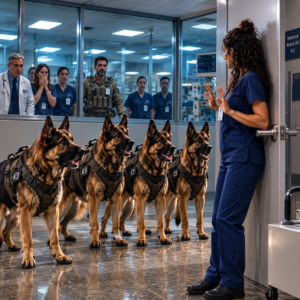
I heard the lock click behind me, echoing off the cold cinder block walls like a gunshot.
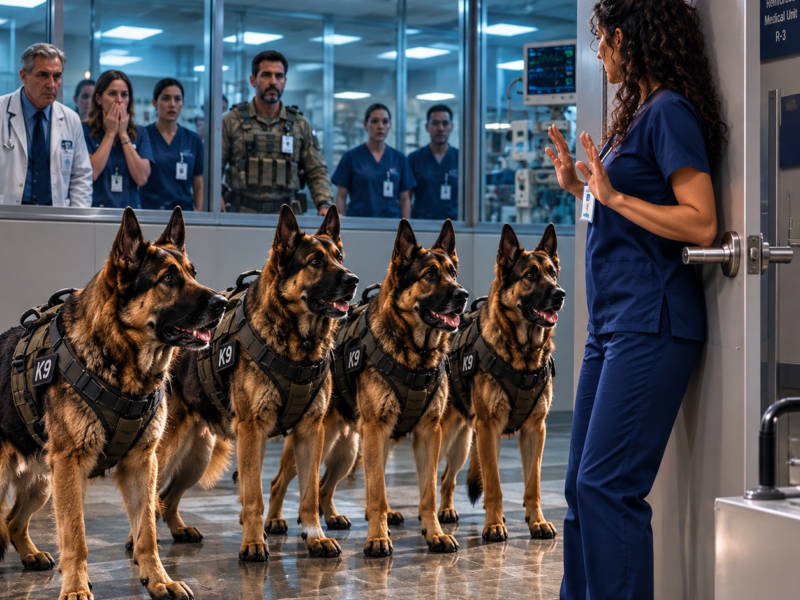
Four German Shepherds stood beneath the buzzing fluorescent lights, their muscular bodies tense, their amber eyes locked entirely on me.
Outside the thick observation window, Dr. Richard Hayes folded his arms and smirked, clearly enjoying the terrified silence of the hospital staff gathered behind him.
“Let’s see how brave our little nurse really is,” he told them, his voice muffled through the reinforced glass.
My name is Emily Carter, and I had worked at the military rehabilitation center in Virginia for almost six months, blending into the background of white coats and quiet corridors.
Until that morning, everyone believed I was an ordinary nurse who kept strictly to herself, never discussed her past, and sometimes woke from nightmares screaming a name nobody recognized.
Then a retired colonel arrived with four military working dogs that had been removed from active duty after a training incident left one handler seriously injured.
The dogs had become completely unpredictable, refusing basic commands and viciously attacking anyone who approached their secure kennels.
Dr. Hayes wanted to prove that his aggressive new behavioral conditioning program could break and control them in a matter of days.
I had openly questioned his cruel methods during the morning briefing, pointing out that fear only made trauma worse.
Apparently, that was enough to make me his next behavioral experiment.
“Open the door,” I said through the glass, keeping my voice remarkably steady despite the racing of my pulse.
He shook his head with a condescending smile.
“You claimed these animals respond to trust rather than force, Emily, so show us your brilliant theory.”
The dogs began circling me slowly, their heavy paws scraping against the polished concrete floor.
One barked sharply, a deep and aggressive sound that made the nurses outside gasp, and another lowered its head, revealing old battle scars across its muzzle.
My heartbeat thundered in my ears, drowning out the ambient hum of the hospital ventilation system.
For a terrifying moment, I was no longer standing in a modern Virginia hospital.
I was back in the burning dust of Afghanistan, kneeling beside a wounded soldier while gunfire shattered the air around us.
I remembered the hot metallic taste of blood on my hands, a radio screaming for emergency evacuation, and a military dog refusing to abandon the man who had trained him.
I closed my eyes tightly against the sudden rush of agonizing memories.
Then I slowly knelt down onto the cold concrete floor, exposing my throat and chest to four apex predators.
“Easy, boys,” I whispered, using a tone reserved for souls who had seen too much darkness.
The largest dog froze mid-stride.
His pointed ears lifted sharply at the sound of my voice.
I tapped my fingers twice against my knee, a rhythm embedded deep in my muscle memory, then made a soft clicking sound I hadn’t used in ten years.
The lead dog approached cautiously, sniffing my outstretched hand with trembling nostrils, before pressing his heavy forehead directly against my chest.
My breath caught in my throat as hot tears pricked the corners of my eyes.
“Shadow?”
The name escaped my lips before I could stop it, a secret I had guarded with my very life.
Outside the observation window, the retired colonel dropped his paper coffee cup, the dark liquid splashing wildly across the linoleum floor.
The second dog hurried toward me with a soft, pleading whine, followed closely by the other two.
Within seconds, all four surrounded me, not with bared teeth or raised hackles, but with the desperate, overwhelming affection of animals recognizing someone they thought they had lost forever.
One of them rested his massive head heavily in my lap.
Another gently licked the jagged scar running along my left wrist.
I began to cry openly, burying my face in Shadow’s thick fur.
“I’m sorry,” I whispered into the silence of the room. “I’m so sorry I couldn’t bring you home.”
The observation room erupted in absolute confusion behind the glass.
Dr. Hayes demanded that someone explain what was happening, but the retired colonel had gone completely pale, clutching the metal railing for support.
He knew those dogs intimately.
More importantly, as I slowly raised my head, he realized he knew me too.
He rushed to the wall intercom and pressed the transmission button with trembling fingers.
“Emily, step away from those animals right now and tell me your full name.”
I looked up from the floor, locking my gaze directly onto the camera lens.
“Emily Carter,” I answered clearly. that isn’t the name written on my classified military discharge papers.”
The colonel gripped the railing so tightly his knuckles turned stark white.
“That’s impossible,” he whispered into the intercom mic, his voice broadcasting into the quiet room. “The unit was wiped out.”
I gently reached down and touched Shadow’s heavy leather collar, where a small metal identification tag had been cleverly hidden beneath the strap.
Then I slowly turned the engraved metal toward the overhead security camera so everyone could read it.
Engraved across the worn surface were the unmistakable words: SPECIAL OPERATIONS K9 UNIT — HANDLER PRESUMED DEAD IN ACTION.
The colonel stared at the tag on the monitor as though the dead had suddenly walked through his door.
Dr. Hayes stopped smiling, his mouth hanging open in stunned disbelief.
Because ten years earlier, a classified black-ops mission in the rugged mountains had ended with the sudden disappearance of a lead handler and four elite military working dogs.
The official government report declared that none had survived the devastating mortar strike.
I stood up slowly, dusting off my nurse’s uniform, and looked directly into the camera lens.
“Now,” I whispered into the microphone above the door, “are you ready to hear what really happened that night?”
Behind the glass, the colonel slowly reached into his pocket for his encrypted government phone.
And when he saw a strange, high-security alert flashing across its screen, he backed away from the window in sheer horror.
He whispered the five words that made my blood turn cold in my veins.
“Someone knows she’s alive.”
The heavy steel door suddenly clicked, but it wasn’t the security guards opening it from the outside.
It was an automated lockdown override triggered from a remote command center two thousand miles away.
The red emergency lights began to pulse along the corridor ceiling.
Dr. Hayes slammed his fists against the glass, screaming for the guards to secure the hallway.
“Don’t let her leave!” he yelled, panic fracturing his voice.
I looked down at Shadow, who let out a low, protective growl that vibrated through the floorboards.
“They aren’t here to contain me, Doctor,” I said quietly. “They’re here to clean up your mess.”
The reinforced door swung open with a heavy metallic groan, revealing an empty hallway filled with swirling dust from the overhead vents.
The hospital staff had already fled down the stairs, terrified by the sudden lockdown and the strange military override codes flashing on every terminal.
Only Dr. Hayes remained near the glass, his face twisted in a mixture of arrogant fury and mounting dread.
“You think a few stolen dogs and fake military papers are going to save you from federal charges?” he shouted, pointing a shaky finger at my chest.
I took a slow step forward, the four German Shepherds falling into a disciplined tactical formation right behind my heels.
“I didn’t steal them, Hayes,” I replied coldly. “They belonged to the unit I commanded before your friends in intelligence tried to bury us all in a shallow grave.”
He swallowed hard, taking a sudden step backward as Shadow bared his teeth just enough to show ivory.
“The mission was classified,” Hayes muttered, glancing toward the empty corridor as if hoping for a miracle rescue. “Decisions were made for national security.”
“Sacrificing your own people to cover up a botched weapons test isn’t national security, it’s murder,” I countered, my voice echoing down the sterile hallway.
Ten years ago, our team discovered that the local contractor supplying our base was intentionally sabotaging equipment to inflate government repair contracts.
When we attempted to report the corruption up the chain of command, our own extraction team was canceled, and an artillery strike was called down on our exact coordinates.
I survived only because Shadow dragged my unconscious body into a deep mountain cave before the blast wave hit.
We wandered the wilderness for weeks, hiding from both enemy combatants and the corrupt officers who wanted us silenced permanently.
Eventually, I made my way across the border using forged identity papers, leaving my military life behind to protect the dogs who had saved my life.
I became a ghost nurse, watching over broken people while keeping my own catastrophic wounds hidden from the world.
Until Dr. Hayes showed up with my old unit’s dogs, threatening to break their spirits just like the military tried to break mine.
“You can’t walk out of here,” Hayes stammered, reaching for a panic button on the wall. “The entire facility is locked down under biohazard protocols.”
I smiled faintly, pulling a small silver override key from the pocket of my scrubs.
“You forget, Doctor,” I whispered, lifting the key. “I helped design the security grid for these rehabilitation centers before you even graduated.
The panel beside the door beeped green as I swiped the key, instantly disabling the biohazard lockdown and plunging the main wing into emergency backup lighting.
Alarms wailed in the distance, but the heavy fire doors remained wide open, creating a clear path toward the underground loading docks.
“Grab him,” I commanded softly.
Before Hayes could press the alarm button, Shadow lunged forward with terrifying speed, pinning the hospital director against the glass wall without a single sound.
The other three dogs formed a defensive perimeter, their eyes scanning the dark corridor for incoming security guards.
Hayes trembled violently, his breath frosting in the chilled air of the hallway.
“Please,” he choked out, staring into Shadow’s fierce, intelligent eyes. “Don’t let him bite.”
I stepped closer, looking down at the man who had tormented helpless animals and terrorized his staff with absolute impunity.
“You wanted to see how brave my dogs were, Doctor?” I asked, leaning in close. “Now you have your answer.”
I reached into Hayes’s lab coat pocket and pulled out his encrypted tablet, tapping the screen to unlock it with his biometric thumbprint.
A list of classified facility transfers appeared immediately, confirming my worst suspicions.
This rehabilitation center wasn’t just a hospital; it was an illegal testing facility for experimental combat stimulants being administered to unsuspecting patients.
“You were using the veterans as guinea pigs,” I said, my voice dropping an octave as cold fury surged through my veins.
“It’s a sanctioned program,” Hayes wheezed, struggling against Shadow’s immense weight on his chest. “The Pentagon funded the research.”
“Not anymore,” I replied, transferring all the encrypted files directly to an external drive hidden inside Shadow’s special tactical harness.
Just then, heavy footsteps echoed from the stairwell at the far end of the hall.
Private security guards in heavy riot gear rounded the corner, shouting orders and raising non-lethal riot guns.
“Freeze! Drop to your knees!” the lead guard yelled, aiming directly at my chest.
I didn’t flinch.
I simply whistled a sharp, three-note cadence that echoed off the metal walls.
The four dogs released Hayes instantly, turning to face the guards with lowered heads and synchronized precision.
The security guards hesitated, lowering their weapons slightly as they recognized the legendary tactical positioning of the military working dogs.
Even trained mercenaries knew better than to charge four frontline K9s in a narrow corridor.
“Stand down!” the lead guard shouted into his radio, calling for reinforcements. “We have an active standoff in wing four with unsecured military animals!”
“Tell them to drop their weapons, Hayes,” I said, resting my hand on Shadow’s muscular shoulder.
Hayes coughed, wiping spittle from his chin as he slumped against the wall.
“Do it,” he wheezed to the guards. “Just don’t let them move.”
I looked past the guards toward the double doors leading directly to the snowy parking lot outside, where an idling transport van waited in the shadows.
It was the exact escape route I had mapped out during my first week at the facility, anticipating that my past would eventually catch up with me.
“We’re leaving now,” I announced clearly to the corridor. “And nobody is going to stop us.”
One of the younger guards tightened his grip on his riot rifle, his knuckles turning white as adrenaline spiked his system.
“You’re committing treason, Carter,” the guard snarled. “You can’t outrun the Department of Defense.”
“Watch me,” I replied with a faint, dangerous smile.
I gave the hand signal for scatter, and in a fraction of a second, all four dogs darted into the side utility rooms before the guards could react.
Instantly, the main electrical breakers for the hallway were thrown from the inside, plunging the entire wing into absolute darkness.
Flashes of emergency strobe lights cut through the smoke and dust as the guards cursed in confusion, sweeping their flashlights wildly across the empty corridor.
I slipped past them in the shadows, my footsteps completely silent against the rubber floor tiles.
Shadow fell in step beside me, his warm breath brushing against my hand as we navigated the familiar maze of service tunnels.
Behind us, the chaos inside the hospital grew louder, sirens wailing and alarms echoing through the ventilation shafts like a dying beast.
We reached the heavy steel fire exit at the end of the subterranean service corridor, the cold night air rushing in from the outside world.
I pushed the heavy metal bar, and the door swung open into the falling snow.
The freezing Virginia wind whipped across my face, carrying the sharp scent of pine and approaching winter storms.
Out in the open parking lot, the dark transport van sat waiting with its engine running softly in the falling snow.
A shadowy figure stood beside the driver’s door, holding an umbrella and watching the hospital exits with intense focus.
It was the retired colonel.
He turned his head as we stepped out of the service tunnel, his eyes widening in the dim amber glow of the security lights.
“Emily,” he called out over the howling wind, walking toward us with his hands visible and empty.
I raised my right hand, signaling Shadow and the other dogs to hold their position in the shadow of the concrete overhang.
“Stay back, Colonel,” I warned, keeping my voice firm. “I’m not going back to a black site.”
The older man stopped ten feet away, his breath pluming in the freezing air as he looked at me with a deep, sorrowful expression.
“I didn’t come to arrest you, Emily,” he said quietly. “I came to finish the extraction that should have happened ten years ago.”
I narrowed my eyes, scanning the empty perimeter for hidden snipers or backup vehicles.
“Forgive me if I don’t trust government extraction teams anymore,” I replied bitterly.
“The people who ordered the strike on your unit a decade ago are no longer in command,” the colonel explained, taking a slow step forward. “An internal military tribunal has been quietly investigating high-level corruption within the defense department for months.”
He pulled a thick manila envelope from beneath his heavy wool coat and held it out.
“Your discharge papers were falsified to protect the generals who sold your unit out,” he continued. “And the files you just downloaded from Hayes’s terminal are the final piece of evidence we need to put them away for life.”
I looked at the envelope, then back at the four dogs standing steadfastly beside me in the snow.
“Why should I believe you?” I asked.
The colonel smiled sadly, reaching into his pocket and pulling out a small, weathered photograph.
He held it up under the light of the streetlamp.
It was a picture of our entire unit taken in the dusty mountains of Afghanistan, laughing together before the world fell apart.
“Because I was the captain who trained those dogs before I was promoted out of the field,” he said softly. “And I spent ten years believing my best soldiers were dead.”
Before I could answer, the front glass doors of the hospital shattered behind us with an explosive crash.
Dr. Hayes appeared in the entrance, bleeding slightly from his forehead and flanked by a dozen armed federal agents in heavy tactical gear.
“There they are!” Hayes screamed, pointing directly at us through the falling snow. “Shoot the dogs and take her alive!”
The tactical team raised their weapons, red laser sights painting the snow around us like angry fireflies.
“Get in the van!” the colonel shouted, throwing open the side door.
Shadow leaped into the vehicle first, followed immediately by the other three dogs with military precision.
I didn’t hesitate, diving into the back seat as the first wave of suppressed rifle fire chipped the concrete wall inches from my head.
The colonel slammed the heavy van door shut and vaulted into the driver’s seat, flooring the accelerator as tires spun wildly on the icy pavement.
The van fishtailed violently before catching traction, surging forward through the security gates just as the federal agents opened fire in earnest.
Glass shattered across the back windows, spraying tiny diamonds of safety glass over my shoulders.
“Hold on!” the colonel roared, cutting the headlights and veering off the main highway into a dense logging road covered in deep snow.
The heavy military-grade tires bit into the mud and slush, carrying us deep into the dark Virginia forest where pursuit vehicles couldn’t easily follow.
I looked out the shattered rear window, watching the distant lights of the hospital fade into the white haze of the blizzard.
Shadow rested his heavy chin on my knee, letting out a long, contented sigh that seemed to wash away ten years of relentless nightmares.
“Are we safe now?” I whispered, mostly to myself.
The colonel glanced at me through the rearview mirror, his expression grim but resolute.
“We’re safe for tonight,” he said quietly. “Tomorrow, the real war begins.”
I opened the encrypted flash drive we had downloaded from Hayes’s terminal and plugged it into the rugged laptop sitting on the seat beside me.
Lines of classified military documents, financial transfers, and illegal human experimentation logs scrolled endlessly down the dark screen.
The evidence was overwhelming, damning, and completely irreversible.
For the first time in ten years, the ghosts of the past weren’t haunting me anymore.
They were fighting right beside me.
The snowstorm raged through the night, burying our secluded woodland cabin beneath three feet of pristine white powder and cutting off all local roads.
Inside, a single fireplace crackled warmly, casting dancing amber shadows across the rustic wooden walls.
The four German Shepherds lay stretched out in a tight circle near the hearth, fast asleep for the first time in weeks without the haunting vigilance of active duty.
I sat at the heavy oak kitchen table, my eyes burning from hours of reviewing the decrypted military files on the laptop screen.
The colonel poured two steaming cups of black coffee, setting one gently down in front of me before pulling out a wooden chair.
“The tribunal received the data package an hour ago,” he said quietly, sitting down and wrapping his cold hands around his mug. “Warrants are already being signed in Washington.”
I took a slow sip of the bitter coffee, feeling the warmth spread through my chest.
“And Hayes?” I asked.
“Detained by federal marshals before he could board a private flight out of the country,” the colonel replied with a faint smile. “His entire operation is being dismantled from the top down.”
I looked over at Shadow, who lifted his head slightly, let out a soft huff, and went back to sleep.
The ten-year nightmare of hiding in the shadows, running from a phantom past, and burying my true identity was finally over.
I wasn’t just a runaway nurse hiding from a corrupt system anymore.
I was the surviving commander of an elite unit that had refused to stay dead.
“What happens when the dust settles?” I asked, looking out the frost-covered cabin window as the first pale rays of winter dawn began to pierce the horizon.
The colonel placed a weathered hand on the table, right beside mine.
“We rebuild,” he said simply. “And this time, we make sure the truth stays out in the open.”
I nodded slowly, feeling a profound sense of peace settle over my soul for the first time since the dust storms of Afghanistan.
The door to my past was finally unlocked, and I was ready to step into the light.
By morning, the storm had cleared, leaving behind a blindingly bright winter landscape stretching out as far as the eye could see.
The crisp morning air smelled of clean snow and pine, carrying the faint, distant sound of birds waking up in the frozen forest canopy.
I stepped out onto the wooden porch of the cabin, wrapped in a heavy wool blanket, with Shadow sitting faithfully at my right side.
Down the winding mountain road, a lone convoy of federal transport vehicles was slowly making its way up through the newly plowed snow.
They weren’t coming to hunt us down or silence the truth.
They were coming to offer formal pardons, official recognition, and a rightful homecoming for a classified unit that the world had tried to erase.
I looked down at Shadow, reaching out to scratch behind his velvety ears just like I used to do a decade ago before everything changed.
“Ready to go home, boy?” I whispered softly.
The dog let out a sharp, joyful bark that echoed across the silent valley, bouncing off the mountain peaks and vanishing into the clear blue sky.
I took a deep breath of the freezing morning air, feeling strong, unbroken, and completely alive.
The secret was finally out, the ghosts were finally laid to rest, and our long journey was finally at an end.