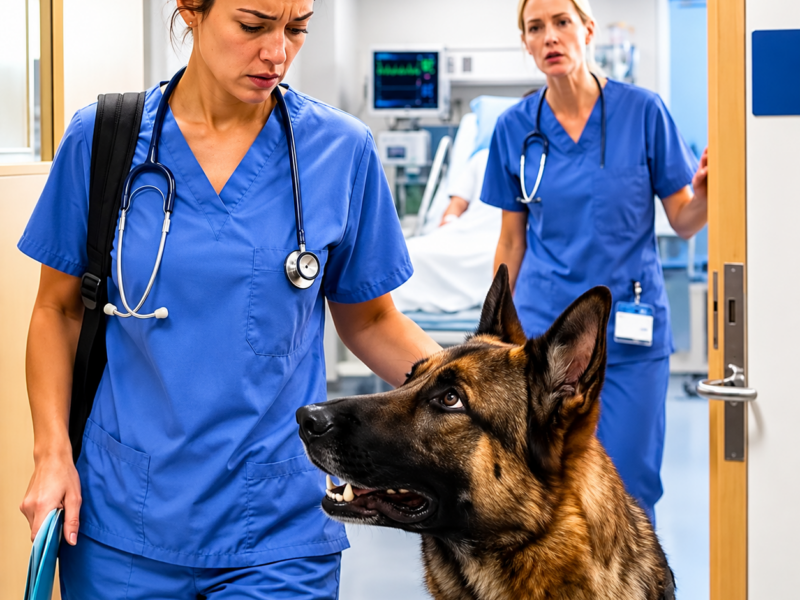
The hospital director grabbed my chart at the nurses’ station and coldly told me, “Your shift is over,” but as I reached for my coat, the SEAL captain’s K9 planted himself between me and the exit, staring at the locked ICU door as if he knew someone inside had been lying.
The heavy glass door of the Intensive Care Unit reflected the fluorescent lights of the corridor, casting long blue shadows across the polished floorboards.
It was 11:48 p.m. at Naval Medical Center San Diego, and the silence of the night shift had already settled over the building.
I leaned over the counter at the central station, adjusting my scrub top while checking the digital readout on the monitor panel.
Room 9 was flicking with erratic yellow pulses.
Captain Ethan Walker lay behind that clear glass pane, intubated, still, and barely breathing after what the navy reported as a routine tactical training exercise gone wrong.
His German Shepherd, a massive Belgian Malinois mix named Atlas, sat like a stone statue beside the foot of the bed, refusing to budge for any of the orderly staff.
I was the quiet nurse on the floor, the one who kept her head down, worked the double shifts, and rarely spoke unless the situation called for it.
Most of the doctors ignored me, which suited me fine.
I liked the quiet, and I liked keeping my eyes on the details everyone else seemed to miss.
Director Mason appeared suddenly at the end of the desk, his heavy leather shoes clicking against the tile with precise, aggressive steps.
Without saying a word, he reached down, snatched Captain Walker’s physical chart right out of my hands, and slammed the binder shut.
“Your shift is over, Nurse Vance,” Mason said, his voice flat and cold as ice.
I blinked, taking a small step back from the desk.
“Sir, Captain Walker’s vitals are still unstable, and his pressure dropped ten points in the last hour.”
“That is no longer your concern,” Mason said, locking his eyes on mine with a flat, unyielding glare.
“Head to the locker room, clock out, and leave the building immediately.”
Something deep in my stomach tightened into a hard knot as I looked past his shoulder toward Room 9.
Inside the quiet room, Atlas had suddenly stood up from the floorboards.
The massive dog was no longer looking at his handler.
He was looking directly through the double glass window, staring straight at me.
Then, slowly, with deliberate precision, Atlas walked toward the heavy sliding door of the ICU.
I reached toward the hook behind the desk for my coat, trying to brush off the cold feeling crawling up my spine.
Before my hand could touch the fabric, Atlas pushed past the sliding door and planted himself directly in front of me.
He lowered his heavy torso, blocking the narrow exit path leading down the main hallway toward the lobby.
“Atlas, move buddy,” I whispered softly, keeping my hands visible.
The dog did not shift his paws an inch.
Instead, he turned his head slowly toward Room 9, let out a deep, chest-rumbling growl, and looked back at my face.
Director Mason’s jaw twitched, his cheeks flushing red before turning a strange, pale gray.
It was subtle, lasting only a fraction of a second, but I saw it clear as day.
Fear.
“Get that animal out of the way and clear out,” Mason ordered, his voice rising slightly in pitch as he reached for his radio.
I didn’t step back toward the coat rack.
Instead, I took one slow step toward the glass front of the ICU.
“You’re not authorized to be near that room anymore, Vance,” Mason snapped, stepping sideways to cut off my line of sight.
I stopped in my tracks and looked Mason dead in the eye.
“Then why is the captain’s dog stopping me from leaving?”
Nobody answered my question.
The hallway fell dead quiet except for the rhythmic, mechanical hum of the ventilator coming from inside Room 9.
Atlas broke the silence by dropping his nose low to the floorboards right beside the bottom cabinet of the nurses’ station.
He raised one heavy paw and scratched twice at the dark gap beneath the baseboard, letting out a low, desperate whine.
I ignored Mason’s warning glance and dropped to my knees on the cold tile.
I reached my hand beneath the dark overhang of the laminate desk, my fingers brushing against cold dust before hitting a rough corner.
It was a small, tightly folded piece of paper, covered in grease and dust.
I pulled it out and opened the crisp folds with shaking hands.
Written in dark, jagged black ink were three short words.
“Don’t trust Mason.”
My blood ran cold, the air leaving my lungs all at once as I stared at the handwriting.
I turned around quickly to look for the director, but the spot where he had been standing was completely empty.
Director Mason was gone, his heavy footfalls completely absent from the long, quiet hallway.
“Come on,” I whispered to Atlas, rising to my feet instantly.
The dog didn’t hesitate, spinning on his hind legs and pushing through the sliding glass door of Room 9.
Inside, the heart monitor suddenly began to beep at a frantic, high-pitched tempo.
Ethan Walker’s body stiffened against the white sheets, his chest heaving under the thin blanket.
His eyes fluttered open, dark gray and unfocused, searching the room until they finally locked onto mine.
I stepped up to the edge of the bed, leaning low over the metal side rail.
“Captain Walker, can you hear me? You’re at the hospital. You’re safe.”
His dry, cracked lips moved slightly, forming a single word without any sound behind it.
“Locker…” he gasped, his fingers twictching against the mattress before his eyes rolled back and his chin dropped.
The monitor dropped back to a slow, weak rhythm, but he was unconscious once again.
I leaned lower, searching his bare wrists and arms for any sign of personal items.
Wrapped around his right wrist, tucked completely out of sight beneath the rubber strap of his tactical watch, was a small brass key.
Stamped on the metal face was a single three-digit number: 214.
Atlas let out another low whine from the doorway, turning his head back toward the dark utility corridor that led to the staff lockers.
“Show me,” I whispered, holding the key tight in my palm as the dog turned and led the way into the darkness.
The staff basement locker room was cold, smelling faintly of bleach, old floor wax, and damp air.
Emergency lighting cast long orange strips down the rows of green metal lockers lining the walls.
Atlas walked straight down the middle aisle, his claws clicking on the concrete floor until he stopped at locker 214.
My hands trembled as I lined the small brass key up with the lock face and turned it to the right.
The heavy latch clicked open with a loud metallic snap that echoed off the high concrete ceiling.
Inside sat a black canvas tactical bag, standard issue, tucked beneath a folded uniform jacket.
I pulled the bag out, placing it carefully on the wooden bench in the center of the room while Atlas kept watch at the door.
Inside the front zipper pouch was a leather-bound military field notebook, three loose photographs, and a thick brown paper envelope.
Across the front of the brown envelope, my name was written in bold, precise block letters: NURSE CLARA VANCE.
I stared at the black ink, my heart hammering against my ribs like a trapped bird.
I had never met Captain Ethan Walker before he was wheeled into my unit four days ago.
At least, that was what I had spent the last ninety-six hours telling myself.
I broke the paper seal on the envelope and pulled out a worn, faded photograph taken at least six years prior.
My thumb brushed across the glossy paper as I stared at the young woman in the frame.
It was me, wearing an oversized rain jacket, covered in mud and blood, standing on the shoulder of a dark highway in the middle of a torrential downpour.
Standing right beside me in the picture was a younger Ethan Walker, wearing a dark green army jacket, his face covered in cuts.
A wave of dizzying memories flooded my head, sharp and violent, breaking through years of repressed silence.
It was six years ago, on a desolate back road three miles from the state line.
A horrific multi-car pileup in the dense fog, vehicles burning in the ditch, chaos everywhere before emergency services could arrive.
I remembered pulling a tiny, terrified six-year-old girl through the broken rear window of a flipped sedan just before the engine caught fire.
I remembered a young soldier helping me carry her up the embankment, holding the tourniquet on her leg while I held her hand.
I had forgotten his face, buried the horror of that night deep down, and never looked back.
But Ethan Walker had remembered every single second of it.
I turned the photograph over, my eyes scanning the thin, shaky handwriting on the back.
“You saved my life once on that road, Clara,” the note read.
“I came to this hospital because someone who knows you is trying to finish what they started six years ago.”
A slow, deliberate sound echoed down the concrete hallway outside the locker room door.
Footsteps.
Heavy, measured, and coming closer with every passing second.
Atlas immediately dropped his head low, stepping in front of my knees, his upper lip pulling back to reveal sharp white teeth.
The handle of the heavy metal locker room door began to turn down, creaking in the silence.
And then, clear as day through the crack in the frame, I heard Director Mason whisper my name into the dark.
“Clara…” Mason’s voice drifted through the gap, smooth, controlled, and entirely stripped of his usual professional authority.
“I know you’re in there, Clara. You always were too curious for your own good.”
I shoved the notebook and the photos deep into my scrub top pocket, locking my fingers tight around the handles of the tactical bag.
Atlas let out a sharp, guttural bark that echoed loudly off the concrete walls, sending a shockwave through the small room.
The heavy door was kicked open, slamming hard against the brick wall with a deafening crash.
Mason stepped through the threshold, holding a sleek black sidearm pointed low, his eyes bright with a cold, desperate energy.
“Step away from the bag, Clara,” Mason said softly, adjusting his grip on the frame of the pistol.
“You don’t understand what you’re interfering with. This isn’t about military protocol anymore.”
“You poisoned him,” I said, my voice surprisingly steady despite the violent pounding in my chest.
“The accident was a cover. You’ve been slowly pushing toxins into his IV line since he arrived in Room 9.”
Mason gave a small, chilling smile, taking one slow step closer to the bench.
“Ethan Walker was asking too many questions about a cold file from six years ago. A file that belonged to me.”
My mind raced, connecting the dots in a blinding flash of clarity that made my stomach turn.
The accident six years ago on the highway wasn’t an accident at all.
It was a hit, a deliberate attempt to erase a family, and I had pulled the only surviving witness out of that burning vehicle.
“The little girl,” I whispered, my voice barely audible over the hum of the overhead lights.
“She wasn’t a random victim. She was yours.”
Mason’s smile vanished instantly, replaced by a dark, dangerous scowl that made my blood freeze.
“She was my sister’s daughter,” Mason snarled, raising the barrel of the gun to point directly at my chest.
“And she knew what I did to her parents’ estate. You took her out of that car before the fire could hide the truth.”
Atlas didn’t wait for Mason to pull the trigger.
The massive dog launched off the concrete floor, a blur of fur and muscle crashing directly into Mason’s chest before he could aim.
The gun fired once, the sound deafening in the enclosed room, the bullet shattering a locker door three feet to my left.
Mason went down hard on the concrete, screaming as Atlas pinned his arm to the floorboards.
“Atlas, hold!” I yelled, snatching the heavy tactical bag off the bench.
The dog kept Mason pinned for two vital seconds before releasing his arm and sprinting back to my side.
We burst out of the locker room door, plunging into the dark basement corridors of the medical center.
Behind us, Mason was already scrambling to his feet, his frantic shouts echoing down the empty halls.
“Lock down the building!” Mason screamed into his radio. “Code Red! Patient in Room 9 is compromised!”
I ran faster, the key to the locker digging deep into my palm as Atlas cleared the way toward the service elevator.
We had to get back to Room 9 before Mason’s security detail could reach Ethan.
The service elevator doors slid open on the third floor with a loud chime that sounded like a alarm in the quiet night.
The hallway was eerily empty, but the red emergency lights were flashing lazily overhead, casting a bloody glow over the tiles.
Atlas sprinted ahead, his nose low, heading directly toward the central glass corridor of the ICU unit.
I rounded the corner just in time to see two uniformed security guards standing outside Room 9, their hands on their belts.
“Nurse Vance!” one of them yelled, stepping forward with his hand raised. “Stop right there! Director’s orders!”
“He’s killing the patient!” I screamed back, not slowing my pace for a single second.
Atlas hit the first guard at waist height, knocking the heavy man off balance and sending him crashing into a plastic cart.
I ducked beneath the second guard’s reaching arm, swinging the heavy canvas tactical bag hard across his face.
The metal frame inside the bag connected with his jaw with a loud crack, dropping him to his knees on the glossy floor.
I scrambled past him, slapping my palm against the automatic release button for Room 9’s heavy sliding door.
The glass panel slid back with a soft hiss, and I threw myself inside, slamming the manual override switch to lock it behind us.
Ethan was thrashing violently on the bed now, his skin pale blue, his fingers clawing blindly at the air above his chest.
The IV bag hanging above his bed was running fast, a clear, odorless fluid dripping rapidly into his central line catheter.
I didn’t hesitate; I grabbed the plastic tubing and ripped it straight out of his arm, tossing the line to the floor.
“Clara…” Ethan rasped, his voice rough as gravel, his gray eyes struggling to focus on my face.
“The… notebook…” he managed to choke out, his chest expanding as he fought for oxygen.
“I have it,” I said, tearing open the main compartment of the black tactical bag I had brought up from the locker.
Inside sat a small, military-grade satellite drive, wrapped in protective foam next to a digital recorder.
“He… he switched… the medication,” Ethan whispered, his hand reaching out to grab the sleeve of my scrub top.
“He tried to finish… what he started six years ago… to keep the money.”
Outside the glass wall, Mason appeared, his face red with rage, surrounded by three more armed facility guards.
He lifted his master keycard and swiped it against the reader, but the red light flashed three times, denied by my override.
Mason lifted the butt of his heavy pistol and slammed it hard against the reinforced safety glass of the door.
A thin spiderweb crack spread across the center of the pane, but the glass held firm for now.
“Open this door, Clara!” Mason roared through the intercom speaker on the wall. “You have nowhere to go!”
I looked at Ethan, then down at the small satellite drive in my hand, my mind working at blinding speed.
“How do I send it?” I asked Ethan, leaning low over his face. “How do I broadcast the files?”
“Plug it… into the main monitor hub…” Ethan gasped, pointing a trembling finger toward the wall unit behind his bed.
“It overrides… the hospital network… sends it straight… to federal authorities.”
Mason slammed his gun against the glass again, and this time, a massive spiderweb split across the entire pane.
The glass was going to shatter in seconds.
The sound of cracking glass filled the small room like a series of small explosions, each strike from Mason’s gun sending long white fractures through the pane.
I reached behind the wall-mounted vital monitor, my fingers blindly searching for the standard data import port in the metal casing.
“Faster, Clara,” Ethan choked out, his hand wrapping around my wrist to steady my trembling fingers.
My thumb found the rubber slot, and I shoved the satellite drive firmly into the connection hub.
A tiny blue LED light on the drive began to pulse rapidly, illuminating the dark corner behind the headboard.
On the main terminal screen, a red progress bar instantly appeared, replacing the heart rate readouts with lines of encrypted code.
UPLOADING FIELD RECORDINGS… DESTINATION: DEPARTMENT OF JUSTICE INTERNAL AFFAIRS.
Outside, Mason saw the blue screen flash and lost all control, firing three live rounds directly through the cracked glass.
The reinforced pane shattered into ten thousand tiny sugar-cube pieces, raining down on the floor like heavy hail.
Atlas charged the opening instantly, his deep bark echoing like thunder inside the small, enclosed patient room.
Mason ducked to the side, throwing his guard in front of him to take the brunt of the dog’s heavy leap.
I grabbed a heavy steel oxygen canister from the corner rack and swung it with all the strength left in my body.
The heavy cylinder struck Mason across his shoulder as he tried to step through the broken frame, sending him sprawling into the broken glass.
His gun clattered across the tile floorboards, sliding straight under Ethan’s medical bed and out of reach.
“It’s over, Mason!” I shouted, holding the heavy steel tank like a club in front of me.
The progress bar on the monitor screen flashed bright green, accompanied by an automatic chime that echoed through the room.
UPLOAD COMPLETE. TRANSMISSION VERIFIED.
Mason scrambled backward on his hands and knees, looking up at the screen with absolute horror in his eyes.
“You don’t know what you’ve done,” Mason whispered, his voice trembling as he looked at the flashing text.
“They’ll destroy everything.”
“They’ll destroy you,” Ethan corrected, his voice sounding stronger now as he slowly pushed himself up against the pillows.
Down the main corridor, the heavy sound of combat boots and emergency sirens began to echo through the building.
Federal agents in dark jackets rounded the corner with weapons drawn, taking control of the floor within seconds.
Mason collapsed back onto the glass-covered floor, his hands rising slowly to hover behind his head in defeat.
Atlas stepped over the mess, standing guard over Mason’s chest until the first federal officer reached the doorway.
I dropped the heavy oxygen tank to the floor, my legs suddenly feeling like water beneath me as the adrenaline began to fade.
Ethan reached across the bed rail and wrapped his warm hand around my cold fingers, holding tight.
“I told you,” Ethan said softly, a tired, faint smile touching his cracked lips. “You saved me again.”
The morning sun broke over the San Diego harbor, casting a bright golden light through the high glass windows of the recovery ward.
The chaos of the night shift had been replaced by the quiet, methodical murmur of a federal investigation team sweeping the building.
Mason had been led away in heavy restraints hours ago, accompanied by three federal prosecutors carrying stacks of seized records.
I sat in a comfortable chair beside Ethan’s new bed on the secure fifth floor, a warm paper cup of coffee held between my hands.
Atlas lay stretched out across the foot of the bed, his head resting comfortably on Ethan’s legs, fast asleep.
“The federal investigators finished reviewing the satellite drive an hour ago,” I said softly, breaking the quiet silence.
Ethan looked over at me, his face pale but his gray eyes sharp and clear in the morning light.
“Did they find everything?” he asked.
“Six years of systematic embezzlement, medical fraud, and staged accidents,” I replied, setting my coffee cup down on the tray.
“The file on that crash six years ago has been officially reopened by the state police.”
Ethan took a slow, deep breath, looking out at the blue water of the bay stretching toward the horizon.
“I spent six years trying to track down the nurse who held that little girl’s hand on the side of the road,” he said quietely.
“I thought I was coming here to protect you from Mason when I found out he was assigned to this facility.”
I gave a small, quiet laugh, looking down at my hands.
“Turns out we ended up protecting each other.”
“That’s how it works,” Ethan said, reaching over to tap the black notebook sitting on the bedside table.
“You don’t leave people behind when the storm hits.”
Atlas raised his head at the sound of Ethan’s voice, letting out a soft, contented puff of air before closing his eyes again.
I leaned back in the chair, feeling the cool morning air coming through the cracked window, washing away the lingering scent of bleach and fear.
For the first time in six long years, the heavy weight in my chest was completely gone.
I wasn’t just the quiet nurse who kept her head down anymore.
I was the one who stood her ground when the dark came calling.
Two days later, the hospital had returned to its normal, quiet rhythm, though the air felt distinctly different without Mason’s presence.
I walked down the main hallway of the third floor, wearing a clean set of dark blue scrubs, my badge clipped neatly to my collar.
The staff members I passed gave me small, respectful nods, no longer looking past me as if I were invisible.
I stopped outside Room 9, looking through the clean glass pane where the broken frame had already been replaced with new glass.
The room was empty now, the bed stripped and remade with crisp white sheets for the next patient.
Ethan had been discharged early that morning, cleared by the military medical board to return to his unit for recovery leave.
I reached into my pocket and felt the small, worn photograph from six years ago that he had left behind for me.
On the back, beneath his original note, he had added a short new line in fresh black ink.
“If you ever decide you’re tired of the quiet shifts, you know where to find us.”
I smiled to myself, tucking the photo safely back into my pocket as I stepped up to the central desk.
My new shift chart was sitting on the counter, waiting for my signature.
I picked up the pen and signed my name cleanly across the top line.
A soft sound at the end of the hall made me turn my head back toward the main elevators.
Standing by the sliding glass entrance was a tall man in a dark civilian jacket, holding a leather leash in his hand.
Beside him, a massive Belgian Malinois mix sat patiently on the floorboards, staring straight down the hall at me.
Ethan raised his hand in a silent, quiet salute from across the wide room.
Atlas let out one short, happy bark that echoed softly through the bright, sunlit hallway.
I smiled, waved back, and picked up my clipboard to start the day.
The late afternoon light painted the coastline in deep shades of orange and gold as I walked out through the main hospital doors.
My double shift was finally over, but for the first time in my career, I didn’t feel exhausted or drained by the work.
The cool ocean air hit my face, crisp and clean, washing away the lingering memories of the dark corridors below.
Ethan was waiting by the foot of the outdoor steps, leaning casually against a dark green utility vehicle parked in the driveway.
Atlas sat right beside his knee, his tail sweeping back and forth against the dry pavement as soon as he spotted me.
“You’re late, Nurse Vance,” Ethan said, a real, genuine smile breaking across his face as I walked down the concrete stairs.
“A critical patient needed an extra wrap on his bandage,” I replied, stopping a few feet away from the bumper.
“Some of us actually take our duty seriously, Captain.”
Atlas pushed his heavy head under my hand, demanding a scratch behind his ears, which I gave him without hesitation.
“The federal report was finalized two hours ago,” Ethan said, his tone turning a bit more serious as he looked at me.
“Mason’s entire network has been dismantled. The girl… my niece… is completely safe now.”
A deep sense of relief settled over my shoulders, warm and comforting in the evening air.
“What happens to you now?” I asked, looking up at his sharp gray eyes.
“I’ve got three months of medical leave before I have to report back to Coronado,” Ethan said, opening the passenger door.
“And I figured Atlas and I could use a good navigator for a road trip up the coast.”
I looked back at the tall glass towers of the medical center behind us, then down at the dog waiting patiently by the seat.
“I think I can take a few vacation days,” I said softly, stepping up toward the open car door.
We drove north along the Pacific Coast Highway as the sun began to dip beneath the wide, dark edge of the ocean horizon.
The steady rhythm of the tires against the asphalt was a peaceful sound, replacing the artificial beeps of the ICU monitors.
Atlas was stretched out across the back seat, his nose tucked out the cracked window to catch the cold ocean breeze.
Ethan kept one hand on the steering wheel, driving with an easy, confident grace that made the miles melt away smoothly.
“You never told me why you stayed,” Ethan said quietely, his eyes fixed on the long ribbon of road stretching ahead.
“Stayed where?” I asked, looking over at his profile against the sunset.
“At that hospital. Quiet room, double shifts, letting everyone ignore you for three straight years.”
I looked out at the dark blue waves crashing against the rocky cliffs below the highway shoulder.
“I thought if I kept my head down, I could forget what happened on that road six years ago,” I admitted softly.
“I thought hiding in the quiet was the same thing as being safe.”
Ethan gave a slow, understanding nod, shifting gears as the road began to climb up into the coastal hills.
“And now?” he asked.
I reached out and placed my hand on the dashboard, feeling the steady rumble of the engine beneath my palm.
“Now I know that the quiet doesn’t protect you from anything,” I said, looking back at Atlas in the rearview mirror.
“It’s the people who stand beside you in the dark that keep you safe.”
Ethan reached over and squeezed my hand briefly before returning his fingers to the wheel.
“Count on it, Clara,” he said softly. “Always.”
The dark blue sky above us filled with a thousand bright, clear stars as the truck continued up the winding coastal highway.
The long night was finally over, and the road ahead was wide, open, and completely free.
We pulled into a small coastal diner overlooking the ocean just as the last light vanished completely from the western sky.
The red neon sign flickered softly in the cool night air, casting a warm glow across the empty gravel parking lot.
Ethan killed the engine, and the quiet cabin was filled with the soft, rhythmic breathing of Atlas waking up in the back.
“Best berry pie on the entire coast,” Ethan said, turning in his seat to look at me with a light spark in his eyes.
“That sounds like a very confident claim for a tactical operator,” I laughed, reaching for my light jacket on the seat.
“I have extensive field data to back it up,” Ethan replied smoothly, opening his door and stepping out onto the gravel.
Atlas hopped out of the rear door, shaking his thick coat before falling into step right beside my right leg.
We walked toward the warm light of the diner entrance together, our shadows stretching long across the dark gravel path.
Inside, the diner smelled of fresh coffee, fried pancakes, and sweet cinnamon, light years away from the cold bleach of Room 9.
An old waitress behind the counter smiled warmly as we walked in, gesturing toward a large booth by the front window.
“Sit anywhere you like, honey,” she called out cheerfully, grabbing a pair of plastic menus from the stack.
“And the big guy is fine inside as long as he behaves himself.”
Atlas trotted over and settled down comfortably beneath the heavy wooden table, resting his chin on my shoes.
I slid into the booth across from Ethan, looking out at the dark expanse of the ocean visible through the clear glass.
“So, Nurse Vance,” Ethan said, leaning his elbows on the table with a quiet, easy smile.
“Where are we heading after the pie?”
I pulled the small, faded photograph out of my pocket one last time and set it gently on the laminate table between us.
The young, frightened nurse on the muddy shoulder of the road felt like a completely different person from a lifetime ago.
I reached out, flipped the photo face down, and looked Ethan straight in the eye with a small, confident smile.
“Wherever the road takes us,” I said softly. “Just keep driving.”