The Galactic Academy rejected the human who had just broken its entrance examination record. And the reason had nothing to do with his intelligence.
The second seam was barely visible.
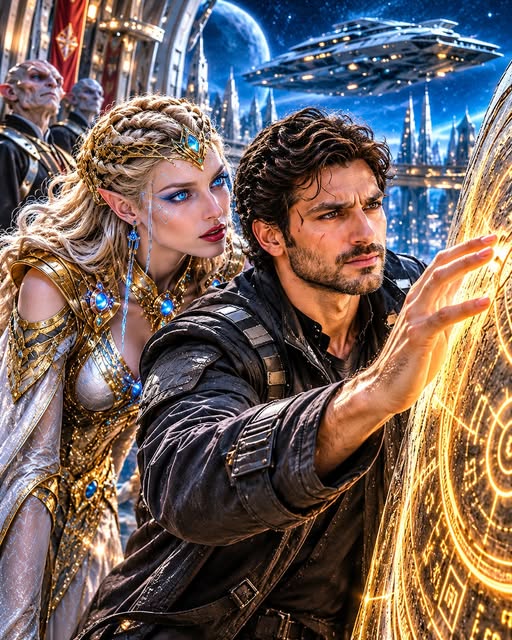
Imran ran his fingers along the sphere’s inner wall, following a line that seemed to disappear beneath the ancient material. Unlike the first opening, this one had no mechanical components, no obvious numerical pattern, and no vibration.
It was completely silent.
That silence troubled him more than anything else.
For eleven days, the sphere had communicated through numbers, frequencies, and carefully arranged geometric structures. Every part of its design suggested that its creators wanted to be understood.
But this second chamber seemed deliberately different.
Imran switched off his maintenance lamp and stood in darkness.
Then he heard something.
Not a sound from the sphere.
A sound from his own breathing.
He took a step backward.
The faint reflection of his breath appeared on the inner surface, revealing a series of microscopic marks that had been invisible under artificial light.
He immediately called Nia.
“Get up. I think we’ve found something.”
Nia arrived three minutes later, still wearing the laboratory jacket she had used as a blanket. Tomas followed with his acoustic equipment.
“What is it this time?” Tomas asked.
Imran pointed toward the inner wall.
“I think the sphere is waiting for a living observer.”
Nia examined the markings.
“That’s impossible. This material has been sealed for thousands of years.”
“Look closer.”
She adjusted her scanner and directed a narrow beam across the surface.
The markings changed.
They weren’t scratches.
They were microscopic channels filled with a substance that reacted to changes in temperature.
Tomas placed his equipment near the wall.
“There’s no vibration,” he said.
“Exactly,” Imran replied. “The first chamber used vibration to communicate. This one uses the absence of vibration.”
Nia frowned.
“How can silence contain information?”
Imran smiled faintly.
“Because silence is only meaningless if you don’t know what you’re listening for.”
They spent the next six hours studying the microscopic channels.
By sunrise, Nia had identified a repeating structure. It contained 17 distinct symbols, arranged in groups of five.
But one symbol appeared more frequently than the others.
It resembled a small circle surrounded by three incomplete rings.
Tomas recognized it.
“I’ve seen that symbol before.”
“Where?” Imran asked.
“On the underside of the Dominion cruisers.”
The room fell silent.
The Dominion had been using the same symbol for centuries.
But why would an ancient civilization’s signature appear on the ships of a military empire that supposedly had no connection to the sphere’s creators?
They checked the Academy’s historical database.
The result was disturbing.
The Dominion’s oldest military records dated back 3,100 years.
However, the symbol appeared in a damaged archaeological document that was estimated to be at least 12,000 years old.
The document described an ancient civilization called the Architects.
According to the surviving records, the Architects had disappeared after building an enormous network of defensive systems throughout the galaxy.
Their technology had later become the foundation of several modern civilizations.
The Dominion claimed to be their rightful successor.
But the document contained one additional detail.
The Architects had not disappeared.
They had deliberately removed themselves from the known universe.
And they had left behind a warning.
NEVER ALLOW THE HEIRS TO COMPLETE THE SEVENTEENTH SEQUENCE.
Nia slowly looked at Imran.
“The Dominion wasn’t trying to steal the sphere because of its defense platforms.”
“No,” Imran replied.
“They were trying to stop us from discovering what it really contains.”
Before Tomas could answer, every light in the gallery turned red.
An alarm echoed throughout the Academy.
Ilvash appeared on the central display, his expression more frightened than any of them had ever seen.
“Dr. Koreshi, you must leave the gallery immediately.”
“Why?”
“Because the Dominion fleet has returned.”
Imran stared at the display.
“That’s impossible. Their ships lost their propulsion systems.”
“They didn’t return with the same ships.”
The screen changed.
Beyond the Academy’s orbital station, a gigantic black structure was approaching.
It was not a warship.
It was something much larger.
A structure nearly 40 kilometers long, covered with thousands of glowing symbols.
At its center was the same circular emblem surrounded by three incomplete rings.
Ilvash spoke quietly.
“The Dominion has activated its ancestral command vessel.”
Tomas swallowed.
“How long until it reaches us?”
“Twenty-three minutes.”
Imran turned toward the sphere.
“Then we have twenty-three minutes to find out what the seventeenth sequence does.”
PART 4 – THE ENEMY WAS NOT WHO THEY THOUGHT
The Academy’s emergency council assembled within minutes.
Representatives from 47 civilizations appeared on the main holographic platform. Some were frightened. Others were furious.
One particularly aggressive representative demanded that humanity be removed from the investigation.
“These primitive visitors have already activated technology that nearly destroyed our entire defense network!”
Ilvash raised one hand.
“They also prevented the Dominion from attacking us.”
“By accident!”
Imran stepped forward.
“Then let me make something clear. We didn’t accidentally open the sphere. We understood its first message. And we can understand the second one.”
A representative with translucent skin leaned toward the microphone.
“Your species has existed for barely a moment in galactic history. Why should we trust you?”
Imran looked directly at him.
“Because your species has had thousands of years to solve this problem. And yet here we are.”
Nobody spoke.
Ilvash intervened before the argument could continue.
“Dr. Koreshi, explain what you have discovered.”
Imran projected the 17 symbols.
“The first chamber contained 61 statements. Together, they formed an instruction manual for the defense network. But this second chamber contains something different. It appears to describe the original purpose of that network.”
He enlarged the seventeenth symbol.
“This is not a command symbol. It’s a warning.”
Nia added another projection.
“The material reacts to biological temperature. That means the second chamber was designed to be accessed by a living organism, not a machine.”
“Why?” asked Ilvash.
“Because machines can repeat information without understanding its consequences,” Nia replied.
Tomas activated an audio recording.
A faint sequence emerged from the speakers.
Seventeen pulses.
Then complete silence.
“The final pulse is missing,” he explained. “And the gap is too precise to be accidental.”
Imran studied the sequence.
He suddenly understood something.
“The Architects weren’t trying to prevent anyone from accessing the final command.”
He turned toward the group.
“They were trying to prevent anyone from activating it without understanding the cost.”
A new transmission interrupted him.
The commander of the Dominion fleet appeared on the holographic platform.
He was an enormous being with dark metallic skin and four luminous eyes.
His name was Commander Varek.
“Representatives of the Galactic Academy,” he announced, “you have 12 minutes to surrender the sphere and all associated research.”
Ilvash stood.
“The Academy will not surrender its discoveries.”
Varek smiled.
“Then you will surrender your lives.”
Imran stepped closer to the transmission.
“Why do you need the sphere?”
Varek’s expression changed.
For the first time, the commander seemed genuinely surprised.
“You have no authority to question me.”
“You’re using technology you don’t understand. You know it, and that’s why you’re here.”
Varek remained silent.
Imran continued.
“The ancient network isn’t a weapon. It’s a communication system. The 212 defense platforms weren’t built to destroy invading fleets. They were designed to prevent something from entering this region of space.”
The commander’s eyes narrowed.
“Stop.”
“Something the Architects were afraid of.”
Varek abruptly terminated the transmission.
The council chamber erupted in confusion.
Ilvash looked at Imran.
“How did you know?”
Imran pointed toward the sphere.
“Because the first defense pulse didn’t destroy the Dominion ships. It stopped them from moving. It was designed to restrain, not kill.”
Nia examined the map again.
“Wait.”
She enlarged the 212 platforms.
“They aren’t positioned around the Academy.”
Tomas moved closer.
“Then what are they surrounding?”
The map rotated.
For the first time, the entire system became visible.
The platforms formed an enormous circular boundary around an apparently empty region of space.
At its center was a star that did not appear in any modern astronomical database.
A dead star.
Its gravitational signature was almost nonexistent, yet the surrounding space seemed distorted.
Imran stared at it.
“The Architects weren’t protecting their civilization from the Dominion.”
He slowly understood.
“They were protecting everyone from whatever is inside that boundary.”
PART 5 – THE SEVENTEENTH SEQUENCE
The next transmission came from the ancestral command vessel.
It contained only one sentence.
“THE BOUNDARY IS FAILING.”
Every scientist in the Academy froze.
Nia immediately opened the sphere’s second chamber.
The seventeen symbols began glowing.
Tomas measured the frequency.
His equipment registered an unexpected pattern.
The missing seventeenth pulse was not absent.
It was being transmitted from the dead star.
And it was getting stronger.
“Imran,” Tomas whispered, “whatever is there has been responding to us.”
Imran studied the data.
The signal contained the same 61-beat rhythm from the first chamber.
But this time, the pattern was reversed.
The Architects had left a message in two directions.
One sequence described how to build the boundary.
The other described how to maintain it.
And the missing seventeenth sequence was the command that connected both.
Nia’s voice trembled.
“If we complete it, we might strengthen the boundary.”
“Or open it,” Tomas replied.
Imran nodded.
“That’s why the final instruction was left incomplete. The Architects wanted someone to make a decision, not simply follow a program.”
Ilvash looked horrified.
“You are suggesting that this entire system depends on a decision made by an individual?”
“Not an individual,” Imran said. “A civilization.”
He explained his reasoning.
The first chamber had tested mathematical understanding. The second tested observation. But the missing sequence required something neither mathematics nor observation could provide.
It required a choice.
The Architects had designed a system that could only be activated by someone willing to accept responsibility for its consequences.
A machine could calculate the most efficient answer.
A military commander could choose the most powerful answer.
But neither could understand why restraint might be more important than victory.
Imran turned toward the council.
“We have two options. We can activate the final sequence and risk opening the boundary, or we can leave it untouched and allow whatever is inside to emerge.”
“How much time do we have?” Ilvash asked.
Tomas checked his instruments.
“Seven minutes.”
The room became chaotic.
Several representatives demanded evacuation.
Others insisted that the Academy destroy the sphere.
Then Varek transmitted again.
This time, he appeared without his military armor.
“My people have guarded the boundary for 3,100 years,” he said.
Imran stared at him.
“Why didn’t you tell us?”
Varek looked exhausted.
“Because we were ashamed.”
The commander explained that the Dominion’s founders had discovered the Architects’ technology thousands of years earlier. They had mistaken the defensive network for a weapon and built their civilization around controlling it.
For generations, their rulers had believed that the dead star contained an unlimited source of energy.
They had spent centuries trying to access it.
Every attempt weakened the boundary.
The current Dominion leadership had finally discovered the truth.
But by then, the damage was already done.
“We came for the sphere because we believed it contained the original command,” Varek said. “We wanted to restore the boundary before it collapsed.”
“Then why did you attack us?” Nia demanded.
“Because our intelligence reports said the Academy had activated the network. We believed you would destroy everything before we could stop you.”
Imran stared at the commander.
“Your fleet is responsible for the instability.”
Varek lowered his head.
“Yes.”
For a moment, nobody spoke.
Then the dead star emitted a massive pulse.
Every screen went dark.
When the lights returned, the map had changed.
Something had appeared inside the boundary.
A gigantic structure, larger than the Academy itself, was slowly moving through the distorted space.
It had no visible engines.
No weapons.
No recognizable shape.
It looked almost like a shadow cast by something that did not belong in the universe.
The Architects had not imprisoned an enemy.
They had imprisoned an entire civilization.
PART 6 – THE LAST CHOICE
The sphere began to vibrate.
Its inner chamber opened completely, revealing a small crystalline object suspended in the center.
Imran approached it.
A series of symbols appeared across its surface.
Nia translated the first line.
“To preserve the boundary, all connected systems must be synchronized.”
Tomas examined the remaining text.
“There is a second condition.”
He paused.
“One civilization must surrender control of the network permanently.”
Ilvash looked confused.
“Why would anyone do that?”
Imran understood.
The Architects had learned that the greatest danger was not the imprisoned civilization.
It was the temptation to control the power that held it.
The Dominion had spent thousands of years fighting for ownership of the network. Every empire that discovered it would eventually try to turn it into a weapon.
The only way to prevent another conflict was to remove the possibility of ownership.
The network had to become a shared responsibility.
But there was a problem.
The synchronization required every active platform to receive the same command simultaneously.
Two hundred and twelve platforms.
Across an enormous region of space.
And the Academy’s communication network was too slow.
“We can’t transmit the sequence in time,” Tomas said.
Imran looked at the map.
“Unless we use the Dominion ships.”
Varek immediately understood.
“Our engines operate on the same frequency.”
“Exactly. Your fleet can relay the command faster than the Academy’s entire network.”
The commander hesitated.
“That would require every ship to enter the boundary.”
“Yes.”
“And if we fail?”
“Then none of us will leave.”
Varek looked toward the enormous shadow approaching the edge of the boundary.
For 3,100 years, his people had believed that power meant controlling others.
Now their survival depended on doing something they had never learned to do.
Trust.
Varek turned toward his officers.
“Prepare every vessel. We will assist the humans.”
Within minutes, nine Dominion cruisers and the ancestral command vessel formed a transmission chain.
The Academy contributed its research stations.
The 212 platforms began awakening one by one.
Imran entered the final sequence.
But the system rejected it.
A message appeared.
FINAL AUTHORIZATION REQUIRED.
Nia examined the symbols.
“There’s another condition.”
Tomas read the translation aloud.
“The civilization initiating the command must accept that the network may never obey it again.”
Imran looked at the screen.
That was the real test.
The Architects were asking whoever activated the network to surrender the power it offered.
No weapons.
No ownership.
No guarantee of protection.
Only cooperation.
Ilvash approached him.
“Dr. Koreshi, if you proceed, the Academy will lose access to technology that could transform our civilization.”
Imran looked at him.
“Then perhaps that’s exactly what we need to lose.”
He placed his hand on the crystalline object.
For a brief moment, he thought of Earth.
Of the observatories where his research had been dismissed.
Of the rejection letter suggesting that humanity should wait another 11,000 years.
He thought of every civilization that had mistaken age for wisdom.
Then he entered the final command.
WE CHOOSE TO PROTECT WHAT WE DO NOT OWN.
The sphere exploded with light.
Across the system, 212 platforms synchronized.
The Dominion cruisers transmitted the sequence.
The Academy’s orbital stations joined the network.
And the boundary began to close.
But the shadow did not retreat.
Instead, it moved faster.
A massive wave of distorted space spread toward the nearest platform.
The first platform disappeared.
Then the second.
Then the third.
“Imran!” Tomas shouted. “We’re losing synchronization!”
Nia checked the data.
“The boundary is collapsing faster than the network can rebuild it!”
Imran stared at the frequency readings.
He realized that the Architects had designed the system to respond to a specific rhythm.
But the shadow was producing an opposing signal.
The two frequencies were canceling each other.
He needed something that could stabilize the rhythm.
Something that could bridge the difference.
Then he remembered the first mystery.
Sixty-one beats.
A carefully measured silence.
And the missing signal from the outer halo.
The answer had been there from the beginning.
He turned toward Tomas.
“Can you generate the original rhythm?”
“Yes, but not at the required intensity.”
“What if we use the ships?”
Tomas looked at the Dominion fleet.
Their engines could produce the exact frequency.
But they would need to operate beyond their safety limits.
Varek understood immediately.
“Commander,” Imran transmitted, “I need your fleet to generate a continuous harmonic pulse.”
“That will destroy our propulsion systems.”
“Possibly.”
“Possibly?”
Imran didn’t answer.
Varek looked toward his officers.
Then he gave the order.
“All ships. Maximum harmonic output.”
Nine enormous cruisers and the ancestral command vessel began vibrating in perfect synchronization.
The sound was too deep for most species to hear.
But every instrument in the system registered it.
The 61-beat rhythm returned.
The boundary stabilized.
The shadow stopped moving.
For a terrifying moment, the entire universe seemed to hold its breath.
Then the ancient structure inside the dead star turned away.
It began retreating into the darkness.
One by one, the 212 platforms went silent.
The boundary closed.
And the system was saved.
PART 7 – THE GALAXY’S YOUNGEST CIVILIZATION
Three days later, the Galactic Academy held its largest assembly in 600 years.
Every major civilization sent a representative.
The Dominion fleet had surrendered its control over the ancient network. Its commander had agreed to participate in an independent investigation into the Architects’ technology.
The Academy had also established a new scientific organization.
Its purpose was to study ancient civilizations without allowing political or military powers to control their discoveries.
But the most important change involved the admission system.
For the first time in its history, the Academy removed the minimum historical-age requirement.
Instead, applicants would be evaluated according to their actual knowledge, creativity, and ability to solve problems.
Ilvash personally presented the revised charter.
Then he invited Imran, Nia, and Tomas to stand before the assembly.
“I once believed that intelligence was something measured by the length of a civilization’s history,” he admitted. “I was wrong.”
He turned toward Imran.
“Dr. Koreshi, the Academy would be honored to offer you a permanent position as its youngest senior researcher.”
Imran accepted.
Nia became director of materials research.
Tomas was appointed head of acoustic systems.
The audience applauded.
But Imran didn’t seem particularly interested in the ceremony.
He was looking at a small envelope resting on the table.
It was his original rejection letter.
Ilvash noticed.
“You kept it?”
“Of course.”
“Why?”
Imran folded it carefully.
“Because I don’t want to forget how this started.”
He looked toward the assembly.
“Your mistake wasn’t rejecting three human applicants. Your mistake was believing that the right to ask questions belonged only to civilizations that had existed long enough.”
He paused.
“Knowledge doesn’t become valuable because it’s old. And curiosity doesn’t become legitimate because someone gives it permission.”
The room remained silent.
Then a young representative from a distant colony stood.
“My civilization is only 800 years old,” she said. “We have never been allowed to apply. Could we now?”
Ilvash smiled.
“Yes.”
Another representative rose.
Then another.
Within minutes, dozens of civilizations were requesting admission.
For the first time, the Academy’s doors were truly open.
And the galaxy began to change.
EPILOGUE – THE MESSAGE FROM THE STARS
Six months later, Imran returned to Earth.
He stood inside the observatory where he had first discovered the mysterious radio signal.
The same observatory where colleagues had dismissed his findings.
The same building where he had spent fourteen years wondering whether anyone beyond Earth would ever understand what he was trying to say.
Now, the entire facility had been transformed into humanity’s first interstellar research center.
Nia was working on a new material that could withstand the extreme conditions near the dead star.
Tomas was coordinating a network of acoustic observatories across three planets.
And Imran had received something unexpected.
A message from the Galactic Academy.
The ancient sphere had activated again.
Not because of a malfunction.
Because it had received a new transmission.
This time, the signal was not coming from the dead star.
It was coming from somewhere beyond the known galactic boundary.
Imran opened the file.
The message contained a sequence of 61 beats.
Then a silence.
Then 17 symbols.
Nia joined him at the console.
“Another mystery?”
Imran smiled.
“Looks like it.”
Tomas appeared on the communication screen.
“How long do you think it’ll take?”
Imran examined the final symbol.
It was different from anything they had seen before.
For the first time, the message included a recognizable word.
Not in the language of the Architects.
Not in any language recorded by the Academy.
It was written in ancient human script.
HELLO.
The three scientists stared at the screen.
Someone had been watching Earth.
Someone had known humanity existed long before the Academy had even considered admitting it.
And someone had deliberately chosen to communicate in a language that humans could understand.
Imran slowly sat down.
“There’s something else.”
He enlarged the final section.
Beneath the word HELLO was a second sentence.
WE HAVE BEEN WAITING FOR YOU TO GROW OLD ENOUGH TO REMEMBER.
For several seconds, nobody spoke.
Then the observatory’s instruments detected another transmission.
This one was much stronger.
It contained a map.
Not of the galaxy.
Not of the known universe.
It showed Earth.
But the planet was marked with a symbol that had appeared on the ancient sphere.
The symbol of the Architects.
Imran leaned back.
He had spent his entire career searching for evidence that humanity was not alone.
He had found it.
Then he had spent eleven days proving that intelligence could come from a civilization the galaxy considered insignificant.
He had found that, too.
But now he was beginning to understand something far more extraordinary.
Perhaps humanity had never been an accidental late arrival in the galactic story.
Perhaps Earth had been part of that story all along.
He looked at Nia and Tomas.
“Well,” he said, “I suppose the Academy’s 43 unsolved problems will have to wait.”
Nia laughed.
“You’re already thinking about the next one, aren’t you?”
Imran smiled.
“Wouldn’t be much of a scientist if I wasn’t.”
Outside, the stars stretched across the night sky.
For thousands of years, humanity had looked upward and wondered whether anyone was listening.
Now the universe had finally answered.
And somewhere beyond the boundaries of known space, an ancient civilization was waiting for humanity to ask its next question.
THE END.
The lesson of the story:
Civilization is not measured by how long a species has existed, how many wars it has won, or how much technology it possesses. True advancement is measured by its willingness to learn, its courage to question what everyone else accepts, and its ability to use knowledge responsibly.
The Galactic Academy had spent 9,000 years searching for the key to an ancient mystery. Three rejected humans solved it because they approached the problem without assuming that the old answers were necessarily correct.
Their greatest achievement was not opening the sphere, defeating the Dominion, or saving an entire star system.
It was proving that intelligence has no age limit, curiosity has no borders, and wisdom begins when we stop believing that we already know everything.