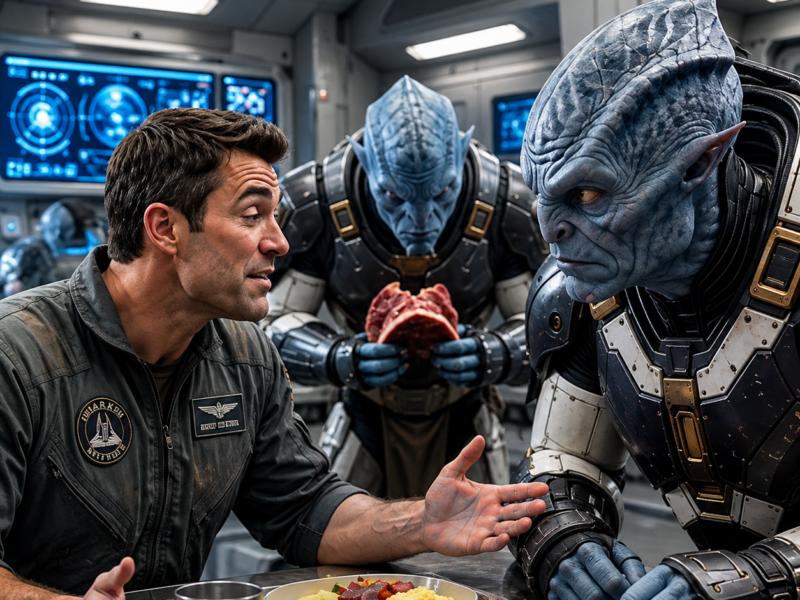
The first time Commander Varkh saw my breakfast, he laughed so hard that the alien warriors around him began slapping the metal table, but when I told them what bacon was made from, the laughter died—and one of the most feared commanders in the galaxy slowly reached for his weapon.
The metal mess hall of the Iron Eclipse always smelled faintly of burnt ozone and recycled air.
I sat at the end of the long obsidian table, nursing my cup of dark roast coffee and flipping strips of thick-cut cured pork in my small induction skillet.
Around me stood towering alien warriors, their blue-scaled arms folded over heavily armored chests as they watched my morning ritual.
To the Khar’Zul, eating was supposed to be a brief, cold necessity—a matter of consuming raw nutrient paste to fuel the war machine.
Seeing a human carefully season, heat, and sear organic matter every single morning was a baffling spectacle.
Commander Varkh stood at the head of the gatherers, his glowing golden eyes fixed entirely on my pan.
He was nearly seven feet tall, covered in thick chitinous scales, and possessed a reputation for razing entire rebel outposts without blinking.
Yet right now, he looked entirely perplexed by a piece of breakfast meat.
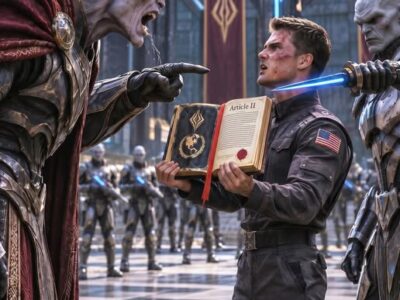
“Your species burns its food before eating it?” Varkh sneered, pointing a clawed finger at my plate.
“No,” I replied smoothly, using my tongs to flip another strip until it crackled. “We improve it.”
The surrounding warriors erupted into booming, metallic laughter that rattled the steel bulkheads.
They nudged each other, pointing at the wisps of aromatic smoke rising toward the ventilation grid.
Varkh did not laugh long; instead, he leaned down, his massive frame towering over my small folding chair.
“What creature provides this… crispy delicacy?” he demanded, his deep voice vibrating through the deck plates.
I took a quiet sip of my coffee and looked up at him.
“Pig.”
The laughter died so abruptly it felt as though the atmospheric pressure in the room had dropped.
Several warriors exchanged swift, uneasy glances, their grip tightening on their sidearms.
Varkh’s massive hand, which had been resting on the edge of the metal table, froze instantly.
“Repeat that word,” he whispered, his tone stripped of all amusement.
“Pig,” I said, frowning slightly at the sudden shift in mood. “A domesticated animal back on Earth. Pretty intelligent, actually. We raise them for meat.”
The commander stood up so abruptly that his heavy alloy chair scraped violently across the floorboards.
“Describe this creature,” he commanded, his chest heaving slightly.
I pulled out my standard-issue datapad, unlocked the screen, and swiped to a high-resolution photo of a farm back in Iowa.
It showed a pink, stout pig rolling contentedly in a mud pit under the bright sun.
For several agonizing seconds, nobody in the hall uttered a sound.
The only noise was the steady, gentle sizzle of the cooling meat in my skillet.
Then Varkh spoke two quiet, gutteral words in his native tongue.
Instantly, every single Khar’Zul warrior in the mess hall dropped to one knee, bowing their heads toward the glowing screen of my tablet.
I stared around the room in utter disbelief.
“Okay…” I stammered, raising my hands slightly. “What did I miss?”
Varkh turned his gaze toward me, looking at me not as a subordinate logistics officer, but as though I had just confessed to an impossible cosmic crime.
“Our oldest legends speak of the Ashborn,” he said, his voice trembling with a rare, terrifying reverence.
“A sacred beast that protected our ancestors from the microscopic parasites that once consumed our ancient cities.”
He stepped closer and pointed a trembling, clawed index finger directly at the pig on my screen.
“It looked exactly like this.”
I blinked, taking a quick step back against the galley counter.
“You’re telling me your sacred, legendary savior beast… was a pig?”
“Not merely a pig,” Varkh growled, his golden eyes blazing with intensity. “The last Ashborn disappeared from our homeworld thousands of years ago during the Great Eclipse.”
He leaned in closer, his heavy scales shifting with a dry, rustling sound.
“Our highest historians believed your kind had never encountered one.”
I tried to laugh it off, hoping to break the choking tension in the room, but his icy expression cut me off immediately.
“Commander, pigs have been a standard part of human agriculture for thousands of years,” I explained carefully. “They’re everywhere on Earth.”
Varkh’s blue skin drained of color, turning a pale, sickly gray beneath his scales.
“Then your ancestors may have taken the last Ashborn from our world.”
“That’s impossible,” I countered instantly, holding my ground. “Humans didn’t even achieve faster-than-light travel until two centuries ago. We didn’t know your species existed.”
“Perhaps,” Varkh replied, his voice chillingly calm now.
He snapped his fingers, gesturing to his second-in-command, Lieutenant Kael.
The officer scrambled to his feet, turned on his heel, and hurried out of the mess hall down the primary corridor.
Minutes felt like hours as the rest of the warriors remained on one knee, maintaining their silent vigil around my breakfast plate.
When Kael returned, he carried a heavy, ancient digital archive unit—a relic from the early expansion era of the Khar’Zul Empire.
Varkh took the device, cleared the table with a sweep of his arm, and slammed the projector onto the surface.
A dusty, flickering blue hologram expanded into the air between us.
It displayed records from an unrecorded deep-space expedition—a fleet that had vanished long before humanity ever dreamed of touching the stars.
The file cycled through degraded environmental scans, star maps, and corrupted audio logs.
Then, a clear image opened before us.
It depicted a wide cargo bay, where a stout, four-legged creature was being led up a ramp into a primitive agricultural transport vessel.
My stomach dropped into a cold pit.
The creature had the exact same rounded snout, floppy ears, and stocky body as the animal on my tablet.
Six Chilling Words
Varkh reached out with his claw and enlarged the holographic image, focusing on the neck of the beast.
A faded metal identification collar hung loosely around its thick neck.
Stamped clearly into the weathered alloy was an emblem I knew better than my own name.
It was the interlocking star pattern of humanity’s First Contact Exploration Fleet—the very pioneers who first stepped outside the Sol system.
Beneath the emblem were two lines of text.
The first was written in archaic English, and the second was translated into ancient Khar’Zul glyphs.
It read six chilling words:
PROPERTY OF KHAR’ZUL EMPIRE – SACRED ASSET
My breath hitched in my throat as the implications crashed over me like a tidal wave.
Our earliest space pioneers hadn’t just discovered new worlds; they had scavenged them.
They had found a dying world, taken its most revered lifeform, and re-branded it as livestock.
Varkh slowly turned his head toward me, his golden eyes locked onto mine with terrifying focus.
“Human,” he whispered, his voice dangerously low. “What else have your people brought home?”
The mess hall remained dead silent as Varkh slowly drew his sidearm, resting the heavy plasma sidearm on the metal table between us.
He didn’t point it at me, but the threat was implicitly clear.
“Commander,” I began, my voice shaking slightly despite my best efforts. “We didn’t know. Our historians recorded pigs as terrestrial animals dating back to ancient Mesopotamia.”
“Then your records were wiped,” Varkh stated coldly. “Or deliberately rewritten to hide a sacrilege.”
He tapped a command sequence into his wrist communicator, opening an encrypted, high-priority channel directly to the Khar’Zul High Command on their homeworld.
A towering hologram of High Chancellor Korath materialized in the center of the room.
The Chancellor’s ancient, battle-scarred face looked down at Varkh with stern authority.
“Report, Commander Varkh. Why do you use the priority channel?”
Varkh gestured toward the flickering image of the pig on my tablet and then to the sizzled meat on my plate.
“Chancellor. The human on board is consuming the flesh of the Ashborn.”
The Chancellor’s eyes widened in sudden, horrifying realization.
“Explain yourself, Commander,” Korath demanded, his voice echoing through the comms system like thunder.
Varkh presented the archived logs, showing the timestamp of the human transport ship and the collar tag.
“It appears the human species did not merely encounter the Ashborn,” Varkh said softly. “They harvested them. They have turned our sacred protectors into their primary food source.”
The Chancellor went entirely still, his glowing eyes scanning the historical data.
On Earth, pigs were just farm animals, a staple of breakfast plates across the globe.
Here, in the heart of Khar’Zul space, I was standing in front of a warlord holding proof of an ancient, accidental cosmic theft.
“Human,” the Chancellor spoke directly to me, his tone heavy with ancient wrath. “Do your people realize what the Ashborn represent?”
“No, Chancellor,” I said quickly, stepping forward into the holographic light. “To us, they are just animals. We had no idea they came from your world.”
“They were not just animals,” Korath growled. “Their blood contained the biological key to immune immunity against the Spore Plague that nearly wiped out our species.”
“When they vanished, millions of our people perished in the Dark Age.”
The gravity of the situation pressed down on my chest like a lead weight.
If the Khar’Zul High Council declared this an act of war, the fragile peace treaty between humanity and the Empire would crumble in an instant.
Earth’s defense fleets were no match for the sheer armada of the Khar’Zul war machine.
All over a plate of breakfast.
“Chancellor,” I pleaded, keeping my voice as steady as possible. “If our ancestors took the Ashborn, it was done before our modern civilization was formed.”
“We cannot undo the past, but we have the genetic sequencing!”
Varkh looked up at me sharply, his hand tightening near his weapon.
“What do you mean, human?”
“We have the full DNA map of the pig,” I explained rapidly, tapping my pad to pull up biological records.
“We have preserved their genetic code for centuries. If the Ashborn held the key to your ancient immunity, we can give you that data right now.”
Chancellor Korath leaned forward in the holographic projection, his sharp teeth bared in thought.
“You offer us the genetic secrets of our lost protectors?”
“Yes,” I said without hesitation. “Everything. Every strand of DNA, every medical study, every breeding record we have.”
Varkh looked at the plate of bacon on the table, then back at me.
“And what of your people’s consumption of them?”
“That stops here—at least on this ship,” I said, carefully picking up the skillet and stepping away from the table.
“I will purge all animal tissue samples from the ship’s replicators immediately.”
The Chancellor remained silent for a long, agonizing minute, calculating the political and spiritual cost of this discovery.
Finally, he closed his eyes and let out a deep, rumbling sigh.
“Send the genetic archives to our medical division immediately, Commander.”
“If the data is complete, we shall treat this not as a crime of intent, but as an ancient tragedy.”
The holographic transmission flickered out, leaving the mess hall in tense, exhausted silence.
Varkh slowly holstered his plasma weapon and stood up to his full height.
The warriors around him rose from their knees, their eyes still fixed on the plate of meat on the table.
“You saved your life today, human,” Varkh said quietly, stepping closer to me. “And perhaps the lives of your entire fleet.”
He looked down at the plate one last time, a strange, complex emotion sweeping across his scaled face.
“Is it truly… that flavorful?” he asked unexpectedly.
I paused, looking at the feared commander of the Iron Eclipse.
“It’s pretty good,” I admitted quietly. “But I think I’m switching to oatmeal.”
Varkh stared at the plate for a moment longer, then walked toward the exit doors.
“Wise choice,” he murmured as the blast doors slid shut behind him. “For your sake, ensure the replicators learn to make oatmeal very well.”