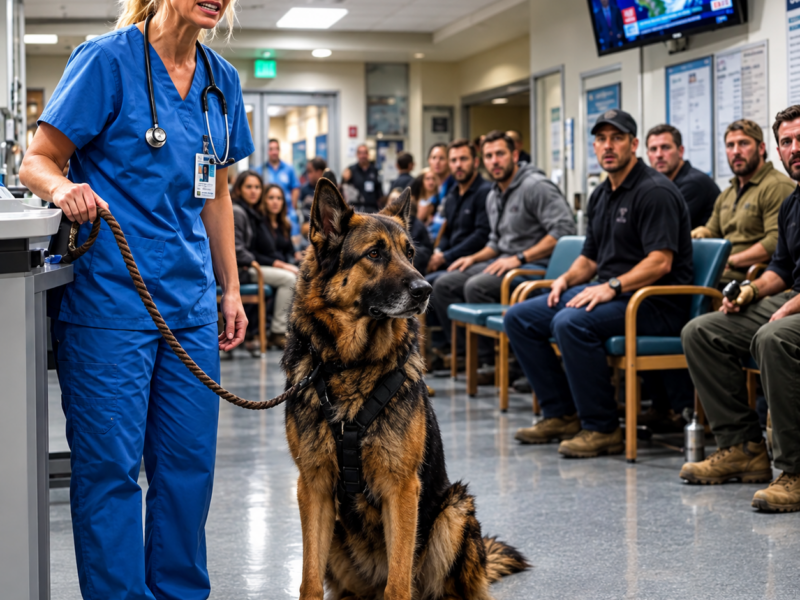
The ER waiting room went silent when a terrified nurse shouted, “Is anyone looking for this K9?” and every SEAL in the room suddenly stood up, while I watched from behind the trauma doors, knowing the dog had not come to the hospital by accident—he had carried evidence of a secret someone had killed to bury.
The night shift at Harborview Medical Center usually tasted like lukewarm drip coffee and burnt ozone.
It was three in the morning when the heavy glass doors burst open, letting in a bitter squall of rain and cold Virginia wind.
A ragged, mud-drenched German Shepherd limped across the polished tile floor.
He was bleeding from his left flank, his ears pinned back, dragging a strip of torn tactical nylon that trailed behind him like a broken leash.
Nurse Melissa gasped, dropping her clipboard onto the counter with a loud clatter.
I stepped out from behind the primary triage station, throwing a pair of nitrile gloves onto my hands.
“Easy, buddy,” I whispered, dropping low to the floor and holding out a palm. “I’ve got you.”
The dog didn’t flinch or bare his teeth.
He simply stood his ground, trembling violently, his dark brown eyes locked on the swinging double doors leading into the trauma bay.
His chest heaved with shallow, ragged breaths.
I reached out, gently smoothing down the matted fur around his shoulder.
That was when my fingers brushed against something stiff tucked beneath his heavy leather collar.
It was a faded, grease-stained military patch sewn into the inner lining.
Melissa leaned over my shoulder, squinting through her rain-spotted glasses.
“SEAL Team,” she whispered, her voice dropping into a sudden, stunned hush.
The tension in the waiting room snapped instantly.
A dozen men in dark jackets, all carrying the same quiet discipline and short hair, froze in place.
One man near the water cooler stood up slowly.
Then another.
Within five seconds, every team member in the room was on his feet.
The silence grew so heavy you could hear the rain hammering against the glass facade.
The German Shepherd suddenly broke away from my hands.
He ignored the younger men completely, dragging his bad leg as he trotted straight toward a gray-haired man sitting alone in the shadow of the wall-mounted television.
The old man looked up, and his face drained of every ounce of color.
“That’s impossible,” he whispered, his knuckles turning chalk-white on the armrests.
The dog didn’t tail-wag or whine.
He dropped his head low and let out a deep, chest-vibrating growl that echoed off the high ceilings.
I stepped closer, taking in the small details that everyone else in the panicked room was missing.
Below the main emblem on the soaked tactical patch, three tiny white letters had been hand-stitched with heavy fishing line.
E-L-I.
“Who is Eli?” I asked, my voice cutting through the silence.
Nobody in the room answered me.
The gray-haired man slowly lowered his head, staring down at his scarred palms.
“You don’t want to know, Doctor,” he said softly.
Twenty minutes before the dog limped into the lobby, an unmarked ambulance had dumped a young Marine at our bay doors.
He was unconscious, covered in third-degree rope burns, suffering from a severe concussion following a high-speed crash on Highway 17.
His state driver’s license had been melted beyond recognition inside his back pocket.
His phone was missing.
The only piece of personal property found on him was a laminated photograph inside his blood-soaked jacket.
It showed a boy no older than six, smiling with a missing front tooth, sitting next to a massive German Shepherd.
The same dog currently standing five feet away from me.
I backed out of the main lobby and pushed through the heavy stainless steel doors into Bay 3.
The young Marine lay beneath the harsh fluorescent overhead lights.
Monitor leads clung to his pale chest, and the heart monitor beat out a steady, rhythmic pulse.
He couldn’t have been more than twenty-five years old.
I grabbed a wet swab, gently wiping a smudge of road grime from his left forearm.
A thick, dark scar caught my eye—a perfectly shaped crescent moon carved deep into his skin.
Outside the door, the German Shepherd pressed his snout against the glass window.
When he saw the scar on the young man’s wrist, he began to whine, a high, pitched sound of pure agony.
A shadow fell over the doorway.
One of the younger operators from the waiting room slid quietly into the bay, letting the heavy door seal shut behind him.
“Doctor,” he said, keeping his voice barely above a whisper. “That man lying on that gurney isn’t Eli’s father.”
My hand hovered over the Marine’s IV line.
“Then who is he?” I asked, looking up.
The operator tilted his head subtly back toward the lobby where the gray-haired man sat.
“He’s the reason Eli disappeared eighteen months ago.”
A cold spike of dread shot straight down my spine.
Before I could ask another question, the overhead lights flickered twice and died.
The emergency red generators kicked in with a deep rumble beneath our feet, bathing the hallway in a eerie, blood-orange light.
High above us, the fire alarm began to scream, its strobes flashing rapidly against the concrete walls.
Panic erupted in the main corridor as nurses scrambled to secure medical carts and patients.
I spun back toward the glass window.
The gray-haired man’s chair in the waiting room was empty.
He had vanished into the chaos of the flashing red lights.
The German Shepherd didn’t hesitate.
He lunged through the partial opening of Bay 3, barking wildly as he slammed his front paws against the side of the hospital bed.
I jumped back as the young Marine on the gurney convulsed violently.
His eyes snapped wide open, bloodshot and frantic.
His right hand shot out like a steel vise, locking around my left wrist with terrifying strength.
“Don’t… trust…” he gasped, his voice raspy from smoke inhalation.
He coughed up a fleck of dark blood, pulling me down until his lips were inches from my ear.
“Don’t trust the SEALs,” he breathed.
His fingers slowly uncoiled from my arm, pointing toward the dog standing beside his gurney.
The German Shepherd raised his neck, and I saw a small red LED light blinking rapidly inside the thick leather of his collar.
My heart hammered against my ribs.
I reached out with trembling fingers, feeling along the reinforced stitching beneath the dog’s throat.
A tiny, spring-loaded plastic hatch clicked open under my thumb.
Inside the hidden compartment lay a folded photograph, a brass key, and a tightly rolled scrap of waterproof paper.
I unrolled the note under the dim emergency light.
“If you’re reading this, Eli is still alive,” the handwritten message read. “And they are coming to finish it.”
I thrust the note deep into my scrubs pocket just as heavy boots echoed down the hallway.
Four of the operators stepped into the bay, their shoulders broad enough to completely block out the red emergency lighting.
“Doctor,” the lead operator said, his voice flat and calm. “We need you to step away from the patient and the dog.”
“He’s unstable,” I lied, stepping between them and the bed. “He has a suspected cervical spine injury and severe internal bleeding.”
“The hospital is on lockdown,” the man replied, taking one step forward. “Police were notified of a tactical threat nearby. We’re securing the floor.”
I glanced past his shoulder through the observation window.
Two other men were dragging heavy emergency crash carts across the main lobby doors, jamming the handles together to block the exit.
They weren’t protecting us from an outside threat.
They were locking us inside with them.
The German Shepherd let out a low growl, pressing his side against my knees.
“Where is the older man who was sitting under the TV?” I asked, keeping my tone as neutral as possible.
The lead operator didn’t blink.
“Commander Vance is coordinating with local law enforcement from the administrative office.”
That was a lie.
I had seen Commander Vance walk in the opposite direction, toward the basement stairs where the hospital’s main server rooms were kept.
The Marine on the bed let out a weak groan, his eyes rolling back into his head as his heart monitor began to beep in an irregular, erratic cadence.
“He’s crashing,” I said quickly, reaching for a syringe of saline to create a distraction. “I need room to work!”
The operators took a half-step back, giving me a tiny window of space.
I grabbed the dog by his collar, slipped through the side curtain into the adjacent utility room, and hit the lock button on the heavy wooden door.
The utility door rattled violently behind me as someone slammed their weight against it.
“Open the door, Doctor!” a voice barked from the hallway. “Don’t make this complicated.”
I didn’t answer.
I pointed down the narrow maintenance hallway toward the laundry chute hatch.
The German Shepherd trotted ahead of me, his limp noticeably lighter now as the adrenaline took over his system.
We squeezed into the cramped service elevator meant for linen carts and hit the button for Basement Level 2.
The rusted elevator groaned as it descended into the dark belly of the hospital.
I pulled out the items I had taken from the dog’s collar.
The brass key was stamped with a five-digit number: 40822.
The photograph showed the same little boy, Eli, holding a wooden toy boat while sitting on a dock behind a dark grey lake house.
On the back of the photo, written in faded blue ink, were two words: PROJECT ECHO.
The elevator jolted to a heavy stop, and the doors slid open into a damp, concrete corridor lined with heavy steam pipes.
The air down here smelled like stagnant water and hot dust.
The German Shepherd immediately bolted out of the car, his nose pressed flat against the concrete floor.
“Hey! Wait!” I whispered, jogging after him in my rubber-soled nursing shoes.
He stopped in front of a locked steel door labeled RECORDS ARCHIVE – 1980-2005.
The brass lock on the door was identical to the key in my hand.
I looked down at the dog, whose ears were perked, listening intently to the floor above us.
“Is he in there?” I whispered.
The dog let out a tiny, barely audible whimpering sound and nudged my hand with his cold, wet nose.
The key turned smoothly in the old brass tumbler, and the heavy door swung open with a rusty moan.
The room inside was vast, packed with row after row of dusty metal filing cabinets under flickering strip lighting.
The dog trotted straight down the third aisle, stopping at a bottom drawer marked with a faded yellow tag: VA CONTRACTS – SPECIAL OPERATIONS.
I knelt in the dirt, my hands trembling as I pulled the drawer open.
It was packed tight with thick manila folders.
I flipped through them rapidly until I found a file bearing the same crescent moon emblem that was scarred into the Marine’s wrist.
Inside were classified transfer orders, medical charts, and a series of blurred surveillance photographs.
The photographs showed Commander Vance standing next to a high-ranking military official inside a secluded compound.
In every picture, a small boy with dark hair was visible in the background, surrounded by guard dogs.
Eli wasn’t just a missing child.
He was the biological son of a whistleblowing naval engineer who had died under mysterious circumstances two years ago.
Vance hadn’t been searching for Eli to save him.
He was using the boy to force the young Marine—Eli’s uncle—to hand over a set of encrypted drive keys.
A sharp click sounded behind me in the dark aisle.
“You should have stayed in the ER, Doctor,” a voice said smoothly from the shadows.
I turned around slowly, my back pressed against the cold metal cabinet.
Commander Vance stood ten feet away, holding a suppressed pistol leveled directly at my chest.
“You’re a doctor,” Vance said softly, taking a slow step forward. “You fix broken bones and sew up lacerations. You don’t belong in this.”
The German Shepherd stood beside my right leg, his teeth bare, a terrifying rumble rising from his chest.
“He’s just a child,” I said, holding the thick file tightly against my ribs. “What did you do to Eli?”
Vance smiled, though his eyes remained entirely cold and lifeless.
“Eli is fine. He’s safe at a secure facility in Maryland, completely unaware of the mess his father left behind.”
“You killed his father,” I said, testing him.
“His father was a traitor who tried to sell tactical encryption software to foreign contractors,” Vance snapped, his voice losing its calm composure for a fraction of a second. “His uncle—that idiot lying upstairs in your trauma bay—thought he could play hero and hide the master drive.”
“And the dog?” I asked, eyeing the distance between us.
“The dog was supposed to be shot along with the Marine on the highway,” Vance said, raising the pistol higher. “It seems my men were careless.”
The dog didn’t wait for Vance to pull the trigger.
With a fierce, explosive roar, the German Shepherd launched himself off the concrete floor, diving straight for Vance’s throat.
The suppressor went off with a soft, dull thwack.
The bullet shattered the concrete wall inches above my ear.
Vance screamed as the dog’s jaws locked onto his arm, slamming his back against a row of filing cabinets.
The heavy steel cabinet tipped forward, crashing down on top of both of them with a thunderous roar of tearing metal and falling paper.
I didn’t hesitate.
I grabbed the manila file, reached down into the wreckage, and grabbed the German Shepherd by his harness, pulling him free from Vance’s flailing grip.
The dog was bleeding from a fresh graze on his shoulder, but he scrambled to his feet instantly.
Vance was pinned beneath the heavy steel cabinet, groaning in pain, his weapon lost somewhere in the mountain of scattered paper.
“Run!” I yelled, pulling the dog toward the back exit of the archive room.
We burst through a set of heavy push-bars, emerging into a narrow service alley behind the hospital’s loading docks.
The rain was falling in heavy, blinding sheets now.
In the distance, the sirens of local police cruisers were finally approaching, their blue lights reflecting off the wet asphalt.
The side door of an unmarked black SUV parked across the alley slammed open.
Two more armed men stepped out, their faces obscured by dark rain gear.
“Doctor! Get down!” a voice shouted from behind me.
I spun around to see the young Marine, his hospital gown soaked in blood and rain, leaning heavily against the open doorway behind us.
He was holding a heavy steel fire extinguisher in his left hand.
With his remaining strength, he slammed the heavy extinguisher against the crash bar of the service door, jamming the lock from the inside and trapping Vance’s men in the hallway.
He fell to his knees on the slick pavement, gasping for breath.
“The key…” he wheezed, looking up at me. “Do you have the key?”
I reached into my pocket and held up the brass key.
“Where does it lead?” I shouted over the noise of the rain.
“The dock,” the Marine gasped, forcing himself up by gripping my arm. “The photo… the house on the lake…”
The German Shepherd barked twice, running toward a white civilian pickup truck parked in the staff lot fifty feet away.
The driver’s door was unlocked, key sitting above the visor where the night shift security guard always left it.
I helped the Marine into the passenger seat while the dog leaped into the back crew cabin.
I shoved the truck into gear, tearing out of the parking lot just as Vance’s men burst through the side windows of the hospital lobby behind us.
Red and blue police lights flooded the intersection ahead, but I bypassed them completely, turning down a dark two-lane backroad that led toward the coast.
“My name is Miller,” the young Marine murmured from the passenger seat, pressing a wad of gauze against his side. “Eli is my nephew.”
“I’m Dr. Hayes,” I said, keeping my eyes locked on the dark, winding road. “How did you find out what Vance was doing?”
“Eli’s father left me a digital key before he was killed,” Miller said, his voice fading in and out. “Vance tracked us down to a safe house in Richmond. I managed to put Eli on a transport with a trusted friend, but Vance caught up to me on the highway.”
He looked back at the German Shepherd, who pressed his large head over the center console, licking the side of Miller’s face.
“Brutus saved my life,” Miller whispered. “He took a bullet for me and still made it to the hospital.”
“Where is the lake house?” I asked.
Miller reached up, pointing toward a faded wooden sign partially hidden by overgrown pine branches.
WHISPERING PINES RESERVOIR – 2 MILES.
The rain had tapered off into a thick, low-lying mist by the time we reached the end of the dirt driveway.
A single-story wooden house sat at the edge of the dark, silent water.
No lights were on inside.
I parked the truck behind a thick cluster of pine trees, cutting the headlights.
“Stay here,” I told Miller, whose face was dangerously pale from blood loss.
“No,” he grunted, forcing his door open. “I’m coming with you.”
Brutus jumped out of the truck first, his tail low, his nostrils flaring as he sniffed the cool night air.
We moved quietly up the rotting wooden steps of the front porch.
I slid the brass key into the front door lock.
It turned with a soft click.
I pushed the door open slowly, stepping into a dark living room filled with the smell of old pine and lake water.
“Eli?” Miller called out weakly, leaning against the doorframe.
A small shadow moved in the far corner of the room behind a worn leather sofa.
A six-year-old boy stepped out into the faint moonlight filtering through the window, clutching a small wooden boat against his chest.
When he saw the dog, his eyes widened, and he dropped the toy.
“Brutus!” he cried out in a tiny, cracking voice.
The German Shepherd lunged forward, throwing his front paws over the boy’s shoulders and covering his face with wet licks.
Eli threw his small arms around the dog’s thick neck, sobbing silently into his dark fur.
Miller dropped to his knees, wrapping his arms around both of them.
I stood by the doorway, watching the three of them, feeling the cold weight of the manila folder still tucked inside my jacket.
Suddenly, the headlights of three heavy vehicles cut through the thick fog outside, illuminating the front windows in a blinding white glare.
The hum of idling diesel engines filled the quiet night air.
“They found us,” Miller whispered, his eyes widening in terror as he pulled Eli behind his back.
“Get into the back room,” I ordered, pulling the heavy tactical knife I had taken from Vance’s jacket out of my belt. “Lock the door.”
“Doctor, you can’t fight them,” Miller said.
“I’m not going to fight them,” I said, pulling out my personal phone, which had finally regained a single bar of cell signal. “I’m going to ruin them.”
I opened the file folder, took high-resolution photos of every single document, medical chart, and photograph, and attached them to a mass email addressed to the State Police Chief, the FBI regional office, and the head of the Department of Veterans Affairs.
I hit SEND.
The progress bar spun slowly.
10%… 40%… 85%…
The front door kicked open with a shattering crash.
Commander Vance stepped into the doorway, his right arm bound in a makeshift sling, his remaining hand holding a dark pistol.
Behind him stood four armed men in unmarked tactical gear.
“It ends here, Doctor,” Vance growled, raising his weapon. “Give me the file and step away from the kid.”
I held my phone up into the white glare of his tactical light.
MESSAGE SENT, the screen read in bold white letters.
Vance froze, his eyes narrowing as he read the confirmation on the screen.
“It’s over, Vance,” I said clearly. “Every law enforcement agency in Virginia just received the Echo files, including your location.”
In the distance, the low, rising wail of dozens of sirens echoed across the water, approaching rapidly from the highway.
Vance’s men looked at each other nervously, their weapons dipping slightly.
“Sir,” one of the men whispered, stepping back toward the porch. “We have multiple units incoming.”
Vance glared at me with pure, unfiltered rage, his knuckles white around the grip of his gun.
For three long seconds, nobody breathed.
Then, with a curse, Vance lowered his weapon and backed out onto the porch, turning to run into the foggy dark.
He didn’t make it twenty yards before a fleet of state police cruisers rounded the bend, blocking the driveway with blinding searchlights and bullhorn commands.
Within minutes, the dark woods were filled with the flashing red and blue lights of federal agents and state troopers.
Vance and his men were forced to their knees on the wet gravel, handcuffed, and led away in silence.
I sat on the edge of the wooden porch, letting the cool morning mist wash over my face as the sun began to peek over the eastern horizon.
A paramedic team tended to Miller’s shoulder on the grass nearby.
Eli sat beside him, his small hand buried deep in Brutus’s thick brown fur.
The German Shepherd lay quietly across the boy’s lap, his eyes closed, finally at peace.
I pulled my stethoscope out of my scrubs pocket and tossed it onto the wooden seat beside me.
My shift was finally over.
As the sun broke through the gray Virginia clouds, Eli looked up at me and offered a small, shy smile.
Brutus raised his head, letting out a single, happy bark that echoed clean and bright across the quiet waters of the lake.









