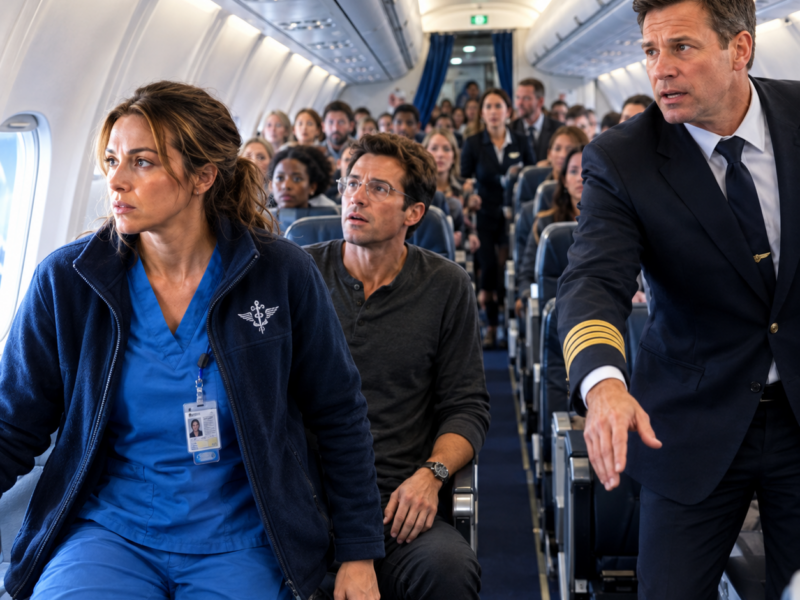
The captain stopped the packed flight before takeoff, publicly demanded that the quiet nurse in Row 28 leave her seat, and coldly asked whether she even understood what was happening
I sat by the oval window in Row 28, pressing my thumb against the faded plastic edge of my hospital badge.
The air inside the cabin smelled of stale coffee, recycled air, and cheap carpet cleaner.
Around me, passengers crammed their carry-on bags into overhead bins, complaining about the heat and the narrow aisles.
I kept my head down, staring at the blue scrubs I had worn for a thirty-six-hour shift at San Francisco General.
All I wanted was to sleep for the entire four-hour flight to Honolulu.
My body ached with a deep, bone-weary fatigue that sleep never quite seemed to cure.
Suddenly, the noisy chatter of the cabin began to die down, row by row.
Heavy, measured footsteps echoed down the narrow aisle, coming from the front of the aircraft.
I looked up just in time to see the captain walking toward me, flanked by two rigid flight attendants.
His uniform was pristine, his gold stripes gleaming under the overhead lights, and his face was set in a stone-cold glare.
He stopped directly beside my seat, blocking the aisle completely.
“Ma’am, I need you to gather your things and come with us right now,” he said.
His voice was loud enough to carry across five rows in either direction.
Every head in the surrounding seats turned toward me in an instant.
Whispers broke out like dry leaves blowing across pavement.
My face burned with a sudden, suffocating heat as dozens of eyes locked onto me.
“I haven’t done anything,” I said, my voice barely above a whisper.
“Is there a problem with my ticket?”
The captain didn’t offer a polite explanation or lower his tone.
Instead, he leaned down slightly, his eyes narrowing as he swept his gaze over my worn medical bag tucked under the seat ahead.
“We received an alert from ground security,” he said, loud and deliberate.
“Information indicates you may possess specialized training and credentials you failed to disclose during check-in.”
He paused, letting the statement hang heavy in the air.
“Do you even understand what is happening right now, or are you confused about federal aviation security protocols?”
A woman across the aisle gasped and pulled her young son closer to her side.
I stared at the captain, a bitter, hysterical laugh bubbling up in my throat.
They thought I was a threat.
They thought the tired nurse in faded scrubs was a security risk to a commercial flight.
“I’m a pediatric surgical nurse,” I said calmly, forcing my hands to remain steady on my lap.
“I’m just going home to visit my sister.”
I reached into my canvas purse, pulled out my wallet, and handed him my California driver’s license and hospital ID card.
He took them with gloved hands, inspecting them under the dim yellow light of the reading lamp overhead.
His brow furrowed into a deep, irritated frown.
“This doesn’t match the flag on our manifest,” he muttered, glancing down at me with pure condescension.
“Where is your secondary identification?”
I swallowed hard, feeling a cold knot form in the pit of my stomach.
The problem was, my secondary identification wasn’t in my wallet.
It was buried at the bottom of a steel trunk in my apartment, locked away alongside memories I had spent eight years trying to erase.
It was a gold-plated Department of Defense credentials card issued to Lieutenant Sarah Vance, United States Navy.
Call sign: Nomad.
A combat flight instructor with over twelve hundred carrier landings and two Distinguished Flying Crosses to her name.
To the airline system, however, I was just a flagged record from an old military watch list that had never been properly cleared.
“I don’t carry any other ID,” I said quietly, looking him straight in the eye.
“You can call ground security and verify my nursing license if you need to, Captain.”
He stared at me for three long, agonizing seconds, searching my face for any sign of panic or deceit.
Finally, he scoffed, tossed my driver’s license back onto my lap, and turned his back on me.
“Stay in your seat,” he snapped to the flight attendant.
“If she moves before we reach cruising altitude, let me know immediately.”
He walked back toward the cockpit, his shoes clicking sharply against the floorboards.
The flight attendants remained near the galley, keeping their suspicious eyes locked onto Row 28.
The cabin door hissed shut, sealed with a heavy mechanical clunk.
Ten minutes later, the engines roared to life, a pair of powerful turbofans pushing us down the runway and up into the gray twilight above the Pacific.
I rested my forehead against the cool glass of the window, watching the city lights dissolve into a vast, pitch-black ocean below.
I thought the humiliating encounter in the aisle was the worst thing that would happen to me tonight.
I was wrong.
Forty minutes into the flight, as the plane glided silently through the darkness at thirty-five thousand feet, the aircraft jolted with a violent, bone-shattering shudder.
The sudden violence of the drop threw my torso forward into the seatbelt.
Trays slammed open, plastic cups tumbled into the aisle, and screams erupted from the rear of the plane.
Before anyone could recover, a loud, metallic bang echoed from under the right wing.
It sounded like a heavy iron door slamming shut inside a hollow vault.
Instantly, the steady, reassuring hum of the right engine turned into an awful, rhythmic grinding sound.
The cabin lights flickered violently once, twice, and then died completely.
The air conditioning stopped blowing, leaving behind a heavy, suffocating silence broken only by the panicked gasps of two hundred travelers.
Emergency yellow floor strips flickered on, casting a eerie, ghostly glow through the cabin darkness.
Above our heads, oxygen masks dropped down on rubber tubes, dancing like pale specters in the gloom.
“Put your masks on!” a flight attendant screamed from the front, her voice cracking with terror.
“Remain seated! Put your masks on!”
I didn’t reach for my mask.
Instead, my eyes instantly tracked the angle of the window pane against the horizon line outside.
We were banking sharply to the right, slipping downward at an unnatural, steep angle.
The nose of the aircraft was pitching down, but the pilot wasn’t leveling the wings to compensate for the roll.
He was letting the aircraft slide sideways through the air.
My body remembered the sensation instantly, overriding eight years of medical routine in a single pulse of adrenaline.
Asymmetric thrust.
The right engine was dead, creating massive drag on one side, while the left engine was still shoving us forward at full power.
If the crew didn’t step on the left rudder pedal and pull back the operational throttle immediately, the plane would enter a spiral dive.
A high-pitched warning siren began to chime behind the cockpit door, its shrill pattern penetrating the cabin walls.
Master Caution. Master Caution.
I knew that chime better than my own alarm clock.
The door to the cockpit swung open, and the captain stepped out into the forward galley area, gripping the doorway for balance.
His hair was disheveled, his tie pulled loose from his collar.
“Ladies and gentlemen, remain calm!” he shouted over the sound of screaming passengers.
“We are experiencing a temporary technical issue! Stay in your seats!”
He was trying to sound authoritative, but his voice was trembling.
I looked closely at his hands.
They were shaking so badly he could barely hold onto the plastic trim of the bulkhead.
His skin was slick with sweat under the yellow emergency lights.
He wasn’t just managing an emergency.
He was terrified out of his mind.
A flight attendant rushed up to him, tears streaming down her face as she whispered loudly enough for the first few rows to hear.
“Captain, engine two is completely dead! Engine one is surging! We’re dropping three thousand feet a minute!”
The captain looked at her blankly, his mouth slightly open, as if his brain had locked up under the weight of the data.
“Initiate… initiate the restart checklist,” he stammered uselessly.
“We did!” she sobbed.
“It failed! The computer isn’t responding to our inputs!”
The plane dropped another five hundred feet in an stomach-churning plummet that sent unbuckled luggage flying into the ceiling.
Panic exploded through the cabin.
Parents were crying, hugging their children, praying out loud in half a dozen languages.
The intercom crackled to life with a static screech.
“We have… we have a control problem,” the captain announced, his voice echoing through the cabin speakers like a death sentence.
He didn’t give instructions.
He didn’t offer hope.
He just left the microphone open, allowing the terrifying sound of the cockpit warning horns to broadcast directly to every soul on board.
I closed my eyes tightly for three seconds.
In the dark behind my eyelids, the sterile hospital hallways vanished completely.
I saw the gray flight deck of the USS Abraham Lincoln slick with rain at midnight.
I smelled the sharp, metallic tang of jet fuel burning in the wind.
I heard the voice of my old wingman, Dave, laughing through the helmet comms before the sky over the Persian Gulf turned into fire.
Eight years ago, I swore I would never put my hands on a set of flight controls again.
I had watched Dave’s F/A-18 slam into the water during a catastrophic engine failure because an automated control system refused to yield manual authority.
I couldn’t save him that night.
I spent the next eight years holding the cold hands of dying patients in intensive care units, trying to balance the scales of a life I felt I shouldn’t have kept.
Now, two hundred people were about to drown in the dark water of the Pacific because an automated system was swallowing an airplane whole.
I unbuckled my seatbelt with a sharp click.
I stood up in the aisle, keeping my feet wide and my weight balanced against the steep, vibrating tilt of the floor.
The flight attendant near Row 28 shouted at me through her mask.
“Sit down! Ma’am, sit down right now!”
I ignored her completely, stepping past her outstretched hand and striding down the center aisle straight toward the open cockpit.
The floor beneath my feet pitched violently to the left, but I caught myself on the edge of a headrest, moving with automatic precision.
When you spend five years walking the deck of an aircraft carrier rolling through forty-foot waves, you never lose your sea legs.
The captain was standing in the forward galley, clutching the edge of the doorway with white knuckles as he tried to read a laminated checklist under the dim red emergency light.
His young first officer was visible through the cockpit door, frantically throwing switches on the overhead panel without reading the secondary indications.
They were overwhelmed.
They were drowning in information overload, classic target fixation during a multi-system failure.
As I reached the threshold of the galley, the captain spotted me coming up the aisle.
His face flushed with immediate anger, mixed with pure panic.
“I told you to stay in your seat!” he yelled, raising a hand to physically block my path.
“You are interfering with a flight crew during a critical emergency! That is a federal crime!”
I didn’t stop moving.
I stepped directly into his personal space, planting my feet firm on the carpet, and looked him straight in the eyes.
“Your attitude indicator is failing,” I said.
My voice was dead calm, sharp as a razor, carrying a tone of absolute command that had nothing to do with nursing.
The captain froze mid-sentence, his arm hovering in the air between us.
“What did you say?” he asked, his voice cracking.
“You’re chasing an artificial horizon that’s frozen at seven degrees nose-up,” I told him, pointing past his shoulder at the primary flight display flickering red on the instrument panel.
“Look at your groundspeed and listen to the airframe.”
The metal skin of the jet was groaning, a low-frequency vibration shivering through the floorboards.
“You’re in a high-speed descent, but your flight computer thinks you’re stalling,” I continued, speaking rapidly with cold, surgical clarity.
“It’s feeding pitch-up trim into the tail to correct a stall that isn’t happening. That’s why you’re fighting the yoke.”
The captain stared at me, his eyes wide, his mouth slightly open.
The arrogant, dismissive officer who had humiliated me in Row 28 vanished in an instant, replaced by a terrified man out of his depth.
“How… how could you possibly know that from the cabin?” he whispered.
“Because I can hear the airframe fighting the flight control actuators,” I said, leaning closer so only he could hear me over the blaring warning horns.
“And because I logged twelve hundred hours flying tactical jets through worse weather than this before you ever put on that four-stripe uniform.”
The first officer yelled from inside the cockpit, his voice shrill with hysteria.
“Captain! hydraulics on system B just dropped to zero! The nose is heavy! I can’t keep the wings level!”
The airplane took another sudden, violent lurch downward, dropping fifty feet in a heart-stopping plunge.
Trays and loose equipment crashed inside the galley behind us.
The captain looked back at his panicked first officer, then turned his gaze back to me.
The conflict was written across his pale face—his pride fighting against his instinct to survive.
“Who are you?” he asked, his voice barely audible over the roaring wind outside.
“Lieutenant Sarah Vance,” I replied coldly. “United States Navy, retired.”
I didn’t wait for his permission.
I grabbed his shoulder, pushed him firmly out of the doorway, and stepped into the cramped, glowing cavern of the cockpit.
The space was filled with a blinding storm of flashing red and yellow warning lights.
A robotic voice barked relentlessly from the central console speakers:
TERRAIN. TERRAIN. PULL UP. PULL UP.
“Get out of the left seat,” I commanded the young first officer, who was staring helplessly at the controls while sweat poured down his neck.
He didn’t argue.
He unbuckled his harness with trembling hands and practically scrambled into the jumpseat behind us.
I slid into the left pilot seat, my hands reaching out before my brain even processed the motion.
My fingers instantly found the master disconnect switch on the control yoke.
I reached down and flipped the primary flight control computer breaker on the side panel behind my elbow.
Click.
The robotic voice stopped instantly.
Half of the flashing warning lights on the main display died, leaving only the raw, unfiltered flight data.
The sudden silence in the cockpit felt deafening.
“What did you just do?” the captain gasped, stepping in behind me. “You just shut off the flight control augmentation system!”
“I took the computer out of the loop,” I said, wrapping my hand firmly around the heavy control yoke.
“Now this plane belongs to me.”
The moment I disconnected the flight computer, the control yoke bucked like a wild animal against my palm.
Without the automated hydraulics smoothing out the airflow over the wings, the heavy Boeing heavy airliner felt raw, heavy, and brutally direct.
The right wing sagged immediately, dropping toward the dark ocean below.
I stomped my left foot down hard on the rudder pedal, catching the slip before it could turn into a spin.
My right hand moved to the throttles, pulling engine two all the way back to idle to stop the surging airflow that was tearing the turbine apart.
I pushed engine one forward just enough to maintain air speed without overpowering the rudder.
“Get in the right seat,” I barked over my shoulder at the captain without looking back.
“Now!”
He scrambled into the co-pilot’s chair, his hands flying to his safety harness as he strapped himself in with frantic movements.
“Read me the manual reversion checklist!” I ordered, my eyes scanning the primary horizon indicator.
“We don’t have the computer to hold this altitude. I need physical pitch trim now!”
“The… the manual trim wheel,” he stammered, flipping through the laminated plastic pages in his lap with trembling fingers.
“Page fourteen… no, page sixteen!”
“Stop guessing!” I snapped, my eyes locked on the dark line of the horizon outside the glass.
“Find the manual trim lever on the central console and pull it up manually!”
He reached down, his hand shaking so violently he missed the handle twice before gripping the metal lever and pulling it back with a sharp grunt.
The pressure on the control yoke eased slightly, allowing me to bring the nose up three degrees.
The steep dive slowed.
The sickening sensation of zero-gravity in my stomach stabilized into a heavy, crushing force as the wings caught the air once more.
“Altitude twelve thousand,” the former first officer called out from the jumpseat, his voice shaking.
“Descent rate decreasing to eight hundred feet per minute!”
“We’re holding,” the captain breathed, staring at the primary flight display in absolute disbelief.
“We’re holding altitude.”
“We aren’t holding anything yet,” I said, my biceps straining as I held the yoke steady against the violent, buffeting crosswinds.
“Engine two is completely dead. Engine one is running at eighty-five percent temperature capacity.”
“If we push engine one any harder, the turbine blades will melt in ten minutes.”
The captain looked out his side window into the pitch-black void over the ocean.
“Where are we?” he asked, his voice filled with a hollow dread.
“Four hundred miles off the coast of Oahu,” the first officer replied, checking the backup GPS unit mounted on the center console.
“We don’t have enough thrust to maintain cruise altitude, and we don’t have enough fuel to loiter.”
“We have one shot at an approach,” I said, my gaze fixed straight ahead through the cockpit glass.
“Calculate our glide path for Honolulu International. Runway eight right.”
The captain looked at me, his eyes wide with fear.
“Honolulu is reporting ground winds at thirty-five knots with rain squalls,” he said.
“You’re trying to land a two-engine heavy jet with one dead engine and manual flight controls in a crosswind?”
“I’ve landed an F/A-18 on a pitching carrier deck in a typhoon with no hydraulics and a burning starboard engine,” I said softly, my voice dropping into a register of absolute, terrifying calm.
“This is just a larger airplane.”
He swallowed hard, looking at me not as a suspect or an arrogant passenger, but as the only human being standing between two hundred people and a wet grave.
“What do you need me to do, Lieutenant?” he asked quietly.
“Call ATC,” I said, setting my jaw as a massive wave of turbulence slammed into the nose of the plane.
“Declare an emergency. Tell them Nomad is coming in.”
The radio crackled with static as the captain keyed the microphone.
“Mayday, Mayday, Mayday. Flight 412 declaring an emergency. Loss of engine two, manual flight control control system active.”
The voice of the Oahu approach controller came back through the overhead speakers, fast and urgent.
“Flight 412, we have you on radar. You are twelve thousand feet, forty miles north of Honolulu. Say intentions.”
“We are executing a manual glide approach for Runway Eight Right,” the captain said into the mic.
He paused, glancing sideways at me before adding, “Be advised, command of the aircraft has been assumed by a qualified military pilot.”
There was a brief pause on the line, followed by the sound of shuffling papers on the ground.
“Flight 412, copy that,” the controller replied, his tone shifting from routine urgency to absolute, laser-focused priority.
“Runway Eight Right is clear. Fire and rescue crews are deployed along the runway. Wind is two-seven-zero at thirty-two knots, gusting to forty-five.”
“Crosswind,” I muttered to myself, my eyes darting across the analog gauges.
A thirty-two-knot crosswind meant the wind was blowing sideways across the runway, trying to shove the tail of the plane sideways into the grass.
With only one operational engine on the left side, turning into the wind was going to require massive physical strength on the rudder pedals.
My thigh muscles were already burning from holding the left pedal down to keep the nose straight.
“Set flaps to fifteen,” I commanded.
“Flaps fifteen,” the captain repeated, reaching for the flap handle.
The moment the mechanical flaps extended from the trailing edge of the wings, the plane shuddered violently.
The drag increased instantly, pulling the nose down toward the dark layer of cloud cover below us.
We plunged into the clouds.
Instantly, the world outside the cockpit glass turned into a wall of thick, white foam illuminated by the flashing strobe lights on our wingtips.
Rain lashed against the windshield with the force of gravel thrown against glass, the sound deafening inside the small cockpit.
Turbulence slammed into the airframe from every angle, tossing the heavy airliner around like a wooden toy in a storm drain.
“Eight thousand feet,” the first officer called out from the back.
“Five thousand feet!”
“I can’t see the ground!” the captain yelled over the roar of the rain.
“Trust the instruments!” I shouted back, my eyes locked on the needle of the turn-and-bank indicator.
“Keep your eyes on the airspeed! If we fall below one hundred and forty knots, we stall, and I won’t have the altitude to recover!”
My shoulders ached with a dull, throbbing pain as I wrestled with the heavy yoke.
Every drop in altitude felt like lifting heavy iron against a stubborn weight machine.
Images flickered through my head against my will—the dark night eight years ago, the smell of burning jet fuel, the sound of metal twisting underwater.
Not tonight, I thought, my jaw clenched so hard my teeth hurt.
Not these people. Not on my watch.
“Three thousand feet!”
” airspeed is dropping! One hundred and forty-five knots!” the captain called out, his voice rising in panic.
“Push throttle one forward two percent!” I commanded.
“I can’t, the temperature gauge is in the red!” he screamed.
“Push it forward!” I roared, turning to glare at him with absolute fire in my eyes.
“We burn the engine or we hit the ocean! Push it!”
He slammed the throttle forward.
The left engine roared with an unhealthy, metallic scream, but the airspeed needle nudged back up to one hundred and fifty knots.
At two thousand feet, we broke through the bottom of the cloud layer.
Below us, through the dark veil of driving rain, a long, thin ribbon of yellow and white lights stretched out into the black ocean.
Runway Eight Right.
“There she is,” the captain whispered, a sob caught in his throat.
“We’re too fast and we’re offset to the left,” I said, my voice dropping back into a cold, lethal rhythm.
“Gear down.”
“Gear down!” the captain repeated, slapping the landing gear lever downward.
With a heavy mechanical thud and a rush of wind noise, the main landing gear locked into place below us.
The runway was rushing up to meet us at a terrifying speed, slanted sideways at a twenty-degree angle because of the howling crosswind.
“We’re crabbed off line!” the first officer screamed from behind.
“We’re going to touch down in the grass!”
“Hold on,” I said quietly, taking a deep breath and tightening my grip on the controls.
“Hold on to something.”
The tarmac was five hundred feet below us, illuminated by the bright red emergency strobes of fifty fire trucks lined up along the runway edge.
The crosswind caught the tail of the plane, violently throwing the nose to the left, away from the centerline.
If we touched down sideways at one hundred and forty miles per hour, the main landing gear would snap like dry twigs, sending the fuselage sliding down the runway on its belly in a shower of sparks and aviation fuel.
“Kick the rudder!” the captain screamed, reaching out as if to grab the yoke himself.
“Don’t touch the controls!” I snapped, my voice cutting through his panic like a whip.
I waited.
Five seconds.
Four seconds.
Three seconds.
The ground rushed up, the black asphalt slick with rain, reflecting the bright runway lights.
At fifty feet above the ground, I stomped my right foot down on the rudder pedal with every ounce of strength left in my body.
At the exact same instant, I turned the control yoke sharply to the left, dropping the left wing directly into the wind.
It was a maneuver every Navy pilot learns to survive carrier landings in high seas—the side-slip kick.
The nose swung violently to the right, aligning perfectly with the painted white centerline of the runway just a fraction of a second before impact.
BAM!
The left main gear slammed onto the concrete with a deafening screech of burning rubber.
The plane bounced once, airborne for a terrifying half-second, before the right gear slammed down hard onto the wet tarmac.
The nose wheel came down with a heavy, jarring thud that rattled the instrument panel in its housing.
“Reverse thrust on engine one!” I yelled, pulling the left engine thrust reverser handle back to the wall.
The left engine roared like a enraged beast, throwing out a massive wall of spray behind us.
I stomped on the tops of both rudder pedals, applying maximum manual wheel brakes.
The tires shrieked against the wet pavement, the smell of burnt rubber filling the cockpit through the air vents.
The plane skidded slightly to the right, the tail swinging wildly on the slippery surface.
I fought the rudder pedals, dancing on the brakes, correction after correction, until the massive machine finally obeyed.
The speed bled off rapidly.
One hundred knots.
Eighty knots.
Forty knots.
Finally, the aircraft rolled to a complete, shuddering halt in the middle of the runway, surrounded by a swirling sea of flashing red emergency lights.
I pulled the single operating throttle back to fuel cutoff.
The left engine whined down into silence.
The cockpit became completely, utterly still.
For five seconds, no one in the cockpit moved or breathed.
The only sound was the heavy, ragged breathing of three people who had just cheated death.
The captain slowly lowered his head onto his folded arms against the dashboard, his shoulders shaking as silent sobs wracked his body.
The first officer sat in the jumpseat, staring blankly out the front window at the flashing red lights of the approaching fire trucks, tears carving clean tracks through the sweat on his face.
I sat back in the pilot seat, my hands trembling uncontrollably as the adrenaline slowly drained from my bloodstream.
My knuckles were white and bruised from holding the yoke.
Behind us, through the reinforced cockpit door, a sound began to rise from the passenger cabin.
It started as a single sob, then grew into a roar of cheering, weeping, and wild applause from two hundred people who had thought they were about to die in the dark ocean.
I reached up, unclipped my flight headset, and let it drop onto the center console.
My work was done.
The flight attendants opened the main cabin door, letting in the warm, humid Hawaiian night air and the loud, rhythmic wail of sirens.
Emergency responders in yellow coats rushed up the mobile stairs, assisting emotional passengers off the aircraft.
I sat quietly in Row 28, having returned to my seat before the cabin door was even unsealed.
I tucked my canvas purse under my arm and waited for the aisle to clear.
Passengers were hugging each other, crying, thanking the flight attendants, completely unaware that the tired nurse in faded blue scrubs sitting near the back had saved their lives.
That was fine with me.
I didn’t want a medal.
I didn’t want my name in the news.
I just wanted to walk out into the quiet air and vanish back into the ordinary life I had spent eight years building.
As the last few passengers filtered out the door, heavy footsteps echoed down the aisle once again.
It was the captain.
His jacket was off, his tie was loose, and he looked twenty years older than he had when he stood over me before takeoff in San Francisco.
He walked down the aisle slowly, stopping right beside my row.
He didn’t speak right away.
He just stood there, looking at me with a complex mix of awe, shame, and profound gratitude.
Slowly, he reached into his front shirt pocket and pulled out a small, metallic object.
He held it out toward me on his flat, trembling palm.
It was my gold Department of Defense credentials card—the secondary military identification he had dismissed four hours earlier.
“I found this under the pilot seat,” he said, his voice quiet and raspy.
“You dropped it when you took the controls.”
I reached out and took the card, slipping it into my purse without looking down at it.
“Thank you, Captain,” I said softly.
He swallowed hard, stepping back a pace and coming to attention.
Then, right there in the narrow aisle of the empty, battered airliner, the veteran airline captain pulled himself up straight and delivered a crisp, formal military salute.
“I owed two hundred lives to a phantom tonight,” he whispered, his eyes glistening with tears.
“I owe you my life, Lieutenant.”
I looked at him for a moment, feeling the old, heavy weight in my chest shift just a fraction.
I didn’t return the salute.
Instead, I stood up, reached out, and shook his hand firmly.
“You kept your head when it mattered, Captain,” I said quietly.
“You don’t owe me anything. Just go home to your family.”
I walked past him, down the aisle, and out the open door into the humid night air.
The airport terminal was a chaotic sea of red lights, flashing television cameras, and emotional families reuniting near the gates.
Reporters were already crowding near the security glass, trying to capture footage of the battered jet sitting out on the wet tarmac surrounded by fire engines.
I kept my head down, pulling my purse strap tight over my shoulder, and navigated through the noisy crowd toward the exit doors.
I just wanted to find a quiet taxi, go to my sister’s house, and submerge myself in a hot shower until the smell of aviation fuel was washed off my skin.
“Lieutenant Vance!” a deep voice called out over the noise of the terminal.
I froze instantly.
That name hadn’t been spoken aloud in an airport terminal in eight years.
I turned around slowly.
Standing a few feet away was a tall man in a crisp dark suit, wearing a yellow airfield clearance badge pinned to his lapel.
He wasn’t an airline employee, and he certainly wasn’t a journalist.
He had the rigid posture, the short haircut, and the sharp, unblinking eyes of Naval Intelligence.
He walked up to me, stepping around a weeping family, and stopped two feet away.
“Lieutenant Sarah Vance,” he said, confirming my identity without asking.
“I’m Special Agent Miller, Naval Criminal Investigative Service.”
My heart thumped hard against my ribs, a cold knot of dread returning to my stomach.
“I’m retired, Agent Miller,” I said, keeping my voice flat.
“My service record was closed eight years ago after the crash off the coast of Oman. I don’t have anything left to say to the Navy.”
“We know about your record, Lieutenant,” he said quietly, reaching inside his dark suit jacket.
“And we know what you just did on Flight 412. The controller in Oahu tower recognized your call sign the second the captain broadcast it.”
He pulled out a heavy, unmarked manila envelope and held it out toward me.
“They’ve been looking for you for three weeks,” he whispered, stepping closer so the surrounding crowd couldn’t hear.
“Not because of your past. Because of new evidence.”
I stared at the plain paper envelope in his hand, refusing to take it.
“Evidence of what?” I asked, my voice barely audible over the terminal announcements.
“The crash eight years ago,” he said, his voice dropping into a solemn tone.
“The flight recorder from your wingman’s F/A-18 was finally recovered from the ocean floor three months ago during a deep-sea salvage operation.”
A cold sweat broke out across the back of my neck.
“I know what happened,” I said, my chest tightening as the old, painful memories flooded back.
“Dave’s jet went down in thirty-five hundred feet of water. He died on impact.”
Agent Miller didn’t look away.
He pressed the envelope gently into my hands.
“That’s what the official report said eight years ago, Sarah,” he said, using my first name for the first time.
“Look inside the envelope.”
My hands shook as I broke the paper seal on the manila envelope.
Inside was a single glossy black-and-white satellite photograph, along with a heavily redacted military intelligence document bearing an official blue stamp at the top.
The photograph showed a remote, arid coastline dotted with radar domes and secure military hangars.
In the center of the image, parked on a dusty taxiway, was the distinct, twin-tail silhouette of an F/A-18 Hornet.
On the side of the fuselage, visible under digital magnification, was a painted yellow naval flight squadron emblem—my old squadron, the Black Aces.
“That’s Dave’s jet,” I whispered, my breath catching in my throat as my eyes scanned the grainy image.
“The telemetry was falsified eight years ago,” Agent Miller said softly, leaning in close.
“The flight computer malfunction that caused your formation to break apart wasn’t an accident. It was a cyber-override executed from a ground station.”
I looked up at him, my brain struggling to process the words.
“What are you saying?” I asked, my voice trembling.
“Dave didn’t crash into the ocean that night, Sarah,” Miller said, his eyes dead serious under the harsh fluorescent lights of the terminal.
He pointed to the back of the photograph, where four words were written in black ink in the distinctive handwriting of my former commanding officer.
One of them survived.
“He was forced down in neutral territory and taken off the grid,” Miller continued quietly.
“The Navy spent eight years believing he was dead because the automated system reported a catastrophic splash.”
“Until three weeks ago, when an encrypted signal carrying your old flight unit code was broadcast from a server inside a private security facility in East Asia.”
The noise of the airport terminal seemed to vanish completely, fading into a low, distant hum.
The tired nurse who had just saved two hundred lives on a falling airliner was gone.
In her place, the combat pilot who had buried her past in a steel trunk felt something cold, fierce, and powerful wake up inside her soul.
“Who has him?” I asked, my voice dropping an octave, razor-sharp and deadly.
Agent Miller reached into his jacket once more and pulled out a sleek, black secure satellite phone, holding it out to me.
“The Admiral is on line one,” Miller said quietly.
“He said if anyone on earth could fly through that storm tonight and land that broken bird, it was Nomad.”
“He wants to know if you’re ready to come back on flight status.”
I looked down at the photograph in my hand, then at the secure satellite phone, and finally back out the glass window at the dark ocean where the storm was slowly clearing under the stars.
I took the phone from his hand and brought it to my ear.
“This is Lieutenant Vance,” I said into the receiver.
“Give me a cockpit.”









