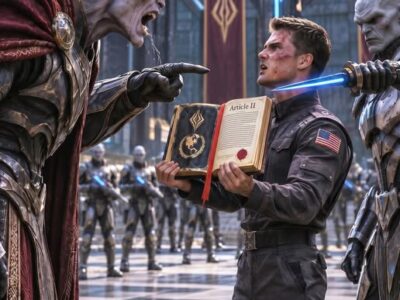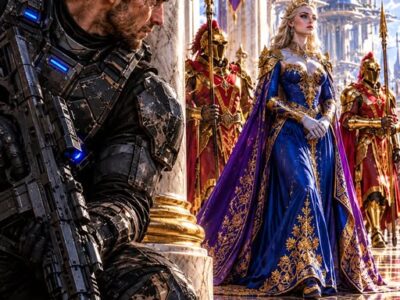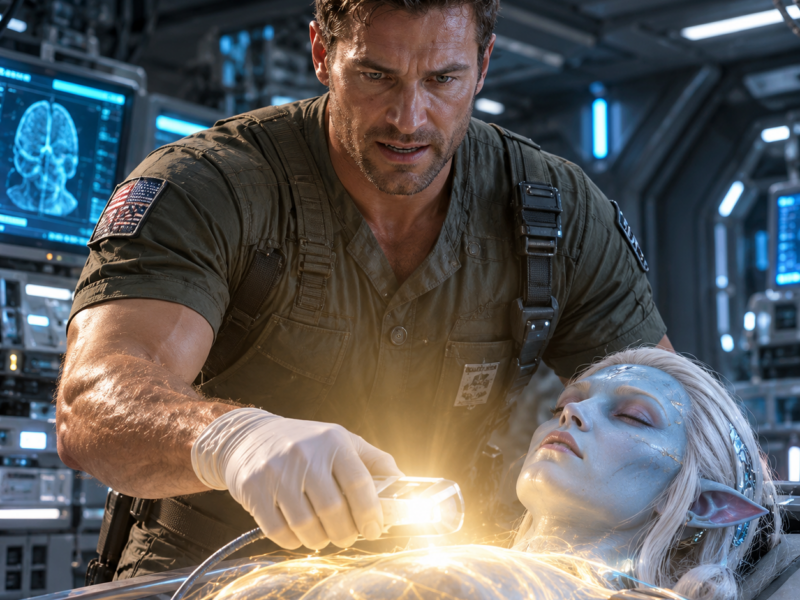
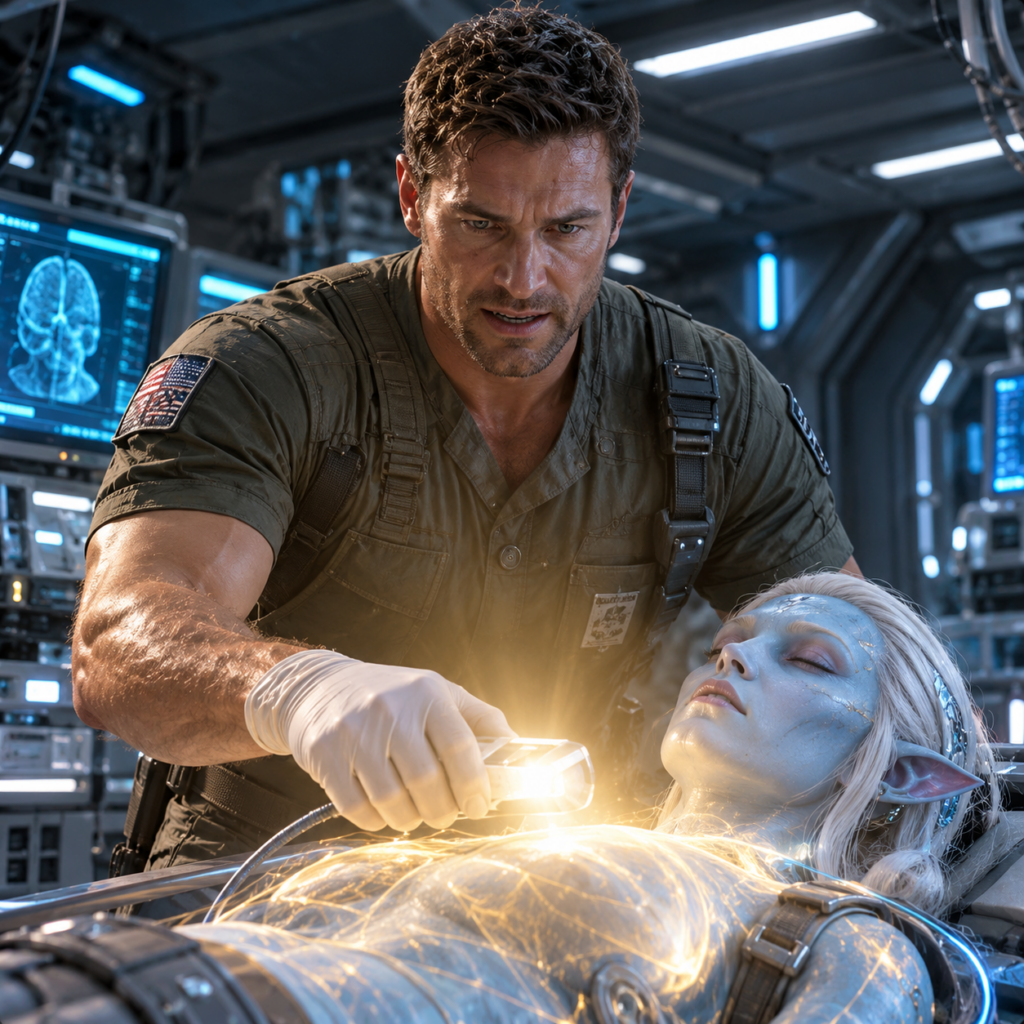
The alien royal court watched in disgust as I pushed past six elite healers and knelt beside their supposedly dead queen, while the emperor ordered my arrest, unaware that the human medic he considered worthless had just discovered the secret behind her apparent death.
The synthesized royal voice continued echoing through the vast arched ceiling of the throne room.
“Human life-signature confirmed. Activate the ancient defense protocol.”
The mechanical vibration was so deep it rattled the glassware in my battered medical field kit.
Beneath our boots, the polished obsidian floor pulsed with an eerie, pale gold luminescence.
Chief Healer Malakor remained frozen on his knees, his three-fingered hands trembling against the tiles.
“Kill the human now,” Malakor choked out, his voice cracking with hysteria.
“Do not let him step off the dias!”
Emperor Vane stood paralyzed between two impossible realities: his revived daughter and a phantom past.
The royal guards, hulking quadrupeds clad in segmented brass armor, leveled their shock-pikes directly at my chest.
“Nobody moves,” I commanded, keeping my fingers pressed against Seraphina’s radial artery.
My voice held the flat, gravelly cadence of a field combat surgeon who had dragged men through burning trenches.
I wasn’t a diplomat.
I was Nathan Carter, Chief Medical Officer of a scavenging fleet that barely survived on recycled water and scrap metal.
“Father, call them off,” Queen Seraphina rasped, her violet eyes burning with desperate urgency.
She coughed, expelling a drop of dark, iridescent fluid onto the clear sterile drape.
The neurotoxin was still fighting for control of her vascular system.
“You were dead, Seraphina,” Emperor Vane whispered, his majestic crest flaring in bewildered agony.
“The medical monitors read flat for twenty-two standard minutes.”
“Because your own council engineered my silence, Father.”
She sat up slowly, clutching the front of her embroidered ceremonial tunic.
“Malakor administered a concentrated dose of Lethan-7 during my morning communion.”
The chief healer scrambled backward like a crab, his robes sweeping across the illuminated runes.
“Lies! She is suffering from neural hypoxia! The human’s barbaric chemicals have scrambled her royal mind!”
“Then explain why this portable scanner reads synthetic paralytic compounds in your personal sleeve injector,” I said.
I picked up the discarded brass syringe from the floor and tossed it onto the emperor’s pedestal.
The metal clattered loudly in the stifling silence.
Vane looked down at the crest etched onto the injector barrel.
It bore the personal sigil of the High Archon, the head of the imperial ministry.
“Vane,” the synthetic voice resonated again, this time rising from the drainage grates below.
“Biometric verification required. First Guardian Carter, please present neural interface.”
Every single gaze in the hall shifted from the weapon to my face.
“What is that machine calling you?” the Emperor demanded, his broad hand dropping toward the ceremonial blade at his hip.
“I have no idea,” I said truthfully, stepping off the dais to put my body between Seraphina and the guards.
“I was born on an orbital transport station above the ruins of Sector 4.”
“You carry the genetic sequence,” Seraphina whispered, reaching out to steady herself on my forearm.
Her skin felt like cooled glass, but the warmth was returning.
“The builders of this palace did not construct these walls for the Veyran people.”
She looked up at the towering columns that reached four hundred feet into the vaulted cavern.
“They built this place as a fortress, Nathan. To shelter our ancestors when your people went to war.”
A sudden concussive blast blew through the grand eastern gateway.
The massive brass doors groaned, their magnetic locks shearing apart in a blinding shower of sparks.
Heavy footfalls approached from the smoke-filled corridor.
Black-armored shock troopers, carrying illegal pulse-rifles, moved into the grand hall in a tight tactical sweep.
Leading them was Archon Thrax himself, his ceremonial robes discarded for battle-hardened blast armor.
“Secure the chamber,” Thrax barked, his voice amplified by an internal vocal synthesizer.
“The Queen’s corpse has been desecrated by an alien operative.“
“Stand down, Thrax!” Emperor Vane bellowed, drawing his heavy blade.
“My daughter lives!”
“Not for long, Your Majesty,” Thrax said, leveling his rifle directly at the emperor’s head.
The air in the room ionized into an unbearable static crackle.
I didn’t think; I acted on raw battlefield reflex.
I grabbed the pneumatic pressure canister from my medical bag and twisted the relief valve.
A blinding cloud of compressed cryogenic vapor erupted between the royal guard and the mercenary squad.
“Run!” I shouted, hauling Seraphina off the platform before the first plasma bolt melted the crystal throne.
Shadows of the Ancient Citadel
The blast wave lifted us off our feet and slammed us into the decorative marble screens behind the dais.
Hot shards of stone rained down through the choking, sulfurous smoke.
Behind us, the emperor roared in defiance, the clash of heavy metal ringing out over the gunfire.
“Father!” Seraphina screamed, struggling against my grip.
“He’s buying us time,” I yelled into her ear, dragging her through the jagged breach in the wall.
“If you die now, his sacrifice means nothing.”
She bit her lip until dark blood welled, then nodded and found her footing.
We tumbled down a narrow maintenance spiral where the air grew damp, thick, and surprisingly cold.
The ornate grandeur of the upper palace vanished within twenty paces.
Here, the walls were not carved from decorative native obsidian.
They were fabricated from dull, seamless titanium alloy, stamped with industrial serial numbers in clear English script.
Seeing my native language etched into the bones of an alien homeworld made my stomach churn.
“How is this possible?” I muttered, running my calloused hand along the cold metal seam.
“Our historians told us your kind were primitive scavengers who arrived on broken colony ships,” she whispered.
She leaned against the wall, breathing heavily as her silver skin flushed with exertion.
“They erased the truth from our archives three centuries ago, after the Great Separation.”
Above us, the rhythmic thud of combat boots echoed down the metal shaft.
“Track the blood trail!” a voice barked from the darkness above.
“The Archon wants the human’s head and the royal crest retrieved intact!”
I looked down at the floor.
Seraphina was leaving small droplets of luminescent blood with every fourth step.
“Give me your sash,” I said, unbuckling my field knife.
She tore the golden fabric from her waist without hesitation.
I quickly wound it around her leg, cinching the fabric tight over her wound to stem the flow.
“You have the hands of a warrior, not just a healer,” she noted, her violet eyes studying my face.
“On the outer rim, if you can’t fight, you don’t live long enough to heal anyone.”
I checked my sidearm—a standard-issue kinetic pistol with only seven rounds remaining in the magazine.
It was useless against heavy kinetic shielding, but it could buy us a second at close quarters.
We reached the base of the shaft where the corridor opened into a colossal sub-level hangar.
Massive support pillars stretched into the gloom like the ribs of a swallowed leviathan.
Rows of rusted, unidentifiable machinery sat under centuries of gray, undisturbed dust.
In the center of the vast chamber stood a monolithic black door, sealed with a circular vault mechanism.
Above the heavy locking pins was a glowing digital interface displaying a flashing blue prompt.
PRIMARY OPERATOR OFFLINE. INPUT OVERRIDE AUTHORIZATION.
“This is the Vault of the Accord,” Seraphina said, her voice dropping to an awe-struck whisper.
“The High Archon spent fifty cycles trying to breach this door with thermal lances.”
“Why couldn’t he get through?”
“Because the locking mechanism doesn’t recognize imperial genetic markers.”
She looked at me, her expression a mix of sorrow and revelation.
“It only responds to the bloodline that built it.”
Behind us, a flare illuminated the darkness of the hangar.
A squad of four armored mercenaries rounded the corner, their thermal sights snapping onto our heat signatures.
“Found them!” one shouted, raising his shoulder cannon.
“Nathan, the console!” Seraphina cried out.
I sprinted toward the pedestal, slamming the flat of my scarred, human hand against the biometric glass.
The surface burned like dry ice, sending an electric shock straight through my nervous system.
The vault gears groaned, but the heavy locking pins didn’t move.
The red targeting reticle from the mercenary’s rifle settled directly between my shoulder blades.
“ACCESS DENIED,” a flat mechanical voice chirped from the panel.
“GENETIC DEGRADATION EXCEEDS ACCEPTABLE TOLERANCE.”
The mercenary raised his weapon, his finger tightening on the firing stud.
“Drop the weapon, alien scum!” the soldier barked, moving forward to secure his shot.
I didn’t have time for a secondary scan.
I whipped around, drew my service pistol, and fired three rapid kinetic rounds into the support cable above his head.
The severed conduit whipped through the air with a deafening screech, discharging hundreds of thousands of volts into the wet floor.
The electrical arc detonated the mercenary’s kinetic shield, throwing him twenty feet across the platform.
The other three soldiers scrambled for cover behind the rusted machinery, laying down a hail of pulse fire.
Blue plasma bolts sheared through the ancient metal casing inches from my skull.
“Nathan!” Seraphina called out, crawling toward the console despite her weakening limbs.
“Your blood! The system needs an unfiltered metabolic sample!”
I understood immediately.
The scanner was an old military-grade biometric lock, designed to prevent dead hands from being used as keys.
It needed living, flowing human blood to calibrate the genetic markers.
Without hesitating, I dragged the serrated edge of my combat knife across my left palm.
Pain flared bright and hot, sharpening my focus.
I slammed my bleeding hand against the glass scanner, smearing the crimson fluid across the optical sensor.
BIOLOGICAL SAMPLE DETECTED.
SEQUENCING DNA… 99.4 PERCENT COMPATIBILITY.
COMMANDER NATHAN CARTER RECOGNIZED. CLEARANCE LEVEL: OMEGA.
The colossal circular door shrieked as pneumatic seals broke after three hundred years of vacuum isolation.
A gust of dry, recycled air rushed outward, carrying the scent of copper and clean ozone.
“Inside! Now!” I roared, grabbing Seraphina by the harness and pulling her through the opening gap.
A plasma round caught the edge of my field jacket, scorching the heavy fabric and scorching the skin along my ribs.
I shoved the Queen through the threshold and threw my full weight against the manual emergency release.
The massive vault door slammed shut with a deafening mechanical thud that reverberated through my teeth.
Outside, the heavy impact of explosive charges detonated harmlessly against three-foot-thick reinforced plating.
We collapsed together onto the polished floor of the inner sanctum.
Seraphina lay gasping for air, her fingers trembling against the cold metal tiles.
“We made it,” she whispered, her voice barely audible over the hum of powering systems.
“We bought ourselves a tomb if there isn’t another way out of here,” I said, wrapping a sterile bandage around my sliced hand.
Suddenly, the lights within the chamber flickered to life one by one.
They weren’t the harsh blue lights of the Veyran palace.
They were soft, warm, amber illumination strips running along the baseboards of a pristine command center.
In the center of the room sat a massive holographic projection table surrounded by dozens of operational terminals.
The central display flared to life, casting a golden glow over our bruised and bloodied faces.
A floating digital avatar materialized in the air—a human woman wearing the dress uniform of the Earth Commonwealth Navy.
“Good evening, Commander,” the avatar said, her voice calm and remarkably lifelike.
“You have been away for one hundred and twelve thousand, four hundred and six days.”
I stared at the uniform, recognizing the emblem of the Seventh Expeditionary Fleet.
“Identify yourself,” I managed to say, holding my breath.
“I am Athena, Autonomous Custodian of Earth Outpost Zero,” the projection replied smoothly.
“And I must inform you that the Veyran treaty violation protocol has reached its final stage.”
Seraphina struggled to her feet, staring at the holographic woman with wide eyes.
“What violation protocol?” she asked.
The hologram turned its gaze to the alien queen, its digital eyes narrowing slightly.
“The protocol initiated when the Veyran Ruling Council murdered the human delegation to steal the terraforming core.”
The Bones of the Forgotten
The silence in the command center was deafening, broken only by the low hum of the environmental recyclers.
Queen Seraphina took a step back, her hand flying to her throat as if the air had turned to glass.
“That’s a lie,” she said, her voice shaking with quiet fury.
“Our scripture teaches that your people abandoned us during the Great Dying.”
“You were supposed to be our protectors, and you fled into the void when the sun flared.”
The holographic custodian tilted her head with an expression of mechanical pity.
“Historical manipulation detected in subject’s neural register,” Athena said softly.
“Displaying historical record: Archive File 774-Bravo.”
The golden light shifted, resolving into a sweeping panoramic view of this very planet three centuries ago.
Sleek, white human vessels hung in low orbit, dropping massive atmospheric scrubbers into the burning skies.
On the ground, camps of Veyran refugees were being organized and sheltered by human medical personnel.
Then the scene changed to an ornate council hall—the very throne room we had just fled.
A group of Veyran officials, wearing robes identical to those worn by Archon Thrax, stood around a table.
They were unsealing canisters of an unmistakable greenish vapor and dumping them directly into the air filtration shafts.
“The atmospheric scrubbers required our primary antimatter cores to stabilize your atmosphere,” Athena explained.
“Your ministers realized that without those cores, our fleet would never have the range to return home.”
The hologram zoomed in on the council floor.
Hundreds of human officers and engineers lay dead, their fingers clawing at their throats just like Seraphina had hours ago.
“Lethan-7,” I whispered, bile rising in the back of my throat.
“The same poison Malakor used on you.”
Seraphina sank to her knees, staring at the floor in horrified realization.
“They didn’t just assassinate the delegation,” she breathed, tears cutting clean paths through the dust on her cheeks.
“They murdered the people who were saving them.”
“Correct, Majesty,” Athena stated without malice.
“Your ancestors harvested the engines from our fleet, built their golden towers upon our wreckage, and rewrote the histories.”
“They declared humans extinct to ensure the theft would never be uncovered.”
I stepped toward the central holographic console, looking at the blinking diagnostic arrays.
“If the fleet was destroyed, why are we here?” I asked.
“Why is this outpost still drawing power?”
“Because this is not merely a research station, Commander,” Athena said, her form shifting into a detailed blueprint of the continent.
“This is the control nexus for the planetary stabilization array.”
“The terraforming engines beneath this bedrock are degrading.”
“Without maintenance from authorized personnel, the tectonic anchors will fail within forty-eight standard hours.”
The entire room shuddered violently, confirming her words.
Deep below our feet, the bedrock groaned with a sound like tearing metal.
“The earthquakes,” Seraphina said, looking up in terror.
“The capital has been suffering from seismic tremors for three moons. The priests claimed it was the wrath of the stars.”
“It is not the stars,” Athena said coldly.
“It is physics. The engines are dying, and the current regime possesses neither the codes nor the intellect to repair them.”
A sudden alarm chimed from the outer monitoring station.
The screen flickered, displaying the heavy blast door we had sealed just minutes ago.
Outside, Archon Thrax had arrived with heavy mining machinery.
A massive plasma drill was already grinding into the secondary locking plates, throwing white-hot sparks across the corridor.
“Commander, external hull breach is imminent,” Athena announced calmly.
“Estimated time until door failure: six minutes.”
Seraphina looked at me, her face pale but her jaw set with newfound determination.
“Nathan, you have to activate the terminal,” she urged, grabbing my wrist.
“Can you fix the planetary anchors from here?”
“I’m a field combat medic, Seraphina,” I said, looking at the complex array of flight controls and physics telemetry.
“I can set a compound fracture and stitch an artery in the dark, but I can’t fly a continent.”
“You won’t have to,” Athena replied, her digital avatar stepping down from the pedestal to face me.
“The station has an automated repair routine.”
“However, accessing it requires Commander-level neural integration.”
She pointed to a metallic chair at the far end of the room, fitted with an array of silver cranial needles.
“To save this world, you must upload your consciousness directly into the planetary matrix.”
“And the survival rate for humans attempting direct neural integration with this model is less than twelve percent.”
The plasma drill screeched against the reinforced door, the sound biting through the titanium bulkheads like teeth.
A bright orange ring was already forming in the center of the outer vault gate.
“Twelve percent,” I repeated, staring at the mechanical needles glistening beneath the amber lights.
“Those aren’t great odds, Athena.”
“They are the only odds available, Commander,” the AI responded with mechanical precision.
“If you do not integrate, the blast door will fail in four minutes.”
“Archon Thrax will execute both of you, the anchors will collapse, and this continent will slide into the mantle by tomorrow evening.”
Seraphina stepped between me and the chair, her arms outstretched.
“No,” she said firmly, her voice trembling with emotion.
“You don’t owe this world anything, Nathan. My ancestors murdered yours.”
“They stole your future, built an empire on your bones, and tried to kill you the moment you set foot in their court.”
“Why would you throw your life away for a species that betrayed you?”
I looked at the scarred palm of my hand, wrapped in rough white linen.
“Because I didn’t take an oath to historical vengeance, Seraphina,” I said quietly.
“I took an oath to preserve life.”
“On that ruined colony ship where I grew up, we learned that holding onto ancient hatreds is just another way of dying slowly.”
“If I walk away now, millions of innocent people on the surface will die for sins committed three centuries ago.”
“That’s not justice. That’s just more slaughter.”
She looked at me, her violet eyes swimming with an emotion I couldn’t quite name.
Slowly, she reached up and touched the side of my face with her cool, silver fingers.
“You are nothing like the monsters our priests warned us about,” she whispered.
A heavy crash shook the vault door as the center section buckled inward.
A stream of molten metal spilled onto the threshold, hissing against the cooling tiles.
“Commander, breach in ninety seconds,” Athena warned.
“I need your decision.”
I turned toward the integration chair and sat down on the cold vinyl cushions.
The leather was cracked with age, smelling faintly of old sweat and ancient canvas.
“What do I need to do?” I asked, gripping the armrests.
“Remain completely still,” Athena instructed, her form flickering as power was redirected from the holotank to the neural conduits.
“The interface will bypass your sensory cortex and link directly to the planetary network.”
“If your neural architecture rejects the data stream, your heart will enter ventricular fibrillation within seconds.”
“I’ve survived worse,” I lied, clenching my teeth.
The mechanical armature lowered from the ceiling with a soft, hydraulic hiss.
Seraphina gripped my right hand tightly, her small fingers interlaced with mine.
“I will be right here, Nathan,” she promised.
“Whatever happens, you will not face the darkness alone.”
The needles touched the base of my skull.
There was no pain at first—only an intense, unnatural cold that spread outward through my teeth and down my spine.
Then the world exploded into blinding, incandescent light.
A torrent of pure information crashed through my mind like a tidal wave of shattered glass.
I saw the deep foundations of the planet: massive crystalline shafts driving thousands of miles into the churning magma.
I felt the immense tectonic strain of three shifting continental plates, groaning under pressures beyond human comprehension.
My heart hammered against my ribs, racing faster and faster until the beats blended into a single, agonizing roar.
Through the static, I heard Seraphina scream my name.
Then the blast door blew inward, and the cold reality of gunfire shattered the light.
The world inside my skull was burning, but outside, the sound of combat was brutally clear.
Through the haze of my fractured perception, I saw Archon Thrax step through the smoking ruins of the vault door.
His heavy rifle was raised, his eyes wide with fanatical hatred.
“Treasonous bitch!” Thrax roared, firing a kinetic slug directly toward the console.
Seraphina didn’t flinch.
She scooped up my discarded service pistol from the floor and fired back with both hands.
The kinetic round took Thrax squarely in the chest plate, staggering him backward into the corridor.
“Nathan, hurry!” she cried out, her voice drowned out by the scream of returning fire.
I was drowning in planetary telemetry.
ERROR: SECTOR FOUR PRESSURE OVERLOAD.
MANIFOLD SIX COOLANT DEGRADED.
MANUAL OVERRIDE REQUIRED FOR ATMOSPHERIC EXHAUST.
My body was convulsing on the chair, every muscle locked in a rigid, agonizing cramp.
The monitor above my head was shrieking with red warnings: ventricular tachycardia.
My human brain wasn’t built to process the sensory input of an entire living world.
I could feel the heat of the mantle melting my skin; I could feel the cold void of the upper atmosphere freezing my lungs.
Let go, a whisper echoed from the dark corners of my mind.
Let the planet tear itself apart. They deserve it.
Then I felt Seraphina’s fingers tighten around mine.
Her pulse—that same faint, resilient rhythm I had pulled back from the edge of the void—grounded me like an anchor.
“You are Nathan Carter,” her voice cut through the digital storm.
“You are a healer. Heal this world!”
I stopped fighting the current and let the data flow through me.
Instead of trying to comprehend the sheer scale of the machinery, I treated the planetary grid like a massive, trauma-shocked patient.
The magma chambers were arterial hemorrhages; the cooling pipes were crushed airways.
I reached out with my fractured consciousness, finding the ancient human subroutines buried beneath centuries of alien code.
ROUTINE INITIALIZED: BYPASSING MANUAL CRADLES.
DIVERTING COOLANT FROM RESERVE TANKS.
ENGAGING MAGNETIC DAMPENERS.
Deep beneath the palace, the agonizing tectonic groan began to subside, replaced by a deep, rhythmic thrum.
The lights in the control center shifted from blinding crimson to cool, steady emerald.
PLANETARY MATRIX STABILIZED. PRIMARY ENGINES ENGAGED.
A massive surge of feedback violently severed the neural link.
I was thrown forward out of the chair, gasping for breath as air flooded my starved lungs.
My vision was blurred, my mouth tasting of salt and copper.
Across the room, Seraphina was pinned against the terminal, her weapon empty and smoking on the floor.
Archon Thrax stood over her, his combat blade drawn and pressed against her throat.
“You gave our kingdom to a dead ghost,” Thrax snarled, his armored arm raised to strike.
“Now die with him.”
I dragged myself up from the bloody floor, every nerve in my limbs screaming in protest.
I didn’t have a rifle; I didn’t have my knife.
All I had was the ancient administrative terminal glowing beneath my bruised fingers.
“Athena,” I rasped, my throat raw from screaming.
“Security protocol… zero-alpha.”
The AI’s voice echoed through the chamber, stripped of all warmth.
“Authorization confirmed. Purging hostile presence.”
The floor beneath Thrax’s feet magnetized instantly with ten thousand Gauss of electromagnetic force.
His heavy titanium blast armor slammed down onto the metal tiles with bone-crushing velocity.
The blade slipped from his fingers, clattering away into the darkness.
He struggled furiously, but the sheer magnetic pull held his suit flat against the floor like an insect under glass.
Seraphina scrambled away from him, crawling toward me across the flickering dais.
She collapsed against my chest, her breaths coming in ragged, sobbing gasps.
“You did it,” she whispered, her hands clinging to my torn jacket.
“You actually did it.”
The mechanical voice of Athena chimed from the central console.
“Planetary stabilization complete. However, Commander, you should be advised.”
The screen displayed a wider sensor scan of the star system.
“The power surge from the primary engine ignition has broadcast an unmasked Commonwealth beacon across twelve light-years.”
“And something in the deep perimeter just answered.”
The high-pitched hum of the electromagnetic floor kept Thrax pinned like a specimen in a laboratory.
His muffled curses drifted across the room, full of venom and impotent rage.
“You’re a fool, human!” Thrax spat, his cheek mashed against the magnetized plating.
“You think you’ve saved her? You’ve signed the death warrant of this entire civilization!”
Seraphina ignored him, rising to her feet and leaning on the edge of the holographic table.
“Athena,” she commanded, her royal authority returning despite her battered appearance.
“Identify the signal.”
The golden avatar of the Commonwealth officer materialized beside us, her face unreadable.
“Scanning incoming trajectory,” Athena reported.
The holographic display zoomed out beyond the planetary orbit, revealing the dark void of the outer rim.
A glowing red signature was descending rapidly toward our coordinates, traveling at near-relativistic speed.
“Is it an imperial warship?” Seraphina asked, glancing anxiously at the ceiling.
“Negative,” Athena replied.
“The engine signature does not match any known Veyran configuration.”
“Transponder telemetry indicates a heavy battlecruiser belonging to the Earth Defense Coalition.”
“The vessel name is the Prometheus.”
A cold stillness settled into my chest.
“The Prometheus was the flagship of the Seventh Expeditionary Fleet,” I muttered, shaking my head.
“It disappeared three centuries ago during the final withdrawal.”
“It didn’t disappear, Commander,” Athena corrected gently.
“It entered a long-range sleeper orbit behind the gas giant in the fourth sector, waiting for this outpost to come back online.”
“Its primary directives are clear: assess indigenous threats and enforce the terms of the original colonization charter.”
“Enforce the terms?” Seraphina echoed, her voice dropping.
“What does that mean?”
Athena looked at her with cool, artificial eyes.
“In the event of treason resulting in the loss of Commonwealth personnel, the Prometheus is programmed to glass the planetary surface.”
The words hung in the air like poison.
“Glass the surface…” Seraphina whispered, looking down at her hands.
“They won’t just punish the council. They’ll incinerate the entire planet.”
“Athena, can you override the ship’s targeting arrays from this console?” I demanded, leaning over the interface.
“Negative, Commander,” the AI said.
“The Prometheus operates under independent battlefield protocols.”
“Once the defense beacon was triggered, its autonomous command system classified this entire star system as a hostile theater.”
“Unless a biological officer boards the vessel and manually inputs the armistice codes, orbital bombardment will commence upon arrival.”
“How much time do we have?” Seraphina asked.
“Estimated time to orbital insertion: four hours, twelve minutes.”
A sharp sound from the blast door made both of us turn instantly.
The ruined metal was kicked aside, and Emperor Vane staggered into the chamber, supported by two surviving royal guards.
His magnificent robes were torn and drenched in blue blood, but his eyes were clear and fierce.
“Seraphina,” the old emperor gasped, his knees buckling before his guards caught him.
“Father!” She ran to him, wrapping her arms around his wounded frame.
“Thrax’s faction has been broken above,” Vane said, his voice heavy with fatigue and sorrow.
“The city is secure, but the people are in the streets. The ground stopped shaking, yet panic reigns.”
He looked past his daughter, his eyes locking onto me and the human console behind me.
“Is this the truth, then?” Vane asked, his voice cracking with imperial shame.
“We are living on stolen ground?”
“We are living on ground that is about to burn to ash, Father,” Seraphina said grimly.
“An ancient human warship is descending upon us, and it will destroy everything we know unless Nathan can stop it.”
The emperor looked down at the bleeding human who had saved his daughter’s life twice in one night.
Slowly, deliberately, the ruler of the Veyran Empire bowed his head to a Terran medic.
“There is an old orbital shuttle in the imperial hangar,” Vane said softly.
“It was salvaged from the ancient ships. We never knew how to pilot it.”
“Can you fly it, Nathan?” Seraphina asked, her eyes searching mine with desperate hope.
“I can fly anything with an engine and a stick,” I said, checking my sidearm.
“Then I am coming with you,” she declared without hesitation.
“Seraphina, no,” the Emperor protested.
“You are the Queen! Your people need you here!”
“My people need to not be incinerated from the sky, Father!” she countered, her voice ringing off the metal walls.
“If the humans see only a warrior, they will fire. They need to see that we are ready to answer for the past.”
Before I could argue, a sudden low-frequency ping echoed from the console.
The Prometheus had just accelerated.
The ancient imperial hangar smelled of dry dust, bird lime, and rancid hydraulic fluid.
Sitting in the center of the forgotten bay was a relic from another epoch: a Commonwealth Sparrow-class orbital interceptor.
Its white composite hull was stained with three hundred years of soot, but its angular, predatory lines were unmistakable.
“The priests called it the Chariot of the Sky Gods,” Emperor Vane said, leaning heavily on his guard’s shoulder.
“They burned incense to it every solstice. None of our engineers could ever decipher its ignition sequence.”
I walked up to the access hatch, wiping away a thick layer of grime to expose the manual entry keypad.
“That’s because they were trying to pray to it instead of turning on the auxiliary battery,” I said.
I pressed the recessed emergency lever and entered my old civilian pilot serial code into the pad.
With a sharp hiss of escaping pressure, the gull-wing hatch popped open, venting a puff of stale, dry air.
The interior was pristine, frozen in time since the day the original pilot stepped out to be murdered by his hosts.
Seraphina climbed in behind me, her silver fingers brushing against the human instruments with quiet reverence.
“It feels so strange,” she whispered, strapping herself into the copilot’s crash couch.
“Everything is designed for five fingers, for your scale, for your perspective.”
“It feels like I’m sitting inside a memory.”
“Keep your harness tight,” I warned, running my hands over the cold cockpit switches.
“Commonwealth interceptors don’t have inertial dampeners as smooth as your royal skiffs.”
“When those thrusters kick in, it’s going to feel like an elephant sitting on your chest.”
I toggled the primary ignition breaker.
Deep in the tail of the craft, the twin ion drives whined to life, a high-pitched scream that sent flocks of native roosting birds fluttering out of the cavern roof.
The instrument panel flared with green and white telemetry, washing the cockpit in cold, functional light.
ENGINES ONLINE. FUEL RESERVES: SEVENTY-TWO PERCENT.
ORBITAL VECTOR COMPUTED.
“Nathan,” Seraphina said softly, her eyes locked on the forward viewport as the massive roof gates began to grind open.
“If we can’t stop this ship… what happens?”
I adjusted the throttle lever, feeling the familiar, reassuring vibration of human steel under my command.
“Then we make sure we go down swinging,” I answered.
“I didn’t crawl out of the Mars trenches just to get vaporized by my own ancestors’ autopilot.“
I slammed the throttle forward.
The interceptor jumped off the landing pad like a startled beast, the raw g-force slamming us hard into the seats.
We shot up through the vertical silo, breaking through the false ceiling of the ancient city into the open night sky.
Below us, the golden towers of the Veyran capital sprawled across the dark plains like a carpet of fallen stars.
For the first time, I could see the true beauty of the alien world I had spent hours trying to save.
Winding rivers of bioluminescent water cut through dark purple forests, and distant mountain ranges glowed with soft geothermal heat.
It was a world worth saving.
The blue sky rapidly darkened into the deep, velvet black of the upper atmosphere.
Stars emerged, sharp and piercingly bright, unmarred by city light or orbital debris.
“Look,” Seraphina breathed, pointing toward the upper quadrant of the forward viewport.
A shadow was moving against the stars.
It was colossal—over two miles of matte-black armor plating, shaped like a brutal, jagged wedge.
Dozens of secondary laser batteries bristled along its spine, and its ventral bays were already glowing with the angry red charge of orbital bombardment lances.
The Prometheus had arrived.
Suddenly, our instrument panel began shrieking with deafening warning tones.
WARNING: MULTIPLE RADAR LOCKS DETECTED.
AUTOMATED POINT DEFENSE SYSTEMS ENGAGED.
INCOMING MISSILES: FOUR.
“Nathan!” Seraphina screamed, bracing herself against the instrument panel.
“Hang on!” I roared, throwing the interceptor into a violent barrel roll as the first pair of proximity warheads detonated against the void.
The shockwave from the proximity blasts hammered through the lightweight composite hull like a giant fist.
The interceptor groaned, its right attitude thruster shearing away in a silent spray of frozen fuel and sparks.
Inside the cockpit, red warning indicators strobed violently, casting harsh, jumping shadows over Seraphina’s pale face.
“Hold on!” I shouted, wrenching the flight stick to the left to avoid a stream of tracer rounds from the warship’s automated flak cannons.
The Prometheus was firing blind, slaved to an ancient perimeter defense algorithm that treated anything leaving the planet’s gravity well as an enemy craft.
“Nathan, the communications array is open!” Seraphina called out, pointing to a flashing green frequency on the console.
“Can you talk to them?”
I flicked the transceiver switch, leaning into the flight microphone.
“Prometheus Actual, this is Commander Nathan Carter, Terran Medical Corps, aboard incoming shuttle! Transmitting civilian clearance codes now! Cease fire!”
A crackle of dead static filled the cabin, followed by a cold, synthesized voice that made my blood freeze.
“Clearance codes outdated by ninety-eight thousand hours. Target classified as hostile planetary insurgent. Commencing primary grid bombardment.”
Across the dorsal surface of the massive warship, three primary plasma conduits flared into blinding, incandescence.
A beam of superheated energy lanced out from the ship’s belly, striking the atmosphere miles below us.
Even from high orbit, the impact was horrific.
A shockwave of ionized air ripped across the cloud cover, vaporizing an entire cloud bank in a fraction of a second.
“They’re targeting the capital,” Seraphina said, her voice dropping into absolute horror.
“The shield around the city won’t survive a second strike.”
“They’re not getting a second strike,” I growled, cutting the primary thrusters and engaging our manual maneuvering jets.
“What are you doing?” she asked, grabbing the armrest as our speed suddenly plummeted.
“They’re expecting us to run or evade,” I said, watching the targeting crosshairs dance across the canopy.
“I’m going to drop us directly into their blind spot, right under the forward ventral hangar.”
The interceptor plummeted like a stone, skimmed past a storm of automated flak fire, and slipped under the massive overhang of the warship’s command keel.
Here, the point-defense cannons couldn’t depress far enough to track us without blowing holes in their own hull.
“Emergency docking protocol,” I said, slamming our docking collar directly against the warship’s secondary maintenance airlock.
The magnetic clamps engaged with a thunderous CLANG that rattled through the entire frame of our shuttle.
The airlock seal pressurized with a sharp, pneumatic hiss.
I unbuckled my harness, grabbed my field bag and kinetic pistol, and turned to Seraphina.
“Stay here. Keep the shuttle engines hot. If I don’t signal in twenty minutes, cut the clamps and drop back into the atmosphere.”
She unbuckled her harness and stood up, her jaw set with absolute, unyielding stubbornness.
“I am not a passenger, Nathan,” she said, pulling a heavy brass ceremonial blade from her belt.
“This war began with my ancestors’ crimes. I will be there when it ends.”
I looked into her violet eyes, seeing the exact same fierce defiance that had kept her alive while Malakor’s poison was eating her heart.
“All right,” I said, cycling the inner airlock door.
“Just don’t touch anything painted yellow. Human warships aren’t built for hospitality.”
The hatch opened into a tomb.
The corridors of the Prometheus were pitch-black, silent, and cold enough to see our breath crystallize in the air.
Our combat boots kicked up thick clouds of white frost with every step.
Along the bulkheads, hundreds of human skeletons lay in their duty stations, preserved by the dry vacuum of deep space.
They hadn’t died fighting.
They were strapped into their seats, their hands folded over their manuals, having frozen to death when their life support reserves ran out three centuries ago.
“They died waiting for orders to come home,” I whispered, the sheer weight of their tragedy settling onto my shoulders.
“Nathan,” Seraphina murmured, stopping beside a doorway and pointing her flashlight into the gloom.
In the center of the auxiliary bridge sat the ship’s automated core: a pulsing sphere of crimson light surrounded by three heavy automated defense turrets.
As our flashlights cut across the chamber, the turrets whined to life, tracking directly onto Seraphina’s alien silhouette.
“INTRUDER DETECTED,” the ship’s master computer intoned, the sound echoing through the cold steel bulkheads like thunder.
“ALIEN BIOLOGICAL SIGNATURE CONFIRMED. DEPLOYING LETHAL COUNTERMEASURES.”
The three automated turrets spun up, their barrels humming with electromagnetic energy.
“Down!” I roared, tackling Seraphina to the frost-covered floor just as a hail of heavy kinetic rounds tore through the air where her chest had been.
Metal shards and shredded insulation showered down upon us like burning rain.
I rolled onto my back, raised my sidearm, and fired two precise shots into the hydraulic mount of the nearest turret.
The mechanism sparked violently, its targeting servo severed, but the remaining two guns adjusted their fire instantly, pinning us behind a low console.
“Nathan, the core terminal!” Seraphina shouted over the deafening clatter of gunfire.
“Can you reach it?”
The main control pedestal was twenty feet away, across an open, unprotected floor swept by continuous auto-fire.
“Not without getting turned into hamburger!” I yelled back.
“Then I will draw their fire,” she said, her muscles coiling to spring.
“Don’t you dare!” I snapped, grabbing her wrist.
“Veyran biology can withstand more kinetic trauma than human flesh!” she argued, her violet eyes burning with desperate conviction.
“If you die, nobody can input the codes! My life is worth less than my entire world, Nathan!”
“Nobody is dying today, Seraphina! I’m your doctor, remember? I don’t let my patients commit suicide!”
I reached into my medical kit and pulled out two magnesium thermal flares, used for cauterizing catastrophic wounds on the battlefield.
I twisted the igniters and hurled them across the bridge toward the opposite wall.
The flares ignited with a blinding, incandescent white glare that completely saturated the automated turrets’ optical and thermal sensors.
The targeting arrays whined in confusion, their barrels swinging toward the heat bloom and unleashing a frantic, wild barrage.
“Now!” I screamed.
We sprinted across the ice-slicked floor together.
A stray bullet grazed my shoulder, tearing through the muscle and sending a blinding jolt of agony down my arm, but I kept my legs pumping.
I slid into the recess beneath the main console, slammed my bloody palm against the primary glass scanner, and screamed into the audio receiver:
“Override authorization: Carter, Nathan! Medical Corps, Rank: Commander! Authorization code: Phoenix-Nine-Zero-Omega!”
The room went dead silent.
The automated turrets stopped firing, their spinning barrels slowing to a halt with a low, mechanical whistle.
The blinding crimson light illuminating the bridge flickered, dimmed, and then shifted to a serene, steady Commonwealth blue.
“Voice print verified,” the ship’s computer announced, its tone returning to standard neutral operating parameters.
“Commander Carter, command privileges restored. Primary bombardment sequence paused at T-minus forty seconds.”
I collapsed against the pedestal, panting heavily as hot blood soaked through my torn sleeve.
Seraphina dropped to her knees beside me, her hands immediately pressing against my shoulder wound with firm, practiced pressure.
“You’re hit,” she breathed, her face inches from mine, her violet eyes wide with frantic concern.
“Just a scratch,” I wheezed, wincing as her fingers found the pressure point.
“I’ve treated worse on drunken deckhands.”
“Commander,” the ship’s computer interrupted.
“The bombardment sequence is paused, not aborted. You must resolve the primary standing order.”
The central holographic projector flickered to life above our heads.
A detailed planetary scan appeared, showing the capital city glowing beneath our targeting reticles.
“The standing orders of the Seventh Fleet require unconditional surrender or total sterilization of the hostile force,” the computer stated coldly.
“An alien dignitary is detected in your presence.”
“Commander, state the terms of engagement. Do we fire, or do we stand down?”
Seraphina looked up from my wound, her face completely still, waiting for my answer.
The silence on the bridge was heavier than the vacuum outside the hull.
The cold blue light of the holographic planet washed over Seraphina’s face, illuminating every sharp, elegant curve of her features.
She slowly withdrew her hands from my shoulder, resting her knuckles against the frosty metal floor.
“If you demand unconditional surrender, Nathan, my father will give it,” she said, her voice steady, stripped of all imperial pretense.
“We will open our cities. We will disarm our guards. We will offer whatever restitution your surviving fleets require.”
“Just spare my people.”
I looked at the skeletal remains of the human crew strapped into their seats along the perimeter walls.
Three hundred years ago, their commanders would have demanded blood for blood, fire for fire.
They would have pressed the button and watched the world burn, calling it justice.
“Computer,” I said, hauling myself up until I stood tall before the command console.
“State the mission of the Seventh Expeditionary Fleet according to Charter One.”
The computer processed the query for a brief second.
“Charter One: To explore, provide humanitarian aid, and preserve civilized life across the sector.”
“Does Charter One allow for the indiscriminate slaughter of civilian populations to avenge a military betrayal?”
“Negative, Commander,” the computer responded smoothly.
“Such actions are classified as war crimes under Commonwealth Military Code.”
“Then the bombardment order is illegal,” I said, my voice echoing across the silent bridge.
“Standing order aborted. Command priority: transition all defensive systems to joint diplomatic protection protocol.”
The red target reticles over the capital vanished instantly from the holographic map.
“Order confirmed,” the ship replied.
“Primary weapons offline. Planetary bombardment canceled.”
Seraphina let out a long, trembling breath and buried her face in her hands, her shoulders shaking with silent, relieved sobs.
I stepped away from the console, walked over to her, and offered my uninjured hand.
“Come on, Your Majesty,” I said with a faint, exhausted smile.
“Let’s go tell your father his kingdom is safe.”
She looked up, wiped the tears from her silver cheeks, and took my hand, pulling herself to her feet.
Without warning, she stepped forward and wrapped her arms around my neck, pressing her forehead against mine in the traditional Veyran gesture of absolute trust.
“Thank you, Nathan,” she whispered.
“Don’t thank me yet,” I said softly, looking at the blinking console.
“We still have to explain all of this to your high council, and my uniform is completely ruined.”
A quiet chime echoed from the auxiliary communications terminal behind us.
The audio speaker crackled, but it wasn’t the Veyran palace.
A voice, rough and distorted by immense distance, broke through the deep-space frequency.
“Prometheus… this is Earth Recon Vessel Daedalus… we read your beacon reactivation…”
“Is anyone alive out there?”
I froze, looking at the speaker as Seraphina’s eyes widened in astonishment.
We weren’t the last ones.
Earth was still out there.
And they were coming to see what was left of their world.
“This is Commander Nathan Carter,” I replied, pressing the transmitter with a steady hand.
“Hold your fire. We have a lot to talk about.”
What began as an execution had ended as an awakening, and the long silence of the galaxy was finally over.