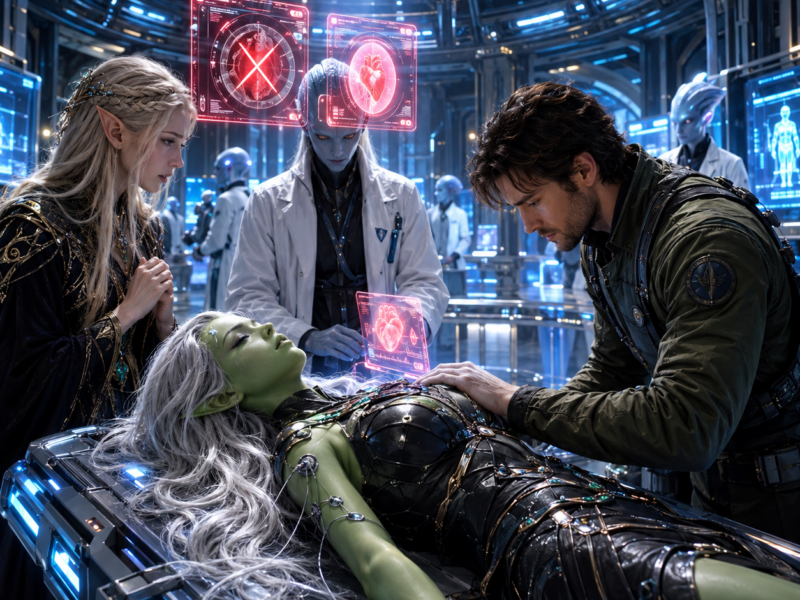
The alien queen collapsed onto the marble floor of the United Earth Embassy, coughing black blood while her own physicians stepped away in fear, but when I refused to leave her bedside, they called me a foolish human because they already knew what was killing her.
The emergency alarms inside the United Earth Embassy pulsed in a silent, crimson rhythm that painted the sterile walls in the color of fresh arterial blood.
I pressed two fingers against the side of Queen Amara’s jaw, feeling the desperate, arrhythmic stutter of her pulse against my palm.
The alien chief physician, a towering figure clad in ceremonial white weave, took two cautious steps backward into the shadows of the chamber.
“Step away from her, Dr. Vance,” the physician whispered, his breath whistling through four narrow respiratory slits along his collarbone. “You are touching a corpse.”
“She’s still breathing,” I said, without looking up at him.
“Her lungs are filled with necrotic sludge,” he replied, pointing a long, trembling finger toward the silver basin sitting on the nightstand. “She belongs to the void now.”
I ignored him and wiped a smear of dark, viscous fluid from the corner of Amara’s lips with the sleeve of my white lab coat.
Her skin, which had shone with a rich, metallic radiance when her transport landed at the Reagan National Spaceport three days ago, was now the dull gray of wet ash.
Around us, the embassy medical suite hummed with the high-pitched whine of suspended diagnostic fields, each light flickering erratically as power dipped across the building.
“We have utilized every restorative compound approved by the Coalition Assembly,” the physician insisted, his voice tightening with a mixture of fear and bruised pride. “Her biology is collapsing under terrestrial atmospheric pressure.”
“That’s a lie and you know it,” I said quietly, adjusting the fluid drip that ran directly into her lower forearm. “Terrestrial pressure doesn’t cause cellular decay at this rate.”
I leaned down until my ear was inches from her lips, listening to the wet, agonizing rasped breath that shook her entire frame.
“She isn’t dying from Earth’s air,” I muttered, staring at the monitor display. “She’s being digested from the inside out.”
The physician didn’t argue. He simply turned his back on me, gathering his silver instrument cases with frantic, uncoordinated movements.
He and his team walked out of the suite, the pneumatic doors sliding shut behind them with a heavy, pressurized hiss that sounded far too much like a seal on a casket.
I was alone with her in the dim room, surrounded by millions of dollars in military-grade monitoring equipment that was telling me absolutely nothing useful.
I reached for the hand scanner sitting on the side cart, pressing the warm glass face against her sternum to re-initialize the deep-tissue scan.
Her hand shot up from the sheets.
Her fingers locked around my right wrist with a force that made the bones in my forearm groan under the pressure.
“Leave me,” she rasped, her voice sounding like glass grinding against slate.
I didn’t try to pull away, even as the pain shot straight up into my elbow.
“I don’t leave patients,” I said, keeping my voice steady and low.
“You are not my physician,” she whispered, her chest heaving as she forced the words past her blue-tinted teeth. “You are an ambassador’s clerk with a medical degree you haven’t used in six years.”
“Tonight,” I said, meeting her dull, clouding eyes, “I’m the only person in this city who isn’t waiting for you to stop breathing.”
She held my gaze for three agonizing seconds before her strength snapped, her arm dropping heavily back onto the mattress like lead.
I shook out my throbbing wrist, brought the scanner back down over her ribs, and locked the display sequence into the primary server.
The machine hummed, sweeping a bright blue plane of light from her chin down to her hip joints.
I stared at the rendering screen, watching the three-dimensional skeletal map reassemble itself line by line in soft green neon.
Her organ systems were failing in a strict, perfectly synchronized sequence that defied every law of alien physiology I had studied at Johns Hopkins.
The liver had ceased function precisely thirty minutes ago; the secondary filtration organs were currently operating at four percent capacity.
It wasn’t a biological infection spreading through a vulnerable immune system.
It was an execution sequence running on a timer.
I pulled up the microscopic blood analysis, pulling the raw feed from the arterial catheter I had inserted into her neck two hours prior.
The high-resolution imaging filled the three-meter wall monitor above her bed with images of her red blood cells, which were uniquely shaped like tiny, interconnected rings.
Normally, those cells carried a dense iron-copper hybrid molecule that gave her people their striking golden complexion and incredible physical endurance.
Right now, those golden rings were fractured, torn into jagged fragments that drifted aimlessly through a cloudy sea of dark plasma.
“Look at this,” I muttered to myself, zooming in four hundred percent on a cluster of damaged red cells.
I expected to find viral capsids or synthetic chemical toxins wrapped around the cell walls.
Instead, I found clean, geometric cuts.
The edges of her damaged blood cells were smooth, sliced with the mathematical precision of a laser cutter operating at the molecular scale.
I dragged the sensor focal point across the field, searching for the agent responsible for the slicing action.
There was nothing there—just empty space between the dying cells.
“That’s impossible,” I whispered, resting my palms against the cold metal edge of the control console. “Toxins don’t cut. They destroy.”
I re-calibrated the scanner to filter out all organic matter, setting the sensor threshold to pick up traces of heavy metals or synthetic carbon structures.
The screen flashed black for a second as the biological data was stripped away.
Then, slowly, the dark screen illuminated with tens of thousands of microscopic red dots.
They were everywhere.
They moved in perfect, rigid formation, drifting through her veins like miniature warships sweeping through an open sea.
Each dot was an identical, eight-sided structure made of an unknown matte-black alloy that absorbed the scanner’s light pulses instead of reflecting them.
They weren’t floating passively in her blood; they were actively anchoring themselves to her vascular walls using tiny, barbed filaments.
“Those aren’t biological,” I said aloud, my breath catching in my throat as I watched a cluster of the black shapes slice through a healthy cell cluster.
“No,” I repeated, leaning closer until my forehead nearly touched the glass screen. “They’re machines.”
From the bed behind me, I heard the faint, metallic sound of the bed frame bending under sudden pressure.
Amara was upright, her shoulders rigid, her head turned toward the massive display on the wall.
Her eyes, stripped of their usual golden warmth, were fixed on the swarming black dots with an expression of pure, unadulterated horror.
“Turn it off,” she choked out, her voice shivering with a terror I had never heard from a sovereign ruler. “Turn the monitor off now!”
I stepped back toward her bed, reaching for the emergency sedative injector on the side tray.
“Amara, who put those inside you?” I asked, grabbing her shoulder to keep her from falling off the mattress. “Was it done before you left your home world?”
She grabbed the collar of my lab coat, pulling me down until her cold face was inches from mine.
“You don’t understand,” she wept, a single tear of dark, viscous fluid trailing down her gray cheek. “They aren’t trying to kill me.”
“They’re destroying your internal organs!”
“They are clearing room,” she whispered, her grip tightening until the fabric of my shirt began to tear. “They are building a frame.”
Before I could ask her what she meant, the heavy steel security doors at the far end of the medical bay blew inward with a deafening, concussive crack.
A wave of grey smoke poured through the shattered doorway, smelling heavily of scorched copper and industrial cordite.
Heavy tactical boots slammed against the marble floor in a fast, rhythmic cadence that echoed off the high ceilings of the ward.
Six men in black tactical gear without insignia fanned out into the room, their suppressed rifles raised and trained directly on my chest.
Behind them walked a man wearing a perfectly tailored charcoal suit, his hair cut in a tight military taper, a bronze crest pinned to his lapel.
It was Director Vance of the Special Activities Division—a man I hadn’t seen face-to-face since my father’s funeral six years ago.
“Step away from the alien, Marcus,” my uncle said, his voice completely void of emotion as he drew a compact black sidearm from his shoulder holster.
I stood my ground, placing my body between his tactical team and the dying queen lying on the bed behind me.
“This is an international diplomatic sanctuary, Uncle,” I said, keeping my hands visible at shoulder height. “You’re committing an act of war just by walking through that door.”
“The treaty was voided twenty minutes ago,” Marcus Vance replied, stepping around a pile of shattered door frame. “By order of the Executive Council.”
“She’s sick,” I spat, gesturing toward the wall monitor that was still displaying the microscopic horror inside her blood. “She was poisoned during the state dinner.”
“She wasn’t poisoned,” Marcus said, stopping five feet from me and raising his weapon until the sights lined up with my sternum. “She is gestating.”
“Look at the screen!” I shouted, pointing behind me. “Those are micro-machines! They are destroying her cellular tissue!”
“I know what they are, Marcus,” he said softly, his blue eyes cold and unblinking behind his thin wire-frame glasses. “We put them there.”
The room seemed to drop five degrees in an instant.
I stared at the man who had paid for my medical school tuition, searching his face for any sign of a joke or a bluff.
“You poisoned an interstellar head of state?” I asked, my voice dropping to a dangerous whisper. “Are you out of your mind?”
“We didn’t poison her,” Marcus said, taking a small silver remote control from his coat pocket. “We activated her.”
On the bed behind me, Amara let out a low, shuddering moan that sounded less like a human scream and more like metal tearing under immense structural stress.
Her back arched off the bed, her ribs expanding to an unnatural width as her chest cavity expanded beneath the thin white medical sheet.
“She cannot be allowed to wake up fully,” Marcus told his squad, gesturing with his hand. “Prepare the cryogenic containment unit.”
Two of the tactical soldiers moved forward, pulling a heavy, insulated cylinder equipped with heavy locking clamps toward the bed.
“Get away from her!” I lunged at the nearest soldier, grabbing the barrel of his rifle and shoving him back into the medical cart.
Instruments slammed onto the floor in a metallic cascade of tray tables and shattered glass vials.
The soldier recovered instantly, driving the butt of his rifle into my ribcage with a speed that knocked the air completely out of my lungs.
I hit the cold marble floor hard, sliding through the puddle of black fluid that had leaked from Amara’s drip line.
“Marcus, stop!” I gasped, clutching my chest as I struggled to pull oxygen back into my bruised lungs.
“You always had your father’s misplaced sentimentality,” my uncle said, standing over me with the weapon still pointed at my forehead. “You see a patient. I see a weapon that has been dormant for three thousand years.”
The lights inside the embassy didn’t just flicker off—they died with a heavy, reverberating thump that signaled the destruction of the main generator sub-station.
Total darkness swallowed the medical bay for two agonizing seconds before the emergency floor runners flickered on, casting a dim, orange glow across the room.
The heavy air-handling units ceased their hum, leaving an absolute, suffocating silence in their wake.
Then came the voice.
It didn’t come from the hallway speakers or the radio units mounted on the soldiers’ tactical vests.
It echoed directly from the small silver remote control holding place in Marcus Vance’s right hand.
“Human medical intervention detected,” a calm, synthetic voice announced, speaking in a flat tone that carried no accent or inflection.
Marcus looked down at the device in his hand, his composed face suddenly cracking with a flash of genuine panic.
“Override sequence alpha,” Marcus barked into the remote. “Authorization code Vance-Seven-Seven-Nine!”
“Override denied,” the voice replied instantly. “Host biomass integration has reached ninety-two percent. Target lock established.”
“Too late,” Marcus whispered, his face draining of all color as he backed away from the bed. “The catalyst reached her brain.”
I pushed myself up from the floor, my ribs burning with every breath, and looked back toward the medical bed.
Queen Amara was no longer thrashing.
She was sitting completely upright, her legs swinging over the side of the bed with a fluid, unnatural grace that carried none of her earlier weakness.
The gray, ash-like texture of her skin was gone, replaced by a smooth, obsidian sheen that seemed to absorb the orange emergency light around her.
Her eyes opened slowly.
The golden irises were gone, replaced by twin pools of blinding, liquid white light that cast narrow shafts of brightness across her cheekbones.
The black micro-machines on the wall display were no longer visible because the display itself had melted, the glass dripping down the wall in long, glowing strands.
“Amara?” I whispered, taking a cautious step toward her.
She turned her head toward me, the motion perfectly silent, her neck muscles locked in a rigid, geometric alignment.
She didn’t look at Marcus or the six armed soldiers holding tactical rifles focused on her forehead.
She looked directly at my chest, right over my heart.
“They found you too, Marcus,” she whispered, her voice sounding like two distinct voices speaking in perfect, harmonic unison.
I stopped, my hand hovering over my injured ribs.
“Who found me?” I asked, my heart hammering against my sternum like a trapped bird. “Amara, what did they do to you?”
She lifted her right hand, her long, metallic fingers extending toward me, her index finger pointing directly at the middle of my chest.
“The ones who built the stars,” she said gently. “The ones who planted the seed in your lineage before your species learned to sharpen flint.”
Before I could answer, a sharp, searing heat ignited deep within my chest, right behind my breastbone.
It wasn’t a muscle spasm or a heart attack.
It was a cold, high-frequency vibration that started deep inside my sternum and radiated outward through my ribcage into my shoulder blades.
I dropped to my knees, clutching my chest as my vision flared with brilliant, blinding streaks of white light.
Beneath my skin, right over my heart, three tiny geometric patterns began to glow through the fabric of my shirt, shining with the exact same radiant light that filled Queen Amara’s eyes.
The pain was unlike anything I had ever felt in my life—it was precise, cold, and stripped of all physical sensation.
It felt as though someone were peeling back the layers of my DNA, unspooling old, forgotten threads and re-stitching them with cold silver wire.
“Fire!” Marcus screamed from the doorway, his voice cracking into a high-pitched panic. “Take them both down now!”
The six tactical soldiers opened fire simultaneously, the suppressed thud of their automatic weapons filling the small room with a hail of high-velocity lead.
I braced for the impact, closing my eyes and ducking my head toward the floor.
The sound of bullets striking flesh never came.
Instead, a high, ringing tone swept through the room, like a crystal wine glass being struck by a hammer.
I opened my eyes and looked up through the dim orange light.
Every bullet fired by the team was suspended in mid-air, frozen three feet from Amara and me, trapped within a dense, rippling field of distorted space.
The bullets hung there like dark insects caught in amber, their lead tips flattened slightly by the force of the kinetic wall holding them in place.
Amara didn’t move a muscle. She simply flicked two fingers of her left hand outward toward the doorway.
The suspended bullets reversed direction instantly, accelerating backward through the air with a deafening crack that shattered every glass display case in the room.
The soldiers were thrown violently back into the hallway, their bodies slamming into the reinforced concrete walls with devastating force.
Only Marcus remained standing, protected by a heavy steel door frame he had dived behind at the first sign of movement.
“Marcus!” I gasped, pushing myself up from the floor as the heat in my chest settled into a low, thrumming hum. “What is happening to me?”
“You were never meant to be in this room,” my uncle said, his hands trembling as he struggled to reload his sidearm with fresh ammunition. “Your father was supposed to take the vault keys to his grave!”
“My father died of a heart attack!”
“Your father died because his heart couldn’t handle the power source inside his chest!” Marcus shouted back, his eyes wild with fear. “He was a carrier! Just like you!”
I looked down at my hands, which were shaking uncontrollably in the dim light.
Through the skin of my palms, faint, silver lines were rising to the surface, forming a delicate grid pattern that ran from my wrists to the tips of my fingers.
They looked like circuit pathways, glowing with a soft, pulsing light that matched the rhythm of my heartbeat.
“The Coalition didn’t come to Earth to sign a peace treaty,” Amara said, her voice echoing off the walls with terrifying clarity. “They came to collect the key.”
She stepped off the bed, her feet making no sound as they touched the smooth marble floor.
“And you, Dr. Vance,” she said, looking down at me with those burning white eyes, “are the lock.”
The hallway outside the medical bay was silent, save for the groan of bent metal and the distant smoke alarms echoing from the floor above us.
Marcus backed away down the corridor, his boots dragging through the shattered glass that covered the tile floor like thick winter ice.
“Stay away from me,” he whispered, holding his small sidearm with both hands, the laser sight bouncing erratically across Amara’s chest.
“You spent thirty years searching the stars for our ancient technology,” Amara said, advancing on him with slow, deliberate steps. “Yet you never thought to dig beneath your own feet.”
“We found the vault in Mesopotamia,” Marcus stammered, his heel catching on the frame of a fallen security monitor. “We knew what was inside.”
“You found the doorway,” Amara corrected him smoothly. “You did not find the password.”
She reached out, grabbing Marcus by the lapels of his tailored suit, and lifted his entire two-hundred-pound frame off the floor with one arm.
He kicked his legs helplessly, his weapon dropping from his paralyzed fingers and clattering onto the floor near my feet.
“Tell me where the third carrier is,” Amara commanded, her voice dropping into a register so low that the floor tiles beneath us vibrated.
“I don’t know!” Marcus choked out, his face turning dark purple as her hand tightened around his throat. “The Council split the files! No single officer had access to all three locations!”
I stepped out of the medical room, holding my ribs, my glowing palms leaving faint streaks of light in the air behind them.
“Amara, put him down,” I said, my voice surprisingly steady despite the chaotic power humming through my veins. “He’s an idiot, but he’s my family.”
She turned her glowing white eyes toward me, holding Marcus suspended in the air like a discarded rag doll.
“Family is a construct of flesh,” she said softly. “Flesh is temporary. The design is eternal.”
“If you kill him, you’ll have every military force in this city on this floor in five minutes,” I argued, taking another step toward her. “Look at the security monitors. The building is surrounded.”
She paused, considering my words, then tossed Marcus dismissively into the corner of the corridor.
He hit the wall hard, slumping into a motionless heap against the baseboard, gasping for air through his crushed windpipe.
Amara turned her back on him and walked over to the wall-mounted communications terminal near the elevator shaft.
She pressed her silver-lined hand against the metal surface of the console.
The dark screen burst into life instantly, lines of high-speed code cascading down the monitor at a rate no human eyes could follow.
“The orbital defense grid has been re-routed,” she announced after a moment, stepping back from the screen. “We have six minutes before the orbital strike drops on this facility.”
“An orbital strike?” I asked, staring at her in disbelief. “On an embassy in the middle of Washington?”
“They would burn this entire city to ensure neither of us leaves this room alive,” she said simply. “They know what happens if the three keys are brought together.”
“What happens?”
She looked at me, her white eyes softening just a fraction, revealing a tiny flicker of the woman who had arrived here three days ago seeking peace.
“The earth wakes up,” she whispered.
We didn’t take the elevators; the shaft had been fused solid by the emergency power shutdown that Marcus’s team had initiated.
Instead, Amara used her bare hands to tear open the heavy steel access door leading to the secondary utility stairs, bending the two-inch-thick deadbolts like wet cardboard.
We moved down into the dark, descending six flights beneath the embassy basement into the deep bedrock upon which the city was built.
My chest was no longer burning, but the cold hum beneath my skin had grown louder, filling my ears with a sound like a distant, roaring ocean.
Every time my feet hit a concrete step, faint ripples of silver light spread out from my soles across the stone floor.
“How long have you known?” I asked her, keeping pace with her smooth, rapid stride.
“Since my coronation,” she replied, her voice echoing in the narrow concrete stairwell. “Our priests passed down the memory through forty generations of queens.”
“They knew humans carried this inside them?”
“We were not two species meeting across the void, Marcus,” she said without turning around. “We were two fragments of a shattered vessel.”
We reached the bottom of the stairs, coming out into an ancient, arched tunnel made of unrefined granite that smelled of damp earth and old water.
This wasn’t part of the US diplomatic facility.
The masonry was rough, aged by centuries of dripping moisture, completely detached from the modern concrete foundation above us.
“The intelligence agency didn’t build this tunnel,” I observed, touching the damp stone wall.
“They merely built their embassy over it,” Amara said, stopping in front of a massive, circular stone slab that blocked the far end of the passage. “They spent forty years trying to cut through this barrier with diamond saws.”
She pointed to the center of the stone disk, where a deep, three-pronged indentation was carved into the rock.
The shape matched the glowing geometric pattern currently burning through the fabric of my shirt.
“They couldn’t open it because they were trying to break it with force,” I realized, stepping forward until I was standing right in front of the ancient stone seal.
“It requires the blood of a carrier,” Amara said, placing her metallic hand beside the carved indentation. “And the resonance of the key.”
I hesitated, looking back toward the dark stairwell we had just descended.
Above us, I could feel the faint, rhythmic shudder of heavy artillery moving into position on the streets of the city.
The orbital strike was coming.
“If I do this,” I said, looking at her glowing profile in the dark, “there’s no going back to my old life, is there?”
“Your old life was a shell, Marcus,” she said softly. “Designed to keep you safe until the hour arrived.”
I took a deep breath, raised my right hand, and pressed my glowing palm flat against the cold, wet stone.
The Resonance Point
The moment my skin made contact with the ancient granite, the stone didn’t just feel cold—it felt alive.
A surge of electricity, sharp and clean, pulled itself from my wrist and drove deep into the core of the circular door.
The carved three-pronged symbol lit up with a brilliant, golden light that washed away the shadows of the subterranean tunnel.
From deep behind the rock face came the sound of massive, ancient gears turning against each other after millennia of silence.
The heavy stone disk split down the middle, the two halves sliding smoothly sideways into the solid granite walls with a heavy, pneumatic thud.
Beyond the door lay a room that shouldn’t have existed.
It was a vast, domed chamber lined with thousands of thin, vertical glass pillars, each filled with a clear, shimmering liquid that defied gravity, flowing upward toward the ceiling.
In the absolute center of the room sat a single, low pedestal made of the same matte-black alloy that had been microscopic inside Amara’s bloodstream.
Resting on top of the pedestal was a small, sphere-shaped device no larger than a human heart, floating two inches above the metal surface.
It was completely motionless, but the air around it rippled with intense, invisible heat.
“The core,” Amara whispered, her white eyes widening as she stepped across the threshold into the dome.
“Is that what my uncle was trying to steal?” I asked, following her into the massive space.
“They couldn’t steal it,” she said, stopping three feet from the pedestal. “Without the key, touching that sphere would reduce an entire city to fine ash in less than a second.”
I walked up to the edge of the platform, looking down at the floating metallic heart.
As I drew closer, the sphere began to react to my presence.
Tiny, hairline cracks of golden light opened across its smooth surface, revealing a complex inner mechanism that turned in perfect, silent alignment with my own pulse.
My chest thrummed in direct response, the three-pronged mark beneath my skin shining so brightly that it showed clearly through my white lab coat.
“It knows you,” Amara said, coming up behind me and placing her hand lightly on my shoulder.
“What is it supposed to do?” I asked, holding my breath as I reached my hand out toward the floating orb.
“It’s a lighthouse,” she answered, her voice dropping into a solemn, reverent tone. “It tells the rest of our people that the home world is ready to rebuild.”
Before my fingers could touch the metal surface, a loud, mechanical screech tore through the chamber from the tunnel behind us.
The heavy stone doors had stopped closing.
A steel wedge had been slammed into the gap, holding the massive stone slabs three feet apart.
Through the narrow opening came a squad of six heavy tactical droids, their crimson optical sensors locking onto us instantly.
Behind them stepped a tall, imposing figure dressed in the high-collared dress uniform of the United Earth Security Council.
It was Supreme Commander Hayes—the highest-ranking military officer on the continent.
“Step away from the device, Dr. Vance,” Hayes commanded through his tactical helmet’s speaker, his voice distorted by static. “You are currently interfering with a Class-One planetary defense initiative.”
“Planetary defense?” I yelled back over the hum of the floating sphere. “You’re trying to weaponize an ancient distress signal!”
“We are preserving human sovereignty!” Hayes shouted, raising his heavy energy sidearm and aiming it directly at the core pedestal. “We will not be ruled by alien relics or resurrected kings!”
“If you fire at that sphere, you’ll vaporize everything within fifty miles!” I warned him, taking a protective step in front of the platform.
“A sacrifice the Council is fully prepared to make,” Hayes replied coldly.
He raised his left hand, signaling the six tactical droids to advance into the room.
The heavy machines moved with terrifying speed, their hydraulic joints hissing as they spread out in a wide tactical arc around the perimeter of the dome.
Amara moved instantly.
She crossed the distance between the platform and the lead droid in a fraction of a second, her metallic hand driving straight through the machine’s heavy chest plate.
Sparks and blue hydraulic fluid sprayed across the polished floor as she tore the core processing unit clean out of its chassis.
The remaining five droids opened fire simultaneously, their heavy plasma cannons discharging bright blue bolts of superheated gas that lit up the domed room.
Amara intercepted three of the blasts with a localized kinetic field, but the sheer force of the incoming fire drove her back toward the pedestal.
A fourth bolt struck her shoulder, shattering the dark obsidian sheen on her skin and sending her tumbling sideways onto the stone floor.
“Amara!” I screamed, turning to go to her aid.
“Touch the sphere, Marcus!” she cried out, her voice straining as she forced herself back up onto one knee to block another volley from the advancing droids. “It’s the only way to activate the chamber’s defensive grid!”
I turned back to the floating black heart.
Commander Hayes brought his heavy sidearm up, adjusting the focus dial on the top barrel to maximum intensity.
“Don’t do it, kid,” Hayes spat, his finger tightening on the heavy steel trigger. “You’re a human being. Act like one.”
I looked at my hand—at the glowing silver lines running across my palm, at the three-pronged mark burning over my chest, and at the alien queen who had suffered six hours of agony just to protect this secret from being turned into a weapon of mass destruction.
“I am acting like one,” I said.
I slammed my palm down onto the top of the floating sphere.
The moment my skin touched the metallic sphere, the world around me ceased to exist.
There was no sound, no light, no pain, and no physical structure left in the room.
My mind was pulled backward through a dark, endless tunnel at incredible speed, dragged through thousands of years of human and alien history in the span of a single heartbeat.
I saw the earth as it was four hundred thousand years ago—a quiet, blue marble drifting through a dark sky, touched by long, silver ships that descended like falling stars to plant seeds deep within the primary mountain ranges.
I saw the construction of the three subterranean vaults—one beneath the sands of Egypt, one deep beneath the ice of Antarctica, and this one, built into the bedrock beneath the river valley that would eventually become Washington.
I saw the first human carriers, men and women whose blood carried the silver blueprint, living quiet, simple lives while the ancient machines slumbered beneath their feet.
Then the tunnel collapsed, and I was snapped violently back into my physical body.
The chamber was bathed in an absolute, blinding storm of pure white light that burned away every shadow in the room.
The five tactical droids were completely immobilized, their metal frames glowing white-hot as the localized energy field overwhelmed their internal circuitry.
Commander Hayes was flat on his back near the stone doorway, his heavy sidearm melted into a useless lump of distorted metal beside his hand.
The floating sphere was gone.
In its place stood a tall, vertical shaft of golden light that stretched from the center of the pedestal straight up through the vaulted ceiling, passing through concrete, dirt, and sky without displacing a single grain of earth.
I looked up through the solid rock ceiling, my new vision allowing me to see right through the layers of the planet above us.
I saw the embassy building, the city streets lined with military vehicles, and the dark night sky above North America.
And through that sky, piercing the heavy clouds like a spear of pure sunlight, the golden beam hit the vacuum of space.
High above the earth, three massive, dormant structures that human astronomers had spent decades misidentifying as icy asteroids began to turn toward the planet.
Their ancient, dark hulls cracked open, revealing miles of golden light that mirrored the beam rising from the basement vault.
Beside me, Amara pulled herself up from the floor, her obsidian skin fully restored, her white eyes radiating a serene, quiet power.
She stood beside me on the platform, looking up at the sky through the open shaft of light.
“They answered,” she whispered softly.
I looked down at my hands, which were no longer shaking.
The silver lines beneath my skin were gone, integrated seamlessly into my nervous system, leaving me feeling more alive, more grounded, and more powerful than I had ever thought possible.
Behind us, Commander Hayes dragged himself up against the stone door frame, staring at us with wide, bloodshot eyes filled with absolute dread.
“What have you done?” he gasped, his voice barely audible over the deep, oceanic thrumming that was now echoing from the center of the earth itself.
I turned my head toward him, my eyes glowing with the steady, unyielding radiance of the key.
“We didn’t start a war, Commander,” I told him, as the ground beneath Washington began to hum with the sound of a thousand waking engines. “We just finished the setup.”